Skip to content

Design

Every show filed under design, ranked by what listeners actually play.

514
shows
0
subcategories
10
new this week

Most subscribed

in design · refreshed hourly

Newest episodes

last seven days
  • Talking Architecture & Design

    Episode 315: Jono Mountfort on how to reduce the carbon embodied in the materials and products used in the built environment

    As operational energy efficiency improves, attention is increasingly turning to embodied carbon—the emissions associated with extracting raw materials, manufacturing products, transporting them, installing them, and, ultimately, dealing with them at the end of their useful life. That puts materials and material innovation firmly at the centre of the conversation. Jonathan Mountfort, Creative Director at Autex Acoustics, has more than two decades of experience across design and manufacturing, with a career spanning mechanical engineering, product design, materials innovation, and acoustics. At Autex, he leads a team across design and engineering and has contributed to recycling technologies, product development, and the company's broader sustainability journey. In this episode, Jonathan shares a particularly interesting perspective from the intersection of product design, manufacturing, and architecture—three areas that increasingly need to work together if we're going to reduce the built environment's carbon impact. This podcast is brought to you in association with Autex Acoustics, proud sponsors of our 2026 Sustainability series of podcasts.

    Yesterday · 43 min
  • CDFAM Computational Design Symposium

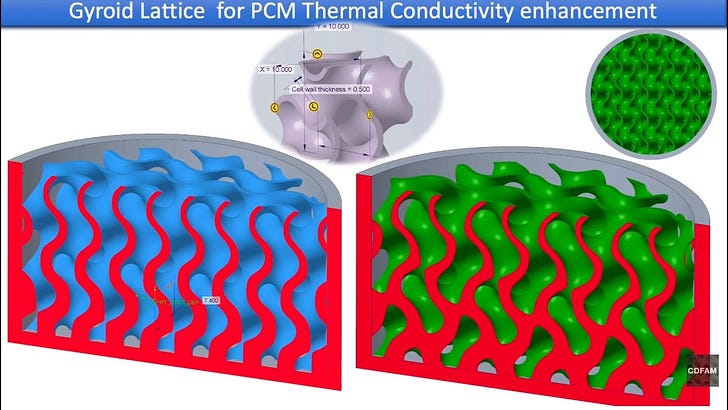
    Optimal Lattice Selection for PCM Thermal Management

    CDFAM Computational Design Symposium — DC 2026 Andreas Vlahinos · Advanced Engineering Solutions PCMs provide cooling without requiring an extra power source, unlike fans or active liquid cooling systems. They absorb peak energy loads during operation and release that heat when the ambient temperature drops, acting as a buffer against rapid temperature changes. This allows for more compact thermal management systems. Because most PCMs have inherently low thermal conductivity, they often fail to absorb or release heat quickly enough for high-demand applications. Designers can significantly improve the thermal performance of Phase Change Materials (PCM) by embedding lattice structures. Embedding a highly conductive lattice, such as aluminum or copper, forms a “thermal skeleton” that functions as a heat highway, dissipating heat more quickly and evenly through the PCM. Adding a 3D-printed metal lattice can increase the effective thermal conductivity of a PCM system by an order of magnitude compared to pure PCM. The internal structure provides a continuous path for heat conduction, which can double the melting speed. Beyond thermal benefits, the lattice provides mechanical support to the PCM, preventing leakage and helping it maintain its shape during the liquid phase. Simulating PCMs’ thermal behavior is difficult due to the highly nonlinear nature of latent heat release, the shifting phase-change boundaries, and the significant differences in physical properties between the solid and liquid states. This presentation demonstrates simulation techniques and showcases the process of optimal lattice selection. Links Talk page with full transcript Watch the talk on YouTube Search this talk's transcript Cite this talk This is a public episode. If you would like to discuss this with other subscribers or get access to bonus episodes, visit www.designforam.com

    Yesterday · 20 min
  • Materialism

    Materialism - Johhan Rosenberg & Karl Joonas Alamaa 29.09.26

    Lavastaja Johhan Rosenberg & kostüümikunstnik Karl Joonas Alamaa räägivad lavastusest "Öömajaaeg",unes kõndimisest & pussycat dollsist.

    Yesterday · 59 min
  • CDFAM Computational Design Symposium

    Git for Hardware: Version Control as the Foundation for Agile Systems Engineering

    CDFAM Computational Design Symposium — DC 2026 Steve Massey · SysGit Software development was transformed when version control became infrastructure rather than afterthought. Hardware engineering has not had an equivalent transition. Requirements live in documents. System models are stored in vendor-locked platforms. Design reviews happen in meetings rather than pull requests. The result is programs that cannot iterate at the speed the environment demands. SysGit applies the tools and workflows that scaled software development — branching, merging, diffing, CI/CD pipelines — directly to systems engineering artifacts, built on SysMLv2 and backed by existing Git infrastructure. Requirements, system models, and verification activities are captured in a single machine-readable format, traceable across the full program lifecycle and accessible to every stakeholder from specialist engineers to contracting officers. This presentation covers the technical architecture behind that approach, the role of agentic AI in automating requirements generation and model validation, and what continuous acquisition looks like when the digital thread is built on open standards rather than walled gardens. Links Watch the talk on YouTube Search this talk's transcript Cite this talk This is a public episode. If you would like to discuss this with other subscribers or get access to bonus episodes, visit www.designforam.com

    Yesterday · 15 min

All Design514