Skip to content
Artwork for Thinking about...
HistorySociety & Culture

Thinking about...

Timothy Snyder

The words we need for the politics of today.

snyder.substack.com
Play
  • 35 episodes
  • Avg 25 min
  • English
Counted on this page — what you have heard stays on this device, so it is not something the list can be paged by.
  • October 15 · 31 min

    Modern Fascism, the Collapse of Truth, and Why Americans Need “Small Courage”

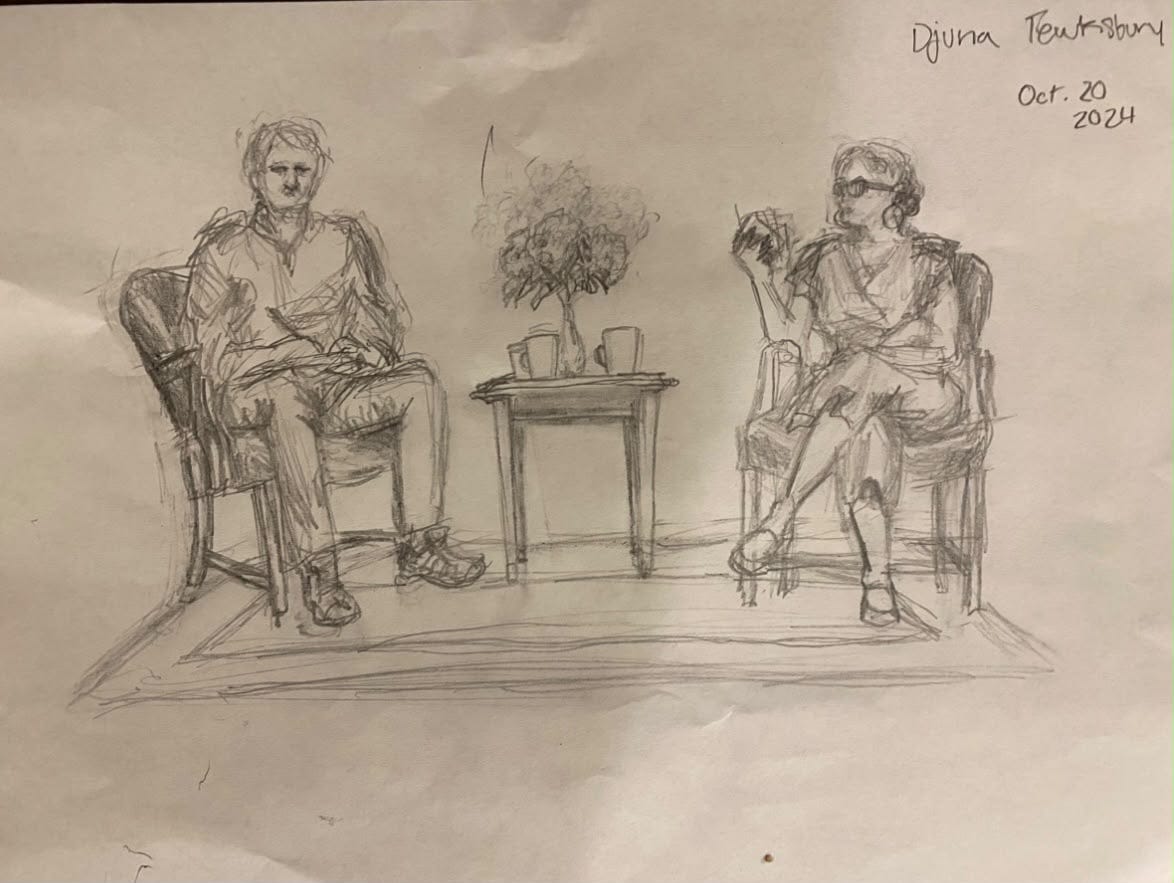
    Dear thinkers: Timothy Snyder joined fellow historian and teacher Sharon McMahon for a sweeping conversation about the state of American democracy, the evolving nature of fascism, and the growing influence of technology and wealth on politics. Below are some thematic highlights and select quotes from Tim during the conversation. I encourage you to watch the conversation in full, as always. I think you’ll learn a lot. How Fascism Is Changing in the 21st Century. Why a Post-Truth Society Is So Dangerous “The fascism is a tool to divide, to divert, to direct people towards a false us and them. Whereas the real us and them is that they have their hands in our wallet.” A Post-Truth Society “A post-truth society is one in which we don’t acknowledge that truth is real.” The Political Power of Tech Billionaires “A lot of people with a lot of means, a lot of wealth and a lot of power are cut off pretty much completely from the world.” The Importance of “Small Courage” “I think it’s very important that we think of courage as something which is small.” For more, continue tuning in here or check out On Tyranny and On Freedom. Thanks, as always, and see you soon Victor This is a public episode. If you'd like to discuss this with other subscribers or get access to bonus episodes, visit snyder.substack.com/subscribe


  • October 13 · 50 min

    Between the River and the Railroad Tracks

    I am sure many of you will share my enthusiasm for Nicole Fleetwood’s “Between the River and the Railword Tracks,” which is a remarkable micro-history of a beautifully and tragically intense neighborhood, the Second Ward of Hamilton, Ohio, the historically segregated African-American district where Nicole grew up. I came to Nicole’s scholarship through her book on art and mass incarceration, Marking Time, and then we have come to know each other as fellow Ohioans — a theme that comes through in this conversation! Through the recollections of her childhood, we get clearer views of the Black Midwest, on the second half of the twentieth century in the United States, and on the most tender and painful of our national crises. We get to the general though through the particular, through the life of a young person and her family, remembered and told (and researched!) with care and pain and love. The book will be officially released early next month but you can pre-order a copy by pressing the button. TS Syracuse NY 10 October 2026 This is a public episode. If you'd like to discuss this with other subscribers or get access to bonus episodes, visit snyder.substack.com/subscribe
  • October 10 · 2 min

    Four Wrongs of a Public Execution

    We as Americans are being invited by the Secretary of Defense to view an execution by firing squad over the internet. This is wrong in at least four ways. In the video I explain, and here I summarize. It is wrong psychologically. It looks like revenge. Secretary of Defense Pete Hegseth has chosen and lost a war against Iran. Given the extraordinary degree of self-promoting bombast by which he described this military adventure, this sorry result is a personal humiliation. It is undisputed that the defendant, Nidal Hasan, committed a horrible crime, and that he deserves punishment. But to rejoice exuberantly in the prospect of the public shooting of a Muslim, as Mr. Hegseth is doing day after day, is to turn personal defeat into a summons for all of us to live inside his personal need for vengeance. It is wrong politically. To livestream an execution will not deter terrorism. It will invite terrorism, as Mr. Hegseth no doubt understands. The deeper political consequence, however, is domestic. The basis of politics in the Trump regime is sado-populism. Rather than offer policy that benefits Americans, Trump uses the government to hurt some, and offer their pain as a spectacle to everyone else. To livestream a public execution is to take that politics to its logical extreme. The federal government would be instructing us to observe, and thus participate in, a public killing. This invitation to us is a major step towards seeing politics only as the pain of others. While execution by firing squad is the endpoint of a judicial proceeding, broadcasting it is to advertise killing is a political transformation. If Americans view, clip, share, and permanently enshrine an American public killing in a million ways on the internet, we will moves towards fascist rituals of violence. It is wrong historically. As Mr. Hegseth will know, public executions in the United States have a particular racial lineage. The lynchings of African Americans were meant to demonstrate that one group is always innocent and another group is always guilty. Lynchings were designed to humiliate the African American who was killed and to terrorize and stigmatize the group to which he belonged. Black men (and women) who were lynched were not (unlike Nidal Hasan) tried before a court of any kind; they were victims of racial terror organized by mobs. The purpose, as in Mr. Hegseth’s planned spectacle, was to involve large numbers of people, young and old, and to normalize a sense of enmity. Although the circumstances are different, to recommence public executions is to invoke a very specific history, and to summon some Americans to a sense of righteous innocence meant to prepare them to kill other Americans. It is wrong ethically. It will not be hard to find external authorities who can help us to see this. The United Nations human rights office can remind us that a public execution is a form of torture. The president of the US Conference of Catholic Bishops can tell us that a livestreamed public execution is a “barbaric promotion of a culture of death.” But we, all of us, all Americans, are being invited to observe and thus participate; the ethics of this are accessible to each of us, personally, as living human beings. The end of life is a mystery, one which arises from the dignity of life. No matter what an individual has done, the end of each life should be respected, for the sake of the dignity of life itself. Thinking about... is a reader-supported publication. Please subscribe. Thanks for reading Thinking about...! This post is public so feel free to share it. This is a public episode. If you'd like to discuss this with other subscribers or get access to bonus episodes, visit snyder.substack.com/subscribe

  • October 8 · 22 min

    Where Do Democrats Go From Here? With Rep. Jake Auchincloss

    Dear thinkers, Tim recently joined Rep. Jake Auchincloss (D-MA) for a Thinking Live conversation. The biggest question during the conversation: where do Democrats go after the midterms? They planned nothing in advance, and the conversation covered a lot. Here are the big themes. Watch the entire conversation above! 1. Win, then act Tim stressed what happens after a win: “My greatest fear is that Democrats win both chambers and then don’t treat it as a victory.” Rep. Auchincloss laid out three priorities: a bipartisan-friendly affordability agenda, accountability for Defense Secretary Pete Hegseth, and a serious attack on dark money. On affordability, he said, “if the Republicans want to vote against, shame on them.” 2. The window to get money out of politics Tim sees an unusual opening: “right now we have an unusual open window to get money out of politics,” because Americans currently blame Trump more than the system itself. Rep. Auchincloss backs overturning Citizens United through state corporate charter law, but warned that the climb will be harder than people expect. Even Massachusetts’ attorney general declined his ballot petition on First Amendment grounds. Still, Tim argued the free speech question has to be met head-on: “the purpose of freedom of speech is to enable the powerless to speak to the powerful, not the other way around.” 3. Tie corruption to your wallet Rep. Auchincloss argued that corruption only lands when voters feel it, and used health care as his example. A billionaire with ties to the biggest insurers ran CMS and raised reimbursement rates for his own investors, which means higher premiums for everyone else. Tim’s takeaway: “Getting affordability and democracy together is the key.” 4. Lessons from Hungary, and what patriotism means Rep. Auchincloss pointed to the anti-Orbán coalition as a model for Democrats: relentless focus on corruption, joyful patriotism, and a cross-ideological economic agenda. He added that Democrats need to “talk and act like we love this country,” and that America isn’t blood and soil: “Americans fight for ideas.” Rep. Auchincloss and Tim ran out of time before Iran and Ukraine, so that’s for another conversation. In the meantime, I hope you enjoy their exchange above. Until next time, Victor Thanks for reading Thinking about...! This post is public so feel free to share it. Thinking about... is a reader-supported publication. To receive new posts and support my work, consider becoming a free or paid subscriber. This is a public episode. If you'd like to discuss this with other subscribers or get access to bonus episodes, visit snyder.substack.com/subscribe

  • October 5 · 7 min

    Basic Political Wisdom (Kharkiv Meditations, 10/10)

    At night last month in Kharkiv, Ukraine, I was moved to record a cycle of thoughts. This is the final one: on basic political wisdom. By that I mean nothing more than a few answers to questions that I get asked a lot, on issues where historical examples, consensus in political science, and experience of recent elections give me some confidence in the answers. This is the video that is most directly relevant to the US midterms; but it also flows naturally from the larger concerns of the previous nine meditations, which were published here in the last couple of days and in September. Please feel free to share this one and all of the others! A last word: thanks to friends in Ukraine who help me to get around and therefore to think. This is a public episode. If you'd like to discuss this with other subscribers or get access to bonus episodes, visit snyder.substack.com/subscribe

  • October 4 · 6 min

    Hydrocarbons (Kharkiv Meditations, 9/10)

    I had an excellent visit to Kharkiv last month, during which I found myself with some free time by myself at night. With the war in the background, or rather in the foreground, I used the opportunity to record the thoughts that arose in that special setting. In this recording, the next to last, the topic is the harm done to us and our future by our dependence on oil and gas. In a war where the aggressor is entirely dependent upon hydrocarbon revenue, it is a hard reality to overlook. The final Kharkiv Meditation, on political common sense, or basic political wisdom, will be released tomorrow, October 5th. This is a public episode. If you'd like to discuss this with other subscribers or get access to bonus episodes, visit snyder.substack.com/subscribe

  • October 3 · 5 min

    The Richness of Language (Kharkiv Meditations, 8/10)

    Last month I had some time at night in Kharkiv to record a few thoughts. One of the prompts was the regularity of Russian attacks; the other was a certain logic that led from one topic to the next. This one is about our capacities as speakers of languages. It follows naturally from earlier meditations on words and from the previous one on AI. I was also staying in the apartment of a very accomplished linguist, and reading his essays. This is the eighth of ten of these Kharkiv Meditations; the last two will appear on October 4 and 5, so tomorrow and the day after. This is a public episode. If you'd like to discuss this with other subscribers or get access to bonus episodes, visit snyder.substack.com/subscribe

  • October 2 · 51 min

    Thinking Live with Min Jin Lee about American Hagwon

    A great novel is here and I had the pleasure of speaking to its author. Please have a listen, and please read the book: American Hagwon. It brings the great themes of the last fin-de-siècle, astonishingly lively and plausible characters, and an exemplary combination of moral sensitivity and wordly realism. My enthusiasm will come through in the conversation, as will some of Min’s humor and wisdom. Thinking about... is a reader-supported publication. Please subscribe. This is a public episode. If you'd like to discuss this with other subscribers or get access to bonus episodes, visit snyder.substack.com/subscribe

  • September 30 · 52 min

    Disagreement and Persuasion with Jessica Tarlov

    Dear Thinkers, Tim recently sat down with Fox News commentator and pollster Jessica Tarlov for a nearly hour-long conversation, split between the state of the midterms and Jessica’s new book, I Disagree: Winning Arguments Without Losing Friends. Below are just some of the topics they touched on: Are we headed for free and fair elections? Jessica opened by naming her worry directly: after Trump aired a taxpayer-funded campaign ad during college football and NFL broadcasts, talk of seizing voting machines, and open interest in a third term, how confident can we be in 2026 and 2028? Tim stressed that unfair elections don’t mean giving up; they mean fighting harder, as Hungary’s opposition did against Orbán even under worse conditions. He argued that real resistance requires a broad coalition, not just one party, and that Trump’s aggressiveness reflects weakness (terrible poll numbers, no real public support) rather than strength. Corruption vs. affordability. Jessica raised a tension inside the opposition: should Democrats lead with investigations, or with kitchen-table issues like gas prices and healthcare? Tim argued this is a false choice. Hungary’s opposition won by fusing the two, showing voters that their daily struggles and systemic corruption were the same story. Jessica pointed to John Ossoff as a model for blending both. Tim added that democracy can’t be sold as a return to the status quo, since most people didn’t like the status quo either; it has to be framed as something new and forward-looking. A world moving on without the U.S. Jessica raised Canada as an example of allies adapting without expecting normalcy to return. Tim reframed the picture: it’s not that Canada is moving on without the U.S., it’s that the “U.S.” as a government with a coherent national interest doesn’t currently exist in the way it once did. His hope is that if allies like Canada, the UK, the EU, and Ukraine hold their democracies together while the U.S. goes through this period, there will be working models to learn from later. From politics to Jessica’s new book. The conversation turned to I Disagree, which Jessica described as a practical guide to arguing with people you disagree with without writing them off. She argued that the American left has often ceded hard conversations across ideological lines, and that reaching people means finding shared values first rather than leading with disagreement. Tim connected this to the corrosive effect of algorithmic media, noting that U.S. social media and AI are less regulated, and more damaging, than in most other countries, and that getting people back into human contact and real-world institutions (schools, hospitals, civic life) is itself a democratic act. They closed by agreeing that dialogue alone won’t change the underlying conditions. Real change requires decisive electoral outcomes. Tim noted that with the wealth and technology available, a much better country is possible, and that the current mood of universal pessimism is itself a tactic borrowed from Putin’s playbook: convince people nothing works anywhere, so nothing seems worth fighting for. I hope you’ll watch, enjoy the conversation, and share it with anyone who might be interested. There is a lot to think about here, and I think you’ll learn a great deal from Jessica and Tim’s exchange. FYI: we’ve got a few more Substack conversations this week, including an exciting conversation with Min Jin Lee tomorrow about her new novel American Hagwon (12pm ET); Talking Feds with Harry Litman (11am ET on Friday) Rep. Jake Auchincloss (2:15pm ET on Friday). See you all soon, Victor Thinking about... is a reader-supported publication. To receive new posts and support my work, consider becoming a free or paid subscriber. This is a public episode. If you'd like to discuss this with other subscribers or get access to bonus episodes, visit snyder.substack.com/subscribe

  • September 29 · 36 min

    Trump, Power, What Comes Next with Robert Reich

    Dear Thinkers, Tim just finished speaking with Robert Reich as a guest on his Substack for a wide-ranging conversation about power, corruption, and what history can tell us about where America goes from here. Below are just some of the things they touched on (watch the full video above for event more): * Superpower suicide. Bob opened by asking Tim to define the term he coined at the Council on Foreign Relations. Tim explained that conventional language about “national interest” and “state calculations” no longer captures what’s happening under Trump. The country is rapidly deflating its own power, both immediately, by torching alliances and losing wars, and over the long term, by hollowing out the economy, social mobility, and the research and educational base that power actually rests on. * Why the second term is worse than the first. Bob pressed on why the unraveling has accelerated. Tim pointed to a chain of lessons Trump has absorbed: he was reelected despite attempting a coup, he was never prosecuted for it, and the Supreme Court’s immunity ruling reinforced the sense that he is above the law. Layered on top of that is a Congress that has abandoned its constitutional function and instead acts as a public-relations arm of the executive, all accelerated by the corrosive role of money in politics. * Would a Democratic Congress matter? Tim argued yes, in two ways. First, Trump’s political brand depends entirely on projecting strength, an image that plays only within U.S. borders and, Tim said, is not shared by the rest of the world. That image can absorb some bad news, but not an unbroken string of it: a lost war in Iran plus a midterm drubbing could crack it. Second, and more conditionally, it matters what Democrats actually do with power. Tim urged that they announce anti-corruption and redistribution legislation right away, even knowing Trump would veto it, simply to stake out the position before public anger curdles back into “everyone is corrupt anyway” cynicism. * Can tyranny’s end lead somewhere better? Bob asked, drawing on Orbán, Putin, Netanyahu, and history’s other strongmen, whether publics actually rebuild strong institutions after a tyrant falls, or whether cynicism wins out. Tim’s answer leaned on agency rather than inevitability: the U.S. has the wealth and technology to give people much better lives, but only if leaders name the current moment as the disaster it is and offer a genuinely forward-looking vision, rather than a promise to return to an idealized past. * The money problem. Bob noted the flood of AI, crypto, and Wall Street money backing Republicans, the Citizens United landscape, and the reality that some Democrats are themselves dependent on big donors. Tim argued that separating money from votes is basic to democracy, and if they can’t move on it, Trump (or a successor) will simply out-corrupt them more charismatically, the same move Putin made in Russia two decades ago. Both agreed the real arguments to reclaim are patriotism, freedom, and humanity, currently deployed to protect wealth and “superintelligence” rather than people. * Power beyond the ballot. Bob offered a note of optimism: the second Trump term has exposed the tech-oligarch structure of power more nakedly than ever, fueling public backlash against the “new robber barons.” Tim agreed, adding that power in November won’t just be lawsuits and suits and ties; it will also be protests, labor, and civil society. Beating Trump requires the Democratic Party, he said, but also something bigger than it. They closed on a shared diagnosis: Trump is less a cause than a consequence of decades of concentrated wealth and power, and the real test isn’t just winning in November, but what vision fills the vacuum afterward. I hope you’ll watch, enjoy the conversation, and share it with anyone who might be interested. There is a lot here to think about, and I think you’ll learn a great deal from Tim and Robert’s exchange. Thanks, as ever, for being part of this community of thinkers. As a note for upcoming Substack Lives this week: On Thursday, Tim will host Min Jin Lee (12:30pm ET) to talk about her new novel American Hagwan. On Friday, Tim will speak with U.S. Congressman Jake Auchincloss on Friday (2pm ET). Hope you will tune in! Until next time,Victor This is a public episode. If you'd like to discuss this with other subscribers or get access to bonus episodes, visit snyder.substack.com/subscribe

  • September 28 · 43 min

    Regime Change and Corruption with Anne Applebaum

    Dear Thinkers, We live in trying and testing times, with a lot of noise and information being hurled, which is why there is no better time than a clarifying and thoughtful conversation with historian and journalist Anne Applebaum (Anne Applebaum), built around her September 14 Atlantic article, “MAGA Is Making the World Safe for Corruption.” Tim and Anne had an extremely enlightening conversation that focused on a question Anne wrote about in her article: What does it mean to say the United States is undergoing a genuine regime change, and what does that change look like when it is exported abroad? Tim opened by asking whether the article was really describing regime change at home, with a state refreshed by elections and guided by some notion of national interest giving way to overlapping oligarchical and ideological clans. Anne described a coalition of actors who have never before controlled the federal government: those bent on destroying the administrative state, Christian nationalists, white supremacists, and tech and crypto oligarchs. While they have different agendas, they share one project, which she called a revolution. Below are some high-level themes that emerged during the conversation (which is worth watching in its entirety above): * Extraction as the organizing idea. Tim argued that these clans treat the U.S. as a zone of extraction, and that the same logic naturally extends to every other country. Anne agreed, noting that for oil, gas, mining, crypto, and tech interests, foreign states are simply obstacles: the EU as a regulator, Brazil as a government that might restrict a social media platform. Anne also pointed out that foreign policy is increasingly run by businessmen with personal ties to Trump rather than by diplomats bound by ethics rules. * Canada as a case study. Anne laid out a coordinated pattern when it comes to the U.S. government’s posture toward Canada: constant demeaning of Canadian sovereignty, MAGA influencers whose business model runs on outrage, open encouragement of Alberta separatism, and punitive tariffs that make little sense for Americans. She likened the two-track approach, normal diplomacy alongside support for movements that undermine a country’s sovereignty, to Bolshevik foreign policy. * Who resists, and why they’re resented. Both Tim and Anne noted that the Bolsheviks didn’t think the state was real, and neither do today’s American clans. Historically, the people who resisted were often defenders of unglamorous ideas: constitutions, states, the rule of law. Canada’s Mark Carney may be modeling a response by doubling down on sovereignty and building ties with Australia, Ukraine, and the EU. Tim suggested that those who have sold out their own country come to resent leaders like Carney and Zelensky who haven’t, much as Putin resents Zelensky. * Civilizations, not countries. Anne noted that the more sophisticated figures in the administration talk about a world divided into civilizational spheres of influence, where a dominant power imposes its will on its neighbors. Tim connected this to Putin’s turn toward “civilization” language around 2011-2012, which was used to deny the Russia-Ukraine border. When you believe in civilizations, Tim observed, you stop believing in states. Tim closed by asking what a dramatic midterm victory might make possible. Anne cautioned that even a big win would be only one step, not the end of the story. Her top hope is that Congress would start playing its constitutional role: using the power of the purse, asking hard questions about State Department activities abroad, and launching a serious national conversation about regulating tech and AI. Tim added that Congress could also run investigations that change the atmosphere and help Americans see what is happening. As you can tell, there was a lot to this conversation — and I hope you’ll watch, enjoy the conversation, and share it with anyone who might be interested. There is a lot here to think about, and I think you’ll learn a great deal from Anne and Tim’s exchange. And, as Tim noted at the end, take some time and read Anne’s work. You’ll be better and smarter off for it. Thanks, as ever, for being part of this community of thinkers. FYI: Tim is doing several Substack Lives this week — both as a guest and as a host. Here is the week so far if you want to add any to your calendar. Later today (9/28), Tim will host Jessica Tarlov (12:30pm ET) and he will join the great Sharon McMahon (1:45pm ET) on her Substack. Tomorrow, Tim will be in conversation with Robert Reich (1pm ET). Then, on Thursday, Tim will host Min Jin Lee (12:30pm ET) to talk about her new novel American Hagwan. To end the week, Tim will speak with U.S. Congressman Jake Auchincloss on Friday (2pm ET) Hope you’ll tune in! Victor Thinking about... is a reader-supported publication. To receive new posts and support my work, consider becoming a free or paid subscriber. This is a public episode. If you'd like to discuss this with other subscribers or get access to bonus episodes, visit snyder.substack.com/subscribe

  • September 27 · 5 min

    AI, War, and Dignity (Kharkiv Meditations, 7/10)

    Given the air raids and such, I had some time at night in Kharkiv to do some thinking out loud. This is the seventh of ten videos that I recorded. There is a logical progression to these ten short meditations; by this point I was thinking about AI, which I suppose was slightly prompted by the tech in jet-propelled Russian drones and other Russian arms, but more generally appropriate after meditations on human ethical concepts. I have some US media coming up on this channel and elsewhere this week, so the remaining three Kharkiv Meditations (on language, hydrocarbons, and political common sense) will be released on October 3, 4, and 5. This is a public episode. If you'd like to discuss this with other subscribers or get access to bonus episodes, visit snyder.substack.com/subscribe

  • September 26 · 4 min

    On Fascism (Kharkiv Meditations, 6/10)

    While in Kharkiv I found myself meditation on some basic issues at night; the prompts came from the war itself, but the time awake lent itself to the effort of connecting daily experience to bigger political concepts. Fascism, the topic of this recording, came to mind at night in Kharkiv for obvious reasons, not least the geographical proximity to fascist Russia, and the wild violence of Russia’s war of aggression. There are four videos remaining after this one: the next two, on AI and on human language, will be released tomorrow and the day after. The final three meditations will be released October 3, 4, and 5 (in between there will be more contemporary material on US politics.). I hope that these meditations are useful or fruitful for you. Please share them if they are. This is a public episode. If you'd like to discuss this with other subscribers or get access to bonus episodes, visit snyder.substack.com/subscribe

  • September 25 · 4 min

    Freedom (Kharkiv Meditations, 5/10)

    Wherever I am, I try to write in the morning; staying in Kharkiv, visiting friends and soldiers during the day, I found it most convenient to instead record a few things at night. The setting was an evocative one: a city that functions despite war and war crimes; the apartment of an interesting Ukrainian intellectual; the timely stimulus of the air raid siren. This is the fifth of ten video meditations I recorded; it is about the meaning of freedom. The next one, on fascism, will be released tomorrow. This is a public episode. If you'd like to discuss this with other subscribers or get access to bonus episodes, visit snyder.substack.com/subscribe

  • September 24 · 3 min

    One Good Thing (Kharkiv Meditations 4/10)

    This is the fourth of the ten video meditations I recorded at night in Kharkiv, in northeastern Ukraine, near the border with Russia. This one is about a very simple idea; to believe in only one thing is to come very close to believing in nothing. It is an idea prompted by an essay written by George Shevelov about faith in communism; but it has much larger implications than that. Belief in only one good thing dulls us to the other good things, and puts us at risk that a loss of faith in one thing means a loss of faith in others. And so zealotry and nihilism are closer than they appear. There will be six more of these videos: three to be released in the next three days, and then three more in early October. (In between, from September 28 to October 2, I will be using this platform and others for some discussions of contemporary US politics.) This is a public episode. If you'd like to discuss this with other subscribers or get access to bonus episodes, visit snyder.substack.com/subscribe

  • September 23 · 5 min

    Moral Language (Kharkiv Meditations, 3/10)

    This is the third of the ten video meditations I recorded in Kharkiv, in northeastern Ukraine, close to the Russian border. The first couple were about courage and cowardice, which led me to the importance of moral categories in general. Is there anything more objective about terms like “interests” and “calculations” than there is about, say, “greed” and “sadism”? Or are we perhaps hiding reality from ourselves by the narrowness of our preferred vocabulary? The next video meditation (the problem of believing in only one big thing) will be released tomorrow, and the one after that (on freedom) the following day. This is a public episode. If you'd like to discuss this with other subscribers or get access to bonus episodes, visit snyder.substack.com/subscribe

  • September 22 · 3 min

    Small Courage (Kharkiv Meditations, 2/10)

    This is the second of the ten video meditations I recorded at night not long ago in Kharkiv, Ukraine. They are thoughts that came to mind in a place which has been under constant attack by missiles and drones for more than four years. The topic this time is small acts of courage, and idea which came to me from observation of people who are effective during war and in resistance. It’s a phrase that works better in other languages, maybe; the idea is not to think of courage as something that is only epic of filmic and therefore out of reach, but as something that usually humble and, at meaningful moments, within our grasp. The next several of these Kharkiv Meditations will be released one per day. This is a public episode. If you'd like to discuss this with other subscribers or get access to bonus episodes, visit snyder.substack.com/subscribe

  • September 21 · 2 min

    On Cowardice (Kharkiv Meditations 1/10)

    This is the first of ten video meditations I recorded at night in Kharkiv, a frontline city in northeastern Ukraine. They concern matters that came to mind during the general setting of a long and terrible war; they were inspired though by the particularities of daily life in Kharkiv, which is less than a minute away from Russia by missile. The topic of this first one is “cowardice,” in particular that of people who kill others whom they never see and for no reason; this led me on to thoughts about courage, moral language, and freedom. These next few will be released one per day in coming days. If I were at all good at this sort of thing I would have thought to bring a light and a microphone; I hope that the spontaneity of these meditations makes up for my technical limitations. Thinking about... is a reader-supported publication. Please subscribe and share. This is a public episode. If you'd like to discuss this with other subscribers or get access to bonus episodes, visit snyder.substack.com/subscribe

  • August 11 · 34 min

    On National Interest, Power, and Ethics with Susan Rice

    Dear Thinkers, Hard as it is to believe, today marks 164 days since President Trump dragged the United States into war with Iran — a war that has produced devastating and deeply humiliating consequences. To make sense of where we are, Tim recently sat down with former U.S. Ambassador and Domestic Policy Advisor Susan E. Rice (Ambassador Susan E. Rice) for a wide-ranging thirty-minute conversation about the war, American power, and what this moment says about the state of our democracy. They began with a fundamental question: Does this administration have a coherent conception of the national interest at all — or was this war undertaken without one? Along those lines, Susan made a striking case for just how unnecessary the war was, which led Tim to frame the conversation around three words that once defined the practice of American statecraft: Diplomacy. Doing the Work. Deterrence. * Diplomacy requires diplomats. Susan pointed to the two years of painstaking, expert-driven negotiations that produced the 2015 Iran nuclear deal — including the involvement of a Secretary of Energy who was himself a nuclear scientist. She contrasted that process with the reportedly rushed June memorandum of understanding negotiated by figures including Steve Witkoff and Jared Kushner, which she described as poorly drafted and sufficiently vague that both sides could walk away with fundamentally different understandings of what they had agreed to. * Doing the work. Tim raised the idea that expertise, relationships, and sustained effort — the kind of career Susan has had — used to be the basis of American power, and that the current leadership treats governance more like opportunism than genuine effort. * Deterrence: Both Tim and Susan agreed that American military power was used extensively in the war, yet failed to achieve its stated goals, which Susan argued undermines the credibility of future threats. Tim added that broadcasting military plans publicly and fighting with munitions the U.S. can’t quickly replace reflects an outdated approach to modern warfare—one that hasn’t absorbed the lessons of Ukraine. Tim closed by asking whether the war might ultimately help Americans see the connection between what he described as American fecklessness abroad and what is happening here at home. Susan’s answer was one of my favorite parts of the conversation. She pointed out that the money, attention, and political capital being spent on war are resources that could instead be devoted to the things Americans actually need: healthcare, Medicaid, rural hospitals, and Social Security — programs she argued this administration has moved to cut or undermine. She also spoke candidly about a political moment in which dissent is being suppressed and rights are being curtailed. But she ended on a hopeful note, identifying three principles she believes Americans across political lines can still rally around: the Constitution, the equal application of the rule of law, and the founding belief in equality. There was no better place to end. I hope you’ll tune in, enjoy the conversation, and share it with anyone else who might be interested. There is a lot here to think about, and I think you’ll learn a great deal from Susan and Tim’s conversation. Thanks, as ever, for being part of this community of thinkers. Until next time, Victor Thinking about... is a reader-supported publication. To receive new posts and support my work, consider becoming a free or paid subscriber. This is a public episode. If you'd like to discuss this with other subscribers or get access to bonus episodes, visit snyder.substack.com/subscribe

  • June 23 · 36 min

    Strongmen Can Fail if We Act with Joyce Vance

    Dear readers: Hope you have a cup of coffee in hand for this one. Tim joined Joyce Vance, former U.S. Attorney during the Obama Administration and host of Civil Discourse with Joyce Vance on Substack, to talk about what language to describe our moment, democracy, and civic participation look like today. Tim and Joyce started off by talking about how “sugarcoating” political realities can become a form of collaboration, because it delays the public response necessary to defend democratic institutions. They both also reject the idea that democracy inevitably self-corrects, stressing that there is no political “pendulum” that guarantees a return to normalcy. Tim also emphasized that democracies survive only when citizens actively participate in shaping their future. The rest of the discussion explored everything from the aftermath of the Iran war to threats against democratic norms at home, including debates over executive power, habeas corpus, voting rights, and the Supreme Court. Tim mentioned, regarding Iran, that authoritarian movements are often fueled by the illusion that force can solve complex problems, while history repeatedly shows that violence creates consequences its architects cannot control, which he writes about in his recent essays on Iran. To me, the most striking part of the conversation focused on what comes next. Tim and Joyce both urged Democrats and democracy advocates to think beyond simply winning the next election. Success, as Tim said, requires a broad coalition, a compelling vision of the future, and a willingness to pursue ambitious democratic reforms—from voting rights and anti-corruption measures to structural changes that will strengthen democratic institutions. Throughout the conversation, both Tim and Joyce returned to a common theme that has helped guide me as I try to navigate these times: history is not a script. There is no singular arc of the universe. The future remains unwritten. Whether America emerges stronger from this moment depends not on inevitability, but on the deliberate choices and actions citizens make now—and with each other. As Tim and Joyce put it in their closing messages, the answer is always action. Until next time, -Victor Thinking about... is a reader-supported publication. To receive new posts and support my work, consider becoming a free or paid subscriber. This is a public episode. If you'd like to discuss this with other subscribers or get access to bonus episodes, visit snyder.substack.com/subscribe

Showing 1–20 of 35 episodes