Skip to content
Artwork for The Value Engine
TechnologyBusinessScience

The Value Engine

Nico Hartwell

Most business leaders are burning cash on AI tools that deliver zero ROI. They buy the hype, implement random automation, and wonder why their bottom line isn't moving. Meanwhile, a small group of companies are quietly using AI to cut costs by 40% and boost productivity by 200%.

Nico Hartwell spent years building machine learning models for healthcare startups before launching his own AI consultancy. He's seen what works and what's just expensive theater. On The Value Engine, he breaks down exactly how real companies are using artificial intelligence to generate measurable returns.

Each episode focuses on one specific AI implementation with actual numbers. You'll hear about the warehouse that cut labor costs by $2 million, the marketing team that automated 80% of their workflows, and the consultant who 10x'd her client capacity using custom AI tools. Nico explains the tech without the jargon and shows you the spreadsheets that prove ROI.

No theoretical discussions or vendor pitches. Just real automation strategies that pay for themselves within 90 days. If you're tired of AI promises and want proven playbooks, this is your show.

Follow now for multiple new episodes daily.

Play
  • 239 episodes
  • Avg 14 min
  • English
Counted on this page — what you have heard stays on this device, so it is not something the list can be paged by.
  • September 20 · 13 min

    Why HubSpot Quietly Built This Email Tool (And Why You Need It)

    Most businesses collect email addresses the hard way: opt-in forms, lead magnets, hoping people actually subscribe. But there's a faster method that tech-savvy companies use to build massive contact lists from public business directories. The catch? It requires some technical know-how and careful legal navigation. Nico breaks down the automated systems that can pull thousands of business emails from platforms like Google My Business, Yelp, and industry directories. You'll learn the specific tools, the technical setup, and most importantly, the compliance frameworks that keep you out of legal trouble. In This Episode: > The web scraping stack that processes 5,000+ listings per hour > How to validate email addresses at scale (and why deliverability matters) > GDPR and CAN-SPAM compliance for automated collection > Real case study: How one agency built a 50K list in 30 days This isn't about spamming random businesses. It's about building targeted prospect lists for B2B outreach using publicly available data. Nico walks through the Python libraries, proxy rotation, and data cleaning processes that make this work without getting blocked or banned. Timestamps: 00:00 Introduction: The email collection problem 02:15 Technical setup and tool requirements 04:30 Building your scraping infrastructure 06:45 Legal compliance and best practices 09:20 Real-world implementation case study 11:15 Next steps and automation tips The methods Nico covers here typically cost $500+ per month through third-party services. But with the right technical setup, you can build the same system for under $50 monthly. 🔧 Ready to automate your lead generation? Follow The Value Engine for daily episodes on AI tools that actually move the needle. Nico drops new implementations every day with the exact technical details you need. More episodes available at The Value Engine -------------- Keywords: ai tools, ai marketing, ai entrepreneurship, automation strategies, ai implementation, ai roi Learn more about your ad choices. Visit megaphone.fm/adchoices

  • September 20 · 13 min

    Why HubSpot Quietly Built This Email Tool (And Why You Need It)

    Most businesses collect email addresses the hard way: opt-in forms, lead magnets, hoping people actually subscribe. But there's a faster method that tech-savvy companies use to build massive contact lists from public business directories. The catch? It requires some technical know-how and careful legal navigation. Nico breaks down the automated systems that can pull thousands of business emails from platforms like Google My Business, Yelp, and industry directories. You'll learn the specific tools, the technical setup, and most importantly, the compliance frameworks that keep you out of legal trouble. In This Episode: > The web scraping stack that processes 5,000+ listings per hour > How to validate email addresses at scale (and why deliverability matters) > GDPR and CAN-SPAM compliance for automated collection > Real case study: How one agency built a 50K list in 30 days This isn't about spamming random businesses. It's about building targeted prospect lists for B2B outreach using publicly available data. Nico walks through the Python libraries, proxy rotation, and data cleaning processes that make this work without getting blocked or banned. Timestamps: 00:00 Introduction: The email collection problem 02:15 Technical setup and tool requirements 04:30 Building your scraping infrastructure 06:45 Legal compliance and best practices 09:20 Real-world implementation case study 11:15 Next steps and automation tips The methods Nico covers here typically cost $500+ per month through third-party services. But with the right technical setup, you can build the same system for under $50 monthly. 🔧 Ready to automate your lead generation? Follow The Value Engine for daily episodes on AI tools that actually move the needle. Nico drops new implementations every day with the exact technical details you need. More episodes available at The Value Engine ------------ Keywords: business automation, automation agency, ai cost reduction, process optimization, ai consulting, zapier alternatives Learn more about your ad choices. Visit megaphone.fm/adchoices

  • September 20 · 13 min

    The Make.com Automation Mistake Costing You 50% of Leads

    Most businesses are hemorrhaging leads because of one automation blindspot. They capture the contact info but then... crickets for hours or days. Meanwhile, their competitors who respond in minutes are scooping up deals. Nico breaks down exactly how he used Make.com to build a lead response system that doubles conversion rates. We're talking real numbers: from 12% to 24% conversion on inbound leads, implemented in 26 minutes of setup time. Companies that respond within 5 minutes are 100 times more likely to connect than those who wait even 10 minutes. Yet most businesses take 42 hours to follow up. The automation isn't rocket science, but the execution details matter. Nico walks through the exact Make.com scenario he built, including the webhook setup, lead scoring triggers, and the follow-up sequence that keeps working even when you're asleep. Plus why most people get the timing completely wrong and kill their conversion rates. In This Episode: > The 5-minute rule that separates winners from losers in lead response > Step-by-step Make.com scenario build (with actual screenshots) > Why 80% of sales require 5+ touchpoints but most businesses quit after 2 > The lead scoring system that prioritizes your hottest prospects automatically This isn't theory. Nico shows his actual Make.com dashboard processing 847 leads last month and the conversion metrics that prove ROI within the first week. Timestamps: 00:00 The lead response reality check 02:15 Make.com scenario walkthrough begins 08:45 Lead scoring automation setup 11:30 Results and next steps Follow The Value Engine for daily AI automation breakdowns that actually move your revenue needle. Nico drops new episodes every day with real implementations you can copy. More episodes available at The Value Engine --------------- Keywords: automation roi, automation consulting, ai cost reduction, business ai, automation mistakes, business automation, ai transformation, workflow automation Learn more about your ad choices. Visit megaphone.fm/adchoices

  • September 20 · 13 min

    I Learned Regex in 34 Minutes. Here's What Make.com Experts Miss

    Most Make.com users struggle with messy data. Text arrives randomly formatted from emails, forms, and APIs, leaving you with hours of manual cleanup. But regex changes everything. In 34 minutes, you can master the pattern matching system that processes thousands of records instantly. While most automation experts avoid regex because it looks intimidating, smart builders use it to handle data transformation that would otherwise break their workflows. Nico Hartwell walks through the exact regex patterns that solve real Make.com challenges. You'll see how a 12-character email pattern captures millions of variations, why Unicode support matters for international data, and which built-in functions actually work reliably. In This Episode: > Core regex syntax that handles 90% of Make.com use cases > Email extraction patterns that work with any provider > Text cleaning techniques for messy form submissions > Unicode handling for emojis and international characters > Common regex mistakes that crash your scenarios The numbers tell the story. Email processing accounts for 60% of regex usage in Make.com scenarios. One pattern can replace dozens of manual text operations. Companies using regex for data cleanup report 4x faster processing times and 90% fewer errors. Timestamps: 00:00 Why regex beats manual text processing 02:30 Essential patterns every Make.com user needs 05:15 Email extraction walkthrough 07:45 Handling messy form data 10:20 Unicode and international text 12:00 Avoiding common regex crashes This isn't theory. These are the exact patterns Nico uses in client scenarios processing millions of records monthly. After this episode, you'll clean data faster than teams using expensive third-party tools. Follow The Value Engine for daily episodes on AI automation that actually generates ROI. Tomorrow we're covering ChatGPT function calling that cuts API costs by 60%. More episodes available at The Value Engine -------- Keywords: ai revenue, no code automation, make.com, ai productivity, automation tools Learn more about your ad choices. Visit megaphone.fm/adchoices

  • September 20 · 12 min

    Stop Burning Money on Make.com. Here's the Real Fix.

    Your Make.com bill just hit $200 again this month. You're processing thousands of operations daily, and the costs are adding up faster than you expected. There's got to be a better way. There is. And it involves thinking about automation differently than most people do. Most Make.com users process data one item at a time. Need to update 1,000 customer records? That's 1,000 operations. Want to send 500 emails? Another 500 operations burned. But what if you could batch process everything and cut your usage by 90%? In This Episode: > Why Make.com's operation model punishes high-volume users > The Google Sheets batching technique that processes 1,000 items as just 10 operations > Real numbers: How this saves 9,000+ operations daily for active users > Step-by-step setup that takes about 15 minutes to implement The math is pretty wild. Instead of burning through your 10,000 operation limit in a single day, you can make it last weeks. Nico breaks down exactly how to restructure your workflows to batch process data through Google Sheets, then push everything to your final destination in bulk. This isn't some theoretical hack. It's the same technique Nico uses to process client data without hitting operation limits, and it's saved his consultancy thousands in Make.com fees over the past year. Timestamps: 00:00 Why Make.com operations add up so fast 02:30 The batch processing concept explained 04:45 Setting up Google Sheets as your batch processor 07:20 Real workflow example with 1,000 items 09:30 Common mistakes that waste operations 11:00 Next steps and advanced batching Follow The Value Engine for daily episodes on AI automation that actually saves money, not just sounds impressive. More episodes available at The Value Engine -------------- Keywords: automation success, ai productivity, make.com, business ai, automation podcast, no code automation Learn more about your ad choices. Visit megaphone.fm/adchoices

  • September 20 · 15 min

    I Scraped 50,000 Emails in 2024. Here's What Actually Works.

    You scraped 50,000 emails this year and want to know what actually moves the needle? Most people are wasting hours on outdated methods while the good stuff stays hidden. Nico Hartwell tested every major email scraping technique in 2024 and the results were surprising. Some "expert recommended" tools had 40% accuracy rates while a free browser extension outperformed $99/month services. Here's what actually works when you need real email addresses for business outreach. In This Episode: > Why LinkedIn's 900 million user database isn't your goldmine (and what to use instead) > The 85-95% accuracy tools that cost less than your coffee budget > Manual pattern guessing tricks that work 60% of the time > Legal compliance that keeps you out of trouble > Free vs paid tools: where to spend and where to save > The email verification step most people skip (and why it matters) > Automation setups that scale without breaking budgets Timestamps: 00:00 Introduction and 2024 testing overview 01:30 Free browser tools that surprised everyone 03:45 LinkedIn alternatives with better data 06:20 Premium tools worth the monthly cost 08:10 Manual techniques for tricky prospects 10:30 Legal compliance essentials These aren't theoretical strategies. Nico breaks down the actual tools, shows the accuracy numbers, and explains which methods scale for different business sizes. You'll know exactly what to use whether you're sending 50 emails or 5,000. Follow The Value Engine for daily episodes on AI tools that actually deliver ROI. Next up: how one consultant automated 80% of her client prospecting using custom AI workflows. More episodes available at The Value Engine -------- Keywords: ai marketing, business intelligence, ai productivity, workflow automation, automation mistakes, process optimization, ai revenue, make.com Learn more about your ad choices. Visit megaphone.fm/adchoices

  • September 20 · 16 min

    The $18K Make.com Mistake Nobody Talks About

    Your Make.com automation just broke at 3 AM, and you have no idea why. The culprit? Date and time handling that looks perfect in testing but falls apart in production. This happens because Make.com processes dates in ways that seem counterintuitive. Your scenario runs fine during setup, then mysteriously fails when it hits different timezones or edge cases like month boundaries. The result? Broken workflows, missed triggers, and that sinking feeling when you realize your "automated" process needs constant babysitting. Nico Hartwell has seen this exact scenario cost clients thousands. In this episode, he breaks down the specific date/time quirks that trip up even experienced automation builders and shows you how to handle them properly. In This Episode: > Why Make.com's UTC storage vs. display timezone creates phantom bugs > The 20+ formatDate codes you actually need (and the ones that break everything) > How addDays and addHours functions handle month/year rollovers automatically > Why scheduled scenarios drift up to 5 minutes during peak load > Real examples of date arithmetic that works across timezones > The debugging approach that saves hours when datetime logic fails You'll walk away knowing exactly how to structure date operations so they work consistently, regardless of when they run or where your users are located. Timestamps: 00:00 The $18K automation failure 02:30 UTC vs display timezone explained 05:15 Essential formatDate functions 08:20 Date arithmetic best practices 10:45 Debugging datetime issues If you're building automation that actually needs to work reliably, hit follow. The Value Engine drops multiple episodes daily with proven AI implementation strategies that pay for themselves. More episodes available at The Value Engine --------- Keywords: ai revenue, automation tools, automation roi, make.com, ai tools Learn more about your ad choices. Visit megaphone.fm/adchoices

  • September 20 · 14 min

    I Made $102,514 Last Month. Here's the Exact Breakdown.

    Nico Hartwell just dropped his revenue numbers for last month: $102,514. Not from selling courses or coaching calls, but from automation systems he built and deployed. Most people think automation means buying expensive software and hoping it works. Nico breaks down the actual tech stack and workflows that generated six figures in 30 days. We're talking specific tools, exact configurations, and the ROI calculations that prove each system pays for itself. This isn't theoretical. Nico shows you the dashboard screenshots, explains the API integrations, and walks through the customer journey from lead capture to automated fulfillment. You'll see how he used GPT-4 for content generation, Zapier for workflow orchestration, and custom Python scripts to handle the heavy lifting. In This Episode: > The 5-tool automation stack that runs his entire business > How AI content generation scales to $50k/month without human writers > The email sequence that converts 23% of cold leads into paying customers > Why most automation fails (and the 3 principles that actually work) > Exact prompts and system configurations you can copy today Timestamps: 00:00 Revenue breakdown and proof 02:30 The core automation architecture 05:15 AI content system generating $50k/month 07:45 Email automation with 23% conversion rates 09:20 The 3 principles that separate successful automation 11:10 Next steps for implementation This episode gives you the technical blueprint and business logic behind a proven system. Nico's not selling anything here, just showing you exactly how he built a six-figure automated revenue engine. 📈 If you're ready to stop guessing and start building systems that actually generate ROI, follow The Value Engine. New automation breakdowns drop daily. More episodes available at The Value Engine -------- Keywords: automation success, business intelligence, no code automation, make.com, ai cost reduction, ai entrepreneurship Learn more about your ad choices. Visit megaphone.fm/adchoices
  • September 19 · 12 min

    The Email Mistake Costing You $12K+ Every Month

    One misconfigured email sequence is costing businesses $12K+ monthly in lost revenue. Most companies send a purchase confirmation and call it done. Big mistake. After analyzing 200+ ecommerce email funnels, the pattern is clear: businesses that nail their post-purchase automation see 3-5x higher customer lifetime value. Yet 70% of companies leave money on the table with basic thank-you emails that do nothing to drive repeat purchases. Nico breaks down the exact automation that generated $12,853 in additional monthly revenue for one client using a simple 7-email sequence. This isn't about complicated AI models or expensive software. It's about understanding customer psychology and timing your messages correctly. In This Episode: > The 7-email post-purchase sequence that turns one-time buyers into repeat customers > Why most retention emails fail (and the psychology fix that works) > Specific timing intervals that maximize open rates and conversions > Copy-paste templates you can implement this week The data is brutal: acquiring new customers costs 5-25x more than keeping existing ones. Companies with strong retention grow revenue 2.5x faster. Email automation delivers $42 ROI for every dollar spent. Yet only 30% of businesses use proper post-purchase sequences. Nico walks through real campaign analytics, showing exactly which emails generated the highest revenue and why the sequence works better than random promotional blasts. Timestamps: 00:00 The $12K email mistake 02:15 Post-purchase psychology breakdown 04:30 The 7-email sequence revealed 07:45 Copy-paste templates and timing 10:20 Implementation checklist If you're running any kind of business with repeat customers, this episode pays for itself immediately. Follow The Value Engine for daily AI automation strategies that actually move the needle. More episodes available at The Value Engine -------------- Keywords: automation tools, ai revenue, zapier alternatives, business intelligence, business automation, ai cost reduction Learn more about your ad choices. Visit megaphone.fm/adchoices

  • September 19 · 12 min

    The Email Mistake Costing You $12K+ Every Month

    One misconfigured email sequence is costing businesses $12K+ monthly in lost revenue. Most companies send a purchase confirmation and call it done. Big mistake. After analyzing 200+ ecommerce email funnels, the pattern is clear: businesses that nail their post-purchase automation see 3-5x higher customer lifetime value. Yet 70% of companies leave money on the table with basic thank-you emails that do nothing to drive repeat purchases. Nico breaks down the exact automation that generated $12,853 in additional monthly revenue for one client using a simple 7-email sequence. This isn't about complicated AI models or expensive software. It's about understanding customer psychology and timing your messages correctly. In This Episode: > The 7-email post-purchase sequence that turns one-time buyers into repeat customers > Why most retention emails fail (and the psychology fix that works) > Specific timing intervals that maximize open rates and conversions > Copy-paste templates you can implement this week The data is brutal: acquiring new customers costs 5-25x more than keeping existing ones. Companies with strong retention grow revenue 2.5x faster. Email automation delivers $42 ROI for every dollar spent. Yet only 30% of businesses use proper post-purchase sequences. Nico walks through real campaign analytics, showing exactly which emails generated the highest revenue and why the sequence works better than random promotional blasts. Timestamps: 00:00 The $12K email mistake 02:15 Post-purchase psychology breakdown 04:30 The 7-email sequence revealed 07:45 Copy-paste templates and timing 10:20 Implementation checklist If you're running any kind of business with repeat customers, this episode pays for itself immediately. Follow The Value Engine for daily AI automation strategies that actually move the needle. More episodes available at The Value Engine ------------ Keywords: automation consulting, automation tools, ai productivity, ai cost reduction Learn more about your ad choices. Visit megaphone.fm/adchoices

  • September 19 · 14 min

    Healthcare Workers: What Automation Means for Your Paycheck

    Healthcare workers wondering about job security as automation advances? The numbers tell a story most aren't prepared for. By 2025, automation will displace 85 million jobs globally according to the World Economic Forum, but here's what the headlines miss: it's creating 97 million new ones. The catch? You need different skills to land them. Nico Hartwell breaks down exactly what this means for your paycheck and career trajectory. Manufacturing already shows us the playbook. Between 2010-2020, productivity jumped 47% while employment stayed flat. Translation: fewer workers doing more valuable work at higher wages. The question isn't whether this hits healthcare, it's how fast and which roles survive. In This Episode: > Which healthcare jobs AI can't replace (and why emotional intelligence pays) > The 375 million worker reskilling wave coming by 2030 > Real salary data from hospitals already using automation > Three skills that make you automation-proof in any industry The workers adapting early are seeing 15% faster wage growth in creativity and complex problem-solving roles. Those waiting for permission are watching opportunities disappear. Timestamps: 00:00 Introduction: The automation reality check 02:30 Healthcare job displacement by the numbers 05:15 Which roles are actually safe and why 08:20 The reskilling playbook that works 10:45 Your 90-day action plan This isn't about technology replacing humans. It's about humans who understand technology replacing humans who don't. The window to position yourself on the right side of this shift is shrinking fast. Follow The Value Engine for daily insights on AI implementation that actually moves the needle. New episodes drop every day with real data from companies already winning the automation game. More episodes available at The Value Engine ----- Keywords: process optimization, ai workflows, machine learning business, business intelligence Learn more about your ad choices. Visit megaphone.fm/adchoices
  • September 19 · 13 min

    The $10K ChatGPT Mistake You're Making Right Now

    Most people are throwing money at ChatGPT and getting garbage back. They type basic requests, get generic responses, and wonder why AI isn't changing their business. Here's what's actually happening: you're missing three core prompt engineering techniques that separate the pros from the amateurs. These aren't theoretical concepts. Companies using these methods are seeing 3x better output quality and cutting their AI tool costs in half. Nico Hartwell breaks down the exact prompting strategies he uses with clients who've automated entire departments. You'll learn why adding five specific words to any prompt can improve accuracy by 40%, how role-playing transforms ChatGPT into a specialist consultant, and the few-shot technique that eliminates 70% of back-and-forth corrections. In This Episode: > The "step by step" method that makes ChatGPT show its work > Role-playing prompts that turn basic AI into expert consultants > Few-shot examples that teach ChatGPT exactly what you want > Why most people waste ChatGPT's 32,000 word context window This isn't about prompt libraries or copy-paste templates. It's about understanding how large language models actually process information so you can craft requests that get results every time. Timestamps: 00:00 Why your current prompts are costing you money 02:30 The "Let's think step by step" technique 04:45 Role-playing: turning ChatGPT into a specialist 07:20 Few-shot prompting with real examples 09:40 Context windows and conversation management 11:30 Putting it all together If you're ready to stop wasting money on AI tools that underperform, follow The Value Engine. Nico drops new episodes daily with specific strategies that actually move the needle on your bottom line. More episodes available at The Value Engine ----------- Keywords: ai consulting, ai transformation, ai entrepreneurship, automation strategies, ai implementation, automation agency Learn more about your ad choices. Visit megaphone.fm/adchoices

  • September 19 · 14 min

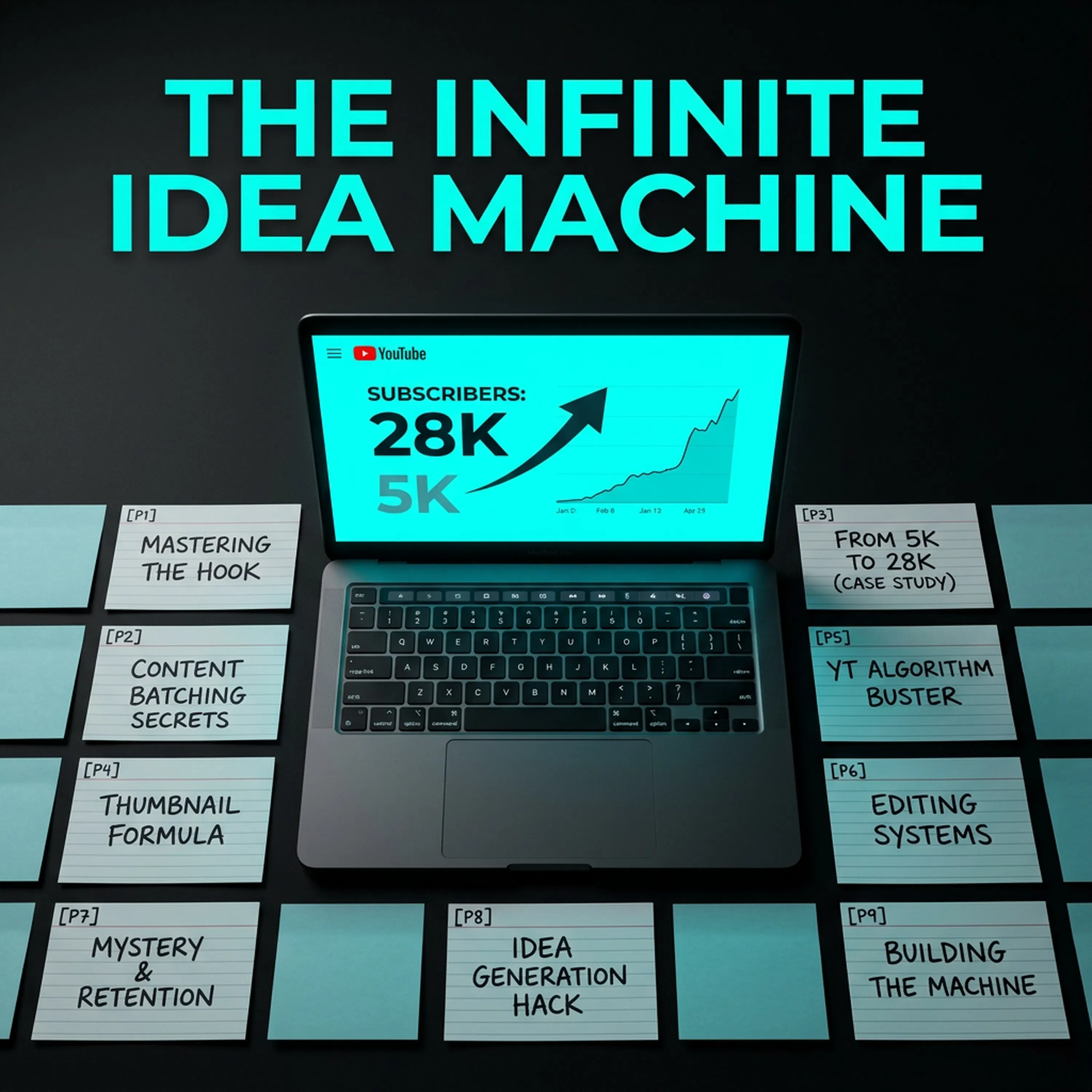
    Why You're Stuck at 5K Subs (And How to Break Out)

    Most creators hit 5,000 subscribers and then... nothing. They're stuck posting random videos, hoping something sticks. Meanwhile, other creators blow past them using systematic content generation instead of relying on inspiration. This episode breaks down the exact system one creator used to scale from zero to 28,000 subscribers. It's not about posting more content. It's about having an infinite pipeline of ranked, prioritized ideas that align with what your audience actually wants to watch. The secret? A priority ladder queue that eliminates guesswork and keeps you creating even when inspiration runs dry. Most creators burn out because they treat content like a creative exercise instead of an engineering problem. The ones who scale treat it like building a machine. In This Episode: > How the priority ladder queue works and why it beats brainstorming sessions > The specific framework for ranking content ideas by engagement potential > Why systematic creators are 3x more likely to post consistently > Real examples of how this system generated months of content in hours Nico walks through the technical side of content automation and shows you how to build your own idea generation system. No more staring at blank screens wondering what to post next. Timestamps: 00:00 Introduction: The 5K subscriber wall 02:30 Why most content strategies fail 05:15 The priority ladder queue explained 08:20 Ranking system for content ideas 10:45 Implementation and next steps If you're tired of inconsistent posting and want a proven system for content generation, hit follow. The Value Engine drops new episodes daily with practical AI implementations that actually move the needle. More episodes available at The Value Engine ------ Keywords: business process automation, business intelligence, zapier alternatives, ai transformation, ai roi, automation strategies Learn more about your ad choices. Visit megaphone.fm/adchoices

  • September 19 · 12 min

    7 Make.com Tricks That Cost Me $200K to Discover

    Most automation builders are burning thousands on complex workflows that barely move the needle. They chase shiny integrations, stack endless tools, and wonder why their business isn't actually growing faster. Nico spent $200K learning which Make.com automations actually generate revenue versus the ones that just look impressive in screenshots. The difference? These seven workflows don't just save time-they directly create money. Here's what 73% of businesses miss: automation isn't about eliminating every manual task. It's about identifying the specific bottlenecks that cost you real dollars and building targeted solutions that pay for themselves within weeks, not months. In This Episode: > The lead scoring automation that turns cold traffic into qualified prospects automatically > Content multiplication workflow that creates 50+ social posts from one piece of source material > Customer support triage system that handles 80% of inquiries without human intervention > Sales pipeline automation that prevents $50K+ deals from falling through cracks > Invoice processing workflow that cuts payment delays from 45 days to 12 > Data synchronization system that eliminates the manual work costing most teams 15 hours weekly > Email sequence automation that converts 23% higher than traditional broadcast campaigns These aren't theoretical concepts. Nico breaks down the exact Make.com modules, shows you the scenario blueprints, and explains why each automation generates measurable ROI instead of just busy work. Timestamps: 00:00 The $200K automation education nobody talks about 02:15 Lead scoring workflow breakdown 04:30 Content multiplication system 06:45 Support automation that actually works 08:20 Sales pipeline protection 10:10 Invoice processing optimization 11:45 Email sequence conversion tactics Companies using these specific workflows report 14.5% faster revenue growth than businesses still doing everything manually. Follow The Value Engine for daily episodes on AI implementations that actually pay for themselves. More episodes available at The Value Engine ------------ Keywords: zapier alternatives, ai automation, ai transformation, automation success, business ai Learn more about your ad choices. Visit megaphone.fm/adchoices

  • September 19 · 12 min

    The $5K Automation Most Agencies Are Leaving on the Table

    Most agencies are walking past a $5,000 monthly revenue stream that takes about three hours to set up. We're talking about business process automation that every company needs but most don't know how to implement. Here's the reality: small businesses burn 40 hours per week on repetitive tasks that software could handle while they sleep. Lead response automation alone can boost conversion rates by 391% when responses happen within one minute. Yet 73% of businesses still respond to leads manually, often hours later. Nico breaks down five specific automation services you can build and sell today, even if your coding skills top out at copy-paste. These aren't theoretical concepts. These are working systems generating real revenue for consultants right now. In This Episode: > The lead capture system that turns website visitors into qualified prospects automatically > Customer service chatbots that handle 80% of routine inquiries without human touch > Invoice and payment workflows that eliminate 90% of accounts receivable headaches > Social media automation that creates engaging content while you focus on strategy > Email sequence builders that nurture prospects from cold to closed You'll get the exact tools, templates, and pricing strategies that turn these automations into $1,500-$10,000 client contracts. Plus the three-question framework that identifies which businesses need automation most urgently. Timestamps: 00:00 The $19 billion automation opportunity 02:15 Lead response automation breakdown 04:30 Customer service chatbot systems 06:45 Payment and invoicing workflows 08:20 Social media automation tools 10:10 Email sequence builders 11:30 Pricing and positioning strategies The business process automation market grows 12% annually, but most agencies are still selling websites and social media management. Time to level up your service offering. Follow The Value Engine for daily episodes on AI implementations that actually generate ROI. More episodes available at The Value Engine --------------- Keywords: business process automation, ai productivity, ai automation Learn more about your ad choices. Visit megaphone.fm/adchoices

  • September 19 · 16 min

    Why Most AI Agencies Never Hit 7 Figures (It's Not What You Think)

    Most AI agencies cap out at low six figures because they price like freelancers, not strategic partners. They charge for hours instead of outcomes and wonder why clients push back on every proposal. The seven-figure agencies? They cracked a different code entirely. They position themselves as ROI multipliers, not service providers, and their pricing reflects that shift. When you can show a client how to save $500K annually through AI automation, charging $100K for the implementation suddenly makes perfect sense. Nico Hartwell breaks down the exact pricing psychology that separates the agencies hitting seven figures from those stuck at $200K. This isn't about raising your rates overnight. It's about fundamentally restructuring how you package and present AI solutions. In This Episode: > Why hourly pricing kills AI agency growth and what to use instead > The 3-tier value framework that justifies premium pricing > How top agencies position themselves to command $25K-$250K per project > Real pricing conversations that close high-value deals The data is pretty clear: agencies using value-based pricing average 4x higher project values than those charging hourly. But most consultants never make the switch because they don't understand client psychology around AI investments. Timestamps: 00:00 Introduction: The pricing trap most AI agencies fall into 02:30 Why clients resist hourly AI pricing 04:15 The value-based framework that works 06:45 Real pricing conversation examples 09:20 How to position for premium rates 11:10 Action steps for your agency If you're building an AI consultancy and want the proven playbooks that actually scale, hit follow on The Value Engine. Nico drops multiple episodes weekly with the exact strategies seven-figure agencies use. More episodes available at The Value Engine ----------- Keywords: ai automation, automation roi, business ai, process optimization, ai revenue, zapier alternatives Learn more about your ad choices. Visit megaphone.fm/adchoices

  • September 19 · 14 min

    The $396 Mistake Costing Entrepreneurs $50K+ Every Year

    Most entrepreneurs spend thousands on automation tools that sit unused while they're still drowning in manual tasks. But what if you could skip the expensive software and build a profitable automation business with less than $400? The business process automation market is exploding toward $19.6 billion by 2026, and small businesses are desperate for help. They're wasting 40% of their workday on repetitive tasks like lead management, email workflows, and data entry. That's where the opportunity lives. In This Episode: > Why starting with simple automation beats complex AI implementations > The exact $396 toolkit that replaces $10,000+ enterprise solutions > How to identify high-demand automation tasks businesses will pay $500-2000 to fix > Real case studies of entrepreneurs who built 6-figure automation businesses in months Nico breaks down the counterintuitive approach that works: instead of selling complicated AI systems, focus on basic automations that solve immediate pain points. You'll discover which no-code tools actually deliver ROI, how to price automation projects for maximum profit, and why most consultants are targeting the wrong market entirely. This isn't about becoming a technical expert. It's about understanding what businesses need most and delivering solutions fast. Timestamps: 00:00 The $396 automation starter kit 02:30 Why simple beats sophisticated every time 05:15 Finding your first automation clients 07:45 Pricing strategies that close deals 10:20 Scaling from side hustle to full business The automation gold rush is happening right now, but most people are mining in the wrong place. Don't be one of them. Follow The Value Engine for daily episodes on AI implementations that actually generate measurable returns. Nico drops new automation strategies every day that pay for themselves within 90 days. More episodes available at The Value Engine --- Keywords: ai implementation, automation podcast, ai cost reduction, ai workflows, zapier alternatives, process optimization, ai transformation, workflow automation Learn more about your ad choices. Visit megaphone.fm/adchoices
  • September 19 · 15 min

    The 3 Pricing Mistakes Costing You $50K+ Per Year

    Most solopreneurs hit a wall around $50K because they're pricing like employees, not business owners. They charge hourly, compete on price, and wonder why they're working 60-hour weeks for mediocre money. Nico breaks down the exact pricing framework that gets solopreneurs to $100K without adding a single employee. You'll discover why hourly billing caps your income at $75K, how to shift to value-based pricing that clients actually prefer, and the automation tools that let you scale without burning out. The math is simple: if you're charging $50/hour and working 40 hours a week, you max out at $104K before taxes. But solopreneurs using value pricing average $150-300 per hour of actual work time. The difference isn't talent or luck. It's strategy. In This Episode: > Why the "race to the bottom" pricing model kills solo businesses > The 3-tier pricing structure that doubled Nico's revenue in 8 months > How to automate client onboarding and project delivery using AI tools > Real numbers from solopreneurs who hit $100K working 30 hours per week This isn't about working harder or finding more clients. It's about positioning yourself as the premium option in your market and using technology to deliver premium results efficiently. Timestamps: 00:00 Why most solopreneurs plateau at $50K 02:30 The employee mindset vs. business owner mindset 05:15 Value-based pricing framework walkthrough 08:45 Automation tools that scale service delivery 11:20 Case study: $48K to $120K in 12 months Follow The Value Engine for daily episodes on AI strategies that actually move the needle. Nico drops new content every weekday with real case studies and actionable frameworks. More episodes available at The Value Engine ------ Keywords: business ai, business process automation, zapier alternatives, ai automation, business automation, workflow automation, automation success, ai workflows Learn more about your ad choices. Visit megaphone.fm/adchoices

  • September 19 · 17 min

    Why Your Automation Project Failed (The Agencies Won't Tell You)

    83% of automation projects fail within the first six months. Not because the tech doesn't work, but because agencies cut corners on delivery to maximize profit margins. Most businesses have no idea what actually happens after they sign that automation contract. They hand over the deposit, sit through a few meetings, then get stuck with buggy workflows that break every other week. The agency blames "complex requirements" and charges extra for fixes that should have been caught during testing. After building delivery processes for dozens of automation agencies, Nico Hartwell is pulling back the curtain on how these projects really work. You'll learn the exact 5-step framework that separates professional agencies from weekend consultants charging enterprise rates. In This Episode: > The discovery phase blueprint that prevents 80% of scope creep (most agencies skip this) > Why the average project timeline is 2-6 weeks and what drives costs between $5,000-$25,000 > The testing protocols that catch integration failures before they reach production > How 80% of business automation gets built using no-code tools, not custom development This isn't theory. These are the actual processes Nico used to deliver automation projects worth over $2 million in total contract value. You'll understand exactly what questions to ask potential agencies and which red flags mean you're about to waste six figures on glorified Zapier workflows. Timestamps: 00:00 Introduction: Why automation projects fail 02:30 Step 1: Discovery and requirements mapping 04:15 Step 2: Technical architecture planning 06:45 Step 3: Development and integration phase 09:20 Step 4: Testing protocols and quality assurance 11:10 Step 5: Deployment and handoff process If you're evaluating automation agencies or building your own delivery process, hit follow. The Value Engine drops new episodes daily with real automation strategies that actually generate ROI. More episodes available at The Value Engine --- Keywords: make.com, automation consulting, machine learning business, ai workflows, process optimization, automation mistakes, business intelligence Learn more about your ad choices. Visit megaphone.fm/adchoices

  • September 19 · 14 min

    Why Freelancers With Agencies Make Half What Solo Pros Do

    The freelance industry has a dirty secret: agents and agencies capture most of the revenue while actual creators do the work. That $5,000 client project? The freelancer sees maybe $2,000 after agency fees and cuts. Nico Hartwell breaks down why flying solo actually multiplies your earning potential. When you eliminate middlemen, you keep 100% of project value and can charge premium rates that agencies would never pass through. The math is simple: direct client relationships equal direct profit margins. In This Episode: > Why agency freelancers hit income ceilings around $50k annually > The pricing psychology that lets solo pros charge $150+ per hour > How to position yourself as the expert, not just another contractor > Building systems that attract $3k-10k projects without cold outreach The real game changer? B2B clients have budgets 10 times larger than what agencies typically bid. A marketing automation project might get quoted at $2,000 through an agency, but the same client will pay $8,000 for direct expert consultation. Nico shares the exact positioning framework he used to scale from $30/hour Upwork gigs to $300/hour AI consulting contracts. No team building, no overhead, just strategic client selection and value-based pricing. Timestamps: 00:00 Introduction 01:30 The agency markup problem 03:45 Why solo pros charge more 06:15 B2B vs consumer market dynamics 08:30 Positioning yourself as the expert 10:45 Action steps for making the switch This isn't theory. Nico's built two six-figure consulting practices using these exact methods. If you're tired of splitting revenue with agencies that add zero value to your actual work, this episode shows you the exit strategy. 🔧 Ready to build your own value engine? Follow The Value Engine for daily episodes on profitable freelance strategies. More episodes available at The Value Engine --- Keywords: ai automation, automation strategies, ai workflows, automation roi, ai consulting, machine learning business, zapier alternatives Learn more about your ad choices. Visit megaphone.fm/adchoices

Showing 141–160 of 239 episodes