
Skip to content
Artwork for The Road to Autonomy
BusinessTechnology

The Road to Autonomy

Grayson Brulte | AUTNMY AI

Hosted by Grayson Brulte, The Road to Autonomy is Institutional Intelligence for the Autonomy Economy™, powered by AUTNMY AI and OMEGA. Episodes combine field research, proprietary Indices, and conversations with the operators, investors, and policymakers building the Autonomy Economy.


Three shows comprise the feed:

  • The Road to Autonomy (Tuesdays): The Road to Autonomy (Tuesdays): Flagship, in-depth conversations and analysis with the architects of The Autonomy Economy.


  • Autonomy Signals, presented by KPMG (Fridays): AUTNMY AI co-founders Grayson Brulte and Rob Grant analyze the underlying technical and regulatory signals moving the market.


  • Autonomy Markets (Saturdays): Grayson Brulte and Walter Piecyk, Partner and TMT Analyst, LightShed Partners and General Partner, LightShed Ventures, break down the week in autonomy from a Wall Street and investment perspective.


With over 450 episodes, The Road to Autonomy is a trusted source for institutional investor, analysts, and executives who need decision-ready intelligence on the Autonomy Economy and physical AI.

Play
  • 37 episodes
  • Avg 55 min
  • English
Counted on this page — what you have heard stays on this device, so it is not something the list can be paged by.
  • #455
    Today · 52 min

    Episode 455 | Autonomy Markets: We Found Atoms, Rode Wayve and Watched Uber’s Autonomy Clock Speed Up

    This week on Autonomy Markets, Grayson Brulte and Walter Piecyk discuss Grayson’s San Francisco Field Work where he rode in a Wayve vehicle on the freeway, compared Waymo’s Jaguar I-PACE and Ojai robotaxis back to back, attended DoorDash’s Dash Forward event, and found Travis Kalanick’s Atoms autonomous vehicle on the streets of San Francisco. Grayson’s verdict on Wayve is clear. With zero interventions in dense San Francisco traffic, the ride felt very similar to Tesla’s Robotaxi. Grayson believes Wayve has the world’s best competitor to FSD today, is 12 to 16 months from an L2+ product in market, and roughly 36 months from going fully unsupervised, most likely first in London. Waymo’s Ojai is still teething but dramatically better than three weeks ago, and while the driving felt identical to Texas, the San Francisco vehicles were spotless while Austin remains the dirtiest Waymo market Grayson has ridden in. After months of searching, Grayson found the Atoms autonomous vehicle near Golden Gate Park, located its depot through OMEGA, and will release an Atoms Field Report on Monday. Uber CEO Dara Khosrowshahi rode unsupervised in a Pony.ai powered Verne robotaxi in Zagreb, while speculation builds that Mobileye might not have a future in robotaxis. On the Foreign Autonomy Desk, Dubai opened the Dubai Autonomous Mobility Lab as it prepares for 25% fully autonomous operations, with WeRide already operating fully autonomously in the Emirate. Episode Chapters 0:00 Waymo SFO Pickup Experience 04:38 Wayve San Francisco and Freeway Ride 08:58 Wayve Timeline to Unsupervised 10:13 233,000 Mile Waymo I-PACE 13:23 Waymo's Avomo Problem 16:23 Atoms Autonomous Vehicle 20:08 Mysterious BMW Testing in San Francisco and Mountain View 22:08 DoorDash Dash Forward Event 25:39 Dara Khosrowshahi Rides Unsupervised in Zagreb 27:02 Where's Mobileye? 30:05 Lyft Expands Brand to Europe 33:15 Who Jumps from Uber to Lyft First? 36:49 When Does Uber Vertically Integrate Robotaxis? 43:24 Zoox Perceived Intersection Problems 45:18 Kodiak Announces IKEA as Unsupervised Over-the-Road Partner 49:05 Foreign Autonomy Desk 49:30 Next Week 📄 Follow Waymo on The Road to Autonomy Indices 📄 Follow Wayve on The Road to Autonomy Indices 📄 Follow DoorDash Dot on The Road to Autonomy Indices -------- About The Road to Autonomy The Road to Autonomy provides institutional intelligence for the Autonomy Economy, powered by AUTNMY AI. We built the indices, set the benchmarks, and execute the fieldwork to put decision-ready physical AI intelligence directly into your workflows with OMEGA. Join institutional investors and industry leaders who read This Week in The Autonomy Economy every Sunday. Each edition delivers exclusive insight and commentary on the autonomy economy, helping you stay ahead of what's next. 📬 Sign up for This Week in The Autonomy Economy newsletter See Privacy Policy at https://art19.com/privacy and California Privacy Notice at https://art19.com/privacy#do-not-sell-my-info.


  • #454
    September 26 · 52 min

    Episode 454 | Autonomy Markets: The Robotaxi Reality Check You Won't Get From an Investor Deck

    This week on Autonomy Markets, Grayson Brulte and Walter Piecyk discuss their Texas Field Work where they rode in Cybercab, Waymo, Avride, May Mobility robotaxis, Kodiak and Aurora autonomous trucks, and inspected depots across Austin and Dallas. Grayson’s verdict on Tesla’s Cybercab is simple. Once you go Cybercab, you don’t go back. In Austin, wait times averaged two to five minutes across dozens of rides, and from a software perspective Grayson found no material difference between Cybercab and the Model Y Robotaxi in terms of performance. In Austin, Grayson counted roighly 200 to 300 vehicles at Avride’s upfitting facility, a presence he believes the market is overlooking, and views Hyundai as a quiet winner of the robotaxi buildout with the IONIQ 5 powering Waymo, Avride and Motional. The Zoox depot in Dallas was under construction with no visible charging infrastructure, and Grayson estimates it is 12 to 18 months from being operational. Both Walt and Grayson rode in a Kodiak autonomous truck and Walt noted clear improvement ahead of Kodiak’s driver-out target on the Dallas to Houston lane by year-end. Additionally, Walt rode in an unsupervised Aurora autonomous truck at their Investor Day. On the Foreign Autonomy Desk, Baidu is ramping supervised robotaxi testing in London with Lyft, Mercedes-Benz signed a licensing deal with Wayve, and Tensor Auto is preparing to deploy robotaxis with Volt Premium Taxi in Bulgaria. Episode Chapters 0:00 Once You Go Cybercab, You Don't Go Back 03:56 Robotaxi in Dallas 09:01 Cybercab Wait Times, Pickups and Routing in Austin 12:10 Austin Robotaxi Depots 13:45 Avride's Austin Depot 16:02 Zoox's Dallas Depot 17:22 May Mobility in Arlington 20:17 Kodiak Targets Driver-Out on Dallas to Houston by Year-End 24:19 Avride in Dallas and the Uber Partner Math 26:46 Hyundai Is the Quiet Winner in Robotaxis 27:30 Walt Amends His View on Upfitting 30:57 Tesla's Vertical Integration and Supercharger Advantage 33:06 Aurora Investor Day and the 1,000 Truck Target 40:22 President Xi's Visit and a Wake-Up Call for Detroit 47:01 Foreign Autonomy Desk 49:33 Next Week 📄 Follow Waymo on The Road to Autonomy Indices 📄 Follow Tesla on The Road to Autonomy Indices 📄 Follow Avride on The Road to Autonomy Indices 📄 Follow May Mobility on The Road to Autonomy Indices -------- About The Road to Autonomy The Road to Autonomy is the leading applied intelligence platform covering the convergence of automation, autonomy, and the Autonomy Economy.™. Through our podcasts, newsletter, and proprietary applied intelligence, we set the narrative for institutional investors, industry executives, and policymakers navigating the convergence of automation, autonomy, and economic growth. Join institutional investors and industry leaders who read This Week in The Autonomy Economy every Sunday. Each edition delivers exclusive insight and commentary on the autonomy economy, helping you stay ahead of what's next. 📬 Sign up for This Week in The Autonomy Economy newsletter See Privacy Policy at https://art19.com/privacy and California Privacy Notice at https://art19.com/privacy#do-not-sell-my-info.
  • #453
    September 25 · 1 hr 11 min

    Episode 453 | Autonomy Signals: May Mobility's SPAC and the $93 Million Question

    This week on Autonomy Signals presented by KPMG, Grayson Brulte and Rob Grant discuss May Mobility filing to go public through a SPAC merger with an estimated $93 million annual cash burn, Mercedes-Benz adding Wayve as its third automated driving software partner, and Figure AI’s Helix 2.5 taking on household chores across 30 homes it had never seen before. May Mobility is merging with ACP Holdings Acquisition Corp at a $1.4 billion valuation and will trade under the ticker MAY upon completion of the transaction. Of the up to $337 million in proceeds, only the $120 million PIPE is committed. At the company’s current burn rate, the PIPE covers about 1.3 years of operations against roughly $10 million in 2025 revenue. The remaining $217 million depends on the redemption rate. Mercedes-Benz signed with Wayve for point-to-point Level 2 driving assistance within two years. Wayve joins NVIDIA and Momenta as Mercedes retreats from L3 Drive Pilot and focuses on L2 driving assistance partnerships. Figure AI’s Helix 2.5 raised zero-shot success from 9% to 56% by pre-training on human behavior data, using half the task-specific data. That still leaves a 44% failure rate in curated homes, with no independent replication and no commercial contracts. The result supports a learning strategy, not a dependable, unsupervised home humanoid. Episode Chapters 0:00 KPMG Sponsor Introduction 01:45 Signal 1: May Mobility's SPAC 27:52 Signal 2: Mercedes Partners Wayve on Autonomous Driving 47:07 Signal 3: Figure AI Introduces Helix 2.5 Follow May Mobility on the Robotaxi Index Follow Wayve on the Autonomous Driving Licensing Index -------- About The Road to Autonomy The Road to Autonomy is the leading applied intelligence platform covering the convergence of automation, autonomy, and the Autonomy Economy.™. Through our podcasts, newsletter, and proprietary applied intelligence, we set the narrative for institutional investors, industry executives, and policymakers navigating the convergence of automation, autonomy, and economic growth. Join institutional investors and industry leaders who read This Week in The Autonomy Economy every Sunday. Each edition delivers exclusive insight and commentary on the autonomy economy, helping you stay ahead of what's next. Sign up for This Week in The Autonomy Economy newsletter See Privacy Policy at https://art19.com/privacy and California Privacy Notice at https://art19.com/privacy#do-not-sell-my-info.

  • #452
    September 23 · 45 min

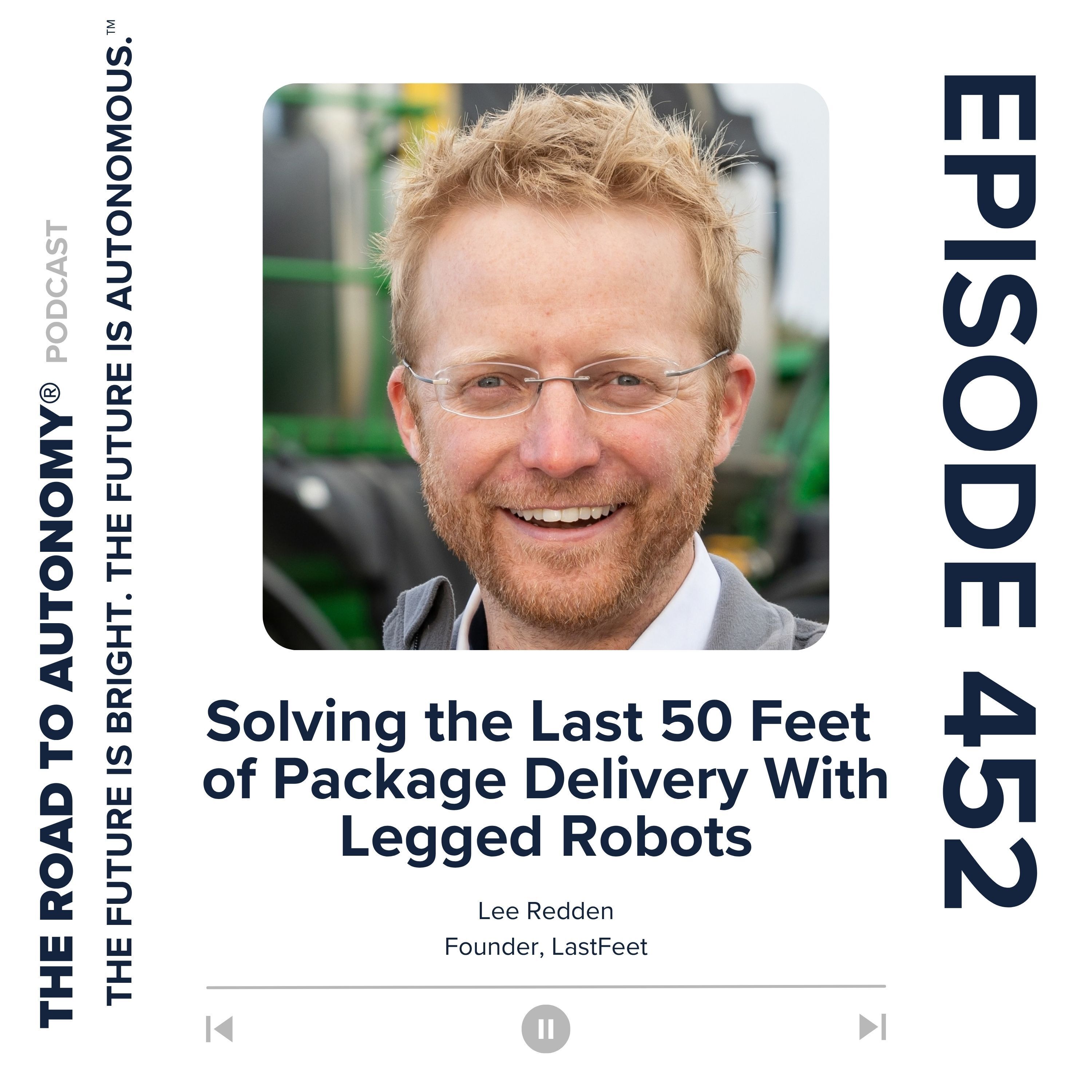
    Episode 452 | Solving the Last 50 Feet of Package Delivery With Legged Robots

    Lee Redden, Founder of LastFeet joined Grayson Brulte on The Road to Autonomy podcast to discuss solving the last 50 feet of package delivery with a custom-built legged robot designed to ride in the jump seat of a delivery van and carry packages from the curb to the doorstep. After co-founding Blue River Technology and selling it to Deere, Lee returned to building because he believes this is one of the best times ever to build robots. LastFeet’s robot walks on four legs with wheels on its feet, so it can climb the high step out of a box truck and then roll quickly and steadily to the door. It learns to walk entirely in simulation, a big change from the hand-calculated kinematics Lee learned in grad school. The inspiration came from delivery drivers. Lee interviewed dozens of drivers and shadowed their routes, then modeled his robot on the runner, the second person who rides in the passenger seat on busy days and carries packages to the door while the driver keeps driving. On day one, the robot sits in the jump seat with no change to how the back of the van is loaded. The driver loads a package, the robot bows at the door to set it on the step, and if it runs into something it can’t handle, it asks a remote human for help. The first robot carries 15 pounds, which covers most packages, and runs on an NVIDIA Orin AGX with two-hour hot-swappable batteries. When it’s unsure what to do, its safety response is to freeze in place and turn into a table. Episode Chapters 0:00 Why Lee Redden Is Building Again 02:41 How the LastFeet Robot Works 04:56 How to Build a Robot in 2026 07:27 Testing in Snow and Ice 10:00 How the Robot Delivers to Every Doorstep 12:43 Riding in the Jump Seat of a Delivery Van 15:00 Manufacturing at Scale 18:46 Building for Rugged Delivery Vans 22:54 LastFeet Business Model 29:32 Battery Life and Charging in the Van 32:11 What Lee Learned Shadowing 50 Delivery Drivers 37:28 Safety and Building Trust With the Public 40:18 The Future of LastFeet 43:11 AUTNMY AI Follow The Road to Autonomy Indices -------- About The Road to Autonomy The Road to Autonomy is the leading applied intelligence platform covering the convergence of automation, autonomy, and the Autonomy Economy.™. Through our podcasts, newsletter, and proprietary applied intelligence, we set the narrative for institutional investors, industry executives, and policymakers navigating the convergence of automation, autonomy, and economic growth. Join institutional investors and industry leaders who read This Week in The Autonomy Economy every Sunday. Each edition delivers exclusive insight and commentary on the autonomy economy, helping you stay ahead of what's next. Sign up for This Week in The Autonomy Economy newsletter See Privacy Policy at https://art19.com/privacy and California Privacy Notice at https://art19.com/privacy#do-not-sell-my-info.

  • #451
    September 19 · 37 min

    Episode 451 | Autonomy Markets: Waymo Takes the World While Tesla Takes the NHTSA Test

    This week on Autonomy Markets, Grayson Brulte and Walter Piecyk discuss Waymo’s expansion to Tokyo and Singapore, NHTSA’s ongoing audit of Tesla’s Cybercab in Austin and Bolt’s plan to deploy up to 25,000 Lucid robotaxis in Europe. Today, Tesla has roughly 40 Cybercabs operating in Austin, and Grayson believes Tesla is respectfully holding at its home market while NHTSA completes a fact-finding audit. If Tesla passes, it is free to deploy in any state that permits fully autonomous operations. Walt expects the process to wrap by year-end, and Grayson reads Administrator Morrison’s Pittsburgh speech on updating outdated federal motor vehicle safety standards (FMVSS) as a signal that a pathway is opening. As Waymo continues their global expansion, Grayson predicts Singapore will be an IONIQ 5 market and Tokyo a Toyota market, with the vehicle constraint that has defined Waymo now dissipating, and he reads the Allianz partnership as the insurance piece falling into place for Waymo’s grand European expansion. In Las Vegas, riders can now go anywhere in the ODD, and in Nashville, The Road to Autonomy Special Field correspondent David Moss got banned from the Lyft app playing autonomy roulette. May Mobility announced a SPAC with $10 million of 2025 revenue and a $270,000 bill of materials, and Wayve hired Waymo’s former CFO, which Grayson views as a signal Wayve may be eyeing the public markets. On the Foreign Autonomy Desk, Grayson and Walt analyzed Einride’s deployment in Germany, Pony AI, Uber and Verne’s driver-out launch in Zagreb on a 13.67-mile fixed loop. Spain issued its first SAE Level 4 permit to WeRide and Uber, with Grayson predicting a Waymo expansion to Madrid by Q2 of next year. In Singapore, Grab is expanding their WeRide fleet 5X to 50 robotaxis. Episode Chapters 0:00 Reviewing the Jason Calacanis Episode 03:17 Tesla Cybercab NHTSA Audit 06:23 NHTSA Administrator Morrison's Pittsburgh Speech 08:14 Waymo on Lyft in Nashville 10:56 Waymo in Las Vegas 13:17 Waymo in Tokyo and Singapore 16:20 Waymo / Allianz Partnership 17:25 Bolt's Grand Robotaxi Ambitions 20:45 May Mobility SPAC 23:42 Wayve's Hires Waymo's Fmr. CFO 24:45 Hyundai IONIQ 5 Robotaxis 28:11 Autonomous Trucking 30:34 Foreign Autonomy Desk 35:35 Next Week Follow The Road to Autonomy Indices -------- About The Road to Autonomy The Road to Autonomy is the leading applied intelligence platform covering the convergence of automation, autonomy, and the Autonomy Economy.™. Through our podcasts, newsletter, and proprietary applied intelligence, we set the narrative for institutional investors, industry executives, and policymakers navigating the convergence of automation, autonomy, and economic growth. Join institutional investors and industry leaders who read This Week in The Autonomy Economy every Sunday. Each edition delivers exclusive insight and commentary on the autonomy economy, helping you stay ahead of what's next. Sign up for This Week in The Autonomy Economy newsletter See Privacy Policy at https://art19.com/privacy and California Privacy Notice at https://art19.com/privacy#do-not-sell-my-info.
  • #450
    September 18 · 1 hr 1 min

    Episode 450 | Autonomy Signals: Will NHTSA Ground Cybercab?

    This week on Autonomy Signals presented by KPMG, Grayson Brulte and Rob Grant discuss NHTSA ordering Tesla to answer 21 technical and legal questions under oath by September 30 on Cybercab self-certification, Waymo hitting local political friction in San Diego after CPUC approval, and GMO Air unveiling a robot EMS vehicle in Tokyo built to service humanoids in the field. NHTSA’s Office of Vehicle Safety Compliance, by special order signed by the Chief Counsel, required Tesla to explain how a steering-wheel-free Cybercab meets FMVSS 101, 102, 108, 111, 126, and 135 standards written around human controls such as mirrors, brake pedals, turn-signal self-cancel, and shift displays, and why Tesla did not seek a Part 555 exemption as Zoox did. The inquiry also asks whether some test results depended on temporary manual controls later removed. Public Cybercab service began September 3, 2026 in Austin. Nothing in the order grounds the fleet or caps production; September 30 is an evidentiary deadline, not a shutdown date. While Tesla answers Washington, San Diego City Council voted 8–0 to request local regulatory authority over AI and autonomous vehicles, a follow-up to CPUC approval that gives the city no power to stop Waymo. California has preempted local autonomous vehicles rules for more than a decade. The San Diego City Council resolution is toothless on paper, but it flags the real friction points: emergency-response incidents, airport access outside state preemption, stricter local ticketing after a July 1 law, and depot or charging permits that still sit with the city. Waymo called the move extraordinarily premature and cited a 100,000-person local waitlist; it already has a field-verified operational depot in San Diego. In Tokyo, GMO Air unveiled a robot EMS vehicle equipped with diagnostic tools, spare parts, a backup humanoid, and a purple roof light distinct from red human-ambulance lighting. The demo still used human-in-the-loop controls because of latency. The signal is adjacent infrastructure, field maintenance and uptime for deployed humanoids, not a driverless medical ambulance for people. Episode Chapters 0:00 KPMG Sponsor Introduction 01:41 Signal 1: Will NHTSA Ground Cybercab? 26:59 Signal 2: San Diego City Council Wants Local Control 48:39 Signal 3: Japan’s Ambulance for Humanoids Follow The Road to Autonomy Indices -------- About The Road to Autonomy The Road to Autonomy is the leading applied intelligence platform covering the convergence of automation, autonomy, and the Autonomy Economy.™. Through our podcasts, newsletter, and proprietary applied intelligence, we set the narrative for institutional investors, industry executives, and policymakers navigating the convergence of automation, autonomy, and economic growth. Join institutional investors and industry leaders who read This Week in The Autonomy Economy every Sunday. Each edition delivers exclusive insight and commentary on the autonomy economy, helping you stay ahead of what's next. Sign up for This Week in The Autonomy Economy newsletter See Privacy Policy at https://art19.com/privacy and California Privacy Notice at https://art19.com/privacy#do-not-sell-my-info.

  • #449
    September 15 · 59 min

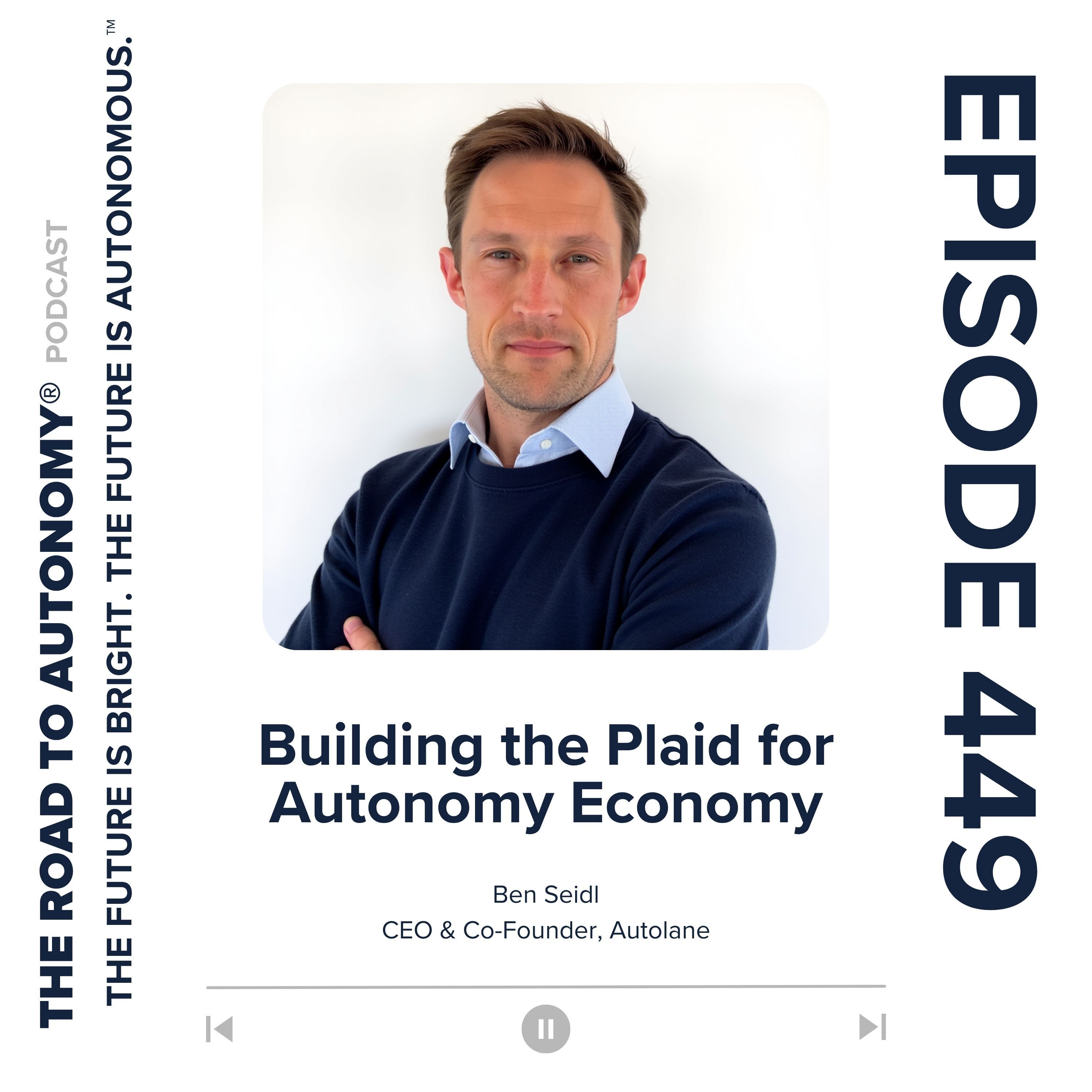
    Episode 449 | Building Plaid for the Autonomy Economy

    Ben Seidl, Co-Founder and CEO of Autolane joined Grayson Brulte on The Road to Autonomy podcast to discuss building Plaid for the autonomy economy, an independent, OEM-agnostic orchestration platform that connects autonomous vehicles to businesses for tip-free delivery. The inspiration for Autolane was born in August 2024 when Ben turned on FSD in his Tesla for the first time and worked backwards from a simple question. When personally owned autonomous vehicles become a reality, what has to exist for a car to drive to a store, park in the right stall, pop its trunk, and complete a transaction without a human in the loop? The answer, a neutral platform that no OEM, marketplace, or retailer controls. Studying the Argo AI and Cruise OEM control of AV 1.0 convinced Ben that taking capital from a Ford or a Walmart limits the market and muddies decision making. Autolane entered the market through ride-hail orchestration, deploying first at Stanford Shopping Center with Simon Property Group in September 2025 to give landlords control over where Waymo and Tesla robotaxis arrive on private property. Over the summer, Autolane went live with So Chinese Takeout in Austin, operating a fleet of 13 Tesla Model Ys equipped with temperature-controlled smart lockers that batch two to three orders per trip as they expand the business beyond ride-hail orchestration. Episode Chapters 0:00 Inspiration for Autolane 4:34 Autolane's Quest to Remain Independent 11:06 Deploying at Stanford Shopping Center 13:02 Chapter One: Orchestration 16:46 Autolane Zones 26:41 Fleet Ownership 28:36 Underwriting Autonomous Delivery 33:53 Matching Supply and Demand 37:29 French Fry Test 39:38 QSR Delivery 46:59 Sidewalk Dots, Drones, and Humanoids 54:35 Plaid for the Autonomy Economy 57:42 AUTNMY AI Follow The Road to Autonomy Indices -------- About The Road to Autonomy The Road to Autonomy is the leading applied intelligence platform covering the convergence of automation, autonomy, and the Autonomy Economy.™. Through our podcasts, newsletter, and proprietary applied intelligence, we set the narrative for institutional investors, industry executives, and policymakers navigating the convergence of automation, autonomy, and economic growth. Join institutional investors and industry leaders who read This Week in The Autonomy Economy every Sunday. Each edition delivers exclusive insight and commentary on the autonomy economy, helping you stay ahead of what's next. Sign up for This Week in The Autonomy Economy newsletter See Privacy Policy at https://art19.com/privacy and California Privacy Notice at https://art19.com/privacy#do-not-sell-my-info.

  • #448
    September 12 · 1 hr 37 min

    Episode 448 | Autonomy Markets: Jason Calacanis on the Robotaxi Endgame

    This week on Autonomy Markets, Grayson Brulte and Walter Piecyk are joined by special guest Jason Calacanis, one of the first investors in Uber, to debate his bull case on Uber, who wins the robotaxi endgame and whether local governments will cap the deployment of autonomous vehicles. Jason earns the first clappy hat of the episode for saying what few in the market will, Tesla is obsessed with safety. The incidents Waymo has absorbed would be showstoppers under Tesla, and Tesla knows it. Jason, who drives FSD daily on Hardware 4, puts the system at 98 percent of the way to Level 4 and wants to buy a Cybercab fleet. The robotaxi endgame, in Jason’s view, comes down to manufacturing. A shift from 2 percent of global miles on rideshare to 30 percent requires more than 100 million autonomous vehicles and a $5 trillion fleet build-out larger than the AI data center build-out. Tesla wins the gold because it owns the factory. In Jason’s opinion Waymo will have to buy a car company, likely Rivian or Lucid, after it spins out of Google and IPOs. Uber owns the demand and will take the rest of the market with its 20 partners, several of which Jason predicts will pivot to building only robotaxis. His market share call is 40 percent Tesla, 35 percent Uber and 15 percent Waymo. Walt pushes back on whether there is enough at the table for Uber’s twelfth partner and questions whether any of them are close to Tesla or Waymo today, with 300 Nuro powered Lucid Gravity vehicles by June being a win. Jason counters that Nuro and Avride will be driver-out within 24 months and that no one else can afford the $100 to $300 per customer required to build another Uber-scale network. The sharpest debate of the episode is regulatory capture. Jason argues local governments will cap and license autonomous vehicles the way they did Airbnb, that drivers will be the first mass unemployment from AI and that Uber is right to negotiate a soft landing with unions. Grayson argues federal preemption is coming and that caps will disappear when a national framework arrives. The two settle it with a steak dinner bet on whether local communities or the federal government win the fight in the United States. Jason closes with his theory on Uber and his dream scenario of Travis Kalanick returning as CEO of Uber. Episode Chapters 0:00 Jason Calacanis joins Autonomy Markets 02:19 Cybercab Fleets 04:04 Tesla's obsession with Safety 07:27 Everywhere-All-at-Once Fallacy 09:33 Uber Shutting Down ATG Was a Mistake 12:51 The Gap Between Engineers and the Market 16:37 Jason Calacanis on Why Waymo has to Buy a Car Company 18:15 Uber's Surge Pricing Strategy 19:16 Jason Calacanis' 40/35/15 Robotaxi Prediction 25:58 Are Any of Uber's Partners Technically Close to Tesla or Waymo? 30:23 Uber Eats is Half of Uber's business 32:18 100 Unsupervised Robotaxi Benchmark 33:37 Robotaxis in China 35:31 Regulatory Capture Debate begins 41:31 Steak Dinner Bet 49:02 Personally Owned Autonomous Vehicles Impact on Shared Rides 52:27 Waymo and Toyota moment to Watch in Q1 27 55:30 Puke in Uber, Get a Bonus 56:28 Travis Kalanick, CloudKitchens and Atoms 58:08 What Travis Kalanick Would do Differently 59:09 PIF, Lucid, Nuro and a Full-Stack Uber with-in 36 months 1:06:16 Atoms Robotaxi Depot Play 1:12:32 If and When Waymo Goes Public 1:17:36 Why Japan needs autonomy 1:20:46 The Next 12 months 1:22:20 The Next Tesla Robotaxi format 1:27:42 Autonomous Regional Travel 1:29:47 Amazon, Google or Tesla should buy Uber 1:31:39 Consolidation, First Dominos, Zipline, Wayve and Nuro 1:34:52 Framing the Bet Follow The Road to Autonomy Indices -------- About The Road to Autonomy The Road to Autonomy is the leading applied intelligence platform covering the convergence of automation, autonomy, and the Autonomy Economy.™. Through our podcasts, newsletter, and proprietary applied intelligence, we set the narrative for institutional investors, industry executives, and policymakers navigating the convergence of automation, autonomy, and economic growth. Join institutional investors and industry leaders who read This Week in The Autonomy Economy every Sunday. Each edition delivers exclusive insight and commentary on the autonomy economy, helping you stay ahead of what's next. Sign up for This Week in The Autonomy Economy newsletter See Privacy Policy at https://art19.com/privacy and California Privacy Notice at https://art19.com/privacy#do-not-sell-my-info.
  • #447
    September 11 · 58 min

    Episode 447 | Autonomy Signals: NHTSA Audits Cybercab While Waymo Launches with Lyft in Nashville

    This week on Autonomy Signals presented by KPMG, Grayson Brulte and Rob Grant discuss NHTSA opening an audit query into Tesla's Cybercab self-certification hours after commercial launch, Waymo launching in Nashville on both the Waymo and Lyft apps with Flexdrive managing fleet operations, and XPENG commissioning a dedicated humanoid production facility in Guangzhou, China. On September 3rd, NHTSA's Office of Vehicle Safety Compliance opened audit query AQ26002 covering an estimated 1,000 Cybercabs, triggered by Tesla deploying a bespoke vehicle with no manual controls on public roads with paying members of the public. The question is not whether the Cybercab is unsafe but whether Tesla unilaterally decided that steering wheel, pedal, and mirror provisions do not apply to a vehicle with no manual controls rather than seeking a Part 555 exemption as Zoox did. Nothing in NHTSA's query halts operations or caps Tesla's Cybercab production. While NHTSA probes Tesla, Waymo went live in Nashville as the first market where its vehicles are bookable through both the Waymo app and the Lyft app with Flexdrive managing the fleet. As robotaxis scale in America, over in China, XPENG commissioned its humanoid production facility in Guangzhou with an 80% automated build, backed by a $900 million raise at a $6.3 billion post-money valuation, the largest single-round private raise in China's embodied AI sector. The Iron humanoid has 76 degrees of freedom and three Turing chips delivering 2,250 TOPS running XPENG's physical AI model on device, with mass production beginning by the end of 2026. Episode Chapters 0:00 KPMG Sponsor Introduction 01:02 Signal 1: NHTSA Opens Audit Query into Tesla Cybercab 32:00 Signal 2: Waymo Launches on Lyft in Nashville 47:11 Signal 3: XPENG Commissions Humanoid Production Facility Follow The Road to Autonomy Indices -------- About The Road to Autonomy The Road to Autonomy is the leading applied intelligence platform covering the convergence of automation, autonomy, and the Autonomy Economy.™. Through our podcasts, newsletter, and proprietary applied intelligence, we set the narrative for institutional investors, industry executives, and policymakers navigating the convergence of automation, autonomy, and economic growth. Join institutional investors and industry leaders who read This Week in The Autonomy Economy every Sunday. Each edition delivers exclusive insight and commentary on the autonomy economy, helping you stay ahead of what's next. Sign up for This Week in The Autonomy Economy newsletter See Privacy Policy at https://art19.com/privacy and California Privacy Notice at https://art19.com/privacy#do-not-sell-my-info.
  • #449
    September 8 · 59 min

    Episode 449 | Building Plaid for the Autonomy Economy

    Ben Seidl, Co-Founder and CEO of Autolane joined Grayson Brulte on The Road to Autonomy podcast to discuss building Plaid for the autonomy economy, an independent, OEM-agnostic orchestration platform that connects autonomous vehicles to businesses for tip-free delivery. The inspiration for Autolane was born in August 2024 when Ben turned on FSD in his Tesla for the first time and worked backwards from a simple question. When personally owned autonomous vehicles become a reality, what has to exist for a car to drive to a store, park in the right stall, pop its trunk, and complete a transaction without a human in the loop? The answer, a neutral platform that no OEM, marketplace, or retailer controls. Studying the Argo AI and Cruise OEM control of AV 1.0 convinced Ben that taking capital from a Ford or a Walmart limits the market and muddies decision making. Autolane entered the market through ride-hail orchestration, deploying first at Stanford Shopping Center with Simon Property Group in September 2025 to give landlords control over where Waymo and Tesla robotaxis arrive on private property. Over the summer, Autolane went live with So Chinese Takeout in Austin, operating a fleet of 13 Tesla Model Ys equipped with temperature-controlled smart lockers that batch two to three orders per trip as they expand the business beyond ride-hail orchestration. Episode Chapters 0:00 Inspiration for Autolane 4:34 Autolane's Quest to Remain Independent 11:06 Deploying at Stanford Shopping Center 13:02 Chapter One: Orchestration 16:46 Autolane Zones 26:41 Fleet Ownership 28:36 Underwriting Autonomous Delivery 33:53 Matching Supply and Demand 37:29 French Fry Test 39:38 QSR Delivery 46:59 Sidewalk Dots, Drones, and Humanoids 54:35 Plaid for the Autonomy Economy 57:42 AUTNMY AI Follow The Road to Autonomy Indices -------- About The Road to Autonomy The Road to Autonomy is the leading applied intelligence platform covering the convergence of automation, autonomy, and the Autonomy Economy.™. Through our podcasts, newsletter, and proprietary applied intelligence, we set the narrative for institutional investors, industry executives, and policymakers navigating the convergence of automation, autonomy, and economic growth. Join institutional investors and industry leaders who read This Week in The Autonomy Economy every Sunday. Each edition delivers exclusive insight and commentary on the autonomy economy, helping you stay ahead of what's next. Sign up for This Week in The Autonomy Economy newsletter See Privacy Policy at https://art19.com/privacy and California Privacy Notice at https://art19.com/privacy#do-not-sell-my-info.

  • #446
    September 8 · 30 min

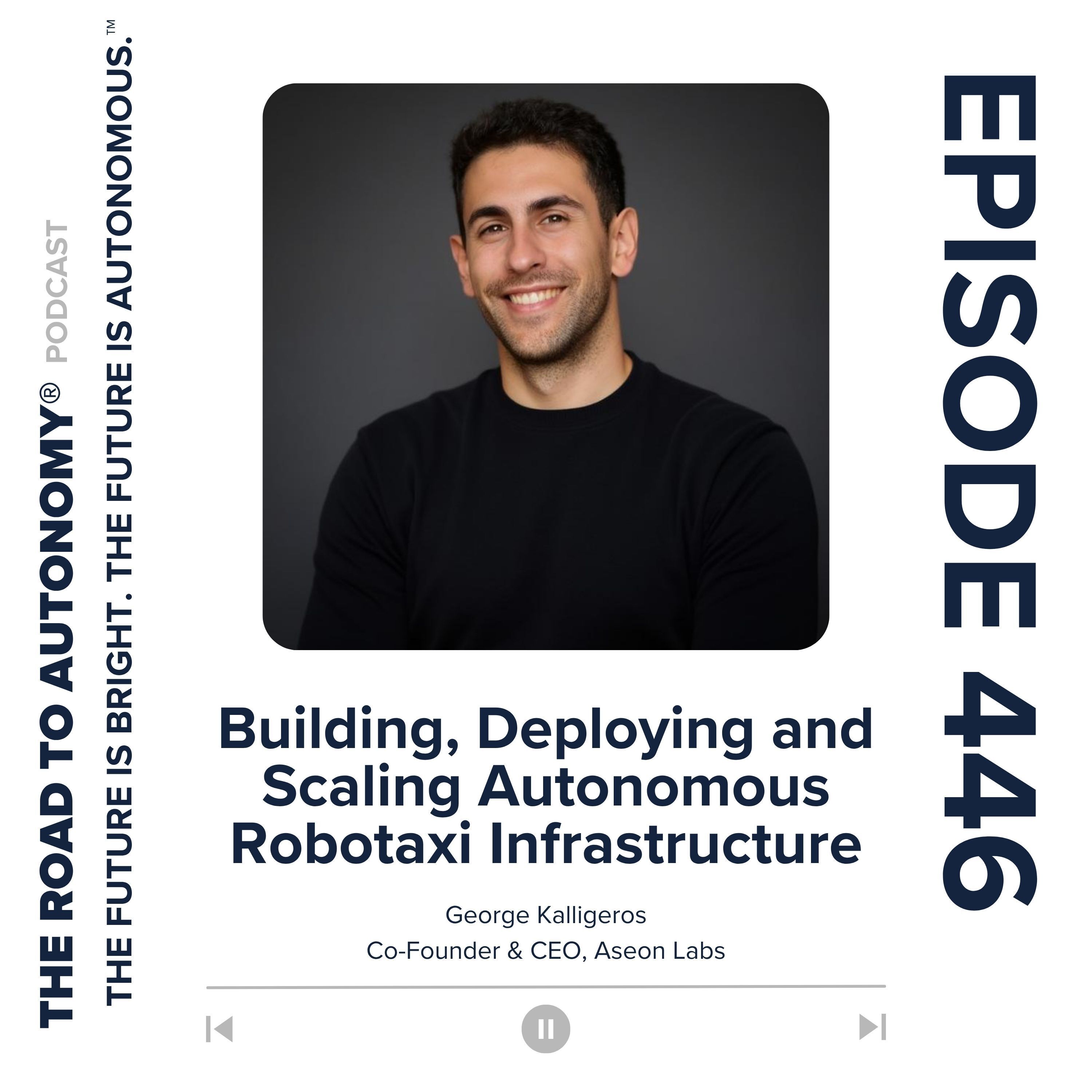
    Episode 446 | Building, Deploying and Scaling Autonomous Robotaxi Infrastructure

    George Kalligeros, Co-Founder and CEO of Aseon Labs joined Grayson Brulte on The Road to Autonomy podcast to discuss building, deploying and scaling autonomous robotaxi infrastructure. After visiting depots across the country, George noticed that the current large-scale depot model needs an update as he estimates that roughly 40% of the cost of a robotaxi depot visit is tied to relocating the vehicle, both in the cost of the trip and in lost demand. Today a vehicle can leave service for two hours at a time, three times a day, to travel to a centralized depot. Aseon’s answer is to shrink the depot footprint and disperse it directly into the operating zones where vehicles already work. Each Aseon pod occupies a single parking bay, arrives on a flatbed truck, rolls off on its own wheels, and expands into position. Inside, a robotic system plugs in the charger, inspects the interior and exterior, removes lost items and trash, vacuums and wipes down the cabin, syncs data, and safely stores the vehicle. Aseon calls it the core reset, and it takes roughly 30 minutes, with a target of 95% fully autonomous uptime and 20 to 30 robotaxi charge/cleaning sessions per pod per day. Because the pods are classified as temporary infrastructure, Aseon can deploy on existing charge point operator sites or EV-permitted parking lots with a conditional use authorization in eight to 12 weeks and relocate a pod on a few days’ notice. Fresh off a $10 million seed round, the company is targeting Dallas, Austin, and Phoenix for its first pilots with robotaxi operators, with a long-term view that infrastructure is the key to scaling robotaxis. Episode Chapters 0:00 Why Robotaxis Need Autonomous Infrastructure 00:47 The 40% Relocation Cost Insight 04:28 Lost Utilization and Where Pods Get Placed 05:55 The Core Reset Services 07:23 Commercialization and Deployment Models 10:14 Depots, Satellites, and Nodes 13:54 Portability and Permitting 15:22 Lessons from Pushme and Tier Mobility 18:11 Inside the Robotic Reset 18:54 Deploying the $10 Million Seed 24:36 Vandalism and Security 26:21 Infrastructure Over the Next Decade 29:51 AUTNMY AI Follow The Road to Autonomy Indices -------- About The Road to Autonomy The Road to Autonomy is the leading applied intelligence platform covering the convergence of automation, autonomy, and the Autonomy Economy.™. Through our podcasts, newsletter, and proprietary applied intelligence, we set the narrative for institutional investors, industry executives, and policymakers navigating the convergence of automation, autonomy, and economic growth. Join institutional investors and industry leaders who read This Week in The Autonomy Economy every Sunday. Each edition delivers exclusive insight and commentary on the autonomy economy, helping you stay ahead of what's next. Sign up for This Week in The Autonomy Economy newsletter See Privacy Policy at https://art19.com/privacy and California Privacy Notice at https://art19.com/privacy#do-not-sell-my-info.

  • #445
    September 5 · 1 hr 1 min

    Episode 445 | Autonomy Markets: Cybercab Day Arrives as Robotaxis Become Bankable

    This week on Autonomy Markets, Grayson Brulte and Walter Piecyk discuss Tesla’s Cybercab commercial launch in Austin, Uber’s continued regulatory capture campaign and Waymo’s first ever debt raise. Tesla officially opened Cybercab to the public in Austin on September 3rd, with paid rides across the full operational design domain (ODD) in a vehicle with no steering wheel and no pedals. Grayson and Walt call it a major milestone for the Autonomy Economy, despite a coordinated effort to make the launch look unimportant. The bigger story surrounding the launch, in Grayson’s view, is Tesla’s new form inviting individuals and companies to purchase Cybercab fleets and build and own robotaxi infrastructure. Grayson sees this as a potential franchise model with Tesla’s ability to finance the fleet as a structural advantage. The Financial Times is reporting on Uber’s continued regulatory capture strategy, requiring human drivers to handle the majority of rides as part of a hybrid network strategy. Grayson concludes Uber is under siege from autonomy and reaching for regulatory capture, while Walt notes it also kneecaps Uber’s own autonomy partners. Waymo opened public rides in Denver, San Diego and Tampa, reaching 14 U.S. cities, and is in the final stage of raising roughly $3 billion in debt, its first borrowing. Zoox earns its first clappy hat for curbside pickup and drop-off at Harry Reid International Airport and announced expanded testing to Houston and San Diego. Wayve and Uber launched supervised robotaxi service in London, with Wayve stating plainly that a safety driver is on board while Uber framed it as the first autonomous rides in the UK. On the foreign autonomy desk, Applied Intuition partnered with Humain to build an autonomous freight corridor in Saudi Arabia, DiDi began fully driverless trials of its purpose-built R2 robotaxi with the UAE next, Waymo will deploy in Munich next year against Momenta and Uber, and WeRide’s robobus is operating in Singapore. Episode Chapters 0:00 Tesla's Cybercab Launch in Austin 08:38 NHTSA's Probe into Tesla's Self-Certification 15:49 LiDAR Debate 21:42 Tesla's Fleet Ownership Model Questions 26:21 Tempering Expectations on Cybercab Rollout 27:54 Uber's Regulatory Capture Campaign 34:44 Waymo Expands to Denver, San Diego and Tampa 36:33 Waymo's $3 Billion Debt Raise 38:45 Robotaxi Depot Infrastructure 41:08 Zoox Launches Service at Harry Reid International Airport (LAS) 48:40 Wayve and Uber Launch Supervised Rides in London 52:32 Autonomous Trucking 55:22 Foreign Autonomy Desk 1:00:33 Next Week Follow The Road to Autonomy Indices -------- About The Road to Autonomy The Road to Autonomy is the leading applied intelligence platform covering the convergence of automation, autonomy, and the Autonomy Economy.™. Through our podcasts, newsletter, and proprietary applied intelligence, we set the narrative for institutional investors, industry executives, and policymakers navigating the convergence of automation, autonomy, and economic growth. Join institutional investors and industry leaders who read This Week in The Autonomy Economy every Sunday. Each edition delivers exclusive insight and commentary on the autonomy economy, helping you stay ahead of what's next. Sign up for This Week in The Autonomy Economy newsletter See Privacy Policy at https://art19.com/privacy and California Privacy Notice at https://art19.com/privacy#do-not-sell-my-info.
  • #444
    September 4 · 1 hr 6 min

    Episode 444 | Autonomy Signals: Waymo Launches Three Additional Cities as UBTECH Develops Bespoke Humanoids

    This week on Autonomy Signals presented by KPMG, Grayson Brulte and Rob Grant discuss Waymo launching commercial robotaxi service in Denver, San Diego, and Tampa on the same day, UBTECH's humanoid revenue surging 1,445% on industrial demand, and Sandvik unveiling SAMI, a cabin-less autonomous surface drill that removes humans from the blast zone. On September 1st, Waymo opened service to the public in Denver, San Diego, and Tampa, bringing the service to 14 cities with a fleet exceeding 4,000 vehicles, roughly 500,000 paid weekly trips, and 220 million fully autonomous miles. Launching three major markets simultaneously confirms Waymo has moved from single-city validation into a repeatable multi-market playbook, timed on the eve of Tesla's Cybercab launch to keep the market focused on verified commercial metrics. Denver is the signal inside the signal as it's Waymo's first cold-weather market, and Tampa becomes the first true head-to-head market where Waymo and Tesla launched within five weeks of each other. Waymo's constraint is vehicle supply, Tesla's is regulatory. While Waymo expanded, UBTECH reported roughly $190 million in first-half revenue, with humanoid sales surging nearly 1,500% year over year to 46% of group sales on 921 full-size Walker S units delivered at a 66.8% gross margin to automotive and smart factory customers such as Foxconn. The caveat is that 96% of that revenue came from bespoke customization contracts rather than repeatable product sales, making UBTECH a high-margin systems integrator wearing a humanoid robotics label, while China's near monopoly on motors, actuators, sensors, and batteries raises the risk that the West is pushed into a software IP licensing role. As humanoids scale on Chinese factory floors, Sandvik introduced SAMI, a fully autonomous, battery-electric, cabin-less concept surface drill that self-replaces its own bits and hammers via an onboard robotic arm, coordinated by a mine-wide AI agent. Removing the operator from the blast zone is immediately quantifiable ROI, and while SAMI remains a concept with unconfirmed timelines, it confirms industrial autonomy is shifting from single-vehicle automation to multi-asset orchestration, where value accrues to whoever owns the digital twin layer rather than the hardware. Episode Chapters 0:00 KPMG Sponsor Introduction 02:07 Signal 1: Waymo Launches service in Denver, San Diego, and Tampa 31:29 Signal 2: UBTECH Humanoid Revenue Surges 1,445% 51:10 Signal 3: Sandvik SAMI Takes Humans Out of the Blast Zone Follow The Road to Autonomy Indices -------- About The Road to Autonomy The Road to Autonomy is the leading applied intelligence platform covering the convergence of automation, autonomy, and the Autonomy Economy.™. Through our podcasts, newsletter, and proprietary applied intelligence, we set the narrative for institutional investors, industry executives, and policymakers navigating the convergence of automation, autonomy, and economic growth. Join institutional investors and industry leaders who read This Week in The Autonomy Economy every Sunday. Each edition delivers exclusive insight and commentary on the autonomy economy, helping you stay ahead of what's next. Sign up for This Week in The Autonomy Economy newsletter See Privacy Policy at https://art19.com/privacy and California Privacy Notice at https://art19.com/privacy#do-not-sell-my-info.

  • #443
    September 1 · 38 min

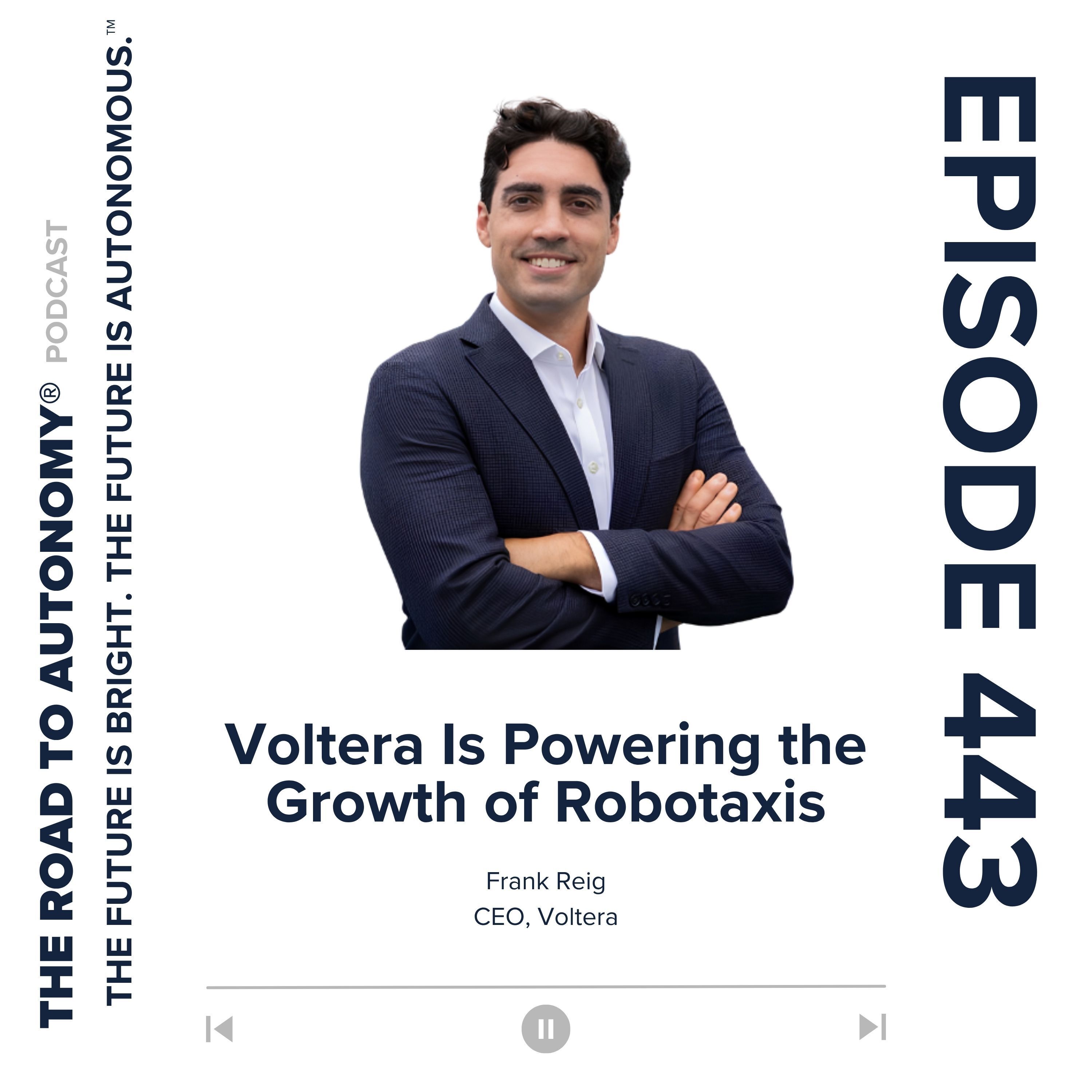
    Episode 443 | Voltera Is Powering the Growth of Robotaxis

    Frank Reig, CEO of Voltera joined Grayson Brulte on The Road to Autonomy podcast to discuss how Voltera is powering the growth of robotaxis and what goes into building a robotaxi depot. As the robotaxi market grows, infrastructure developers are racing to meet the demand for large-scale fleet depots. Following the strategic merger between Voltera and Revel, the newly combined Voltera has doubled its development and real estate capacity to build, own, and operate high-power charging depots tailored specifically for robotaxis. Voltera’s robotaxi infrastructure strategy centers on a hub-and-spoke model, combining large-scale central facilities capable of heavy maintenance with strategically dispersed charging hubs designed for high utilization and quick vehicle turnaround. To support the rapid growth of robotaxis, Voltera standardizes site layouts while maintaining the flexibility to adapt to local constraints, future-proofing its locations with high-capacity underground conduits, fiber connectivity, and high-voltage power architectures to meet escalating power demands. Episode Chapters 0:00 AUTNMY AI 0:36 Growth of Robotaxis 1:34 The Voltera and Revel merger 3:31 Permitting and Powering Depots 7:49 Airport Depots 11:37 Standardizing Depot Design 16:11 Single-Tenant vs Multi-Tenant Depots 18:18 Automation Inside the Depot 20:49 Future-Proofing for 800-Volt Architecture 24:38 Will Voltera Expand Internationally? 30:48 Hub-and-Spoke Depot Model 35:39 The Future of Voltera Follow The Road to Autonomy Indices -------- About The Road to Autonomy The Road to Autonomy is the leading applied intelligence platform covering the convergence of automation, autonomy, and the Autonomy Economy.™. Through our podcasts, newsletter, and proprietary applied intelligence, we set the narrative for institutional investors, industry executives, and policymakers navigating the convergence of automation, autonomy, and economic growth. Join institutional investors and industry leaders who read This Week in The Autonomy Economy every Sunday. Each edition delivers exclusive insight and commentary on the autonomy economy, helping you stay ahead of what's next. Sign up for This Week in The Autonomy Economy newsletter See Privacy Policy at https://art19.com/privacy and California Privacy Notice at https://art19.com/privacy#do-not-sell-my-info.

  • #442
    August 30 · 1 hr

    Episode 442 | Autonomy Markets: Cybercab Is Coming, Waymo Isn't Impressed

    This week on Autonomy Markets, Grayson Brulte and Walter Piecyk discuss Grayson’s field work across the Bay Area, Tesla’s September 3rd Cybercab launch and Nevada’s authorization of 8,000 autonomous vehicles in Clark County. Fresh off a week of field work in California, Grayson shares firsthand impressions from his first rides in Waymo’s Zeekr-built Ojai, including a visit to Waymo’s Toland depot in San Francisco. While the Ojai rides lighter and less luxurious than the Jaguar I-PACE, its elevated sensor placement meaningfully reduces repair costs and insurance payouts in the event of a rear-end collision. Grayson views the Ojai as a stopgap vehicle on the path to the Hyundai IONIQ 5, which he believes will be Waymo’s massive production ramp vehicle. After riding in the Zoox, the Ojai and the Jaguar back-to-back, and observing Waymo’s infrastructure buildout from San Francisco down to San Jose, Grayson makes a prediction. When Waymo adds roughly 1,000 to 1,200 additional vehicles in the Bay Area, the company will capture a significant portion of the rideshare market share. Grayson also rode with Wayve with his AUTNMY AI co-founder Rob Grant in a fully dynamic, no-fixed-route supervised ride, noting the technology has accelerated meaningfully since his last ride in London as Wayve gears up for unsupervised operations. Turning to Tesla, the Cybercab is scheduled to commercially launch in Austin on September 3rd, with Grayson expecting a measured rollout of sub-30 Cybercabs in week one, driven by an internal safety metric and infrastructure that is still being built out. Meanwhile, Nevada’s Transportation Authority unanimously authorized 8,000 autonomous vehicles in Clark County over 12 months. But the growth comes with a catch, as autonomy drop-off fees and exclusive resort partnerships threaten to bring Vegas-style nickel and diming to robotaxis in Sin City. On the foreign autonomy desk, China’s Autonomous Belt and Road Initiative continues to take hold in Europe. Episode Chapters 0:00 Grayson's Latest Bay Area Field Report 19:30 How Many Cars Will Actually Be on the Road when Cybercab Launches? 24:25 Tesla's Self-Certification Strategy for Cybercab 25:31 Tesla Semi 30:40 Waymo's 10 AI Lessons 36:36 The Robotaxi Infrastructure, Energy and Manufacturing Layers 37:38 Nevada Authorizes 8,000 Autonomous Vehicles in Clark County 39:55 Uber's Robotaxi Playbook Raises Doubts 42:08 Waymo Expands to Munich, Germany 45:06 NVIDIA Earnings. Where is Automotive? 49:53 Autonomous Food Delivery 52:33 Who is Cheaper? Uber or Lyft? 56:39 SFO Robotaxi Access 58:10 Foreign Autonomy Desk 59:53 Next Week Follow The Road to Autonomy Indices -------- About The Road to Autonomy The Road to Autonomy is the leading applied intelligence platform covering the convergence of automation, autonomy, and the Autonomy Economy.™. Through our podcasts, newsletter, and proprietary applied intelligence, we set the narrative for institutional investors, industry executives, and policymakers navigating the convergence of automation, autonomy, and economic growth. Join institutional investors and industry leaders who read This Week in The Autonomy Economy every Sunday. Each edition delivers exclusive insight and commentary on the autonomy economy, helping you stay ahead of what's next. Sign up for This Week in The Autonomy Economy newsletter See Privacy Policy at https://art19.com/privacy and California Privacy Notice at https://art19.com/privacy#do-not-sell-my-info.

  • #441
    August 22 · 42 min

    Episode 441 | Autonomy Markets: Supervised Robotaxis Are Having a Moment Unsupervised Robotaxis Are Having a Decade

    This week on Autonomy Markets, Grayson Brulte and Walter Piecyk discuss Waymo’s California regulatory moat, Cybercab’s pending commercial launch and Uber’s series of supervised launches in Europe and Dubai. In California, Waymo is completing 1.4 million fully autonomous rides per month, a 10X growth rate over two years. Additionally, the CPUC (California Public Utilities Commission) granted Waymo commercial driverless expansion authority across 40,000 square miles, covering roughly 25 million California residents and giving Waymo an estimated two-year regulatory moat over competitors. Waymo also opened service to all riders in Houston, its 10th market, with San Antonio likely to follow, and launched the Zeekr-built Ojai to all riders across San Francisco, Los Angeles and Phoenix while introducing its own custom silicon chip to boost compute performance and drive down vehicle costs. While Waymo continues to scale, Tesla is preparing for a Cybercab commercial launch in Austin following first-responder training sessions with local fire departments. Then there is Uber, which is focused on expanding globally. In Dubai, Baidu’s Apollo Go went live on the Uber app, allowing riders to explicitly select an autonomous ride or be assigned one when booking Comfort or UberX. In London, Wayve and Uber launched early trip access using supervised Ford Mach-E vehicles, though debate remains over who will secure the critical Autonomous Passenger Service (APS) permit. Pony AI also touted its growing Uber partnership during earnings, though its planned European expansion faced scrutiny over ODD limitations and safety driver supervision. In sidewalk delivery, Avride is expanding its autonomous campus delivery fleet to 1,000 bots across 25 universities this fall. Following its split from Uber, Serve Robotics quickly pivoted by cutting deals with DoorDash and Grubhub, expanding into San Jose and Washington, D.C., while promoting its Beacon platform to potentially disintermediate traditional delivery platforms for local restaurants. Episode Chapters 00:00 Waymo Racks Up the Miles in California 07:02 Airports Matter, In California Permits Matter More 09:50 Waymo Opens Houston to All Riders, San Antonio Likely Next 13:34 Waymo Opens Ojai to All Riders 16:21 Waymo’s Declining Costs 19:28 New York City Does Not Want Robotaxis 21:28 The 100 Car Benchmark 25:05 Pony AI's European Expansion 28:09 Baidu Apollo Go Goes Live in Dubai 30:31 Wayve and Uber Launch Supervised in London. Who Gets the APS Permit? 36:17 Avride Expands Campus Delivery Bots 37:07 Serve Robotics Expands with DoorDash, Grubhub and Beacon 41:27 Next Week Follow The Road to Autonomy Indices -------- About The Road to Autonomy The Road to Autonomy is the leading applied intelligence platform covering the convergence of automation, autonomy, and the Autonomy Economy.™. Through our podcasts, newsletter, and proprietary applied intelligence, we set the narrative for institutional investors, industry executives, and policymakers navigating the convergence of automation, autonomy, and economic growth. Join institutional investors and industry leaders who read This Week in The Autonomy Economy every Sunday. Each edition delivers exclusive insight and commentary on the autonomy economy, helping you stay ahead of what's next. Sign up for This Week in The Autonomy Economy newsletter See Privacy Policy at https://art19.com/privacy and California Privacy Notice at https://art19.com/privacy#do-not-sell-my-info.

  • #440
    August 21 · 1 hr 29 min

    Episode 440 | Autonomy Signals: No Wheel, No Pedals, No Driver, Cybercab Launch Is Imminent

    This week on Autonomy Signals presented by KPMG, Grayson Brulte and Rob Grant discuss Tesla preparing to launch the steering wheel-free and pedal-free Cybercab in Austin, Waymo unlocking commercial driverless service across 18 California counties, and SoftBank leading a $200 million Series A in Gravis Robotics that values the company at $1 billion. As Tesla prepares for the commercial launch of Cybercab in Austin, the company will most likely self-certify the Cybercab to the Federal Motor Vehicle Safety Standards, a path that carries no caps on production volume and, if NHTSA does not intervene, clears the way for Gigafactory Texas to produce more than 125,000 Cybercabs a year, creating a manufacturing moat no competitor can currently match. While Tesla readies the Cybercab, the CPUC (California Public Utilities Commission) approved Waymo's Tier 2 advice letter authorizing paid driverless rides across 18 California counties from Sacramento to San Diego, covering roughly two-thirds of the state's population. With Waymo currently operating 100% of the 1.4 million monthly driverless rides in the state and no other operator holding a driverless deployment permit, Waymo's regulatory lead in California is measured in years, though the CPUC's phased rollout framework may open a door for Zoox or Tesla to apply for the entire state at once. As Waymo consolidates the Golden State, SoftBank led a $200 million Series A in ETH Zurich spin-out Gravis Robotics, the largest Series A in construction robotics history, valuing the company at approximately $1 billion. Gravis' retrofit system bolts onto legacy excavators from Caterpillar, Komatsu, Volvo and John Deere, and SoftBank is betting that monetizing the existing $1 trillion install base of heavy machinery through rental companies, rather than requiring fleet replacement, is a software-multiple opportunity and not an industrial hardware play. Episode Chapters 0:00 KPMG Sponsor Introduction 01:50 Signal 1: Cybercab Launch is on the Horizon 39:06 Signal 2: Waymo's Golden State Robotaxi Monopoly 1:11:11 Signal 3: SoftBank's $200M Bet on Gravis Robotics Follow The Road to Autonomy Indices -------- About The Road to Autonomy The Road to Autonomy is the leading applied intelligence platform covering the convergence of automation, autonomy, and the Autonomy Economy.™. Through our podcasts, newsletter, and proprietary applied intelligence, we set the narrative for institutional investors, industry executives, and policymakers navigating the convergence of automation, autonomy, and economic growth. Join institutional investors and industry leaders who read This Week in The Autonomy Economy every Sunday. Each edition delivers exclusive insight and commentary on the autonomy economy, helping you stay ahead of what's next. Sign up for This Week in The Autonomy Economy newsletter See Privacy Policy at https://art19.com/privacy and California Privacy Notice at https://art19.com/privacy#do-not-sell-my-info.

  • #439
    August 15 · 48 min

    Episode 439 | Autonomy Markets: Waymo's Expansion Exposes Uber's Robotaxi Risk and Opens the Door for Lyft

    This week on Autonomy Markets, Grayson Brulte and Walter Piecyk discuss Zoox Las Vegas pricing, Waymo’s post-Uber divorce Phoenix expansion and WeRide saying the quiet part out loud, regulatory permits can create moats. Zoox launched paid rides in Las Vegas with a $12 base fare, $1.50 per mile, and 40 cents per minute, premium pricing paired with 15 to 30 minute wait times and select destinations. Walt calls it a Disney ride, not a premium product, and once Waymo and Tesla enter the market, that pricing gets hard to defend, especially if wait times continue to be high. Staying in Vegas, Waymo announced a dedicated pickup and drop-off zone with Allegiant Stadium while Zoox has a deal with the Sphere, which might cost riders a $40 drop-off fee, opening a new battleground in Vegas where every casino and venue deal becomes a potential competitive advantage. Weeks after Waymo and Uber divorced in Phoenix, Waymo added 55 square miles of service area, increasing the total to 350 square miles. On the WeRide earnings call, management said the quiet part our loud, regulatory permits are an asset. Over in Europe, OMEGA uncovered a Waymo incorporation in Zurich registered to Google’s largest engineering office outside the United States, one week after the president of Switzerland rode in a Waymo in Mountain View. On the Foreign Autonomy Desk, Uber and Wayve are preparing a supervised Tokyo launch with Nissan LEAF vehicles, with the word supervised buried in the last paragraph of the press release. Episode Chapters 00:00 Zoox Launches Paid Rides in Las Vegas 07:19 Fleet Fragmentation and the Lyft Opportunity 11:24 Waymo's Dedicated Zone at Allegiant Stadium 19:16 Waymo Adds 55 Square Miles in Phoenix 21:07 Waymo's Upcoming European Expansion 24:06 WeRide Earnings 28:06 Mercedes, NVIDIA, and the Compute Question 31:44 Uber Serve Robotics Divorce 40:47 7,200 Waymo Vehicles 44:03 Foreign Autonomy Desk 47:56 Next Week Follow The Road to Autonomy Indices -------- About The Road to Autonomy The Road to Autonomy is the leading applied intelligence platform covering the convergence of automation, autonomy, and the Autonomy Economy.™. Through our podcasts, newsletter, and proprietary applied intelligence, we set the narrative for institutional investors, industry executives, and policymakers navigating the convergence of automation, autonomy, and economic growth. Join institutional investors and industry leaders who read This Week in The Autonomy Economy every Sunday. Each edition delivers exclusive insight and commentary on the autonomy economy, helping you stay ahead of what's next. Sign up for This Week in The Autonomy Economy newsletter See Privacy Policy at https://art19.com/privacy and California Privacy Notice at https://art19.com/privacy#do-not-sell-my-info.

  • #438
    August 14 · 1 hr 22 min

    Episode 438 | Autonomy Signals: The Demand Aggregator Trap

    This week on Autonomy Signals presented by KPMG, Grayson Brulte and Rob Grant discuss Uber fully exiting its equity position in Serve Robotics as the delivery partnership ends, CaoCao launching robotaxi operations in Hangzhou, and Boeing offloading Wisk, SkyGrid and Insitu to Archer Aviation in a deal that trades equity for cash flow. Uber recently liquidated its entire remaining stake in Serve Robotics, as Serve announced on their Q2 2026 earnings call that the company will not be renewing its delivery partnership when the contract expires in 2027, exposing the pitfalls of being reliant on a demand aggregation platform. While Uber and Serve prepare to part ways, CaoCao launched public road testing without a safety driver in Hangzhou’s Binjiang District with a fleet of roughly 100 vehicles, backed by parent Geely’s manufacturing might and a purpose-built EvaCab robotaxi with a sub $35,000 BOM cost targeting 100,000 units by 2030. As China’s robotaxi industry grows, Boeing exited autonomy by selling Wisk, SkyGrid and Insitu to Archer Aviation for a 19.75% equity stake, immediately re-anchoring Archer’s valuation on defense cash flow rather than eVTOL speculation while pushing autonomous certification down the line. Episode Chapters 0:00 KPMG Sponsor Introduction 01:32 Signal 1: Uber and Serve Robotics Get Divorced 31:40 Signal 2: CaoCao Vertically Integrates Robotaxis 1:00:10 Signal 3: Boeing Exits Autonomy with Archer Aviation Deal Follow The Road to Autonomy Indices -------- About The Road to Autonomy The Road to Autonomy is the leading applied intelligence platform covering the convergence of automation, autonomy, and the Autonomy Economy.™. Through our podcasts, newsletter, and proprietary applied intelligence, we set the narrative for institutional investors, industry executives, and policymakers navigating the convergence of automation, autonomy, and economic growth. Join institutional investors and industry leaders who read This Week in The Autonomy Economy every Sunday. Each edition delivers exclusive insight and commentary on the autonomy economy, helping you stay ahead of what's next. Sign up for This Week in The Autonomy Economy newsletter See Privacy Policy at https://art19.com/privacy and California Privacy Notice at https://art19.com/privacy#do-not-sell-my-info.

  • #437
    August 8 · 48 min

    Episode 437 | Autonomy Markets: Can Uber's Robotaxis Scale?

    This week on Autonomy Markets, Grayson Brulte and Walter Piecyk discuss Uber’s Waymo hangover, Zoox launching paid rides in Las Vegas, the Teamsters suing California over driverless trucking, and NVIDIA’s Alpamayo 2 open model. Uber is nursing a Waymo hangover. Revenue came in light on take rate, management finally owned the $10 billion autonomy spending number first reported by The Financial Times, and the stock sold back into the sixties as the autonomy overhang weighs on the story. After 12 years, Zoox begins charging for rides in Las Vegas on August 10. An NHTSA filing surfaced by OMEGA reveals the catch, the vehicles cannot operate above 45 mph while average traffic out of Harry Reid International airport runs 55, complicating the airport unlock. With 105 vehicles as of June across seven approved cities, pricing 20% to 40% above rideshare, and wait times stretching past an hour, Walt calls it tourism pricing for a Disney World attraction. Meanwhile, Waymo returned to freeways after a two-month pause, and OMEGA is picking up new Waymo corporate filings around the world. Lucid burned over a billion dollars in the quarter but declared the Uber and Nuro robotaxi program a must-win project. The Teamsters sued the California DMV in Alameda Superior Court to repeal driverless trucking rules as autonomous trucking companies continue to rack up supervised miles in the state. On the Foreign Autonomy Desk, Wayve received a TfL license to carry paying passengers in London with safety drivers across 15 vehicles, but the APS permit is the asset that controls every relationship in the market. If Baidu secures one, it holds a clear off-ramp from Uber and FreeNow by Lyft to launch Apollo Go on its own. Meanwhile, Pony AI is targeting 500 to 1,000 Gen4 robotrucks in mainland China with CATL over the next two to three years, with a hint of foreign ports expansion. Episode Chapters 0:00 Uber's Waymo Hangover 4:52 Zoox Prepares to Go Paid in Vegas 12:19 Waymo Returns to Freeways 14:13 Uber, Nuro, Lucid Robotaxi Timeline 20:30 DoorDash and the Market for Autonomous Food Delivery 26:08 NVIDIA Alpamayo 2 32:22 The Teamsters sue the California DMV over Driverless Trucking Rules 35:50 Tesla's China Business Question 39:00 Foreign Autonomy Desk 45:35 Next Week Follow The Road to Autonomy Indices -------- About The Road to Autonomy The Road to Autonomy is the leading applied intelligence platform covering the convergence of automation, autonomy, and the Autonomy Economy.™. Through our podcasts, newsletter, and proprietary applied intelligence, we set the narrative for institutional investors, industry executives, and policymakers navigating the convergence of automation, autonomy, and economic growth. Join institutional investors and industry leaders who read This Week in The Autonomy Economy every Sunday. Each edition delivers exclusive insight and commentary on the autonomy economy, helping you stay ahead of what's next. Sign up for This Week in The Autonomy Economy newsletter See Privacy Policy at https://art19.com/privacy and California Privacy Notice at https://art19.com/privacy#do-not-sell-my-info.

Showing 1–20 of 37 episodes