Skip to content
Artwork for TED-Ed
EducationScienceTechnology

TED-Ed

TED-Ed

TED-Ed’s mission is to create lessons worth sharing. Feed and expand your curiosity with our award-winning animated shorts - published on YouTube and available with supplemental learning materials on ed.ted.com.

Want to suggest an idea for a TED-Ed animation, nominate an educator or animator? Visit our website at: http://ed.ted.com/get_involved.

Consider backing us on Patreon. By doing so, you directly support our nonprofit mission to create free, high-quality educational content: https://www.patreon.com/teded

For more information on using TED-Ed content for commercial purposes (e.g. employee learning, in a film, or in an online course), please submit a Media Request using this link: https://media-requests.ted.com/

Play
  • 1,909 episodes
  • daily
  • Avg 9 min
  • English

Episodes 1,909

Counted on this page — what you have heard stays on this device, so it is not something the list can be paged by.
  • October 30 · 18 min

    Your brain is more than a chemical bag - David Anderson

    View full lesson: http://ed.ted.com/lessons/your-brain-is-more-than-a-bag-of-chemicals-david-anderson Modern psychiatric drugs treat the chemistry of the whole brain, but neurobiologist David Anderson believes in a more nuanced view of how the brain functions. He illuminates new research that could lead to targeted psychiatric medications -- that work better and avoid side effects. How's he doing it? For a start, by making a bunch of fruit flies angry. (Filmed at TEDxCaltech.) Talk by David Anderson. Learn more about your ad choices. Visit megaphone.fm/adchoices

  • October 30 · 7 min

    How will AI impact the world?

    Explore the current limitations of artificial intelligence and the possibility of creating human-compatible technology. -- In the coming years, artificial intelligence is probably going to change your life— and likely the entire world. But people have a hard time agreeing on exactly how AI will affect our society. Can we build AI systems that help us fix the world? Or are we doomed to a robotic takeover? Explore the limitations of artificial intelligence and the possibility of creating human-compatible technology. This video is based on interview excerpts from the Radio Davos Podcast. The episode is called, “The promises and perils of AI - Stuart Russell on Radio Davos”. Listen to the full episode here: https://www.weforum.org/agenda/2022/01/artificial-intelligence-stuart-russell-radio-davos Directed by Christoph Sarow, AIM Creative Studios. This video made possible in collaboration with World Economic Forum Learn more about how TED-Ed partnerships work: https://bit.ly/TEDEdPartners Support Our Non-Profit Mission ---------------------------------------------- Support us on Patreon: http://bit.ly/TEDEdPatreon Check out our merch: http://bit.ly/TEDEDShop ---------------------------------------------- Connect With Us ---------------------------------------------- Sign up for our newsletter: http://bit.ly/TEDEdNewsletter Follow us on Facebook: http://bit.ly/TEDEdFacebook Find us on Twitter: http://bit.ly/TEDEdTwitter Peep us on Instagram: http://bit.ly/TEDEdInstagram ---------------------------------------------- Keep Learning ---------------------------------------------- View full lesson: https://ed.ted.com/lessons/things-are-going-to-get-weird Dig deeper with additional resources: https://ed.ted.com/lessons/things-are-going-to-get-weird#digdeeper Animator's website: http://aimcreativestudios.com Music: https://soundcloud.com/aim-music ---------------------------------------------- Thank you so much to our patrons for your support! Without you this video would not be possible! Mark Morris, Misaki Sato, EdoKun, SookKwan Loong, Bev Millar, Lex Azevedo, Michael Aquilina, Jason A Saslow, Yansong Li, Cristóbal Moenne, Dawn Jordan, Prasanth Mathialagan, Samuel Doerle, David Rosario, Dominik Kugelmann - they-them, Siamak Hajizadeh, Ryohky Araya, Mayank Kaul, Christophe Dessalles, Heather Slater, Sandra Tersluisen, Zhexi Shan, Bárbara Nazaré, Andrea Feliz, Victor E Karhel, Sydney Evans, Latora, Noel Situ, emily lam, Sid, Niccolò Frassetto, Mana, I'm here because of Knowledge Fight Facebook group., Linda Freedman, Edgardo Cuellar, Jaspar Carmichael-Jack, Michael Burton, VIVIANA A GARCIA BESNE, The Vernon's, Olha Bahatiuk, Jesús Bíquez Talayero, Chels Raknrl, Sai Pranavi Jonnalagadda, Stuart Rice, Jing Chen, Vector-Dopamine math, Jasper Song, Giorgio Bugnatelli, Chardon, Eddy Trochez and OnlineBookClub.org. Learn more about your ad choices. Visit megaphone.fm/adchoices

  • October 30 · 7 min

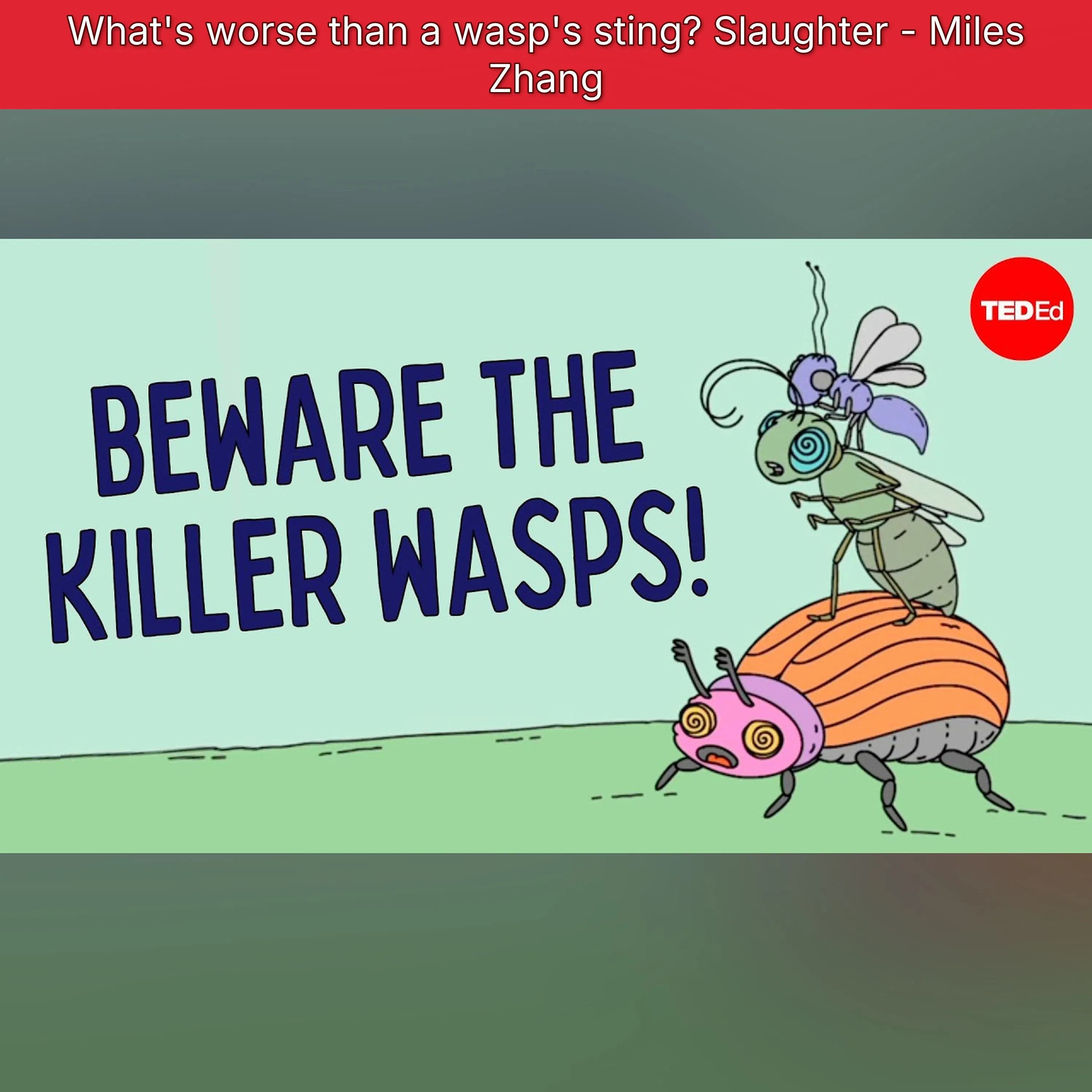
    What's worse than a wasp's sting? Slaughter - Miles Zhang

    Explore the gruesome evolutionary strategy employed by parasitoid wasps where they feed off other animals to grow their offspring. -- A cockroach and jewel wasp are locked in battle. The wasp latches onto the cockroach and inserts her stinger into the cockroach's brain, where her venom blocks its fight-or-flight response. Now, the cockroach is essentially a zombie, and its carcass will be used to grow the wasp’s offspring. Miles Zhang explores the gruesome evolutionary strategy known as parasitoidism. Lesson by Miles Zhang, directed by Denys Spolitak. Support Our Non-Profit Mission ---------------------------------------------- Support us on Patreon: http://bit.ly/TEDEdPatreon Check out our merch: http://bit.ly/TEDEDShop ---------------------------------------------- Connect With Us ---------------------------------------------- Sign up for our newsletter: http://bit.ly/TEDEdNewsletter Follow us on Facebook: http://bit.ly/TEDEdFacebook Find us on Twitter: http://bit.ly/TEDEdTwitter Peep us on Instagram: http://bit.ly/TEDEdInstagram ---------------------------------------------- Keep Learning ---------------------------------------------- View full lesson: https://ed.ted.com/lessons/the-bizarre-world-of-parasitic-wasps-miles-zhang Dig deeper with additional resources: https://ed.ted.com/lessons/the-bizarre-world-of-parasitic-wasps-miles-zhang#digdeeper Animator's website: https://vimeo.com/user50965180 Music: https://www.campstudio.co ---------------------------------------------- Thank you so much to our patrons for your support! Without you this video would not be possible! Jezabel, Abdullah Abdulaziz, Xiao Yu, Melissa Suarez, Brian A. Dunn, Francisco Amaya, Daisuke Goto, Matt Switzler, Peng, Tzu-Hsiang, Bethany Connor, Jeremy Shimanek, Mark Byers, Avinash Amarnath, Xuebicoco, Rayo, Po Foon Kwong, Boffin, Jesse Jurman, Scott Markley, Elija Peterson, Ovidiu Mrd, paul g mohney, Steven Razey, Nathan Giusti, Helen Lee, Anthony Benedict, Karthik Balsubramanian, Annastasshia Ames, Amy Lopez, Vinh-Thuy Nguyen, Liz Candee, Ugur Doga Sezgin, Karmi Nguyen, John C. Vesey, Yelena Baykova, Nick Johnson, Carlos H. Costa, Jennifer Kurkoski, Ryan B Harvey, Akinola Emmanuel, Jose Arcadio Valdes Franco, Sebastiaan Vleugels, Karl Laius, JY Kang, Abhishek Goel, Heidi Stolt, Nicole Sund, Karlee Finch, Mario Mejia and Denise A Pitts. Learn more about your ad choices. Visit megaphone.fm/adchoices

  • October 30 · 6 min

    Kabuki: The people's dramatic art - Amanda Mattes

    View full lesson: http://ed.ted.com/lessons/kabuki-the-people-s-dramatic-art-amanda-mattes Uploaded 30-09-13 The Japanese dance and theater art of kabuki, derived from the word kabuku, meaning "out of the ordinary," can be traced back to the streets of seventeenth-century Kyoto. Kabuki became a dramatic art for the common people, with its use of makeup and facial expressions rather than masks, as well as a playful take on current events. Amanda Mattes tracks the evolution of kabuki and its place in Japan's rich cultural heritage. Lesson by Amanda Mattes, animation by Tom Gran. Learn more about your ad choices. Visit megaphone.fm/adchoices Learn more about your ad choices. Visit megaphone.fm/adchoices

  • October 30 · 5 min

    How do your kidneys work? - Emma Bryce

    Explore how kidneys operate, and how this organ helps filter waste and excess fluid from your blood. Uploaded 09-02-15 -- After drinking a few glasses of water on a hot day, you might be struck with a sudden ... urge. Behind that feeling are two bean-shaped organs that work as fine-tuned internal sensors. Emma Bryce details how the incredible kidneys balance the amount of fluid in your body, detect waste in your blood, and know when to release the vitamins, minerals, and hormones you need to stay alive. Lesson by Emma Bryce, animation by Tremendousness. View full lesson: http://ed.ted.com/lessons/how-do-your-kidneys-work-emma-bryce Learn more about your ad choices. Visit megaphone.fm/adchoices Learn more about your ad choices. Visit megaphone.fm/adchoices

  • October 30 · 7 min

    Are Elvish, Klingon, Dothraki and Na'vi real languages? - John McWhorter

    View full lesson: http://ed.ted.com/lessons/are-elvish-klingon-dothraki-and-na-vi-real-languages-john-mcwhorter Uploaded 26-09-13 What do Game of Thrones' Dothraki, Avatar's Na'vi, Star Trek's Klingon and LOTR's Elvish have in common? They are all fantasy constructed languages, or conlangs. Conlangs have all the delicious complexities of real languages: a high volume of words, grammar rules, and room for messiness and evolution. John McWhorter explains why these invented languages captivate fans long past the rolling credits. Lesson by John McWhorter, animation by Enjoyanimation. Learn more about your ad choices. Visit megaphone.fm/adchoices Learn more about your ad choices. Visit megaphone.fm/adchoices

  • October 30 · 7 min

    How to track a tornado - Karen Kosiba

    View full lesson: http://ed.ted.com/lessons/how-to-track-a-tornado-karen-kosiba Uploaded 21-04-14 Atmospheric scientist Karen Kosiba studies how tornadoes form and do damage. Getting measurements near the surface of these twisters is difficult, though, and driving into them is a practice mostly reserved for the big screen. In this TEDYouth Talk, Kosiba describes how she and her team use observations and modeling to track these super storms, while sharing some incredible footage from the field. Talk by Karen Kosiba. Learn more about your ad choices. Visit megaphone.fm/adchoices Learn more about your ad choices. Visit megaphone.fm/adchoices

  • October 30 · 19 min

    Tribal leadership - David Logan

    David Logan talks about the five kinds of tribes that humans naturally form -- in schools, workplaces, even the driver's license bureau. By understanding our shared tribal tendencies, we can help lead each other to become better individuals. (Filmed at TEDxUSC.) Uploaded 17-07-13 Talk by David Logan. Learn more about your ad choices. Visit megaphone.fm/adchoices Learn more about your ad choices. Visit megaphone.fm/adchoices
  • October 30 · 7 min

    Why do you want to squish cute things? - Joshua Paul Dale

    Explore the psychology of the phenomenon known as cute aggression, which is the urge to squeeze, bite or pinch something cute. -- Watching a kitten fumbling around, it might feel as if you’ve never encountered anything so devastatingly adorable in your mortal life. You may want to pet its soft fur and kiss its tiny head. But you may also feel the conflicting urge… to squeeze or smush the kitten, maybe even stuff it in your mouth. What is this peculiar phenomenon? Joshua Paul Dale explores the urge known as cute aggression. Lesson by Joshua Paul Dale, directed by Oksana Kurmaz. Support Our Non-Profit Mission ---------------------------------------------- Support us on Patreon: http://bit.ly/TEDEdPatreon Check out our merch: http://bit.ly/TEDEDShop ---------------------------------------------- Connect With Us ---------------------------------------------- Sign up for our newsletter: http://bit.ly/TEDEdNewsletter Follow us on Facebook: http://bit.ly/TEDEdFacebook Find us on Twitter: http://bit.ly/TEDEdTwitter Peep us on Instagram: http://bit.ly/TEDEdInstagram ---------------------------------------------- Keep Learning ---------------------------------------------- View full lesson: https://ed.ted.com/lessons/why-do-you-want-to-squeeze-cute-things-joshua-paul-dale Dig deeper with additional resources: https://ed.ted.com/lessons/why-do-you-want-to-squeeze-cute-things-joshua-paul-dale#digdeeper Animator's website: https://kurmaz.me Educator’s website: https://www.cutestudies.org ---------------------------------------------- Thank you so much to our patrons for your support! Without you this video would not be possible! Siamak Hajizadeh, Ryohky Araya, Mayank Kaul, Christophe Dessalles, Heather Slater, Sandra Tersluisen, Zhexi Shan, Bárbara Nazaré, Andrea Feliz, Victor E Karhel, Sydney Evans, Latora, Noel Situ, emily lam, Sid, Niccolò Frassetto, Mana, I'm here because of Knowledge Fight Facebook group., Linda Freedman, Edgardo Cuellar, Jaspar Carmichael-Jack, Michael Burton, VIVIANA A GARCIA BESNE, The Vernon's, Olha Bahatiuk, Jesús Bíquez Talayero, Chels Raknrl, Sai Pranavi Jonnalagadda, Stuart Rice, Jing Chen, Vector-Dopamine math, Jasper Song, Giorgio Bugnatelli, Chardon, Eddy Trochez, OnlineBookClub.org, Eric Shear, Leith Salem, Omar Hicham, Adrian Rotaru, Brad Sullivan, Karen Ho, Niklas Frimberger, Hunter Manhart, Nathan Nguyen, Igor Stavchanskiy, James R DeVries, Grace Huo, Diana Huang and Chau Hong Diem. Learn more about your ad choices. Visit megaphone.fm/adchoices

  • October 30 · 6 min

    Why don’t poisonous animals poison themselves? - Rebecca D. Tarvin

    Have you checked out our Patreon page? https://www.patreon.com/teded Uploaded 05-07-18 View full lesson: https://ed.ted.com/lessons/why-don-t-poisonous-animals-poison-themselves-rebecca-d-tarvin Thousands of animal species use toxic chemicals to defend themselves from predators. Snakes have blood clotting compounds in their fangs, the bombardier beetle has corrosive liquid in its abdomen and jellyfish have venomous, harpoon-like structures in their tentacles. But how do these animals survive their own poisons? Rebecca D. Tarvin details the strategies that protect animals from themselves. Lesson by Rebecca D. Tarvin, animation by Giulia Martinelli. Thank you so much to our patrons for your support! Without you this video would not be possible! Jordan Tang, Christopher Jimenez, Juan, Tracey Tobkin, Sid, emily lam, Kathryn J Hammond, Elliot Poulin, Noel Situ, Oyuntsengel Tseyen-Oidov, Latora Slydell, Sydney Evans, Victor E Karhel, Bernardo Paulo, Eysteinn Guðnason, Andrea Feliz, Natalia Rico, Josh Engel, Bárbara Nazaré, Gustavo Mendoza, Zhexi Shan, Hugo Legorreta, PnDAA , Sandra Tersluisen, Ellen Spertus, Fabian Amels, sammie goh, Mattia Veltri, Quentin Le Menez, Yuh Saito, Joris Debonnet, Heather Slater, Dr Luca Carpinelli, Janie Jackson, Christophe Dessalles, Arturo De Leon, Eduardo Briceño, Bill Feaver, Ricardo Paredes, David Douglass, Grant Albert, Paul Coupe, Jen, Megan Whiteleather, and Mayank Kaul. Learn more about your ad choices. Visit megaphone.fm/adchoices Learn more about your ad choices. Visit megaphone.fm/adchoices

  • October 30 · 18 min

    A girl who claimed her schooling - Kakenya Ntaiya

    Kakenya Ntaiya made a deal with her father: She would undergo the traditional Maasai rite of passage of female circumcision if he would let her go to high school. Ntaiya tells the fearless story of continuing on to college and of working with her village elders to build a school for girls in her community. It's the educational journey of one that altered the destiny of 125 young women. (Filmed at TEDxMidAtlantic.) Talk by Kakenya Ntaiya. Learn more about your ad choices. Visit megaphone.fm/adchoices

  • October 30 · 10 min

    1000 TEDTalks, 6 words - Sebastian Wernicke

    Sebastian Wernicke thinks every TED Talk can be summarized in six words. In this talk, he shows how to do just that -- and less. (Filmed at TEDxZurich.) Uploaded 15-08-13 Talk by Sebastian Wernicke. Learn more about your ad choices. Visit megaphone.fm/adchoices Learn more about your ad choices. Visit megaphone.fm/adchoices

  • October 30 · 11 min

    Four sisters in Ancient Rome - Ray Lawrence

    Sign up for our newsletter and never miss an animation: http://bit.ly/TEDEdNewsletter How did the young, wealthy women of Ancient Rome spend their days? Meet Domitia and her sister Domitia and her sister Domitia and her sister Domitia. Ray Laurence sketches the domestic life of leisure that these young girls lived, despite little recorded information on women from this otherwise well-documented era. Lesson by Ray Laurence, animation by Cognitive Media. Learn more about your ad choices. Visit megaphone.fm/adchoices

  • October 30 · 7 min

    Animating a photo-real digital face - Paul Debevec

    Computer graphics trailblazer Paul Debevec explains the scene-stealing technology behind Digital Emily, a digitally constructed human face so realistic it stands up to multiple takes. (Filmed at TEDxUSC.) Uploaded 17-07-13 Talk by Paul Debevec. Learn more about your ad choices. Visit megaphone.fm/adchoices Learn more about your ad choices. Visit megaphone.fm/adchoices

  • October 30 · 7 min

    Why do we have museums? - J. V. Maranto

    View full lesson: http://ed.ted.com/lessons/why-do-we-have-museums-j-v-maranto Uploaded 05-02-15 Museums have been a part of human history for over 2,000 years -- but they weren't always like the ones we visit today. J. V. Maranto uncovers the evolution of museums, from the first museum in 530 BC (curated by a princess) to PT Barnum’s freak shows and beyond. Lesson by J. V. Maranto, animation by Zedem Media. Learn more about your ad choices. Visit megaphone.fm/adchoices Learn more about your ad choices. Visit megaphone.fm/adchoices

  • October 30 · 14 min

    The World Machine | Think Like A Coder, Ep 10

    The adventure ends! Episode 10: Can Ethic make it to the World Machine and stop Hedge from covering the world in a giant maze? Uploaded 24-09-20 -- This is episode 10 of our animated series “Think Like A Coder.” This 10-episode narrative follows a girl, Ethic, and her robot companion, Hedge, as they attempt to save the world. The two embark on a quest to collect three artifacts and must solve their way through a series of programming puzzles. Lesson by Alex Rosenthal, directed by Kozmonot Animation Studio. Supported by Endless: https://endlessnetwork.com A special thank you to the programmers who assisted in the development of this series: Eric Wastl, Sara Kladky, Ryan Harvey, Dan Bernier, Eden Girma, Matt Gruskin, and James Griffith. Sign up for our newsletter: http://bit.ly/TEDEdNewsletter Support us on Patreon: http://bit.ly/TEDEdPatreon Follow us on Facebook: http://bit.ly/TEDEdFacebook Find us on Twitter: http://bit.ly/TEDEdTwitter Peep us on Instagram: http://bit.ly/TEDEdInstagram View full lesson: https://ed.ted.com/lessons/the-world-machine-think-like-a-coder-ep-10 Thank you so much to our patrons for your support! Without you this video would not be possible! Jun Cai, Tim Robinson, Henrique 'Sorín' Cassús, cnorahs, Lyn-z Schulte, Elaine Fitzpatrick, Karthik Cherala, Clarence E. Harper Jr., Milad Mostafavi, Аркадий Скайуокер, Kiara Taylor, Louisa Lee, eden sher, Vignan Velivela, Sage Curie, Srikote Naewchampa, Tejas Dc, Khalifa Alhulail, Faiza Imtiaz, Martin Stephen, Jerome Froelich, Dan Paterniti, Jose Henrique Leopoldo e Silva, Mullaiarasu Sundaramurthy, Elnathan Joshua Bangayan, Caleb ross, Duo Xu, Quinn Shen, Marvin Vizuett, Sid, Marylise CHAUFFETON, Karen Goepen-Wee, Sama aafghani, Mandeep Singh, Abhijit Kiran Valluri, Morgan Williams, Kris Siverhus, Jason Weinstein, Tony Trapuzzano, Devin Harris, Brandy Jones, Shawn Quichocho, Gi Nam Lee, Joy Love Om, Miloš Stevanović, Ghassan Alhazzaa, Yankai Liu, Pavel Zalevskiy, Claudia Mayfield and Stephanie Perozo. Learn more about your ad choices. Visit megaphone.fm/adchoices Learn more about your ad choices. Visit megaphone.fm/adchoices

  • October 30 · 8 min

    How enormous sea creatures consume tiny sea creatures - Kelly Benoit-Bird

    View full lesson: http://ed.ted.com/lessons/how-giant-sea-creatures-eat-tiny-sea-creatures-kelly-benoit-bird It's a paradox of ocean life: The largest mammals, like dolphins and whales, survive on the tiniest food, like krill. (Picture trying to make a full meal out of flying kernels of popcorn!) So how do these big animals gather enough food to live? At TEDYouth 2012, Kelly Benoit-Bird discusses new research that shows large sea animals actually herding their tiny food into big, bitable chunks. Talk by Kelly Benoit-Bird. Learn more about your ad choices. Visit megaphone.fm/adchoices

  • October 30 · 5 min

    The Chinese myth of the immortal white snake - Shunan Teng

    Dive into the world of Chinese folktales with the myth of the white snake, a story of the demon Bai Su Zhen and her love, Xu Xian. (Part One of the myth of the white snake). Uploaded 07-05-19 -- The talented herbalist Xu Xian had just started his own medicine shop where he created remedies with the help of his wife, Bai Su Zhen. One day a monk named Fa Hai approached him, warning him that there was a demon in his house. The demon, he said, was Bai Su Zhen. Xu Xian laughed. How could his kind-hearted wife be a demon? Shunan Teng traces the tale of the immortal white snake. Lesson by Shunan Teng, directed by Kino Bino. Sign up for our newsletter: http://bit.ly/TEDEdNewsletter Support us on Patreon: http://bit.ly/TEDEdPatreon Follow us on Facebook: http://bit.ly/TEDEdFacebook Find us on Twitter: http://bit.ly/TEDEdTwitter Peep us on Instagram: http://bit.ly/TEDEdInstagram View full lesson: https://ed.ted.com/lessons/the-chinese-myth-of-the-immortal-white-snake-shunan-teng Thank you so much to our patrons for your support! Without you this video would not be possible! Annamaria Szilagyi, Morgan Williams, Abhijit Kiran Valluri, Mandeep Singh, Sama aafghani, سلطان الخليفي, Marylise CHAUFFETON, Marvin Vizuett, Jayant Sahewal, Quinn Shen, Caleb ross, Elizabeth Cruz, Elnathan Joshua Bangayan, Mullaiarasu Sundaramurthy, Jose Henrique Leopoldo e Silva, Dan Paterniti, Jerome Froelich, Tyler Yoshizumi, Martin Stephen, Justin Carpani, Faiza Imtiaz, Khalifa Alhulail, Tejas Dc, Benjamin and Shannon Pinder, Srikote Naewchampa, Sage Curie, Exal Enrique Cisneros Tuch, Ana Maria, Vignan Velivela, Ahmad Hyari, eden sher, Travis Wehrman, Louisa Lee, Kiara Taylor, Аркадий Скайуокер, Milad Mostafavi, Rob Johnson, Clarence E. Harper Jr., Mihail Radu Pantilimon, Karthik Cherala, haventfiguredout, Violeta Cervantes, Elaine Fitzpatrick, Lyn-z Schulte, cnorahs, Henrique 'Sorín' Cassús, Tim Robinson, Jun Cai, Joichiro Yamada and Paul Schneider. Learn more about your ad choices. Visit megaphone.fm/adchoices Learn more about your ad choices. Visit megaphone.fm/adchoices

  • October 30 · 6 min

    What sex ed doesn't tell you about your cognition - Shannon Odell

    Explore what we know— and still don’t know— about puberty and its effects on the body and brain. -- While we often talk about puberty’s effect on the body, what gets overlooked are the fascinating changes that happen in the brain. Puberty, in fact, begins in the brain, and lasts as long as five years. And during this extended process, the brain undergoes its own transformation, thanks to estrogen and testosterone. Shannon Odell details what we know— and still don’t know— about puberty. Lesson by Shannon Odell, directed by Biljana Labović. This video made possible in collaboration with Bezos Family Foundation Learn more about how TED-Ed partnerships work: https://bit.ly/TEDEdPartners Support Our Non-Profit Mission ---------------------------------------------- Support us on Patreon: http://bit.ly/TEDEdPatreon Check out our merch: http://bit.ly/TEDEDShop ---------------------------------------------- Connect With Us ---------------------------------------------- Sign up for our newsletter: http://bit.ly/TEDEdNewsletter Follow us on Facebook: http://bit.ly/TEDEdFacebook Find us on Twitter: http://bit.ly/TEDEdTwitter Peep us on Instagram: http://bit.ly/TEDEdInstagram ---------------------------------------------- Keep Learning ---------------------------------------------- View full lesson: https://ed.ted.com/lessons/how-puberty-changes-your-brain-shannon-odell Dig deeper with additional resources: https://ed.ted.com/lessons/how-puberty-changes-your-brain-shannon-odell#digdeeper ---------------------------------------------- Thank you so much to our patrons for your support! Without you this video would not be possible! Nick Johnson, Carlos H. Costa, Jennifer Kurkoski, Ryan B Harvey, Akinola Emmanuel, Jose Arcadio Valdes Franco, Sebastiaan Vleugels, Karl Laius, JY Kang, Abhishek Goel, Heidi Stolt, Nicole Sund, Karlee Finch, Mario Mejia, Denise A Pitts, Doug Henry, Keven Webb, Mihai Sandu, Deepak Iyer, Javid Gozalov, Kyanta Yap, Rebecca Reineke, William Biersdorf, Patricia Alves Panagides, Yvette Mocete, Cyrus Garay, Samuel Barbas, LadyGeek, Marin Kovachev, Penelope Misquitta, Hans Peng, Gaurav Mathur, Erik Biemans, Tony, Michelle, Katie and Josh Pedretti, Hoai Nam Tran, Kack-Kyun Kim, Michael Braun-Boghos, zjweele13, Anna-Pitschna Kunz, Edla Paniguel, Thomas Mungavan, Jaron Blackburn, Venkat Venkatakrishnan, ReuniteKorea, Aaron Henson, Rohan Gupta, Begum Tutuncu, Brian Richards, Jørgen Østerpart and Tyron Jung. Learn more about your ad choices. Visit megaphone.fm/adchoices

  • October 30 · 6 min

    What is the coldest thing in the world? - Lina Marieth Hoyos

    Check out our Patreon page: https://www.patreon.com/teded Uploaded 10-07-18 View full lesson: https://ed.ted.com/lessons/what-is-the-coldest-thing-in-the-world-lina-marieth-hoyos The coldest materials in the world aren’t in Antarctica or at the top of Mount Everest. They’re in physics labs: clouds of gases held just fractions of a degree above absolute zero. Lina Marieth Hoyos explains how temperatures this low give scientists a window into the inner workings of matter, and allow engineers to build incredibly sensitive instruments that tell us more about the universe. Lesson by Lina Marieth Hoyos, animation by Adriatic Animation. Thank you so much to our patrons for your support! Without you this video would not be possible! Ryohky Araya, vivian james, Tan YH, Brittiny Elman, Mayra Urbano, Ruth Fang, Kostadin Mandulov, Alex Schenkman, Ivan Todorović, Antero Semi, Yanuar Ashari, Mrinalini, Anthony Kudolo, Scott Gass, Querida Owens, Hazel Lam, Manav parmar, Dwight Tevuk, Siamak H, Dominik Kugelmann, Mary Sawyer, David Rosario, Samuel Doerle, Susan Herder, Savannah Scheelings, Prasanth Mathialagan, Yanira Santamaria, Dawn Jordan, Constantin Salagor, Activated Classroom Teaching, Kevin Wong, Umar Farooq, Goh Xiang Ting Diana, Dmitry Neverov, Cristóbal Medina Moenne, MJ Tan Mingjie, Yansong Li, Jason A Saslow, Joanne Luce, Henry Li, Kyle Nguyen, Taylor Hunter, Noa Shore, Lex Azevedo, and Merit Gamertsfelder. Learn more about your ad choices. Visit megaphone.fm/adchoices Learn more about your ad choices. Visit megaphone.fm/adchoices

Showing 521–540 of 1,909 episodes