
November 1 · 18 min

TED-Ed
TED-Ed’s mission is to create lessons worth sharing. Feed and expand your curiosity with our award-winning animated shorts - published on YouTube and available with supplemental learning materials on ed.ted.com.
Want to suggest an idea for a TED-Ed animation, nominate an educator or animator? Visit our website at: http://ed.ted.com/get_involved.
Consider backing us on Patreon. By doing so, you directly support our nonprofit mission to create free, high-quality educational content: https://www.patreon.com/teded
For more information on using TED-Ed content for commercial purposes (e.g. employee learning, in a film, or in an online course), please submit a Media Request using this link: https://media-requests.ted.com/

Leslie Morgan Steiner was in "crazy love" -- that is, madly in love with a man who routinely abused her and threatened her life. Steiner tells the dark story of her relationship, correcting misconceptions many people hold about victims of domestic violence, and explaining how we can all help break the silence. (Filmed at TEDxRainier.) Talk by Leslie Morgan Steiner. Learn more about your ad choices. Visit megaphone.fm/adchoices

View full lesson: http://ed.ted.com/lessons/how-tsunamis-work-alex-gendler Uploaded 24-04-14 The immense swell of a tsunami can grow up to 100 feet, hitting speeds over 500 mph -- a treacherous combination for anyone or anything in its path. Alex Gendler details the causes of these towering terrors and explains how scientists are seeking to reduce their destruction in the future. Lesson by Alex Gendler, animation by Augenblick Studios. Learn more about your ad choices. Visit megaphone.fm/adchoices Learn more about your ad choices. Visit megaphone.fm/adchoices

Explore how oysters use calcium carbonate to create pearls, and how this chemical compound creates a vast array of other materials. -- Despite their iridescent colors and smooth shapes, pearls are actually made of the exact same material as the craggy shell that surrounds them. Pearls, urchin spines, the shells of mussels, snails and clams, even coral— all these structures are made out of the same chemical compound: calcium carbonate. So how does this single ingredient form such a vast array of materials? Rob Ulrich investigates. Lesson by Rob Ulrich, directed by Ivana Bošnjak. Support Our Non-Profit Mission ---------------------------------------------- Support us on Patreon: http://bit.ly/TEDEdPatreon Check out our merch: http://bit.ly/TEDEDShop ---------------------------------------------- Connect With Us ---------------------------------------------- Sign up for our newsletter: http://bit.ly/TEDEdNewsletter Follow us on Facebook: http://bit.ly/TEDEdFacebook Find us on Twitter: http://bit.ly/TEDEdTwitter Peep us on Instagram: http://bit.ly/TEDEdInstagram ---------------------------------------------- Keep Learning ---------------------------------------------- View full lesson: https://ed.ted.com/lessons/how-do-oysters-make-pearls-rob-ulrich Dig deeper with additional resources: https://ed.ted.com/lessons/how-do-oysters-make-pearls-rob-ulrich#digdeeper Music: https://www.campstudio.co ---------------------------------------------- Thank you so much to our patrons for your support! Without you this video would not be possible! Khalifa Alhulail, Martin Stephen, Jose Henrique Leopoldo e Silva, Mandeep Singh, Abhijit Kiran Valluri, Morgan Williams, Devin Harris, Pavel Zalevskiy, Karen Goepen-Wee, Filip Dabrowski, Barbara Smalley, Megan Douglas, Tim Leistikow, Ka-Hei Law, Hiroshi Uchiyama, Mark Morris, Misaki Sato, EdoKun, SookKwan Loong, Bev Millar, Lex Azevedo, Michael Aquilina, Jason A Saslow, Yansong Li, Cristóbal Moenne, Dawn Jordan, Prasanth Mathialagan, Samuel Doerle, David Rosario, Dominik Kugelmann - they-them, Siamak Hajizadeh, Ryohky Araya, Mayank Kaul, Christophe Dessalles, Heather Slater, Sandra Tersluisen, Zhexi Shan, Bárbara Nazaré, Andrea Feliz, Victor E Karhel, Sydney Evans, Latora, Noel Situ, emily lam, Sid, Niccolò Frassetto, Mana, I'm here because of Knowledge Fight Facebook group., Linda Freedman and Edgardo Cuellar. Learn more about your ad choices. Visit megaphone.fm/adchoices

Explore the psychology of social identity and in-group bias and discover the conditions that cause people to turn against one another. -- One day a pair of brothers working together as shoemakers had an explosive fight that split the family business in two. Over the coming years, this disagreement divided their town— residents and businesses chose sides. Could such a serious divide really be about shoes? Doesn’t it take more significant differences to produce this degree of conflict? Jay Van Bavel and Dominic Packer investigate. Lesson by Jay Van Bavel and Dominic Packer, directed by Arvind Singh Jeena, Totem Creative. Support Our Non-Profit Mission ---------------------------------------------- Support us on Patreon: http://bit.ly/TEDEdPatreon Check out our merch: http://bit.ly/TEDEDShop ---------------------------------------------- Connect With Us ---------------------------------------------- Sign up for our newsletter: http://bit.ly/TEDEdNewsletter Follow us on Facebook: http://bit.ly/TEDEdFacebook Find us on Twitter: http://bit.ly/TEDEdTwitter Peep us on Instagram: http://bit.ly/TEDEdInstagram ---------------------------------------------- Keep Learning ---------------------------------------------- View full lesson: https://ed.ted.com/lessons/the-sibling-rivalry-that-divided-a-town-jay-van-bavel-and-dominic-packer Dig deeper with additional resources: https://ed.ted.com/lessons/the-sibling-rivalry-that-divided-a-town-jay-van-bavel-and-dominic-packer#digdeeper Animator's website: https://www.totemcreative.in Music: https://www.vinyl-mix.com ---------------------------------------------- Thank you so much to our patrons for your support! Without you this video would not be possible! Jaspar Carmichael-Jack, Michael Burton, VIVIANA A GARCIA BESNE, The Vernon's, Olha Bahatiuk, Jesús Bíquez Talayero, Chels Raknrl, Sai Pranavi Jonnalagadda, Stuart Rice, Jing Chen, Vector-Dopamine math, Jasper Song, Giorgio Bugnatelli, Chardon, Eddy Trochez, OnlineBookClub.org, Eric Shear, Leith Salem, Omar Hicham, Adrian Rotaru, Brad Sullivan, Karen Ho, Niklas Frimberger, Hunter Manhart, Nathan Nguyen, Igor Stavchanskiy, James R DeVries, Grace Huo, Diana Huang, Chau Hong Diem, Orlellys Torre, Corheu, Thomas Mee, Maryann H McCrory, Blas Borde, John Hellmann, Poompak Meephian, Chuck Wofford, Adam Pagan, Wes Winn, Conder Shou, ntiger, Noname, Hansan Hu, David D, Mac Hyney, Keith Ellison, robin valero walters, Lynne Truesdale and Gatsby Dkdc. Learn more about your ad choices. Visit megaphone.fm/adchoices

Check out our Patreon page: https://www.patreon.com/teded Uploaded 21-06-18 View full lesson: https://ed.ted.com/lessons/how-do-your-hormones-work-emma-bryce Over our lifetimes, our bodies undergo a series of extraordinary metamorphoses: we grow, experience puberty, and many of us reproduce. Behind the scenes, the endocrine system works constantly to orchestrate these changes. Emma Bryce explains how this system regulates everything from your sleep to the rhythm of your beating heart, exerting its influence over each and every one of your cells. Lesson by Emma Bryce, animation by Daniel Gray. Thank you so much to our patrons for your support! Without you this video would not be possible! Michał Friedrich, Arlene Spiegelman, Doug Henry, Alick Au, denison martins fernandes, Hashem Al, Daniel Nester, Richard A Berkley, Benjamin Chan, Dee Wei, Abdallah Absi, Dominick Biolsi, Denise A Pitts, Pi Guanghui, Doris, Kurt Almendras, Raymond Lee, Nicolas Silva, Tsz Hin Edmund Chan, Melvin Williams, Eric Monarrez, Tirath Singh Pandher, Athena Grace Franco, Terry Minion, Ian McPherson, Mauricio Basso, Kelvin Lam, Jamesbo87 , Tara Frost, Karlee Finch, Chumi Ogbonna, Barthélémy Michalon, Lefty McGoo, Lucas Pincerato, Prefer Anonymous, Mohamed Elsayed, Ankur Deshwal, Pawan Kumar, Amin Shahril, Mihail Radu Pantilimon, Chris Thompson, Derek Drescher, Karisa Caudill, Diana Habashneh, Zhong Ming Zenny Tan, Christina Salvatore, Brady Jones, Todd Gross, Alexis Hevia, Heidi Stolt, Daisy Trujillo, Robert Seik, Coenraad Keuning, Charles A Hershberger, Alan Wilder, and Laura Cameron Keith. Learn more about your ad choices. Visit megaphone.fm/adchoices Learn more about your ad choices. Visit megaphone.fm/adchoices

View full lesson: http://ed.ted.com/lessons/the-brilliance-of-bioluminescence-leslie-kenna Some lucky animals are naturally endowed with bioluminescence, or the ability to create light. The firefly, the anglerfish, and a few more surprising creatures use this ability in many ways, including survival, hunting, and mating. Leslie Kenna investigates this magical glow - and our quest to replicate it. Lesson by Leslie Kenna, animation by Cinematic Sweden. Learn more about your ad choices. Visit megaphone.fm/adchoices

View full lesson: http://ed.ted.com/lessons/reasons-for-the-seasons-rebecca-kaplan Why do some regions experience full-time heat while others are reckoning with frigid temperatures and snow? And why are the seasons reversed in the two hemispheres? Rebecca Kaplan explains how the shape of the Earth's orbit around the Sun and the Earth's tilt on its axis affect the amount of sunlight each region receives. Lesson by Rebecca Kaplan, animation by Marc Christoforidis. Learn more about your ad choices. Visit megaphone.fm/adchoices

View full lesson: http://ed.ted.com/lessons/your-brain-can-solve-algorithms-david-j-malan An algorithm is a mathematical method of solving problems both big and small. Though computers run algorithms constantly, humans can also solve problems with algorithms. David J. Malan explains how algorithms can be used in seemingly simple situations and also complex ones. Lesson by David J. Malan, animation by enjoyanimation. Learn more about your ad choices. Visit megaphone.fm/adchoices

Explore how scientists are developing a flu vaccine that would protect you against every strain— even ones that don’t exist yet. -- There’s a vaccine being developed now that would protect you against every strain of the flu— even ones that don’t exist yet. But influenza is constantly mutating, so is a universal vaccine even possible? And how do you design a vaccine that will be effective against future strains? Explore how scientists are developing new ways to help our immune systems fight viruses. Directed by Igor Coric, Artrake Studio. This video made possible in collaboration with Gates Ventures Learn more about how TED-Ed partnerships work: https://bit.ly/TEDEdPartners Support Our Non-Profit Mission ---------------------------------------------- Support us on Patreon: http://bit.ly/TEDEdPatreon Check out our merch: http://bit.ly/TEDEDShop ---------------------------------------------- Connect With Us ---------------------------------------------- Sign up for our newsletter: http://bit.ly/TEDEdNewsletter Follow us on Facebook: http://bit.ly/TEDEdFacebook Find us on Twitter: http://bit.ly/TEDEdTwitter Peep us on Instagram: http://bit.ly/TEDEdInstagram ---------------------------------------------- Keep Learning ---------------------------------------------- View full lesson: https://ed.ted.com/lessons/could-one-vaccine-protect-against-everything Dig deeper with additional resources: https://ed.ted.com/lessons/could-one-vaccine-protect-against-everything#digdeeper Animator's website: https://www.artrake.com ---------------------------------------------- Thank you so much to our patrons for your support! Without you this video would not be possible! Roberto Chena, Oliver Koo, Luke Pisano, Andrea Gordon, Aleksandar Donev, Nicole Klau Ibarra, Jesse Lira, Ezekiel Raui, Petr Vacek, Dennis, Olivia Fu, Kari Teffeau, Cindy Lai, Rajath Durgada Manjunath, Dan Nguyen, Chin Beng Tan, Tom Boman, Karen Warner, Iryna Panasiuk, Aaron Torres, Eric Braun, Sonja Worzewski, Michael Clement, Adam Berry, Ghaith Tarawneh, Nathan Milford, Tomas Beckett, Alice Ice, Eric Berman, Kurt Paolo Sevillano, Jennifer Heald, Megulo Abebe, isolwi, Kate Sem, Ujjwal Dasu, Angel Alberici, Minh Quan Dinh, Sylvain, Terran Gimpel, Talia Sari, Katie McDowell, Allen, Mahina Knuckles, Charmaine Hanson, Thawsitt, Jezabel, Abdullah Abdulaziz, Xiao Yu, Melissa Suarez and Brian A. Dunn. Learn more about your ad choices. Visit megaphone.fm/adchoices

View full lesson: http://ed.ted.com/lessons/how-we-think-complex-cells-evolved-adam-jacobson Uploaded 17-02-15 Imagine you swallowed a small bird and suddenly gained the ability to fly … or you ate a cobra and were able to spit poisonous venom! Well, throughout the history of life (and specifically during the evolution of complex eukaryotic cells) things like this happened all the time. Adam Jacobson explains endosymbiosis, a type of symbiosis in which one symbiotic organism lives inside another. Lesson by Adam Jacobson, animation by Camilla Gunborg Pedersen. Learn more about your ad choices. Visit megaphone.fm/adchoices Learn more about your ad choices. Visit megaphone.fm/adchoices
View full lesson: http://ed.ted.com/lessons/the-most-groundbreaking-scientist-you-ve-never-heard-of-addison-anderson Uploaded 01-10-13 Seventeenth-century Danish geologist Nicolas Steno earned his chops at a young age, studying cadavers and drawing anatomic connections between species. Steno made outsized contributions to the field of geology, influencing Charles Lyell, James Hutton and Charles Darwin. Addison Anderson recounts Steno's little-known legacy and lauds his insistence on empiricism over blind theory. Lesson by Addison Anderson, animation by Anton Bogaty. Learn more about your ad choices. Visit megaphone.fm/adchoices Learn more about your ad choices. Visit megaphone.fm/adchoices

View full lesson: http://ed.ted.com/lessons/speech-acts-constative-and-performative-colleen-glenney-boggs Uploaded 03-10-13 When are words just words, and when do words force action? Linguist J.L. Austin divided words into two categories: constatives (words that describe a situation) and performatives (words that incite action). For instance, is a "No running" sign describing your gait, or are you not running because the sign prohibits it? Colleen Glenney Boggs describes how these categorizations give power to words and, ultimately, to your actions. Lesson by Colleen Glenney Boggs, animation by Lou Webb. Learn more about your ad choices. Visit megaphone.fm/adchoices Learn more about your ad choices. Visit megaphone.fm/adchoices

An animated interpretation of Denice Frohman's poem "Accents" Uploaded 02-05-19 -- Watch an interview with the poet here: https://youtu.be/MbA7hvrDneo This animation is part of our series, "There's a Poem for That," which features animated interpretations of poems both old and new that give language to some of life's biggest feelings. Check out the full series here: http://bit.ly/TEDEdTheresAPoemForThat Poem by Denice Frohman, directed by KAPWA / Robertino Zambrano. Sign up for our newsletter: http://bit.ly/TEDEdNewsletter Support us on Patreon: http://bit.ly/TEDEdPatreon Follow us on Facebook: http://bit.ly/TEDEdFacebook Find us on Twitter: http://bit.ly/TEDEdTwitter Peep us on Instagram: http://bit.ly/TEDEdInstagram #poetry Learn more about your ad choices. Visit megaphone.fm/adchoices Learn more about your ad choices. Visit megaphone.fm/adchoices
Master a variety of communication skills with TED’s official public speaking course. This course will teach you how to identify, develop and share your best ideas with the world. This video - the first in the series - is available for free. If you'd like to continue on this learning journey, you can purchase the full 11-lesson course. All proceeds support TED-Ed's nonprofit mission to develop and share free high-quality educational materials with the world. Lesson 1 Learning Goal: Identify the qualities of ideas worth spreading. This lesson is full of foundational knowledge that will help you get the most out of this course. Before you begin the lesson, take a moment to briefly reflect on the questions below. No need to have formal answers, but have an example or two in mind. If you need help, check out the Library for inspiration. Questions You’ll Answer After the Video: What's the best example of public speaking you've ever seen? What is your favorite TED talk? What is it about that memorable talk that has persisted in your mind for days, months or even years? Can you identify the speaker’s idea? Learn more about your ad choices. Visit megaphone.fm/adchoices

Get informed on the science behind post-traumatic stress disorder, PTSD, its symptoms and how the brain reacts to trauma. Uploaded 25-06-18 -- Many of us will experience some kind of trauma during our lifetime. Sometimes, we escape with no long-term effects. But for millions of people, those experiences linger, causing symptoms like flashbacks, nightmares, and negative thoughts that interfere with everyday life. Joelle Rabow Maletis details the science behind post-traumatic stress disorder, or PTSD. Lesson by Joelle Rabow Maletis, directed by Tomás Pichardo-Espaillat. Sign up for our newsletter: http://bit.ly/TEDEdNewsletter Support us on Patreon: http://bit.ly/TEDEdPatreon Follow us on Facebook: http://bit.ly/TEDEdFacebook Find us on Twitter: http://bit.ly/TEDEdTwitter Peep us on Instagram: http://bit.ly/TEDEdInstagram View full lesson: https://ed.ted.com/lessons/the-psychology-of-post-traumatic-stress-disorder-joelle-maletis Thank you so much to our patrons for your support! Without you this video would not be possible! Jordan Tang, Christopher Jimenez, Juan, Tracey Tobkin, Sid, emily lam, Elliot Poulin, Noel Situ, Oyuntsengel Tseyen-Oidov, Latora Slydell, Sydney Evans, Victor E Karhel, Bernardo Paulo, Eysteinn Guðnason, Andrea Feliz, Natalia Rico, Josh Engel, Bárbara Nazaré, Gustavo Mendoza, Zhexi Shan, Hugo Legorreta, PnDAA , Marcel Trompeter-Petrovic, Sandra Tersluisen, Ellen Spertus, Fabian Amels, Mattia Veltri, Quentin Le Menez, Yuh Saito, Joris Debonnet, Martin Lõhmus, Ded Rabit, Heather Slater, Dr Luca Carpinelli, Janie Jackson, Christophe Dessalles, Arturo De Leon, Eduardo Briceño, Bill Feaver, Ricardo Paredes, Jonathan Reshef, David Douglass, Grant Albert, Paul Coupe, Jen , Megan Whiteleather, Adil Abdulla, Steven LaVoy, Ryohky Araya, vivian james, Tan YH, and Brittiny Elman. Learn more about your ad choices. Visit megaphone.fm/adchoices Learn more about your ad choices. Visit megaphone.fm/adchoices

Puzzle through a classic ethical dilemma and decide: how do we determine the value of a life, whether human or non-human? -- To protect against a possible resurgence of smallpox, the US government is funding research to improve treatments and vaccines. And since it’s unethical to expose people to a highly lethal virus, labs are using monkeys as research subjects. But is it right to harm these animals to protect humanity from a potential threat? Rebecca L. Walker takes a look at this classic ethical dilemma. Lesson by Rebecca L. Walker, directed by Sharon Colman. This video was produced in collaboration with the Parr Center for Ethics, housed within the renowned Philosophy Department at the University of North Carolina at Chapel Hill. The Parr Center is committed to integrating abstract work in ethical theory with the informed discussion of practical ethical issues, and prides itself on the development of innovative and inclusive approaches to moral and civic education. Learn more about how TED-Ed partnerships work: https://bit.ly/TEDEdPartners Support Our Non-Profit Mission ---------------------------------------------- Support us on Patreon: http://bit.ly/TEDEdPatreon Check out our merch: http://bit.ly/TEDEDShop ---------------------------------------------- Connect With Us ---------------------------------------------- Sign up for our newsletter: http://bit.ly/TEDEdNewsletter Follow us on Facebook: http://bit.ly/TEDEdFacebook Find us on Twitter: http://bit.ly/TEDEdTwitter Peep us on Instagram: http://bit.ly/TEDEdInstagram ---------------------------------------------- Keep Learning ---------------------------------------------- View full lesson: https://ed.ted.com/lessons/how-do-we-determine-the-value-of-a-life-rebecca-l-walker Dig deeper with additional resources: https://ed.ted.com/lessons/how-do-we-determine-the-value-of-a-life-rebecca-l-walker#digdeeper Animator's website: https://www.sharoncolman.com ---------------------------------------------- Thank you so much to our patrons for your support! Without you this video would not be possible! Francisco Amaya, Daisuke Goto, Matt Switzler, Peng, Tzu-Hsiang, Bethany Connor, Jeremy Shimanek, Mark Byers, Avinash Amarnath, Xuebicoco, Rayo, Po Foon Kwong, Boffin, Jesse Jurman, Scott Markley, Elija Peterson, Ovidiu Mrd, paul g mohney, Steven Razey, Nathan Giusti, Helen Lee, Anthony Benedict, Karthik Balsubramanian, Annastasshia Ames, Amy Lopez, Vinh-Thuy Nguyen, Liz Candee, Ugur Doga Sezgin, Karmi Nguyen, John C. Vesey, Yelena Baykova, Nick Johnson, Carlos H. Costa, Jennifer Kurkoski, Ryan B Harvey, Akinola Emmanuel, Jose Arcadio Valdes Franco, Sebastiaan Vleugels, Karl Laius, JY Kang, Abhishek Goel, Heidi Stolt, Nicole Sund, Karlee Finch, Mario Mejia, Denise A Pitts, Doug Henry, Keven Webb, Mihai Sandu, Deepak Iyer and Javid Gozalov. Learn more about your ad choices. Visit megaphone.fm/adchoices

When Colin Stokes' 3-year-old son caught a glimpse of Star Wars, he was instantly obsessed. But what messages did he absorb from the sci-fi classic? Stokes asks for more movies that send positive messages to boys: that cooperation is heroic, and respecting women is as manly as defeating the villain. (Filmed at TEDxBeaconStreet.) Talk by Colin Stokes. Learn more about your ad choices. Visit megaphone.fm/adchoices

James Glattfelder studies complexity: how an interconnected system -- say, a swarm of birds -- is more than the sum of its parts. And complexity theory, it turns out, can reveal a lot about how the economy works. Glattfelder shares a groundbreaking study of how control flows through the global economy, and how concentration of power in the hands of a shockingly small number leaves us all vulnerable. (Filmed at TEDxZurich.) Talk by James B. Glattfelder. Learn more about your ad choices. Visit megaphone.fm/adchoices
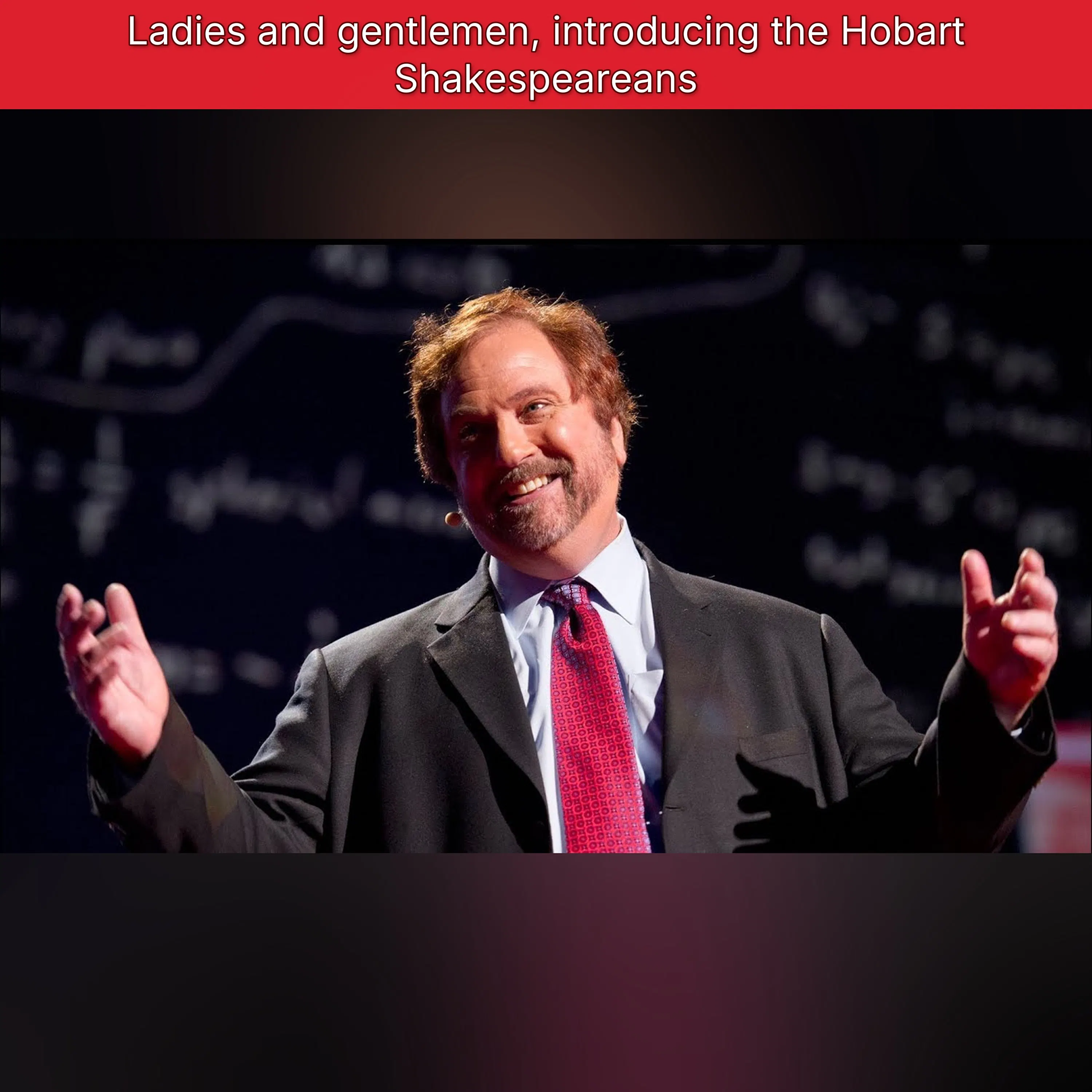
Filmed at TED 2012. View on TED-Ed blog: http://blog.ed.ted.com/2013/05/16/ladies-and-gentlemen-the-hobart-shakespereans/ Learn more about your ad choices. Visit megaphone.fm/adchoices

View full lesson: http://ed.ted.com/lessons/history-vs-richard-nixon-alex-gendler Uploaded 12-02-15 The president of the United States of America is often said to be one of the most powerful positions in the world. But of all the US presidents accused of abusing that power, only one has left office as a result. Does Richard Nixon deserve to be remembered for more than the scandal that ended his presidency? Alex Gendler puts this disgraced president’s legacy on trial. Lesson by Alex Gendler, animation by Brett Underhill. Learn more about your ad choices. Visit megaphone.fm/adchoices Learn more about your ad choices. Visit megaphone.fm/adchoices