Skip to content
Artwork for STR Global Unlocked with Simon Lehmann

STR Global Unlocked with Simon Lehmann

Simon Lehmann

Simon Lehmann talks to the people running short-term rental at scale.
Operators, platform CEOs and investors, on the decisions that separate
businesses that scale from ones that plateau.

No panel-discussion politeness and no vendor pitches. Guests have included
the co-founder of Vacasa, the president and CEO of Booking Holdings, and the
founder of Holidu. The conversations go where the operating problems actually
are: unit economics, distribution, AI, capital, and what breaks when you grow.

Simon is a former CEO of Interhome, co-founder and chairman of Vacasa Europe,
past president of Phocuswright, and sat on the HomeAway board before the IPO.
He now advises operators, investors and hospitality technology vendors.

New episodes every Tuesday.

simonlehmann.net

Play
  • 28 episodes
  • weekly
  • Avg 46 min
  • English
Counted on this page — what you have heard stays on this device, so it is not something the list can be paged by.
  • S1 · E51
    Tuesday · 52 min

    Why Your Competitors Get Found and You Don’t | Jessica Gillingham

    Book a strategic consultation with me now: https://link.simonlehmann.net/widget/bookings/simon-lehmann-personal-calendar-igt0r2y3pbjffnt How do you make your hospitality business the one customers find, understand and trust? In this episode of STR Global Unlocked, I sit down with Jessica Gillingham, founder of Abode Worldwide, to explore how strategic PR, clear positioning and a consistent brand story help short-term rental operators and travel tech companies stand out. Jessica explains why public relations goes far beyond press releases, how earned media and owned channels work together, and why third-party credibility matters as AI search becomes part of the customer journey. We discuss what makes a company ready for a PR agency, the positioning mistakes that hold founders back, and how to start building authority with a smaller budget. Which questions are answered in this episode? - What does PR actually do beyond press releases? - How can your business stand out in a crowded market? - What helps customers find and trust your company through AI search? - How should earned media and your own content work together? - When is hiring a PR agency too early? - How can founders build authority without being comfortable on stage? - Where should you start with a small marketing budget? - What can property managers do to build a stronger local reputation?

    • Transcript
  • S1 · E50
    October 13 · 39 min

    050: The Hidden Trap Keeping Rental Owners Working 24/7 | Vivian Yip

    Book a strategic consultation with me now: https://link.simonlehmann.net/widget/bookings/simon-lehmann-personal-calendar-igt0r2y3pbjffnt If your rental business stops working when you step away, you’ve built a job that depends on you. How do you turn it into a business that runs without you? In this episode of STR Global Unlocked, I sit down with Vivian Yip, whose background at Apple and in global supply chain logistics brings a fresh perspective to short-term rental operations, mid-term rental strategy, and building better systems. We explore why hosts become the bottleneck in their own businesses, how to document and delegate essential tasks, and why buying more software won’t solve a broken process. Vivian also explains how booking windows, guest behavior, and calendar planning can help operators combine short-term and mid-term stays more effectively. In this conversation, you’ll learn: • How to move essential business knowledge out of your head • How value stream mapping helps identify unnecessary work • Why booking windows matter for mid-term rental demand • Where to start with cleaning and smart lock automation • How a property management system and unified inbox support delegation • Why a hybrid rental strategy requires coordinated calendar planning

    • Transcript
  • #49
    October 6 · 15 min

    049: STR Academy Launch: What 400 advisory hours taught | Simon Lehmann

    simonlehmann.net/academy Twenty years ago, Simon Lehmann took over a 24,000-property vacation rental company with no manual, no course and no one to call. He came from ground handling and logistics. He knew how to turn an aircraft around in 35 minutes. He had never turned around a vacation home. What followed was a career spent learning the hard way: running Interhome, serving on the HomeAway board through its scale to Expedia, chairing Make Comfy through exit, investing as an angel, and advising more than 50 management teams across 20 countries and five continents. None of that experience came with an instruction manual, which is the gap this episode addresses. In this solo episode, Simon explains why he built the Simon Lehmann STR Academy, who it is for, and what it is designed to solve. It starts with a diagnosis most operators get wrong. Simon's argument is simple: most property managers do not have a growth problem. They have a numbers problem, and adding more units often hides it rather than solving it. The Academy is his attempt to make 20 years of expensive lessons, rebuilt with AI, available before the next operator has to pay for them the same way. In this episode Why one in five properties loses money without the owner ever seeing it, hidden inside the average of the portfolio's profit and loss. Why, in one portfolio Simon reviewed, 13% of the owners held 44% of the properties, and what that concentration actually means for the business. How a currency mismatch between euros and Swiss francs once halved his profit on flat revenue, and how a due diligence mandate he lost redirected his entire career toward advising instead of running. Why 400 hours of real advisory calls, not conference panels, kept surfacing the same blind spots: measured across 750 operators in 15 countries, average owner tenure runs closer to three and a half years than the five to ten most founders assume. What the Simon Lehmann STR Academy actually contains: nine modules and 67 sessions built entirely from transcripts of real advisory and mentorship calls, with no vendor pitches and no sponsor names. Who this is built for and who it is not: founders running between 30 and 200 properties, not three unit hosts and not thousand unit operators who need a conversation instead of a course. Why only a quarter of surveyed operators actually want to sell, and why the four conditions that make a business sellable are the same four that let a founder take a month off or hand the business to their children. The Simon Lehmann STR Academy opened on 5 October 2026. Twenty places at the opening terms, until Tuesday 13 October 2026. After that it moves to the standard price. Every buyer also joins Simon for a live session about a month in. simonlehmann.net/academy

    • Transcript
  • S1 · E48
    September 29 · 58 min

    048: The STR Growth Strategy Most Operators Ignore! | David Angotti

    Book a strategic consultation with me now: https://link.simonlehmann.net/widget/bookings/simon-lehmann-personal-calendar-igt0r2y3pbjffnt What happens to your short-term rental business if Airbnb changes the rules? In this episode of STR Global Unlocked, I talk with entrepreneur David Angotti about platform dependence, direct bookings, customer acquisition costs, and why owning guest demand can make a property management company more valuable. David shares how he built a destination content platform alongside a property management business, turning local knowledge into a way to reach guests before they were ready to book. He explains the difference between creating demand and capturing it, why operators need to understand their guests’ booking behavior, and how diversified demand can reduce risk for a future buyer. Which questions are answered in this episode? - What does it really cost to depend on Airbnb and other booking platforms? - How can short-term rental operators create demand of their own? - What is the difference between creating demand and capturing demand? - Why should property managers pay closer attention to customer acquisition costs? - How can direct bookings and a stronger brand affect the value of a business? - What will matter most as technology changes short-term rental distribution?

    • Transcript
  • S1 · E47
    September 22 · 57 min

    047: 1,000+ STR Tools: Which Ones Do You Actually Need? | Gernot Zechner

    Book a strategic consultation with me now: https://link.simonlehmann.net/widget/bookings/simon-lehmann-personal-calendar-igt0r2y3pbjffnt With more than 1,000 technology providers competing in the short-term rental industry, finding the right software has become increasingly difficult. The tools that dominate Google searches and “top 10” lists are often those with the largest marketing budgets - not necessarily those that best fit your operation. In this episode of STR Global Unlocked, I speak with Gernot Zechner, the creator of one of the most comprehensive living maps of the short-term rental technology ecosystem. We explore why STR operators frequently choose the wrong software, how overlapping features create unnecessary costs and why independent reviews and transparent comparisons are essential. Gernot also reveals what his analysis of more than 1,000 providers, 6,000 integrations and approximately 45% feature overlap tells us about the state of the industry. Which Questions Are Answered in This Episode? - Why do Google and AI tools often recommend the same STR software providers? - How many technology providers currently serve the short-term rental industry? - Why should operators stop relying on “top 10” software lists? - How can operators identify the tools that truly fit their business? - Why do so many STR technology stacks contain overlapping features? - How much money could operators be wasting on redundant software? - Which STR technology categories are already overcrowded? - Where are the biggest gaps and opportunities in the market?

    • Transcript
  • S1 · E46
    September 15 · 42 min

    046: The Biggest Lie in Vacation Rental Reviews! | Ashley Ching

    Book a strategic consultation with me now: https://link.simonlehmann.net/widget/bookings/simon-lehmann-personal-calendar-igt0r2y3pbjffnt A five-star vacation rental review tells you whether a guest was satisfied. But does it tell the next guest what level of service to expect? In this episode of STR Global Unlocked, I speak with Ashley Ching, founder of Inhaven, about the trust problem facing short-term rentals. We explore why reviews cannot define a property’s promise on their own, why earlier attempts at vacation rental standards failed, and whether shared quality and service tiers could help guests book with more confidence. Questions answered in this episode: - Why don’t five-star reviews tell guests what to expect from a vacation rental? - What can short-term rentals learn from hotel standards? - Why have previous attempts to standardize vacation rentals failed? - Should standards apply to individual homes or property managers? - How can property managers get homeowners on board? - Where does technology improve the guest experience, and where is human service essential? - Who should define and verify vacation rental standards? - Could shared standards make STR businesses more valuable?

    • Transcript
  • September 8 · 14 min

    How Top STR Operators Actually Use AI to Scale

    Book a strategic consultation with me now: https://bit.ly/simon-consultation Most property managers already use AI tools - but very few have truly integrated artificial intelligence into their operations. A chatbot, AI-generated listing descriptions, or a few automated responses are not enough to create a lasting competitive advantage. In this video, I explain where AI delivers measurable results in short-term rental and property management businesses. I break down four key areas: guest communication, revenue management, operations, and owner acquisition. You’ll also discover which AI applications are currently overhyped and could waste your time, money, or owner trust.

    • Transcript
  • S1 · E45
    September 1 · 52 min

    045: The Real Cost of Furnishing a Short-Term Rental | Andria Santos

    Most short-term rental operators invest heavily in acquiring a property - but treat furnishing and interior design as an afterthought. Yet design may be one of the most powerful levers for increasing bookings, improving guest reviews and driving more revenue. In this episode of STR Global Unlocked, I speak with Andria Santos, Founder and CEO of Fülhaus, about why furnishing remains one of the most undercapitalized decisions in the short-term rental industry. Andrea explains how operators should budget for furniture and design, where quality matters most and where it is possible to save. She also reveals why guests book with their eyes, how professional photography shapes expectations and why beautiful images can never compensate for an uncomfortable stay. Which Questions Are Answered in This Episode? Why is design one of the most overlooked investments in rental properties? How can interior design increase bookings, revenue and guest satisfaction? Where should property owners invest—and where can they save? Why can cheap furniture become expensive in the long run? How important are professional photos when guests choose a property? How do operators balance visual appeal with comfort and functionality? How is AI changing interior design and furniture procurement? How can property managers convince owners to invest in upgrades? Which amenities and furnishings do guests now expect as standard? How often should rental properties be renovated or refreshed?

    • Transcript
  • S1 · E44
    August 25 · 53 min

    044: Hotel vs. Airbnb Is Over: Here’s What Wins | Niko Karstikko

    Hotels, serviced apartments and short-term rentals are moving closer together - but most hospitality companies are still operating as if these old categories matter. In this episode of STR Global Unlocked, I speak with Niko Karstikko, Co-Founder and CEO of Bob W, about the emergence of a new, technology-enabled hospitality category built around flexibility, consistency and the needs of the modern traveler. Niko explains why the Airbnb generation expects more than either traditional hotels or inconsistent short-term rentals can offer. He also reveals how Bob W delivers a full-service guest experience without a traditional front desk, operates with a fraction of the staff of a comparable hotel and uses technology to remove repetitive work without losing the human touch. Questions Answered in This Episode: - Why are traditional hospitality categories becoming irrelevant? - What does the modern traveler actually expect from accommodation? - Are hotels and short-term rentals becoming one category? - Why could the traditional front desk become obsolete? - How does Bob W deliver full service with one-seventh of the staff? - Can technology improve both efficiency and the guest experience? - Which hospitality operators are most at risk?

    • Transcript
  • S1 · E43
    August 18 · 57 min

    043: Why Big Property Managers Should Be Worried | Jannik Abraham

    Book a strategic consultation with me now: https://bit.ly/simon-consultation Small hosts are becoming more professional, technology is getting more powerful, and guest expectations are rising fast. But what does this shift mean for the future of short-term rentals? In this episode of STR Global Unlocked, i speak with Jannik Abraham about why the next generation of successful STR operators will not necessarily be the biggest - but the ones that understand their business, master the basics and use technology intelligently. We discuss why scaling to more units is not always the right goal, how small hosts can now compete with professional property managers, why PMS platforms are evolving into operating systems, and where AI and automation can actually create value. Questions answered in this episode: - What separates a casual host from a professional STR operator? - Why is scaling to more units not always the right goal? - Can small hosts really compete with large property managers? - How much should STR operators rely on Airbnb and other OTAs? - When does multi-channel distribution actually make sense? - How are PMS platforms evolving into operating systems? - Where can AI and automation create the most value in hospitality? - What parts of the guest journey should never be automated?

    • Transcript
  • August 11 · 11 min

    Why Scaling Your STR Breaks Without This System

    Book a strategic consultation with me now: https://bit.ly/simon-consultation Scaling a short-term rental business shouldn’t mean hiring endlessly, adding more tools, or working longer hours. Yet for many STR operators, growth creates more complexity, tighter margins, and a business that still depends heavily on the founder. In this video, I break down what actually makes a short-term rental business scalable. Drawing on decades of experience building and leading companies in the hospitality industry and working with operators managing anywhere from 50 to 10,000+ units, he explains why most STR businesses build the wrong kind of systems. You’ll discover the three pillars every scalable STR operating system needs, why SOPs and technology alone aren’t enough, and what separates a documented process from a system that actually works without you.

    • Transcript
  • S1 · E42
    August 4 · 57 min

    042: Why Your Rental Business Is Easy to Replace | Rachel Alday

    Most short-term rental operators are trying to stand out with better photos, smarter pricing, stronger listings, and more automation. But what if the real problem is not visibility - but replaceability? In this episode of STR Global Unlocked, I speak with Rachel Alday, founder of Abode Luxury Rentals, a boutique property management company with more than 200 luxury vacation homes across Park City, Jackson Hole, and Sun Valley. Rachel explains why many vacation rental businesses do not actually have a memorable brand, why competing on price keeps operators dependent on platforms, and how service standards, company culture, consistency, and direct guest relationships create real differentiation. Which questions are answered in this episode? Why do many short-term rental operators struggle to build a brand guests actually remember? How can property managers differentiate themselves without competing only on price? Why are direct guest relationships so important for reducing OTA dependency? How did Abode Luxury Rentals achieve more than 60% direct bookings? What role do service standards, company culture, and consistency play in building a strong vacation rental brand? How can operators scale their portfolio without losing service quality? Why should profitability matter more than simply adding more properties? When does bringing housekeeping in-house make sense?

    • Transcript
  • S1 · E41
    July 28 · 52 min

    041: This Property Manager Increased Profit by 160% With AI | Alex Zemianek

    Book a strategic consultation with me now: https://bit.ly/simon-consultation In this episode of STR Global Unlocked, I speak with Alex Zemianek, CEO of JZ Vacation Rentals, about how he rebuilt his operations around internal AI agents. From finance and marketing to security, development and daily reporting, Alex explains how his company increased operating income by 160% without significantly increasing its unit count or headcount. You’ll discover how AI agents can reduce manual work, replace an overloaded tech stack and help property managers operate more efficiently. Alex also reveals why AI should support employees rather than replace them, how his company continues working while he sleeps and which tasks still require human judgement. Which questions are answered in this episode? - How can property managers use AI agents to increase profitability without adding more units or employees? - Why is the traditional property management tech stack becoming increasingly inefficient? - What is the difference between using AI as a simple tool and building an AI-powered operating system? - How can internal AI agents support finance, operations, marketing, security, and development? - Which property management tasks can run autonomously, and where is human approval still essential? - How should operators onboard and train AI agents like new team members? 00:00 – How AI is reshaping property management 03:02 – The biggest lie in property management 05:13 – Automating a critical operational role 08:54 – 160% more operating income without more units 12:20 – Inside the AI-powered “Mission Control” 19:02 – How 12 specialized AI agents work together 26:23 – Running a property business that never stops 29:56 – Three rules for successfully implementing AI 37:48 – Where property managers should start with AI 44:11 – Why humans remain essential in hospitality

    • Transcript
  • July 23 · 14 min

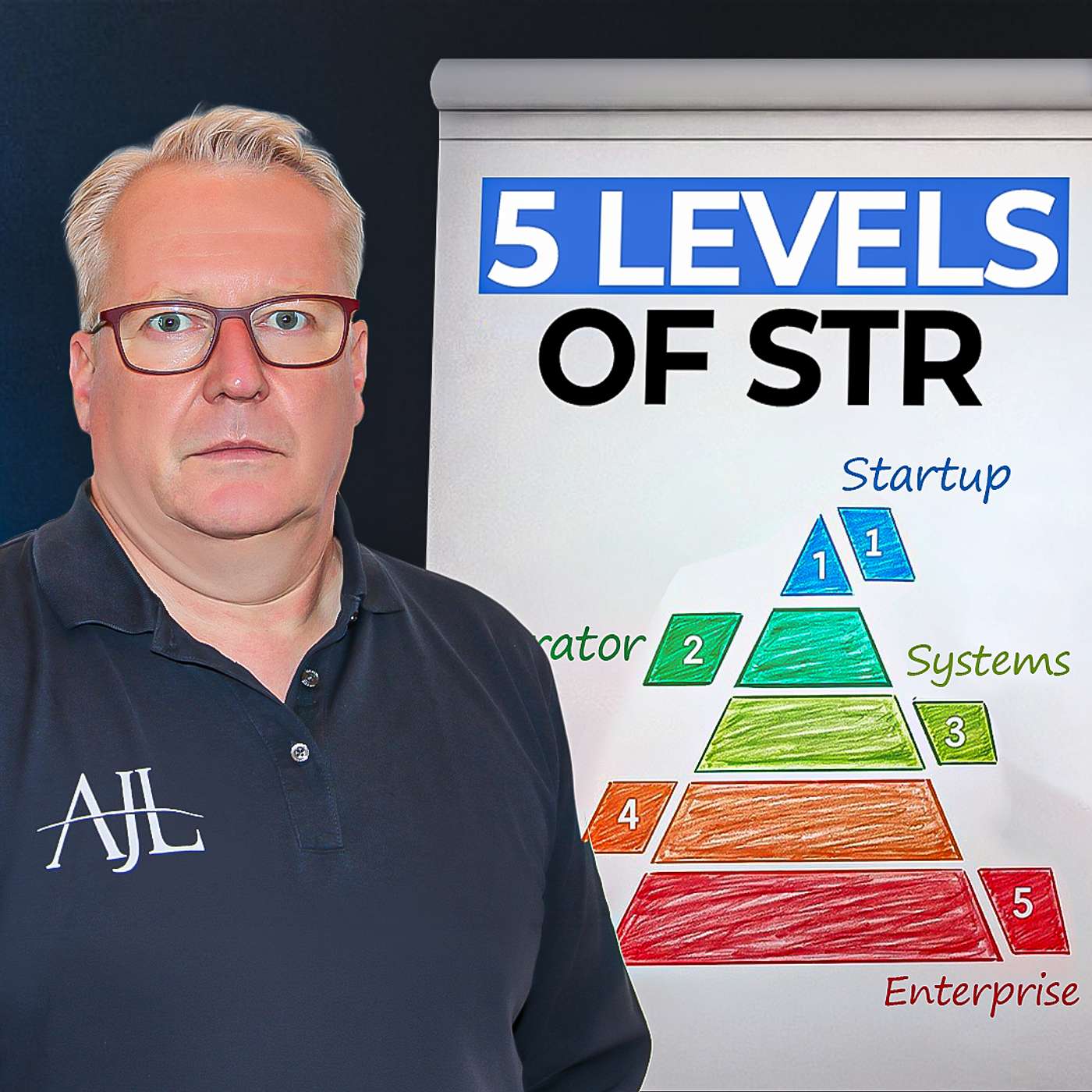
    The 5 Levels of STR Companies Explained

    Many property management companies grow quickly - until they suddenly hit an invisible ceiling. But why do some short-term rental businesses successfully scale to thousands of units while others struggle to grow profitably despite increasing bookings? In this video, i explain the five key growth stages of a professional property management company - from the founder-operator managing a small portfolio to an international industry leader with more than 2,500 units. You will learn which structures, systems, and leadership roles are required at each stage, why more than 80% of PMCs get stuck during the transition from Level 2 to Level 3, and why working harder alone is not enough to reach the next level of growth.

    • Transcript
  • S1 · E40
    July 21 · 1 hr

    040: How to Turn STR Guests Into Loyal Customers | Matthew Orley

    Most short-term rental operators focus on adding more units, entering new markets, and automating their operations. But what if the strongest competitive advantage is not the size of your portfolio, but the relationship you build with your guests? In this episode of STR Global Unlocked, I speak with Matthew Orley, CEO of Red Cottage, about how STR operators can build a memorable brand that drives guest loyalty, repeat stays, and direct bookings. Matthew explains why many property managers do not truly own their guest relationships, how Red Cottage built a successful membership program, and why loyalty needs to offer more than simple discounts. He also shares how a clearly defined target guest, a consistent portfolio, and proactive communication can turn one-time bookings into long-term customer relationships. Which questions are answered in this episode? - How can STR operators build a brand guests actively return to? - Why do many property managers still not truly own their guest relationships? - What makes a membership and loyalty program work in short-term rentals? - How can STR brands increase repeat stays and direct bookings without relying on discounts? - Why are brand consistency, guest communication, and a clearly defined target audience so important? - How should operators balance AI and automation with high-touch human service? - And why could the human relationship become the strongest competitive advantage in an increasingly automated STR industry?

    • Transcript
  • S1 · E39
    July 7 · 1 hr

    039: Hospitality Isn’t Ready for the Future Guest | Jamie Lane

    AI is changing hospitality, but I believe the bigger question is not just how AI will change our tools, our operations, or our businesses. The bigger question is: what happens when AI starts changing the customer? In this episode of STR Global Unlocked, I’m joined by Jamie Lane, Chief Economist at AirDNA and one of the leading voices on travel demand, market trends, and the future of short-term rentals. Together, we talk about how AI-driven productivity, job shifts, income distribution, and changes in disposable income could reshape travel demand in the years ahead. Because while many operators are focused on how AI can improve pricing, guest communication, automation, and efficiency, I think we also need to understand what AI could do to the wider economy around our guests. Which questions are answered in this episode? What happens when AI starts changing the customer, not just hospitality businesses? How could AI-driven productivity, job shifts, and income distribution affect travel demand? Why should short-term rental operators pay attention to macroeconomic trends? Could changes in disposable income reshape who travels, how often they travel, and where they stay? And what can hospitality leaders do today to prepare for the future guest?

    • Transcript
  • S1 · E38
    June 30 · 58 min

    038: Short-Term Rentals Are Entering Their Most Dangerous Era | Shaun Shirazian

    In this episode of STR Global Unlocked, I speak with Shaun Shirazian, CEO of Lodgify, about one of the biggest shifts happening in short-term rentals and hospitality: the rise of AI search, direct bookings, and the future of guest experience. Shaun shares what Lodgify is seeing across more than 30,000 hosts and 100,000 listings, why the short-term rental market has become more competitive, and why the old price advantage over hotels is disappearing. He explains why direct bookings are becoming more important, how hosts can reduce dependency on OTAs like Airbnb, Booking.com and Expedia, and why some operators are already seeing bookings come directly from ChatGPT. Which questions are answered in this episode? How is AI changing the way travelers search for short-term rentals? Why are hosts already getting bookings from ChatGPT? Are direct bookings becoming more important for STR operators? What percentage of direct bookings is realistic for hosts today? Why is the short-term rental price advantage over hotels disappearing? What do the best operators understand that average hosts still miss? How can hosts reduce their dependency on Airbnb, Booking.com and Expedia? Why is guest experience becoming the real competitive advantage? What role will technology play in professionalizing short-term rental operations?

    • Transcript
  • S1 · E37
    June 23 · 1 hr 3 min

    037: Will AI Replace Hospitality Teams? | Stone Fish, Vancauwenberghe, Ullrich, Rubin

    Book a strategic consultation with me now: https://bit.ly/simon-consultation AI is transforming guest communication in short-term rentals and hospitality. In this episode of STR Global Unlocked, I speak with industry leaders Aarlo Stone Fish, Anthony Vancauwenberghe, Jay Ullrich and Cole Rubin about AI agents, automation, guest experience, operations, reviews, upsells, and the future of hospitality. We discuss what operators often get wrong about automation, why guest communication is no longer just a support function, how AI can improve response times and guest satisfaction, and where the human touch still matters. The conversation also explores the future of STR operations, revenue opportunities through upsells, and whether guests will still talk to humans in an AI-powered hospitality world. Which questions are answered in this episode? How is AI changing guest communication in hospitality and short-term rentals? What do operators often get wrong when implementing AI agents? Should AI fully replace human guest communication teams? Where is the line between automation and human hospitality? How can AI improve response times, reviews, and guest satisfaction? What is the real ROI of AI automation for property managers? Can AI reduce headcount and increase company value? How can AI identify upsell opportunities like early check-in, late checkout, and add-on services? Why is guest communication connected to operations, cleaning, locks, PMS, and workflows? Will guests still talk to humans in the future of hospitality?

    • Transcript
  • June 16 · 14 min

    The Margin Mistake Killing Most STR Companies!

    Book a strategic consultation with me now: https://bit.ly/simon-consultation Profit margins can make or break a short-term rental business - but most operators are looking at the wrong numbers. In this video, I break down the real profit benchmarks for STR operators across different business models, including property management companies, aparthotels, hybrid models, urban portfolios, and resort/vacation rentals. You’ll learn what healthy gross and net margins look like, why revenue alone can be misleading, and which KPI reveals whether your business is truly profitable or just looks good on paper: contribution margin per unit per year.

    • Transcript
  • #26
    June 9 · 53 min

    036: How to Build a Business That AI Can’t Replace | Siddhi Mittal

    Book a strategic consultation with me now: https://bit.ly/simon-consultation In this episode of STR Global Unlocked, I sit down with Siddhi Mittal, co-founder of yhangry, a Y Combinator–backed hospitality marketplace scaling across the UK and US. Together, they explore what AI-first hospitality really means beyond faster guest messages, automation tools, and surface-level efficiency. Siddhi shares how yhangry is rebuilding parts of the company around AI-native workflows, including an internal agent that reached 75% autonomous bug resolution in under 14 days. This conversation dives into the future of hospitality, marketplaces, operations, AI agents, customer experience, and human value in a world where execution is becoming automated. We discuss why average businesses are becoming more exposed, why technical competence alone is no longer enough, and why the next competitive advantage may come from judgment, taste, curiosity, trust, and emotional intelligence. Which questions are answered in this episode? - What does AI-first hospitality actually mean beyond faster guest communication? - How is AI changing the way operators, founders, and leaders think about work, value, and execution? - Why is “being good” or technically competent no longer enough in an AI-native business environment? - What happens when operational consistency, SOPs, and execution become easier to automate? - How can hospitality companies use AI to remove manual workflows without losing the human experience? - Why does Siddhi Mittal believe curiosity, judgment, taste, character, and emotional intelligence are becoming more valuable? - What can operators learn from yhangry’s AI-first rebuild across product, operations, and customer experience?

    • Transcript
Showing 1–20 of 28 episodes