Skip to content
Artwork for Navigating the Customer Experience
BusinessEntrepreneurshipCareersEducationSelf-Improvement

Navigating the Customer Experience

Yanique Grant, Customer Experience Strategist, Entrepreneur

Join host Yanique Grant as she takes you on a journey with global entrepreneurs and subject matter experts that can help you to navigate your customer experience. Learn what customers really want and how businesses can understand the psychology of each customer or business that they engage with. We will be looking at technology, leadership, customer service charters and strategies, training and development, complaint management, service recovery and so much more!

Play
  • 21 episodes
  • fortnightly
  • Avg 23 min
  • English
Counted on this page — what you have heard stays on this device, so it is not something the list can be paged by.
  • Tuesday · 21 min

    281: Is Human Support Becoming a Luxury? with Ben Rosenberg

    Send us Fan Mail Is human support about to become a luxury only premium customers can afford? Yanique Grant sits down with Ben Rosenberg, VP of Customer Experience Delivery at ChurnZero, a SaaS leader with two decades of customer experience behind him at companies like Zenefits and Sendoso. Ben gives an honest answer on whether automation is creating a two tier CX model, explains why AI still struggles with complex B2B context, and shares the data that convinced his team course based customer education is dead or dying. Plus, how he uses AI as an Iron Man suit for his team, not a replacement. In this episode: • Why a two tier CX model already exists and how automation could widen it • Human support as a strategic differentiator, not just a premium perk • Where AI still falls short in complex B2B support • Three months of data that changed ChurnZero's customer education strategy • Designing training for the 90 percent of users who just want to get on with their day • Ben's guiding quotes for pushing through pressure Featured resources: Book: How I Built This (NPR podcast hosted by Guy Raz): long form interviews with founders and CEOs, Ben's favorite listen for work ChurnZero (customer success platform for post sale teams) Claude and Claude Code (AI assistant Ben uses daily for organization and building team automations) YouTube (where most people now go to learn) Raspberry Pi (the kit Ben is using to learn home automation and hardware basics) Heart Over Hardware: Mastering the Human Skills AI Can't Touch. Our CX Human and AI Lab, live on Zoom, Tuesday, October 13, 6:00 to 7:00 PM Eastern. Hands on and interactive, not a lecture. Seats are $30. Register at the link and bring your team. Connect with the guest: LinkedIn: linkedin.com/in/benarosenberg (Ben is most active here and welcomes messages) Company: churnzero.com Ben is active in several CX networking groups and loves to talk shop on anything discussed in this episode. Follow the show: X @NavigatingCX and join our private Facebook group, Navigating the Customer Experience Community. Hosted by Yanique Grant.

    • Transcript
    • Chapters
  • September 8 · 26 min

    280: The Skills AI Can't Replace: Why Human Service Still Wins with Jeff Toister

    Send us Fan Mail AI won't replace your people. It will replace the ones acting like robots. Returning guest Jeff Toister, best-selling author of Human Service: The Skills AI Can't Replace, joins Yanique Grant to unpack where humans still win in a world racing to automate. Drawing on new research spanning more than 370,000 phone calls and 400-plus face-to-face interactions, Jeff makes the data-backed case for connection, understanding, and advocacy, the three human skills AI simply can't provide. In this episode: - Why connection is efficient: warm rapport makes calls 16% shorter - Understanding and advocacy, the skills that beat automation on complex issues - The greeting research: 12% better first-contact resolution and warmer customers - Why AI replaces the transactional employee, not the true expert - How to simplify your service strategy heading into 2027 Featured resources: Book: Human Service: The Skills AI Can't Replace by Jeff Toister Book: The Service Culture Handbook by Jeff Toister Zoom (video conferencing Jeff uses daily, while noting no single tool is truly indispensable) LinkedIn Learning (home to Jeff's training courses, taken by 5 million-plus learners) Customer Service Tip of the Week (Jeff's free weekly email with content to share with your team) Connect with the guest: Human Service book (download the first chapter free): humanservicebook.com Customer Service Tip of the Week (free weekly research and tips): toistersolutions.com/tips Reply directly to any weekly email and it goes straight to Jeff Follow the show: X @NavigatingCX and join our private Facebook group, Navigating the Customer Experience Community. Hosted by Yanique Grant.

    • Transcript
    • Chapters
  • August 25 · 14 min

    279: Where AI Ends and Humans Begin: Building Customer Success on Clean Data with Rebecca Stone

    Send us Fan Mail Where should AI stop and a human step in? Rebecca Stone has spent 20 plus years finding the line. Rebecca Stone, Chief Customer and Marketing Officer at Plume, joins Yanique Grant to unpack why clean, centralized data is the real foundation of customer experience, and where AI should augment the journey versus where a human relationship has to show up. From the name problem that makes one customer look like four, to using AI to carry context across every support tier, to building high performing teams, Rebecca shares practical moves any leader can use. In this episode: - The first move to make when your customer data is messy - Where AI ends and human connection has to begin - Using AI to carry customer context across every support tier - The tools Rebecca can't live without: Claude, Gong, Salesforce, Marketo - Building high performing teams with The Five Dysfunctions of a Team - The Colin Powell quote that keeps her on track Featured resources: Book: Made to Stick by Chip Heath and Dan Heath Book: The Five Dysfunctions of a Team by Patrick Lencioni Claude (AI for building presentations and freeing up time) Gong (conversation intelligence and customer context) Salesforce (CRM and customer data) Marketo (marketing automation) Connect with the guest: LinkedIn: Rebecca Stone, connect and send her a message Company: Plume Follow the show: X @NavigatingCX and join our private Facebook group, Navigating the Customer Experience Community. Hosted by Yanique Grant.

    • Transcript
    • Chapters
  • August 11 · 26 min

    278 : Clarity Beats Confidence: How Great Leaders Actually Change with Terez Rijkenberg

    Send us Fan Mail What if the fastest way to lead change was to stop trying to feel confident? Executive coach Terez Rijkenberg says clarity beats confidence every time, and she has the frameworks to prove it. Terez Rijkenberg, executive coach to C-suite leaders and director at Tuitive AI, joins Yanique Grant to share the two frameworks behind her work: the RAFT formula (results, actions, feelings, thoughts) and Radical Adaptability. She unpacks how change really happens, how she coaches leaders through it with a real client story, and how her Claude-based AI system hands executives back 10-plus hours a week. She also shares the grounding quote she uses when stress spikes. In this episode: - Terez's journey from the corporate ladder through postpartum depression and identity shift to executive coaching - The RAFT formula: why your thoughts drive your feelings, actions, and ultimately your results - Radical Adaptability: safety, clarity, belief, experiment, and integrate, the five steps of real change - A client story showing why coaching a team is faster than telling them what to do - Before and after: building AI workflows that remove manual work and free leaders to think - The grounding self-talk Terez uses under pressure: this is not an emergency Featured resources: Book: The Success Principles by Jack Canfield Book: The Freakonomics series by Steven Levitt and Stephen Dubner (her gateway into behavioral economics and psychology) Claude (Anthropic) - where Terez builds her processes, systems, and personalized client dashboards AI Amplified Exec - her Claude plugin that turns spreadsheets, transcripts, and documents into branded outputs like board packs in minutes Tuitive AI - where Terez is director and built AI Amplified Exec, helping senior executives use AI safely for real gains in personal productivity. Connect with the guest: Website: terezrijkenberg.com Weekly email / blog: terezrijkenberg.com/blog LinkedIn: Terez Rijkenberg (most active here) Follow the show: X @NavigatingCX and join our private Facebook group, Navigating the Customer Experience Community. Hosted by Yanique Grant.

    • Transcript
    • Chapters
  • July 28 · 15 min

    277 : Deflection Done Right: Building AI Support That Customers Actually Love with David Karandish

    Send us Fan Mail Can AI answer your customers without pushing them away? David Karandish has automated support for 20,000 companies, and he says deflection should make the experience better, not worse. David Karandish, founder and CEO of Capacity, joins Yanique Grant to unpack how to bring AI into customer support the right way. After selling Answers Corp for $960 million, David built Capacity into an omni-channel support automation platform serving roughly 20,000 customers. In this episode he shares the design principles that keep automation human, why your first AI project should be a small, provable win, and how AI agents are now running entire companies from finance to marketing. In this episode: - The design principles that make AI deflection improve the customer experience instead of frustrating people, from great escalation paths to leading with empathy - Why human behavior is largely universal across regions, and where support questions actually differ - What the $960M Answers.com journey taught David about people who are truly stuck and have nowhere to turn - The single most practical first step for any support leader: go get your small win, then iterate - How builder agents let a complete novice spin up workflows, integrations, and CSAT surveys just by asking Featured resources: Book: Principles by Ray Dalio — a first-principles breakdown of how Dalio built one of the most successful investment firms of all time. Foundational AI models — Google Gemini, OpenAI, and Anthropic's Claude, used across the business. Jira — for tracking development tickets; David uses LLMs to analyze time-in-stage when off-the-shelf plugins fall short. Capacity — an AI-powered support automation platform that deflects emails, calls, and tickets across voice, SMS, WhatsApp, web, and email. ~20,000 customers, 250+ app integrations. Connect with the guest: Website: capacity.com Email: david@capacity.com Follow the show: X @NavigatingCX and join our private Facebook group, Navigating the Customer Experience Community. Hosted by Yanique Grant.

    • Chapters
  • July 14 · 22 min

    276 : Pricing AI: Why the First Price Is Always Wrong and What Smart SaaS Leaders Do About It with Dan Balcauski

    Send us Fan Mail Pricing AI is the hardest pricing problem in software right now, and most SaaS leaders are getting it wrong on the first try. In this episode of Navigating the Customer Experience, host Yanique Grant sits down with Dan Balcauski, founder of Product Tranquility, to unpack why the first AI price a company sets is always wrong, how to set usage caps when you have no historical data, and what smart B2B SaaS leaders do differently to turn pricing from a liability into a strategic advantage. Dan has spent more than 20 years in software, starting as an engineer before moving into product management and discovering that how a company captures value matters far more than how it builds the product. Today he advises B2B SaaS CEOs on the AI pricing and packaging decisions that keep them up at night, and in this conversation he shares the frameworks, the mistakes to avoid, and the practical playbook he uses with real companies. WHAT YOU WILL LEARN IN THIS EPISODE Why the first AI price is always wrong, and why that has nothing to do with how smart your team or your consultants are. Dan explains the fundamental economic shift underway in software, where both sides of the pricing equation are moving at once. On the cost side, he points to a benchmark showing the cost per task for a top model dropping by roughly 390 times in a single year, a change no normal business ever absorbs in its cost of goods sold. On the value side, models keep getting more capable, handling this month what they could not handle last month. His research shows that every application layer software company he studied that released AI capabilities revised its pricing and packaging within 18 months. The lesson is not to price perfectly on day one. It is to build for change. How to set usage caps and pricing tiers with zero historical data. Dan frames the real problem plainly. You know what a token costs, but you have no idea what customers will actually do with a new AI feature. Products are full of features that barely got adopted, and AI features do not get to skip that step of the innovation cycle. On top of that, a small group of power users, often around 5 to 10 percent, can drive the overwhelming majority of usage and cost. That makes the tempting shortcuts unreliable. Using dashboard views as a proxy breaks down because good AI gets used far more than the dashboards it replaces, and a beta group rarely matches the usage profile of the full market. The early access playbook that sits between beta and general availability. Dan recommends a stage where companies announce their limits, put a price on the feature, and communicate it clearly, but do not enforce or meter it yet for a defined window that can run anywhere from six weeks to 18 months. This eases customer anxiety about surprise bills, encourages real adoption, and lets the company gather genuine usage patterns instead of guessing from proxies that break down. Why you should separate ordinary plan limits from fair use limits. Even when you are not metering usage, Dan explains, you can reserve the right to throttle or downgrade the rare customer using a capability a hundred or a thousand times more than the average, much like companies already do with API request limits. Those levers let teams keep experimenting during early access without the finance team panicking when the bill arrives. Why communication is where pricing changes succeed or fail. As Dan puts it, most pricing blowups come not from the change itself but from the fact that it was communicated poorly or not at all. Agility beats certainty, and reviewing pricing on a quarterly cadence beats the old annual or five year rhythm. This episode is essential listening for SaaS founders, product leaders, pricing strategists, and customer experience professionals who want to understand how AI is reshaping the economics of software and what to do about it before the market forces the decision for them. ABOUT DAN BALCAUSKI Dan Balcauski is the founder of Product Tranquility, where he helps B2B SaaS CEOs turn pricing from a confusing liability into a strategic advantage. With more than 20 years in software, Dan began his career as an engineer before moving into product management and discovering that how companies capture value matters far more than how they build it. His work now centers on one of the most pressing questions in software today: how to price AI. Before founding Product Tranquility, Dan was a principal product strategist at SolarWinds and head of product at LawnStarter. He holds a BSc in computer engineering from Iowa State University and an MBA from the Kellogg School of Management at Northwestern, where he also helps teach executive education courses on product strategy. He is the host of the SaaS Scaling Secrets podcast. QUESTIONS YANIQUE ASKED Could you share a little about your journey and how you got from where you were to where you are today? You have said the first AI price is always wrong. Why is that, and what should a SaaS company do differently knowing they are going to get it wrong the first time? So many companies are trying to set usage caps and pricing tiers for AI with zero historical data. How would you advise a CEO to make that decision when they are essentially flying blind? What is the one online resource, tool, website, or application that you absolutely cannot live without in your business? Can you share one or two books that have had a positive impact on you, professionally or personally? What is one thing going on in your life right now that you are really excited about? Do you have a quote or saying that keeps you on track during times of adversity? Where can listeners find and connect with you online? KEY TAKEAWAYS The first AI price is always wrong, and that is not a failure of intelligence. It reflects a fundamental economic shift where both cost and value are moving fast. Every application layer company Dan studied revised its AI pricing and packaging within 18 months. Plan for revision, not perfection. Agility beats certainty. Review pricing on a quarterly cadence rather than annually or every five years. Communication is where pricing changes succeed or fail. Most blowups come from poor communication, not the change itself. Usage proxies break down. Dashboard views and beta groups rarely predict how customers will actually use an AI feature. A small group of power users can drive the majority of usage and cost, so average user assumptions are dangerous. Early access is the smart middle stage. Announce and price the limits, communicate them, but do not meter yet while you gather real data. Separate plan limits from fair use limits. Reserve the right to throttle extreme usage even when you are not metering everyone. Do not borrow problems from the future. Anxiety about what has not happened yet only adds problems to the present. AI is making custom, personal business software economically viable for the first time, opening the door to tools built exactly the way you work. CHAPTERS 00:00 Introduction and Guest Bio 01:51 Dan's Journey: From Engineer to Pricing Strategist 04:03 Learning That Pricing Is Different in Every Industry 04:49 Why the First AI Price Is Always Wrong 05:36 The 390x Cost Shift and the Moving Value Equation 06:49 Agility, Faster Pricing Reviews, and Communication 09:28 Setting Usage Caps With No Historical Data 11:32 Why Dashboard Proxies and Beta Groups Break Down 12:59 The Early Access Playbook Between Beta and GA 13:20 Plan Limits vs. Fair Use Limits 17:04 The One Tool Dan Cannot Live Without: Claude Code 17:38 Book Recommendation: Monetizing Innovation 18:31 Building Custom Business Software With AI 19:55 How to Connect With Dan Online 20:27 Dan's Guiding Quote: Don't Borrow Problems From the Future FEATURED RESOURCES Book mentioned: Monetizing Innovation by Madhavan Ramanujam and Georg Tacke Tool mentioned: Claude Code, Dan's work surface and the engine behind his custom business software CONNECT WITH DAN LinkedIn: Search Dan Balcauski on LinkedIn, and mention that you heard him on the podcast so he can separate you from the spam Website: producttranquility.com Podcast: SaaS Scaling Secrets, wherever podcasts are found DAN'S GUIDING QUOTE "Don't borrow problems from the future." Dan Balcauski Dan explains that most of our anxiety is about things that have not happened yet. Worrying about a future scenario pulls that problem into the present before it ever arrives, giving you more to carry now for no reason. Like debt, it is borrowing against your future self. His practice is to stay focused on what is real and in front of him, which keeps him grounded when challenges or uncertainty threaten to pull him off track. ABOUT N

    • Transcript
    • Chapters
  • June 30 · 26 min

    275 : From Pissed to Empowered: How Consumer Feedback Drives Business Transformation

    Send us Fan Mail What if the most valuable thing a customer could do for your business was complain? In this episode of Navigating the Customer Experience, Yanique Grant sits down with Michael Podolsky, co-founder and CEO of PissedConsumer.com and Wisebrand.com, to explore the power of negative feedback and why organizations that take it seriously are the ones that build lasting customer loyalty. Michael built PissedConsumer.com after a deeply frustrating personal experience as a customer left him with no recourse and no resolution. Starting with just $200 and no venture backing, he has grown the platform over the past 20 years into a consumer advocacy powerhouse serving over 30 million users. His message to businesses is consistent: complaints are not your enemy. They are your most honest source of business intelligence. WHAT YOU WILL LEARN IN THIS EPISODE 87% of consumers contact a company directly before leaving a negative review online. That statistic sits at the heart of everything Michael teaches. By the time a review is posted, the customer has already tried to reach you. The review is not the problem. The missed connection is. In this conversation, Yanique and Michael explore how organizations of all sizes can shift the way they receive and respond to consumer feedback, including how to categorize complaints by severity, how to establish timelines for resolution, and why the department most often blamed for service failures is rarely the one responsible for causing them. KEY TOPICS COVERED From a Bad Vacation to 30 Million Users Michael shares the origin story behind PissedConsumer.com, which was born from a travel experience that left him with no recourse as a consumer. That frustration became the foundation for one of the largest negative review platforms in the world. Collective Complaints: A New Way to Get Businesses to Respond PissedConsumer.com recently introduced a collective complaint feature that groups consumer feedback around a single issue and gathers signatures to amplify the message. Companies that routinely ignore individual complaints have begun responding to collective ones. Complaints as Small Gifts 72% of consumers who leave negative reviews are trying to protect future customers from the same experience. They want things to improve. Michael's position is that every complaint is a gift, and businesses that receive it that way build stronger relationships than those that deflect or dismiss. Customer Service Is Not a Deflection Mechanism Michael addresses one of the most common and costly mistakes in large organizations: treating customer service as a buffer designed to keep consumers away from the business rather than a function empowered to fix the actual problem. When customer service has real authority and clear escalation paths, the feedback loop works. Empowering Your Team with AI Michael shares how his organizations have deployed agentic AI systems using multiple models across departments including recruitment, operations, marketing, and deep research. His belief is that business leaders must integrate AI and human institutional knowledge now, not later. The Last Generation to Manage Only Human Teams Perhaps the most thought-provoking moment in the conversation comes when Michael reflects on where AI is taking the workforce. His message to his own employees: in nine months, the company will either need 70% fewer people or will be ten times more productive. Every single person chose productivity. BOOK RECOMMENDATION Getting Past No by William Ury. Michael has carried this book on negotiation and conflict resolution for over 40 years. For anyone who deals with difficult customers, challenging conversations, or resistant stakeholders, this is the read he points to first. CONNECT WITH MICHAEL PODOLSKY LinkedIn: Search Michael Podolsky, PissedConsumer Website: pissedconsumer.com Website: wisebrand.com FOLLOW NAVIGATING THE CUSTOMER EXPERIENCE X (Twitter): @NavigatingCX Facebook: Navigating the Customer Experience Community LinkedIn: Yanique Grant Website: yaniquegrant.com

    • Chapters
  • June 9 · 28 min

    274 : Lead With Clarity: Burnout, Cultural Intelligence, and the Strategy Every Leader Needs with Dr. Kerrian M. Peart, PHD.

    Send us Fan Mail NAVIGATING THE CUSTOMER EXPERIENCE Episode 274 | Lead With Clarity: Burnout, Cultural Intelligence, and the Strategy Every Leader Needs What happens to your customers when the leader serving them is running on empty? In this episode, Yanique Grant sits down with Dr. Kerriann M. Peart, organizational psychologist, executive coach, and founder of Island Rooted Co., for a conversation that connects leadership well-being directly to customer experience outcomes. Dr. Peart brings over 20 years of experience in organizational psychology, public health, and executive coaching, and her work challenges the idea that high performance should come at the expense of people. Drawing on her own journey as a Caribbean woman who navigated three cycles of burnout while building her consulting practice in corporate America, she offers leaders a grounded, practical framework for leading with clarity, cultural intelligence, and personal strategy. WHAT YOU WILL LEARN IN THIS EPISODE How burned-out leaders show up to customers in three distinct patterns, and which one is the rarest and most powerful Why happy employees are defined by competence AND capacity, and how both translate directly to the customer experience How the anchored bias of "this is how we have always done it" is damaging customer interactions in Caribbean businesses The difference between a growth mindset and an agile mindset, and why leaders in culturally diverse environments need the latter Why humble leaders go further and last longer than those who demand to be followed The one personal strategy shift that will change how customer experience professionals show up, even on their hardest days BOOKS MENTIONED The Prophet by Kahlil Gibran The 48 Laws of Power by Robert Greene The Power of Now by Eckhart Tolle CONNECT WITH DR. PEART LinkedIn: Search Kerriann Peart Website: peartconsulting.org FOLLOW NAVIGATING THE CUSTOMER EXPERIENCE X: @NavigatingCX Facebook: Navigating the Customer Experience Community LinkedIn: Yanique Grant Website: yaniquegrant.com/podcasts

    • Chapters
  • June 2 · 15 min

    273 : Lead Forward: AI, Leadership, and the Future of Work with Jack Jendo

    Send us Fan Mail What does it actually take to lead in an era where artificial intelligence is reshaping every industry, every role, and every assumption about how work gets done? On this episode of Navigating the Customer Experience, Yanique Grant sits down with Jack Jendo, founder of BrainDigits, AI strategist, and author of Lead Forward, to explore what the future workplace really looks like and why leadership is the most important skill you can develop right now. Jack brings a perspective shaped by years of working across the Middle East, Europe, and Australia, building AI-powered programs for governments, corporations, and startups. His message is clear: AI is not just a tool. It is a mindset shift, and leaders who understand this will be the ones who define what comes next. WHAT YOU WILL LEARN IN THIS EPISODE Jack shares the journey that took him from juggling three jobs during university to running agencies across multiple continents and founding BrainDigits. He talks about why he wrote Lead Forward, a book designed for three types of people he encounters every day: entrepreneurs who are just getting started, senior professionals who feel like their career is winding down when it does not have to be, and leaders in the middle who feel pressure but lack clarity. Jack also introduces a concept that reframes how leaders can use AI: the Digital Twin. Rather than using AI as a general assistant, Jack trains specialized AI versions of himself, one for brainstorming, one for financial strategy, one for business development. He has been building and refining these tools for years, and the result is a thinking partner that reflects his values, his frameworks, and his way of approaching problems. THE FUTURE WORKPLACE: AI FIRST OR AI ENABLED? Jack places AI in the same category as transformative inventions like the printing press and the internet. Each of those disrupted every industry it touched. AI is doing the same. But the change is not primarily about tools. It is about mindset and clarity. He describes two futures emerging for organizations. The first is a company that adopts AI aggressively without understanding what it is doing, relying on automation without the human judgment to direct it. That organization will struggle. The second is a company led by people who know exactly what they need, who operate with ownership and freedom, and who use AI to remove friction and accelerate execution. That is the organization every leader should be building toward. AI IS THE NEW LEADERSHIP SKILL Jack and Yanique explore what it means to treat AI as a leadership skill rather than a software category. His view is that every task with a clear process can now be handled by AI. What cannot be automated is knowing what needs to be done, deciding the direction, and leading people through change. The leaders who will thrive are those who invest in training their AI tools the same way they would develop a trusted assistant. Not with generic prompts, but with context, values, goals, and frameworks. That investment is what turns a general tool into something genuinely useful. Jack shares that his two primary tools are ChatGPT, where he has trained a custom model called TwinJack over four years for brainstorming and strategic thinking, and Claude, which he has used for automation over the past year. He describes them as complementary, each with a distinct role, and both trained with the same foundation. KEY INSIGHTS FROM THIS EPISODE Experience compounds. Working across multiple roles and industries, especially early in a career, creates a foundation that multiplies future opportunity. Retirement is not an endpoint. Jack pushes back on the idea that experienced professionals should wind down. Their knowledge, relationships, and judgment are among the most valuable assets available to any organization. Scaling happens during crisis. When others pull back, Jack leans in. His approach is to build capacity, strengthen teams, and expand during periods of pressure because that is when the real growth happens. The guiding question Jack returns to during adversity is simple: remember why you started. It is not about nostalgia. It is about using original purpose as an anchor when clarity is hard to find. BOOKS MENTIONED IN THIS EPISODE Lead Forward by Jack Jendo https://www.amazon.com/s?k=lead+forward+jack+jendo Start with Why by Simon Sinek https://www.amazon.com/s?k=start+with+why+simon+sinek Rich Dad Poor Dad by Robert Kiyosaki https://www.amazon.com/s?k=rich+dad+poor+dad The Richest Man in Babylon by George S. Clason https://www.amazon.com/s?k=richest+man+in+babylon TOOLS MENTIONED ChatGPT (Custom GPT / TwinJack): https://chatgpt.com Claude (AI): https://claude.ai BrainDigits: https://braindigits.com CONNECT WITH JACK JENDO LinkedIn: https://www.linkedin.com/search/results/all/?keywords=jack+jendo Instagram: Search Jack Jendo Jack responds personally to every message. FOLLOW NAVIGATING THE CUSTOMER EXPERIENCE X (Twitter): https://x.com/navigatingCX Facebook Community: https://www.facebook.com/groups/NavigatingtheCustomerExperience LinkedIn: https://www.linkedin.com/in/yaniquewagrantcx/ Website: https://yaniquegrant.com/podcasts/

    • Chapters
  • May 26 · 11 min

    Anniversary Episode : 10 Years, 272 Episodes, and a Lifetime of Lessons: A Mother-Daughter Conversation

    Send us Fan Mail 10 Years, 272 Episodes, and a Lifetime of Lessons: A Mother-Daughter Conversation This episode is unlike any other in the 272-episode history of Navigating the Customer Experience. To celebrate 10 years of podcasting, host Yanique Grant invited her daughter Summer to turn the tables, Summer takes the microphone and interviews her mom about the journey, the hard lessons, and what the next decade holds. It's personal, honest, and deeply human. What You'll Hear in This Episode Yanique shares why she launched the podcast in May 2016 not because podcasting was trending, but because she was genuinely passionate about customer experience and saw a free platform to connect with professionals globally. She credits a podcast coach from Canada with helping her get off the ground, and reflects on how much harder it would have been without today's AI tools. She opens up about what kept her going through 272 episodes — including taking on solo production after losing her internal team member — and names the guests who have stayed with her over a decade: Matt Swain, Joey Coleman (twice!), Jimi Gibson, Jason Feifer, Jay Baer, Paul Brunson, and Rochelle Gapere. She talks about the doors podcasting has opened — from sitting on a podcast panel in Arlington, Washington, to serving as Master of Ceremonies at a major BPO Mindshare event in Canada with 100+ global attendees. And she gets vulnerable about the one thing she'd do differently: stop trying to sound "North American" and just sound like Yanique. Key Takeaways Start with purpose - passion is what sustains a 10-year run, not hype Get support early - a coach at the start changes everything Be yourself on mic - your voice, your accent, your personality are assets Consistency compounds - 272 episodes, one at a time Credibility creates opportunity - the podcast opened doors Yanique never planned for Relationships are the real ROI Featured Resources Mac Whisper - AI transcription tool Claude (AI) - claude.ai - show notes and production workflow Buzzsprout - podcast hosting CapCut — video editing Connect with Yanique 🌐 yaniquegrant.com 🐦 X/Twitter: @NavigatingCX 👥 Facebook: Navigating the Customer Experience Community 💼 LinkedIn: Yanique Grant Listen on Apple Podcasts, Spotify, YouTube, and yaniquegrant.com

    • Chapters
  • May 19 · 29 min

    272 : Show Up Scared: Networking, Resilience, and Building Real Connections with Alexandra Labarr

    Send us Fan Mail What does it take to walk into a room full of strangers and walk out with real connections? In this episode of Navigating the Customer Experience, host Yanique Grant sits down with Alexandra Silva Labarr, internationally recognized speaker, author, and founder of Xandra Marketing and PR. Known as the Networking Queen, Alexandra brings over 25 years of experience in marketing, business development, and sales to a conversation that is practical, personal, and deeply inspiring. Alexandra's journey is one of remarkable resilience. After decades in corporate America, she bet on herself and launched her own marketing firm just before COVID hit, shutting down the in person networking she had built her reputation on. Instead of retreating, she pivoted, went digital, gave back to her community, and emerged stronger. Today, Xandra Marketing and PR helps businesses take full ownership of their marketing, from social media and branding to digital presence and messaging strategy. Her story starts at 13 years old, when she lost her mother. That experience taught her that finding the right people and leaning on them is not weakness, it is strategy. That understanding became the foundation for everything she has built since, including her Power of Networking Community, now with 15 chapters across South Florida. She is also the author of three books: The Power of Networking, Show Up Scared, and Show Up Scared: Teen Edition, which became an Amazon bestseller and has taken her into schools and universities across the country. In this episode Alexandra walks us through her Seven Essential C's of Networking and highlights the two people struggle with most: Courage and Common Ground. She explains why most people have courage and confidence backwards, and why showing up scared is the only real path to confidence. She also gets practical, giving you a step by step approach for exactly what to say at a networking event, how to approach a group already in conversation, how to introduce yourself without leading with a pitch, and how to craft a 30 second commercial built around the pain you solve. Alexandra also shares her thoughts on follow up, encouraging listeners to pick up the phone and let people hear their voice, because authenticity lives in your voice and people do business with people they can feel. Topics covered include the Seven C's of Networking, courage vs confidence, building common ground, crafting your 30 second commercial, follow up strategy, AI tools for entrepreneurs, and details on the Show Up Scared teen event at the Mayfair Hotel in Coconut Grove on June 23rd. Featured Resources: The Power of Networking by Alexandra Silva Labarr available on Amazon Show Up Scared by Alexandra Silva Labarr available on Amazon Show Up Scared: Teen Edition by Alexandra Silva Labarr available on Amazon How to Win Friends and Influence People by Dale Carnegie available on Amazon It's Not Who You Know, It's Who Knows You available on Amazon Books by John C. Maxwell available on Amazon Books by Brené Brown available on Amazon Claude AI: claude.ai Show Up Scared Teen Event: June 23rd at the Mayfair Hotel, Coconut Grove, FL. Visit alexandrasilvabar.com for full event details and tickets. Connect with Alexandra Silva Labarr: Google her name and everything will appear including her website, social media profiles, upcoming events, and speaking opportunities. She is especially active on LinkedIn and responds to every message personally. Website: alexandrasilvalabarr.com Connect with Navigating the Customer Experience: Follow us on X @NavigatingCX and join our private Facebook group, Navigating the Customer Experience Community. You can also find us on LinkedIn and at yaniquegrant.com. If this episode added value to you, please share it with a fellow business owner, leave us a review, and subscribe so you never miss a new episode. Thank you for listening and until next time, keep navigating forward.

    • Chapters
  • May 12 · 26 min

    271 : The Human Element Behind AI-Powered Copywriting with Jon Benson

    Send us Fan Mail "What happens when the inventor of the Video Sales Letter meets AI? Jon Benson joins us for a conversation that will change how you think about creativity, copy, and your business." In Episode 271 of Navigating the Customer Experience, host Yanique Grant sits down with Jon Benson, the pioneering copywriter and entrepreneur who invented the Video Sales Letter (VSL) the format that became the backbone of modern digital marketing. Since 2010, Jon has been quietly working at the intersection of AI and persuasion science, partnering with early AI companies as far back as 2015 to teach machines the nuances of high-converting copy. Today, he's the creator of BNSN (pronounced "Benson"), a proprietary AI copywriting platform built exclusively for ethical marketers who want to attract their ideal customers not just anyone with a credit card. But before any of that, Jon was a graphic designer who nearly lost his life. At 38 years old, he suffered a heart attack a consequence of obesity, stress, and burning the candle at both ends. His recovery led him to write a bestselling book on fitness transformation, which launched him unexpectedly into the world of internet marketing and copywriting. It's one of the most compelling origin stories you'll hear, and it sets the tone for everything Jon has built since. In this episode, Jon and Yanique explore: 🔹 The real problem with AI-generated copy and why most of it sounds hollow, even when it's technically correct 🔹 What Jon calls "HI meets AI" the philosophy of blending Human Intelligence with artificial intelligence to create copy that's fast, high-converting, and authentically YOU 🔹 Why Jon believes consciousness and lived experience are the last truly irreplaceable elements of human creativity and how he uses his own story to prove it 🔹 The right question to ask about AI and your team (hint: it's NOT "How many people can I replace?") 🔹 How Jon's AI assistant, named Isaac, logged into a 6-hour course the night before a strategy meeting, synthesized the entire thing, produced a 1-pager for Jon and a 4-pager for the team, and delivered a full implementation plan... in 18 minutes 🔹 The free tool every business owner should use before writing a single line of copy: freebuyerprofile.com a 15-page report that aligns your values with your ideal buyer 🔹 Why it's better to resonate with 100% of a targeted 10% than to broadcast broadly and attract the wrong clients 🔹 The voice dictation tool that replaced typing for one of the fastest copywriters in the business and how it can unlock faster, friction-free ideation for you Jon also shares the two books that shaped his philosophy most deeply The Brothers Karamazov by Dostoevsky and Walden by Thoreau and the Thoreau quote that became the compass of his entire entrepreneurial life: "The mass of men lead lives of quiet desperation." He heard it for the first time on the drive to his first and only corporate job and never looked back. Whether you're a business owner trying to figure out where AI fits in your workflow, a marketer wondering whether human creativity still matters, or an entrepreneur who just wants to build something you're proud of with customers you actually love this episode is for you. Resources Mentioned: BNSN AI Copywriting Platform: bnsn.ai Free Buyer Profile Tool: freebuyerprofile.com Whisperflow (voice dictation): whisperflow.com The Brothers Karamazov by Fyodor Dostoevsky Walden by Henry David Thoreau Connect with Jon Benson: Website: bnsn.ai YouTube: jonbenson.com/YouTube Facebook: Search Jon Benson Follow Navigating the Customer Experience: X (Twitter): @NavigatingCX Facebook: Navigating the Customer Experience Community LinkedIn: Yanique Grant Website: yaniquegrant.com

    • Chapters
  • May 5 · 32 min

    270 : AI Search Optimization & Personal Branding in the Age of AI with Jimi Gibson

    Send us Fan Mail In this episode, Yanique Grant sits down with Jimi Gibson, VP of Brand Communication at Thrive Internet Marketing Agency, to explore how AI is fundamentally changing business visibility online. Jimi shares insights from 20+ years in digital marketing and 70+ podcast appearances, discussing the critical shift from traditional SEO to AI Search Optimization (Answer Engine Optimization and Generative Engine Optimization). Learn why 60% of Google searches don't click through anymore, how to become visible to large language models like ChatGPT, Claude, and Gemini, and why personal branding is now mandatory for business growth in 2026. Discover what the future holds for AI agents, autonomous task management, and how to ensure your business doesn't get left behind. Key Topics: • From Magician to Marketing Strategist: Jimi's unexpected career path • The 60% Google search shift and what it means for your business • Traditional SEO vs. AI Search Optimization (AEO/GEO) • How to become visible to large language models • The future of AI agents and autonomous helpers • Why YouTube and LinkedIn are critical for AI visibility • The personal branding revolution: Why it's mandatory now • Featured books: Jonathan Livingston Seagull & I'm Possible Resources: Thrive Internet Marketing Agency: thrive-agency.com Jimi on LinkedIn: Connect with Jimi for daily AI insights (posts Mon-Fri) Follow Navigating the Customer Experience: X (Twitter): @NavigatingCX Facebook: Navigating the Customer Experience Community Website: yaniquegrant.com

    • Chapters
  • March 3 · 19 min

    269: Faith Over Fear: Leading with Humanity in the Age of AI with Victoria Mensch

    Send us Fan Mail In this insightful episode of Navigating the Customer Experience, we welcome Victoria Mensch, Founder & CEO of the Silicon Valley Executive Academy, for a powerful conversation on leadership, innovation, and thriving in the age of AI. With a PhD in Psychology, an MBA from UC Berkeley, and more than 25 years in Silicon Valley, Victoria has built her career at the intersection of human behavior, executive performance, and technological transformation. Arriving in Silicon Valley during the dot-com boom, she was inspired by its bold, world-changing mindset. That culture of innovation shaped her journey from working across semiconductor and software companies to launching her own executive academy, where she helps global leaders apply Silicon Valley’s innovation principles within their own organizations. A central theme of the episode is how leadership must evolve in today’s fast-changing 2026 environment. Victoria emphasizes that leadership isn’t limited to job titles—it exists at every level. She outlines three essential qualities leaders must cultivate: Self-Responsibility & Agency – Great leaders take ownership of their choices and focus on what they can control, even amid disruption. Curiosity – With technological, political, and economic shifts happening constantly, leaders must stay open, adaptable, and willing to explore new perspectives. Continuous Learning – In the age of AI, growth is non-negotiable. Leaders must embrace learning, develop new skills, and view change as an opportunity rather than a threat. One of the most powerful discussions centers on reframing failure. Victoria explains that fear of failure is often driven by imagined future scenarios. The key practice is returning to the present moment and rationally assessing reality. She also offers a mindset shift: the probability of success is equal to the probability of failure—yet we tend to focus only on what could go wrong. By consciously balancing those possibilities, leaders can make decisions rooted in clarity instead of fear. When asked for one word leaders should adopt for 2026, Victoria chooses humanity. As organizations increasingly integrate artificial intelligence, she believes leaders must keep the human element at the forefront. Technology should create space for deeper creativity and stronger connections—not replace them. The goal isn’t simply to be faster or more efficient, but to be better in how we serve and relate to others. Victoria also shares her excitement about AI-driven automation and tools that eliminate time-draining tasks, freeing leaders to focus on high-value work. She recommends exploring Lovable, a platform that allows users to build applications and landing pages without coding skills. A book that influenced her thinking is Digital Darwinism: Surviving the New Age of Business Disruption by Tom Goodwin, which examines how companies navigate digital transformation. Her personal guiding quote? “Faith over fear.” This episode delivers practical leadership insights for executives, entrepreneurs, and professionals ready to embrace change, lead with intention, and remain human in a rapidly evolving digital world. Connect with Victoria at www.svexecutive.academy and join the conversation on X @navigatingcx or in the Navigating the Customer Experience community.

  • February 17 · 36 min

    268: The Trust Index: Building an Ecosystem of Trust From the Inside Out with Gal Borenstein

    Send us Fan Mail In this episode of Navigating the Customer Experience, Gal Borenstein, Founder and CEO of The Borenstein Group, joins us for a powerful conversation on trust, branding, and customer experience in the digital and AI era. With nearly 30 years of experience advising growth-oriented organizations in complex and regulated industries, Gal shares how leaders can protect credibility and build sustainable brands when trust is on the line. Gal’s journey is a true immigration success story. Born and raised in Israel, he served as a military journalist before moving to the United States at 21 to pursue his education. After completing his undergraduate degree at Temple University in just two and a half years and earning a master’s degree from George Mason University, he quickly recognized a major gap in the marketplace: highly technical companies struggled to communicate their value clearly. Armed with a $2,000 loan and a vision, he launched The Borenstein Group in the Washington, DC area, focusing on helping B2B technology firms connect complex solutions to clear messaging. Over the past three decades, he has worked closely with CEOs and executive teams navigating cybersecurity, AI, advanced analytics, and government contracting—industries where trust, precision, and differentiation are critical. In this episode, Gal discusses his latest book, Don’t Believe the Hype: When Trust Is On The Line in the Age of Digital and AI, and explores what’s driving the breakdown of trust between brands and customers today. From his perspective, the erosion of trust accelerated with digital transformation and automation. As companies adopted CRM systems, AI tools, and scripted customer service processes, they unintentionally removed the human element that once anchored relationships. What used to be human-to-human trust has often become process-driven interaction—efficient, but emotionally disconnected. AI can execute tasks faster, but it cannot replace empathy, judgment, or values. Gal emphasizes that customer experience failures are rarely external problems alone. They usually reflect internal disconnects. Leadership may believe they are communicating clearly, while employees feel unheard or misaligned. Without internal trust, external trust collapses. He challenges organizations to develop a measurable “trust index” that identifies strengths, weaknesses, and perception gaps across departments. We also explore one of today’s biggest CX threats: fake reviews and AI-generated misinformation. In the past, companies largely controlled their narrative. Today, anonymous posts on review platforms and social media can shape perception overnight. Gal explains that reacting defensively is not enough. Brands must actively monitor conversations, engage in social listening, and integrate feedback into internal systems. Trust must become an ecosystem—shared by executives, middle management, and frontline employees alike. When asked about tools he relies on, Gal highlights LinkedIn as an essential knowledge hub, connecting professionals across industries and geographies. He also leverages AI platforms like OpenAI, while cautioning leaders to “trust but verify” due to AI hallucinations and inaccuracies. What excites him most right now is helping companies operationalize trust—turning it from an abstract value into a measurable, monetizable strategy that aligns culture, communication, and customer experience. His guiding mindset, inspired by Seinfeld, is both humorous and profound: “It’s not a lie if you believe it.” For Gal, this reflects the power of vision. When leaders truly believe in their narrative—and back it with integrity and proof points—they inspire teams, partners, and customers alike. This episode challenges CX leaders and business professionals to see trust as a critical strategic asset in the age of AI and digital disruption.

  • January 27 · 31 min

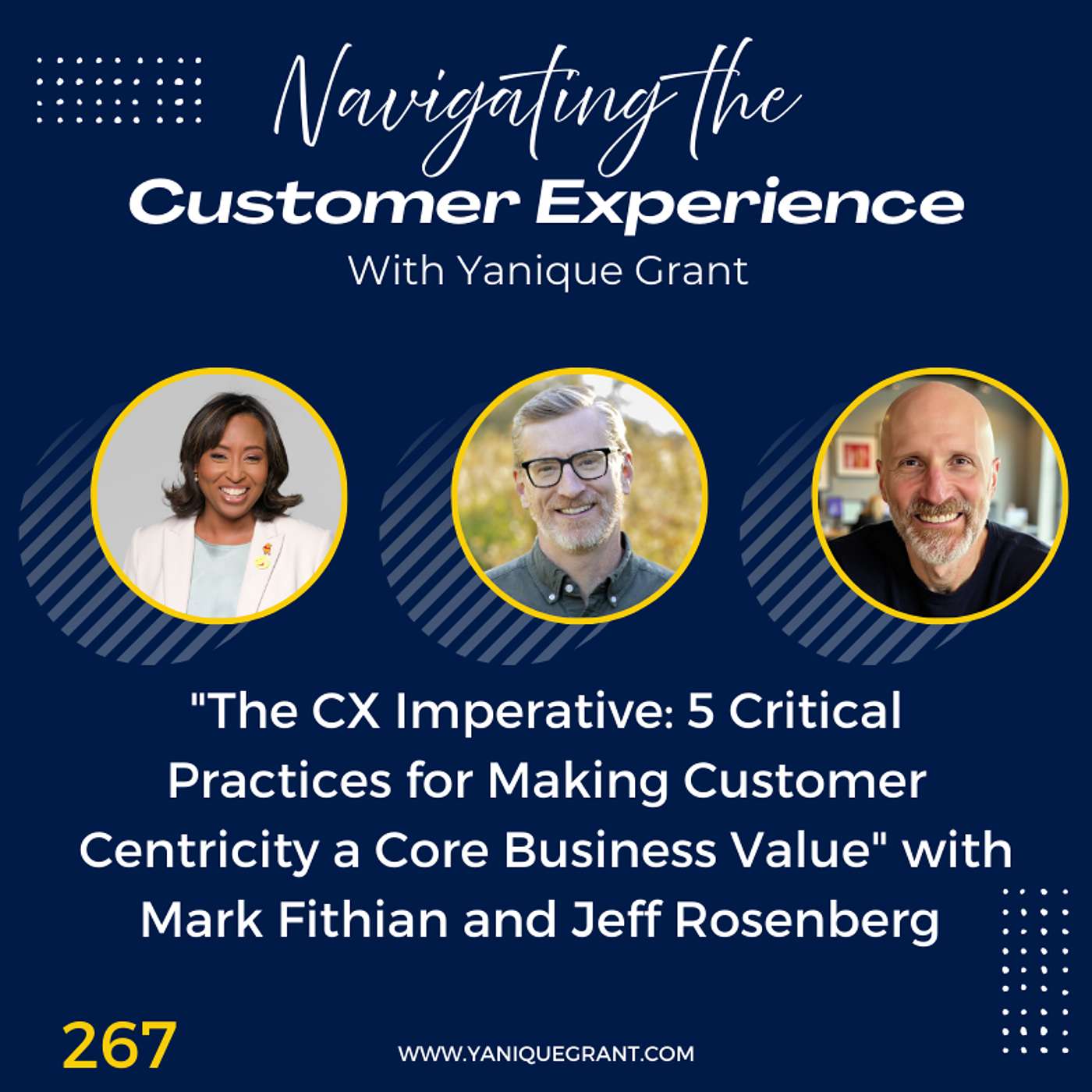
    267: The CX Imperative: 5 Critical Practices for Making Customer Centricity a Core Business Value with Mark Fithian and Jeff Rosenberg

    Send us Fan Mail In this episode of Navigating the Customer Experience, we sit down with Mark Fithian and Jeff Rosenberg, cofounders of WideOpen, a strategic customer experience (CX) consulting firm, and authors of the book The CX Imperatives: Five Strategic Practices for Renewal of the Customer-Centered Enterprise. With more than 30 years of experience each, Mark and Jeff bring deep insight from working across industries including healthcare, technology, automotive, consumer goods, and professional services. Mark and Jeff share their professional journeys and the “red thread” that has guided their careers: a commitment to understanding customers as humans, not just data points. From early roles in marketing, operations, and consulting, both authors describe moments when they realized organizations often make decisions without considering how customers truly experience them. That realization ultimately led to the founding of WideOpen and the development of the frameworks outlined in their book. The conversation centers on The CX Imperatives and its purpose as a practitioner’s guide for CX leaders and professionals who already care about customer experience and want to embed customer centricity across the enterprise. Rather than focusing on one-off “wow moments,” the book emphasizes creating consistent, meaningful experiences across the entire customer journey that align with business strategy and drive growth and innovation. Importantly, the authors stress that the principles are industry-agnostic, applicable to both B2B and B2C organizations of all sizes. Mark outlines the book’s five strategic CX practices: Insights – deeply understanding customers as emotional, human beings, not just metrics; CX Strategy – aligning customer insights with business objectives to focus effort where it matters most; Blueprinting – translating strategy into operationally actionable designs; Operating Model – enabling cross-functional collaboration through roles, processes, and shared accountability; and Culture – ensuring employees understand, believe in, and are equipped to deliver the intended experience. Through real-world examples, including healthcare, Mark and Jeff demonstrate how engaging frontline employees and embedding CX into culture can generate both tangible outcomes (cost savings, growth initiatives) and intangible benefits (employee ownership, sustainability, and trust). The discussion also explores the connection between internal culture and external customer experience, with both guests agreeing that consistently poor CX is often a symptom of internal organizational challenges. They share practical advice for CX leaders navigating varying levels of leadership support, emphasizing the importance of meeting stakeholders where they are and addressing resistance with empathy and clarity. To bring CX to life, Mark and Jeff each share standout customer experiences—from thoughtful airline journey improvements to an unexpectedly empowering healthcare onboarding experience—illustrating how intentional design can transform how customers feel. The episode wraps with personal insights into the tools, books, and mindsets that inspire them today, reflections on why this is an exciting time for the CX discipline, and where listeners can connect with them and learn more about their work, workshops, and book. This episode is a must-listen for leaders and practitioners looking to move beyond surface-level CX and build customer-centered enterprises that deliver sustainable value for both customers and the business.

  • January 6 · 22 min

    266: Leading From the Inside Out: Voice, Peace, and the Power of People with Jeremie Kubicek

    Send us Fan Mail In this episode of Navigating the Customer Experience, we sit down with Jeremie Kubicek, a powerful communicator, serial entrepreneur, and co-founder of GiANT, a global leadership development company. Jeremie is the author of several influential leadership books, including 5 Voices, 5 Gears, The 100X Leader, The Peace Index, and his newest release, The Voice-Driven Leader. Jeremie shares his entrepreneurial journey and explains how years of building businesses taught him a critical lesson: while business plans and financial plans matter, it is the people plan that most often determines success or failure. Early in his career, he realized that people were often treated as liabilities rather than assets. This insight led him to dedicate his work to helping leaders understand, develop, and empower people so they can truly thrive. At the heart of the conversation is Jeremie’s new book, The Voice-Driven Leader. He explains that the most important role in any organization is the team leader—the person who leads people day-to-day. Using the metaphor of a “Sherpa,” Jeremie emphasizes that when a leader is healthy and self-aware, the team they lead is far more likely to be healthy as well. The book helps leaders understand their own voice, personality, and wiring, as well as the voices of those they lead, so they can communicate more effectively and create meaningful development plans. Jeremie outlines several core leadership principles, especially for those transitioning from peer to leader. These include learning to “speak the language” of others rather than forcing them to adapt to your style, clearly defining expectations and development paths, and guiding people through the discomfort of learning—what he calls the “pit of despair.” By understanding how people are wired and how they respond under stress, leaders can better support growth and avoid unnecessary breakdowns. The conversation also explores how communication has evolved, particularly across generations, and how small misunderstandings—tone, emojis, or short messages—can unintentionally damage relationships if leaders are not intentional and aware. Jeremie shares what excites him most right now: his focus on the idea that peace is power. He explains that leaders cannot give what they do not possess. If a leader is not at peace internally, their leadership and customer experience efforts will feel transactional rather than authentic. He introduces The Peace Index, a practical framework that helps individuals assess peace across five areas of life, reinforcing the idea that personal well-being directly impacts professional effectiveness. Listeners also hear about the tool Jeremie uses daily—the 5 Voices App, an AI-powered resource designed to help people navigate communication, relationships, and leadership based on personality dynamics. He recommends Unreasonable Hospitality by Will Guidara as a book that deeply influenced his thinking on journeys, employee experience, and customer experience. Jeremie closes by sharing simple yet powerful phrases he uses during challenging times, including “Choose joy” and “Call up, not out,” reminding us that leadership begins within. This episode is a compelling reminder that great customer experiences start with healthy, self-aware leaders who are alive, at peace, and intentional about how they show up every day. Connect with Jeremie Kubicek www.jeremiekubicek.com

  • Dec 9, 2025 · 28 min

    265: Why Feelings Drive Growth: Emotional Equity, Belonging & Brand Transformation with Jean-Pierre LaCroix

    Send us Fan Mail In this episode of Navigating the Customer Experience, we sit down with Jean-Pierre LaCroix—President and Chief Strategy Officer of SLD, brand visionary, author, and creator of groundbreaking tools such as the Trust Ladder and the Ideal Omni Experience Model. With more than 46 years of experience helping global organizations transform their retail, brand, and customer experience ecosystems, Jean-Pierre brings deep insight into what it truly takes to build emotionally resonant brands. Jean-Pierre begins by sharing his personal journey—from growing up on an Air Force base in Germany to working long days on his family’s farm, to discovering his passion for design at Sheridan College. Launching his first firm just two years after graduating, he eventually built SLD into a leading global strategic design agency. He then dives into his latest book, ThinkBlink Manifesto, which distills decades of experience into seven core tenets for creating emotionally connected brands. Jean-Pierre explains why emotional equity—not features, benefits, or promotions—is what customers respond to most deeply. The seven tenets include: Owning the Emotional Moment Personifying the Emotional Value Through Design Communicating a Compelling Brand Story Understanding Target Personas Beyond Demographics Creating Belonging Experiences Measuring What Truly Matters (Emotional Metrics) Future-Proofing the Brand Jean-Pierre discusses how leaders can shift beyond pre-COVID thinking by embracing new metrics, strengthening community and belonging for employees and customers, and leveraging SLD’s newly launched ThinkBlink AI Assessment tool to evaluate emotional connection, differentiation, and future readiness. He also highlights companies that exemplify these principles—such as Apple, Harley-Davidson, and Canadian innovator Cineplex—organizations that have built loyalty and community through purpose-driven experiences. A voracious reader, Jean-Pierre shares the books that have shaped him most, including Blue Ocean Strategy, The Challenger Mindset, and Nudge. He also opens up about what he’s currently excited about: becoming a grandfather and being invited once again as a keynote speaker at the Financial Brand Forum. To close the episode, he shares his personal mantra for challenging times: “Leadership is about seeing the opportunity in the challenges versus the challenges in the opportunity.” Connect with Jean-Pierre on LinkedIn or visit www.sld.com for tools, insights, and free resources.

  • Nov 18, 2025 · 23 min

    264: No One-Size-Fits-All CX: Ty Givens on Playbooks, People and Performance

    Send us Fan Mail In this episode of Navigating the Customer Experience, we sit down with Ty Givens, the dynamic Founder and CEO of CX Collective, a consultancy known for building customer experience programs that scale while still feeling human. With a career that began at just 18 years old, Ty walks us through her remarkable journey from her first customer service desk at Office Depot to leading global teams and eventually launching her own company nine years ago. Ty shares how an early promotion into workforce management shaped her analytical mindset and laid the foundation for her future leadership roles. After years of being called in to “fix” support operations, she recognized that real transformation requires more than one person—it requires systems, collaboration, and a dedicated team. That realization became the catalyst for starting CX Collective. One of her greatest rewards today is witnessing the tangible results of her team’s work—whether it's improving a help center’s searchability or strengthening an AI knowledge base. Ty describes herself as results-driven and energized by project-based outcomes that create long-term value for clients. Ty also opens up about the emotional challenges of leading support teams. Early leadership training at Intuit, combined with her MBA in Organizational Leadership, helped her develop a grounded approach centered on emotional intelligence, inquiry, and humility. Recognizing her strengths as an operator rather than a novice-leader coach, she began developing CX playbooks—practical guides that help leaders navigate common challenges, from time management to launching AI programs. These playbooks have become both her most essential tool and a source of self-reflection. Ty talks about the importance of community, staying curious about industry trends, and the advantage of having worked inside many different organizations. She also shares the fiction authors who shaped her love for storytelling—Eric Jerome Dickey and Carl Weber—and why their writing continues to resonate. We also explore what Ty is most excited about these days: celebrating her niece’s freshman year at Tuskegee University and being stretched professionally as she leans into marketing her playbooks to a broader audience—an entirely new frontier after years of organic, word-of-mouth growth. Ty closes the conversation with two powerful affirmations from her grandparents that guide her through adversity: “You can do anything you put your mind to,” and “Lace up your bootstraps.” These messages remind her to stay grounded, confident, and ready to face whatever comes. Connect with us on X @navigatingcx and join our private Facebook community, Navigating the Customer Experience.

  • Nov 4, 2025 · 18 min

    263: Empowering Teams and Elevating CX with Jamie Homen

    Send us Fan Mail In this episode of Navigating the Customer Experience, we dive deep into the career and mindset of Jamie Homen, a seasoned customer experience (CX) leader with over 20 years in the industry. Now leading CX at Mural, an AI-powered visual collaboration platform, Jamie shares valuable perspectives on effective leadership, cross-functional alignment, and how customer-centric decisions drive business success. 🛤️ Jamie’s Journey into Customer Experience Starting as a call center agent, Jamie never anticipated becoming a Chief Customer Officer. He has watched the field mature and is now thrilled to see customer experience earn a seat at the executive table. At Mural, he’s helping customers visualize collaborative work in a remote world, which he believes is central to modern CX strategies. 💡 Key Leadership Insights To drive customer success in today’s dynamic environment, Jamie focuses on two major practices: Cross-Functional Alignment: Ensuring teams like sales, marketing, product, and CX operate cohesively. He emphasizes co-creation to close gaps and build customer-centric processes. Empowering Teams: Encouraging employees at all levels to make customer-first decisions, supported by ongoing development and understanding of individual skill sets—especially as AI reshapes roles. 🧠 Overcoming Challenges Jamie shares a personal story: in high school, he was told he shouldn't pursue college. Refusing to let that define him, he pushed forward and earned three degrees. This experience now fuels his belief in perseverance and self-motivation—key traits he brings into his leadership. 🛠️ Can’t-Live-Without Tool ChatGPT tops Jamie’s list for its ability to generate ideas, create personas, and gather insights. He predicts a growing shift from traditional search platforms to AI-powered tools across industries. 📚 Book Recommendation Managing Up by Rosanne Badowski has had a lasting impact on Jamie’s leadership approach, especially in building effective relationships with managers—a skill he considers timeless despite changing workplace technology. 🤖 What’s Exciting Jamie Now AI transformation. He’s focused on integrating AI across Mural to better understand customers and enhance internal workflows without losing the human element—AI as an enabler, not a replacement. 💬 Favorite Quote “Adversity introduces a man to himself.” — Albert Einstein Jamie uses this quote as a reminder to reflect, grow, and persist through obstacles. 🔗 Connect with Jamie LinkedIn – Jamie Homen Website – mural.co/blog Thanks for tuning in! Be sure to follow us on X @navigatingcx and join our private Facebook community: Navigating the Customer Experience.

Showing 1–20 of 21 episodes