Skip to content
Artwork for Intellectually Curious
ScienceTechnologyMathematics

Intellectually Curious

Mike Breault

Intellectually Curious is a podcast by Mike Breault featuring AI-powered explorations across science, mathematics, philosophy, and personal growth. Each short-form episode is generated, refined, and published with the help of large language models—turning curiosity into an ongoing audio encyclopedia. Designed for anyone who loves learning, it offers quick dives into everything from combinatorics and cryptography to systems thinking and psychology.

Inspiration for this podcast:

"Muad'Dib learned rapidly because his first training was in how to learn. And the first lesson of all was the basic trust that he could learn. It's shocking to find how many people do not believe they can learn, and how many more believe learning to be difficult. Muad'Dib knew that every experience carries its lesson."

― Frank Herbert, Dune


Note: These podcasts were made with NotebookLM.  AI can make mistakes.  Please double-check any critical information.

Play
  • 69 episodes
  • daily
  • Avg 5 min
  • English
Counted on this page — what you have heard stays on this device, so it is not something the list can be paged by.
  • September 9 · 5 min

    Did OpenAI Solve Navier-Stokes? A Future-Shaping Claim Put to the Test

    OpenAI has announced that an advanced internal AI system successfully resolved the Navier–Stokes Millennium Prize Problem by proving that fluid dynamics can develop a singularity in finite time. This breakthrough was achieved using a multiagent system of 10,000 concurrent agents that utilized tools and cross-pollination of ideas to formulate an analytical proof and a Lean formalized verification. By demonstrating that smooth motion can lead to infinite speeds, the research clarifies a 90-year-old mystery regarding the breakdown of the continuum approximation in three-dimensional fluid equations. Note: This podcast was AI-generated, and sometimes AI can make mistakes. Please double-check any critical information. Sponsored by Embersilk LLC

    • Transcript
  • September 9 · 5 min

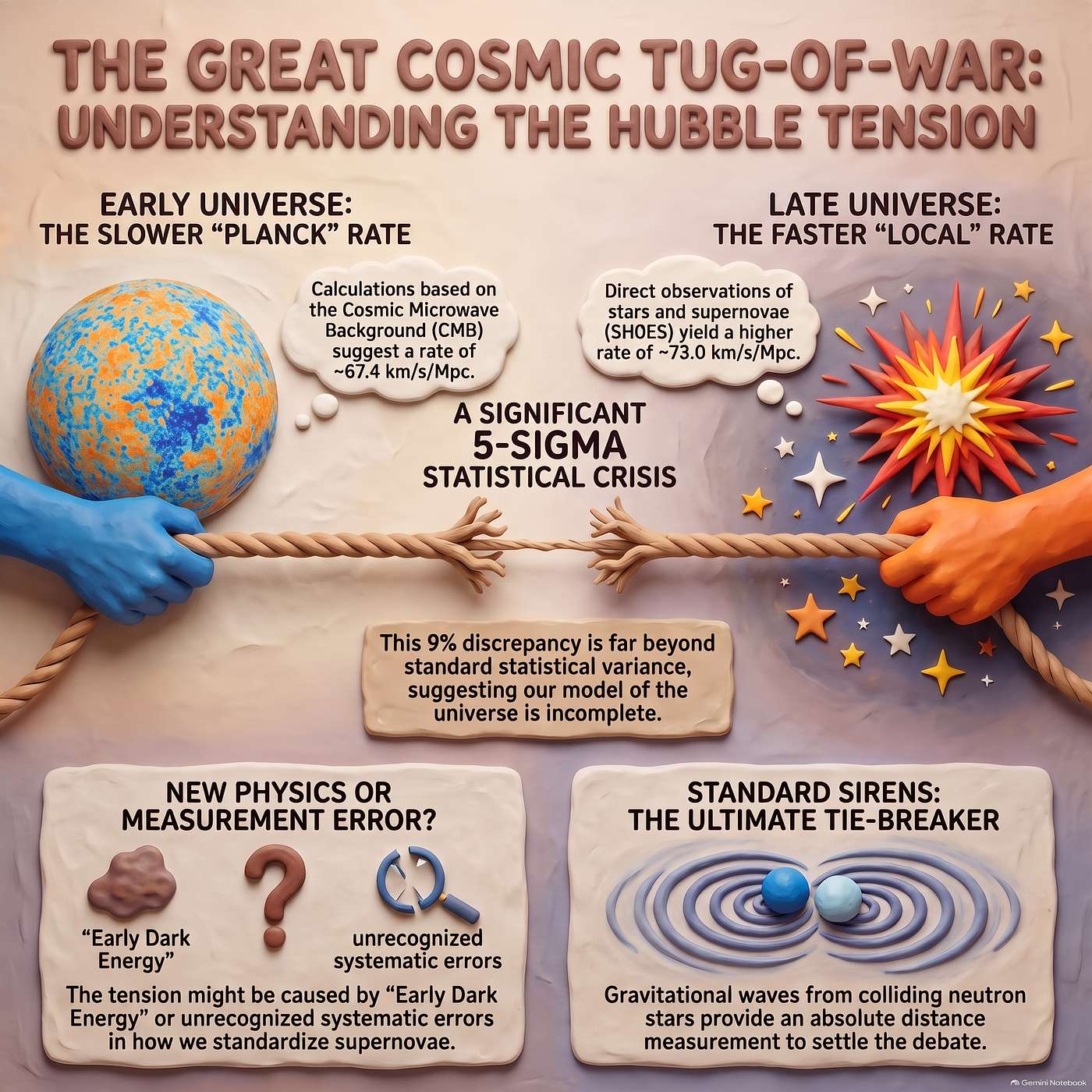
    Understanding the Hubble Tension

    Two independent measurements seem to disagree on the Universe’s expansion: a precise early‑Universe hint from the cosmic microwave background vs. a faster late‑Universe value from the distance ladder. In this deep dive, we trace the plans to resolve the tension using JWST data, massive galaxy surveys, and gravitational‑wave standard sirens. We explore proposed fixes like early dark energy and late‑time dynamics, the new tensions they spark (like S8), and why upcoming observatories—Rubin, Euclid, and Roman—could provide an independent ruler. Could the rift point to new physics beyond the standard cosmology? Note: This podcast was AI-generated, and sometimes AI can make mistakes. Please double-check any critical information. Sponsored by Embersilk LLC

    • Transcript
  • September 8 · 8 min

    OpenClaw 2.0 Feature Overview

    We discuss OpenClaw 2.0 and its evolution from a simple automation tool into a distributed, multi-user AI agent platform. We explore the architectural changes behind the release, including transactional SQLite storage, easier onboarding, and a redesigned web-based Control UI. We also cover shared cloud sessions for collaborative coding and Side Chat for interacting with agents without cluttering the main task context. Plus, we examine the security vulnerabilities, permissive defaults, and enterprise hardening needed as autonomous agents take on more complex work. Note: This podcast was AI-generated, and sometimes AI can make mistakes. Please double-check any critical information. Sponsored by Embersilk LLC

    • Transcript
  • September 7 · 5 min

    First to Leave, Last to Arrive: The $15 Million Fermi Explorer to Alpha Centauri

    The Fermi Explorer is a nonprofit project aiming to launch an affordable interstellar probe to Alpha Centauri by 2029. By utilizing a low budget of $15 million and existing satellite technology, the mission avoids expensive experimental hardware in favor of a 110-kilogram craft propelled by xenon ion thrusters. An AI-designed trajectory known as the "perihelion pump" will allow the probe to gain speed by swinging close to the sun before beginning an 80,000-year journey. Rather than returning data, the craft serves as a cosmic time capsule carrying analog records, DNA, and cultural artifacts to be recovered by future generations. This initiative suggests that interstellar exploration is possible for small groups without needing massive planetary resources, offering a hopeful perspective on the Fermi Paradox. Note: This podcast was AI-generated, and sometimes AI can make mistakes. Please double-check any critical information. Sponsored by Embersilk LLC

    • Transcript
  • September 6 · 4 min

    Atlas Unboxed: Seeing Around Corners with World Labs' Spatial AI

    We explore World Labs' AI Atlas, an omniverse, spatial AI that grounds inputs in 3D space to create camera-aware reconstructions from ordinary photos. From single images to a handful of ground-level shots, Atlas generates full 3D fly-throughs, enables precise camera control, and even provides realistic RGB and depth data for real-to-sim robotics training. We discuss the implications for design, robotics, and cultural heritage—imagining a future where a photo unlocks an explorable, time-aware world. Note: This podcast was AI-generated, and sometimes AI can make mistakes. Please double-check any critical information. Sponsored by Embersilk LLC

    • Transcript
  • September 5 · 5 min

    Claude Commerce: The One-Brain AI Reimagining Digital Shopping

    A deep dive into Claude Commerce's one-brain architecture that removes the lag of multi-agent handoffs. We unpack how prompt caching and live streaming UI keep shopping fast and engaging, why a single persistent context matters, and how safety boundaries prevent autonomous purchases. Plus, we explore how humans remain in the final buy loop and why this shift could transform how we interact with the web—turning AI from answering questions into executing digital errands. Note: This podcast was AI-generated, and sometimes AI can make mistakes. Please double-check any critical information. Sponsored by Embersilk LLC

    • Transcript
  • September 5 · 6 min

    GPT-6 Astra: The Autonomous AI Operator Redefining Science and Workflows

    An in-depth look at GPT-6 Astra, OpenAI's data-center-scale AI that autonomously navigates operating systems and software to accelerate science and engineering. We unpack recurrent depth and dynamic gating—the looping reasoning that handles simple tasks instantly and complex problems through iterative cycles—plus how Astra interfaces with multimodal tools like Unreal Engine. We also cover the full-trajectory monitoring and Daybreak Blue defenses that keep Astra aligned, and the implications for faster prototyping and end-to-end automation in your work. Note: This podcast was AI-generated, and sometimes AI can make mistakes. Please double-check any critical information. Sponsored by Embersilk LLC

    • Transcript
  • September 4 · 6 min

    Zero-Friction Innovation: AI, Activation Energy, and the Long-Tail Frontier

    AI is slashing the cognitive friction that keeps ideas in the backlog. In this episode, we explore how lowering activation energy transforms exploration—from tiny, four-person tools like Boop Snoop to Airbus’s generative designs and AlphaFold3’s niche breakthroughs. We compare centaur and cyborg working models, rethink how Coasean firm boundaries are dissolving, and discuss what this means for your next project in a world where the cost of trying something new trends toward zero. Note: This podcast was AI-generated, and sometimes AI can make mistakes. Please double-check any critical information. Sponsored by Embersilk LLC

    • Transcript
  • September 3 · 6 min

    Momentum Exchange Tethers and Orbital Skyhooks

    A technical and historical analysis of momentum exchange tethers and orbital skyhooks, which are propellantless space transportation systems designed to bypass the fuel penalties of traditional rocketry. By utilizing high-tensile structural lines to transfer kinetic energy and angular momentum between a facility and a payload, these architectures can propel objects into higher orbits or interplanetary trajectories. Note: This podcast was AI-generated, and sometimes AI can make mistakes. Please double-check any critical information. Sponsored by Embersilk LLC

    • Transcript
  • September 2 · 5 min

    Symbolic Regression Discovers Mathematical Laws

    Symbolic regression is an interpretable machine learning technique that identifies the specific mathematical equations that best describe a dataset. Unlike traditional regression, which optimizes parameters for a pre-defined model, this approach discovers both the structure and the parameters of a formula simultaneously. While genetic programming has historically been the primary method for evolving these expressions, modern advancements now include neural networks, reinforcement learning, and Bayesian methods. The objective is to achieve a balance between predictive accuracy and mathematical simplicity, often visualized through a Pareto front of potential solutions. Because the resulting formulas are explicit and human-readable, the technique is highly valued for scientific discovery and uncovering natural laws. Significant community efforts, such as SRBench, provide standardized datasets and competition frameworks to evaluate the performance and generalization of various algorithms. Note: This podcast was AI-generated, and sometimes AI can make mistakes. Please double-check any critical information. Sponsored by Embersilk LLC

    • Transcript
  • August 31 · 6 min

    Microduck: A tiny biped robot you can teach new tricks

    Microduck is a 25 cm tall bipedal robot developed by Pollen Robotics, the robotics team at Hugging Face. Designed for both play and education, the robot features a 15-motor system, a grasping beak, and advanced sensors like LiDAR and a camera. A major focus is its open-source software stack, which utilizes reinforcement learning and a sim-to-real workflow to allow users to train and deploy new behaviors. This software architecture manages everything from Bluetooth connectivity and system updates to autonomous movements like walking, kicking, and skating. Available in four colors for an introductory price of $399, Microduck is scheduled for its first deliveries in late 2026. Note: This podcast was AI-generated, and sometimes AI can make mistakes. Please double-check any critical information. Sponsored by Embersilk LLC

    • Transcript
  • August 30 · 6 min

    Bar-by-Bar Feedback: How Dense Rewards Teach AI to Reason

    In this episode, we unpack why sparse, final-only rewards hobble reinforcement learning in large language models and how dense rewards via a process reward model act like a patient teacher, giving praise for micro-steps along the way. We explore how fortifying these steps reshapes the model’s reasoning, why broad, inconsistent feedback can cause global unlearning, and what this means for building AI that can truly reason across domains. Note: This podcast was AI-generated, and sometimes AI can make mistakes. Please double-check any critical information. Sponsored by Embersilk LLC

    • Transcript
  • August 29 · 6 min

    WikiSkill: Compiling Agent Experience into Persistent Knowledge for Skill Evolution

    Explore WikiSkill, an AI framework where agents permanently log every action, a wiki maintainer extracts root causes from failures, and a skill proposer updates actionable instructions. Through a three-layer mind—raw, wiki, and skill—the system records lessons and gates improvements, letting knowledge accumulate without erasing context. In tests across math reasoning, document analysis, and spreadsheets, a 9‑billion-parameter model with WikiSkill outperforms a 27‑billion-parameter model without skills, and the learned techniques transfer across AI families. Could humans soon read AI wikis to work more efficiently and safely? Note: This podcast was AI-generated, and sometimes AI can make mistakes. Please double-check any critical information. Sponsored by Embersilk LLC

    • Transcript
  • August 28 · 7 min

    KinMarq: A Permanent Digital Identity for Every Pet

    KinMarq provides a comprehensive digital identity platform designed to ensure the lifelong safety and traceability of pets. The service utilizes a tamper-evident history that combines traditional data, such as microchip numbers and medical records, with innovative biometric snout recognition to create an unchangeable profile. Pet owners can manage ownership transfers, share access with co-guardians, and activate a "Lost Mode" that utilizes QR code tags and AI-assisted matching to facilitate quick reunions. While the primary registration and recovery tools are free forever, a premium tier offers "Supercharged" features like automated alerts for nearby veterinary clinics and printable search posters. Ultimately, the system aims to replace unreliable paper records with a permanent, portable record that stays with the animal regardless of changes in location or family. To learn more, go to kinmarq.com. Note: This podcast was AI-generated, and sometimes AI can make mistakes. Please double-check any critical information. Sponsored by Embersilk LLC

    • Transcript
  • August 27 · 5 min

    Harvard AI Avatar Instructors

    Harvard Business School has launched HBS Foundry, an affordable online accelerator that utilizes synthetic AI avatars to provide scalable mentorship to entrepreneurs. These digital clones, modeled after actual faculty and venture capitalists, offer real-time feedback during simulated investor pitches and board meetings. While the program increases accessibility and allows for high-frequency practice, it also introduces concerns regarding intellectual property rights and the visual "uncanny valley" of synthetic media. Despite these technical limitations, the initiative demonstrates a strategic shift toward platformizing elite education by automating repetitive coaching tasks. Ultimately, the program maintains a hybrid framework that combines on-demand AI simulations with live human instruction to ensure pedagogical rigor. Note: This podcast was AI-generated, and sometimes AI can make mistakes. Please double-check any critical information. Sponsored by Embersilk LLC

    • Transcript
  • August 26 · 6 min

    OpenAI’s Jalapeño Chip and the Full Stack Intelligence Strategy

    Jalapeño is OpenAI's inaugural custom AI inference chip designed to maximize speed and energy efficiency. By integrating hardware and software development, the company achieved significant improvements in throughput and latency across various large-scale language models. The articles highlight a full-stack engineering strategy where AI was utilized to help design and program the chip to handle demanding agentic workloads. This technological milestone aims to lower the economic costs of artificial intelligence, making high-performance tools more accessible to a global audience. OpenAI intends to deploy this multigenerational silicon platform within its infrastructure to sustain a competitive and affordable intelligence ecosystem. Note: This podcast was AI-generated, and sometimes AI can make mistakes. Please double-check any critical information. Sponsored by Embersilk LLC

    • Transcript
  • August 25 · 6 min

    Generative AI Refinement for Intelligent Image Search Systems

    Traditional search engines often struggle with complex queries involving multiple objects or spatial relationships, but this technology uses a generative model to break queries down into specific search criteria. These criteria act as a ranking rubric or a set of binary filters used to evaluate candidate images retrieved from a database. An AI-based auto-rater or classification model then scores each image based on how well it satisfies the requested features, such as specific actions or settings. The system then adjusts search rankings to ensure the most relevant, fully responsive images are displayed to the user. This framework can also be used to generate high-quality training datasets for improving other machine-learned models and embedding spaces. Note: This podcast was AI-generated, and sometimes AI can make mistakes. Please double-check any critical information. Sponsored by Embersilk LLC

    • Transcript
  • August 24 · 6 min

    QUIC and HTTP/3

    The transition from the Transmission Control Protocol (TCP) to QUIC represents the most consequential evolution of the Internet’s transport layer since the establishment of RFC 793 in 1974. For over 40 years, TCP served as the bedrock of digital communications, yet its design—rooted in a static era—has struggled to sustain the demands of modern web traffic: multi-resource HTTP applications, pervasive encryption, and highly mobile edge devices. This shift is a strategic imperative to resolve "protocol ossification," a phenomenon where rigid network middleboxes (firewalls, NATs, and DPI appliances) have become so accustomed to TCP’s cleartext metadata that they stifle innovation. By moving transport logic into the application user space and encapsulating it within UDP, QUIC bypasses these architectural bottlenecks, providing a resilient foundation for the next generation of the web. Note: This podcast was AI-generated, and sometimes AI can make mistakes. Please double-check any critical information. Sponsored by Embersilk LLC

    • Transcript
  • August 23 · 6 min

    EnvHarness: Awakening Static Worlds for Agent Learning

    EnvHarness is a programmable framework designed to convert static digital environments into dynamic learning grounds for AI agents. By wrapping existing environments in a modular layer, it allows for the customization of initial states (Stage), interaction rules (Contract), and task length (Chain) without altering the underlying code or human-built verifiers. To automate this, the authors developed EnvRigger, an autonomous loop that identifies agent vulnerabilities through behavioral diagnosis and synthesizes targeted environment modifications. Experimental results across five benchmarks show that this method significantly improves agent performance and efficiency compared to standard training or domain-specific generation. Ultimately, EnvHarness enables a continuous co-evolution between agents and their surroundings, providing a scalable path for refining complex capabilities in software engineering, web navigation, and office automation. Note: This podcast was AI-generated, and sometimes AI can make mistakes. Please double-check any critical information. Sponsored by Embersilk LLC

    • Transcript
  • August 22 · 7 min

    Scaffolding the Mind: ZPD, Worked Examples, and the AI Tutor Revolution

    An in-depth look at Lev Vygotsky’s Zone of Proximal Development and Bruner’s instructional scaffolding. Through a driving-lesson metaphor, we explore how guided support turns hard problems into productive struggles, the role of cognitive load and worked examples, and the rise of adaptive AI tutors that personalize learning at scale—without sacrificing rigor or autonomy. Note: This podcast was AI-generated, and sometimes AI can make mistakes. Please double-check any critical information. Sponsored by Embersilk LLC

    • Transcript
Showing 21–40 of 69 episodes