Skip to content
Artwork for Dharma Lab
ScienceHealth & FitnessMental Health

Dharma Lab

Dharma Lab

Modern neuroscience meets ancient contemplative wisdom, with Dr. Richard Davidson and Dr. Cortland Dahl

www.dharmalab.co
Play
  • 28 episodes
  • fortnightly
  • Avg 36 min
  • English
Counted on this page — what you have heard stays on this device, so it is not something the list can be paged by.
  • October 30 · 44 min

    The Shadow Side of Meditation

    In this episode of Dharma Lab, Cortland Dahl and Richard Davidson are joined by Center for Healthy Minds researchers Simon Goldberg, Polina Beloborodova, and Matt Hirshberg to examine the “shadow side” of meditation. When people report anxiety or other difficult experiences during practice, how can we tell whether meditation caused them? The group discusses what studies of meditation apps and mindfulness programs reveal, why intensive retreats are a different question, and how loneliness, support, and our expectations of practice shape what happens when we sit down to meditate. Enjoy! Watch on YouTube; Listen on Spotify or Apple Podcasts. If these conversations are useful, please consider subscribing to our YouTube channel. Referenced in this episode: Healthy Minds Program app — The free meditation app studied in the research discussed in this conversation. Beloborodova, P., et al. (2026). Prevalence and predictors of self-reported adverse experiences in digital meditation training: 2 randomized controlled trials. JMIR Mental Health, 13, e90602. https://doi.org/10.2196/90602 Hirshberg, M. J., Goldberg, S. B., Rosenkranz, M., & Davidson, R. J. (2022). Prevalence of harm in mindfulness-based stress reduction. Psychological Medicine, 52(6), 1080–1088. https://doi.org/10.1017/S0033291720002834 Baer, R. A. (2003). Mindfulness training as a clinical intervention: A conceptual and empirical review. Clinical Psychology: Science and Practice, 10(2), 125–143. https://doi.org/10.1093/clipsy.bpg015 Episode Field Guide with Flashcards Upcoming Events: * The Restless Mind — November: A gifted online week from Dharma Lab and ServiceSpace, November 14–21, exploring how to meet everyday stress, distraction, and overwhelm with greater clarity and ease. Bringing together ancient wisdom and modern neuroscience, the week features leading contemplatives and researchers including Robert Sapolsky, Laurie Santos, Mingyur Rinpoche, Judson Brewer, Sharon Salzberg, Martin Picard, Cortland Dahl, and Richard Davidson. Learn more / register In This Episode: 00:00 Intro - The Shadow Side of Meditation01:32 Meet the Researchers03:17 Why Study Meditation’s Side Effects?06:12 Difficult Experiences vs. Harmful Effects14:48 More Anxiety, or More Awareness?15:55 Loneliness and Social Support19:26 When Difficult Practice Can Be Helpful22:19 How Common Are Negative Experiences?26:40 What Controlled Studies Reveal30:24 Is Meditation Right for Everyone?34:07 What the Research May Be Missing35:51 When Practice Feels Like It’s Going Backwards39:55 Self-Compassion and Knowing When to Step Back41:00 How Expectations Shape Meditation Written transcript for those who prefer to read Lightly edited for readability from the supplied edited transcript. Chapter timestamps follow the edited recording, including the opening teaser. Spoken claims and figures are retained as stated. 00:00 Intro - The Shadow Side of Meditation Cort: There have been a lot of headlines coming out of a lot of the research that’s happened over the years about a supposed dark side to meditation. Does meditation put us at risk for difficult mental, emotional, perhaps even physical experiences? Polina: We found in this paper that about 30% of the participants across both of our studies did have some sort of negative experiences during their meditation training. Again, these may not have been caused by meditation training, but have been subjectively attributed by participants to the meditation training. Matt: What’s the view that people bring to meditation? What’s the conceptual understanding of what meditation is supposed to do? Because if your motivation is to not feel sad, and you believe meditation should be the absence of sadness, and you experience sadness in meditation, then your subjective experience of that is going to be very different than someone who feels like, “Well, my motivation is to train the mind and develop equanimity. And I expect that anything that can arise will arise in meditation.” And so when sadness arises, then, like you said, Cort, like people have just reflected, that actually might be an invitation to develop that equanimity. 01:32 Meet the Researchers Cort: Welcome, everyone, to another episode of Dharma Lab. I am Cortland Dahl, your co-host, along with world-renowned neuroscientist Dr. Richard Davidson, who many of you probably know. We are here to have a really important and what I think will be a very interesting discussion about the shadow side of meditation. There have been a lot of headlines coming out of a lot of the research that’s happened over the years about a supposed dark side to meditation. Does meditation put us at risk for difficult mental, emotional, perhaps even physical experiences? This has been a major topic of research, including the research that we’ve done at the Center for Healthy Minds. So we’re going to unpack that a little bit. What does the science really say? There are actually some very surprising and even counterintuitive findings here, and we have an all-star panel to have this discussion. Here joining Richie and me are Polina Beloborodova, who is a social psychologist and a postdoctoral research associate at the Center for Healthy Minds. We’ve also got Simon Goldberg. He’s an associate professor in counseling psychology at UW–Madison, also one of our colleagues at the Center for Healthy Minds. And finally, Matt Hirshberg, another colleague from the Center for Healthy Minds and a research assistant professor at the Center. All three of our colleagues, in addition, of course, to Richie, are some of the leading researchers on this topic. So, Richie, why don’t I turn it over to you? Maybe you could provide a little bit of context. Why is this even on the map of scientific research? And then we can dive into the specific paper that was published recently and some of what we’ve learned. 03:17 Why Study Meditation’s Side Effects? Richie: Meditation and related practices today are being used in a wide range of contexts, one of which is with individuals with elevated rates of depression and anxiety and other kinds of psychiatric issues. Whenever we are dealing with interventions, particularly when they’re applied to patient populations, in addition to looking at the beneficial outcomes, we always want to monitor for side effects, if you will. This is something that is true of really all areas of clinical science, whether it’s a medication trial for a physical disease or a behavioral intervention for a psychiatric problem. We really need to, as researchers, be attentive to the possibility that, of course, although our motivation in utilizing these interventions is to benefit people, there are times when the interventions that we’re working with can actually either not have much effect or potentially even produce harm. It’s our obligation and responsibility to carefully and honestly characterize these potential side effects and publish them so that we can be alert to these possible dangers. Of course, one of the most important issues is: Can we predict who might be likely to have a possible negative effect and, in that way, ameliorate the possibility up front, if you will, so that we can tailor the interventions more specifically to those who are most likely to actually have benefit? So that’s the broad framing. In the area of meditation, there have been a number of scientists at very respectable institutions who have published some observations about possible negative side effects. It underscores the importance of taking this seriously, and this is something that we at the Center for Healthy Minds have been doing for quite some time. We really have the all-star team here. I’d like to first turn it over to Polina, who has published a very recent paper. She’s the first author of this paper on potential adverse experiences associated with digital forms of meditation training, something that has not been extensively examined in the past. So, Polina, please tell us what you found and give us some insights about … This is a public episode. If you'd like to discuss this with other subscribers or get access to bonus episodes, visit www.dharmalab.co/subscribe

    • Transcript
  • #41
    October 15 · 44 min

    The Neuroscience of Gratitude

    We often think of gratitude as a response to something good happening. But it’s also a skill we can practice. In this episode of Dharma Lab, Cortland Dahl and Richie Davidson explore how to notice and savor everyday moments of gratitude, and extend that appreciation to people we find difficult. They discuss research by psychologist Sonja Lyubomirsky and her colleagues on why writing a gratitude letter can be especially powerful, and share small practices they use in their own lives. Enjoy! Sources: Regan, A., Walsh, L. C., & Lyubomirsky, S. (2023). Are Some Ways of Expressing Gratitude More Beneficial Than Others? Results From a Randomized Controlled Experiment. Affective Science, 4(1), 72–81. https://doi.org/10.1007/s42761-022-00160-3 Watch on YouTube; Listen on Spotify or Apple Podcasts. If these conversations are useful, please consider subscribing to our YouTube channel. Episode Companion Flashcards: Upcoming Events: * The Restless Mind — November: A gifted online week from Dharma Lab and ServiceSpace, November 14–21, exploring how to meet everyday stress, distraction, and overwhelm with greater clarity and ease. Bringing together ancient wisdom and modern neuroscience, the week features leading contemplatives and researchers including Robert Sapolsky, Laurie Santos, Mingyur Rinpoche, Judson Brewer, Sharon Salzberg, Martin Picard, Cortland Dahl, and Richard Davidson. Learn more / register In This Episode: 00:00 — Gratitude Is a Skill: A Preview01:12 — Welcome: A Celebration of Richie03:16 — What It Feels Like to Receive Gratitude07:56 — How Gratitude Spreads10:10 — Making Space for Appreciation11:16 — The Science of Training Gratitude13:57 — Why Writing a Gratitude Letter Helps15:12 — How to Practice: Start Where It’s Easy18:09 — Everyday Gratitude: A Moment with a Stranger19:54 — Recognizing and Savoring Gratitude22:22 — What Happens in the Brain?24:40 — The Insula and Feeling Gratitude in the Body27:11 — Why Expressing Gratitude Benefits You, Too28:56 — Intentional Practice: What Science Has Yet to Establish30:56 — Extending Gratitude Beyond Your Inner Circle32:19 — Gratitude Toward Difficult People36:10 — Richie’s Practice: Appreciation, Emails, and Constructive Feedback40:03 — Cort’s Practice: Finding Appreciation in Ordinary Things41:53 — Three Things: A Gratitude Ritual Before Bed43:11 — Closing Gratitude Written transcript for those who prefer to read: 00:00 — Gratitude Is a Skill: A Preview Richie: Her work really convincingly shows that gratitude can be trained, that you can improve this by engaging in various intentional exercises to cultivate gratitude. And when you do that, it improves well-being more generally. Cort: The thing that I’ll always remember is an instruction I got from Mingyur Rinpoche. When he was teaching appreciation as a meditative practice, he was talking about these very mundane things. Like you can even start with yourself, just appreciate the fact that you brush your teeth, appreciate that you got out of bed in the morning. And I thought, “Rinpoche, come on.” It felt so mundane. I wanted some mind-blowing, transcendent experience or something. Cort: But when I practiced it, I realized actually that is precisely the power of it, because then it is everywhere. If you just get used to noticing that, that is the profundity of it. It’s just that it’s all around you. 01:12 — Welcome: A Celebration of Richie Cort: Welcome everyone to another episode of Dharma Lab. I am Cortland Dahl, your host, along with my co-host and dear friend and Dharma brother and world-renowned neuroscientist, Dr. Richie Davidson. Today we would talk about appreciation and gratitude, which is a very, very timely topic for us because we just came off a couple days where I would say in my entire life, actually, I’ve never had a few days that were so infused with gratitude. And the cause for that was Richie, actually. Some students of Richie from decades back made a plan actually years ago. I got an email actually two years ago, with a save the date for a celebration of Richie and his career and his life by some people who have been working with him for decades. Cort: And this culminated in these few days where we really were just sharing both our own lives and our own experience, but especially the many, many ways that we have all had our lives transformed and been benefited by you, Richie. So I’m kind of putting you on the spot here because it was also quite unique for you. You basically had three days or a few days, two or three days of just endlessly receiving the gratitude of others. And it was amazing. I’ve never experienced anything like this. I can’t imagine what it was like for you, Richie. But it was the kind of thing that I think a few of us were talking after the fact. Cort: Unfortunately, it’s the kind of thing that oftentimes only happens when somebody’s passed away, strangely. We oftentimes don’t say the things until, it’s sort of too late. And this was just a beautiful example where we didn’t wait. We took that opportunity to share the gratitude we all feel for you. And so maybe Richie, I’ll just start with what it was like for you to be on the receiving end of that and what your experience of this was. 03:16 — What It Feels Like to Receive Gratitude Richie: Yeah, I mean it was humbling and a bit overwhelming at times. There was on Friday a three-and-a-half-hour data blitz where 26 of my former trainees, either graduate students or postdocs or collaborators, each gave seven-minute talks and talked about how their current work was influenced by the time they were in our center or lab. And I was asked to give some remarks. At the end, and I got up there, and I certainly wasn’t planning on this, but I just burst out crying. And really it took a while for me to gain my composure, but I just felt a deep sense of gratitude toward them for all they’re doing and for carrying on. Richie: This work and a kind of hopefully not an arrogant pride but a quiet pride in the work that they’re doing. I was really proud of them for all they’re doing and many of these people are doing cutting edge science that is really of great benefit to humanity. I have no doubt that the world is much better for their presence. It was so deeply moving to me people came from China, from Europe, from Mexico, from really all over the world I was just so incredibly touched You know, I think that there’s a community that was formed and I think all of us really felt that sense of community and one of the people who was there who was so close to me and I’ve known her for forty years was Roshi Joan Halifax. Richie: And for those of you who know something about Roshi, you’ll know what I’m talking about. For those of you who don’t, Roshi is someone who brings her practice to the world, to everyday life. And really has a very, very palpable, deep ethical core that you feel. That she brings to the work she’s done with people who are dying, with people who are incarcerated with people who have been living in adversity, who’ve been unfortunate victims of natural disasters, and the list goes on. And she is an embodiment of that and it was so beautiful to share this with her and with so many others. Richie : So yeah, I’m still feeling very much these ripples and people who weren’t there who couldn’t make it have been sending me videos. I just got one from Angela Duckworth like five minutes ago. Really beautiful. Recounting a very specific instance which I don’t remember honestly of an interaction between us and it was a beautiful interaction you know, from her description I can feel it. So I just truly feel very blessed and I’ll end here. I feel that all of this I think gave each of us a taste of the power of gratitude because we all felt that this was something that contributed to our collective flourishing. Richie : And I think it’s fair to say that everyone who participated in these three days of events they just their heart was really open and we all were incredibly connected, even those who were meeting… This is a public episode. If you'd like to discuss this with other subscribers or get access to bonus episodes, visit www.dharmalab.co/subscribe
    • Transcript
  • October 2 · 3 min

    You don’t have to turn ambition off; September AMA with Cort

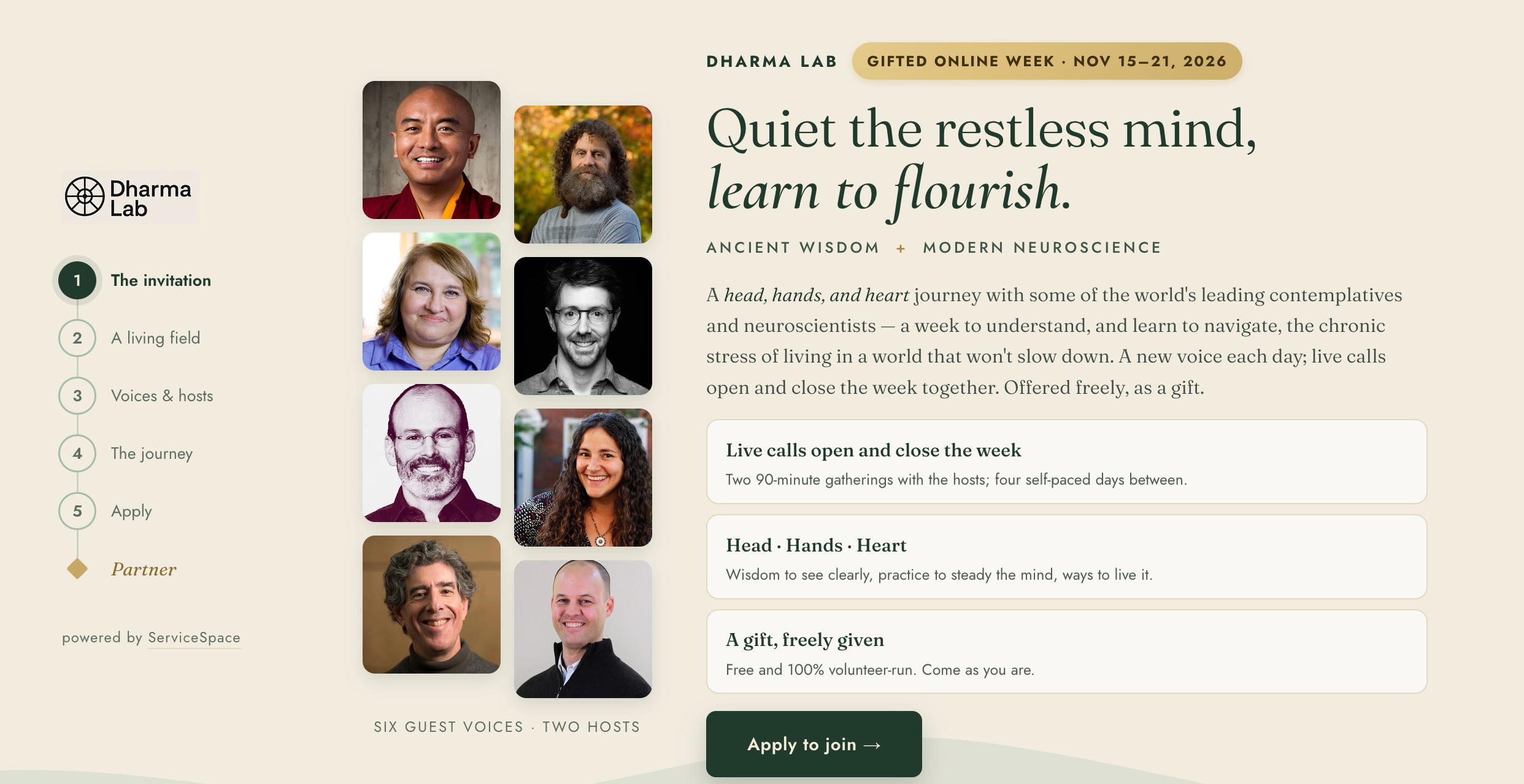
    This is a free preview of a paid episode. To hear more, visit www.dharmalab.co What happens to our drive when we stop looking to the next achievement for fulfillment? In our latest AMA, Cortland Dahl explores topics such as how to widen awareness when the mind feels contracted, why the motivation behind a practice matters, and how compassion can become the energy behind an engaged, creative life. Kim brought your questions, and Cort joined us for the hour while Richie was traveling. What’s inside * Three ways to widen the aperture of awareness: the body, the breath, and the mind * Shamatha and loving-kindness: why the same technique can serve different purposes * Meditation, autism, and ADHD: promising research, unanswered questions, and strengths worth recognizing * Career ambition and the shift to a different source of motivation * What we know—and still don’t know—about consciousness * A 2-minute guided practice led by Cort * Practicing with death, impermanence, and the moments before sleep The full hour mapped below, plus the flashcards and the recording for paid members. Companion Flashcards At Bottom You don’t have to turn ambition off An anonymous listener asked how to balance “the false promise of desire” with career ambition. If Buddhism teaches being, are we supposed to stop progressing and find contentment in the job we already have? Cort looked to the people who have gone deepest into the practice of being. The teachers he knows are productive, creative, and engaged. Learning to be has not left them sitting on the couch. We are not losing the energy and drive in our life. What we’re doing is we’re changing the energy source.—Cortland Dahl He described the familiar mixture that powers a career: some care and purpose, some competition, some hope that success or status will finally make us feel fulfilled. Practice can change that mixture. We still need to make a living, and we can still want to accomplish things. But caring for our family, our community, and the wider world can become the driving force. There can be an awkward stretch in between. The old motivation has weakened before the new one feels fully available. It’s almost as though they’ve unplugged from the old energy source, but they’re just beginning to find the light socket for the new one.—Cortland Dahl Cort suggested learning about people who have navigated that transition. Their lives can help us recognize what a different motivation looks like in action. The energy may carry us further along our current path, or it may lead somewhere else. The moment before you start meditating Mary Beth asked what we are actually doing when we “widen the aperture,” and whether there are different ways to practice it. Cort offered three entry points. With the eyes, let attention include the edges of the visual field. With the breath, notice the release that comes with an exhale. With the mind, sit as though you are about to meditate, but haven’t started yet. You are a little more alert because you are getting ready. But you haven’t begun following the breath or running a technique. See whether you can remain in that small space of wakeful presence. So if that feels like nothing’s happening, that’s perfect.—Cortland Dahl Even the thought “Am I doing it?” can show up. The invitation is to become familiar with being, without turning it into another task to perform correctly. Cort recommended short doses: five or ten seconds, then return to whatever you were doing. These little moments can happen during meditation or in the middle of the day. With repetition, the opening becomes more familiar. 2-MINUTE PRACTICE LED BY CORT In the recording, 01:25–03:04 2-minute practice: Wherever you are, if you’re sitting still, let your eyes close or remain gently open. Take a few slow, deep breaths and feel the breath moving in and out of your body. Allow the mind and body to settle. Then bring a little kindness and compassion into the moment. In words or images that resonate with you, form an intention that whatever good comes from this time might ripple outward—benefiting your own life, the people around you, and the wider world. Rest with that motivation for a few breaths. The full hour, mapped Read the gist below, then drop into the recording at any timestamp. 01:25 — Begin with a compassionate motivation. Cort leads the opening micro-practice: settle with the breath, then imagine the good from this time rippling outward. He uses this pause before meetings and other activities throughout the day. 03:49 — Three ways to widen the aperture. Mary Beth’s question opens a practical exploration of expansive awareness. Cort offers entry points through peripheral vision, the release of an exhale, and the shift from doing to being. 09:15 — Before the doing starts. Imagine you are about to meditate, but haven’t begun. Notice the alertness already there. Nothing special needs to happen; try a few seconds, then return to your day. 12:07 — Shamatha and loving-kindness. Maya asks whether these practices cultivate different capacities. Cort explains how loving-kindness can support absorptive concentration in some traditions, while others emphasize bringing kindness into everyday life. The motivation and purpose matter alongside the technique. 19:08 — Meditation, autism, and ADHD. Brenda asks about different neurotypes and long-term practitioners. Cort describes the research as promising but preliminary, with short training periods and limited longer-term evidence. 21:06 — Compared with what? Why a waitlist and an active comparison group answer different research questions. Cort explains why an intervention’s failure to outperform another treatment should not automatically be read as “nothing happened.” 25:28 — Strengths deserve attention, too. Cort asks what research might discover by examining how practice supports neurodivergent strengths. After a listener flags his earlier language, he acknowledges the correction and returns to the strengths-focused spirit of his answer. 27:46 — Awareness, connection, insight, and purpose. Rachel asks how these capacities relate to nervous system practices. Cort suggests thinking of them as possible ingredients across approaches, while emphasizing that he would need to know the specific method to say more. 30:38 — Career ambition and a different energy source. Can we practice contentment and still want to progress? Cort explores the shift from pursuing fulfillment through success to working from compassion, care, and purpose—and the uncertain transition between them. 37:24 — Does explaining the brain explain the mind? Dave’s question, prompted by Douglas Hofstadter’s I Am a Strange Loop, leads into competing views of mind and matter. Cort argues for humility and openness about unresolved questions of consciousness. 44:28 — How shall I live, knowing I will die? Gwen asks about daily practice with mortality. Cort pairs appreciation for the opportunity of being alive with the recognition that we do not know how long it will last. “Today is the day to be kind.” 49:42 — The in-between states. Cort introduces the Tibetan concept of bardos, then describes how observing the transition into sleep and practicing lucid dreaming fit into that tradition’s preparation for death. 55:32 — Can someone near death sense our care? Sherry’s question brings a careful answer: Cort says he does not know scientifically. He distinguishes possible awareness without communication from traditional beliefs and family anecdotes about offering love and reassurance. 59:19 — A community built through questions. Cort closes with gratitude for the dialogue, the people joining each month, and the generosity that makes these gatherings possible. Upcoming Events: * Quiet the Restless Mind — November: A gifted online week from Dharma Lab and ServiceSpace, November 15–21, exploring how to meet everyday stress, distraction, and overwhelm with greater clarity and ease. Bringing together ancient wisdom and modern neuroscience, the week features leading contemplatives and researchers including Robert Sapolsky, Laurie Santos, Mingyur Rinpoche, Judson Brewer, Sharon Salzberg, Martin Picard, Cortland Dahl, and Richard Davidson. Learn more / register Episode Companion Flashcards:

    • Transcript
  • #40
    September 24 · 36 min

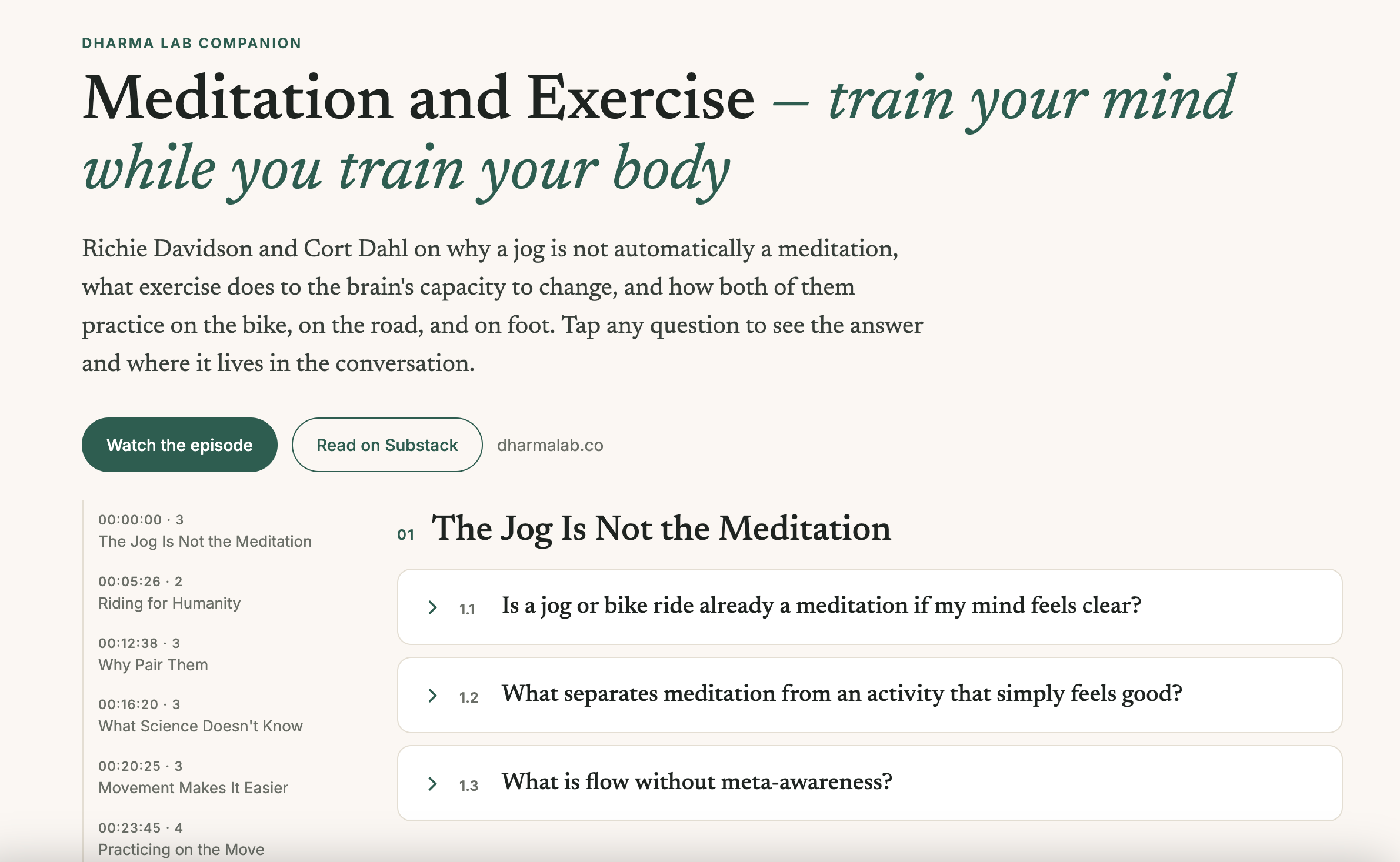
    Your Workout Could Train Your Mind, Too

    In this episode of Dharma Lab, Dr. Cortland Dahl and Dr. Richie Davidson explore how exercising your body can also become a way to train your mind. We asked Richie why exercise supports neuroplasticity, and why a more changeable brain isn’t necessarily a happier one. We also discuss what makes a workout meditation, and share how we bring these practices into our own biking, walking, and yoga routines. Enjoy! Watch on YouTube; Listen on Spotify or Apple Podcasts. If these conversations are useful, please consider subscribing to our YouTube channel. Episode Companion Flashcards: Upcoming Events: * From Doing to Being: Effortless Meditation & the Lost Art of Doing Less with Dr. Cortland Dahl and Kasumi Kato, October 9–11 at Omega Institute in Rhinebeck, NY. This is an independent Omega Institute program and is not affiliated with Dharma Lab. Learn more / register * Quiet the Restless Mind — November: A gifted online week from Dharma Lab and ServiceSpace, November 15–21, exploring how to meet everyday stress, distraction, and overwhelm with greater clarity and ease. Bringing together ancient wisdom and modern neuroscience, the week features leading contemplatives and researchers including Robert Sapolsky, Laurie Santos, Mingyur Rinpoche, Judson Brewer, Sharon Salzberg, Martin Picard, Cortland Dahl, and Richard Davidson. Learn more / register In This Episode: 00:00 Intro - Is your workout really meditation?01:15 Training body and mind together03:05 Is exercise really meditation?07:51 Why intention matters11:29 Flow versus meditation13:19 Exercise and neuroplasticity16:19 Should you meditate during or after exercise?20:25 Can movement make meditation easier?24:14 How Richie practices while cycling27:26 Cort’s practice: Yoga, jogging, and attention32:12 Interval training for the mind33:32 What the research tells us so far Written transcript for those who prefer to read: 00:00 Intro - Is your workout really meditation? Richie: What I often hear when I give public talks, people often raise their hand and say, my jog is my meditation, or my bicycle ride is my meditation. And my response to that is always, well, maybe, but not necessarily. Cort: It’s not just that your mind was a little more clear or a little more peaceful while you were exercising. In fact, actually that I would say is not at all the deciding point about whether it would or would not be meditation, but rather it’s that you’re doing something very intentional with your mind. You’re training your mind very consciously and very intentionally. So the promise of this all is that you basically can train your mind at the exact same time you’re exercising your body. And not only do you get the benefits of each of those individually, there’s at least the potential that there’s a synergistic benefit that’s greater than the sum of the parts. 01:15 Training body and mind together Cort: Welcome everyone. I am Cortland Dahl, and I’m here with my dear friend and Dharma brother, Dr. Richard Davidson, who of course we all call Richie, one of the most eminent and respected neuroscientists on the planet. And today we’re going to discuss how we can train our minds in the same way that we train our bodies, and especially that we can do this at the same time. So there’s some really interesting science here, but before we get there, I just want to share my own personal experience, which is I’ve been meditating for more than 30, well, more than well over three decades, probably about 35 years or so. And of course, sitting meditation is super important for me. But I noticed at a certain point that bringing meditation into my exercise routine actually has been incredibly powerful. And in some respects, I feel like some of the best meditations I have are when I’m jogging, for example. In the early days, I did yoga every day. I was Kind of very diligently had a yoga routine up until my son was born, and that kind of fell by the wayside. But I was really doing, I was really meditating as part of my exercise routine. And it wasn’t necessarily a replacement for my formal practice, but it was really, really powerful. And I could tell in my own experience that there was some synergy between the physical movement and pairing that up with doing a very intentional training of the mind. So this is a very exciting area of science. I know we’re both passionate about this as one of the frontiers of kind of modern science in this area. But Richie, why don’t why don’t I just turn it over to you to share whether your your kind of opening thoughts or your own experience, and then we can kind of go back and forth both to share a little bit about the scientific promise of this, but also how we actually do it and how we personally do it in our own lives. 03:05 Is exercise really meditation? Richie: Yeah. So thank you, Cort, and it’s great to be here together talking about this on this beautiful Sunday morning in Madison. so yeah and I’ve been meditating pretty much every single day for more than fifty years. And I too have been really interested in exploring the relationship between meditation and physical exercise. and before we talk about the science, I think there’s a bunch of th other things to share, some of which just are personal and and To begin with, I too have figured out ways of combining them for me that are really important and personally very meaningful. But before we get to that, I I wanna begin with what I often hear when I give public talks. Sometimes when we give public talks together, people often raise their hand and say, My jog is my meditation or my bicycle ride is my meditation. and my response to that is always, well, maybe, but not necessarily. and so I think it’s really important to make that very clear. And when we talk about meditation, we’re really talking about the intentional use of our mind in ways that promote human flourishing and if you go into exercise and your mind is all over the place and you’re not intentionally deploying your mind in that way then maybe it’s not so much that your exercise is your meditation and so i think that some people slip into that in a in a bit too cavalier a way. And so one of my aspirations is that in the next few minutes together we really can explore that and we can explore when your exercise might be reasonably thought of as your meditation and when it might not be. And so let me just share something personal that I do regularly. I’m a very avid bicycle rider, and particularly in the beautiful warm weather, I ride outside. And before I ride, I do something that I do before I meditate in the same kind of way, which is I and I do this, I really don’t take any extra time. So, you know, I ride a road bike and it requires you know putting on clothes and putting on special bicycle shoes. So there’s a lot of opportunity to reflect as I’m just engaging in the preparation activities for my bike ride. And during those periods I simply reflect on how riding my bike is beneficial to my health. But it’s not just beneficial for me, but being healthy and having vitality is beneficial for all of those I interact with, for my work, for my for what I do in the world. and it takes on a a kind of Sense of altruism or pro-sociality, that I’m doing it not just for myself. And what happens then is I mostly I ride alone. Maybe one day a week I ride with others, but the other times I ride alone. And particularly when I’m riding alone, I find that that reflection recycles spontaneously as I ride. And I come back to it many times. And it just really energizes me, like I’m riding for humanity. I mean, it sounds a little corny, but you know, I do genuinely reflect on that as I’m riding And although I don’t have any evidence to suggest that it’s beneficial, it feels beneficial to me. and first of all, it motivates me to engage in these activities, which I think is. good thing. know, I’m convinced that it does have other benefits as well, which we can explore later and may even change the biological effects of the exercise when… This is a public episode. If you'd like to discuss this with other subscribers or get access to bonus episodes, visit www.dharmalab.co/subscribe
    • Transcript
  • #39
    September 10 · 24 min

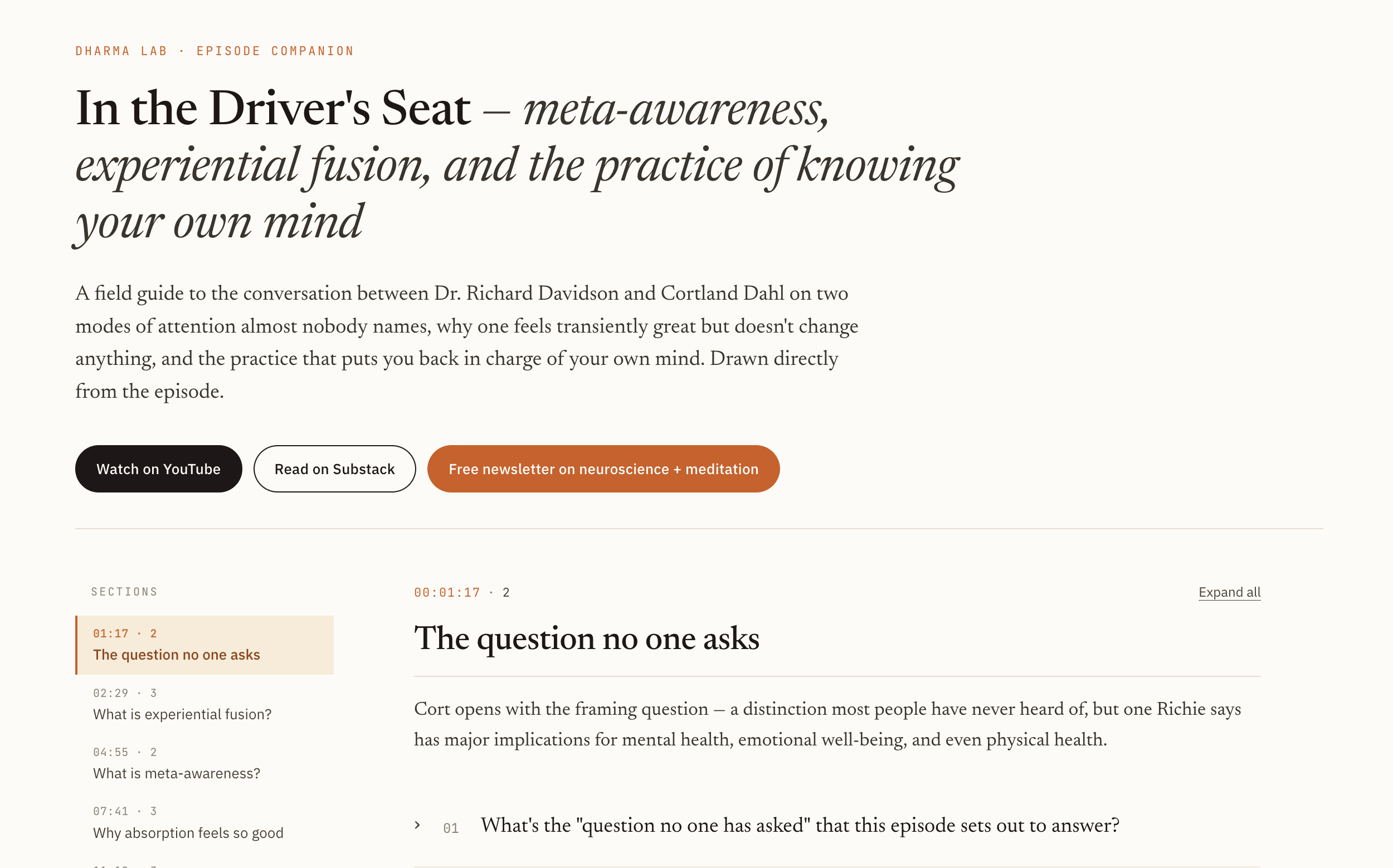
    Are You Meta-Aware?

    In this episode of Dharma Lab, Cortland Dahl and Richard Davidson unpack the difference between experiential fusion, being so absorbed in an experience that awareness narrows, and meta-awareness, the capacity to know what your mind is doing while you’re doing it. They explore why activities like movies, video games, rock climbing, Sudoku, and even doomscrolling can feel good in the moment, how they temporarily suppress the brain’s default mode, and why that does not necessarily translate into lasting change. They also discuss whether meta-awareness actually adds something to positive experiences, how it may increase cognitive and emotional flexibility, and a few simple ways to practice it in everyday life. Enjoy! Watch on YouTube; Listen on Spotify or Apple Podcasts. If these conversations are useful, please consider subscribing to our YouTube channel. Episode Companion Flashcards Upcoming Events: * From Doing to Being: Effortless Meditation & the Lost Art of Doing Less with Dr. Cortland Dahl and Kasumi Kato, October 9–11 at Omega Institute in Rhinebeck, NY. This is an independent Omega Institute program and is not affiliated with Dharma Lab. Learn more / register * Quiet the Restless Mind — A gifted online week from Dharma Lab and ServiceSpace, November 15–21, exploring chronic stress and human flourishing through ancient wisdom and modern neuroscience, with leading contemplatives and researchers including Robert Sapolsky, Laurie Santos, Mingyur Rinpoche, Judson Brewer, Sharon Salzberg, Martin Picard, Cortland Dahl, and Richard Davidson. Learn more / register In This Episode: 00:00 Intro: Is It Good to Be Lost?01:17 Experiential Fusion vs. Meta-Awareness02:29 What Is Experiential Fusion?04:55 What Is Meta-Awareness?06:45 Why Being “Lost” Can Feel Good09:09 The Default Mode Network and Temporary Relief11:34 What Meta-Awareness Adds13:21 Flexibility, Attention, and the Ability to Disengage14:17 Responding Instead of Reacting16:53 Can Startle Reveal Meta-Awareness?19:39 Ancient Meditation Instructions for Meta-Awareness21:11 How to Practice Meta-Awareness in Daily Life Written transcript for those who prefer to read: 00:00 Intro: Is It Good to Be Lost? Cort: We don’t like to ruminate. It’s a deeply unpleasant experience. But isn’t it good to be lost? What’s the problem with being absorbed in a good book or a movie? And would it be better if we had meta-awareness? Does that add anything in a moment like that? Richie: My view of this is that it feels transiently good. In the movie theater or doing Sudoku, when it ends, we go back to our neurotic self and the default mode of the brain comes roaring back. And so it’s a transient state. Meta-awareness is very helpful, I think, in disengaging our attention and enabling us to be flexible. 01:17 Experiential Fusion vs. Meta-Awareness Cort: Welcome everyone to another episode of Dharma Lab. I’m Cortland Dahl. I’m here with eminent neuroscientist, And we wanted to talk today about a really important question that you and no one else has ever asked, which is what is the difference between meta awareness and experiential fusion? And I guarantee that although you have not asked that question and probably nobody has ever asked that question, it is one of the most important questions you could ask because it has massive implications for mental health, for emotional well-being, and even for physical health. So these are two terms that we use a lot in our research. We publish papers that are defining these and have been exploring ways to measure them, but they’re just very central to a lot of the work that we do on human flourishing. So why don’t we just start off with, I think, the one that most of us are more familiar with, Richie, and maybe you can... Give some practical examples and share your own insights on this, but that would be experiential fusion. This is, I think, where a lot of us live our lives. So what is this and why should people care? Why is this so important? 02:29 What Is Experiential Fusion? Richie: Yeah, so experiential fusion is a term that we came up with in a paper we wrote a number of years ago together, and it’s a term that’s used to convey the idea that we can get totally absorbed in an activity that we lose awareness We often call this a flow experience, but we are so completely immersed in the experience that we are no longer aware of our context. So one example of this would be going to a movie and being so engrossed in the movie that you no longer aware that you’re in a movie theater. And in many cases, you’re no longer aware that you’re actually watching a movie. You’re so engrossed in the plot that you’re just in the middle of this plot. That’s experiential fusion. Cort: And it’s an interesting thing because it can be absorbed in an activity like movie theater example is perfect, a perfect example. You know, reading a really good novel or playing video games can be very absorbing. I think a very common one these days is doom scrolling. You’re just kind of totally caught up in this activity. So experiential fusion can be lost in thoughts, right? It can also be rumination where you’re just lost in your own thoughts. But the interesting thing about these examples, the movie theater example, doom scrolling, playing a video game, actually you’re attentive. It’s not as though you You’re distracted in that moment. In fact, you might be very, very focused on what you’re doing, but it’s as though the light of awareness dims a bit. It’s almost your attention is narrowed into whatever you’re doing and you’re absorbed in it and there’s a feeling of being lost in it. And I think the contrast is when there’s this feeling of almost like you’ve woken up from that. And it does almost feel like you’re waking up when you shift out of that state of absorption. So maybe we could just give the contrast now. So this is experiential fusion, which again, can be everything from you’re daydreaming, you’re ruminating, you’re lost in thoughts, or you’re absorbed in some engrossing activities. We gave these examples, but what’s the alternative? And then we can maybe compare and contrast the two. 04:55 What Is Meta-Awareness? Richie: Yeah, so the alternative is meta-awareness, and meta-awareness refers to the capacity to know what our minds are doing. And to go back to the movie theater example, how would meta-awareness show up in a movie theater? Well, you might be totally attentive to the movie, completely undistracted, but you’re aware that you’re sitting in a theater, you’re kind of aware in the background. You can think of it as the Penumbra of awareness, the sort of edges of awareness. But you’re aware that you’re sitting in a movie theater, you’re aware that you’re watching a movie, but you’re also completely attentive. There’s no distraction. And that would be an example of meta-awareness. And so as it would apply to everyday life, you can be in a conversation with someone you know well, Be totally in the groove with them, be deep in conversation, but not be lost in the conversation. You can be aware that you’re sitting here, you may have just had breakfast together, and it’s Tuesday, and we’re having this conversation. So that That background is really supplied, if you will, by meta-awareness. Meta-awareness is this faculty of knowing what our minds are doing. And we think, for many different reasons, that meta-awareness is really key to being able to transform your mind. And one of the things I often say is that it’s very difficult to transform our mind if we’re not aware of what’s happening in our mind. 06:45 Why Being “Lost” Can Feel Good Cort: So when it comes to experiential fusion, as we said, there’s a spectrum there, right? It can be being engrossed in a good book or a movie, or it could even be a conversation with a friend. You’re just totally absorbed in the moment. To the point that you kind of lose touch with everything else other than, you know, the narrow band of what you’re doing. And then on the other end of the sp… This is a public episode. If you'd like to discuss this with other subscribers or get access to bonus episodes, visit www.dharmalab.co/subscribe
    • Transcript
  • August 27 · 2 min

    Your brain builds reality like a dream; August AMA with Richie and Cort

    This is a free preview of a paid episode. To hear more, visit www.dharmalab.co How much of what we experience comes from the world itself, and how much comes from our expectations about it? In our latest AMA, Richie Davidson and Cortland Dahl explore how the brain constructs perception, why the gap between reality and expectation can amplify suffering, and what changes when we begin to notice that process as it happens. We had a few moments of technical issues with frozen screens or background noise, but they don’t last long. What’s inside * Why your brain constructs reality the way it builds a dream * Why controlling the mind backfires * TMS: is it cheating? * Why open awareness loosens pain * The neuroscience of grief and regret * A 2-minute guided practice (free, led by Cort) * A preview of our upcoming November summit * The full hour mapped below, plus the flashcards and the recording for paid members Companion Flashcards At Bottom Your brain builds reality like a dream A listener named Linda asked about acceptance, and about the idea, drawn from Anil Seth and Lisa Feldman Barrett, that reality is a construction of the mind. Cort answered first, and reframed where suffering actually comes from. It’s actually the gap between reality and our expectations of what should be happening. However big that gap is, that’s like the size of suffering in that moment. —Cortland Dahl Cort was clear it is not erasing expectations. It is seeing that they are there and that they are out of step with what is happening, bringing them into the light of conscious experience rather than letting them run under the hood. Then Richie discussed how the brain networks that build our beliefs and expectations are the very networks through which we perceive. He used the dream as proof. Just as in a dream, we can feel those emotions in our body, and there are documented changes in our heart rate and breathing, and yet there’s nothing out there. It’s all in our mind. It turns out that’s actually the way it works with the real world. That’s how our brains construct reality. —Richard Davidson His image for the practice came from Mingyur Rinpoche: caught in the middle of a river, you are swept along by the turbulent flow. Become aware of the thoughts and expectations driving your perception, and it is more like sitting on the bank, watching the water move without being pulled in. Cort added a pointer for anyone who wants the science firsthand, calling Anil Seth’s TED talk one of the best he has seen. The picnic and the four police officers Victoria asked why open awareness loosens physical pain. Richie described what his lab calls “stickiness,” the attachment or aversion that makes an emotion reverberate long after the thing that caused it is gone. In open awareness, the reverberation drops away. In some of our own research, the response in sensory regions is actually larger when you’re doing open awareness. It’s not diminished. But there’s no reverberation. It happens and comes back to baseline. We’re not creating emotional zombies.—Richard Davidson That fast return to baseline, he said, is a neural signature of resilience. Cort then told a story from the Tibetan tradition that ties to this. Imagine you drive to a park for a picnic, thrilled to be there. Then four police officers walk up and tell you that you are ordered to stay in this park all day, that they will block you if you try to leave. Even though you wanted to go there in the first place, suddenly everybody’s trying to think how they can get out. Life does not like to be constrained and controlled in any way.—Cortland Dahl The mind works the same way. The harder we clamp down on a feeling, the more it strains to escape. Open awareness runs the other direction. Cort called it a practice of trust, close to the opposite of control. FREE · 2-MINUTE PRACTICE LED BY CORT 2-minute practice: Wherever you are, settle into a comfortable posture. Let your eyes stay gently open or close them. Take a few moments to simply feel the breath moving in and out of the body. Notice the sounds around you, or the silence. Then open the heart a little by bringing to mind the many challenges in the world right now, the suffering so many are carrying, and form a quiet intention: that whatever good comes from your practice might ripple outward and ease the suffering of others. Rest there for a few breaths, then carry that motivation into whatever comes next. The full hour, mapped Read the gist below, then drop into the recording at any timestamp. 03:46 — “Grandpa!” and the end of the sitting. Twelve minutes into an early-morning practice, Richie’s two-and-a-half-year-old grandson opened the door. He let the formal session go and kept practicing as grandpa. Anywhere, anytime meditation; everywhere, all the time. 08:32 — Active practice is as powerful as the cushion. The Healthy Minds research finds the benefit of active practices comparable to formal sitting. Cort put his son down for nearly every nap for three years and came to see those as the real practice. 09:59 — Acceptance and the gap. Suffering tracks the gap between reality and our expectations. The shift is not dropping expectations but seeing them clearly. 13:54 — Your brain constructs reality like a dream. Anil Seth, Lisa Feldman Barrett, and the river metaphor. Perception is built by the same networks that build belief. 17:40 — So how do we share a reality at all? Rob from Toronto asks about controlled hallucination and shared social realities. Richie on entrainment, cooperation, and why it remains “a shared illusion of a sort”.” 20:18 — Why open awareness loosens pain. Stickiness, reverberation, and the larger-but-faster response that marks resilience. We are not creating emotional zombies. 27:00 — The picnic and the four police officers. Why control backfires in a park, in a relationship, and in the mind. Open awareness as trust. 29:40 — TMS and the urge to hack the mind. TMS stands for “transcranial magnetic stimulation”, and Richie explains that TMS belongs to a broader family of methods designed to modulate brain function relatively non-invasively. There is growing interest in whether these tools could affect meditation, but he emphasizes that we do not yet know whether they meaningfully support practice. The Center for Healthy Minds has also been exploring neuromodulation and meditation more broadly. Cort shares about neuromodulation as one more entry point into an interdependent system. 37:37 — Where does awareness live in the brain? Edith’s question. Visual cortex, anterior cingulate, and the honest answer: no single location, no single switch 40:24 — The unresponsive who were actually aware. Melanie Boly’s work: patients thought to be vegetative held more awareness than we credited, unable to communicate it. A communication problem, not an awareness problem. 45:18 — The neuroscience of grief that doesn’t fade. Amygdala and hippocampus jammed together, and reconsolidation: a memory is a reconstruction that changes each time it is recalled, not a photograph. 51:20 — When grief opened into gratitude.Cort on his father’s sudden death four years ago, holding the feeling fully in the body, and the sadness opening, unbidden, into gratitude. 57:38 — A free November summit.A free online gathering through ServiceSpace this November, with Sharon Salzberg, Jud Brewer, Robert Sapolsky, Martin Picard, Mingyur Rinpoche, and Laurie Santos. November 2026 Free Online Summit with Legends of Neuroscience and Practice

    • Transcript
  • August 20 · 1 hr 1 min

    Free Guided Meditation Practice Hour (Recording)

    Dharma Lab’s First Guided Meditation Hour In Dharma Lab’s first guided practice hour, Dr. Cortland Dahl and Dr. Richard Davidson took us from talking about wellbeing to actually practicing it. Drawing on the Healthy Minds framework of awareness, connection, insight, and purpose, shaped through years of research and practice connected with the Center for Healthy Minds at the University of Wisconsin–Madison and Humin (formerly Healthy Minds Innovations), they led participants through four short practices designed to make each capacity directly experiential. The session explored a central idea running through their work: meditation is less about fixing ourselves than learning to recognize and cultivate qualities of wellbeing that are already present. Keep Practicing — Upcoming Events If you’d like to continue exploring these practices, the free Healthy Minds Program App offers guided practices and learning across awareness, connection, insight, and purpose, with Cortland Dahl, Richard Davidson, and other teachers. Our next “Ask Me Anything”with Richie and Cort is live on Tuesday, August 25th, 8pm ET. Please send us questions in advance by replying to this email or dropping a comment. We have an exciting lineup of guest speakers for a free online summit in November to explore the restless mind. More details to come, but check out initial info at the bottom of this email and registration details here. Please share widely! Thank you for your support and we hope to see you at these future events. —The Dharma Lab Team This is a public episode. If you'd like to discuss this with other subscribers or get access to bonus episodes, visit www.dharmalab.co/subscribe
    • Transcript
  • August 13 · 33 min

    Why Can't I Stay Focused?!

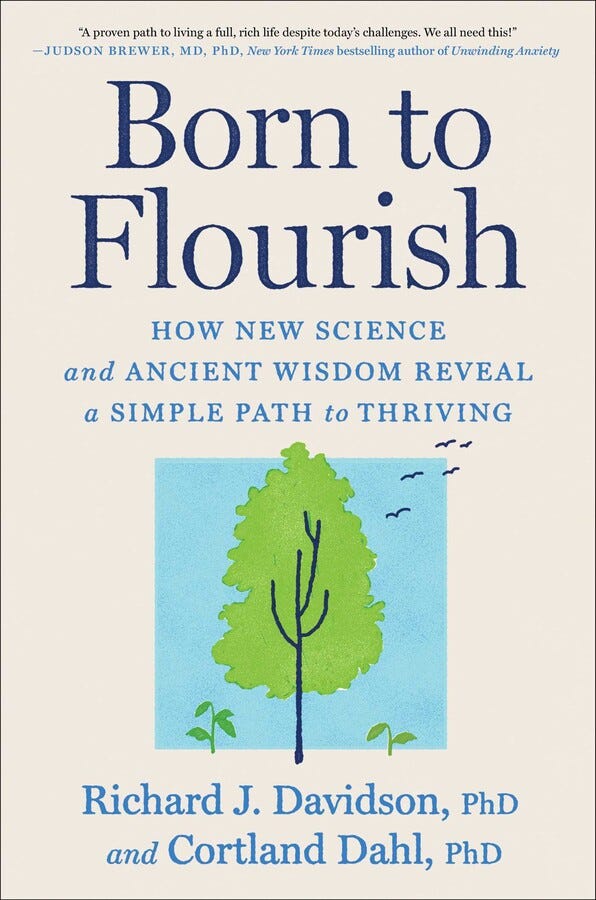
    In this episode of Dharma Lab, Dr. Cortland Dahl and Dr. Richard Davidson explore why attention feels harder to control than it used to, how modern technology exploits basic mechanisms in the brain, and what we can do to regain more choice over where our attention goes. They discuss why we may be more distracted than we were 50 years ago, how novelty and emotion capture attention, and why simple acts of intentionality can function like reps for the brain. Enjoy! Watch on YouTube; Listen on Spotify or Apple Podcasts. If these conversations are useful, please consider subscribing to our YouTube channel. Reminder: We have a FREE 1-hour live practice session on Wed Aug 19th, 7pm CT with Richie and Cort discussing how different meditation practices map to the four pillars of well-being (Awareness, Connection, Insight, and Purpose). More details and register here! Companion Flashcards In This Episode: 00:00 Taking Back Control of Attention 01:21 Why Focus Feels So Hard 02:51 Are We More Distracted Than 50 Years Ago? 05:15 Why the Brain Is Wired for Distraction 09:03 How Our Attention Gets Hijacked 13:20 Why Surprise Captures the Brain 16:35 The Reinforcement Loop Behind Endless Scrolling 17:44 How Emotion Disrupts Self-Control 21:24 Rebuilding Control Over Attention 25:53 Attention as a Practice of Intention 29:46 Digital Hygiene: Designing Your Environment for Focus Written transcript for those who prefer to read: 00:00 — Taking Back Control of Attention Richie: Now we have basically ceded control to the forces around us, and it has led to a kind of impairment, a collective impairment in prefrontal function that we’re all suffering from. There are data to suggest that we are indeed more distracted today than we were 50 years ago. It’s not just a kind of subjective impression. Cort: I would say if there’s one word that captures the heart of this as a practice, I would say intention. And simply being intentional about what’s going on with my attention. Just choose. Before your mind gets pulled somewhere, I just got an alert. I’m going to choose to do that. And I noticed the pull, but I’m going to actually ask myself, do I want to check this message right now? Or I just heard a sound. I’m going to actually choose. Do I want to keep my attention with what I’m doing? Or do I want to You know, turn and look to see what was happening over there, like actually just making a choice. Like you were saying, the reps, you can do a thousand of those a day easily. 01:21 — Why Focus Feels So Hard Cort: Welcome everyone to another episode of Dharma Lab. I am Cortland Dahl, one of the co-hosts here, and of course I’m here with Dr. Richard Davidson. Richie, to all of us who know him well, one of the preeminent neuroscientists on the planet. And today we’re gonna discuss one of the most common problems that probably every human faces, which is how incredibly hard it is just to stay focused. Now, I must admit, maybe this is an embarrassing admission, given that I’m supposedly one of the experts who’s talking about this stuff. But there’s a lot of days where I’m sitting, getting stuff done, answering emails or focused on some project. And it’s just really hard to not get pulled in to other things. You know, I’m answering emails and suddenly I’m shopping online or I’m working on a report and then I’m checking my emails. It’s just it feels like There are so many things in our life that are just pulling us in a million different directions. And I thought today we could just answer two very simple questions. One, why is it so incredibly hard to stay focused? And two, what can we do about it given this chaotic world we’re living in? So maybe we can just I can just turn this over to you, Richie, and you can kick this off however you want to. But I’d love to hear specifically from a neuroscientific point of view at some point. But yeah, what does this spark for you? Richie: Yeah, well, first it sparks familiarity. 02:51 — Are We More Distracted Than 50 Years Ago? Richie: So, you know, I think that it’s true. I often say we’re all participants in a grand experiment for which none of us have provided our informed consent. And that’s, of course, referring to the exposure that we all have to this extraordinary amount of information through Our online activities through social media, all of that. And that’s a huge source of distraction. And so, you know, I think that one, I certainly think that it’s inevitably true that one major reason why people experience more distraction perhaps today than they did And there are data to suggest that we are indeed more distracted today than we were 50 years ago. It’s not just a kind of subjective impression, but inevitably I think it’s at least in part true that it’s because of our exposure to this information that is so readily available. So we’re clearly not going to change that. We don’t have the power To influence the tech companies to do the kind of regulation that might be needed. So, you know, we’re left, I think, with the inevitable conclusion that really the only thing we can change is our own minds. And so that, I think, is an important opportunity. And so here’s another case where the kind of, quote, And us being so distracted can also be the opening for real change and transformation. And in the language that you and I have used, Cort, in our book, Born to Flourish, and at other times in Dharma Lab, we can think of distraction itself as an affordance, distraction itself as a moment of awakening, if you will, because the moment we recognize we’re distracted, That’s a moment of awakening and can really be helpful in the process of changing your mind. 05:15 — Why the Brain Is Wired for Distraction Cort: I’m curious about the neural mechanisms for why we are so easily distracted. I think the experience is, it’s like our attention is like a restless puppy that just gets excited and is rushing off after any bright, shiny object. It sees a squirrel on a tree outside and it’s banging itself against the window and then hears something in the kitchen and goes racing off. And it feels like that sometimes. I mean, it feels like that, you know, even for me having 35 years of meditation under my belt and done all these long retreats where I’m very specifically training my attention. And I feel like in some respects have, you know, have developed A strong attentional skill set, so to speak. And yet I still feel that when I’m in a meeting like this, I could be talking to you and then I see a notification on my computer or something happens in my environment. It seems like the mind and brain are just... Really wired actually for that to happen. I mean, it clearly, you know, happened spontaneously and effortlessly countless times every single hour. So what’s going on in the brain? I mean, is it as it seems that this is sort of how we’re wired? I imagine there’s evolutionary reasons why this is this is likely to be the case. Richie: I think it is in part how we’re wired. We are wired to detect surprise, to detect discrepancies, to detect rare events, because those often are events that have more salience. For example, our Sensitivity to danger and to cues that may signal danger. Those are the kinds of things that are relatively rare, but they’re super important. So we want to be primed, if you will, to notice those. And the problem is that that machinery that evolution has provided us with can be harnessed or hijacked by all these other things around us. But I think I can pretty much guarantee based on everything we know that if you receive the identical information, say something surprised you that drew your attention, if that thing were repeated 10 times, by the 10th time, you’re no longer going to pay attention to it. And that process habituation is something we know very well. And so the masters of technology have very much figured out how to capture our attention. By providing us with, in many cases, more and more extreme examples of things that are of interest to us. And the i… This is a public episode. If you'd like to discuss this with other subscribers or get access to bonus episodes, visit www.dharmalab.co/subscribe
    • Transcript
  • August 4 · 2 min

    Strangers could tell who the meditators were — July AMA with Richie & Cort

    This is a free preview of a paid episode. To hear more, visit www.dharmalab.co (The full AMA recording plays in the video pane above, for Dharma Lab members.) In our 11th AMA, Kim read your questions while Cort made his way back from a retreat with Mingyur Rinpoche. Richie spoke to a study where strangers could tell who the meditators were, from a photo alone. What’s inside * Full recording and transcript for paid members * The photo study: what strangers saw in the faces of long-term meditators * You are not your beliefs: a simple two-step practice to see them clearly * A 2-minute guided practice (free, led by Dr. Richie Davidson) * The full hour mapped below, plus the flashcards and the recording Strangers could tell who the meditators were This came up during a question about moods. Richie’s point was that one consequence of long-term practice is that people generally end up in a more positive mood. To show it, he described a study his lab published. Whenever they studied long-term meditators, they routinely took a picture of everyone, both the meditators and age- and gender-matched controls, without telling them what it was for. Then they gave all the pictures to random people who had no idea where they came from, and asked them to rate each face: how friendly the person is, how much you trust them, how happy they are. The long-term meditators were judged, in Richie’s words, “whoppingly more positively” than the controls. The raters had no idea where the pictures came from. He called it a powerful, unobtrusive measure that there is something about an enduring mood that gets expressed on the face and that people pick up on. The study: Goldberg, Hirshberg, Tello, Weng, Flook, Davidson (2019), “Still facial photographs of long-term meditators are perceived by naïve observers as less neurotic, more conscientious and more mindful.” You are not your beliefs Another listener asked about the difference between a belief and an ordinary thought. Cort put it this way: thoughts are the words and images moving through the mind, the inner commentary, and they are an expression of deeper beliefs about the world that are often not conscious. Richie added the distinction he and Cort work with: when we hold beliefs, especially about ourselves, we misconstrue them as a description of who we actually are. He calls it experiential fusion. Most of the time we are not even aware we hold the belief; it just feels like the narrative of our self. Meta-awareness, or metacognition, is having an awareness that we have these beliefs, which lets us recognize we are not necessarily the same as them. Cort framed the aim in the Tibetan approach he practices: we are not trying to fix ourselves, but to get in touch with the parts that were never broken. Then he gave a two-step practice. First, simply observe your thoughts, like watching a wild animal in its natural habitat, from behind a tree, just watching what it does. Then pause and ask what assumptions, beliefs, and expectations underlie the thought. The point is not to change anything, just to bring the unconscious up to the conscious level. “We’re not trying to fix ourselves. We’re really trying to get in touch with the parts that were never broken.” — Cortland Dahl Try this 2-minute practice from the AMA (free, led by Richie) Prefer to read it? Bring awareness into your body. Then bring to mind one person who first introduced you to practice, who opened this door and shined a light where you had not looked before. Hold them in your heart and let appreciation, gratitude, even love bubble up. Carry that glow into whatever comes next. The full hour AMA, mapped Read the gist, then drop into the recording. 04:39 — Is it only meditation that slows brain aging? Compared to athletes or chess players, we don’t yet know. But Richie’s informed conjecture: an altruistic motivation may add a biological benefit over and above the activity itself. 09:12 — What childhood trauma does to the brain. The well-replicated finding of reduced hippocampal volume, and the honest unknown of how far practice can reverse it. Cort on memory reconsolidation. 13:55 — Can practice move your brain’s asymmetry? Functional asymmetry can shift (the first randomized trial of MBSR, 2003), but temperament tends to persist. The masters keep their color; they are not emotional zombies. 20:27 — Belief vs. thought, and how to loosen a harmful one. Experiential fusion vs. meta-awareness, Mingyur Rinpoche’s burnt-rope image, and the two-step practice of watching thoughts and inquiring into the belief beneath. 30:59 — Moods, and the photo study. Why moods differ from emotions, why long-term practitioners carry a positive baseline, and the study where strangers read it off their faces. 38:33 — A stroke, and the beauty in the pauses. For a listener living with brain injury and stroke: being over doing, the sky that stays when the clouds go, and Ram Dass, whose long word-finding pauses Richie found beautiful. 47:28 — After an awakening, why the crash? The four families of retreat experience (body and energy, emotional upheaval, perception, sensing energy), and why to treat them all as passing clouds, not permanent, not the point. 56:16 — What happens in the brain at death. The flatline, why biology is analog and not digital, and the early reports of gamma oscillations near death, the same signature seen in long-term meditators. Plus how the traditions prepare. Upcoming Events Save the date: a free practice and meditation hour with Richie and Cort on August 19th at 7pm Central. Register free. events.dharmalab.co Episode Companion Flashcards:

    • Transcript
  • July 30 · 27 min

    Does Meditation Really Change Your Brain?

    For years, headlines claimed that meditation could actually grow parts of the brain. But what if that’s not the most interesting question? As the science has evolved, researchers have shifted their focus. What changes in the brain? Which changes matter most? And why might some structural changes grow, then recede, as expertise develops? In this conversation, Richie and Cort explore what decades of neuroscience have taught us, what scientists have gotten right, what they’ve gotten wrong, and where the research is heading. Enjoy! Watch on YouTube; Listen on Spotify or Apple Podcasts. If these conversations are useful, please consider subscribing to our YouTube channel. Reminder: We have a FREE 1-hour live practice session on Aug 19th, 7pm CT with Richie and Cort discussing how different meditation practices map to the four pillars of well-being (Awareness, Connection, Insight, and Purpose). More details and register here! Episode Companion Flashcards! In This Episode: 00:00 Does Meditation Really Change the Brain? 03:16 Brain Function vs. Brain Structure 05:41 The Gray Matter Studies That Started It All 11:45 Why the Gray Matter Evidence Changed 15:20 White Matter and Brain Connectivity 18:01 What the Research Actually Means 21:40 Brain Health, Neuroplasticity, and Human Potential Transcript for those who prefer to read: Richie Davidson: There’s no question that meditation changes the brain. We’re talking here about both the function and the structure of the brain. There’s no question that meditation changes the brain, and there is overwhelming evidence for that. Structural changes, like increases in gray matter in specific regions of the brain after short amounts of meditation, however, are a different story. The evidence for those findings has really not held up. Even more interesting, some of the effects that have been reported are actually the opposite of what we might expect. Cortland Dahl: Hello everyone. Welcome to another episode of Dharma Lab. I’m Cortland Dahl, and I’m here with Richie Davidson, one of the pioneering neuroscientists who has helped us understand the relationship between the mind, the brain, emotions, and how we can train ourselves to flourish. Today we’re diving into one of the biggest scientific questions in meditation research: does meditation actually change the brain? When I think about my own life, I can point to experiences that feel like a clear before and after. When I started meditating more than thirty years ago, I had a genuine phobia of public speaking. It wasn’t just that I got nervous. I had a severe fear of speaking in front of people. Years later, not only do I no longer get anxious, I actually enjoy it. I’ve even measured my physiology with devices like my Oura Ring. My heart rate and other biometrics actually shift into a deeply relaxed state when I’m speaking in front of a crowd, something that would have been unimaginable twenty or thirty years ago. Whether or not my brain changed, it seems difficult to imagine that such a profound transformation could happen without the brain changing in some way. At the same time, we often see confusing headlines. One day the headline says, “Meditation changes your brain.” The next day another study appears suggesting the opposite. Even the phrase “changes your brain” can mean different things. Are we talking about how the brain functions? Are we talking about the physical wiring of the brain? Are we talking about changes in structure? Richie, you’ve done some of the most important work in this area, and I think this is one of those topics where the headlines often miss the nuance. How should we think about it? Richie Davidson: You set this up beautifully by distinguishing between functional changes in the brain and structural changes. Functional changes refer to differences in how the brain is operating. We can measure those by looking at patterns of activity in different brain regions. Structural changes are different. They refer to the physical characteristics of the brain itself. That includes gray matter, which consists of the cell bodies of neurons, and white matter, which consists of the axons that connect one region of the brain to another. It’s entirely possible for the brain to change functionally without changing structurally. If structural changes occur, they almost always imply changes in function as well. One of the reasons this field became so exciting was that, about twenty years ago, several early studies suggested that people who completed an eight-week Mindfulness-Based Stress Reduction course showed increases in gray matter in regions such as the prefrontal cortex. Those findings generated enormous excitement and headlines claiming that meditation could literally grow your prefrontal cortex. Cortland Dahl: Before we go further, why would someone even want a larger prefrontal cortex? Richie Davidson: The prefrontal cortex is central to what we call the executive network. It’s involved in planning, goal-directed behavior, regulating attention, forming healthy habits, and inhibiting behaviors we want to change. If you’re making a grocery list, planning your route to the store, or intentionally directing your attention toward something important, the prefrontal cortex plays a major role. It also allows us to think about the future and reflect on the past. That’s incredibly useful, but it’s also one of the reasons humans worry so much. As Robert Sapolsky famously described in his book Why Zebras Don’t Get Ulcers, zebras don’t spend time worrying about tomorrow. Humans do, largely because we have this remarkable prefrontal cortex. So it’s an extraordinary gift, but it can also contribute to suffering. Returning to the research, those early studies suggested that relatively short periods of meditation increased gray matter in regions like the prefrontal cortex. Many additional studies followed. Then, in 2023, a meta-analysis concluded that Mindfulness-Based Stress Reduction produced structural brain changes. However, the story didn’t end there. The journal later retracted that meta-analysis because important data had been omitted. When those missing data were included, the reported effects disappeared. Around the same time, our own research published in Science Advances found no structural gray matter differences between people who completed Mindfulness-Based Stress Reduction and carefully designed control groups. So when it comes to gray matter increases after relatively short periods of meditation, the evidence has simply not held up. There’s another finding that’s particularly intriguing. Some studies have examined whether people with more meditation experience show greater structural changes. Interestingly, the relationship appears to go in the opposite direction. The more meditation people have practiced, the smaller the structural differences often become. When you think about expertise, that actually makes sense. If gray matter simply kept increasing forever, eventually we’d have bumps sticking out of our heads. That’s obviously not how biology works. Instead, expertise in many domains appears to involve temporary structural changes that later become more efficient as skills mature. There may be a period where gray matter increases, but as expertise develops, those changes may naturally recede. Cortland Dahl: So the story is much more nuanced than simply saying meditation makes your brain bigger. Richie Davidson: Exactly. And that’s where white matter becomes especially interesting. White matter reflects the connections between different regions of the brain. Across many different kinds of learning, white matter appears to be much more responsive to experience than gray matter. For example, beginning jugglers can show measurable white matter changes after only about an hour and a half of training. Those changes are dynamic. If you stop practicing, they may recede. We’ve found similar results with meditation. In the same study where we found no gray matter changes, we did observe white matter changes in pathways related to self-… This is a public episode. If you'd like to discuss this with other subscribers or get access to bonus episodes, visit www.dharmalab.co/subscribe
  • #36
    July 16 · 54 min

    You Don't Get Through The Day Alone - Sharon Salzberg on DL Ep. 36

    Sharon Salzberg joins Richie Davidson and Cortland Dahl for a conversation about loving-kindness, connection, and the quiet ways our lives are supported by others. At a time when many people feel lonely, cut off, or pulled into habits of criticism and competition, Sharon offers a simple experiment: pause, notice who makes your life possible, and see what happens when appreciation becomes part of daily life. Sharon Salzberg is a meditation teacher, New York Times bestselling author, and co-founder of the Insight Meditation Society in Barre, Massachusetts. She has written fifteen books, including Lovingkindness and Real Happiness. Her upcoming workbook, Living Lovingkindness, is available for pre-order and will be released in January 2027. Enjoy! Watch on YouTube; Listen on Spotify or Apple Podcasts. If these conversations are useful, please consider subscribing to our YouTube channel. Episode Companion Flashcards The full conversation is below, lightly edited for readability. Chapter List * (00:00) A true icon, and a first story * (03:33) The Dalai Lama and the crutches * (09:35) What actually trips people up * (13:33) Why Sharon prefers the word “connection” * (18:30) A guided reflection * (21:26) Vulnerability, and the neutral person * (28:10) Attention, and what the science shows * (36:26) The obstacles, and where to start * (46:46) Little rituals, and eating as practice * (52:00) Parting thoughts Try this 2-minute Micro-Practice from Sharon Now (00:00) A true icon, and a first story Cort Dahl Hello, welcome everyone to another episode of Dharma Lab. I’m very honored and excited to be here with our two guests. Of course, I’m here with Richie Davidson, who many of you already know, one of the most well-known neuroscientists on the planet. And we’re here with a true icon of the world’s meditative tradition, Sharon Salzberg, who’s also a dear friend, and truly one of those people who, when the history books are written about the manifestation of these meditative traditions in the modern world, played an incredibly important role. Just before this started, we were all chatting, and Sharon, you were mentioning that this is the 50th anniversary of the Insight Meditation Society. IMS, as it’s commonly referred to, is certainly one of the first and one of the most important centers for Buddhist practice and meditation in the modern world. Sharon is one of the co-founders of IMS, back in the 1970s. It’s hard to believe it’s been 50 years. She has written some of the most well-known books in the meditation world. Loving-Kindness — she literally wrote the book on loving-kindness, and has been the main proponent of it as one of the main forms of meditation coming out of the Buddhist tradition, traditionally known as metta. She also has a podcast, Metta Hour, which both Richie and I have been on. And she’s written many other books, including her first children’s book, Kind Carl. Richie Davidson I read it to my six-year-old granddaughter, who loved it, absolutely loved it, and wanted more copies to give to all her friends. Cort Dahl And many, many other books — Real Life, Real Love, Real Happiness, a whole series. Loving-Kindness, the book I mentioned first, is really a modern classic. It was one of the first books I read back in the nineties when I was starting to meditate. So, Sharon, you’ve been an inspiration to so many of us — through your writing, through co-founding IMS, through your endless teaching all over the world. It’s an honor to have you. I thought we could start with a story I’ve heard a few times and always found moving: His Holiness the Dalai Lama visiting the United States for the first time, and your interactions with him. Let’s start there, and see where the conversation goes. (03:33) The Dalai Lama and the crutches Sharon Salzberg Sure. And I’m so happy and honored to be with the two of you, truly. We co-founded the retreat center — Jack Kornfield, Joseph Goldstein and I — in 1976. It’s in Barre, Massachusetts, about 40 minutes from Amherst. In 1979 we heard the Dalai Lama was coming to Amherst, so, being young and bold, we wrote a letter to his private office and said, maybe you’d like to visit us too. And to our amazement, we got a letter back saying, yes, he’ll come. It was an incredibly zooey day. We had sheriffs and people patrolling the roof with guns, the street blockaded. A very intense day. And I’d been in a car accident a few weeks before — I had a broken bone in my foot and was using crutches, which I was not very skilled with. So I was standing way at the back of about a hundred people. His car pulled up, he got out, and he did something I’ve seen him do many times since, but it was the first time. It’s almost like he has a kind of radar for who in a crowd is suffering the most, and that was me. He cut through a hundred people, took my hand, looked me in the eye, and said, what happened? Standing there in the back, I’d been thinking, I’m so stuck back here, this is terrible — I helped start this place, and here I am at the back. But if I go up front I’ll fall on my face, because I’m so bad with the crutches, so I’d better stay in the back. And he just dissolved that with that one gesture. It sort of redefined compassion for me, because he certainly couldn’t have made the injury not happen, or made me any better with the crutches. But that horrible feeling of being so alone, so unseen, so stuck in the back — it just dissolved. There’s another story from that visit, and there are many. We had a retreat going, about two weeks in, and the Dalai Lama asked to go into the meditation hall and give a talk. Then he asked for questions. A young man raised his hand and said, I’ve been meditating for about two weeks and I realize it’s not going to work for me. I can’t do it. I don’t have the capacity to grow or learn or get more loving or more mindful. I just can’t do it. And the Dalai Lama looked at him and said, well, you’re wrong. You’re just wrong. He went on to talk about buddha nature — one’s capacity, which it’s believed is never ever destroyed. A capacity for growth and understanding and change. It may be covered over, it may be hard to find, but it’s never ever destroyed. And the funny thing is, after the talk, all these people came up to me and said, the Dalai Lama shouldn’t have said that. That’s bad pedagogy. You should never tell anyone they’re wrong. But you know who got a huge amount out of it? The young man, for whom it was such an important message. You should have a little more faith in yourself, and in the possibility of change. Cort Dahl That’s so beautiful. The image of the Dalai Lama cutting through all those people — at a moment where most of us would be on autopilot, this is what you do in this situation, you shake hands and wave. And he didn’t. He was just utterly human, and could see beyond the dynamics. I’ve always found that story so beautiful. Richie Davidson I love that story too. I have this image of our detectors, our antenna, for suffering, that can actually be developed. And the Dalai Lama is such an extraordinary exemplar of that. Wherever suffering is occurring, he makes a beeline for it. Cort Dahl And the human element is something I really think about with you as a teacher. I was just having lunch with my wife, Kasumi. We’ve been together thirteen, fourteen years now. When we first met, she was about to go on a retreat with you — you were visiting Madison — one of her first retreats. You’ve been a huge influence in her life. Over lunch I said, I’m going to be talking to Sharon, what would you ask? And she said something that’s so true, something I’ve heard from many people and know from my own experience: you talk so candidly about your own experience, and the human experience, in a way that’s quite uncommon. Just being fully human and sharing your experience. Because it’s so easy to see someone at the front of the room teaching meditation and imagine, wow, they’ve got it all figured out, this perfect life — and here I am, a distracted, anxious mess. I think that’s one of the reasons your teachings resonate so deeply. With all these decades of working directly with people, hearing from thousands of them, what are the things that either trip us up — the common stumbling blocks early on — or the things that inspire and unlock us when we hear the right thing at the right time? (09:35) What actually trips people up Sharon Salzberg Well, I think we — including myself — bring some of our greatest patterns into the meditative process. Especially a kind of harsh self-criticism, which I’ve seen over and over. Even people in really difficult situations, really hard diagnoses, something hard to bear. Sometimes I listen and think, give yourself a break — this is hard, look what you’re going through. That’s one of the reasons I found loving-kindness practice, and the understanding that we can grow in other ways rather than punishing ourselves for our mistakes. We can move on. We can learn to begin again. There’s resilience there. I’ve found that a huge help for a lot of people. Somebody asked me the other day whether I wanted to teach Buddhism or better mental health. And I said, mental health is not that high right now. So many people feel broken and lonely and estranged and confused. Of course we always do to some degree, but it feels so exaggerated now, so emphasized. For people to have a sense of not being so alone, and caring about themselves and about one another, having a greater sense of community — that seems to be what we can offer these days. Cort Dahl That’s so helpful. Richie, any thoughts from you, having explored the same territory yourself, both personally and in your work? Richie Davidson In terms of the situation today, it really is true. I often say we’re all part of a grand experiment for which none of us have provided our informed consent. It’s a challenging time, and a lot of it is simply outside of our control. The one thing we have at least the possibility of exerting a little more control over is our own mind. So that’s a great place to start. One of the things I love about your work, Sharon, and would love to hear more about, is that — at least I’ve found, being with different kinds of public audiences — giving them a simple taste of very ordinary but really nourishing connection, like a little hit of appreciation. Bring someone into your mind and your heart who’s been helpful to you, and just observe what happens. Being able to taste that little hit is really an elixir for the soul. And it’s very accessible. We don’t have to go to any special place or be in any special posture. We can do it anywhere, anytime — a phrase Mingyur Rinpoche uses for one of his programs. I’ve renamed it, everywhere, all the time, why not. I’d love to hear your reflections. (13:33) Why Sharon prefers the word “connection” Sharon Salzberg There are many layers I want to respond to. One is that I’ve so appreciated your work and your use of the word connection. I’ve been struggling to translate metta, the Pali word for loving-kindness, because loving-kindness is such an odd term. You wouldn’t necessarily be in a coffee shop and hear the people at the next table talking about loving-kindness, except maybe in a hyper-religious context. My concern is that it makes the quality seem somewhat arcane and removed from day-to-day life, precious in the negative sense. Translators and scholars have said to me, stop being so cutesy, just say love — that’s what you mean. And that of course is a complicated term. What do we mean when we say love? How often is it a medium of exchange, or, I’ll love myself as long as I never make a mistake — something so fragile and breakable. My favorite translation is connection. There’s a classical translation as friendship, but my concern with friendship is that the development of qualities like loving-kindness or compassion doesn’t mandate a certain kind of action. When I think of friendship, I think, let’s go to the movies, let’s spend time together. And it may be that your heart is genuinely full of loving-kindness or compassion for someone, and discernment, wisdom, understanding is saying, don’t go there — it’s not safe, or it’s not appropriate. There’s such a great fear that if I develop more metta, more loving-kindness, I’ll have to say yes, I have to smile, I have to give in. And we don’t have to do anything. So I really prefer the word connection to any other word. I love the idea of appreciation, just for a moment. It’s part of what I like to teach if I’m going into a company or an organization. There are two reflections. One is, can you express appreciation to somebody, anybody? Because we’re also culturally tuned to feel we’ll feel better about ourselves if we can put other people down — a kind of culture of degradation. Richie Davidson And that’s particularly true in the university, by the way. Sharon Salzberg That’s scary and sad. People get into that, and there’s a lot of loneliness right there — hyper-competitive, constantly putting other people down. So I see all of Dharma practice as an experiment. Are you willing to step out of those familiar ruts — go into work and express some appreciation for somebody? The other reflection is interconnection. My favorite question in a group of people who work together: how many other people have to do their job well for you to do your job well? Sometimes that doesn’t resonate, so I say, do you commute? Do you ever think about the bus driver, the engineer, the car mechanic? And if you don’t commute, there’s certainly some technology involved. And if that doesn’t resonate — have you eaten today? You don’t grow all your own food. Just think about that: our lives, truly, realistically, are part of a network. We can feel so alone and cut off, but the truth is we’re connected. So let’s make an experiment, do these reflections, and see what happens. Cort Dahl I realize I skipped a step that Richie and I do every single time. Usually before we hit record, we do a little practice to set our motivation — to be of benefit, wanting whatever comes of the work to help people. Richie talked about having a little taste. Sharon, would you be willing to lead a little practice, just to give us an experiential taste of what we’re talking about, and then we can keep going? (18:30) A guided reflection Sharon Salzberg Sure. I’ll do a reflection based on what I just said. You can sit comfortably, close your eyes or not, however you feel most at ease. We’re just going to spend a few moments bringing to mind anyone who has somehow had a role in your being here right now. Somebody told you about their meditation practice, or the science, or this podcast. Somebody read you a poem or played you a piece of music. There was some opening somewhere. Maybe you’ve never met these people who come to mind. Maybe you were inspired from afar. Just see who comes up. Every time I do this reflection, I think about the Board of Regents of the State of New York, which gave me a scholarship, which was how I was able to go to college, which is how I ended up in India as an independent study project, which is a big reason I’m here now. Sometimes I do this reflection and think about those people whose actions have really hurt me — not the ones I just found annoying, but the times I felt I was at an edge and had to find a different way to live or think. Because they’re part of why I’m here right now too. Just who comes to mind. And you can extend a sense of recognition to all of these different beings, because this moment in time is a confluence of connection, relationship, influence, interaction. However alone we sometimes feel or cut off, this is the truth of our experience. And you can open your eyes, or lift your gaze, and we can end that reflection. (21:26) Vulnerability, and the neutral person Cort Dahl So beautiful. Thank you, Sharon. When I first started these practices, I’d been doing mindfulness for probably seven or eight years. Then I encountered some teachers, and for me the first practice more in this heart-connection space was sending and taking, often referred to as tonglen, very much in the space of loving-kindness and compassion. It was very interesting what it did. One of the first things I noticed was that it brought up an intense feeling of vulnerability. The way it manifested was, I’d be having a conversation with somebody, and out of the blue I’d start blushing. And I come from a long line of Olympic-level blushers — Scandinavian complexion, maybe. It’s very visible, there’s no hiding. This went on for months. Almost every interaction, for no reason at all, I’d feel this naked vulnerability. And it was just connecting with people, actually. I didn’t see it at all until that moment. But when I started these practices, I started to see how guarded I was a lot of the time — a weird protective mechanism I hadn’t even been aware of. That feeling of vulnerability, which weirdly manifested as blushing, was just genuine connection with people, but in a raw way I wasn’t used to. It was actually hard. Not easy for me. Inspiring, and I was seeing things about myself I hadn’t seen before, but challenging territory, and totally unexpected. So I’m wondering if you could talk about vulnerability, and the power of working with it in practice despite the discomfort. Sharon Salzberg It’s a really fascinating thing to explore — the components. I don’t know that this was your experience at all, but it’s common for people to feel somehow responsible for fixing a situation if someone else is expressing pain. Not only do we feel it with the kind of sensitivity you’re describing, but it enters us in some strange way, things get distorted, and we get this hyper-sense of responsibility — I’ve got to fix it. We’d call that a real imbalance. Maybe there’s a lot more compassion for someone else than there is for us, or maybe there’s not enough wisdom for correct boundaries or discernment. The combination of the sensitivity with the wisdom, we’d call equanimity. It’s a kind of balance. We are conditioned, by and large, to look the other way in terms of other people’s situations. And my favorite part of loving-kindness practice, actually, is loving-kindness for a neutral person — someone we don’t especially like or dislike, someone we feel kind of neutral toward. Usually people pick somebody like the checkout person at the grocery store, someone they see but have no real sense of connection to. I love it, because over time, here’s someone we usually objectify, overlook, look through instead of look at — and as we do the practice, offering them attention, may you be happy, may you be peaceful, something actually grows inside us. People come back with incredible stories. Like, I fell in love with my dry cleaner. I said to this woman — well, I didn’t say it, she could see it on my face — I thought they were dating. And she said, no, no, not romantically. He’s my neutral person in my practice. Every day I call him to mind and wish him well. And now I go into the store and it’s like we’re on the same team. So you’re also confronting all that conditioning of, look the other way, they’re not really people, they’re just utilities — not to mention bias or prejudice, which fits in there too, the other who doesn’t count. The more we tune into people and realize they do count, that we’re part of this whole, we’ll have the effect of that. But that effect needs to be balanced. Richie Davidson The piece about neutral people is so powerful. One of the greatest teachings for me has been being with the Dalai Lama at major formal events, where there are, quote, lots of important people around. And then he’ll go out through a side entrance, and he’ll stop and greet all the custodians, all the kitchen people, the security people, and he treats them exactly the same as the important people. Absolutely no difference whatsoever. When you see that in practice — when you see him stopping and holding them and asking how they’re doing — it’s such a powerful reminder that this really is accessible, and it can totally change our life. Our everyday life becomes all of these really nourishing moments of connection. (28:10) Attention, and what the science shows Sharon Salzberg You’re reminding me that so many times we can understand connection, or loving-kindness, or compassion, as an emergent property of paying attention. If we’re more present and listening, that’s where the connection is born — which is a nicer way of realizing it, rather than thinking I’ve got to drum up some feeling I don’t really have, and manufacture it. Cort Dahl That’s what stands out to me about the story of you on the crutches — it wasn’t as though he’d memorized some rulebook of elevated compassion. He was totally tuned in to what was going on in the moment, and who was in front of him. And conversely, the vulnerability I felt was seeing how many of my interactions are governed by a script — this is what I say or do in this situation — rather than being fully there, authentic and spontaneous. There was something in that Dalai Lama story that felt like that spontaneity of really being there and seeing what’s actually happening. You don’t have to have some feeling or thought or impulse; it’s just a natural response, because you’re fully tuned in. It’s so beautiful. But getting there, from where a lot of us live, is kind of awkward, honestly. We’re relearning how to be human and connected without that rawness where we feel threatened or awkward. Sharon Salzberg That’s another reason it’s reassuring to have a sense of community. You’re not the only one making this experiment. And I’m curious — do you still blush, or is that over? Cort Dahl Occasionally I do. One of the few times I blush these days is actually when I tell that story. But it was a great practice, because it went on for months and was so inescapable. It was very clear: I could either go lock myself in my room and isolate, which clearly wasn’t healthy, or I was going to have to apply the practice I was learning. It was two things. One was to allow myself to feel what I was feeling, and, as you said, go easy on myself — I’d had a lot of social anxiety and thought I was past it, and then here it was again. So, not beating myself up, and really just feeling it fully. And then staying in that space of connection where the vulnerability was almost a practice of staying in the rawness of it — being human, being my messy self, and not having to fix anything. That was the practice, rather than, I will transcend this and no longer feel it. It was, no, okay, maybe this is the rest of my life, I’m just going to have this. So it was less about whether I blush anymore and more a comfort with the whole cascade — okay, I can let this play out, and it’s fine. But that took practice. The universe gave me a lot of opportunities. I wonder if we could shift gears a little. You wrote Loving-Kindness and started teaching this back in the nineties, when mindfulness wasn’t even a thing yet — it became the big thing decades later. This was a pretty new practice coming into the more secular meditation world, and even in Buddhist circles it wasn’t nearly as well known as it is now. For a lot of traditions, it feels like there’s a sequence — you start with awareness or mindfulness practices, then move on to these. Richie, maybe you could tee this up, since it’s also a scientific question. Richie Davidson Sure, and thank you for teeing it up, Cort. Some of this emerged in the context of the book Danny Goleman and I wrote, Altered Traits, published in 2017. When we wrote it, we reviewed the scientific literature on meditation. There were, and still are, many more studies on mindfulness-type practices than on loving-kindness and compassion practices, but a scientific literature was beginning — and Sharon, I know you yourself have contributed to that, in work you’ve done with various scientists. One of the things we observed was that there was evidence of benefits measured with very short periods of practice. And it seemed then, and I believe it’s still the case, that on a variety of standardized measures — some of which you might think of as objective measures, meaning they don’t depend on a person’s own self-report — benefits emerge with loving-kindness and compassion practices pretty quickly. At least there’s some evidence for that. In the work Cort and I have been doing, in developing our Healthy Minds Program, which includes practices of awareness as well as connection and others, one of the things we notice is that some people prefer to start with connection. In the standard sequence, as Cort mentioned, we typically invite people to do awareness or mindfulness practices first. And the last piece — then I’ll stop and love to hear your thoughts — is just to acknowledge that one size does not fit all. There are many different paths, and it’s probably a bit of hubris to think there’s a single path that’s best for everyone. So I wonder what your thoughts are, given the range of your teaching experience — if there are essential insights you can share. (36:26) The obstacles, and where to start Sharon Salzberg I often think one of the greatest obstacles to practicing loving-kindness — and I teach it in a pretty classical way, repeating phrases, making that offering to yourself and to others — is even believing it’s not stupid. Having some sense that it’s a powerful way of being, rather than the doormat endlessly smiling at nothing. That’s a particularly Western problem, I’ve found — people think it’s a gift: you’ve either got it or you don’t, and if you don’t, you’re out of luck. Whereas in the East it certainly can be trained, because it’s an emergent property of how we pay attention, and we know attention can be trained. That’s exactly what meditation practice does. If people don’t get stuck on those issues, many find it an easier practice to begin with. It’s meaningful, it’s opening, and it’s often easier to concentrate — the breath can be a bit of a soporific and then you’re asleep, but here you’re making an offering, there’s imagery, something very alive about that sense of connection. People may come from a faith tradition that has the principles, if not the practices, embedded in it, so it feels like coming home to something precious. And they say the Buddha taught it as the antidote to fear. As a remedy for anxiety, it’s the exact parallel for our time, which is a pretty anxious time. So I’ve found many people do find it easier, if they can only trust it. Cort Dahl Do you have a sense of the easiest entry point? These days there’s a lot of talk about self-compassion, and it’s even, I wouldn’t say controversial, but in more traditional formulations sometimes it’s not a thing at all. In the Tibetan tradition you go to a loved one, a neutral person, difficult people, all beings — and you sort of bypass the self. And these days so many of us have so much self-hatred or fear toward ourselves. In all your years teaching, what have you found to be the easiest entry point for people just getting going, if this is new territory? Sharon Salzberg Funny that you say that about neutral people. I’ve always wondered about the social etiquette of telling somebody after a retreat, you were my neutral person — I found you totally neutral, really kind of indifferent to you. Anyway. Some of it is a sense of — which is hard if you’re teaching via an app, reaching a large number of people — sensing the person, and also receiving feedback. I was once doing a program with Barbara Fredrickson, who had done research into loving-kindness meditation. We were on stage, and she said she felt it was very important for people within a couple of weeks to have some sense of the effect of the practice, or they’d get too discouraged and stop. And she said it’s especially hard because you start with yourself — which, in the Burmese or Theravada tradition, you do; you start with the offering of loving-kindness to yourself, then move on to someone who’s helped you. And she said it’s especially hard because you start with yourself, and that’s so hard for so many people. So I said, why don’t you change the order? Just change the order. And she said she felt at the time — though I know she’s changed her mind since — that she couldn’t, because of scientific research needs for things to be in the same sequence. I realized at that point we had two different goals. I’d change the order in ten seconds if someone was in front of me and it was too much of a struggle. You do start classically with yourself, offering loving-kindness to yourself, but you don’t have to. I find there are problems all along the way, truly. It takes a sense of investigation and experimentation, and not feeling so alone in your practice. People have said to me, I don’t have any benefactors — that’s the classical term for those who’ve helped us — I don’t have anybody. Somebody said, I had an unprotected childhood, I’ve never had people on my side. And you think, well, that’s a problem too. Even though we say, just move to the benefactor, it’ll be all shiny and you’ll feel there’s love in the universe — not always. So it’s a process of figuring out where that entry point is. As a growth experiment, it takes time and repetition. And the openings, which are genuine and real and liberating, may not be evidenced in your formal meditation practice. They’re shown in your life, which is where it counts — because that’s where we actually need it, but we don’t always think to look there. People think, I still don’t have these great waves of loving feeling. And it really doesn’t matter, because when we’re interacting with a stranger, or we’ve made a mistake and see how we speak to ourselves, we start to see the shadings of difference. That takes great patience too. How do you know if it’s working? It depends on where you look to see the effect. It’s a practice that isn’t formulaic, even though you’re repeating phrases. It’s very creative. The principle I was taught when I did it intensively in Burma was that it needs to be done in the easiest way possible. And that’s hard. If it’s too hard to offer loving-kindness to yourself, move on to someone else. There’s another category in the sequence, over time — a difficult person. And it’s said to best be a mildly difficult person, not the person at first, not the one who’s harmed us horrifically or behaved so terribly on the world stage — that’s nearly impossible. Start with someone who’s just a little bit of unease, and over time move on. But I’ve found this is often a place — it certainly was in me — where people don’t like it. They say, don’t you think I can do the real thing? Why, do you think I’m a coward? What about this horrible person? That tendency to do something in the hardest way possible doesn’t really fit this approach. So that’s a whole concept of learning as well. Cort Dahl I love the playful experimentation. That’s the challenge — you read a book or hear a teaching, it’s presented in some way, and there’s a sense of, I should fit myself into that progression. What you’re saying, which I can see — not necessarily in the way the Tibetan approach is presented, but you can intuit how it evolved — is that they found something that worked for them culturally. In Tibet, the way it’s often presented, they start with a loved one, and specifically your mother. In Tibet, mothers are like deities, revered like no other culture I’ve seen. So it makes perfect sense to start there — there’s a natural sense of gratitude and connection and nurturing. And of course, whatever you want to say about other cultures, certainly here in the US we have some complexity in our experiences with our parents. I think that’s the first thing the Tibetans learned — that people aren’t responding in that intuitive way. But what you’re saying is, you look for the in, the connection point. Where is it easy? Where is it natural? And you nurture that. Where can you get the spark? If it’s not happening, you don’t just keep doing something that’s clearly not working. Once you have the spark, you keep it alive and extend it to something gradually more challenging. Most of us hear a teaching and think, that’s the right way, now I need to do it that way, and if it’s not working, somehow it’s my fault. It’s not easy. Richie, do you remember your early experiences with these practices, and what resonated with you? (46:46) Little rituals, and eating as practice Richie Davidson First, I think this last bit of conversation is so important — this theme of not fighting with your mind, approaching it with curiosity and openness, and exploring what might be the natural opening, the natural door you can go through. It’s not going to be the same for each person, and that’s fine. That’s the nature of being human. We’re different. I really love that, and it resonates deeply with the approach we often take. For me, when I first discovered these practices of loving-kindness and compassion — I’m just naturally a touchy-feely guy, and I needed this. I needed my heart to be nourished. Cort Dahl For the record, that is an understatement. In the best possible way. Richie Davidson So it was really important to me. One of the things that’s been such a blessing is developing little rituals I bring to my everyday life, where these practices are so much a part of what I do every day. From making tea in the morning for my wife, to — when we had cats; our kitty recently passed away, so it’s no longer a ritual — but I used to scoop the cat litter every night and do it as a practice. It’s just a little shift of mindset, and what might ordinarily be a yucky chore became something I actually looked forward to. It was beautiful — done as an offering, an appreciation. You alluded to this earlier, Sharon. One of the things we humans do pretty much every day is eat. And it doesn’t take much reflection to recognize how unbelievably interdependent we are. To get food on our plate requires this extraordinary village. That sense of appreciation for interdependence — we talk about this in our book; there’s a chapter on developing daily habits by piggybacking them onto activities of daily living, like eating. To use a bit of psychological jargon that conveys something important — the term is affordance. Eating is an affordance for the expression of appreciation and the recognition of interdependence. The very moment you’re sitting down to eat, it automatically arises. And being able to do this in your everyday life, a few times a day, every day — it changes you. It’s why we’ve come to the view, and we actually have evidence now to support this, that it’s easier than you think. It doesn’t take much to get these circuits of the mind going, or circuits of the heart, because this is who we are. This is our nature. We’re just recognizing it. Sharon Salzberg It’s beautiful. One of my students, to my eternal amusement, coined the phrase micro-dosing loving-kindness — for exactly that. You sit down to a meal and spend a few moments. Or I have a friend who looks at all the little faces in the boxes of a Zoom meeting and thinks, may you be happy. You have to be silent in a lot of those circumstances, but you make that offering, and then you start the meeting. (52:00) Parting thoughts Cort Dahl I can’t believe we’re already at the end of our time. It feels like we could go for a few more hours. Maybe to end — if you have any parting thoughts. To state the obvious, we’re in an era pervaded by a feeling of division and a lack of connection. We might have connection with our close circle, but so much division outside of that. Any parting thoughts, individually or collectively, on how we can bring more of this into our lives, wherever we are on the path? Sharon Salzberg I love what Richie was just saying. We can do it, and we don’t have to think of it as this monumental task. It’s just, okay, this meal, this moment. It really makes a difference. Cort Dahl On that note, we’ll end with a note of gratitude to you, Sharon, for all the incredible work, the tireless effort to share these practices and ideas with so many people. I know it’s made a huge impact on our lives, even our scientific work, and on so many others. It’s been an honor to have you on for this conversation. I’m truly grateful for everything you’ve done and continue to do. Sharon Salzberg Well, thank you so much. Richie Davidson Deep bows, deep bows. One of the things we didn’t mention is that Sharon taught the very first meditation retreat for scientists at IMS, sponsored by Mind and Life. That was a pivotal moment for sharing these practices with the scientific community. I’m just so grateful for your dedication, and your indefatigable effort to bring the Dharma to the West. So thank you. Sharon Salzberg Thank you. Thank you both. Cortland Dahl To be continued. We hope to have you on again sometime. Thank you, Sharon. This is a public episode. If you'd like to discuss this with other subscribers or get access to bonus episodes, visit www.dharmalab.co/subscribe
    • Transcript
  • June 25 · 42 min

    The Superpowers in Your Brain’s Wiring with Dr. Richard Davidson and Dr. Cortland Dahl (DL #35)

    Dr. Richard Davidson and Dr. Cortland Dahl explore how stable differences in brain activity may shape personality and the ways we engage with the world. They discuss introversion, anxiety, approach and withdrawal styles, what meditation can change without erasing our natural dispositions, and how meta-awareness can help us find the strengths in our own brain style. This is the third part in a series on Brain Asymmetry: Part 1: Your Brain Is A Storyteller Part 2: The Left Brain / Right Brain Myth Part 3: The Superpowers in Your Brain's Wiring This is a public episode. If you'd like to discuss this with other subscribers or get access to bonus episodes, visit www.dharmalab.co/subscribe
    • Transcript
  • June 11 · 23 min

    Boredom is Where You Meet Your Mind; DL Ep.34 with Dr. Richie Davidson and Dr. Cortland Dahl

    We now live in a world where boredom is almost optional. The moment there is a gap in the day, we can reach for a device and instantly distract ourselves. In this episode of Dharma Lab, Dr. Richard Davidson and Dr. Cortland Dahl explore boredom and restlessness from both a scientific and contemplative perspective. Richie explains why boredom often brings us face to face with the “default mode” of the brain, the self-referential narrative we carry around about who we are. Cort reflects on the physical, restless energy of boredom, and how meditation can turn that discomfort into an object of curiosity. They also offer a simple and powerful tool to bring more awareness into our day: the next time we feel the urge to escape boredom, we can pause, notice the urge, and let that moment become a practice. Watch on YouTube; Listen on Spotify or Apple Podcasts. If these conversations are useful, please consider subscribing to our YouTube channel. Episode Companion Flashcards! In this episode 00:00:00 – Have we lost the ability to be bored?00:00:58 – Why boredom matters00:01:21 – “I could not sit still”00:03:34 – Boredom and comfort with our own mind00:04:19 – The default mode network00:05:01 – Why awareness can feel uncomfortable at first00:06:52 – The body’s role in restlessness00:08:36 – Richie’s childhood outlet: the bicycle00:11:12 – Why kids need to move00:12:15 – Meditation as training for boredom00:13:19 – Phones as an escape from discomfort00:14:41 – The everyday practice of not checking your phone00:16:25 – Turning the urge into a cue for awareness00:18:44 – What does boredom actually feel like?00:20:21 – Who is actually bored?00:22:03 – Turning ordinary waiting into practice Written transcript for those who prefer to read 00:00:00 – Have we lost the ability to be bored? Cortland Dahl:We’re now living in a world where we just have such an easy escape hatch. We carry around these devices, and it’s so easy to distract ourselves that I feel like we’ve almost developed an incapacity to be bored. Richie Davidson:Our response to boredom, our relationship to boredom, has a lot to do with our comfort with our own mind. One of the things about boredom is that we tend to get bored when there’s not stuff for us to do. And when there’s not stuff for us to do, we are confronted inevitably by our own mind. 00:00:58 – Why boredom matters Cortland:Hello everyone. Welcome to Dharma Lab. I’m here with my dear friend and colleague, Dr. Richard Davidson, one of the world’s eminent neuroscientists, and I’m Cortland Dahl. Today we’re going to talk about something I think probably everybody experiences, and maybe experiences a lot, which is boredom and restlessness. 00:01:21 – “I could not sit still” Cortland:I have such vivid memories of this. If we had a normal distribution of where people fall and how easily bored they are, I’m pretty sure I would have been an outlier. I was so easily bored as a kid. I was one of those kids who just could not sit still. I have vivid memories, especially of summer afternoons, sitting at home and desperately trying to call my friends to see if anybody wanted to hang out. There was nothing on TV. This was back in the days before you could get everything on demand, just boring daytime TV shows. And I remember this feeling of crawling out of my skin. I literally could not sit there. We had no mobile phones. This was long before the iPhone and smartphones. But I would have done anything to have had something like that. Now it’s kind of amazing. After years of meditation, I would say if one thing has changed in my life, it’s my relationship to boredom. I kind of feel like I’m immune to boredom now. There’s a whole long practice history with that. But I thought we could start by talking about boredom because we’re now living in a world where we have such an easy escape hatch. We carry around these devices, and it’s so easy to distract ourselves that I feel like we’ve almost developed an incapacity to be bored, to just sit with that. So maybe we could talk about it from a scientific perspective. We can both share our personal experiences. But let me kick it over to you, Richie, and see if you have any opening thoughts. Then we can dive into it more deeply. 00:03:34 – Boredom and comfort with our own mind Richie:I think boredom is an interesting topic. Cortland:It is. That’s the weird thing. It’s strangely interesting. Boredom is not boring. Richie:Yeah, it is strangely interesting. I think it’s a phenomenon that has been deeply impacted by changes in the fabric of our society, by the development of technology and so forth. And I think boredom, our response to boredom, our relationship to boredom, has a lot to do with our comfort with our own mind. One of the things about boredom is that we tend to get bored when there’s not stuff for us to do. And when there’s not stuff for us to do, we are confronted inevitably by our own mind. That is the one thing we can’t get rid of. People try, with drugs and other ways to dull the mind, but under most circumstances we have our minds. 00:04:19 – The default mode network Richie:From a neuroscientific perspective, we know that when a person is not engaged in a demanding activity that really requires their mental resources, what is active is a mode of brain function that we call the default mode. The default mode is mostly associated with self-referential thought. By self-referential thought, we mean the narrative we tell ourselves about who we are and all the things associated with that. And for a lot of people, that’s uncomfortable. 00:05:01 – Why awareness can feel uncomfortable at first Richie:We have data from work we’ve done using our Healthy Minds program with beginning meditators who’ve never meditated before. We often see that after the first week or so of cultivating awareness, they actually become more anxious. They report more anxiety. We think it’s not that they’re actually experiencing more anxiety, but that they’re noticing what’s going on in their mind. And what’s going on in their mind is often quite chaotic. Simply becoming more aware of it makes them more anxious, or they perceive their anxiety more accurately for the first time. And so they report higher scores more accurately. So I think one of the reasons people try to find strategies to get rid of boredom is because the chaotic nature of their own mind is uncomfortable. I actually think this is why people engage in certain kinds of leisure activities that are cognitively demanding, but that don’t serve any other function other than being interesting leisure activities. For example, doing crossword puzzles or Sudoku. There are a lot of people who spend a lot of time doing those things, and people report that they enjoy it. I think they enjoy it because it temporarily blocks the default mode. It temporarily engages other parts of their mind, so they’re not aware of the self-referential activity. They’re not aware of the narrative going on in the background. 00:06:52 – The body’s role in restlessness Cortland:I’m curious about one thing I’d love to unpack from a scientific point of view: the relationship between these brain networks, specifically the default mode network that you talked about, and the rest of the nervous system. If I think back to my teenage self sitting on the couch, which to me is the most intensely bored I can remember feeling in my life, I think at that time I was completely oblivious to what was going on in my mind. When I remember that, I don’t remember the thought activity. Now, having meditated, I’m sure it was going on, but I just didn’t know how to attend to what was going on in my mind. But what I do remember is the physicality. There was almost this charge of restless energy. I needed to release the energy, and it just had nowhere to go. You’re kind of just this ball of energy, and yet it’s like you’re trying to constrain a ball of energy that’s trying to get out, but there’s no release for it. I’m imagining there are all sorts of things going on in the … This is a public episode. If you'd like to discuss this with other subscribers or get access to bonus episodes, visit www.dharmalab.co/subscribe
    • Transcript
  • May 28 · 29 min

    DL Ep. 33: The Left Brain / Right Brain Myth with Dr. Richie Davidson and Dr. Cortland Dahl

    In this episode, Richie and Cort continue their conversation on brain asymmetry by revisiting one of the most popular neuroscience ideas of the 1990s: the divide between the “left brain” and the “right brain.” Was the right hemisphere really the creative side of the brain, and the left hemisphere the logical one? Richie explains where that idea came from, what it got right, and why it was taken too far. Along the way, he explores language, visual-spatial processing, the 200 million neurons connecting the hemispheres, and why real creativity may depend less on one side of the brain than on the coordination between both. Watch on YouTube; Listen on Spotify or Apple Podcasts. If these conversations are useful, please consider subscribing to our YouTube channel. CHECK OUT EPISODE COMPANION FLASHCARDS below! This is the second part of our conversation on hemispheric specialization with Dr. Richard Davidson and Dr. Cortland Dahl. For the first part, see Your Brain Is a Storyteller, where we explore what split-brain research reveals about consciousness and emotion. For more on the popular science misreadings Richie warns about here, see our recent episode on Why dopamine isn't your problem. Dr. Richard Davidson is the William James and Vilas Research Professor of Psychology and Psychiatry at the University of Wisconsin–Madison and founder of the Center for Healthy Minds and the Healthy Minds App. His new book with Dr. Cortland Dahl, Born to Flourish, was published by Simon & Schuster in March 2026. Podcast Chapter List 00:00:00 – Intro clip: Creativity requires both hemispheres00:01:30 – Welcome to Dharma Lab00:02:47 – Left brain/right brain ideas in popular culture00:04:00 – Where did these ideas come from?00:05:11 – Language, handedness, and hemisphere differences00:07:36 – The myth of the creative right brain00:08:50 – The 200 million neurons connecting both hemispheres00:10:38 – Split-brain patients and the corpus callosum00:11:57 – What surprised Richie in the early asymmetry research?00:13:10 – The resting brain data they almost threw away00:15:15 – Stable patterns in the resting brain00:16:04 – From “noise” to emotional style00:18:23 – The prefrontal cortex and emotion00:19:58 – Could you choose to use one side of the brain?00:21:52 – A grain of truth, taken too far00:22:55 – Sequential vs. parallel processing00:23:50 – Why real creativity requires both hemispheres00:24:51 – Interhemispheric coordination and creativity00:26:08 – Tibetan mudras and two-handed movement00:27:31 – Visualization, imagination, and creativity00:28:34 – Closing Earlier Post on Brain Asymmetry (Part 1) Written transcript for those who prefer to read Lightly edited for clarity and readability. Intro clip: Creativity requires both hemispheres 00:00 Richard Davidson:One of the things that’s true about language, and especially about speech, is that it’s sequential. We can’t say six words at the same time. Just can’t do it. Cortland Dahl:I’m pretty sure my son could when he was really young, but in any case, it’s usually true. Richard Davidson:Usually true. But if you have pictures of those six words — let’s say there are six animals and you present a picture — you can see all six at the same time. That difference is what we call sequential versus parallel processing. There are certain kinds of visual-spatial skills that can be done more in parallel, and other kinds of skills and tasks that require more sequential activity. And of course, real human creativity, I think, requires both. This is why we have this massive fiber bundle that connects the two hemispheres together so they can work in an integrated way. I think it’s really an oversimplification to think that the right hemisphere is creative and the left is not. Every human being has the potential to be creative. When humans are the most creative, we’re harnessing the full capabilities of our brain. It’s not just the right hemisphere or the left hemisphere. It’s both. Welcome to Dharma Lab 00:01:30 Cortland Dahl:Hello everyone. Welcome back to another episode of Dharma Lab. I’m Cortland Dahl. I’m here with Dr. Richard Davidson, who we all affectionately call Richie, one of the great living neuroscientists on the planet. Today we’re going to continue a discussion we’ve had previously about some of Richie’s most important early work. Richie, I’m excited to ask you about this, partly because I myself have always wanted to geek out and hear more about these things. We always have a million things to talk about, but I never get to talk to you about this. In a previous episode, we talked about your very early research when you were just at Harvard, coming out of grad school, and your early work that showed differences between the different hemispheres of the brain — what is most simply referred to as asymmetry between these different hemispheres. We talked a lot about that, and we can put a link to that previous discussion. Left brain/right brain ideas in popular culture 00:02:47 This was back in the late seventies and into the eighties. Then something very interesting happened in the nineties. I graduated from high school in 1992 and was just starting college. There was a book at that time, and there was all sorts of stuff in the popular media about asymmetry, although that word probably wasn’t used. I remember a lot of things about the left side and right side of the brain. There was a book that I think was something like Drawing on the Right Side of the Brain. It was pointing, in many ways, to your work, which you were very much at the forefront of and had been for many years at that point. But I imagine, like many things, there was probably a lot of oversimplification and perhaps even misunderstanding about what the science really says and what’s really going on in the brain. So maybe we could start there, going back to this discussion about asymmetry and what your research and other researchers were really finding about the different hemispheres of the brain — and how that relates to things like creativity, being more logical, and all the stuff that was at work in our popular conversations about the brain at that time. Where did these ideas come from? 00:04:00 Richard Davidson:Thank you for that great introduction. There’s so much to say. Just being primed with that brings back intense memories from that period. I was very much living this. I published more than 100 papers on brain asymmetry in one way or another, and edited two books on brain asymmetry that were published by MIT Press. They were major compendiums at the time, with a scientist in Norway named Kenneth Hugdahl, one of my early collaborators. So yes, there’s so much to say. Let’s begin by asking where these ideas may have come from. In the previous episode of Dharma Lab, where we began to introduce this topic, one of the things we talked about is that the left hemisphere can speak and has language much more so than the right hemisphere — at least in most people. Language, handedness, and hemisphere differences 00:05:11 I should say that these broad generalizations about the left and right hemisphere are roughly true for right-handed people only. They are not necessarily true for people who write with their left hand. That itself is a whole topic of really interesting conversation, and we’ll bracket it. We can come back to it today briefly. But for now — and I apologize to all you lefties out there — since the majority of people are right-handed, roughly 85%, we’ll just stick with that for now. One of the questions scientists posed is this: if the left hemisphere can speak and really is the primary province of language, what is the right hemisphere doing? It’s presumably not just an appendage. It’s not just there to structurally latch on to the left hemisphere and hold it in place. It has to be doing something. Does it have some specialized role? If the left hemisphere is specialized more for language, is there some set of functions for which the right hemisphere may be better than the left hemisphere? Sci… This is a public episode. If you'd like to discuss this with other subscribers or get access to bonus episodes, visit www.dharmalab.co/subscribe
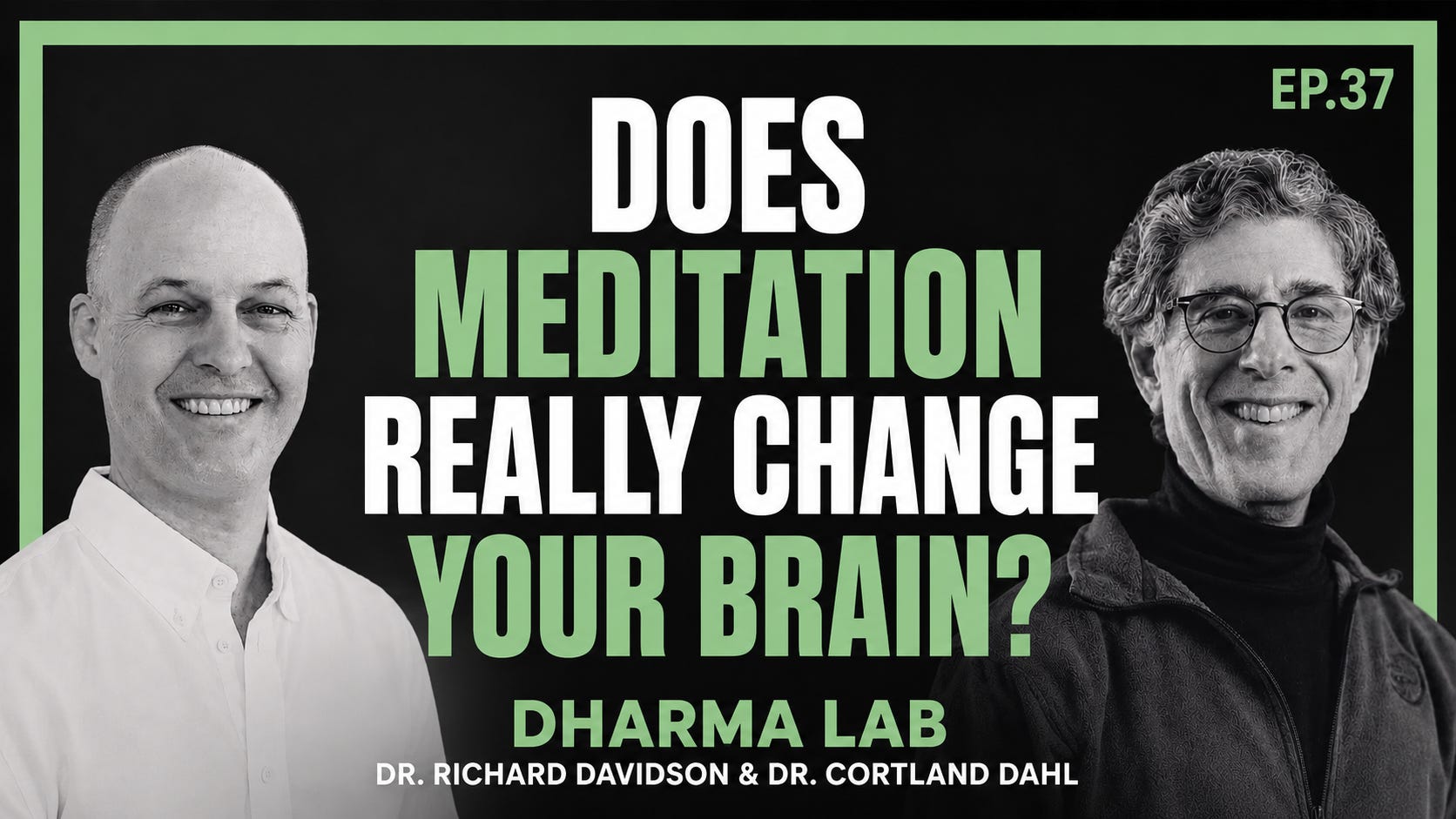
    • Transcript
  • May 21 · 48 min

    DL Ep.32: Dopamine Isn’t Your Problem with Dr. Richard Davidson and Dr. Cortland Dahl

    In this episode, Richie Davidson and Cortland Dahl unpack a very misunderstood molecule in popular culture: dopamine. Often blamed for craving, scrolling, distraction, and the endless loop of wanting more, dopamine is not something we can “detox” from or simply turn off. It is essential to motivation, aspiration, learning, and even the desire to practice meditation. Together, Richie and Cort explore what dopamine actually does in the brain, why wanting and liking are not the same thing, how novelty keeps us hooked, and how savoring may help us step out of compulsive loops and reorient toward what is genuinely nourishing. Enjoy! Watch on YouTube; Listen on Spotify or Apple Podcasts. If these conversations are useful, please consider subscribing to our YouTube channel. CHECK OUT EPISODE COMPANION FLASHCARDS! Podcast Chapter List (00:00:00) – Dopamine is not something we can turn off (00:03:46) – What is a neurotransmitter? (00:06:04) – Dopamine as neurotransmitter and neuromodulator (00:08:20) – Why the brain is too complex for simple chemical stories (00:12:02) – The awe and mystery of the brain (00:15:51) – Dopamine, motivation, and the myth of dopamine detox (00:17:04) – Wanting vs. liking (00:19:24) – Doom scrolling and the loop of seeking (00:22:32) – Does dopamine explain why we keep scrolling? (00:24:21) – Experiential fusion and mindless behavior (00:25:42) – Why one molecule is never the whole story (00:26:57) – Novelty and reward prediction error (00:29:00) – The Easter egg example: seeking, finding, and disappointment (00:30:23) – Dopamine in different brain circuits (00:35:37) – What actually helps with compulsive loops? (00:37:47) – Savoring as a way out of wanting (00:39:24) – Meditation, breath, and the practice of savoring (00:43:20) – Letting go of seeking (00:43:56) – Gratitude, bodhicitta, and the sweetness of connection (00:45:28) – Renunciation as reorientation (00:48:00) – Closing Related Topics From the Archives: Written transcript for those who prefer to read Lightly edited for clarity and readability. Dopamine Is Not Something We Can Turn Off (00:00:00) Richard Davidson:Dopamine is essential for human life. Cortland Dahl:There’s no turning dopamine off. Richard Davidson:No turning dopamine off. And anyone who thinks they’re going on a dopamine detox and really banishing their brain of dopamine, I hate to burst the bubble, but that would not be compatible with life. Dopamine is essential in motivation, desire, seeking, and anything that is goal-directed. It has been described by the neuroscientist Kent Berridge as central to “wanting,” which he contrasts with something that it is often confused with: “liking.” Many times, we like the things we want. But not all the time. Sometimes we get caught up in a wanting cycle that is not necessarily leading to liking. But dopamine also plays an incredibly positive and important role. When I spring out of bed in the morning, go down to have my cup of tea, and have the strong aspiration to meditate, that is inevitably relying on the dopamine system too. Welcome to Dharma Lab (00:01:45) Cortland Dahl:Welcome everyone to another episode of Dharma Lab. I’m Cortland Dahl, and I’m here with my dear friend Richie, Dr. Richard Davidson, who, as I’m sure most of you know, is one of the most eminent neuroscientists on the planet. We’re incredibly fortunate to have him in discussion yet again, and for a topic that he is especially well suited to talk about, which is dopamine. I never thought dopamine would be a hook for a conversation like this, but it has taken on almost mythic status in popular culture. It has almost become the bad boy of the brain, like the amygdala, which is one brain region that always gets a bad rap and is associated with all sorts of negative things. These days, of course, we hear a lot about dopamine. You might have heard of things like a dopamine detox, which makes it sound like dopamine is some toxic thing in the brain that we want to get rid of or shut off or have less of in some way. So we thought we could get into the science of neurotransmitters generally, and then specifically dopamine. What does the science really say? What function does dopamine actually play, not only in our brains but in our ability to thrive and flourish? Richie, maybe we can start by zooming way out. I’m guessing people have heard the word dopamine. Some may have geeked out a little and learned more or even tried something like a dopamine detox. Other people may have heard about serotonin or other neurotransmitters, but my guess is that people’s understanding is still a little fuzzy. Could we start with the idea of a neurotransmitter, and then zoom in and look at dopamine specifically? What Is a Neurotransmitter? (00:03:46) Richard Davidson:Yes. Thank you so much. This is a juicy topic and very appropriate for Dharma Lab. There is a constellation of molecules in the brain that play many different roles. One of those roles is what you mentioned: a neurotransmitter. A neurotransmitter has a very specific role in mediating the interaction between two neurons. When one neuron fires, it sends an electric potential down the axon of that neuron. You can think of the axon as the wire extending from the cell body. The cell body is where the basic machinery is, and the axon extends from the neuron. Those axons can be short, and they can also be very, very long. If I asked you right now to move the big toe in your right foot, all of you should be able to do that. That is actually a neuron that extends all the way from your brain to your big toe. Cortland Dahl:That’s a single neuron? That’s cool. I didn’t know that. Richard Davidson:Yes, it is a single neuron. Neurons have many different lengths. At the end of the axon, there is machinery that releases a little packet of chemical. That packet binds to what is called a receptor on another neuron, and that initiates an electric change in the second neuron. That is how communication works between two or more neurons. That is called a neurotransmitter. Dopamine as Neurotransmitter and Neuromodulator (00:06:04) There are also neurotransmitters and other molecules that act as neuromodulators. A neuromodulator is different from a neurotransmitter. Dopamine, which is the topic of our conversation today, can serve as both a neurotransmitter and a neuromodulator. What is the difference? A neuromodulator alters the threshold for the firing of a neuron. It is not directly involved in cell-to-cell communication in the same way. It is more like the molecular soup in which the neuron resides, and that changes the threshold for the firing of the subsequent neuron. There are many molecules that serve as both neurotransmitters and neuromodulators, and dopamine is one of them. I think most neuroscientists would agree that we have not yet discovered the full range of neuromodulators and neurotransmitters in the human brain. It is a vast number. In the popular press, we’ve heard about dopamine, serotonin, maybe norepinephrine, maybe GABA. But there are hundreds of these molecules playing complicated roles. This is why, in general, it is extremely hazardous to pin a particular mental state on a single molecule. That is almost assuredly excessively simplistic and wrong. To the best of our knowledge, there is no well-defined psychological state that can be pinned to one specific molecule. It is much more complex than that. Why the Brain Is Too Complex for Simple Chemical Stories (00:08:20) Cortland Dahl:Just as a footnote, I think it’s mind-boggling when you hear how complex our brains are. Could you say a little about the estimates of how many neurons there are, and then beyond that, the connections between neurons? Now we’re talking about neurons communicating with each other. It’s an order of magnitude we can’t even comprehend. Richard Davidson:The estimated number of neurons in the human brain is about 85 or 88 billion. Cortland Dahl:That’s a “b,” everyone. Richard Davidson:Yes, billion. And the estimated number of connections among thos… This is a public episode. If you'd like to discuss this with other subscribers or get access to bonus episodes, visit www.dharmalab.co/subscribe
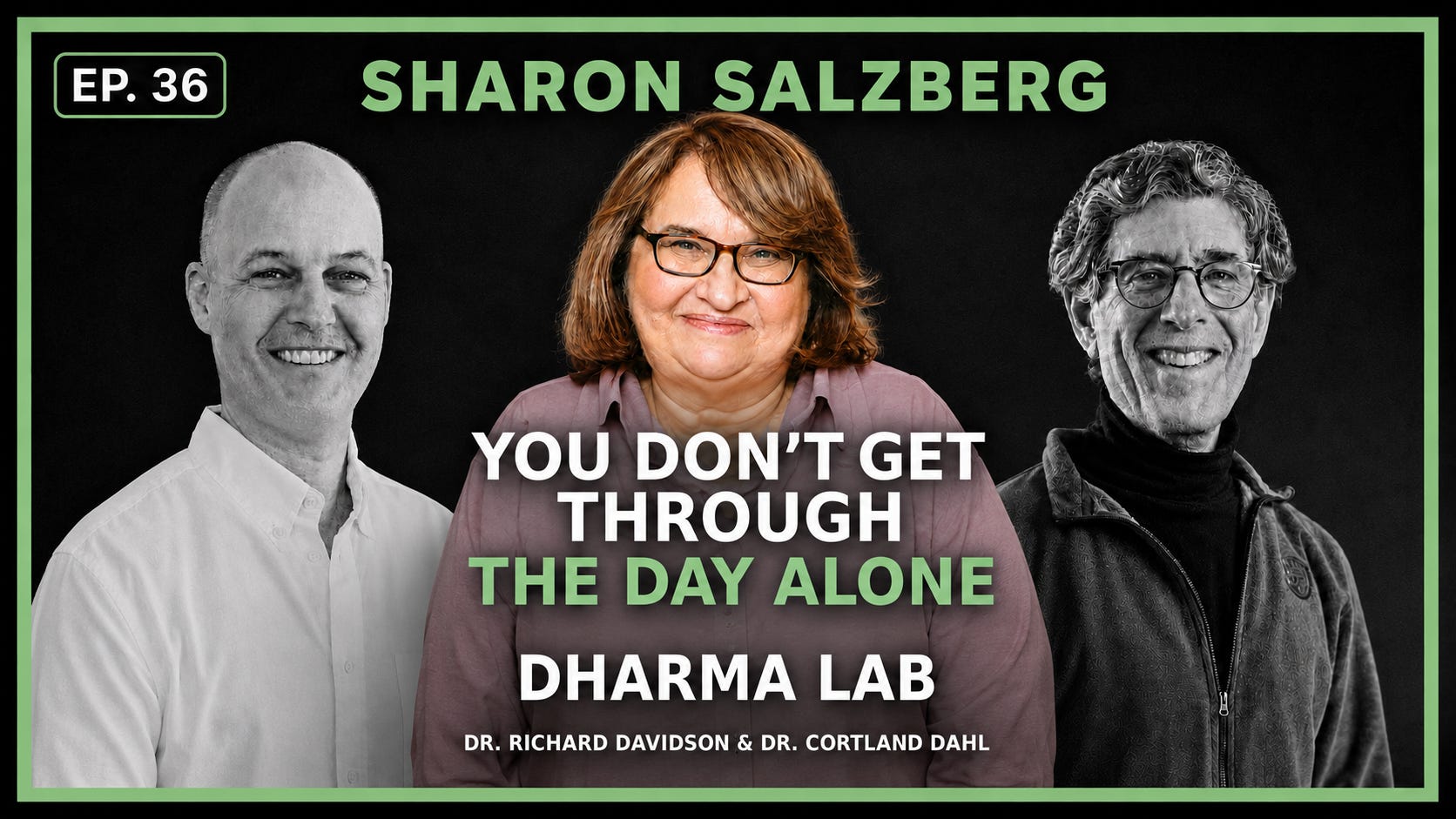
    • Transcript
  • #31
    May 7 · 50 min

    DL Ep. 31: Your Brain Is a Storyteller

    In this episode, Richie Davidson and Cortland Dahl deeply explore the science of the emotional brain: why the mind is a storyteller, what split-brain research reveals about consciousness, how brain asymmetry shapes emotion, why some people approach opportunity with optimism while others withdraw, and what meditation may do to the brain and immune system. Enjoy! See below for FLASHCARDS, Full Transcript Below Watch on Youtube; Listen on Spotify or Apple Podcasts. FLASHCARDS / EPISODE COMPANION HERE Podcast Chapter List (00:00:00) – The brain is a storyteller (00:01:03) – Welcome to Dharma Lab (00:04:05) – Norman Geschwind and behavioral neurology (00:06:31) – The thumbtack story: emotional memory without conscious memory (00:12:12) – Language, the left hemisphere, and the corpus callosum (00:19:04) – Brain asymmetry and emotion (00:22:54) – Why emotion was so understudied (00:29:26) – Brain asymmetry, attachment, and aversion (00:31:19) – The prefrontal cortex and the old divide between thought and feeling (00:37:07) – Studying emotion in newborn infants (00:42:37) – Meditation, brain asymmetry, and the immune system (00:47:04) – Why “it’s not so simple” Written transcript for those who prefer to read Lightly edited for clarity and readability. The Brain Is a Storyteller (00:00:00) Cortland Dahl:The example you gave earlier, with Broca’s area and the split-brain findings, points to something fascinating. Parts of the brain are not always talking to each other. One part of the brain clearly knows something, but the part that communicates doesn’t. And it doesn’t stay silent. It makes something up. That’s the funny thing. In the absence of information, we don’t just stay silent. When we don’t know something, we are not comfortable with not knowing. Some instinctual part of us fills in the blanks almost all the time. Richard Davidson:Exactly. The human mind and brain is a storyteller. This is how we make sense of our world. We create these narratives. Welcome to Dharma Lab (00:01:03) Cortland Dahl:Welcome everyone to another episode of Dharma Lab. I’m Cortland Dahl, and I’m here with Dr. Richard Davidson, who we all lovingly call Richie. As many of you know, Richie is one of the most pioneering and widely studied neuroscientists on the planet. It’s a gift to be in conversation with him. Today we’re going to have a conversation I’ve wanted to have for a long time. I moved to Madison, Wisconsin in 2012 to study with Richie, and over the years I’ve heard many conversations at the Center for Healthy Minds about neuroscience, meditation, and the mind. But one thing that has never really happened, even for those of us who work closely with Richie, is a kind of broad “download” from him about the amazing body of work he has contributed to over the decades. Many people know Richie as a pioneer of contemplative science and contemplative neuroscience, the scientific study of how practices like meditation affect the mind, the brain, and our biology. But he is also a pioneer of affective neuroscience, which you might think of as the neuroscience of emotion. To be a pioneer in one field is extraordinary. To be a pioneer in two is kind of mind-boggling. So today I want to dig into some of those key insights, especially around neural asymmetry, which was a huge part of Richie’s early career and a central theme in affective neuroscience. Norman Geschwind and Behavioral Neurology (00:04:05) Richard Davidson:This topic is near and dear to my heart. It still is something I’m extremely interested in. It really began when I was a graduate student and had the opportunity to study with Norman Geschwind at Harvard Medical School. Geschwind was one of the great towering figures in what we now call behavioral neurology. I took a course with him on functional neuroanatomy, which is basically how different parts of the brain are connected to different behavioral functions. He was a neurologist, so he looked at people’s behavior as an external reflection of what was going on in the brain. He was an extremely keen observer of behavior, and he was also very demanding. He was what we would now call a localizationist, someone who believed in the specific localization of different functions in different parts of the brain. He used to say that if you don’t believe in localization, it’s because you don’t know neuroanatomy well enough. That pushed me to learn neuroanatomy deeply, including doing a human brain dissection. I also went on rounds with him, where he would visit neurological patients in the hospital. He would do these bedside exams that were incredible, using clever ways of interacting with patients to reveal what might be different about their brains. The Thumbtack Story: Emotional Memory Without Conscious Memory (00:06:31) Richard Davidson:One of the most famous demonstrations I saw involved a technique associated with Korsakoff, who described a syndrome of dementia related to alcoholism. Korsakoff showed that there can be a separation between memory for declarative information and memory for emotional information. A person with severe dementia might not recognize you if you came back the day after seeing them. They may have no conscious memory of who you are. But the question was whether the same was true for emotional information. The demonstration was this: a doctor would put a thumbtack in his hand and shake the patient’s hand. The patient would feel the prick and withdraw. The next day, the doctor would return and ask, “Do you know who I am?” The patient would say no. The doctor would identify himself and offer his hand again. But the patient refused to shake his hand. When asked why, the patient confabulated. He said something like, “I think your hand is dirty, and I don’t want to shake your hand.” That’s a beautiful demonstration of the dissociation between declarative memory and emotional memory. The declarative memory was gone. The patient did not recognize the doctor’s face or name and had no conscious memory of having seen him. But the emotional memory remained. Cortland Dahl:That one point has huge implications for life. We often have an interpretation of something and we are completely convinced of it. It seems so real that it doesn’t occur to us that it’s an interpretation. And yet the mind may have limited information, or may not be conscious of something, and it creates a whole story. In some cases, the story is flat-out wrong. But in the moment, it feels like reality. Richard Davidson:Exactly. And this is not just occurring in patients with frank brain damage. This is happening in all of us all the time. This is how our minds work. The mind creates a story about the world, and it’s from that story that we operate. It is not from some veridical perception of things in the world. There is no such thing as that. Our minds are constantly creating these stories. This relates directly to our insight pillar of well-being, which is about the narratives we are constantly creating about ourselves. Language, the Left Hemisphere, and the Corpus Callosum (00:12:12) Richard Davidson:One of Geschwind’s great contributions was his work on language-related lateralization in the human brain. In virtually all right-handed people, which is about 85 to 90 percent of the population, it is the left hemisphere that can speak, while the right hemisphere cannot. There is a key region called Broca’s area, named after Paul Broca. Damage to this area, often through stroke, can impair a person’s ability to speak. What is interesting is that this is one of the most clearly lateralized functions in the human brain. If this area in the left hemisphere is damaged, the corresponding area in the right hemisphere does not simply take over. The two hemispheres of the brain are very similar in many ways, but they have important differences. They are connected by the corpus callosum, a massive bundle of white matter that connects neurons in one hemisphere to corresponding neurons in the other. It is the largest pathway of connection in the human br… This is a public episode. If you'd like to discuss this with other subscribers or get access to bonus episodes, visit www.dharmalab.co/subscribe
    • Transcript
  • April 24 · 59 min

    DL Ep.30: The Dharma of Relationships with Devon + Nico Hase

    Relationships can be one of the most powerful parts of the spiritual path because they reveal the parts of ourselves we cannot easily see alone. In this episode of Dharma Lab, Cortland Dahl and Richie Davidson are joined by meditation teachers and authors Devin and Nico Hase to explore how Buddhist practice can help us navigate love, conflict, vulnerability, appreciation, and repair. Drawing on their new book, This Messy, Gorgeous Love, they reflect on why relationships are inherently challenging, how they become mirrors for growth, and how simple practices like awareness, check-ins, and appreciation can turn partnership into a path of awakening. Podcast Chapter List 0:00 Relationships are rough: using partnership as a spiritual path1:11 Introducing Devin and Nico Hase and This Messy, Gorgeous Love5:36 What can a monastic tradition teach us about relationships?7:05 Devin on translating Buddhist teachings into modern lay life9:53 Nico on bringing Dharma into the gritty reality of family and partnership11:29 Richie on family, feedback, and why Dharma must matter in real life15:23 Retreat, relationship, and why we can’t hide from ourselves18:04 Partners as teachers: what relationships reveal about us19:34 Nico on monastic ideals, friction, and freedom21:29 Richie on being exposed, seen, and changed by relationship22:16 Self-knowledge, co-regulation, and the dance of partnership23:36 Writing the book together and relationship as mirror25:07 Cort on intimacy, fear, and what love uncovered28:40 Relationships are rough: the myth of smooth sailing30:04 Vulnerability, exposure, and becoming resilient together31:21 Dukkha and the “bumpy ride” of partnership34:24 Appreciation, gratitude, and learning to see the good42:42 Conflict styles: volcanoes, diplomats, and dodgers52:19 The trance of nice: kindness, emotion, and authenticity55:12 Practical takeaways: check-ins, fun, and daily connection57:43 Final reflections on relationships, friendship, and the book’s wider relevance This is a public episode. If you'd like to discuss this with other subscribers or get access to bonus episodes, visit www.dharmalab.co/subscribe
    • Transcript
  • March 27 · 52 min

    DL Ep.29: Daniel Goleman on Practicing Before Life's Challenges

    Dr. Richie Richard Davidson, Cortland Dahl, Dan Goleman Discussion Chapter Summary: 00:05:51 — Dan Goleman returns from India and meets Richie Davidson at Harvard00:06:38 — Studying meditation in academia when the field dismissed it00:07:11 — Their careers diverge: journalism at the New York Times and neuroscience research00:08:08 — The Mind & Life Institute and first meetings with the Dalai Lama00:09:20 — Paul Ekman’s surprising transformation after meeting the Dalai Lama00:12:03 — Richie’s quiet strategy: exposing scientists to contemplative practice00:13:09 — The birth of a new generation of contemplative scientists00:14:37 — Cort Dahl discovers meditation research in graduate school00:16:10 — Jon Kabat-Zinn teaching yoga in a Harvard Square basement00:17:35 — “The after is the before for the next during” — meditation changes baseline states00:18:43 — The breakthrough 2004 meditation brain study00:20:26 — The Dalai Lama’s lifelong assignment to study and share these practices00:21:47 — Shifting psychology from pathology to human flourishing00:26:09 — Emotional intelligence as a path to well-being00:31:16 — Why practice—not theory—is what actually changes people00:32:37 — Cort Dahl’s experience with social crisis and emotional complexity00:35:31 — The Dalai Lama’s advice on skillfully working with anger00:38:28 — Two contemplative approaches to difficult emotions00:45:24 — “Feel what you are feeling” — a simple practice that changes awareness00:46:11 — Dan Goleman on Vipassana meditation00:47:10 — Scaling well-being beyond formal meditation practice00:50:04 — Mingyur Rinpoche after retreat: “the same, only more so” This is a public episode. If you'd like to discuss this with other subscribers or get access to bonus episodes, visit www.dharmalab.co/subscribe
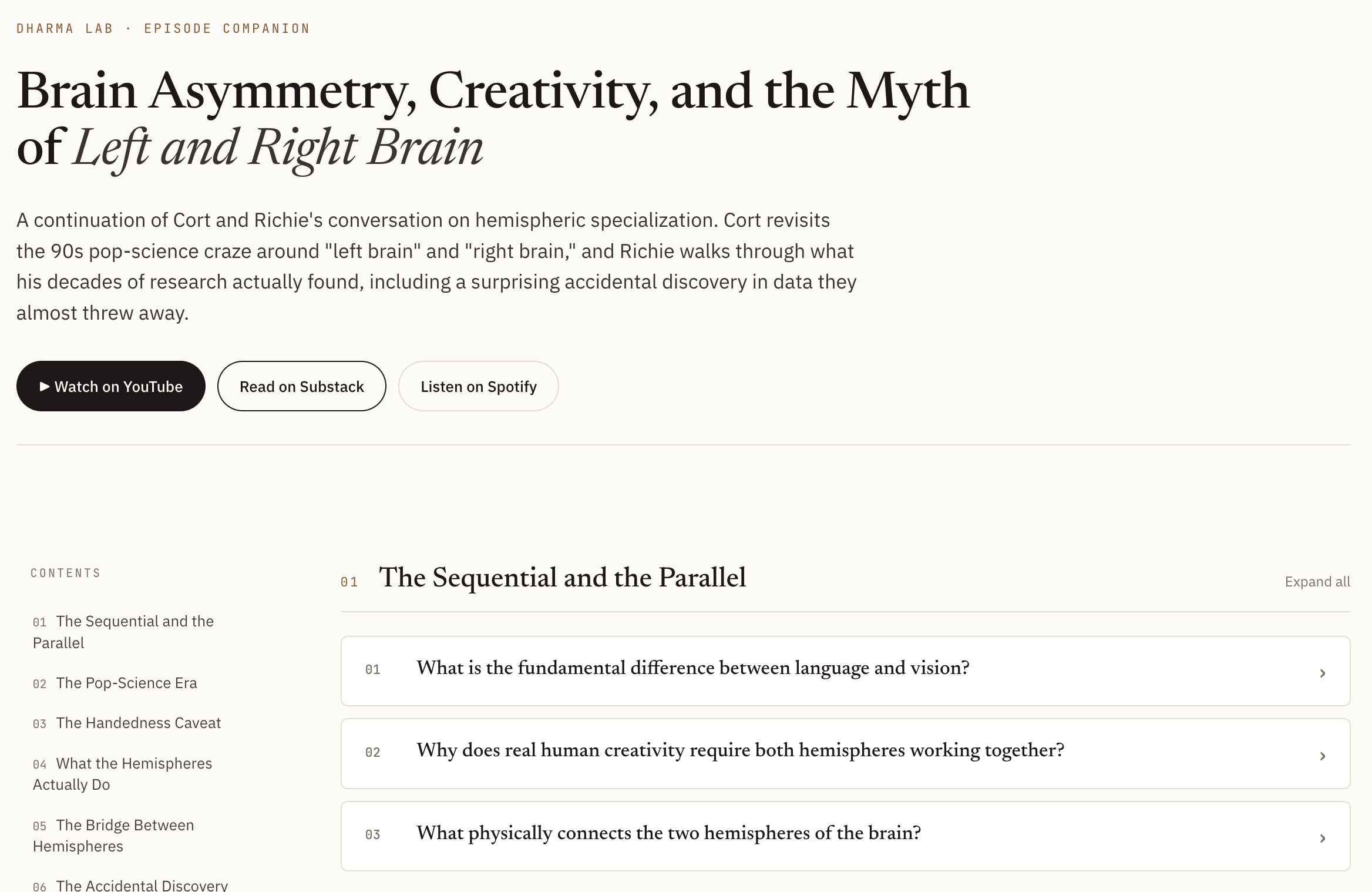
    • Transcript
  • March 12 · 30 min

    DL Ep. 28: Mingyur Rinpoche - Are You Drained Or Are You Energized?

    We are so honored to welcome Yongey Mingyur Rinpoche to another episode of Dharma Lab. In today’s conversation with Cort and Richie, Rinpoche shares practical ways to stay present in a busy life: a powerful metaphor (“time is like a rubber band”), an “inner sky” teaching for working with anxiety and emotional storms, and a simple micro-practice you can try in under a minute. They also explore why meditation can increase energy and effectiveness, how altruistic intention can transform stress into purpose, and what early research suggests about “flourishing” rippling outward into our families, workplaces, and communities. Podcast Chapter List: 00:00 – Mingyur Rinpoche’s “32 projects” and the secret to steady energy00:27 – Why busyness pulls the mind into past/future (and out of the present)00:55 – How stress shows up in the body 01:14 – “Time is like a rubber band”: making practice fit real life03:13 – Retreat, discipline, and why highly productive people still practice deeply05:23 – The “inner sky”: storms of emotion don’t change awareness06:25 – The airplane rule: “Put your mask on first” (service without burnout)08:24 – Altruistic motivation: practicing for the benefit of others08:53 – Richie’s 2-minute post-meditation calendar practice (be more helpful today)09:56 – “Plugging into a power source”: curiosity, insight, and wisdom as fuel10:06 – The trap of endless wants/needs—and why it’s draining10:26 – Service as nourishment: turning a busy day into a meaningful day21:11 – Doomscrolling vs. creating space for wisdom and compassion24:50 – The science question: does flourishing ripple into systems and communities?25:25 – Mexico healthcare study with Atentamente (practice in the real world)26:35 – Randomized controlled trial results: wellbeing, care outcomes, productivity28:30 – 1-minute micro-practice with Mingyur Rinpoche: connect with the wish to be happy, and expanding that intention outward: love, compassion, and shared flourishing In case you missed it, previous conversation with Rinpoche: Cort and Richie’s new book is coming out in a few weeks! Pre-order Born to Flourish and get: * 1 full year of paid access to Dharma Lab ($100 value) with weekly essays, research updates, podcasts, and member-only online events * Live access to an exclusive Born to Flourish Launch Event * Richie and Cort’s personal reading list on the art of flourishing * A daily protocol for training the mind to flourish Other posts referenced in this episode: This is a public episode. If you'd like to discuss this with other subscribers or get access to bonus episodes, visit www.dharmalab.co/subscribe
    • Transcript
Showing 1–20 of 28 episodes