Skip to content
Artwork for Chasing Consciousness

Chasing Consciousness

Freddy Drabble

The curious person’s guide to all things mind!
Have you ever wondered how it is that your thoughts and feelings relate to the grey matter in your head? How space and time came to be out of nothing? How what life means to us influences our day-to-day struggles with mental health?
In conversation with experts in physics, psychology, neuroscience and philosophy, Chasing Consciousness will take you to the very fringes of reality and share with you the groundbreaking discoveries that are dramatically changing the way we relate to the world, the future, and our own minds.

Play
  • 23 episodes
  • fortnightly
  • Avg 1 hr 28 min
  • English
Counted on this page — what you have heard stays on this device, so it is not something the list can be paged by.
  • S5 · E73
    May 31, 2025 · 1 hr 19 min

    DMT ENTITY ENCOUNTERS, A QUANTITATIVE STUDY - Dr David W Lawrence #73

    What’s the architecture of a DMT experience, who are the entities that regularly interact and what’s their message? How can DMT therapy facilitate positive mental health outcomes? In this episode we’re going to learn about the bizarre types of experience that users of DMT have; DMT being the most powerful hallucinogenic molecule on the planet. So we’ll be getting into the background of psychedelics for mental health; and the particularities of DMT, the active ingredient in Ahyuasca and the psychedelic that most often presents entities that interact meaningfully with the experiencer; we’re going to discuss the different types of entities: from mythological creatures, to Gods and Demons, to machine elves and aliens, and the significance of these same characters appearing significantly often without an obvious primer; we’ll also discuss the importance of mystical experience and teacher /guide experiences to positive mental health outcomes. Fortunately our guest was the head researcher on a 2022 paper that looked at exactly this topic, the medical doctor and sports scientist professor at the University of Toronto, Dr. David Wyndham Lawrence. He’s published over 35 scientific papers across sports science and psychedelics for medical use. What we discussed: 00:00 Intro 05:20 Concussion, sports mental health & psychedelic therapy. 08:10 Bringing in Robin Carhartt-Harris on the gaps in sports mental health treatment. 12:06 Why psychedelics for those already in psychological difficulty? 14:04 Serotonin receptor - neuro-protective mitochondria function. 15:00 DMT is endogenous to the brain. 18:20 Medical institution meets shamanism. 23:50 David’s DMT phenomenology paper. 30:10 The architecture of the DMT world. 32:60 Mostly positive, interactive entity encounters. 37:05 Occasionally negative encounters. 38:40 Negative psychedelic experiences study - Jules Evans. 40:05 How much “Primers” from pop culture influence experiences. 44:00 Alien encounters in %16 of participants. 45:30 Medical procedures by entities in 9% of participants. 47:05 Mystical experiences in %70 of participants. 49:00 Familiarity/ sense of home in the experiences. 52:20 Default Mode Network is less active during altered states. 48:35 Ego dissolution Vs mystical experience. 01:00:00 5meoDMT Vs DMT. 01:03:20 Wise teacher experience in 32% of participants. 01:05:20 Death bed palliative doses to alleviate fear of death. 01:09:50 ‘You’re not ready for this experience’ message. 01:11:05 Theories of DMT experiences evaluated. 01:12:20 ”All models are false but some are useful”, anonymous statistician. References: David Lawrence, “Phenomenology and content of inhaled DMT” David Wyndham Lawrence and Robin Carhart-Harris, “Sports Medicine, Mental Health & Well-Being, and Psychedelics” Benny Shanon, “Antipodies of the Mind” Matthew W. Johnson - Johns Hopkins Andrew Gallimore - “Death by Astonishment” Jules Evans et al, “Extended difficulties following the use of psychedelic drugs” Similarities between DMT and Alien encounters paper David W. Lawrence, “DMT Occasioned Familiarity and the Sense of Familiarity Questionnaire” Roland Griffiths, “Psilocybin produces substantial and sustained decreases in depression and anxiety in patients with life-threatening cancer”
  • S5 · E72
    May 14, 2025 · 1 hr 13 min

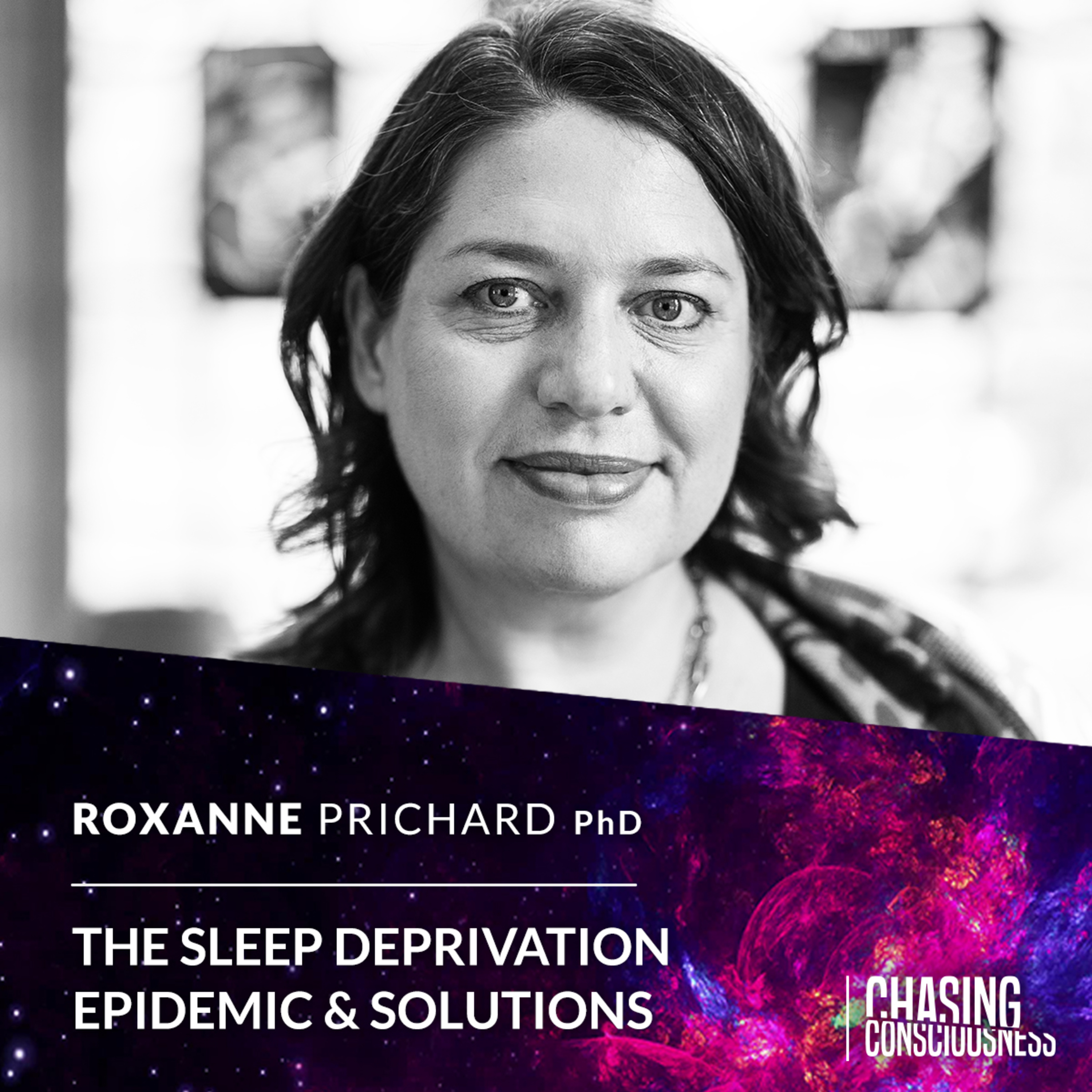
    THE SLEEP DEPRIVATION EPIDEMIC & SOLUTIONS - Roxanne Prichard PhD

    What are we sleeping less and less? What are the benefits of getting a good nights sleep and the risks if we consistently don’t? How is sleep linked to memory, cognitive performance, blood sugar regulation & stress hormones? How is young people’s development affected by sleep? In this episode we have the surprising data on the science of sleep to get up to date on; so, why there’s a sleep deprivation epidemic; how sleep works and what it’s required for; dreams; and importance of sleep for learning and for immunity. We’re also going to discuss the wide range of serious health issues that arise with even a small sleep deficit, and the vast benefits of getting sleep right; and the lifestyle tips we need to consistently get the sleep we need. And of course, sleep and mental health, and the importance of sleep for development in young people. Gratefully our guest today is a psychologist and neuroscientist that specialises in sleep, mental health and dream research, particularly in young people. She’s the Scientific Director of Psychology at the University of St. Thomas, Minnesota, Roxanne Prichard! She’s the author of over 40 highly citied scientific papers, and her TEDx talk “Addressing our Childrens Sleep Debt” was featured in the lecture series: Transforming Education. She’s quoted regularly in the press, inlcuding the New York Times, Wall Street Journal, Teen Vogue, and USA Today. What we discussed: 00:00 Intro. 05:00 The Sleep deprivation epidemic. 07:15 Shaking off prejudice about resting being laziness. 08:31 Glymphatic system for toxin removal. 10:00 Synaptic plasticity: Learning & unlearning. 11:10 Learning & memory require sleep. 14:00 The hippocampus processes memory during sleep. 15:00 Late night cramming for exams blocks learning. 15:50 Lack of sleep appears to the body as a threat out in the world. 17:40 Blood sugar regulation is affected by sleep. 18:00 “Sleep! Like diet and exercise only easier!” 19:10 Immunity and sleep deprivation. 21:00 Cancer & regularity of circadian rhythms. 22:00 Evolution, daylight, circadian rhythms & learning. 23:45 Sleep delay of morning stress hormones in teens. 26:15 Light Vs Deep ‘Slow Wave’ Vs REM sleep. 30:00 REM Sleep explained. 33:00 Dreams: The top theories. 36:30 The electrical nature of sleep & brain waves. 40:00 Alpha Waves and biofeedback for insomnia. 42:00 Insomnia & the health risks of sleep deprivation. 46:00 Sleep is within our control. 47:15 The inflammation link with sleep. 49:30 The mental health risks of sleep deprivation. 50:00 Catastrophising and attention deficit. 50:45 College students mental health & sleep as a crucial marker. 57:30 Persausive technology, screens & sleep. 01:02:30 How much sleep do we need? 01:04:25 Avoid external stimulants & go to low light. 01:06:00 Avoid internal stimulants like caffeine and alcohol. 01:07:40 Sleep and wake at regular times every day. 01:08:40 Core temperature dropping signals sleep. 01:10:00 Roxanne’s campaign points. 01:12:00 The shame around rest. References: Ya Chai at al, ‘Two nights of recovery sleep restores hippocampal connectivity but not episodic memory after total sleep deprivation’ paper.https://www.nature.com/articles/s41598-020-65086-xN.I.H. article, 'Sleep on it - How snoozing strengthens memories' (40% drop in learning after sleep deprivation)https://newsinhealth.nih.gov/2013/04/sleep-itU. Chicago Medicine article, 'New study helps explain the link between sleep loss and diabetes'. Trisha Hershey, ‘the Nap’ Bishop. - “Rest is Resistance” book.

  • S5 · E71
    Apr 30, 2025 · 1 hr 38 min

    GLOBAL FIELD CONSCIOUSNESS THEORY - Roger Nelson PhD #71

    Can intention alone cause changes in physical systems? Can the collective attention of a large group of people to an event cause changes in the coherence changes in physical systems, despite that lack of intention to do so? In today’s episode we’re going to be exploring a field consciousness hypothesis: so a variation on the idea that consciousness may extend beyond the body and interact casually with physical systems and the consciousness of other beings, in some kind of resonant field phenomena. We’re going to be learning about the experiments with random number generators used to test this hypothesis; how human intention and attention has been proved to be able to affect these random outputs in a vast backlog of positive results and meta analyses; We're going to hear about how these experiments have been taken global, looking at collective effects on RNGs of particularly important world events that many people are attending to; we’re going to be looking at criticisms of the statistical analysis and a potential experimenter effect; and we’re going to be talking about the contrast between some seemingly non-local effects with other localised effects; and as always we’re going to be getting into the implications, in this case of whether the ‘field consciousness’ effect the data seems to point to, is more likely to be a unified field of consciousness, so in some sense a single mind, or simply the aggregated sum of all individual consciousnesses. Now fortunately to guide us as we carefully test the thickness of the ice on this genuinely alternative world view of consciousness, we have the cognitive psychologist that has pioneered these field consciousness experiments since he founded the Global Consciousness Project at the Princeton University PEAR labs, Roger Nelson. Roger worked at Princeton’s PEAR labs in the department of Mechanical and Aerospace Engineering, initially under Bob Jahn, for over twenty years until his retirement in 2002. He is also the author of the book “Connected: The emergence of global consciousness”. What we discuss: 00:00 Intro. 07:30 Random Number generator ‘mind-matter interaction’ experiments at Princeton PEAR labs. 21:10 Bob Jahn - Dean of Engineering at Princeton. 28:45 Emotional and passionate group events saw coherence in the RNG experiments. 33:00 Contrast between apparent local and non-local effects. 37:55 David Bohm’s Implicate / Explicate order concept. 38:55 “Pilot wave” and “active information” link between the implicite and the explicate. 43:55 Statistical results generation and analysis of significance. 49:05 The sceptics criticisms. 51:45 The Global Consciousness Project methodology. 53:05 Pierre Teilhard de Chardin’s mind sphere, called ‘Noosphere’. 57:45 Measuring the group coherence of Princess Diana’s funeral. 01:00:25 The 9/11 Results. 01:05:55 The emotional component in coherence. 01:18:40 The quantity of people and strength of the emotion, whether positive or negative, raises the effect size. 01:11:10 A single collective consciousness VS an aggregate of all individual consciousnesses. 01:14:50 Different levels of collective consciousness above individual bodies. 01:16:55 The analogy of individuals being like neurones in a cosmic brain. 01:20:55 The Experimenter effect criticism. 01:26:10 The Helmut Schmidt “Unobserved tape” experiment. 01:29.10 The indeterminate state before observer ‘collapses of the wave function’ analogy to explain results. 01:37:25 The Schmidt ‘retrocausation’ hypothesis. References: Roger Nelson, “Connected: the Emergence of Global Consciousness” Robert Jahn And Brenda Dunn, “Margins of Reality” International Consciousness Research Laboratories (ICRL) Publishing. Pierre Teilhard de Chardin, “The Phenomena of man”

Showing 21–23 of 23 episodes