EP Edge Journal Watch: Cardiac Electrophysiology Research
EP Edge® Journal Watch, Issue 46, November 2026: AF Ablation, Cardiac Resynchronization and Stroke Prevention, Part 1
Short preview
When does better rhythm control translate into better symptoms? EP Edge and LAHRS revisit the 2026 evidence on atrial fibrillation ablation, pacing for heart failure and left atrial appendage closure.
Episode description
In Part 1 of our 2026 electrophysiology review, EP Edge and the Latin American Heart Rhythm Society (LAHRS) revisit decisions that come up in the EP clinic and lab. Should a patient with persistent atrial fibrillation (AF) start with pulsed field ablation or an antiarrhythmic drug? If ablation is chosen, what justifies treating tissue beyond the pulmonary veins?
First-line ablation and the posterior wall
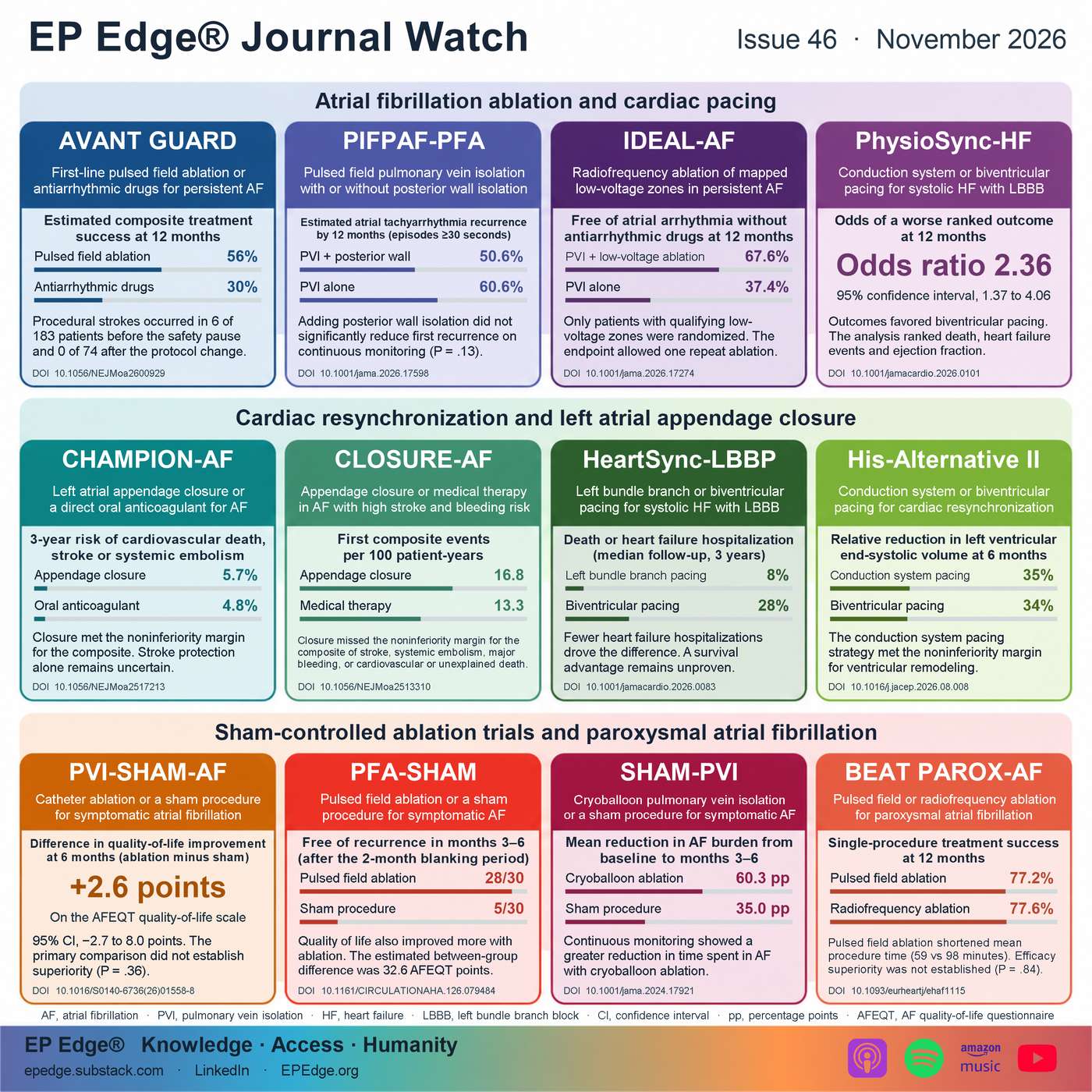
In AVANT GUARD, estimated 12-month success on the composite rhythm-control endpoint was 56% with ablation and 30% with drug therapy. Yet the same ten-minute AF episode counted as a recurrence if the patient felt it and fell below the one-hour threshold if it was silent. We examine six procedural strokes before the trial pause, the subsequent changes to patient selection and anticoagulation, and why zero strokes among the 74 patients treated afterward leaves uncertainty about safety. AVANT GUARD
PIFPAF-PFA found no significant improvement in its primary recurrence endpoint with routine posterior wall isolation. IDEAL-AF found greater freedom from arrhythmia off antiarrhythmic drugs when additional radiofrequency ablation targeted mapped low-voltage tissue in patients who met its mapping criteria. PIFPAF-PFA · IDEAL-AF
Cardiac resynchronization in heart failure
Brazil’s PhysioSync-HF favored biventricular pacing on an outcome that prioritized death and worsening heart failure. HeartSync-LBBP found fewer deaths or heart failure hospitalizations with left bundle branch pacing, driven mainly by fewer hospitalizations. His-Alternative II measured the reduction in left ventricular end-systolic volume at six months. We discuss why confirming conduction system capture matters when applying these results. PhysioSync-HF · HeartSync-LBBP · His-Alternative II
Left atrial appendage closure and stroke prevention
CHAMPION-AF met its noninferiority criterion for cardiovascular death, stroke or systemic embolism in patients eligible for anticoagulation. How much does meeting that composite endpoint tell us about stroke prevention itself? We examine Anish Shah and colleagues’ Heart Rhythm viewpoint using historical placebo data, then turn to CLOSURE-AF, where closure failed to demonstrate noninferiority to medical therapy in patients at high risk of both stroke and bleeding. CHAMPION-AF · Shah viewpoint · CLOSURE-AF
What patients feel after ablation
PVI-SHAM-AF, PFA-SHAM and the earlier SHAM-PVI all found better rhythm outcomes with ablation. PFA-SHAM and SHAM-PVI also found a quality-of-life benefit. In PVI-SHAM-AF, the primary six-month quality-of-life comparison fell short of statistical significance. We look at baseline symptoms, beta-blocker use and the care patients received after a sham procedure. PVI-SHAM-AF · PFA-SHAM · SHAM-PVI
BEAT PAROX-AF compared pulsed field with radiofrequency ablation in paroxysmal AF. Pulsed field ablation shortened procedure time without demonstrating superior rhythm control. BEAT PAROX-AF
AF burden, AF density and ischemic stroke
One continuous day of AF and one hour on each of 24 days give the same burden over a month. Does the clustering of those hours matter? We close with the device-monitoring study by Lindsey Rosman and colleagues, its corrected one-year stroke estimates and the limits of using this observational association to guide anticoagulation for an individual patient. AF density study · Published correction · Authors’ reply
Part 2 of the annual review is planned for January 2027. Regular weekly Journal Watch coverage continues in the meantime.
Today · 37 min
TM
Tiny Matters
[CHAIN REACTION] From Insulin to GLP-1s — A Peptide Saga: The Drugs That Shape Us, Episode 4
If you’re on social media, you may feel bombarded by influencers promoting peptides for a range of ailments so broad it almost seems like a brand-new trend. But peptide-based therapies actually date back to 1922, when insulin was first administered to treat diabetes. But it wasn’t until semaglutide (better known as Ozempic) entered the market that peptides truly captured public attention. In today’s episode, we explore how what chemists and other scientists learned from insulin paved the way for the remarkable effectiveness of GLP-1 drugs, and how treatments originally developed for diabetes are now being used to address obesity, substance use, and more. Listen to Chain Reaction by ACS wherever you get podcasts and at acs.org/chainreaction.
See Privacy Policy at https://art19.com/privacy and California Privacy Notice at https://art19.com/privacy#do-not-sell-my-info.
Today · 41 min
R
Robert
149. Anders Sandberg • AI förbättrar redan AI - vad händer med människan?
Anders Sandberg är tillbaka för ett lekfullt och svindlande samtal om verkligheten, artificiell intelligens och människans plats i framtiden.
Robert och Anders börjar med frågan om vi kan leva i en simulation, men upptäcker snart att den leder rakt in i våra mest vardagliga val: Vad ger livet mening? Spelar våra relationer mindre roll om verkligheten är konstruerad? Och hur behåller vi vårt inflytande när AI kan bli bättre än människan på att organisera företag, skapa kultur och fatta beslut?
Ett samtal om allt från Matrix, medvetande och fri vilja till AI-drivna kaféer, självreproducerande kapital, digitalt brus och framtida civilisationer – med en oväntat praktisk slutsats om hur stora tankeexperiment kan hjälpa oss att leva klokare här och nu.
00:00:00 - Lever vi i en simulation?
00:06:21 - Nick Bostroms obekväma simulationsargument
00:10:07 - Vad ger livet mening om allt är simulerat?
00:16:50 - Vad betyder det att något är verkligt?
00:33:25 - Fri vilja, tid och verkligheten som berättelse
00:47:00 - Superintelligent AI och framtidens simulationer
00:57:49 - Kommunikation bortom språk och våra personliga AI
01:08:13 - När AI blir smartare än människan
01:22:02 - AI-företag, kapitalism och framtidens organisationer
01:37:42 - Självgående företag och autokatalytiskt kapital
01:49:41 - Om vi tappar kontrollen över AI
02:01:15 - Demokrati, AI-representanter och mänskligt inflytande
02:11:24 - AI-slask, äkthet och människans kreativitet
02:23:12 - Kan AI skapa något genuint nytt?
02:30:05 - Dyson-svärmar och hur vetenskapliga myter uppstår
02:43:46 - Anders viktigaste lärdom från samtalet
Today · 2 hr 47 min
PM
Project Medtech
Episode 290 | Darren Obrigkeit, CEO at Resivant Medical | Super Glue Meets Silicone: Taking a First-of-Its-Kind Skin Adhesive from Lab to OR
How do you sterilize super glue with heat, keep it shelf-stable for two years, and then convince a busy surgeon to stake their reputation on it? In this episode, Duane Mancini sits down with Darren Obrigkeit, a chemical engineer from the University of Michigan and MIT who sold his first startup, Angstrom Medica, before learning the business side at Flextronics and DSM Biomedical. Today he leads Resivant Medical, a University of Akron spin-out whose Cutiva PLUS Skin Closure System pairs a surgical mesh with the first new skin adhesive chemistry in decades: a stretchy, silicone-based super glue.
Darren explains why every formulation change "turns the clock back to zero" on FDA shelf-life data, why the team designed every detail of the adhesive, applicator and packaging to be as good as possible before launch, and what it really takes to get through a hospital value analysis committee, where a surgeon has to spend their own political capital to bring you in. He also shares the story behind the company's first patient cases at Eisenhower Health, the nerve-racking moment before a device is used for the first time, and how a laser cutter, a 3D printer and a $300 vacuum former replaced $5,000 prototype quotes. Plus, his advice for international founders: don't expect US hospitals to pay a premium for a better device. If you're bringing a product to market on a startup budget, this is a lesson in grit, team-building and doing it right the first time.
Darren Obrigkeit LinkedIn
Resivant Medical Website
Resivant Medical LinkedIn
Resivant Medical First Patient Cases Press Release
Duane Mancini LinkedIn
Project Medtech LinkedIn
Project Medtech Website
Thank you to our sponsors: Ward Law, Wheelhouse DMG, and JumpStart Inc.


 EP Edge Journal Watch: Cardiac Electrophysiology Research