Skip to content
Artwork for We The Builders
TechnologyBusiness

We The Builders

Suffiyan Malik

Conversations with practitioners at the edge of their craft across business, media, startups, frontier technologies, investing.

wethebuilders.us
Play
  • 29 episodes
  • Avg 1 hr 15 min
  • English
Counted on this page — what you have heard stays on this device, so it is not something the list can be paged by.
  • May 12 · 1 hr 19 min

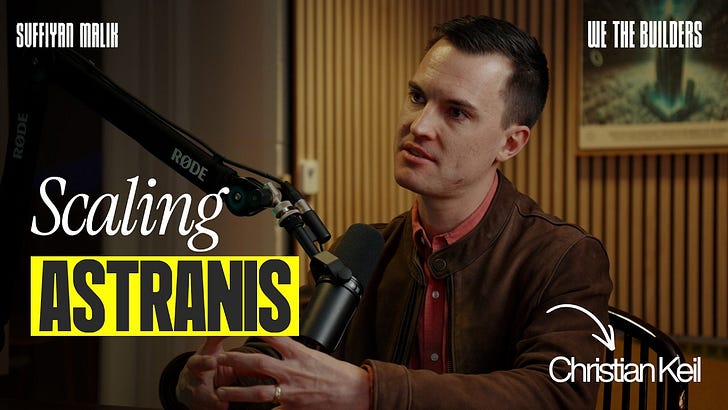
    E28: Christian Keil, Partner at A16Z on Lessons from Scaling Astranis and Traits of Elite Operators

    Intro I first met Christian Keil over Twitter/X DMs probably 3 years ago or so. He started building the Astranis media function in public, he was the face of it as he figured out Twitter and video in real time. When he joined, they were a team of 50 and by the time he left they were about 500 people. How to be an elite operator at a startup? Take on more projects. I agree with Christian on this and can relate. Some of them become whole orgs, Christian was hired for a finance job, got looped into recruiting as the company was struggling to find a good recruiter, he was involved in regulatory and building their owned premium media. He hired Jason Carman (E21 on We The Builders), who he describes as generational video talent to start their owned premium media production at the company and they started doing this before cinematic video went mainstream as a channel for startups, especially frontier tech startups. In this conversation, we cover: * Hiring generational talent * How become good at something you have no experience in? * How to get good at Twitter/X without rage baiting * Podcasting and his show 1st Principles * How to think about what problem to go after? * Time allocation, digital and physical cleanliness Tune into the full episode for all the insights. Watch on YouTube: Timestamps: 00:00 - Introduction01:57 - Growing Twitter/X04:37 - Finding the message to fit the audience06:24 - “Reply Guy” as a growth strategy 08:46 - Building a marketing function from scratch10:50 - Spotting generational talent12:47 - Why you should only hire “Standard Deviation” outliers?15:13 - Curiosity as the core predictor for successful operators at startups 16:52 - From 50 to 500 people18:46 - When to hire specialists vs. promoting from within?20:25 - What is the Chief of Staff role?21:54 - The process of becoming good at something new23:33 - Lessons in practicality and steady leadership24:30 - The stress and spectacle of a satellite launch33:31 - How space regulations work?35:44 - The “Parking Spots” of space and the ITU37:21 - Range Safety: Proving you won’t explode the pad40:15 - Why space-based Internet is easier than fiber?42:06 - Dedicated satellites vs. shared constellations44:33 - Why we don’t see many startups challenging telecom giants?46:09 - Goal of “First Principles”: Getting better at technical video48:23 - The harder path: Choosing optimism over rage-bait51:53 - How high school debate channels competitive energy?54:27 - 180 Mindset shift: Realizing parenting is hard58:11 - Joining the American Dynamism team at a16z1:00:06 - Why media and government engagement matter for VCs?1:01:46 - Advice for early talent: Optimizing for trajectory1:03:19 - Why you should work in-person early in your career?1:05:40 - Reducing mental burden through time allocation1:07:50 - The danger of “Job Hopping” every two years1:10:18 - Sci-Fi and the best Harry Potter book1:14:42 - Rebranding the “State Schooler” party with Chipotle1:17:52 - Closing thoughts This is a public episode. If you would like to discuss this with other subscribers or get access to bonus episodes, visit wethebuilders.us
  • May 2 · 1 hr 34 min

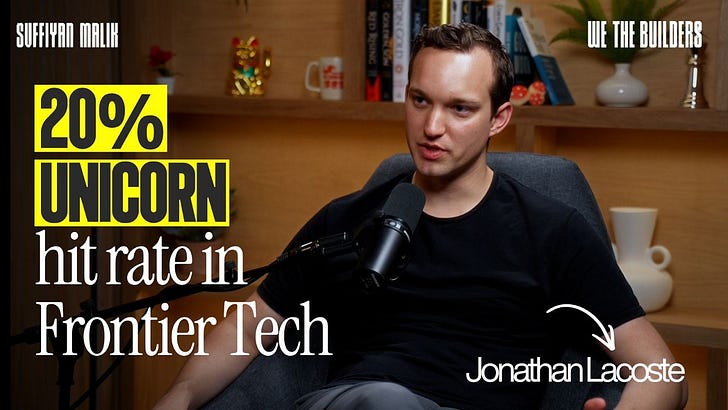
    E27: Jonathan Lacoste, Founder of SpaceVC on Building & Investing in Frontier Tech & His Own Founder Journey

    Intro Jonathan Lacoste, is the founder of SpaceVC, a pre-seed frontier tech fund with at least a 20% unicorn hit rate, this is my observation based on publicly reported valuations of the companies listed on their website. Before starting his fund, Jonathan was an entrepreneur, he dropped out of college to start his company Jebbit for which he raised for $90m and successfully exited to BlueConic. Their product was similar to a better version of SurveyMonkey or Qualtrix, like a Canva and SurveyMonkey fusion. Highlight of the company was that they sold billions of questions in consumer interactions with customers like NFL, NHL, eBay, NBA, P&G. Jonathan’s company was part of one of the early Techstars cohorts which is pretty successful and a mafia of its own. His cohort includes people like Nikita Bier, the founders of PillPack (TJ Parker & Elliot Cohen) acquired by Amazon for $750m, their MD Katie Rae is the Cofounder of The Engine at MIT, Kash Razzaghi who is now CCO of Circle ($CRCL) a $25B company. Highlights of what we cover: * Early investments in Castelion and True Anomaly which just announced a new funding round valuing them at $2.2B alongside friends of the show Colin Greenspon (E9 and E22), Seth Winterroth (E25), Thiel Capital etc * Why concentrated portfolio is a winning strategy * When to run away from a category? * How to identify top-decile founders? (by camping outside SpaceX, Anduril and Pentagon?) * What makes a great cofounding team? * Would SpaceVC ever consider getting acquired by a mega fund? * How the skill of debating is great for cofounding relationships * The State of Accelerators * Approaching venture as a craft business and learning from CJ Reim at Amity Watch on YouTube: Timestamps 00:00 - Introduction01:49 - The state of start ups in Austin05:07 - Why venture capital is concentrating into fewer deals? 07:54 - The founder journey and transitioning to VC 09:59 - Discussing Castalian and True Anomaly 11:17 - How to find top-decile founders at inception? 13:26 - Why small concentrated funds win at pre-seed? 16:17 - What It Takes To Build a Frontier Tech Franchise? 19:42 - Frontier Tech vs. Deep Tech: Engineering execution over science risk 21:14 - Evaluating technical founders without data points 26:11 - The importance of speed and iteration 31:36 - Identifying market forces before they become obvious 36:45 - Finding insights at the edge of the venture lexicon 40:41 - Why now is the time to invest in biotech? 43:25 - Why being a founder is harder than being a VC? 44:54 - The power of a concentrated, hands-on portfolio 47:59 - Talent networks: SpaceX, Tesla, and the cultures of innovation 49:18 - The DNA of a complementary co-founding team 52:20 - The founding journey: From college dropout to multi-hundred million dollar exit 55:37 - Gorilla marketing and the early pivots in his company1:01:48 - How accelerators have evolved over 15 years? 1:06:27 - Brand degradation in the venture and education ecosystem 1:09:58 - Learning the craft: Mentorship and firm building 1:11:51 - Discipline in deployment: The courage to not do a deal 1:15:15 - Underwriting towards a standard 10-year fund life 1:18:05 - Cross-sector lessons in culture and fundraising 1:22:21 - The role of X and LinkedIn in VC marketing 1:24:42 - Historical influences: From Genghis Khan to Alan Turing 1:28:12 - Book recommendations: Ambition and breakthrough stories 1:32:34 - Closing This is a public episode. If you would like to discuss this with other subscribers or get access to bonus episodes, visit wethebuilders.us
  • April 28 · 1 hr 32 min

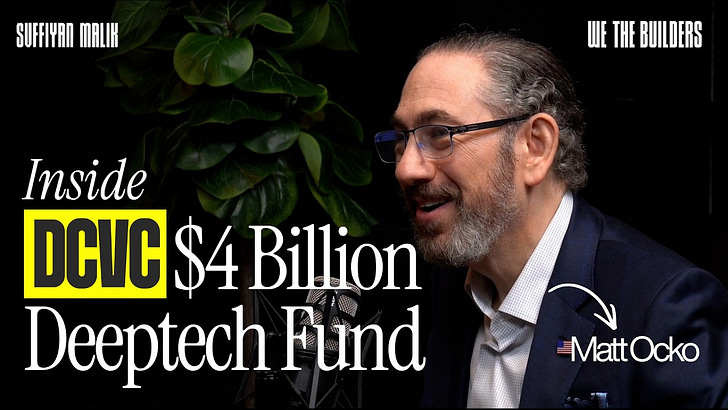
    E26: Matt Ocko, Cofounder DCVC on Lessons from 30+ Years in DeepTech Venture Capital

    Intro Matt Ocko is the Cofounder and Co-Managing Partner of DCVC, a firm he started with Zachary Bogue 16 years ago. Matt started his career at Oracle and then went on to join a $1B AUM fund called Helix Investments in the 90s where he learnt the lesson that venture is 90% people from Ben Webster. Matt coined the term “deeptech” almost a quarter of a century ago with Steve Jurvetson on a late 1999 winter night when they were talking about quantum computing being an investable category. DCVC has been investing in deeptech since its inception and has invested in companies like RocketLab, Oklo, Planet, Agility Robotics, SentinelOne, Recursion Pharmaceuticals, Confluent, Evolv and many more. Watch on YouTube: Timestamps: 00:00 - Introduction04:45 - The Oracle Mafia08:45 - Why venture outcomes are 90% people?12:45 - The Great Man Theory 16:45 - What It Takes To Build a DeepTech Franchise? 20:45 - Customer trust in deeptech24:45 - Disucssing Latus Bio 28:45 - How Moore’s Law and open-source enabled modern deeptech32:45 - Validating nuclear energy on venture dollars 36:45 - The strategic failure of Chinese supply chain dependency 40:45 - What policy changes we need to decouple from China? 48:45 - Protecting energy markets and homeowner Equity 52:45 - How Pivot Bio disrupts global fertilizer monopolies 56:45 - The parallel journeys of Peter Beck and Elon Musk 1:00:45 - It takes a team to execute on vision 1:04:45 - Why every failed investment comes back to people 1:08:45 - First to market vs. first to scale 1:12:45 - You need a 100x better product at seed 1:16:45 - Overcoming the risk aversion of market 1:20:45 - Tidal Metals and the future of critical minerals 1:24:45 - Culture for successful organizations 1:28:45 - Closing This is a public episode. If you would like to discuss this with other subscribers or get access to bonus episodes, visit wethebuilders.us
  • April 25 · 23 min

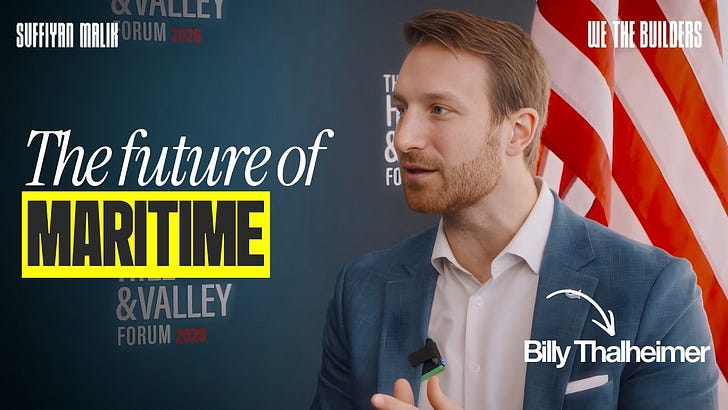
    In conversation with Billy Thalheimer, Cofounder & CEO of Regent

    This is a special edition of We The Builders recorded at The Hill & Valley Forum 2026. Billy cofounded Regent, building all-electric Seaglider vessels for fast, safe, and low-cost coastal transportation. The company is backed by Founders Fund, Lockheed Martin, Mark Cuban, Caffeinated Capital, 8090 Industries and more. Watch on Youtube: Timestamps: 00:00 - Introduction 04:45 - Dual-Use Framework 08:45 - Strategizing for the Indo-Pacific 12:45 - Reinvigorating American Shipbuilding: Addressing the Competitiveness Gap 16:45 - Rhode Island's Maritime Hotbed: Proximity to Talent and Capital 20:45 - Hardware as a Durable Moat This is a public episode. If you would like to discuss this with other subscribers or get access to bonus episodes, visit wethebuilders.us
  • April 17 · 1 hr 28 min

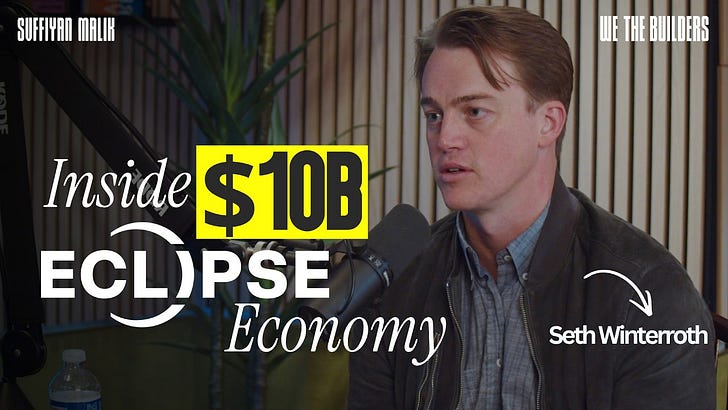
    E25: Seth Winterroth, Partner at Eclipse: Investing $10B in the Physical Economy

    Intro Seth Winterroth is a Partner at Eclipse where he has been investing in the physical world for over a decade. They now have fresh $1.3B in funds taking their AUM (Assets Under Management) to ~$10B to build and invest in critical technologies in the physical world. His portfolio alone is collectively worth over $13B and includes: * Wayve - valued at $8.6B as of their last round. Their global team is advancing AV2.0, a next-generation embodied AI system that can learn from real-world experience and large-scale data, and generalize across cities, vehicles, and driving conditions worldwide. * True Anomaly - valued at $1.5B as of their last round. The only defense technology company focused exclusively on space defense. It designs and builds spacecraft, payloads and software for space superiority * Mytra - reportedly valued at $2B. It is a software-defined automation platform built around three modular components: The bot, storage, and operator interface. All the intelligence lives in the bot and software layer; the storage structure is commodity steel. That architecture eliminates the lifts, cranes, and conveyors that make traditional automation systems rigid and prone to cascading failures, and replaces fixed workflows with a platform that can be configured and changed in software * Forsight Robotics - reportedly valued at $500m. The company aims to bridge the worldwide gap in the accessibility to eye surgery and help over one billion people who suffer from preventable vision impairment. * Ursa Major - reportedly valued at $600m. An aerospace and defense company delivering flight-proven capabilities for hypersonics, solid rocket motors, space mobility and launch. *The company descriptions are sourced from Eclipsed website and the valuations are sourced from publicly available reporting. In this conversation we cover: * The talent density in frontier tech is growing, fueled by leaders and decision-makers trained at organizations like SpaceX, Tesla, and Rivian, alongside software builders “bored” of the “long tail of SaaS”. * Eclipse’s investment framework prioritizes “market, market, market,” alongside a strong team and a differentiated technology-driven product. * The firm focuses on taking engineering execution risk—following the Jeff Bezos adage that “hard is our moat”—while actively avoiding science risk or net new invention risk. * Seth is excited about distributing large foundation models into physical world applications for multi-variable problems, but notes that hard engineering execution challenges must be solved to proliferate this capability. * He defines Eclipse’s opportunity set as every problem that exists in the physical world, viewing the 80% of global GDP in that domain as an unbelievably large opportunity. * A key insight for early-stage teams is the willingness to ship, knowing they will get “punched in the face” during the pilot phase. The most important factor for success is how teams incorporate those messy learnings into Gen 2 and attack the next phase with vigor. * Seth’s most contrarian view is that “physical AI” is currently “a lot of hype,” and that humanoids and general-purpose models for robotics are “ninth-inning robotics,” suggesting the category will unfold through an iterative grind, not a sudden “ChatGPT moment”. Watch on Youtube: Timestamps 00:00 - Introduction 02:14 - Breaking down techno-optimist Tech Twitter04:45 - Rediscovering Silicon in Silicon Valley 08:45 - The SpaceX and Tesla Training Grounds 12:45 - Hard is the Moat: Engineering Execution vs. Science Risk 16:45 - Institutionalizing a Thesis-Driven Culture 20:45 - Partnering with Highly Prepared Minds 24:45 - The Wave Series A Case Study 28:45 - The Willingness to Ship: Managing the "Gen 1" Failure 32:45 - Managing Design Partners and Expectations 36:45 - The Hard Reality of Defense Tech Go-To-Market 40:45 - The First Chapter of Company Formation 44:45 - The Mytra Thesis 48:45 - The Build-Co Strategy at Eclipse 52:45 - First Principles Thinking and Avoiding the Small Idea Trap 56:45 - Why General Purpose Robotics is a Ninth-Inning Game 1:00:45 - Breaking the Industrial Food Complex: A Decade-Long Opportunity 1:04:45 - Finding Value After the Hype 1:08:45 - The Rigor of Capital Allocation and Returns 1:12:45 - Reindustrialization: Market Dynamics and National Security 1:16:45 - Sustaining Long-Term Value and Discipline 1:20:45 - History, Podcasting, and the Next Generation of SaaS This is a public episode. If you would like to discuss this with other subscribers or get access to bonus episodes, visit wethebuilders.us
  • April 16 · 21 min

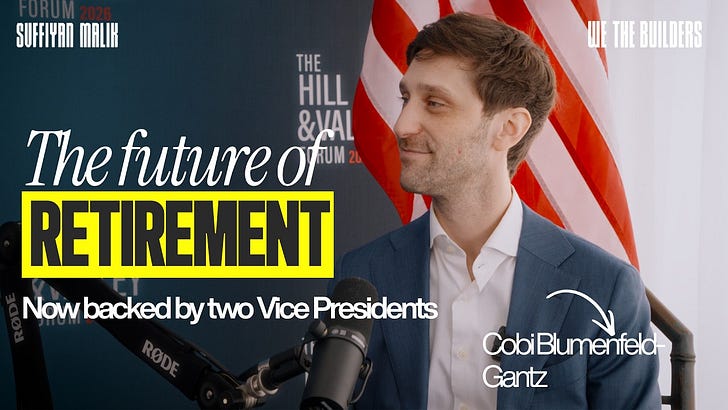
    In Conversation with Cobi Blumenfeld-Gantz, Cofounder & CEO of Chapter ($3B retirement company)

    Intro Cobi Blumenfeld-Gantz cofounded Chapter with Vivek Ramaswamy. This is his second appearance on the show and is a special format we recorded at the Hill & Valley Forum. The company is backed by Narya Capital, Generation (Al Gore), XYZ Capital, Addition (Lee Fixel), Peter Thiel, Kivu Ventures and more. Watch on YouTube Timestamps 00:00 - Introduction01:08 - The rise and fall of empires, and the arc of history04:38 - The “spin-off” to the British Empire06:44 - Stagnation 07:43 - Scientific advances vs. Systemic decline in the American health landscape09:01 - Why insurance carriers aren’t paid to keep you healthy?11:06 - Administrative bloat and the “jobs program” reality 13:21 - How Silicon Valley and D.C. began working together?14:15 - Why the government moves slowly by design?15:37 - The ongoing fight for private sector procurement17:24 - Addressing the societal implications of a growing senior population18:41 - The loss of learned wisdom from elders19:54 - Finding purpose without a job20:21 - Helping seniors navigate modern technology and finance21:06 - Closing thoughts This is a public episode. If you would like to discuss this with other subscribers or get access to bonus episodes, visit wethebuilders.us
  • April 11 · 1 hr 40 min

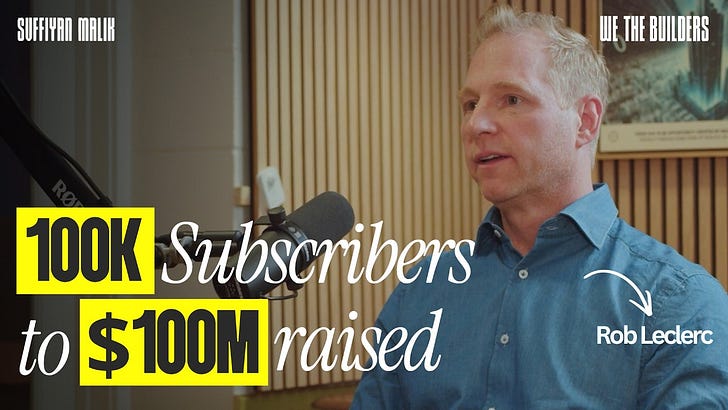
    E24: Rob Leclerc on Building AgFunder, the Biggest Media Platform & Venture Fund focused on Food & Ag

    Intro Rob Leclerc is the Cofounder and General Partner of AgFunder which is $300m AUM venture fund focused on food and agriculture. He also started AgFunder News which has over 100,000 subscribers and is the largest publication and source of news for the world of venture and startups focused on food & ag. In this conversation we discuss how media and venture have always gone together and how Rob was able to use that as a platform to build the venture business. We also dive into his personal story of why and how he got started in venture capital having no experience in the space. What people might not know is that AgFunder actually started out as a crowdfunding platform for food & ag startups and was part of the 500 Global accelerator. Watch on YouTube: Timestamps: 00:00 - Introduction 01:55 - From being un-hirable to a PhD and starting a VC Fund 04:03 - The 2008 financial crisis and exposure to the Agriculture space 07:47 - Going from computer science and philosophy to food and bio 13:36 - The “Miserable Failure” of Rob’s first startup 16:40 - Building the TechCrunch for AgTech 22:28 - Going from media to venture and finding your own voice 27:44 - 500 Global and the million-dollar demo day 31:19 - Transitioning from Broker to Principal 37:50 - “Trust can’t be rushed”, how that applies to fundraising 42:21 - AgFunder’s business model and keeping storytelling alive 51:35 - The evolution of AgFunder’s thesis 1:00:26 - Managing customer relationships 1:04:55 - What builds founder resilience 1:08:58 - The true definition of agency and how do you inculcate that in kids 1:13:48 - What’s more important agency or intelligence? 1:14:56 - Rob’s vision for 2050 1:21:42 - Humanoid Robotics and the “Specialized vs. General” debate 1:26:08 - Rob’s lessons in storytelling 1:30:51 - Reputation through Reps: The intentional practice of the pitch 1:38:04 - Closing questions, how does Rob build relationships This is a public episode. If you would like to discuss this with other subscribers or get access to bonus episodes, visit wethebuilders.us

  • April 9 · 2 hr 19 min

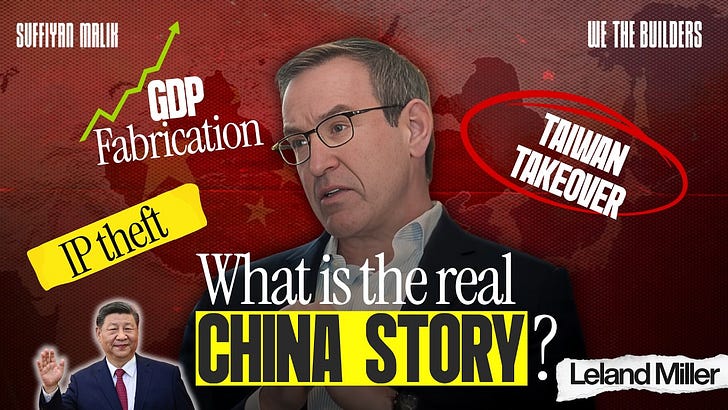
    E23: Leland Miller Breaks Down the China Threat. IP Theft, GDP Fabrication, Taiwan Takeover. What is Really Going On?

    Intro: Leland Miller is the Cofounder of China Beige Book, which according to some media reports has been labelled as a firm having more data on China than even the CIA. He is also a Commissioner on the U.S.-China Economic & Security Review Commission. He has advised Fortune 50 CEOs and top government officials including the Congress on China. In this conversation we talk about: —> The espionage in the tech industry from universities to companies —> Why China has long-term strategy for Taiwan where they expect the West to self-implode —> How U.S banks including JP Morgan were partially responsible for covering up China’s real economic condition —> How China fabricated their GDP —> What happened to the great China opportunity? —> China’s military readiness And more. Full episode now available wherever you get your podcasts. Watch on YouTube: Timestamps: 00:00 - Introduction01:26 - China 101: The death of the “China Dream” 09:26 - Surveillance, residency permits, and the reality of internal environment 11:04 - Supply chain leverage: Why critical minerals are national security 13:50 - The pharmaceutical threat: Chinese control of U.S. medication supply chains 16:34 - Strategic decoupling: Reshoring and friendshoring national security nexuses 19:45 - Dependence on Chinese foundational materials 24:21 - The military balance in the Pacific: Why everyone thinks they would lose 27:56 - Command readiness: Xi Jinping’s military purges and wartime memory loss 31:13 - Geostrategy in the neighborhood: Japan, Philippines, and missile distance 35:20 - Made in China 2025: The fourth industrial revolution playbook 37:46 - Reindustrialization hurdles: Shipbuilding, chips, and bipartisan focus 39:50 - Breaking the rare earth processing monopoly 43:54 - An Economic Security Strategy: A 5-point master plan for the US 49:19 - IP theft and clones: The deep-rooted issue of technological espionage 52:01 - The STEM dilemma: Training talent in the U.S. and letting them go back55:27 - China’s compute disadvantage and U.S incentives 01:00:23 - The Food and Energy problem01:06:12 - Xi Jinping’s psyche: Paranoia, time horizons, and the Taiwan ticking clock 01:10:56 - Economic sensibilities: Global frustration with the imbalanced trade model 01:16:35 - Why China doesn’t drive global growth 01:19:02 - GDP Fabrication: Trillon-Yuan exaggeration 01:28:41 - Tracking credit and stimulus in a “non-commercial” system 01:33:59 - AI, Quantum, and Biotech integration 01:45:18 - Counterbalancing industrial policy01:58:19 - Why China uses 12x more robots than prediction 02:08:52 - Why Xi doesn’t care about consumers 02:14:35 - Closing thoughts This is a public episode. If you would like to discuss this with other subscribers or get access to bonus episodes, visit wethebuilders.us

  • April 8 · 29 min

    In Conversation with Shahin Farshchi at Lux Capital, $7B Fund Accelerating SciFi

    Special conversation with Shahin Farshchi at Hill & Valley Forum 2026 now available wherever you get your podcasts. Lux Capital has deployed over $7B in deeptech and have been accelerating us towards SciFi future for over 20 years. Shahin has invested in companies manufacturing in space (Varda), building autonomous transportation systems (Zoox), providing robots as a service (Formic), automating industries (Covariant), using space to revolutionize the Earth observation industry (Planet), 3D printing rockets (Relativity Space) and many more. Watch on YouTube This is a public episode. If you would like to discuss this with other subscribers or get access to bonus episodes, visit wethebuilders.us

Showing 21–29 of 29 episodes