Skip to content
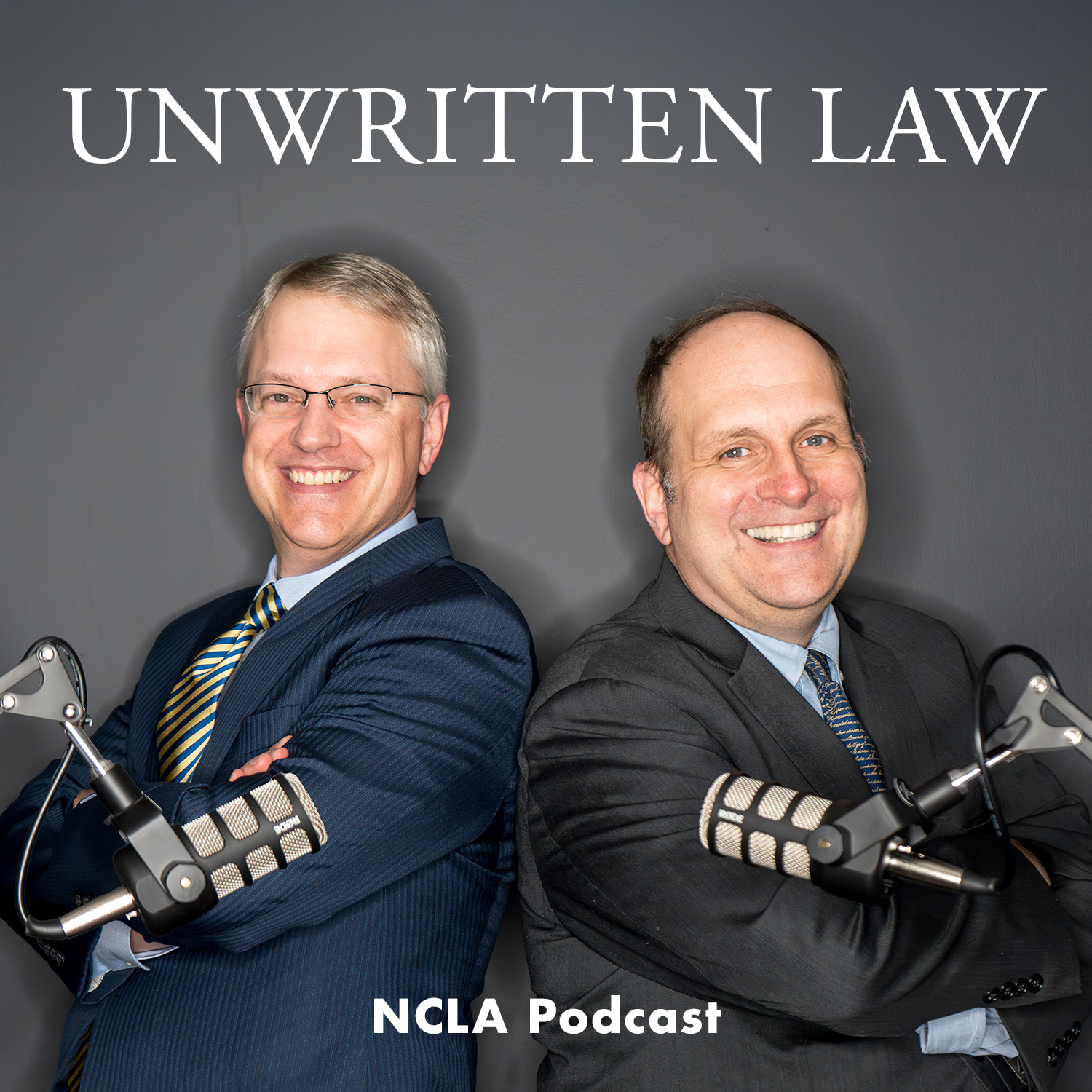
Artwork for Unwritten Law
GovernmentNewsEducation

Unwritten Law

Mark Chenoweth & John Vecchione

Every day, unelected federal agencies make decisions that affect your job, your business, your speech, your property, and your constitutional rights—often without Congress ever voting on them. From the rules that govern small businesses to the regulations that shape everyday life, the modern administrative state reaches further than most Americans realize.

On Unwritten Law, constitutional lawyers Mark Chenoweth and John Vecchione break down the biggest legal battles involving federal agencies, government overreach, and the Constitution. Each episode explores real cases challenging the expanding power of the administrative state, explaining how these disputes affect ordinary Americans, businesses, and the future of limited government.

Whether the topic is the Supreme Court, free speech, property rights, due process, jury trials, executive power, or the separation of powers, Unwritten Law explains the legal issues behind today's biggest constitutional debates in clear, accessible language. You'll hear directly from the attorneys litigating landmark cases, as well as clients whose lives and livelihoods have been changed by unlawful government action.

Produced by the New Civil Liberties Alliance (NCLA), Unwritten Law takes listeners behind the headlines to explain how federal agencies exercise regulatory power, how constitutional challenges move through the courts, and why these cases matter—even if you've never stepped inside a courtroom.

If you've ever wondered who really writes the rules that govern your life, why unelected bureaucrats hold so much authority, or how the Constitution protects individual liberty, Unwritten Law will give you the context, the legal insight, and the real-world stories behind today's most important fights for civil liberties.

Whether you're a lawyer, business owner, public servant, student, or simply someone who wants to better understand how government power affects everyday life, Unwritten Law gives you the legal insight behind the headlines—and the constitutional principles that protect individual liberty.

Subscribe each week for conversations about Supreme Court litigation, constitutional law, the administrative state, federal agencies, government accountability, civil liberties, free speech, property rights, due process, separation of powers, regulatory power, and the legal battles shaping the future of American government.

Play
  • 30 episodes
  • Avg 20 min
  • English
Counted on this page — what you have heard stays on this device, so it is not something the list can be paged by.
  • S1 · E141
    Wednesday · 29 min

    A New Supreme Court Ruling Could Spell Trouble for the SEC’s CAT

    The SEC's Consolidated Audit Trail collects information on virtually every stock-market transaction in the United States, creating an enormous database that regulators can search for suspicious activity without first identifying a particular person or crime. NCLA has long argued that this mass collection and searching of Americans' financial information violates the Fourth Amendment. Now, a new Supreme Court decision could strengthen that challenge. On this episode of Unwritten Law, NCLA President and Chief Legal Officer Mark Chenoweth and Senior Litigation Counsel John Vecchione are joined by Margot Cleveland to discuss the Supreme Court's recent decision in Chatrie v. United States and its implications for NCLA's CAT challenge, Davidson v. SEC. In Chatrie, the Supreme Court held that the government's use of Google's location database to identify people near the scene of a crime constituted a Fourth Amendment search. Rather than beginning with a suspect supported by probable cause, investigators searched a large pool of people's location information and worked backward to identify a suspect. Mark, John, and Margot explain why they see a powerful parallel with CAT. The government collects vast amounts of trading data, runs algorithms against it looking for suspicious transactions, and then identifies the individuals behind those trades. As they put it, the government is using the search itself to develop the probable cause that ordinarily should precede a search. They also discuss the “third-party doctrine,” whether Americans surrender their privacy rights simply because financial information passes through a broker, and why constitutional protections must keep pace with the government's increasingly powerful surveillance technology.

  • S1 · E140
    September 29 · 21 min

    A Win for the Right to Self-Defense at a Maryland Synagogue

    NCLA has won an important preliminary victory for members of the Silver Spring Jewish Center who want to protect their congregation. In this episode of Unwritten Law, NCLA President and Chief Legal Officer Mark Chenoweth and Senior Litigation Counsel John Vecchione are joined by Senior Litigation Counsel Jacob Huebert to discuss the latest development in Silver Spring Jewish Center v. Montgomery County. Montgomery County banned firearms at places of public assembly, including houses of worship, as well as within 100 yards of those locations. The restrictions prevented the Silver Spring Jewish Center from continuing to use its internal security team of trained, licensed congregants—a security measure the synagogue adopted following the October 7, 2023, terrorist attacks in Israel and the subsequent rise in antisemitism. UL Silver Spring Jewish Center A federal judge has now issued a preliminary injunction allowing members to carry firearms at the synagogue, finding that NCLA's clients are likely to succeed on their claims under both the Second Amendment and the First Amendment's Free Exercise Clause. But the fight isn't over. The court left Montgomery County's 100-yard restriction in place. That presents a particular problem for Orthodox Jewish members who must walk to synagogue on the Sabbath and Jewish holidays. As Jacob explains, one of NCLA's clients cannot make that walk without passing within 100 yards of parks, schools, or other prohibited locations. UL Silver Spring Jewish Center Mark, John, and Jacob discuss the court's ruling, why NCLA is asking the judge to reconsider the 100-yard restriction, and the unusual collision of Second Amendment and religious-liberty rights at the heart of the case.

  • S1 · E139
    September 20 · 18 min

    Who Can Challenge the White House Ballroom?

    The Supreme Court has allowed construction of the new White House ballroom to continue—but the Court's 5–4 decision turned largely on a threshold question: Who actually has standing to challenge it? On this episode of Unwritten Law, NCLA Senior Litigation Counsel John Vecchione is joined by NCLA Staff Attorney Andreia Trifoi to break down National Park Service v. National Trust for Historic Preservation in the United States. The National Trust sued over the demolition and replacement of the White House East Wing. A lower court blocked above-ground construction, but the Supreme Court has now stayed that injunction, concluding that the Trust is likely to lack Article III standing. Its theory rested on a member who argued that the new ballroom would injure her aesthetic, cultural, and historical interests when she viewed the White House. John and Andreia discuss why the Court rejected that theory, how the decision fits with decades of environmental standing cases, and the unusual 5–4 split—with Chief Justice Roberts joining Justices Sotomayor, Kagan, and Jackson in dissent. They also tackle the question lurking beneath the standing fight: If Congress—not a preservation group—has the strongest claim to challenge the project, why hasn't Congress acted?

  • S1 · E138
    September 15 · 33 min

    NCLA Asks SCOTUS to Rein In the SEC

    Can the SEC force someone to give up money when it cannot identify a single harmed investor? NCLA is asking the Supreme Court to take Spartan Securities Group v. SEC, a case that has been winding through the courts for years and now presents two significant questions about the reach of federal securities law. NCLA President and Chief Legal Officer Mark Chenoweth and Senior Litigation Counsel John Vecchione are joined by Senior Litigation Counsel Kara McKenna Rollins, who has worked on the case since 2019. After a 14-count SEC complaint, NCLA’s clients were found not liable on 13 counts. The remaining dispute has now reached the Supreme Court, where NCLA is challenging both the scope of securities-fraud liability and the SEC’s use of disgorgement. First, NCLA argues that statements made privately to FINRA and the Depository Trust Company cannot be treated as statements made “in connection with” the purchase or sale of securities when there is no evidence any investor ever saw or heard them. Second, NCLA argues that traditional equitable principles do not allow the SEC to obtain disgorgement when there are no harmed investors and the money instead goes to the U.S. Treasury. Mark, John, and Kara explain why the case could give the Supreme Court an opportunity to clarify important limits on SEC enforcement—and resolve a question that has been developing in the lower courts for nearly a decade.

  • S1 · E137
    September 3 · 19 min

    60 Years Without Congressional Authorization

    For roughly 60 years, the Department of Labor’s Office of Federal Contract Compliance Programs enforced a sweeping regulatory regime governing federal contractors—one rooted largely in presidential executive orders rather than laws passed by Congress. Now, the Department of Labor has acknowledged that much of that regime lacked statutory authority. In this episode of Unwritten Law, NCLA President and Chief Legal Officer Mark Chenoweth and Senior Litigation Counsel John Vecchione are joined by Senior Litigation Counsel Kara Rollins to discuss a major change at OFCCP and NCLA’s role in bringing it about. Kara explains how OFCCP’s regulatory system developed from Executive Order 11246 and expanded over decades, imposing requirements on companies that do business with the federal government. NCLA has argued that executive orders cannot substitute for congressional authorization when the government imposes binding legal obligations. After Executive Order 11246 was revoked, the Department of Labor reconsidered its implementing regulations. NCLA submitted comments urging the Department not merely to rescind the regulations, but to acknowledge that much of the regime lacked statutory authority in the first place. The Department’s final action embraces that central argument while preserving OFCCP’s enforcement of requirements that do have statutory foundations, including protections concerning veterans and individuals with disabilities. Mark, John, and Kara discuss what this means for federal contractors, why Congress—not the executive branch—must make the law, and how participating in the public-comment process can actually influence federal policy. As Mark puts it, this 60-year regulatory regime is “Exhibit A” for Unwritten Law.

  • S1 · E136
    September 2 · 16 min

    Why Is Washington Tracking Crabbers 24/7?

    In this episode of Unwritten Law, NCLA Senior Litigation Counsel John Vecchione is joined by NCLA General Counsel Zhonette Brown to discuss Franey v. Washington Department of Fish and Wildlife, NCLA’s challenge to Washington State’s warrantless surveillance of commercial crabbers. Washington requires commercial crabbers to install government-mandated tracking equipment on their boats. Once crab pots are placed in the water, the government tracks the vessel continuously—every minute—even when the crabbers are back at port or using their boats for activities completely unrelated to fishing. The resulting location information is stored in a government database. John and Zhonette explain why NCLA argues this surveillance violates the Fourth Amendment and Washington State Constitution’s protections against unreasonable searches. They also discuss NCLA’s takings claims, the state’s requirement that crabbers place tracking equipment on their private property, and why the Washington Department of Fish and Wildlife lacks statutory authority to impose the mandate. The episode also examines the broader implications of cheap, persistent electronic surveillance. As technology makes it easier for government to track people continuously and store that information indefinitely, John and Zhonette discuss why constitutional protections for privacy become more—not less—important. NCLA has moved for summary judgment and is seeking to stop Washington from enforcing the tracking requirement against its clients.

  • S1 · E135
    August 26 · 17 min

    When Regulatory Shortcuts Become the Rule

    In this episode of Unwritten Law, NCLA President and Chief Legal Officer Mark Chenoweth and Senior Litigation Counsel John Vecchione discuss the D.C. Circuit’s recent decision in Heroes Technology v. Consumer Product Safety Commission. NCLA challenged a CPSC safety rule affecting infant support cushions. Congress created a streamlined rulemaking process for a limited category of “durable infant or toddler products,” including products such as cribs, playpens, and high chairs. But CPSC used that shortcut to regulate infant support cushions—and potentially thousands of other products that NCLA argues fall well outside the category Congress had in mind. Mark, who served as a CPSC commissioner shortly after Congress created this expedited process, explains why he believes the agency has stretched the law far beyond its original purpose. He and John discuss the D.C. Circuit’s decision upholding the rule, what counts as a “durable” infant product, and why allowing regulators to bypass the normal rulemaking process can have consequences not only for the rule of law, but for consumer safety itself. The conversation also explores regulatory creep, statutory interpretation, and an important lesson for Congress: when lawmakers leave statutory lists open-ended, agencies may find ways to expand exceptions far beyond their intended scope.

  • S1 · E134
    August 25 · 26 min

    Should Federal Judges Get to Pick Federal Prosecutors?

    In this episode of Unwritten Law, NCLA President and Chief Legal Officer Mark Chenoweth and Senior Litigation Counsel John Vecchione are joined by Senior Litigation Counsel Jacob Huebert to discuss NCLA’s amicus brief in Rogoff v. Trump, a case raising an unusual separation-of-powers question: Should federal judges be allowed to appoint the U.S. attorneys who prosecute cases in their own courts? Federal law allows a district court to appoint a U.S. attorney when a temporary appointment expires without Senate confirmation. That practice dates back to the Civil War era. But NCLA argues that it conflicts with the Constitution’s separation of powers and the Appointments Clause. U.S. attorneys exercise substantial executive authority, deciding whom to prosecute, what charges to bring, and which enforcement priorities to pursue. NCLA argues that officials wielding that kind of power should not be selected by judges. Jacob explains why NCLA argues U.S. attorneys are principal officers who must be nominated by the President and confirmed by the Senate—and why cross-branch appointments would remain constitutionally problematic even if they are considered inferior officers. The discussion also explores judicial independence, the appearance of impartiality when a judge appoints the prosecutor appearing before that court, and the practical consequences of a system increasingly reliant on temporary and court-appointed U.S. attorneys. Mark, John, and Jacob also debate the other issue in Rogoff: whether President Trump had the authority to remove the court-appointed U.S. attorney. And they consider whether the court will ever reach the larger—and more interesting—constitutional appointment question.

  • S1 · E133
    August 17 · 17 min

    BASE Jumping, Bureaucrats, and Criminal Law

    In this episode of Unwritten Law, NCLA Senior Litigation Counsel John Vecchione is joined by Litigation Counsel Casey Norman to discuss NCLA’s appeal in BASE Access v. National Park Service, now before the U.S. Court of Appeals for the Fifth Circuit. For decades, the National Park Service has treated BASE jumping as a federal crime in national parks. But Congress never passed a law specifically criminalizing BASE jumping. Instead, the Park Service relies on a 1965 regulation prohibiting the “delivery” of people or objects by parachute or other airborne means—a rule adopted roughly 13 years before BASE jumping emerged in the United States. Casey explains NCLA’s argument that Congress unconstitutionally transferred criminal lawmaking power to the executive branch and why the Park Service’s decades-old regulation does not actually apply to people who enter a park normally, climb to a jumping point, and parachute to another location within the park. But before those arguments can even be decided, NCLA must overcome the district court’s ruling that the BASE jumpers lack standing. The court concluded that a pre-enforcement challenge requires an interest in exercising a specific constitutional right—even though several plaintiffs have previously been prosecuted for BASE jumping and want to do it again. Casey explains why NCLA says that standard would effectively force Americans to break the law, risk prosecution, and potentially go to prison before they can challenge an unconstitutional criminal prohibition. John and Casey also discuss NCLA’s Fifth Amendment vagueness and Administrative Procedure Act claims, the Park Service’s refusal to conduct the planning process it says is necessary to permit BASE jumping, and why NCLA is asking the Fifth Circuit to revive the case.

  • S1 · E132
    August 14 · 15 min

    Education Is Speech: NCLA's Groundbreaking Case for Parental Choice

    In this episode of Unwritten Law, NCLA Senior Litigation Counsel John Vecchione is joined by NCLA General Counsel Zhonette Brown to discuss Jacobsen v. Spellerberg, NCLA's newly filed lawsuit advancing a groundbreaking First Amendment argument: education is speech, and parents have a constitutional right to choose the educational speech provided to their children. Nebraska requires parents to educate their children while directing substantial public funding exclusively toward the state's public-school system. Parents who choose homeschooling or private education because they disagree with the messages conveyed in public schools must bear those costs themselves while continuing to support the public system. NCLA argues that this amounts to viewpoint discrimination and imposes an unconstitutional condition on parents who exercise their First Amendment rights. Zhonette explains the legal theory developed by NCLA founder Philip Hamburger, the families challenging Nebraska's system, and the century-old Supreme Court precedents recognizing parents' authority to direct their children's education. She and John also discuss what NCLA is asking the court to do and how a victory could expand educational choice in Nebraska. Show Notes Public Schools Shouldn’t Be Fiefdoms of Government Speech — Philip Hamburger, National Review New NCLA Lawsuit: Nebraska’s Educational Scheme Violates Parents’ Free Speech Education Is Speech: Parental Free Speech in Education — Philip Hamburger, Texas Law Review

  • S1 · E131
    August 13 · 27 min

    “Make Congress Great Again”? The Problem Isn’t the Supreme Court

    In this episode of Unwritten Law, NCLA President and Chief Legal Officer Mark Chenoweth and Senior Litigation Counsel John Vecchione take on a provocative argument from The New Republic: Is the Supreme Court weakening Congress and creating a more powerful presidency? Mark and John give author Matt Ford credit for a thoughtful and well-researched article—but think he draws the wrong conclusion from much of the evidence. They examine major Supreme Court decisions including Loper Bright/Relentless, SEC v. Jarkesy, Cargill v. Garland, Seila Law, and Trump v. Slaughter and argue that the Court's recent jurisprudence is better understood as an effort to restore the constitutional separation of powers. The president should control the executive branch. Congress should make the laws. Courts should exercise judicial power. And when Congress gives the executive branch too much discretion, the solution isn't to blame the courts for presidential power—it's for Congress to reclaim its constitutional responsibilities. Mark and John also discuss presidential removal power, administrative adjudication, jury trials, emergency powers, presidential immunity, and why Congress may need to revisit decades-old statutes that hand enormous discretion to the executive branch.

  • S1 · E130
    August 12 · 23 min

    Can a Federal Agency Be Your Prosecutor and Judge?

    In this episode of Unwritten Law, NCLA President and Chief Legal Officer Mark Chenoweth and Senior Litigation Counsel John Vecchione are joined by Senior Litigation Counsel Russ Ryan to discuss Department of Labor v. Sun Valley Orchards, an important case headed to the Supreme Court. Sun Valley Orchards is a family farm that employs domestic workers as well as foreign workers through the H-2A visa program. After the Department of Labor accused the farm of violating requirements governing its workers, the agency pursued the case through its own administrative adjudication process and ultimately imposed roughly half a million dollars in penalties. But should an executive agency be able to adjudicate a case involving private rights and impose substantial monetary penalties—or does the Constitution require that kind of dispute to be heard by an independent Article III court? Russ discusses NCLA's amicus brief, filed with the Buckeye Institute and Americans for Prosperity Foundation, arguing that judicial power belongs exclusively to the judicial branch. The conversation also explores the distinction between so-called "public" and "private" rights, the Supreme Court's decision in SEC v. Jarkesy, and why the Court may finally need to confront its longstanding Atlas Roofing precedent. With Sun Valley Orchards set to be argued before the Supreme Court, the case could provide important answers about the constitutional limits of administrative adjudication.

  • S1 · E129
    August 1 · 29 min

    Can the Government Force You to Join a Private Organization?

    In this episode of Unwritten Law, NCLA President and Chief Legal Officer Mark Chenoweth and Senior Litigation Counsel John Vecchione are joined by Senior Litigation Counsel Andy Morris to discuss National Association of Wholesaler-Distributors v. Ryan, NCLA's newly filed challenge to Colorado's Producer Responsibility Program for recycling. The lawsuit isn't about opposing recycling. Instead, it challenges Colorado's decision to replace local recycling systems with a statewide program administered by a private organization—the Circular Action Alliance (CAA)—that businesses must join in order to sell certain products in the state. Andy explains why NCLA argues the law unlawfully delegates governmental authority to a private entity that can set fees, establish rules, and impose significant consequences on businesses without meaningful public accountability. The discussion also explores the law's First Amendment implications, due process concerns, the Dormant Commerce Clause, and a provision that prohibits businesses from itemizing these recycling fees on customer receipts. Mark, John, and Andy examine why distributors across the country may bear the costs of Colorado's program and what the lawsuit could mean for the constitutional limits on delegating government power to private organizations.

  • S1 · E128
    July 31 · 18 min

    Can Government Disarm a Synagogue?

    In this episode of Unwritten Law, NCLA President and Chief Legal Officer Mark Chenoweth and Senior Litigation Counsel John Vecchione are joined by Senior Litigation Counsel Jacob Huebert to discuss NCLA's newly filed lawsuit challenging Montgomery County, Maryland's ban on firearms in places of worship and within 100 yards of numerous public gathering places. The case, Silver Spring Jewish Center v. Montgomery County, was filed just days after the ordinance took effect. NCLA argues that the law violates the Second Amendment by making it nearly impossible for law-abiding citizens to exercise their right to bear arms while also interfering with the synagogue's ability to protect its congregation. Jacob explains why the lawsuit also raises significant First Amendment concerns. The Silver Spring Jewish Center believes that members of its congregation should provide security during worship, consistent with its religious beliefs and practices. NCLA argues that the county's ordinance unlawfully burdens both the free exercise of religion and the autonomy of religious institutions. The discussion also examines the Supreme Court's recent decision in Wolford v. Lopez, the meaning of "sensitive places" under the Second Amendment, and why NCLA believes Montgomery County has gone far beyond the constitutional limits recognized by the Court.

  • S1 · E127
    July 29 · 20 min

    Should SCOTUS Revisit Its 120-Year-Old Vaccine Precedent?

    In this episode of Unwritten Law, NCLA President and Chief Legal Officer Mark Chenoweth and Senior Litigation Counsel John Vecchione discuss NCLA's Supreme Court amicus brief in Boysen v. PeaceHealth, a case asking the Court to revisit Jacobson v. Massachusetts, its landmark 1905 vaccine mandate decision. The conversation examines how Jacobson—which upheld a smallpox vaccination requirement more than a century ago—was relied upon by courts throughout the COVID-19 pandemic to uphold modern vaccine mandates. John explains why NCLA argues that today's courts have expanded Jacobson far beyond its original facts, applying it to vaccines that do not prevent transmission and to mandates carrying consequences far more severe than the modest fine at issue in the 1905 case. Mark and John also discuss the constitutional right to refuse unwanted medical treatment, the significance of natural immunity, emergency use authorizations, and why they believe the Supreme Court should clarify the limits of Jacobson now—before another public health emergency forces courts to confront these issues under crisis conditions. The episode explores why Boysen v. PeaceHealth could provide the Court with an important opportunity to define the constitutional boundaries of public health mandates for the modern era.

  • S1 · E126
    July 22 · 22 min

    Can the Government Escape Accountability for Censorship?

    In this episode of Unwritten Law, NCLA President and Chief Legal Officer Mark Chenoweth and Senior Litigation Counsel John Vecchione are joined by Litigation Counsel Casey Norman to discuss NCLA's appeal in Dressen v. Flaherty, a case challenging alleged government-induced censorship during the COVID-19 pandemic. The plaintiffs include individuals who say they were censored after sharing their personal experiences with COVID-19 vaccine injuries or questioning official public health narratives. Casey explains why NCLA alleges that federal officials, working alongside outside organizations and social media platforms, pressured private companies to suppress constitutionally protected speech. The discussion focuses on the district court's dismissal of the case on standing and personal jurisdiction grounds, despite detailed allegations drawn from thousands of pages of discovery produced in Missouri v. Biden. Casey explains why NCLA believes plaintiffs should at least be allowed to conduct discovery before their claims are dismissed, and why courts should not require impossible levels of proof at the pleading stage. Mark, John, and Casey also examine the Fifth Circuit appeal, the role of the Stanford Internet Observatory and the Virality Project, Section 1985(3), and why this case could determine whether Americans have any meaningful judicial remedy when government officials allegedly pressure private platforms to censor speech.

  • S1 · E125
    July 21 · 13 min

    Can Agency Commentary Increase Your Prison Sentence?

    In this episode of Unwritten Law, NCLA President and Chief Legal Officer Mark Chenoweth and Senior Litigation Counsel John Vecchione are joined by Litigation Counsel Casey Norman to discuss Beaird v. United States, a Supreme Court case that could reshape federal criminal sentencing. At issue is Stinson deference, a doctrine requiring courts to defer to the U.S. Sentencing Commission’s commentary interpreting the federal sentencing guidelines. Unlike the guidelines themselves, that commentary is never approved by Congress and never goes through notice-and-comment rulemaking—yet it can dramatically increase a defendant’s prison sentence. Casey explains why the case follows naturally from the Supreme Court’s recent decisions limiting administrative deference, including Kisor v. Wilkie and Loper Bright. The discussion explores why courts—not agencies—have the constitutional duty to interpret the law, why due process requires fair notice before liberty is taken away, and why the rule of lenity weighs against expanding criminal punishment through agency interpretation. Mark, John, and Casey also examine Article III, judicial independence, and why Beaird could become the Court’s next major administrative law decision.

  • S1 · E124
    July 14 · 16 min

    SCOTUS Special (Part 4): Title IX Means Sex

    In this episode of Unwritten Law, NCLA President and Chief Legal Officer Mark Chenoweth and Senior Litigation Counsel John Vecchione are again joined by NCLA Staff Attorney Andreia Trifoi to discuss the Supreme Court’s opinion in West Virginia v. B.P.J. The Court held that neither Title IX nor the Equal Protection Clause prevents states from organizing school sports teams based on biological sex. Andreia explains why the Court looked to the ordinary meaning of “sex” when Title IX was enacted in 1972 and why the statute’s original purpose was to expand athletic opportunities for women. The discussion also focuses on Justice Gorsuch’s concurrence and NCLA’s amicus argument under the Spending Clause. Because Title IX conditions federal funding on compliance with certain requirements, states must receive clear notice of those conditions before accepting the money. Andreia explains why states agreeing to Title IX in 1972 could not have understood “sex” to include gender identity decades later. Mark, John, and Andreia also discuss the history and practical effects of Title IX, the Biden Administration’s unsuccessful attempt to expand the statute through regulation, and why federal agencies cannot rewrite the terms of Congress’s spending programs after states have already accepted them.

  • S1 · E123
    July 14 · 19 min

    SCOTUS Special (Part 3): A Major Win for Digital Privacy

    In this episode of Unwritten Law, NCLA President and Chief Legal Officer Mark Chenoweth and Senior Litigation Counsel John Vecchione are joined by NCLA Staff Attorney Andreia Trifoi to discuss the Supreme Court's landmark Fourth Amendment decision in Chatrie v. United States. The Court held that the government's collection of cell phone location history through a geofence warrant constitutes a Fourth Amendment search—a significant victory for digital privacy and one of the Court's most important Fourth Amendment decisions since Carpenter v. United States. Andreia explains how geofence warrants work, why they can sweep millions of people's location records into a single investigation, and why the Court concluded that this type of dragnet surveillance implicates constitutional protections. The discussion also explores the relationship between Chatrie and Carpenter, the future of automatic license plate reader (ALPR) litigation, Justice Gorsuch's property-based concurrence, and what the decision could mean for emerging surveillance technologies. For anyone concerned about privacy in the digital age, Chatrie represents an important reaffirmation that constitutional protections must evolve alongside modern technology.

  • S1 · E121
    July 10 · 26 min

    SCOTUS Summer Series (Part 1): The End of Humphrey's Executor

    In this special Supreme Court edition of Unwritten Law, NCLA President and Chief Legal Officer Mark Chenoweth and Senior Litigation Counsel John Vecchione are joined by NCLA Of Counsel Margot Cleveland to discuss the Supreme Court's landmark decision in Trump v. Slaughter. The Court's decision effectively ends Humphrey's Executor, the 1935 precedent that limited the President's authority to remove leaders of independent agencies such as the Federal Trade Commission. Margot, who authored NCLA's amicus brief supporting the President's position, explains why the decision represents one of the Court's most significant separation-of-powers rulings in decades. The discussion explores how the Court built on earlier decisions such as Seila Law, why Chief Justice Roberts described Myers v. United States as the foundational precedent for presidential removal authority, and what the decision means for the future of the administrative state. Mark, John, and Margot also examine Justice Gorsuch's concurrence, severability, the unresolved questions surrounding the Federal Reserve and the civil service, and why the Court appears to be methodically restoring presidential control over executive officers. The episode concludes with a look ahead at the next constitutional battles likely to follow in the wake of Trump v. Slaughter.

Showing 1–20 of 30 episodes