Skip to content
Artwork for Thinking Psychologically
Society & CultureHealth & FitnessMental Health

Thinking Psychologically

Russell Vant

A podcast about people.

Hosted by Russell Vant, a practicing psychotherapist, this podcast explores life through a psychological lens. Every episode unpacks an idea that helps us better understand ourselves and those around us.

Drawing on psychology, philosophy, history, psychotherapeutic practice, and lived experience, the podcast looks beneath the surface of everyday life to explore what it means to be human.

If you're interested in psychology, psychotherapy, self-understanding, personal growth, meaning, culture, and the complexities of human nature, this podcast offers thoughtful, accessible explorations of the forces that shape our lives.

New episodes uploaded regularly.

Play
  • 6 episodes
  • fortnightly
  • Avg 24 min
  • English
  • #6
    Wednesday · 26 min

    6: A Question of Comfort

    Why do we go to such lengths to avoid things that make us uncomfortable? And what might our attempts to avoid discomfort be costing us? In this sixth episode of Thinking Psychologically, we explore the psychological forces of attraction and aversion, and their behavioural counterparts, approach and avoidance. The discussion touches on: Fear, social judgement, and stepping outside our comfort zones Exposure, progressive desensitisation, and Albert Ellis's experiments in overcoming rejection sensitivity Attraction and aversion among all living organisms Approach and avoidance in relation to others, to tasks or activities, and to our own thoughts and feelings Freud's pleasure principle, and our capacity to tolerate what he called ‘unpleasure’ The immediate benefits of avoidance – and its potential longer-term costs Ultimately, we consider how our inclination to move towards what we find pleasant, and away from what we find unpleasant, shapes the lives we lead – and our capacity to step beyond this influential polarity. . . Music credit Music used in this episode is drawn from the royalty-free work of PaulYudin. Many thanks for making this music freely available for creators.

  • #5
    November 4 · 27 min

    5: The Other Side of Boredom

    Boredom is a familiar, often unwelcome experience. But what exactly is it? And what might it reveal about ourselves and the world? In this fifth episode of Thinking Psychologically, we explore boredom through a range of psychological lens. The discussion touches on: Stimulation, attention, and the struggle to engage Boredom as an emotional signal and seeking state Existential questions of meaning and meaninglessness, featuring Irvin Yalom, Viktor Frankl, and veteran sushi chef Jiro Ono Loneliness, connection, and the traditional philosophy of ubuntu Psychoanalytic perspectives, some of which frame boredom as a consequence of the mind protecting itself Pausing, emptiness, and the roots of creativity It turns out that boredom is really rather interesting. . . Music credit Music used in this episode is drawn from the royalty-free work of PaulYudin. Many thanks for making this music freely available for creators.
  • #4
    October 21 · 25 min

    4: Psychedelics: Beyond the Familiar

    Psychedelics are back. Once associated with the counterculture of the 1960s, substances such as LSD and psilocybin are now attracting renewed interest from neuroscientists, psychiatrists, and psychotherapists. But why? What is it about the effects of these substances that have captured our attention once again? What happens when our familiar ways of experiencing the world – and ourselves – undergo profound change? And what, if anything, might we take from these experiences into our everyday lives? In this fourth episode of Thinking Psychologically, we begin with a brief tour of the history of psychedelics, before exploring the wide-ranging effects they can produce. We consider what research in neuroscience is beginning to suggest about the way psychedelics interact with the brain, including in relation to its capacity for change. Our exploration also turns to the psychological significance of these experiences. What happens when familiar ways of thinking and feeling are disrupted? Might such experiences open up new possibilities for understanding ourselves and relating to the world? At the heart of these questions is a broader one: what might we discover when the familiar ways in which we experience ourselves give way to something beyond the familiar? . . Music credit Music used in this episode is drawn from the royalty-free work of PaulYudin. Many thanks for making this music freely available for creators.
  • #3
    October 7 · 26 min

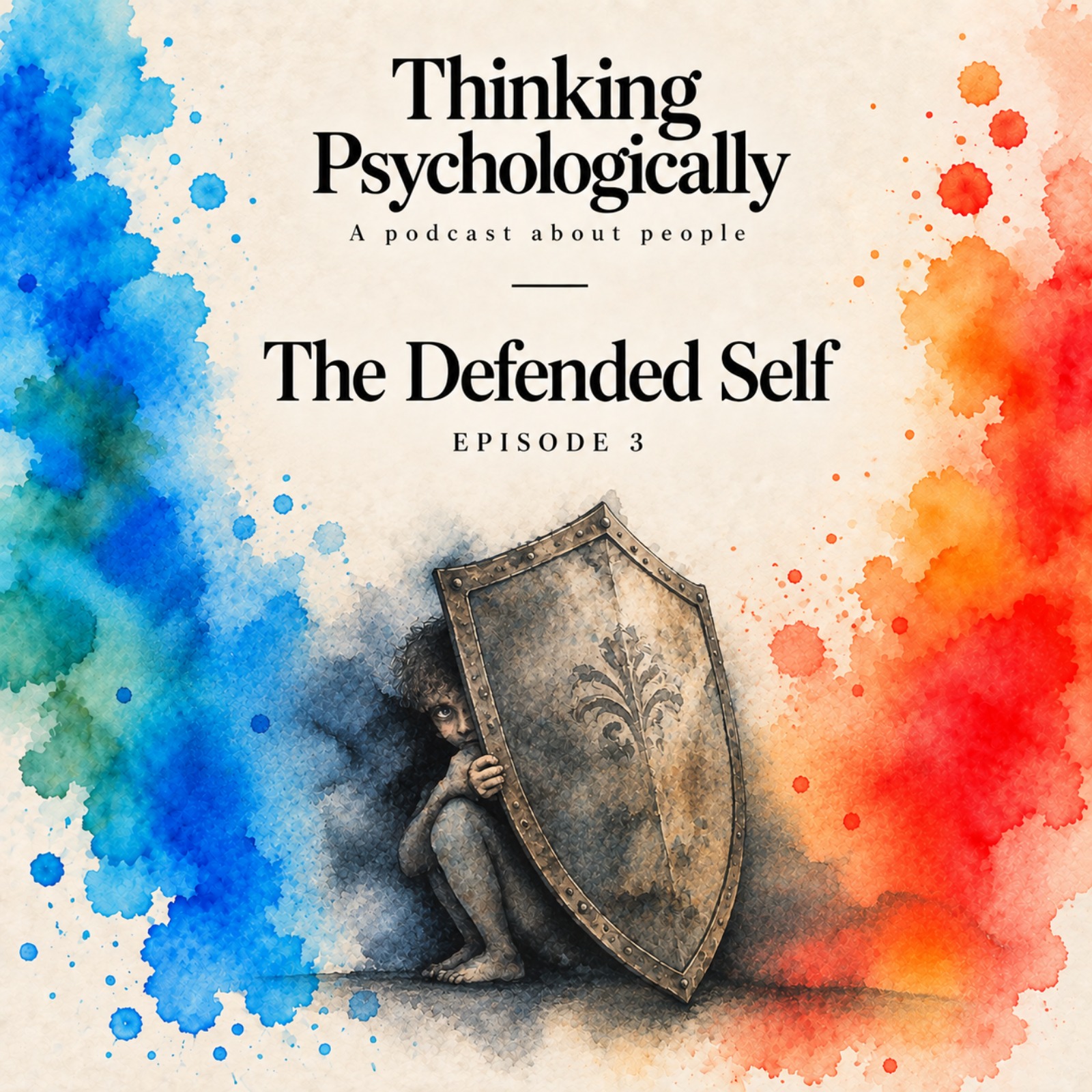
    3: The Defended Self

    What does it mean to be a conscious self in contact with reality? In this third episode of Thinking Psychologically, we begin by exploring the conscious sense of self – the "I" or "me" we experience ourselves as being – and the challenge of maintaining its stability and coherence in the face of realities that may at times be distressing, disturbing, or destabilising. From this foundation, we develop a framework for understanding defence mechanisms: unconscious psychological processes that operate behind the scenes, helping us to negotiate this challenge. Building on this framework, the second half of the episode introduces eight commonly discussed defence mechanisms: denial, projection, splitting, repression, rationalisation, displacement, reaction formation, and sublimation. This episode considers what defence mechanisms are really defending - and defending against, and the remarkable psychological work involved in preserving the conscious sense of who we are. . . Music credit Music used in this episode is drawn from the royalty-free work of PaulYudin. Many thanks for making this music freely available for creators.

  • #2
    September 23 · 21 min

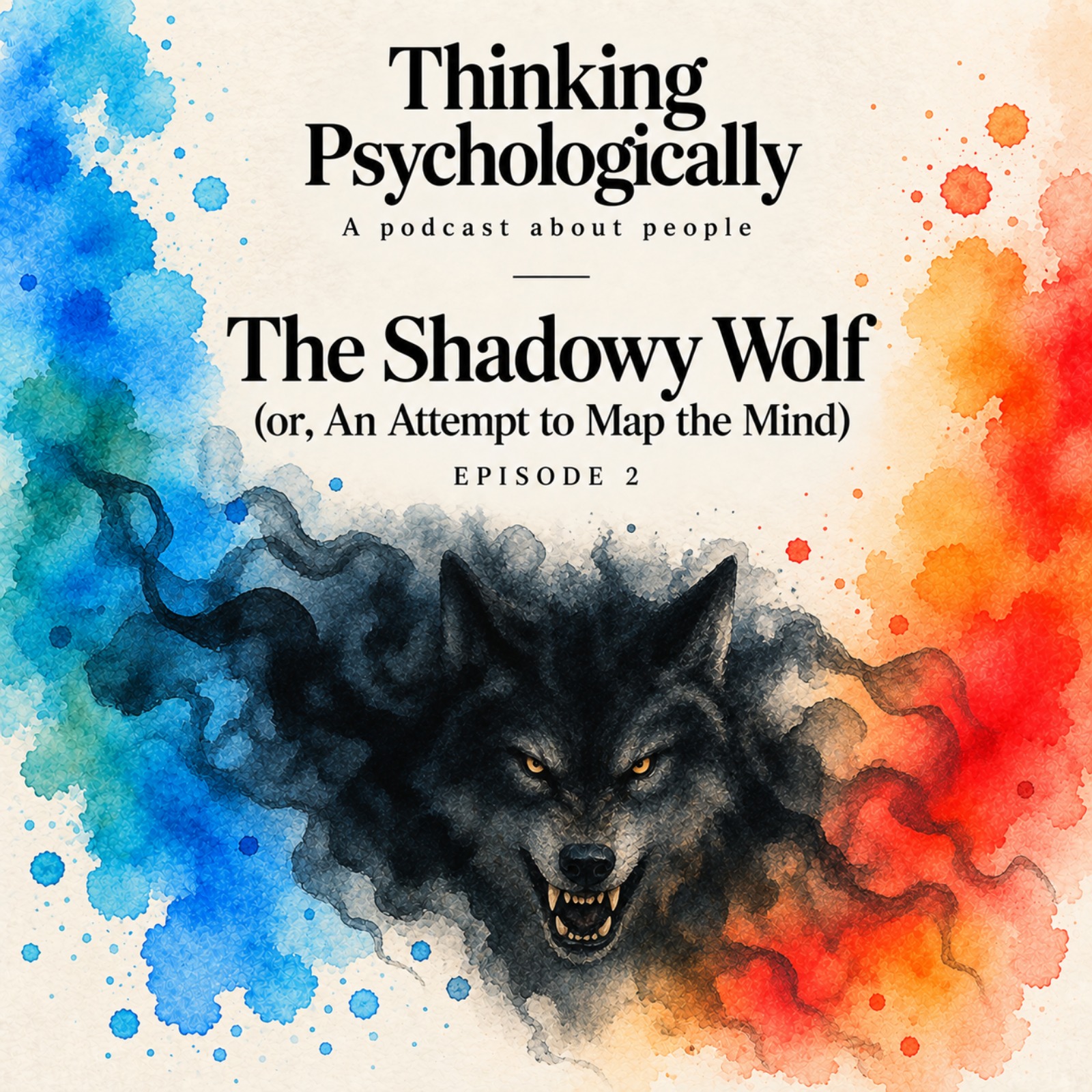
    2: The Shadowy Wolf (or, An Attempt to Map the Mind)

    For several years in my late teens and early twenties I used to wake in the middle of the night, gripped by the chilling certainty that a vast, shadowy wolf had materialised in my room. It would prowl back and forth at the foot of my bed before pouncing, pinning me down as it snarled in my face. Terrified, paralysed, unable to cry out, I would fight desperately to push it away. In this second episode of Thinking Psychologically, these strange and dreadful nocturnal experiences act as inspiration as we set out to formulate a working model of the human mind. Drawing on our evolutionary history, neuroscience, and human development, we gradually build a picture of the hidden psychological life that exists beyond conscious awareness - and consider what it might mean to approach that hidden life with curiosity. . . Music credit Music used in this episode is drawn from the royalty-free work of PaulYudin. Many thanks for making this music freely available for creators.

  • #1
    September 9 · 20 min

    1: Is a Tattoo Ever Just a Tattoo

    Tattoos have accompanied human beings for thousands of years. But why do we do it? Why willingly endure pain and permanently mark our bodies? In this first episode of Thinking Psychologically, we explore tattoos through a psychological lens, considering the various functions they may serve in our psychological lives. Along the way, the discussion touches on: Permanence, impermanence, and existential questions of mortality Belonging, conformity, and the human need for connection Transgression, individuation, and becoming more fully oneself Trauma, bodily autonomy, and reclaiming the body Carl Jung, symbolism, and the unconscious The episode does not attempt to explain what any particular tattoo means. Instead, it asks a broader question: Is a tattoo ever just a tattoo? . . Music credit Music used in this episode is drawn from the royalty-free work of PaulYudin. Many thanks for making this music freely available for creators.

Showing 1–6 of 6 episodes