transcript
show notes
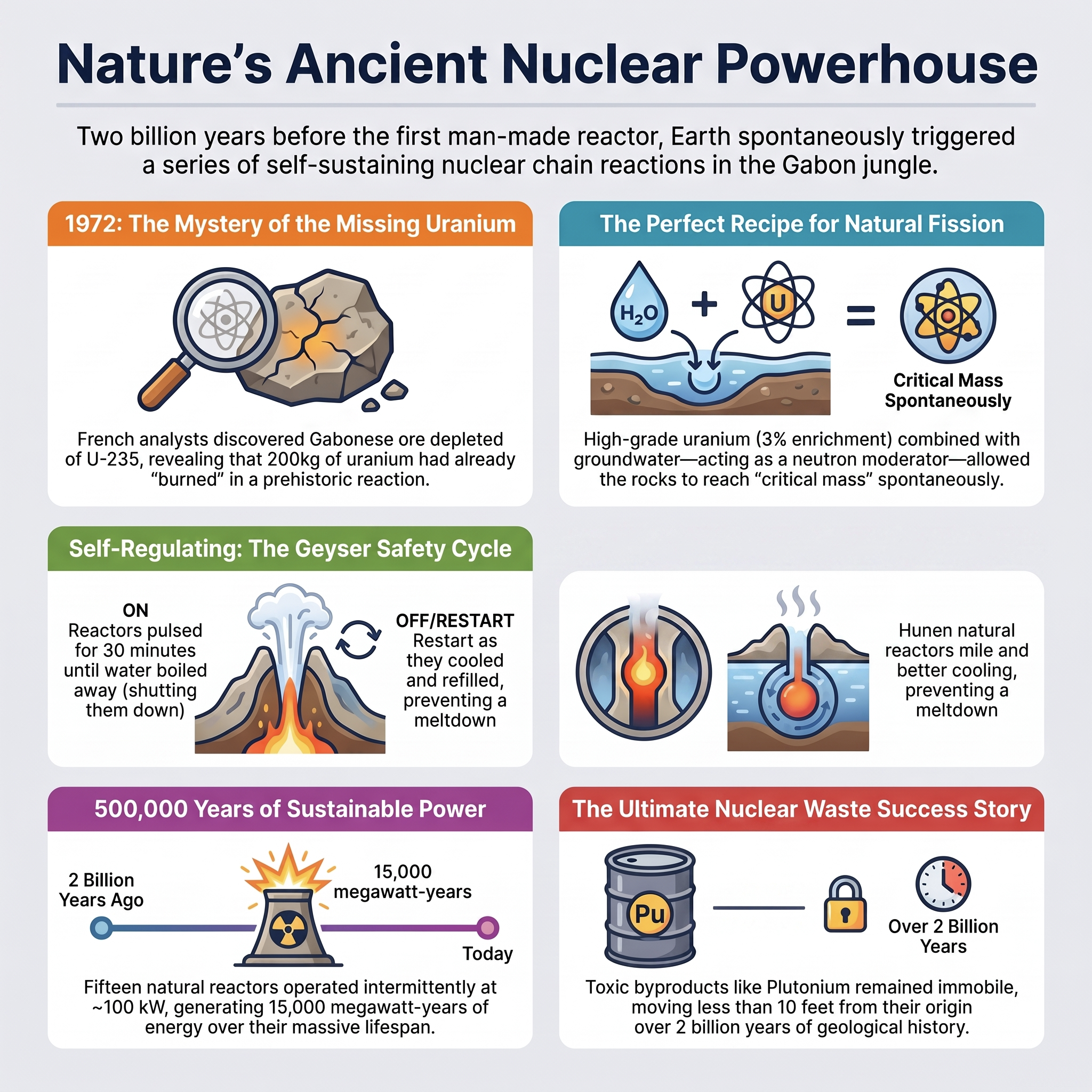
Examining the Oklo phenomenon, a series of natural nuclear fission reactors that operated spontaneously in Gabon, Africa, approximately two billion years ago. Scientists discovered these sites in 1972 after noticing a depletion of the uranium-235 isotope, confirming theoretical predictions that natural uranium deposits could achieve criticality under specific environmental conditions. The reactors were sustained by high uranium concentrations, a water moderator, and a lack of neutron poisons, all of which were made possible by the Great Oxidation Event that allowed uranium to mobilize and concentrate. Beyond their historical significance, these sites serve as a crucial natural analog for modern nuclear waste storage, demonstrating how geological barriers like clays and organic matter can effectively contain radioactive byproducts for eons. Additionally, researchers use data from these fossilized reactors to test the constancy of physical laws and evaluate hypotheses regarding the Earth's internal heat.