Skip to content
Artwork for The BIG Home Ed Conversations
Kids & FamilyEducation for KidsEducationSelf-ImprovementParenting

The BIG Home Ed Conversations

Kelly Rigg & Ashley Vanerio

The BIG Home Ed Conversations is one of the top active 'home education' podcasts for parents who want to move past the myths and dive deep into what we actually want to talk about as alternative educators. Join Kelly (home ed mum of 2 and home education coach & mentor) and Ashley (ex-primary teacher & home ed mum of 3) as they debunk myths, tackle real challenges, and share honest, empowering, mindset-shifting conversations for families choosing alternative education.

Whether you’re new to home educating or looking for fresh perspectives to support your child’s learning journey, this podcast offers practical advice, mindset shifts, and heartfelt stories from UK-based parents and experts. We go beyond the basics—helping you handle the ups and downs of home education, break free from generational patterns, and build confidence in your own path.

Tune in for weekly episodes packed with reassurance, motivation and community for mums, dads, and anyone passionate about holistic, alternative, project-led, or eclectic education.

Find out why we’re one of the top-rated home ed podcasts, and feel less alone on your journey.

Find us at www.bighomeedpodcast.com

Ps. We only use the term homeschooling from time to time to help US, European and new to home ed families find us!

Play
  • 24 episodes
  • weekly
  • Avg 47 min
  • English
Counted on this page — what you have heard stays on this device, so it is not something the list can be paged by.
  • Thursday · 49 min

    Home Ed Learning Styles: The VARK Myth, Mixing It Up (and Knowing When to Leave It for Another Day)

    One child happily gets on with a maths app, and the other says a hard no to everything you put in front of them. If you're home educating more than one child, or just one who changes their mind every few months, working out how they learn can feel like building on shifting sands. In this Season 6 episode of our series on the tricky bits of home education, Kelly and Ashley talk about learning styles: what the research actually says, why what works for one child doesn't work for the other, and how to stop wearing yourself out looking for the perfect approach. Ashley explains what she found when she looked into the popular VARK learning styles model (visual, auditory, reading/writing and kinaesthetic). It turns out to be a well-known neuromyth. Children do have real preferences, but teaching to them doesn't improve how much they remember. What matters more is letting the content decide the method, mixing approaches, prior knowledge, interest and motivation, and any learning differences. Kelly shares how her son's favourite maths app didn't stick, how a brilliant online chess tutor took over where her own enthusiasm ran out, and how listening to Harry Potter for the umpteenth time turned into real inquiry. Together they explore how our own school hang-ups (maths GCSE, we're looking at you) shape what we think learning should look like. They talk about why it's okay for home ed to be softer and slower than school, and why a big regimented family might need more structure. Kelly also explains why neurodivergent kids often need to regulate before learning, not after. They finish with the importance of leaving space in the week, knowing when to cut your losses, and giving yourself and your kids some grace. We'd love to hear from you: how do you mix things up for your kids, and what do you do when something that used to work suddenly stops working? Next week: The bit nobody puts in the home ed brochure: money. When your child is in school, the curriculum, books, science lab and specialist teachers all come included. When you home educate, every bit of it comes out of your own pocket. We're getting honest about what it really costs and how families make it work. Want to go deeper this season? Visit our website and join the waiting list for When Home Ed Gets Hard, our reflection and journalling companion with questions for every episode of Season 6, releasing in December. Waiting list members will be the first to hear when it's ready and get an early-bird discount: https://www.bighomeedpodcast.com/when-home-ed-gets-hard/ And if you're navigating ADHD or neurodivergence, whether as a family or for yourself, Kelly offers 1:1 coaching. Find out more at https://www.kellyrigg.mykajabi.com. Loved this episode? Please leave us a review on Apple Podcasts, Spotify or wherever you listen. It really helps other families find us.
  • October 15 · 56 min

    Home Ed Burnout: Spotting the Signs, Lowering the Bar (and Finding Your Way Back)

    Whether you came to home ed after your child burnt out of school, or you're the parent running on empty right now, burnout is something so many of us know far too well. In this Season 6 episode of our series on the tricky bits of home education, Kelly and Ashley get honest about home ed burnout: what parent burnout actually looks like, why it creeps up on us, and how to find our way back, for our kids and for ourselves. Kelly shares how she went hell for leather in her first year of home ed, filled the calendar to the brim with meetups and outings, and burnt out hard and fast, plus the early warning signs she watches for now, from irritability and creeping clutter to answering work emails at dinner. Ashley talks about how disrupted evenings and sleep, solo parenting and being always on as parent, educator, driver, planner and social secretary tip her towards homeschool burnout, and the small changes she's made, from cutting back activities to getting the kids making their own lunches and cosying up the house with soft lamps, candles and coffee-shop music. Together they explore the pressure home educating parents feel to prove home ed works, the home ed comparison trap, why the well-meaning advice to just relax can backfire for families recovering from school burnout, and why home education is a marathon, not a sprint. Kelly shares a happiness hack (make the bits you hate a little better and the bits you love even better), the family meeting that transformed their car journeys, scheduling protected rest into the diary, and giving yourself permission to lower the bar on tired days. We'd love to hear from you: what are your tricks for changing the environment or reducing the workload to sidestep burnout? Next week: Why won't they just...? We're talking learning styles and effort, why one child flies through a worksheet while another needs to build it, act it out or argue with you about it first, and why what looks like not trying is sometimes something else entirely. Want to go deeper this season? Visit our website and join the waiting list for When Home Ed Gets Hard, our reflection and journalling companion with questions for every episode of Season 6, releasing in December. Waiting list members will be the first to hear when it's ready and get an early-bird discount: https://www.bighomeedpodcast.com/when-home-ed-gets-hard/ And if you're navigating ADHD or neurodivergence, whether as a family or for yourself, Kelly offers 1:1 coaching. Find out more at https://www.kellyrigg.mykajabi.com. Loved this episode? Please leave us a review on Apple Podcasts, Spotify or wherever you listen. It really helps other families find us.
  • October 8 · 57 min

    Home Ed Consistency: Rhythm vs Routine (and Letting Go of the Perfect Timetable)

    Consistency is one of those words that can make home educating parents feel a bit twitchy. Some weeks your home ed routine flows beautifully, and some weeks the maths book hasn't been opened and someone's still in their pyjamas at 2pm. In this Season 6 episode on the tricky bits of home ed, Kelly and Ashley unpick what consistency really means in home education. Do you need a strict homeschool schedule, or is a gentler rhythm (showing up, keeping the curiosity going and coming back to things after a break) enough? Kelly shares how a week of painting the bedroom turned into an unexpected lesson in life skills and independent learning, and the simple daily rhythm (one helpful task, three bits of learning, then screen time) that works for her ADHD and autistic kids. Ashley talks about swapping school days to fit in a new outdoor meetup, why a predictable routine helps children feel safe, and why getting back into a routine after a long summer break can be such a battle. Together they explore rhythm vs routine, how much of our worry about consistency comes from school and society rather than from our children, whether structure and child-led learning can work together, why being consistent in how we respond to our kids matters as much as any timetable, how to scaffold child-led goals like becoming a zoologist or a vet, and the small household routines that quietly set children up for adult life. We'd love to hear from you: what's one small thing you do consistently that makes a bigger difference in your children's lives than any curriculum could? Send us a message through our website or on Instagram. Next week: burnout. What happens when you've been showing up and showing up with nothing left in the tank. Want to go deeper this season? Visit our website and join the waiting list for When Home Ed Gets Hard, our reflection and journalling companion with questions for every episode of Season 6, releasing in December. Waiting list members will be the first to hear when it's ready and get an early-bird discount: https://www.bighomeedpodcast.com/when-home-ed-gets-hard/ And if you're navigating ADHD or neurodivergence, whether as a family or for yourself, Kelly offers 1:1 coaching. Find out more at https://www.kellyrigg.mykajabi.com. Loved this episode? Please leave us a review on Apple Podcasts, Spotify or wherever you listen. It really helps other families find us.
  • October 1 · 51 min

    Back to Home Ed After Summer: Transitions, New Systems and Too Many Hats

    Welcome to season six of The BIG Home Ed Conversations Podcast, where we're digging into the tricky bits of home education. Not the sunshine-and-nature-walks highlight reel, but the real, unglamorous moments that every home educating family knows too well. After a summer apart, Kelly and Ashley catch up on what's been going on and why September always seems to bring that big "go" energy, the pressure to have new systems, new attitudes and a whole new approach. Ashley shares what it's like to go straight from a holiday in Italy into a new term with no pause, plus the realisation that her eldest is only a few years from needing to think about what comes next. Kelly talks about why transitions can feel like grinding gears for neurodivergent families, and the simple fridge chart and wall calendar that have helped her autistic kids feel settled and accomplished. Together they explore finding the right time of day for learning, the tricky balance between child-led learning and the bigger picture, why living alongside all the mess of home ed can feel so much heavier than a classroom, and Kelly's "which hat am I wearing?" mantra for staying focused. They also talk about helping kids face that big wall of "this feels too hard", from handwriting struggles to fractions, and why teaching our children how to learn and persevere might be the most important thing of all. If you've been feeling the pressure this September, this one is a gentle reminder that none of us are doing it wrong. We're just in the iteration we're in right now. Want to go deeper this season? We're creating When Home Ed Gets Hard, a reflection and journaling companion with questions for every episode of season six, releasing in December. Join the waiting list at https://www.bighomeedpodcast.com/when-home-ed-gets-hard/ to be the first to hear when it's ready and get an early-bird discount. And if you're navigating ADHD or neurodivergence, whether as a family or for yourself, Kelly offers 1:1 coaching. Find out more at kellyrigg.mykajabi.com. Loved this episode? Please leave us a review on Apple Podcasts, Spotify or wherever you listen. It really helps other families find us.
  • July 19 · 45 min

    Season Finale: Screen Safety, Fake News & AI: Helping Home Ed Kids Build Digital Discernment

    In this final episode of the season, we’re doing something a bit different. (Please note, no explicit details are mentioned, but use caution if you listen with children as we do discuss things they may be exposed to as they start to use the internet more widely.) We originally planned an episode focused on internet safety and online security… and then real life happened. We were away at our annual home ed camp, the world took over, and we decided to lean into the learning that was already happening right in front of us. So this becomes a wider conversation about: Why “the plan” doesn’t always happen (and why that’s not a failure) How real-life experiences can teach safety, boundaries, communication, and responsibility in a way no worksheet ever could How to start age-appropriate conversations about online safety without introducing scary details too early We also share practical ways we’ve been exploring digital literacy at home, including: Noticing how fast-paced videos are designed to keep kids watching (frame changes, zooms, constant stimulation) Comparing YouTube-style content to slower documentaries and noticing what our brains remember Talking about influence: how creators shape what kids think is “normal” (including illegal or unsafe behaviour being presented as entertainment) Helping kids question whether something is real or AI-generated Teaching “data safety”: what not to share online (surname, location, pet names, family details) Why pausing, checking sources, and doing a bit of research matters (especially with fake news and misinformation) A real example of a child being scammed in an online game—and what that taught about trust, risk, and due diligence And we bring it back to the heart of home education: community, character, and the kind of learning that happens when children are given space to live, play, negotiate, help others, and grow. Sponsor: Strew - a home education logging app created by a home educating mum and her brother. We have loved using Strew this season, loved the feed its created of the amazing adventures we've had with our kids, the learning insights it has offered and the ease of pulling these memories to the surface when we will need to produce reports for the LA in due course. Try it now: https://strew.app/r/bighomeed or use code 'bighomeed' We’ll be back in September with a new season. Thank you for listening, and if you’ve loved this season, please leave a review—it genuinely helps the podcast reach more home educating families.

  • July 5 · 1 hr

    State of Mind: Mental Health and Education. Guest Episode - Dr Chris Bagley

    In this bonus episode of The BIG Home Ed Conversations, Kelly Rigg is joined by Dr. Chris Bagley — educational psychologist, musician, author, and co-founder of States of Mind (with B. Herbert). Together, they unpack why so many young people are “not ok at school” — and what happens when an education system prioritises compliance, metrics, and control over human development, agency, and real connection. Chris shares why States of Mind is “allergic” to tokenistic ideas like “pupil voice” when they’re used as a fake listening exercise — where young people are asked for their opinions, but nothing actually changes. He explains how this can mirror an unhealthy relationship dynamic: being invited to be vulnerable, then ignored. Kelly reflects on her own experience of being a “good student” who learned to tick boxes, impress adults, and stay quiet — and how that conditioning can follow us into adulthood, shaping our self-worth, relationships, and mental health. They explore how many parents in transition to home education are realising the same thing: school was supposed to be “good for them”… so why is their child anxious, distressed, or shutting down? In this conversation we explore: Why “normal” is a social construction (and why there may be no such thing as a “typical” brain) How labels and diagnoses can sometimes become the only route to compassion — and why that’s complicated The difference between genuine participation and performative “student voice” Why young people need space to talk about their lives and the world without being controlled or shut down How fear of uncertainty drives institutions to narrow, label, measure, and punish Why agency, belonging, and autonomy matter (for children and adults) Chris’s powerful reminder: you can’t have harmony without difference Chris also shares what young people consistently ask for when they’re truly listened to: more agency, more authentic connection, and spaces to explore real life, mental health, and meaning — not just performance and compliance. Links Chris Bagley’s book: States of Mind - https://www.statesofmind.org/ Sponsor: Strew is an online home education logging app that helps you capture what you’re doing day-to-day (photos, notes, tags), and optionally uses AI to reflect back the skills and areas of development you’ve covered — which can be especially helpful when you need to pull everything together later. Use code: BigHomeEd when you download it! https://strew.app/r/bighomeed

  • June 28 · 44 min

    Home Educating UK Topic Challenge: Raising Brave Kids — Activism, Justice & Quiet Protest

    In this week’s episode of The BIG Home Ed Conversations Podcast, Kelly Rigg and Ashley Vanerio dive into a big question many home educating UK families wrestle with: how do we teach our children about activism, justice, and using their voice — without overwhelming them? We talk honestly about: Why “quiet protest” (like choosing elective home education) is still activism How kids can learn courage, integrity, and a strong moral compass through everyday life Exploring activism through books, documentaries, and values-led conversations (including learning about Greta Thunberg) How to handle tricky conversations with people who don’t “get” home education (and the judgement that can come with it) Practical ideas you can try at home: writing letters to companies, researching issues together, and building confidence through small actions A fun evolution-inspired activity that sparked brilliant conversations about climate, deforestation, and change Whether you’re fully in flow or just finding your feet with Home Education, these home education resources will help you to find your way through this topic. This episode is a reassuring reminder: our children’s opinions matter, and they’re never “too young” to care. Sponsor note: This season is sponsored by Strew (the home education logging app). Strew are running a survey right now and they genuinely want your feedback on what features you want, what you love, and what you’d change. There’s also a chance to win £25 Amazon vouchers. Survey link: https://strew.app/the-2026-strew-survey-prize-draw/ or download the app here: https://strew.app/r/bighomeed Keyword section: home education uk, home educating uk, elective home education, homeschooling uk, home schooling, home educating, home education resources uk, alternative education, deschooling, unschooling, child-led learning, neurodivergent families, adhd, autism, mindset, values education, kids activism, teaching kids activism, social justice for kids, climate change education for kids, writing letters to companies, raising socially conscious kids, parenting outside the school system

  • June 14 · 45 min

    Summer Home Education: Letting Go of the Pressure (and Trusting Real-Life Learning)

    In this chatty catch-up episode, Kelly Rigg and Ashley Vanerio reflect on what home education can look like as summer approaches — when clubs pause, routines shift, and the calendar suddenly feels wide open. Together, they explore the different ways families plan (or don’t plan) through summer, how guilt can creep in around “what we’ve achieved this year,” and why many home educating parents eventually find a calmer rhythm — especially when they start trusting that learning doesn’t stop just because the school year ends. What we cover Why summer can feel either freeing or overwhelming (and why both are valid) How Strew’s tracking insights can reassure you about progress and balance Socialisation pressure and the reality of home educated kids’ social skills “Traditional” learning vs real-world learning (and why the distinction can be unhelpful) Planning styles: structured curriculum planning vs going with the flow Why boredom can be a catalyst for creativity, independence, and resilience Gentle “check-in” moments that help you notice progress without formal testing A reminder that home education is allowed to be sustainable (and imperfect) If you enjoyed this episode, please subscribe, leave a review, and share with a friend — it genuinely helps more home educating families find the podcast. Website: www.bighomeedpodcast.com Follow us on socials: @bighomeedpodcast Try Strew (our Season 5 Sponsor) We’ve loved trying Strew as a simple way to log learning and spot patterns over time. If you’re signing up, mention the referral code “bighomeed” so they know you came from us. https://strew.app/r/bighomeed SEO keywords: home education UK, home educating, elective home education, homeschooling UK, home schooling UK, unschooling, deschooling, home education, socialisation, alternative education UK.

  • May 31 · 40 min

    Topic Challenge: Thoughts and Feelings, Fostering Emotional Maturity in Children

    Welcome back to The BIG Home Ed Conversations Podcast with Kelly Rigg and Ashley Vanerio. This week’s topic: Feelings and journaling (real life edition) We recorded in the middle of a heatwave, so we’re talking dysregulation, grumpy kids, and how hard it can be to “do the right thing” when everyone’s overstimulated. What we actually found helpful: A feelings wheel (free printable) to help kids find more precise words than just “angry/sad” A simple empathy prompt: “How do you think your sibling feels?” Journaling alternatives for kids who hate writing: drawing feelings, scribble pages, talking, creativity, movement, baking A reminder that feelings aren’t just cognitive — sometimes kids regulate best through safe physical outlets Schedule note: We’re taking a short one-week break, then we’ll be back with a general catch-up episode (summer plans and a bit of a chat). After that, we’ll return to the topic challenge with protest and social change. Season 5 Sponsor: Strew (home education logging app) This week we’re sharing a quick behind-the-scenes feature: Study Points settings. In the Study Points area you can choose an education style (child-led learning, Waldorf/Steiner, Charlotte Mason, unschooling/deschooling, or general home ed) which can change how the Study Points categories are shown. It’s totally optional, but a handy way to get an at-a-glance view of what you’ve been logging over time. Use code 'bighomeed' if you try Strew. https://strew.app/r/bighomeed Thanks for listening — subscribe, leave a review, and share with a friend. Find us on Instagram and TikTok, and at www.bighomeedpodcast.com .

  • May 24 · 48 min

    Town Planning & Street Furniture (Home Education UK Topic Challenge)

    In this episode of The BIG Home Ed Conversations Podcast, Kelly and Ashley continue their weekly home education UK “topic challenge” — choosing a theme and exploring it with their children through real-life learning, conversation, and curiosity-led activities. This week’s topic: Town planning and street furniture — and it turns into a brilliant mix of project-based learning, local community awareness, and practical thinking about how towns work (and who decides what gets built). Whether you’re home educating, (homeschooling for our US friends), this episode is packed with ideas you can adapt for your own family. What we cover in this episode: Town planning basics: how towns evolve, what problems they’re trying to solve, and why infrastructure matters. Street furniture in everyday life: benches, lamp posts, traffic lights, junctions, road layouts — and the “why” behind them! A fun “run the town” council game (decision-making, teamwork, budgeting, environment, and community trust.) Learning through videos and visuals: what’s underneath major cities (including hidden infrastructure) how cities change over time (including a London evolution-style video) how heating, water, and energy systems can work at city scale. Real-life community learning moments: conversations sparked by local elections and meeting a local candidate talking about leadership, values, and why voting matters (and why kids can’t vote yet!) Hands-on play: building a town at home using toys (roads, emergency services, zoo, trains, role play and storytelling) So whether your home education journey is eclectic, unschooling, project led or otherwise - you can draw some great ideas from this episode and as usual - we would love to hear yours too! Share with us on Instagram or TikTok - @bighomeedpodcast or visit our new website - www.bighomeedpodcast.com This season is sponsored by Strew, a home education logging app created by a UK home educating mum and her brother. To try Strew, head to https://strew.app/r/bighomeed or Search “Strew Home Ed app” on your apple or android phone and use code: bighomeedpodcast

  • May 17 · 48 min

    Special Guest: Jenn Hodge Interview: The Children’s Wellbeing and Schools Bill (Now the Act) — What Home Educating Families Need to Know

    In this episode of The BIG Home Ed Conversations Podcast, Kelly shares a powerful interview with Jenn Hodge, founder of Doing Education Differently. Jenn is a leading voice in neurodiversity and education reform, and has been at the forefront of challenging the Children’s Wellbeing and Schools Bill — which has now become the Act. Together, Kelly and Jenn talk through what’s happening, why it matters, and what families should be paying attention to as the Act begins to come into effect. This conversation is especially relevant for: Home educating families in the UK Families navigating “children not okay at school” Neurodivergent families and those supporting SEND needs Anyone concerned about how policy changes could impact autonomy, rights, and day-to-day home education life What we cover: Who Jenn Hodge is and why her work matters in this space The shift from the Children’s Wellbeing and Schools Bill to the Act What the proposed changes mean in real life for families (not just in theory) Why neurodivergent children and families are often disproportionately affected by education policy The importance of staying informed, connected, and empowered (without spiralling into fear) How advocacy works behind the scenes — and why community voices matter What to watch for next as the Act is implemented, and how families can prepare Kelly’s intention with this episode: This isn’t about panic or pressure — it’s about clarity, empowerment, and making sure families have access to grounded information as things change. This season is sponsored by Strew, a home education logging app created by a UK home educating mum and her brother. To try Strew: Search “Strew Home Ed app” (iOS + Android) and use code: BIGHOMEED or click here https://strew.app/r/bighomeed

  • May 10 · 48 min

    Topic Challenge: Lesser Known Sports (Weird & Wonderful Games, What Counts as a Sport, and Why Movement Matters)

    In this episode of The BIG Home Ed Conversations Podcast, Kelly and Ashley explore this week’s “topic from the hat” challenge: lesser known sports. They start by going down the rabbit hole of strange and wonderful sports from around the world (and even a few from right here in the UK), and it quickly opens up bigger conversations about creativity, culture, community, and what sport is actually for. We chat about: The weird and wonderful sports humans have invented (and why some of them are genuinely shocking) Chess boxing (yes, really): alternating rounds of chess and boxing, and what that says about “mental” vs “physical” sport The difference between a sport and a game (and using the dictionary to define it properly) How quickly a sport can grow once people actually see it (media, Olympics, exposure, and suddenly everyone wants to try it) Why “lesser known” doesn’t mean “less valuable” — it might just mean it hasn’t had the PR yet How sport can be about fun, community, identity, tradition, and entertainment (not just winning) Making space for movement in other areas of their education (especially for neurodivergent kids), and why physical activity supports mental health too How this topic can branch into loads of learning: history, geography, PE, science (heart rate/pulse), maths (scoring), literacy (writing rules), and even coding-style logic (if this happens, then what?) Kelly and Ashley also share some of the real-life ways this topic showed up in their week — from hobby horsing and play-based competitions, to watching Paralympic sport and noticing how many different bodies and abilities can be included in athleticism. If you’re joining in with the weekly topic challenge, we’d love to hear what you did with it — and remember, this is never about pressure or “doing enough”. It’s just a fun way to spark ideas, follow curiosity, and bring a bit of variety into your home ed rhythm. To try Strew (our Season 5 sponsor) home education logging app - on IOS and Android and use code: bighomeed Don't forget to subscribe, share an episode with a friend or drop us a rating - every one helps more people like you to find us! Head here: https://strew.app/r/bighomeed

  • May 3 · 47 min

    Topic Challenge: Food Around the World

    Welcome back to another episode of the BIG Home Ed Conversations Podcast. Kelly and Ashley are continuing Season 5’s “topic from a hat” home education challenge — where they pick a theme, explore it with their kids for the week (without telling each other what they’re doing), then come back to compare notes, resources, and real-life learning. This week’s topic: Food Around the World — and it takes them way beyond “trying new recipes”, into geography, history, climate, farming, food miles, hunger relief, and how food choices impact communities and the planet. Season 5 Sponsor: Strew (and the feature we’re loving this week) This season is sponsored by Strew — a home education logging app developed by a UK home educating mum and her brother. They’ve given us access to the app and we’re using it to track what we’re doing and share what we’re enjoying as we go. This week, Ashley has been focusing on the book tracking function: You can scan a book and log it as an activity (great for read-alouds and independent reading) Ashley created a “dummy child” called Library to track her home education book collection She tags books with keywords (country, geography, history, etc.) so she can quickly see what she already owns It helps prevent over-buying or borrowing loads from the library when you don’t need to Kelly’s also using Strew to support a reading challenge with her kids and to look back over time at: What they’ve read How their reading level and text complexity is developing You can download Strew on iOS and Android. https://strew.app/r/bighomeed Use code bighomeed when you subscribe (so it links back to where you found it). In this episode, we chat about: Why “Food Around the World” can go in a million directions (and why that’s the magic of it) Food, travel, culture, and how communities grow/produce food differently How climate, geography, and environment shape what people eat How food connects to history (including Roman influences in Britain) Why this topic can be tricky with neurodivergent / selective eaters — but still totally doable Food miles, carbon impact, and the surprising footprint of an everyday breakfast Soil health, farming, and how modern agriculture affects nutrients, rivers, and habitats Hunger relief, food banks, and how food distribution works behind the scenes Local economy: where your food money goes (and why local matters) Listen to find out next weeks topic! Follow + connect Instagram + TikTok: @bighomeedpodcast Website + weekly blog/resources: bighomeedpodcast.com If you’re joining in with our weekly topic challenge, come and tell us what you did — we’d love to hear your ideas and share them with the community.

  • April 26 · 51 min

    Topic Challenge: Capital Allocation & Investment with Kids

    Welcome back to the BIG Home Ed Conversations Podcast. In this episode, Kelly and Ashley share how they tackled a surprisingly big topic with their kids: capital allocation and investing — including spending vs saving, risk, impulse buying, and how money habits form early (for better or worse). In this episode, we chat about: Why this topic matters (and why most of us weren’t taught it!) Helping kids understand spend / save / invest / give Kelly’s “family token currency” experiment (spend pot, save pot, investment pot + family pot) How risk works (and why investing can go up or down) Monopoly as a not-so-surprisingly good money-learning tool Bank accounts, budgeting, and setting realistic goals Impulse buying (and a family challenge to reduce it) Why values matter: experiences vs “stuff” (and how everyone prioritises differently) Every week we will be picking a new topic from the hat that we wouldn't often choose to cover with our kids - we go away and give it a whirl, coming back to share what we did - bit like home ed topic speed dating! Listen to find out next week's topic! Resources mentioned: Finance With Kids Podcast (Episode 24: Practicing Smart Spending Habits and Avoiding Impulse Buying) FI for Kids podcast (Financial Independence for Kids) Teachers Pay Teachers: “Personal Financial Literacy” (3rd grade math unit) Usborne Lift-the-Flap Questions & Answers About Money Know Nonsense Guide to Money: An Awesome Fun Guide to the World of Finance Investing for Kids: From Piggy Banks to Portfolios Why Money Matters (Deborah Meaden) Monopoly - any version Season 5’s paid sponsor is Strew — a home education logging app developed by a UK home educating mum and her brother. They’ve given us access to play around with the app over the next few weeks, and we’ll be reviewing it honestly as we go.https://strew.app/r/bighomeed So far, we’re especially loving: The feed (a scrollable timeline of what you’ve been up to) Uploading photos and adding notes (so your memories don’t just sit in your camera roll with no context) The ability to scan books (and other learning) into the app The optional AI feature that can help categorise what you’ve logged (e.g., literacy, maths, etc.) and generate “study points” If you want to try Strew, use code 'bighomeed' when you subscribe. - Head to https://strew.app/r/bighomeed to download it now on IOS and Android. Follow + connect Instagram + TikTok: @bighomeedpodcast Website + weekly blog/resources: bighomeedpodcast.com If you’re joining in with our weekly topic challenge, come and tell us what you did — we’d love to share your ideas with the community.

  • April 19 · 33 min

    Season 5 - Welcome Back! New Season, New Topic, New Sponsor!

    Welcome back to Season 5 of the BIG Home Ed Conversations Podcast. In this short “we’re back!” episode, Kelly Rigg (home ed mum of two, qualified mindset + ADHD coach) and Ashley Vanerio (home ed mum of three, former primary teacher) share what’s been happening behind the scenes, why we took a break, and what’s coming up next. This season we’re doing something a bit different: each week we’ll pick a random topic out of a hat, go away and explore it with our kids (without telling each other what we’re doing), then come back to compare notes. We’ll share what worked, what flopped, what resources we found, what questions our kids asked, and what unexpected learning popped up along the way. We’re also excited to share that Season 5 is sponsored by Strew — a UK-built home education app created by brother and sister duo, Kayley & Woody as fellow home educators - they really know what we need from a home ed app! We’ll be trying out features across the season (photos, activity logging, book scanning and more) and reporting back honestly as we go. Take a listen to find out what we pulled from the hat first then come and join the conversation on social media, and tell us what you do with this week’s topic. Season 5 is Sponsored by: Strew App - Download here: https://strew.app/r/bighomeed and use code: 'bighomeed' so they know where you found it! Follow Strew on Social media - @strewapp on Instagram and TikTok. Follow us: Instagram + TikTok: @bighomeedpodcast Website: bighomeedpodcast.com

  • Dec 19, 2025 · 53 min

    Season 4 Finale – Our Home Ed Year in Review

    It’s the final episode of Season 4 of the BIG Home Ed Conversations Podcast, and we’re keeping up our (now official!) yearly tradition: a relaxed, honest Year in Reflection. Kelly and Ashley look back on what’s worked in their home education lives this year—what’s felt joyful, what’s been challenging, and what they want to carry forward into next year. Expect a cosy, chatty recap filled with real-life wins, lessons learned, and practical ideas you can borrow for your own home ed. In this episode, we talk about: Why travel (UK trips, camping, and overseas adventure) brings built-in novelty and learning—especially for neurodivergent families Using different modes of transport (ferries, trains) as learning opportunities and curiosity fuel The ongoing juggle of routines, energy and extracurriculars (pony share, forest school, climbing, online classes) How read-alouds, audiobooks and book studies have shaped learning, sparked big conversations, and supported reluctant readers Regulation tools, movement, and mixing up learning mediums (chalk pens, drawing on glass, sensory supports) Enterprise learning through craft fairs and kid-led projects What we’re adjusting next year: social rhythms, responsibilities/chores, games, and finding a better balance We also share a huge thank you to everyone who’s listened, reviewed, shared, and supported Season 4—and we’ll be taking a short break before returning for Season 5 in the spring. Don't forget to subscribe and catch up on earlier episodes while you wait! Keywords: home education UK, home ed year in review, neurodivergent home education, unschooling, eclectic homeschooling, home ed travel, home education routines, read alouds, audiobooks for kids, home ed resources Stay connected: Follow us on Instagram and TikTok @bighomeedpodcast, and catch up on any episodes you’ve missed while we’re on break. We’ll also be dropping the occasional book review over the winter.

  • Nov 30, 2025 · 50 min

    Challenging Adultism, Respecting Children & Rethinking the Power Dynamic in Parenting

    In this episode of the BIG Home Ed Conversations Podcast, Kelly and Ashley get real about adultism—the often-unquestioned power imbalance between adults and children. Inspired by fellow home educating mum and respected expert on Adultism, Eloise Rickman and her book 'It's Not Fair', they reflect on how even the most conscious parents can slip into controlling patterns, and what it means to truly respect kids as full people. They discuss: What adultism is, and how it shows up in everyday family life. The challenge of letting go of control as kids grow and assert themselves. Why children’s rights and autonomy matter (and why most of us never learned about them.) The impact of language, discipline, and school structures on children’s self-worth. Personal stories about food battles, bodily autonomy, and learning to find a balance between protection and control. How to balance safety, boundaries and respect—without losing your mind as a parent! Kelly and Ashley share honest moments of vulnerability, cringe from some seriously eye opening moments experienced whilst reading, and how important growth is in this area, as well as offering practical ways to shift from a power-over dynamic to a more collaborative, compassionate approach. They highlight the importance of compromise, self-reflection, and community support for parents doing this work. Take it further: Listen in for inspiration, solidarity, and practical ideas to help you rethink your own patterns and raise more empowered, respected kids. Join the conversation on Instagram or TikTok @bighomeedpodcast, or via the blog www.offroadingmotherhood.co.uk/blog Don't forget to grab a copy of Eloise Rickman's book, 'It's Not Fair' to take your journey down this road further Keywords: adultism, respectful parenting, children’s rights, home education UK, conscious parenting, autonomy for kids, power dynamics, BIG Home Ed Conversations Podcast

  • Nov 24, 2025 · 47 min

    Refugee Education, Prejudice & Shared Humanity: Learning From Displaced Young People

    In this episode of the BIG Home Ed Conversations Podcast, Kelly and Ashley sit down with Catherine Gladwell, founder and CEO of Refugee Education UK, to explore what education really looks like when your whole life has been uprooted. Catherine shares powerful stories from her work with refugee children and teenagers in the UK – many of whom have been out of school for years, arrived alone as unaccompanied minors, or are trying to learn in a new language while carrying trauma, grief and separation from family. Together they unpack: Why over half of the world’s refugee children are currently out of school The hidden barriers refugee learners face in the UK (language, trauma, missing records, complex systems) How academic potential is misjudged when language and PTSD get mistaken for “low ability” Incredible resilience and self‑motivation – from teens fighting to sit GCSEs to those dreaming of rebuilding their home countries The emotional impact of prejudice, othering and hostile narratives about refugees How schools can better recognise prior learning (mother‑tongue GCSEs, accelerated learning, subject‑specific language support) What home‑educating families can do to talk about refugees, challenge stereotypes and raise more compassionate kids Kelly and Ashley also reflect on parallels with home education: worries about “translating” a non‑standard educational path into exams, further education and future opportunities – and how our current systems often measure the wrong things while missing character, resilience and lived experience. Resources mentioned: The Boy at the Back of the Class by Onjali Q. Raúf - Get it here. Refugee Education UK - https://www.reuk.org/donate Take it further: Use this episode as a springboard to talk with your children about refugees, displacement and shared humanity. Small acts of welcome – a smile, a hello, an invitation to play – can make a huge difference to a young person starting again in a new country. Keywords: refugee education UK, refugee children in school, asylum seekers and education, prejudice and refugees, inclusive education, trauma‑informed teaching, accelerated learning, home education UK, changing perspectives, empathy for refugees

  • Nov 16, 2025 · 55 min

    SEND, Ableism & Neurodivergence in Education: Rethinking 'Standard'

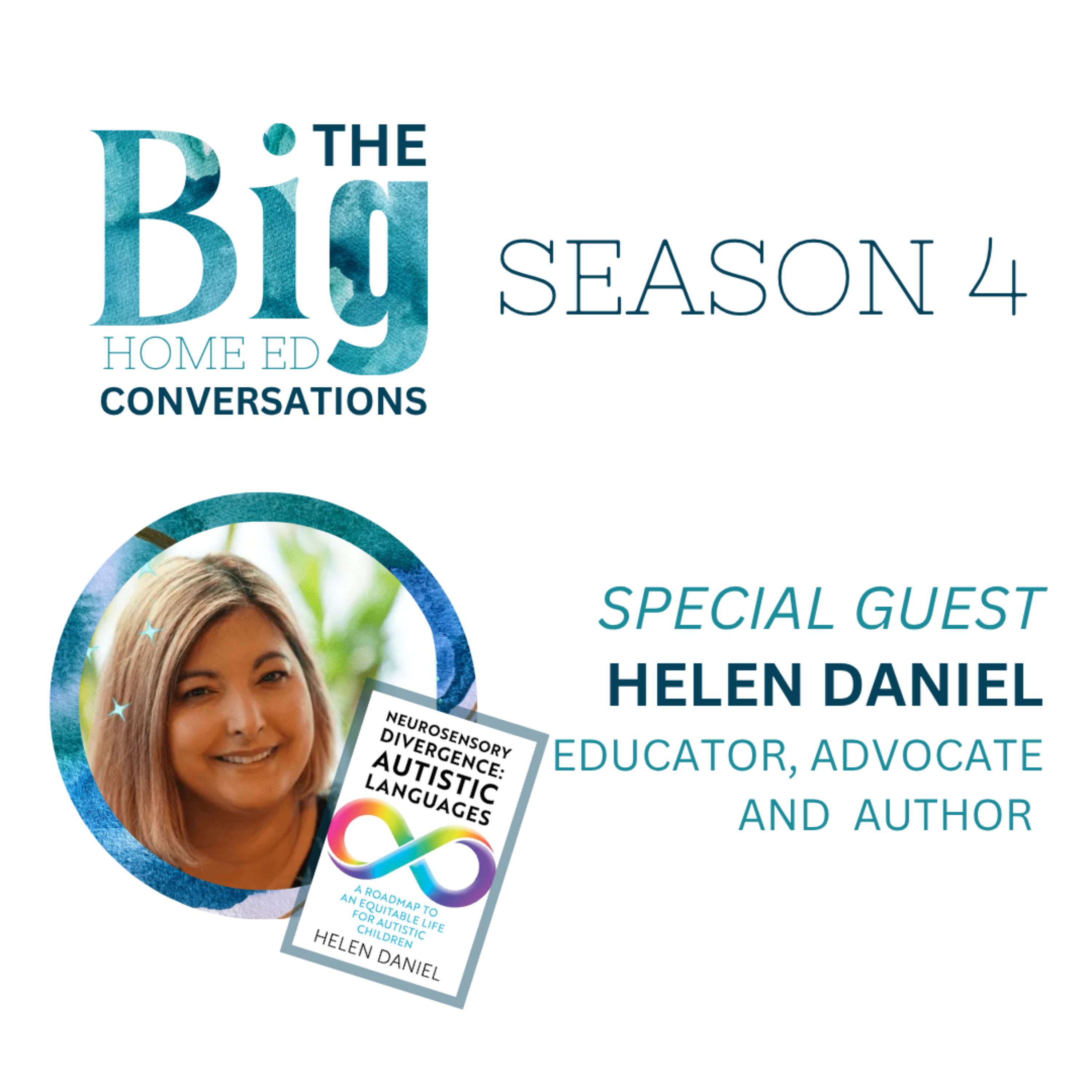
    In this powerful episode of the BIG Home Ed Conversations Podcast, Kelly and Ashley sit down with author, educator and neurodivergent advocate Helen Daniel to unpack ableism in the education system through the lens of SEND and neurodivergence. Drawing on Helen’s experience as a teacher, academic and author of Neurosensory Divergence: Autistic Languages, they explore how a system built on standardisation often fails autistic and otherwise neurodivergent children – and what more equitable, sensory-aware education could look like, both in school and in home ed. Together they dive into: How curriculum changes and raised targets (times tables, Shakespeare, early formal writing) pushed more neurodivergent children “outside the norm.” Why standardisation is the enemy of equity – and why one-size-fits-all schooling doesn’t work for diverse brains. EHCPs, SEND provision and why the system feels broken for so many families. Sensory profiles, overload and meltdowns: what’s really going on beneath “behaviour.” Practical examples of small, powerful accommodations (movement, video learning, headphones, flexible seating.) How home ed groups can unintentionally replicate ableism – and how to design more inclusive spaces. Teaching all children (ND and NT) compassion, curiosity and respect for different needs. This is a validating, eye-opening listen for: Parents of autistic, ADHD, PDA or otherwise neurodivergent children. Home educating families navigating SEND needs. Teachers who feel the system is wrong but don’t know how to change it. Any parent wanting to raise more compassionate, neuro-affirming kids. Guest Spotlight: Find Helen’s book Neurosensory Divergence: Autistic Languages in all the usual places for a deeper dive into sensory processing, autistic communication and building truly equitable lives for autistic children. Find Helen at https://outsidetheboxsensory.com/ or on social media @otbsensory. (New website coming soon though!) Join the conversation: Has this episode resonated with your family’s experience of SEND or neurodivergence? Share your stories or questions with us on Instagram or TikTok @bighomeedpodcast, or head to the blog www.offroadingmotherhood.co.uk/blog for more resources and episode notes. Keywords: SEND and ableism, neurodivergent children, autism and education, EHCPs UK, sensory needs in school, home education UK, inclusive home ed, trauma-informed education, alternative education, autistic-friendly learning, neurosensory divergence

  • Nov 9, 2025 · 1 hr 12 min

    Changing Perspectives: Prejudice within the Home Education Community

    In this episode of the BIG Home Ed Conversations Podcast, Kelly and Ashley dive deep into the often-unspoken topic of prejudice within the home educating community. From unschooling vs. curriculum-based approaches, to faith, politics, socioeconomic status, and cultural backgrounds, they unpack the subtle (and not-so-subtle) biases that can create divides among home educators. With real-life stories, honest reflections, and a healthy dose of empathy, they explore: Why different home ed methods spark debate (unschooling, project-based, curriculum-led, eclectic) How faith, politics, and culture shape our perspectives—and how to honour differences Socioeconomic barriers, privilege, and the importance of compassion over comparison The risks of judgement and the power of community support Practical tips for recognising and challenging your own biases Whether you’re a seasoned home edder or just starting out, this episode is a call to celebrate individuality, question assumptions, and create a more welcoming, diverse, and resilient home education community. Book Spotlight: This week, we’re recommending Wonder by R.J. Palacio—a moving story about difference, kindness, and the courage to stand out. It’s a brilliant way to open up conversations about prejudice, empathy, and the importance of welcoming everyone, no matter how different they may seem. Support the Podcast and the environment, get it from World of Books Now: https://tidd.ly/4i0oMg3. Join the conversation: Has this topic resonated with you? Share your experiences or questions with us on Instagram or TikTok @bighomeedpodcast, or visit our blog for more resources and episode notes. Keywords: home education UK, home ed prejudice, unschooling vs curriculum, diversity in home education, home education community, challenging bias, inclusive homeschooling, home ed support, alternative education, neurodivergent families

Showing 1–20 of 24 episodes