Skip to content
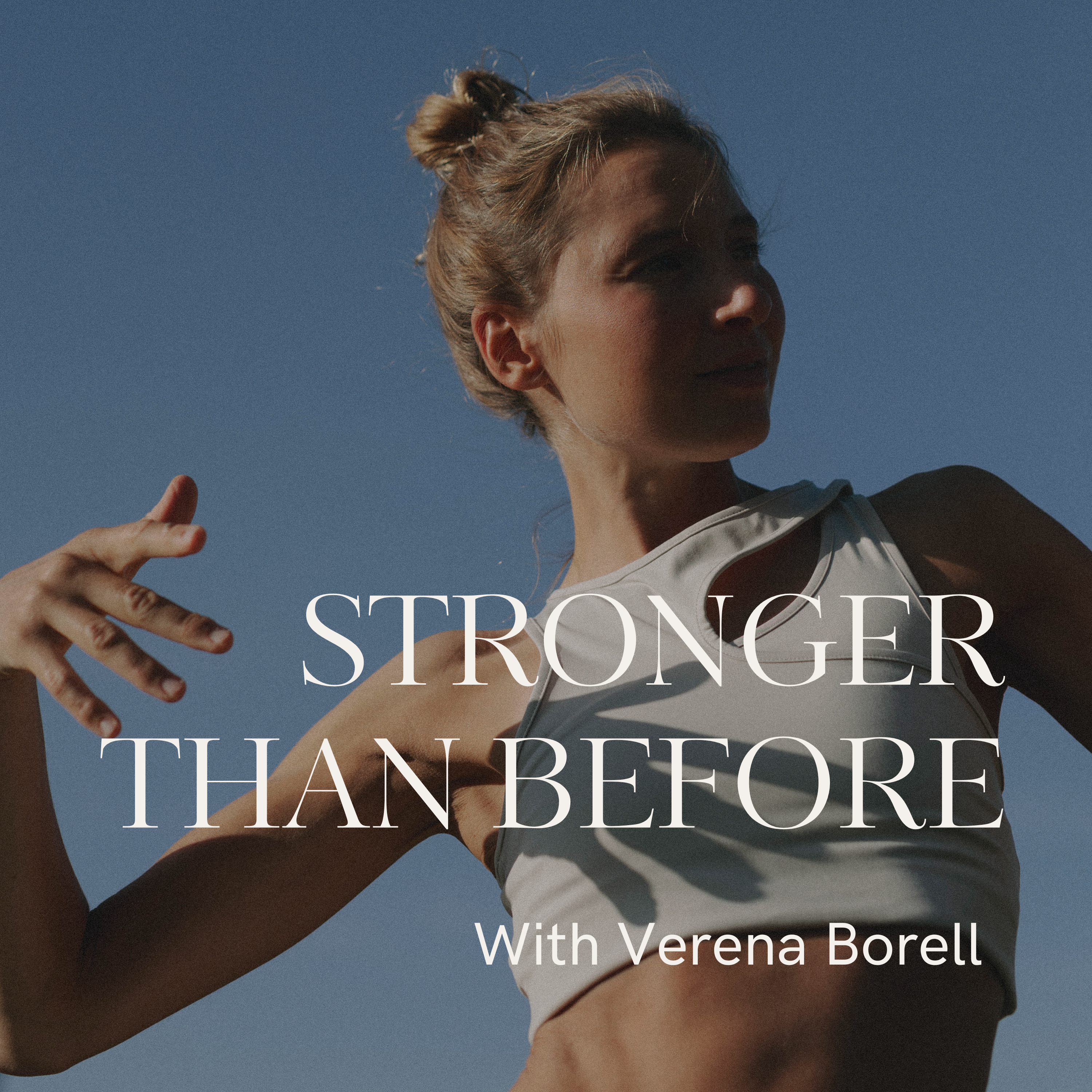
Artwork for Stronger Than Before
EducationSelf-Improvement

Stronger Than Before

Verena Borell

An honest, real, and raw podcast on strength & softness, sports & spirituality, somatic healing & weight training, and the pain & pleasure of being a soul in a body on Earth. Follow me, Verena, on my journey of healing, recovery, rebirth, build-up, and becoming stronger than before – always, at any time, and on every step in the process. We don’t shy away from talking about messy in-between-stages, health challenges, exercise addiction, burnout, identity-loss, and what it really takes to go from caterpillar to butterfly – again & again. Feel inspired, empowered, and less-alone on your path!

Play
  • 9 episodes
  • Avg 34 min
  • English
  • S1 · E9
    Thursday · 37 min

    9: Don’t function your pain away! How to listen to your symptoms without giving up your power

    My rheumatoid arthritis wants to be seen! So let’s give her some space, shall we...? In this episode, I share an honest account of living with rheumatoid arthritis alongside two horseback riding accidents and the pressure to keep functioning. I explore what it means to listen to symptoms without becoming defined by them, combining medical care with nervous system regulation, strength training, and a more compassionate relationship with my body. I also share why it is so important to stay connected with your Self and your personal power even though and especially if you feel powerless. In this episode: Why my rheumatoid arthritis wants to be seen and not injected away Why medication helped for a time but no longer seems to control the inflammation Medication as necessary support rather than the complete answer The balance between taking symptoms seriously and refusing to identify entirely as the disease My favorite holistic practices for supporting recovery “Syndromes” as complex patterns involving stress, trauma, hormones, the immune system, the brain, and nervous system Why you cannot and must not do it ALL when it comes to healing Thank you for listening to the show and for witnessing my process! My hope is that my words encourage and inspire you on your way of becoming stronger than before – always, at any time, and on every step in the process. I would love to hear from you and get to know you better. Please reach out via ⁠⁠⁠mail@verenaborell.com⁠⁠⁠! It would mean the world to me if you share the episode with a friend, leave a comment, and subscribe to the show! Let’s connect: Website: ⁠⁠⁠https://www.verenaborell.com/en⁠⁠⁠ Email: ⁠⁠⁠mail@verenaborell.com⁠⁠⁠ Newsletter: https://www.verenaborell.com/en/newsletter Timestamps 00:00 - Why I am giving rheumatoid arthritis a voice 01:54 - The beginning of the mysterious left-knee pain 03:22 - Receiving a diagnosis after months of uncertainty 04:14 - Medication, stress, trauma, and the first major flare 05:13 - How rheumatoid arthritis pain feels in everyday life 07:52 - Learning that the disease wants to be seen and witnessed 08:48 - When a previously effective medication stops helping 10:52 - Why medication is support, not the whole healing process 11:52 - The lifelong pattern of functioning no matter what 14:47 - “You cannot work me away or inject me away” 15:47 - Autoimmunity as a metaphor for fighting against oneself 16:41 - Listening to symptoms without giving them total power 19:34 - Combining medical care with somatic and nervous system support 23:15 - Preserving pleasure, movement, and agency despite limitations 24:23 - Strength training and rebuilding a sense of power 25:25 - “I’m not my rheumatoid arthritis” 26:07 - Understanding syndromes as complex symptom patterns 27:41 - Why autoimmune symptoms cannot be reduced to one cause 29:58 - What happens when stress and overwhelm never fully settle 33:02 - Listening to the message while asking the symptom to ease 36:50 - Choosing pause, support, and a fuller way of living

  • S1 · E8
    September 3 · 41 min

    8: Pushing through or flowing with life? Finding balance between too much + too little

    When is it time to push beyond your limitations, and when is it wiser to slow down and respect your boundaries? In this episode, I explore how our default nervous-system patterns, life circumstances, and physical signals can help us decide whether growth requires more resilience or more softness. Because it’s often not that easy to know if it’s time to grit your teeth, leave the comfort zone and go against the grain or if it’s part of your healing and strengthening process to flow with life, choose the easeful way, and relax. My hope is that this episode helps you better recognizing what your body, nervous system, and current phase of life are asking for. In this episode The difference between pushing through challenges and learning to feel safe while slowing down How fight-flight patterns can drive resilience, ambition, self-confidence, burnout, inflammation, and self-neglect How freeze-fawn patterns can support adaptability and conservation while also leading to procrastination, people-pleasing, and settling How “too much, too fast, too soon” can overwhelm the nervous system and contribute to trauma My recovery after two horseback-riding accidents and the lesson that courage can become recklessness Using titration and baby steps to build strength without overloading the body Why pain and physical limits deserve attention rather than shame or automatic resistance How to choose coaches, trainers, and mentors who support what your system needs now Thank you for listening to the show and for witnessing my process! My hope is that my words encourage and inspire you on your way of becoming stronger than before – always, at any time, and on every step in the process. I would love to hear from you and get to know you better. Please reach out via ⁠⁠⁠⁠mail@verenaborell.com⁠⁠⁠⁠! It would mean the world to me if you share the episode with a friend, leave a comment, and subscribe to the show! Let’s connect: Website: ⁠⁠⁠⁠https://www.verenaborell.com/en⁠⁠⁠⁠ Email: ⁠⁠⁠⁠mail@verenaborell.com⁠⁠⁠⁠ Timestamps: 00:00 - Going with the flow versus going against the grain 02:24 - Why both pushing and slowing down matter 03:18 - Finding balance during physical recovery 05:16 - How your default mode shapes growth and resilience 06:42 - Nature, nurture, conditioning, and inherited patterns 08:41 - The strengths and risks of fight-flight 12:12 - The strengths and risks of freeze-fawn 15:29 - How your needs change through different life phases 18:50 - When courage becomes recklessness 21:38 - “Too much, too fast, too soon” and trauma 23:38 - Understanding pain and respecting limits 24:59 - Procrastination, overwhelm, and nervous-system protection 27:20 - Learning to receive support by slowing down 29:37 - Titration: taking small steps toward change 31:27 - Trial and error during recovery 32:19 - Identifying and balancing your default mode 34:01 - Listening to mentors without abandoning inner knowing 35:45 - Making rest and pleasure part of recovery 37:14 - Working with the body instead of against it 38:04 - Elder Duck: following the flow 39:21 - Elder Salmon: cultivating resilience 39:45 - Why getting stronger requires both stress and resilience

  • S1 · E7
    August 26 · 38 min

    7: Clarity as key for new strength + why the struggle (inside your body-mind-soul) is real

    What if your life looks nice on the outside but your inner world and body feels like a war zone? In this episode, I take you on a ride – into my brain, soul, body, and my current life reflections. I discover the link between clarity and strength, and how my own body has been teaching me that insight can feel physical. I share honestly about chronic overwhelm, childhood depression, trauma, autoimmune illness, and my current process of understanding how these pieces connect. The episode gives you hopefully new hope for finding your personal (baby) steps to go from A to B, what (not) to do in the messy middle, and how you can hold your past and future self with more compassion, love, and (new) strength. In this episode How to sense and notice clarity in the body Reflections on my chaotic health journey and how it brought deeper misbalances in my body-soul-nervous-system to the surface Connecting the dots between singular diagnoses and challenges like ADHD/neurodivergence, high sensitivity, functional depression, trauma, hormonal imbalance, and autoimmune disease Childhood sadness, shame, and how I tried to get „control“ over my emotions, mind, and body through anorexia Growing compassion for my younger self – including the high-achieving child and the partying and drinking version of myself in my twenties Getting clarity on what is not working and allowing myself to have new visions for my future The systemic dimensions of (my) personal struggle: systems that are not made for bodies and minds that do not function like machines Why growth is ongoing, healing happens in tiny steps and rest ist also as movement Thank you for listening to the show and for witnessing my process! My hope is that my words encourage and inspire you on your way of becoming stronger than before – always, at any time, and on every step in the process. I would love to hear from you and get to know you better. Please reach out via ⁠⁠⁠mail@verenaborell.com⁠⁠⁠! It would mean the world to me if you share the episode with a friend, leave a comment, and subscribe to the show! Let’s connect: Website: ⁠⁠⁠https://www.verenaborell.com/en⁠⁠⁠ Email: ⁠⁠⁠mail@verenaborell.com⁠⁠⁠ Timestamps 00:00 - Why clarity feels like strength in the body 03:08 - A chaotic year of illness, accidents, and health revelations 05:07 - Exploring depression, trauma, ADHD tendencies, and hormones 07:31 - A lifetime of reflection and trying to understand myself 11:41 - Why my life looked fine from the outside but felt like a war zone inside 14:47 - Childhood sadness, shame, and the start of my eating disorder 16:16 - Building control through organization and coping strategies 18:14 - The autoimmune connection and the cost of overworking herself 20:43 - Compassion for my younger self and my current self 22:32 - Joy, dopamine, and the need for daily mental health hygiene 25:22 - Why office work and long computer hours go against my nature 26:54 - What is missing now: community, belonging, and embodied connection 28:32 - The tension between wanting joy and being told to toughen up 30:35 - Hope for a life that feels more natural and supported 33:17 - Somatic experiencing, baby steps, and the value of rest 35:56 - Why the problem is also systemic, not just personal 37:23 - Final encouragement: compassion for your younger self and trust in your strength

  • S1 · E6
    August 18 · 28 min

    6: Reorienting towards resilience + how my dumbbells helped me survive the weakest phase of my life

    When we work (out) with the body and not against it healing and recovery can happen! In this episode, I share how I still move(d) my body and exercised – even now, in the weakest phase of my life, while healing from horseback riding accidents, surgery, and rheumatoid arthritis. The episode focuses on how tiny, safe workouts can support physical recovery, nervous system regulation, mental health, and emotional balance when your body feels weak, injured, or overwhelmed. My hope is to give you some practical tips on working with your body instead of against it, too. Important to say: I also speak openly about the difference between healthy movement and exercise addiction, and why rest, pacing, and professional support matter. In this episode Moving my body and exercising safely during recovery without pushing through illness Practical reflection: my first home exercises after my surgery, tiny baby steps towards more strength, and finding my power within disempowerment How movement and (weight) training can help the nervous system reorient away from pain and trauma toward strength, capability, resilience, and agency My past patterns of exercise addiction and disordered eating, and how to discern between moving from genuine desire rather than compulsion How somatic experiencing and the practice of pendulation between weak/injured parts and still-strong parts of the body can support recovery and healing My gradual progress: first wheelchair use, then crutches, and now gentle cycling, yoga stretches, weight training, and more expanded workouts The value of physical therapy, trial and error, and listening to the body’s feedback Patience and the balance between pushing yourself and accepting your limits Thank you for listening to the show and for witnessing my process! My hope is that my words encourage and inspire you on your way of becoming stronger than before – always, at any time, and on every step in the process. I would love to hear from you and get to know you better. Please reach out via ⁠⁠⁠⁠mail@verenaborell.com⁠⁠⁠⁠! It would mean the world to me if you share the episode with a friend, leave a comment, and subscribe to the show! Let’s connect: Website: ⁠⁠⁠⁠https://www.verenaborell.com/en⁠⁠⁠⁠ Email: ⁠⁠⁠⁠mail@verenaborell.com⁠⁠⁠⁠ Timestamps (00:00) Opening reflection on moving during weakness and recovery (00:30) Why rest days matter and why I am not promoting daily workouts (01:26) Moving every day versus exercising through illness or fever (02:22) Hospital recovery after accidents, surgery, and rheumatoid arthritis (04:18) Returning home in a wheelchair and needing my mother’s care (05:46) First tiny home workouts in bed with dumbbells and core work (07:41) Somatic experiencing and the “unescapable attack” trauma response (08:40) Why micro-movements helped my feel more empowered (09:09) Exercise addiction versus genuine body-led movement (11:40) Reorienting toward resilient parts of the body (13:54) Recovery progress: no crutches, more exercises, and gentle cycling (16:42) The role of physical therapy (18:02) Trial and error: learning what helps and what hurts too much (19:01) Why I now work with my body instead of pushing against it (20:58) Staying in communication with the body (22:50) Knowing your tendency: underpushing versus overpushing (24:20) Holding both strength and pain without repressing either (25:16) Pendulation between weak parts and resilient parts of the self (26:05) Current workout progress and what I am training now

  • S1 · E5
    August 16 · 27 min

    5: Body (dis)trust, healing, and how to stop micromanaging the body

    Your body still knows how to heal and become stronger, even after trauma. – In this episode, I share a vulnerable update on my health journey and the emotional and somatic work of rebuilding trust with my body after major injuries, surgery, and chronic pain. I explore why healing is not just physical but also somatic, emotional, and relational, and why I am learning to trust my body’s pace instead of controlling every step. I reflect on resilience, nervous system safety, and what it means to embody the belief that the body wants to heal. If you sometimes struggle to really and deeply trust your body and your natural ability to heal, this episode is for you. In this episode: How my body trust has been challenged by a series of health events, surgeries, and accidents Why repeated injuries to the same party of my body created fear, hypervigilance, and a sense of unpredictability in my nervous system The emotional layers underneath physical recovery, including grief, shame, self-blame, and frustration about past choices and health patterns The belief that the body is built for healing, balance, vitality, and regeneration, and has a natural repair intelligence Somatic practices that can help holding mistrust and trust, fear and hope Why healing cannot be forced how to support the body without micromanaging it Thank you for listening to the show and for witnessing my process! My hope is that my words encourage and inspire you on your way of becoming stronger than before – always, at any time, and on every step in the process. I would love to hear from you and get to know you better. Please reach out via ⁠⁠⁠mail@verenaborell.com⁠⁠⁠! It would mean the world to me if you share the episode with a friend, leave a comment, and subscribe to the show! Let’s connect: Website: ⁠⁠⁠https://www.verenaborell.com/en⁠⁠⁠ Email: ⁠⁠⁠mail@verenaborell.com⁠⁠⁠ Timestamps 00:00 - Opening reflection on body trust 02:12 - My story with rheumatoid arthritis 04:36 - The horseback riding accident that changed everything 05:29 - Slow recovery, then a brief period of hope 06:55 - A second horseback riding accident and renewed trauma 10:26 - How these events exposed deeper layers of bodily fear 11:37 - Working with somatic experiencing and noticing the split between fear and trust 12:29 - Shame, self-blame, and the history behind body distrust 14:29 - Why I belief the body wants to heal and return to balance 16:06 - Wounds, skin repair, and the “magic” of regeneration 18:43 - The lesson of not running away from discomfort 19:19 - Fear that healing may never be finished 25:22 - Choosing to trust the body’s natural pace and ability to heal

  • S1 · E4
    August 14 · 33 min

    4: The dangerous line between self-identity and self-worth

    Allowing yourself to change is the only way to stay true to yourself. – In this episode, I reflect on self-identification, identity shifts, and what happens when the version of yourself you have built your life around is disrupted by burnout, illness, and major life changes. As always, I connect my personal experience with a broader point: identity can be empowering and helps you grow, but when it becomes too rigid, it can also become a source of fear, pressure, and loss. I share how athletic identity, business identity, and being the productive one can become tied to self-worth, meaning of life, and nervous system safety. This episode is a personal reflection on learning to hold identity more lightly, while still honoring the parts of yourself that matter. In this episode: My strong identification as a sporty, strong, Type A person and why that felt useful and authentic for long periods of my life How my first burnout in 2018/19 and a major health crisis reshaped my understanding of self-worth Why self-identification can help you to reach your goals and implement healthy habits Why attaching your self-worth too tightly to your identity can become dangerous when life changes or that role disappears The connection between identity attachment and nervous system safety + why mindset work alone has its limits The idea that identity should be flexible, so it can evolve when family roles, health, work, or life stage changes At the end I guide you into a somatic reflection to notice what you identify with and whether those identities are supporting you or limiting you. Thank you for listening to the show and for witnessing my process! My hope is that my words encourage and inspire you on your way of becoming stronger than before – always, at any time, and on every step in the process. I would love to hear from you and get to know you better. Please reach out via ⁠⁠⁠mail@verenaborell.com⁠⁠⁠! It would mean the world to me if you share the episode with a friend, leave a comment, and subscribe to the show! Let’s connect: Website: ⁠⁠⁠https://www.verenaborell.com/en⁠⁠⁠ Email: ⁠⁠⁠mail@verenaborell.com⁠⁠⁠ Timestamps 00:00 - Returning after a two week recording gap and publishing the episode 02:07 - Why this episode is about self-identification and why it can empower or disempower you 03:19 - Early identity as the sporty, Type A version of myself 03:55 - Burnout in 2019 and the first crack in the "machine, not a body" mindset 05:04 - Health crisis and rheumatoid arthritis diagnosis 06:54 - Identity can feel magical when it helps you become who you want to be 07:15 - The difference between casually exercising and claiming "I am an athlete" 10:32 - How business owner identity created strength and self-understanding 11:45 - The danger of making your business the center of your entire self-worth 13:20 - Why losing physical capacity can create a true identity crisis 14:59 - When security, nervous system safety, and self-worth get attached to one role 17:08 - Learning to feel safe even without the old version of myself 18:19 - How identity attachment can become toxic when it limits growth 19:55 - Why mindset work is not enough without nervous system work 22:28 - Productivity, self-worth, and creativity as a collective theme 26:25 - Learning to stay aware of what you identify with 28:42 - Letting old identities fall away so new ones can emerge 30:32 - Trusting that a new version of you will come together when life burns down an old one 32:30 - Looking ahead to becoming active again and coming back stronger than before

  • S1 · E3
    August 7 · 55 min

    3: Why I stopped treating my body like a machine

    How (dis)embodied can you become and how does this influence your health, your wellbeing, your relationships, and your joy of life? In this episode, I reflect on my so far 39 years long journey of (dis)embodiment which feels as personal and intimate as collective and relatable. I talk about what it means to live in a body, especially when that body has carried illness, burnout, eating disorder recovery, and chronic pain. I trace my relationship with performance, control, sensitivity, and healing, and explain why this podcast exists as part reflection, part therapeutic process, and part invitation to others who feel similarly. I share my story moving from childhood and school pressure to anorexia, overwork, alcohol use, burnout, and finally toward somatic healing and a slower, more embodied life. The central thread is simple but powerful: healing is not just mindset work, but learning to listen to the body. In this episode: How childhood pressure, performance, and perfectionism shaped a disconnection from rest, needs, and self-trust. The lasting impact of anorexia, chronic pain, burnout, and pushing through physical warning signs. Why exercise, achievement, and even spiritual practice can become another way to disconnect from the body. Moving from survival mode toward a more somatic, nervous-system-aware approach to healing. The role of sensitivity, neurodivergence, and overwhelm in my relationship with work, alcohol, and rest. Returning to nature, softness, nourishment, boundaries, and a slower pace of life. How somatic healing has supported my deeper relationship with the body, emotions, and personal needs. Rheumatoid arthritis and injuries as an invitation to listen more closely and care more fully for myself. A hopeful commitment to becoming stronger—not through performance, but through compassion, presence, and respect for the body. Thank you for listening to the show and for witnessing my process! My hope is that my words encourage and inspire you on your way of becoming stronger than before – always, at any time, and on every step in the process. I would love to hear from you and get to know you better. Please reach out via ⁠⁠mail@verenaborell.com⁠⁠! It would mean the world to me if you share the episode with a friend, leave a comment, and subscribe to the show! Let’s connect: Website: ⁠⁠https://www.verenaborell.com/en⁠⁠ Email: ⁠⁠mail@verenaborell.com⁠⁠ Timestamps (00:00) Why this podcast exists as an audio journal (03:13) Early health struggles and the rheumatoid arthritis diagnosis (04:36) Society’s habit of treating bodies like machines (06:24) Childhood temperament, astrology, and being naturally embodied (08:55) Her father’s trauma and its impact on the family system (11:19) Feeling seen only for performance and school success (14:42) Creativity, care, and the love her mother gave her (15:10) Anorexia at 14 and the drive to live from the mind (16:35) Control, intellect, and the body as something to manage (19:25) The mysterious foot and knee pain that changed everything (23:16) College, Starbucks, partying, and using the body as a tool and a machine (26:06) Internships, journalism, and high-output work culture (28:03) Alcohol, relaxation, and being unable to truly switch off (29:30) Neurodivergence, ADHD, sensitivity, and overwhelm (32:16) The social conditioning that rewards overwork, especially for women (37:18) Burnout, losing meaning, and finally stopping (38:15) Returning to yoga, philosophy, and spirituality (41:13) Astrology as a tool for understanding and seeing my patterns, then and now (45:28) Moving to Austria and realizing stress followed me (47:29) Therapy helps, but the nervous system still needs attention (48:41) The turning point: listen to your body, listen to Earth (49:15) Somatic healing, rest, and rebuilding from the body up (52:15) Learning to care for myself more fully, especially with illness (54:06) My hope to get stronger, healthier, and more embodied than before

  • S1 · E2
    August 7 · 23 min

    2: You are always stronger than before – even and especially in your weakest moments

    In this raw and deeply personal episode, I reflect on what it means to become stronger—not despite vulnerability, but through it. After two traumatic horseback-riding accidents, a rheumatoid arthritis diagnosis, and a season of forced rest, I share how physical weakness has opened a profound space for spiritual, emotional, and inner growth. I explore the difference between meaningful reflection and spiritual bypassing, making room for pain without needing to explain it away. I also speak candidly about my past with anorexia, my relationship with movement and nourishment, and the realization that constant intensity is not the same as true strength. This is an invitation to soften, rest, ask for help, and honor the seasons when growth happens quietly beneath the surface. In this episode: Why “stronger than before” feels like a new chapter Finding strength while feeling vulnerable and dependent Living through pain without forcing a meaning onto it The healing power of rest, recovery, and slowing down Releasing the pressure to earn food or rest through exercise Redefining strength beyond productivity, cardio, and pushing through A reflection on how life’s difficult seasons can shape us Thank you for listening to the show and for witnessing my process! My hope is that my words encourage and inspire you on your way of becoming stronger than before – always, at any time, and on every step in the process. I would love to hear from you and get to know you better. Please reach out via ⁠mail@verenaborell.com⁠! It would mean the world to me if you share the episode with a friend, leave a comment, and subscribe to the show! Let’s connect: Website: ⁠https://www.verenaborell.com/en⁠ Email: ⁠mail@verenaborell.com⁠

  • S1 · E1
    July 29 · 24 min

    1: Spiritual and sporty...? How to embrace every facet of yourself

    In the first episode of my new podcast, I explore the journey of embracing every facet of yourself — from spirituality to physical health, and from vulnerability to strength. When I recorded the episode, I wanted to call the podcast „Spiritual & Sporty“ (which turned out to be not the name of the show!) so I also talk about my inner conflicts between my spiritual self and my sporty self and why I sometimes struggle to feel like I belong–in the gym, on the mat, and in spiritual circles. Get ready for raw reflections on my past struggles with burnout, exercise addiction, and physical injuries, and I talk about the importance of reconnecting with the body’s wisdom and embracing softness alongside strength. Hear more about… The importance of accepting and exploring all parts of yourself, including softness and vulnerability The healing power of reconnecting with the body, spiritual rituals, somatic practices, and physical exercises My (current and future) transformation from being the “strong one” to a more balanced, gentle kind of strength How trauma and emotional health influence physical well-being, including autoimmune conditions The role of spirituality, astrology, and somatic work in my self-discovery Thank you for listening to the show and for witnessing my process! My hope is that my words encourage and inspire you on your way of becoming stronger than before – always, at any time, and on every step in the process. I would love to hear from you and get to know you better. Please reach out via mail@verenaborell.com! It would mean the world to me if you share the episode with a friend, leave a comment, and subscribe to the show! Let’s connect: Website: https://www.verenaborell.com/en Email: mail@verenaborell.com Timestamps: 00:00 - Introduction: embracing a new journey of self-expression and exploration 00:30 - My perspective as an explorer, not an expert 01:03 - Being in a human body as a soul, with all its pain and pleasure 01:42 - Facing the heaviness of physical existence and past ways to dissociate 02:12 - Past struggles: eating disorders, alcohol, adrenaline, and survival habits 03:26 - Exercise addiction and its impact on health 04:21 - Creating a space to live all facets of identity, including spirituality and physical strength 05:19 - Balancing spirituality with physical practices like working out 06:44 - Honoring injuries and what it means to be strong and soft 07:54 - The desire to explore the body deeper, especially in relation to health 08:25 - Reflecting on past burnout and unhealthy lifestyle choices 09:10 - Rediscovery of spirituality 10:38 - Moving into the body and embracing a full-body-yes-life 12:07 - Learning to feel and live in the lower chakras and trauma healing 12:36 - The call to explore the body through pain, including rheumatoid arthritis 14:55 - Physical injuries from horseback riding and their deeper spiritual significance 16:52 - Releasing the image of being always strong and embracing vulnerability 18:01 - The ongoing process of transformation and the goo phase of growth 19:18 - Redefining strength as something internal, soft, and accessible 20:15 - Asking for help, honoring needs, and allowing oneself to be vulnerable 22:13 - Future plans: rebuilding strength, healthy training, and balancing the body, mind, and spirit 23:28 - Closing thoughts: embracing the journey, ongoing healing, and gratitude

Showing 1–9 of 9 episodes