Skip to content
Artwork for Statecraft
NewsPoliticsSociety & CultureDocumentary

Statecraft

Santi Ruiz

Statecraft is an interview series about how policy actually gets made.

www.statecraft.pub
Play
  • 24 episodes
  • Avg 1 hr 4 min
  • English
Counted on this page — what you have heard stays on this device, so it is not something the list can be paged by.
  • November 12 · 44 min

    The Office of Extraordinary Innovation

    In 2015, LA Metro’s new CEO, Phil Washington, created the Office of Extraordinary Innovation. To run it, he brought in an outsider from DC: Joshua Schank. Schank's office had some notable successes and notable failures: he wrote them all up with two colleagues in New Tricks for Old Bureaucracies: Improving Policy Outcomes in the Public Sector, an unusually candid account of what worked and what didn’t. The full transcript for this episode is available at www.statecraft.pub. This is a public episode. If you would like to discuss this with other subscribers or get access to bonus episodes, visit www.statecraft.pub

    • Transcript
  • November 10 · 41 min

    How Kristi Noem Lost DHS

    Anna Giaritelli has covered immigration and the border for the Washington Examiner since 2018. In the last two years, I’ve found her reporting invaluable for understanding the Department of Homeland Security, including the campaign by Kristi Noem and Corey Lewandowski to push out the head of Customs and Border Protection, the border wall contracts stuck on Noem’s desks, and more. We taped a week before the midterm elections. As a reminder, the full transcript is available at www.statecraft.pub. This is a public episode. If you would like to discuss this with other subscribers or get access to bonus episodes, visit www.statecraft.pub
    • Transcript
  • October 30 · 1 hr 7 min

    How to Give Money + Should You Quit Your Job?

    AI could bring a huge windfall to American philanthropy. Caleb Watney wants to make sure that money is spent well. Caleb is Coefficient Giving's first managing director of public policy, and also my old boss. We talk about his essay “A Long Sequence of Small, Correct Decisions,” how to be effective in DC, and whether you, dear listener, should quit your job. I have a wonderful co-host for this episode: Leah Sargeant, my successor as IFP’s editorial director and Statecraft superfan. As always, the full transcript for this conversation, with links, is available at www.statecraft.pub. This is a public episode. If you would like to discuss this with other subscribers or get access to bonus episodes, visit www.statecraft.pub
    • Transcript
  • September 29 · 57 min

    How to Build a Policy School

    My guest today is Will Howell, the inaugural dean of the School of Government & Policy at Johns Hopkins, which welcomes its first class in fall 2028. His argument is that the standard policy masters degree is no longer fit for purpose. I happen to agree. Two disclaimers: I took Will’s class as an undergraduate at the University of Chicago, and I’m a Journalist-in-Residence at his school now. Thanks to Harry Fletcher-Wood and Shadrach Strehle for their support in producing this episode. This is a public episode. If you would like to discuss this with other subscribers or get access to bonus episodes, visit www.statecraft.pub

    • Transcript
  • September 10 · 1 hr 21 min

    How to Build an Authoritarian Regime

    A while back, Edward Luttwak explained to us how to stage a coup. Julian Waller focuses on the next step: how authoritarian regimes are built and maintained. We discuss: * Authoritarian regimes as the historical norm * Why military juntas don’t last and party states do * Autocracies: Iran, North Korea, and the Papacy * How the Kremlin has reacted to the Wagner mutiny * What a “pacted transition” looks like in Venezuela * Why the US shouldn’t worry about authoritarianism This is a public episode. If you would like to discuss this with other subscribers or get access to bonus episodes, visit www.statecraft.pub

    • Transcript
  • July 30 · 1 hr 3 min

    The James C. Scott Memorial Episode

    Today, my guest is writer, thinker, and friend Dan Wang. He was on Statecraft a year ago, but this time, we're talking about a scholar who has shaped both of our thinking: the late great James C. Scott, author of (among many other classics) Seeing Like a State. We discuss: * How Scott’s fieldwork helped him understand peasant life and state capacity * How mountains impede state power, in Southeast Asia and the USA * How peasants and civil servants resist authority * The advantages of tubers over rice * Dan’s guiding principles for a career in an era of large language models For the full transcript of this conversation, go to www.statecraft.pub. This is a public episode. If you would like to discuss this with other subscribers or get access to bonus episodes, visit www.statecraft.pub

    • Transcript
  • June 17 · 45 min

    Merit vs. Tenure: Reforming Federal Firing

    Today we have a special repeat guest, Scott Kupor, Director of the Office of Personnel Management (OPM). The OPM is the people function in the federal government — the department that sets the rules for the various HR departments in other agencies. Director Kupor was on Statecraft six months ago, and is now a little more seasoned in the federal government. We discuss: * How veterans’ preference works in federal hiring * Who gets fired first when an agency conducts a Reduction In Force (RIF) * Proposed changes to prioritize performance during RIFs * Kupor’s progress in recruiting early career and tech talent to government The full transcript for this conversation is at www.statecraft.pub This is a public episode. If you would like to discuss this with other subscribers or get access to bonus episodes, visit www.statecraft.pub
    • Transcript
  • June 12 · 58 min

    "The Strongman Presidency"

    On today’s episode, we’re continuing a conversation about presidential power that we broached a couple of weeks ago on Statecraft in an essay called, “What Trump Can Learn From Nixon.” It was about the attempts, in Richard Nixon‘s one and a half presidential terms, to build what observers called the “administrative presidency” — the presidency that actually fully controlled the administrative state. My guests today have thought very deeply about presidential attempts to control the administrative state. William Howell and Terry Moe are co-authors of a book called, Trajectory of Power: The Rise of the Strongman Presidency. They’re both political scientists. Terry is a professor of political science at Stanford, and senior fellow at the Hoover Institution. Will is the Dean of the School of Government and Policy at Johns Hopkins University. We discuss: * Why most federal employees in the 1800s were mailmen, and what changed * How presidents have tried to control the administrative state * Whether Republicans have used presidential power to rein in agencies they object to * Whether the Supreme Court has been a firewall against Trump For the full transcript of this conversation, go to www.statecraft.pub. This is a public episode. If you would like to discuss this with other subscribers or get access to bonus episodes, visit www.statecraft.pub
    • Transcript
  • March 12 · 58 min

    How the National Security Strategy Gets Made

    In the last six months, we’ve been covering big strategic documents published by the executive branch. We’ve interviewed Dean Ball, the principal author of the Trump administration’s AI Action Plan. We’ve also spoken with Judd Devermont, who authored the Biden administration’s Strategy Toward Sub-Saharan Africa. We’re continuing the trend today, but at a higher strategic register. I’m joined by Nadia Schadlow, the former Deputy National Security Advisor for Strategy in the first Trump administration and lead architect of the 2017 National Security Strategy. Currently, Nadia is a senior fellow at the Hudson Institute where she focuses on strategy, national security, and industrial policy. We discuss: * The process of drafting the National Security Strategy * The differences between the 2017 and 2025 strategies * Why time is an underappreciated element of strategy * What to read to understand Russia better For the full transcript of this conversation, go to www.statecraft.pub. This is a public episode. If you would like to discuss this with other subscribers or get access to bonus episodes, visit www.statecraft.pub
  • March 5 · 13 min

    Ten Thoughts on Government Data

    Government data often underpins policy debates. Nevertheless, those who work with it will know how uniquely frustrating it can be. Relative to the private sector, government systems collect data in idiosyncratic ways. They prioritize continuity and legality over ease-of-use, in anticipation of a narrow set of users. As a result, these datasets can feel impenetrable. In October 2024, I was trying to understand how international students enter the US workforce: where they move for work, how many of them use programs like Optional Practical Training, and whether they stay in the US after graduating. So, I opened up a dataset from the Department of Homeland Security’s Student and Exchange Visitor Information System (SEVIS). Today this data is available on the OPT Observatory; it’s the most granular public resource available to answer these questions. But it took me over a year to produce. The process of getting there taught me as much about government data as it did anything else. For the full transcript of this conversation, go to www.statecraft.pub. This is a public episode. If you would like to discuss this with other subscribers or get access to bonus episodes, visit www.statecraft.pub
  • February 26 · 1 hr 15 min

    When FAFSA Broke, They Called This Guy

    Jeremy Singer is the President of College Board, which he has led for over a decade. In that role, he oversees the SAT, AP, and other core elements of the U.S. college access ecosystem, and he’s previously had leadership roles at Kaplan and McGraw Hill Education. Why is Jeremy on Statecraft today? After the failed redesign of FAFSA in 2023, he spent six months at the Department of Education helping to ensure the 2024 launch was successful. The revised application form meant 1.7 million students were eligible for maximum Pell Grants in the 2025-26 application cycle. We discuss: * Why attempts to simplify FAFSA went so badly wrong * The problems caused by precise drafting in Congress * How Singer got FAFSA back on track * What politicians and GAO don’t understand about developing software The full transcript for this conversation is at www.statecraft.pub. This is a public episode. If you would like to discuss this with other subscribers or get access to bonus episodes, visit www.statecraft.pub

  • February 19 · 1 hr 9 min

    How a Congressional Office Actually Works

    Baillee Brown is Head of Government and External Affairs at Inclusive Abundance, which works to help members of Congress get more interested in abundance-policy areas, principally housing, energy, science, innovation, and good governance. She worked on Capitol Hill for 10 years, for Congressman Scott Peters from San Diego. She began as scheduler, moved to the legislative team, and was most recently his chief of staff in the DC office. For the full transcript of this conversation, go to www.statecraft.pub. This is a public episode. If you would like to discuss this with other subscribers or get access to bonus episodes, visit www.statecraft.pub

    • Transcript
  • February 13 · 1 hr 1 min

    How to Rewire City Hall

    James Anderson leads the Government Innovation Program at Bloomberg Philanthropies, the umbrella for the charitable giving of billionaire and former three-term New York City Mayor Michael Bloomberg. He was Mayor Bloomberg’s communications director, leading on the design of NYC Service and on public engagement for a number of Bloomberg reforms. James has paid more attention than almost anyone to how cities work, and how they learn from each other. But is the Bloomberg model for making cities better “technocratic”? What can it do, and what can’t it do? And should mayors be “innovative”? Or are the best practices, at the end of the day, pretty straightforward? We get into these questions and more. Read this conversation transcript at www.statecraft.pub. This is a public episode. If you would like to discuss this with other subscribers or get access to bonus episodes, visit www.statecraft.pub

  • February 4 · 1 hr 26 min

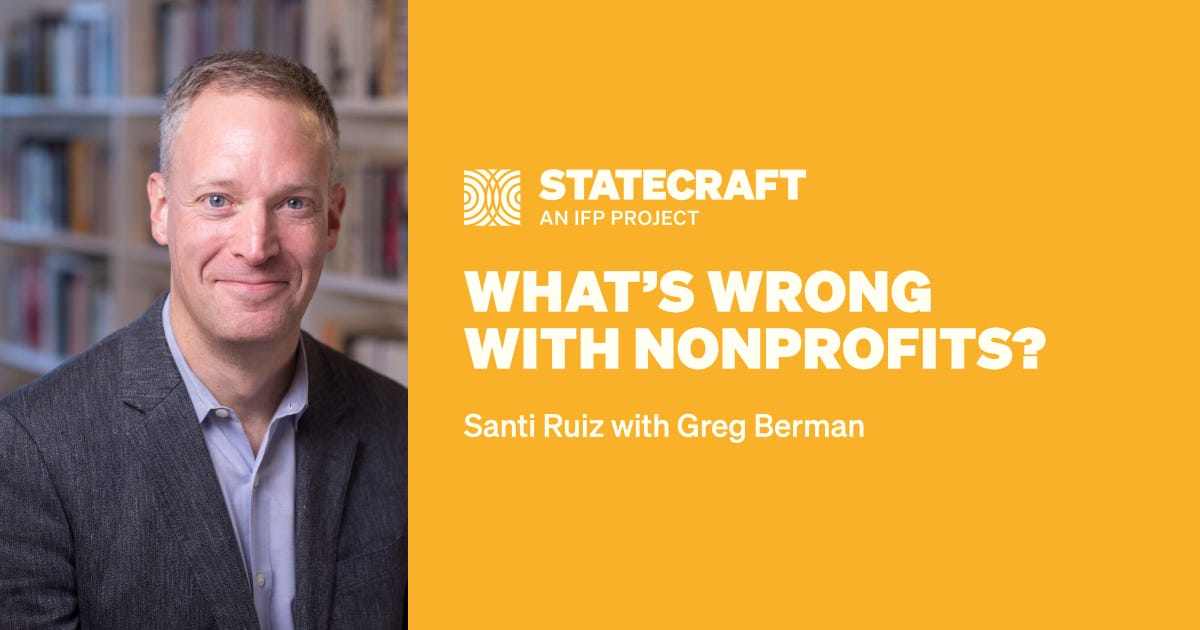
    What’s Wrong with Nonprofits?

    Today’s guest is Greg Berman, and we talk about nonprofits — Non-Governmental Organizations, or NGOs. Greg’s got a new book out called The Nonprofit Crisis: Leadership Through the Culture Wars, which I enjoyed. I asked him to explain his diagnosis of the nonprofit sector. What’s happened to nonprofits this century? What’s happened to how people perceive nonprofits? And are “NGOs the bad guys”? As critics from both ends of the political spectrum will argue. Greg was part of the founding team responsible for creating the Center for Justice Innovation, serving as Director from 2002 to 2020, and helping to guide it from a start-up to an org with an annual budget of more than $80 million. Alongside that, he: * Has written multiple books, mostly on reducing mass incarceration, including Trial and Error in Criminal Justice Reform and Good Courts: The Case for Problem-Solving Justice. * Has been at the center of left-liberal attempts to do criminal justice reform, especially in New York City, over the past two decades. * Was on the Board of Correction for Mayor Michael Bloomberg, and the public safety transition team for Mayor Bill de Blasio and Manhattan District Attorney Cy Vance. * Is the co-editor of a publication called Vital City, which I enjoy — it’s one part New York journalism, one part policy journal. * Is the Distinguished Fellow of Practice at the Harry Frank Guggenheim Foundation, investigating various topics related to violence. Thanks to Charles Lehman, Sean Sullivan, Oliver Traldi, Park MacDougald, Rafa Mangual, Ari Schulman, and many others for their contributions to my thinking on this piece. We discuss: * Why nonprofits matter to government service delivery * Critiques of nonprofits from the left, the right, and both sides * How the Center for Justice Innovation reduced incarceration, and why funding that work got harder * What nonprofits should do to regain public trust The full transcript for this conversation is at www.statecraft.pub. This is a public episode. If you would like to discuss this with other subscribers or get access to bonus episodes, visit www.statecraft.pub
  • January 27 · 1 hr 32 min

    One Year of Trump’s Economic Statecraft

    When I got this episode on the calendar a month ago, my vision was, “Let’s get three of the smartest, most thoughtful liberals I can find on the topic of economic statecraft, and we’ll do a full assessment of the first year of Trump’s second term.” The idea was to take each of the domains — tariffs and the trade war, export controls, industrial policy — and do two things: get an accurate picture of what’s actually happened, and hear how Biden admin insiders and Democratic thinkers see them. Where are there continuities between administrations? Where have their expectations been overturned? And what lessons are they incorporating into their own worldviews? Then, in a totally novel example of economic statecraft, we grabbed Maduro and seized Venezuelan oil; we had to discuss that too. As a result, we’re doing a lot in this episode, and we leave some important questions out: the legal challenges to the current tariff regime, for example. But I think readers will come away from this episode with a clear view of the old and new tools of US policy in the realm of economic statecraft. Our guests Daleep Singh is an economist who served in two separate periods in the Biden Administration as Deputy National Security Advisor for International Economics. Peter Harrell served as Senior Director for International Economics at the White House, jointly appointed to the National Security Council and the National Economic Council. My colleague, Arnab Datta is Director of Policy Implementation at IFP. He’s also the Managing Director of Policy Implementation at Employ America. We cover a lot of ground in this episode. Here’s our table of contents: We discuss * What is economic statecraft? * Venezuela * China and tariffs * Trade deals * Industrial policy * Lessons learned The full transcript for this conversation is at www.statecraft.pub This is a public episode. If you would like to discuss this with other subscribers or get access to bonus episodes, visit www.statecraft.pub
  • January 9 · 1 hr 11 min

    What’s Wrong with NIH Grants?

    Mike Lauer is the former Deputy Director for Extramural Research at the National Institutes of Health. A cardiologist and researcher, he joined the NIH’s National Heart, Lung, and Blood Institute in 2007 as the Director of the Division of Prevention and Population Science. From 2015, he oversaw the NIH’s $32 billion funding program for external research. Since leaving NIH in 2025, he has become an outspoken advocate for fundamental reform in how the federal government supports biomedical research. We discuss: * Why the NIH used to fund 60% of grant applications — and now funds just 10% * How “soft money” forces researchers to fund their own salaries * How distributing lots of small grants wastes everyone’s time * How block grants could fund more breakthrough science * Why researchers don’t get their first independent award until their mid-40s The full transcript for this conversation is at www.statecraft.pub This is a public episode. If you would like to discuss this with other subscribers or get access to bonus episodes, visit www.statecraft.pub
  • Dec 16, 2025 · 1 hr 2 min

    99.8% of Federal Employees Get Good Performance Reviews. Why?

    Today we’re joined by Scott Kupor, Director of the Office of Personnel Management. I think of it as the federal HR department — he makes a compelling case that it’s really the government’s talent management organization. Scott manages talent for an organization of 2+ million people with a $7 trillion budget. We discuss: * How DOGE cut federal headcount — and what comes next? * Why agencies rehired employees they had just laid off * How few federal employees get fired for poor performance * What OPM can do without congressional help For the full transcript of this conversation, go to www.statecraft.pub. This is a public episode. If you would like to discuss this with other subscribers or get access to bonus episodes, visit www.statecraft.pub
  • Dec 12, 2025 · 1 hr 35 min

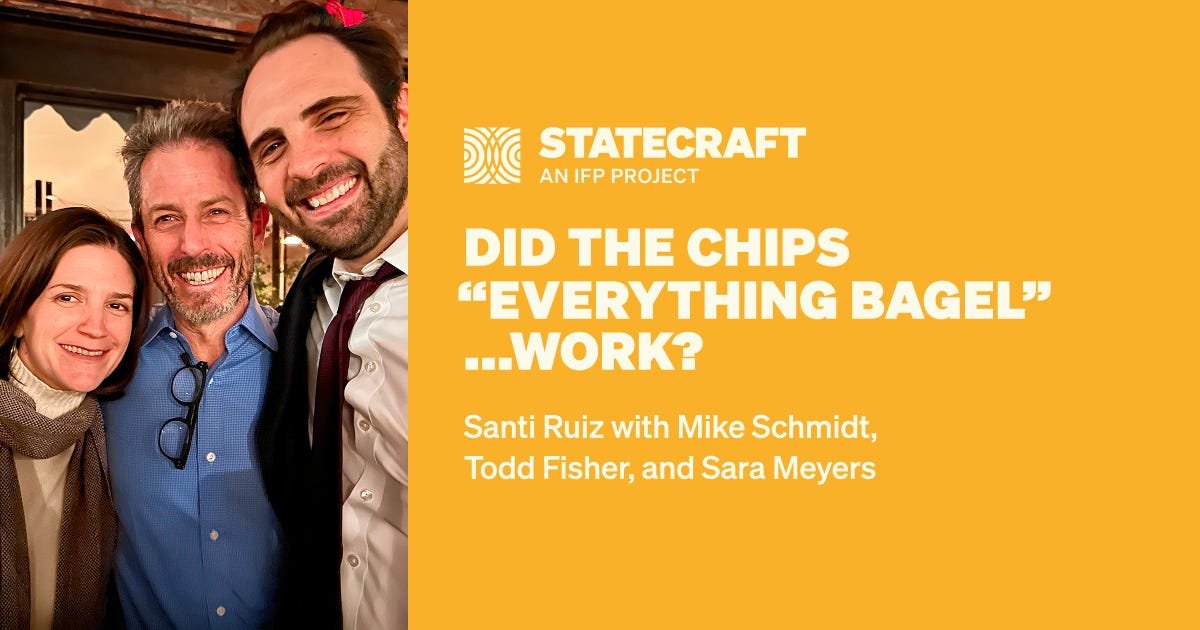
    Did the CHIPS "Everything Bagel"...Work?

    CHIPS, the Creating Helpful Incentives to Produce Semiconductors Act, is another. It spurred a massive investment boom in semiconductors on American soil, led by the CHIPS Program Office (CPO) at the Department of Commerce. The CPO had to decide how to allocate $39 billion in manufacturing incentives—and then negotiate the details with some of the world's biggest companies. Today, I’m lucky to have on three of the founding members of the CHIPS Program Office team: * Mike Schmidt, the inaugural Director, * Todd Fisher, the Chief Investment Officer, and * Sara Meyers, Chief of Staff and Chief Operating Officer. Mike, Todd, and Sara have a clear sense of what went right for them, what went wrong, and what they’d do differently the next time. In a new project for IFP called Factory Settings, they describe what they learned. The full transcript for this conversation is at www.statecraft.pub. This is a public episode. If you would like to discuss this with other subscribers or get access to bonus episodes, visit www.statecraft.pub

  • Dec 4, 2025 · 1 hr

    How to Save Science Funding

     If you’re a scientist, and you apply for federal research funding, you’ll ask for a specific dollar amount. Let’s say you’re asking for a million-dollar grant. Your grant covers the direct costs, things like the salaries of the researchers that you’re paying. If you get that grant, your university might get an extra $500,000. That money is called “indirect costs,” but think of it as overhead: that money goes to lab space, to shared equipment, and so on. This is the system we’ve used to fund American research infrastructure for more than 60 years. But earlier this year, the Trump administration proposed capping these payments at just 15% of direct costs, way lower than current indirect cost rates. There are legal questions about whether the admin can do that. But if it does, it would force universities to fundamentally rethink how they do science. The indirect costs system is pretty opaque from the outside. Is the admin right to try and slash these indirect costs? Where does all that money go? And if we want to change how we fund research overhead, what are the alternatives? How do you design a research system to incentivize the research you actually wanna see in the world? I’m joined today by Pierre Azoulay from MIT Sloan and Dan Gross from Duke’s Fuqua School of Business. Together with Bhaven Sampat at Johns Hopkins, they conducted the first comprehensive empirical study of how indirect costs actually work. Earlier this year, I worked with them to write up that study as a more accessible policy brief for IFP. They’ve assembled data on over 350 research institutions, and they found some striking results. While negotiated rates often exceed 50-60%, universities actually receive much less, due to built-in caps and exclusions. Moreover, the institutions that would be hit hardest by proposed cuts are those whose research most often leads to new drugs and commercial breakthroughs. Thanks to Katerina Barton, Harry Fletcher-Wood, and Inder Lohla for their help with this episode, to Matt Esche and Caleb Watney for their work on the graphs, and to Beez for her help translating this topic to a general audience. For a printable PDF of this interview, click here: Let’s say I’m a researcher at a university and I apply for a federal grant. I’m looking at cancer cells in mice. It will cost me $1 million to do that research — to pay grad students, to buy mice and test tubes. I apply for a grant from the National Institutes of Health, or NIH. Where do indirect costs come in? Dan Gross: Research generally incurs two categories of costs, much as business operations do. * Direct or variable costs are typically project-specific; they include salaries and consumable supplies. * Indirect or fixed costs are not as easily assigned to any particular project. [They include] things like lab space, data and computing resources, biosecurity, keeping the lights on and the buildings cooled and heated — even complying with the regulatory requirements the federal government imposes on researchers. They are the overhead costs of doing research. Pierre Azoulay: You will use those grad students, mice, and test tubes, the direct costs. But you’re also using the lab space. You may be using a shared facility where the mice are kept and fed. Pieces of large equipment are shared by many other people to conduct experiments. So those are fixed costs from the standpoint of your research project. Dan: Indirect Cost Recovery (ICR) is how the federal government has been paying for the fixed cost of research for the past 60 years. This has been done by paying universities institution-specific fixed percentages on top of the direct cost of the research. That’s the indirect cost rate. That rate is negotiated by institutions, typically every two to four years, supported by several hundred pages of documentation around its incurred costs over the recent funding cycle. The idea is to compensate federally funded researchers for the investments, infrastructure, and overhead expenses related to the research they perform for the government. Without that funding, universities would have to pay those costs out of pocket and, frankly, many would not be interested or able to do the science the government is funding them to do. Imagine I’m doing my mouse cancer science at MIT, Pierre’s parent institution. Some time in the last four years, MIT had this negotiation with the National Institutes of Health to figure out what the MIT reimbursable rate is. But as a researcher, I don’t have to worry about what indirect costs are reimbursable. I’m all mouse research, all day. Dan: These rates are as much of a mystery to the researchers as it is to the public. When I was junior faculty, I applied for an external grant from the National Science Foundation (NSF) — you can look up awards folks have won in the award search portal. It doesn’t break down indirect and direct cost shares of each grant. You see the total and say, “Wow, this person got $300,000.” Then you go to write your own grant and realize you can only budget about 60% of what you thought, because the rest goes to overhead. It comes as a bit of a shock the first time you apply for grant funding. What goes into the overhead rates? Most researchers and institutions don’t have clear visibility into that. The process is so complicated that it’s hard even for those who are experts to keep track of all the pieces. Pierre: As an individual researcher applying for a project, you think about the direct costs of your research projects. You’re not thinking about the indirect rate. When the research administration of your institution sends the application, it’s going to apply the right rates. So I’ve got this $1 million experiment I want to run on mouse cancer. If I get the grant, the total is $1.5 million. The university takes that .5 million for the indirect costs: the building, the massive microscope we bought last year, and a tiny bit for the janitor. Then I get my $1 million. Is that right? Dan: Duke University has a 61% indirect cost rate. If I propose a grant to the NSF for $100,000 of direct costs — it might be for data, OpenAI API credits, research staff salaries — I would need to budget an extra $61,000 on top for ICR, bringing the total grant to $161,000. My impression is that most federal support for research happens through project-specific grants. It’s not these massive institutional block grants. Is that right? Pierre: By and large, there aren’t infrastructure grants in the science funding system. There are other things, such as center grants that fund groups of investigators. Sometimes those can get pretty large — the NIH grant for a major cancer center like Dana-Farber could be tens of millions of dollars per year. Dan: In the past, US science funding agencies did provide more funding for infrastructure and the instrumentation that you need to perform research through block grants. In the 1960s, the NSF and the Department of Defense were kicking up major programs to establish new data collection efforts — observatories, radio astronomy, or the Deep Sea Drilling project the NSF ran, collecting core samples from the ocean floor around the world. The Defense Advanced Research Projects Agency (DARPA) — back then the Advanced Research Projects Agency (ARPA) — was investing in nuclear test detection to monitor adherence to nuclear test ban treaties. Some of these were satellite observation methods for atmospheric testing. Some were seismic measurement methods for underground testing. ARPA supported the installation of a network of seismic monitors around the world. Those monitors are responsible for validating tectonic plate theory. Over the next decade, their readings mapped the tectonic plates of the earth. That large-scale investment in research infrastructure is not as common in the US research policy enterprise today. That’s fascinating. I learned last year how modern that validation of tectonic plate theory was. Until well into my grandparents’ lifetime, we didn’t know if tecto… This is a public episode. If you would like to discuss this with other subscribers or get access to bonus episodes, visit www.statecraft.pub
  • Nov 25, 2025 · 1 hr 5 min

    Should the Feds Bail Out Chicago?

    The full transcript for this conversation and many others can be found at www.statecraft.pub. Today we’re joined by David Schleicher. David is Professor of Property and Urban Law at Yale Law School, and an expert in local government law, land use, finance, and urban development. I found David’s book, In a Bad State: Responding to State and Local Budget Crises, a fascinating and readable primer on municipal debt: what it is, how it grows, and how cities can face up to it. Municipal pension funding may not sound like the most fascinating topic. I hope this conversation illustrates two things. First, how our pension systems work matters to all of us — whether or not we are enrolled in a municipal pension. Second, these questions go to the heart of how our cities are run, why they fail, and how they can be improved. We discuss: * Why are so many municipal pension funds in debt? * Why New York City went bankrupt and Chicago didn’t * Moral hazard in municipal credit * The practice of "universal log rolls" * How the federal government should respond to local bankruptcies This is a public episode. If you would like to discuss this with other subscribers or get access to bonus episodes, visit www.statecraft.pub
Showing 1–20 of 24 episodes