The Hamid and Christina Moghadam Program in Iranian Studies fosters the interdisciplinary study of Iran as a civilization. Each academic year, the Program offers undergraduate courses related to Iran in such disciplines as language, literature, economics, and political science. It provides a wealth of events for scholars, students and the general public, which include conferences, symposia, forums, lectures and performances.
Listen to one of our podcasts or check out our youtube channel to discover Iran!
This lecture is based on Dr. Fathali M. Moghaddam’s new book "Psychology of Revolution" (Cambridge University Press, 2024) devoted to understanding the psychology of revolution—the first since Gustav Le Bon’s now classic book of 1894.
Fathali Moghaddam, a psychologist who experienced revolution in Iran, his own country of birth, presents a psychological analysis and a new model of revolution based on both objective research and personal experience. The first part of the lecture critically examines revolutionary movements and the process of regime change, with reference to psychological theories of collective mobilization. In the second part, and unique to this new book on the psychology of revolution, the focus moves to what happens after regime change. It is argued that only by understanding what happens after regime change, a neglected topic, that the enigma of revolution can be solved. The concept of political plasticity is used to explain how and in what ways change does and does not take place after regime change, why so many revolutions against dictatorships lead to new dictatorships, and why in the 21st century the momentum of democracy is being challenged by authoritarian movements in many parts of the world.
Fathali M. Moghaddam is Professor of Psychology at Georgetown University. Prior to joining Georgetown, he worked for the United Nations and for McGill University. His research and publications are mostly on collective mobilization, radicalization, human rights and duties, political plasticity, and intergroup conflict. He has also published on psychology and Shakespeare.
Learn more about Dr. Moghaddam's new book: https://www.cambridge.org/core/books/psychology-of-revolution/C1E4C74F0E7EED9B2F71A1AE134EE9F8#fndtn-metrics
Shahrnush Parsipur (1946-2026) was an acclaimed and award-winning author, and the recipient of the ninth Bita Prize in Persian Arts from Stanford University. Dr. Mandana Zandian prepared this video for the memorial event hosted by Stanford Iranian Studies on July 31, 2026 (https://iranian-studies.stanford.edu/....
Abbas Milani is the director of the Hamid and Christina Moghadam Program in Iranian Studies at Stanford University; and co-director of the Iran Democracy Project and a research fellow at the Hoover Institution. His expertise is U.S.-Iran relations as well as Iranian cultural, political, and security issues.
Shahrnush Parsipur (1946-2026) was an acclaimed and award-winning author, and the recipient of the ninth Bita Prize in Persian Arts from Stanford University. Dr. Mandana Zandian prepared this video for the memorial event hosted by Stanford Iranian Studies on July 31, 2026 (https://iranian-studies.stanford.edu/....
Mojdeh Shamsaie is an Iranian actress, theater practitioner, and multidisciplinary artist. A Crystal Simorgh Award winner, she has long collaborated with Bahram Beyzaie and has co-led acting workshops at Stanford University since 2014.
Shahrnush Parsipur (1946-2026) was an acclaimed and award-winning author, and the recipient of the ninth Bita Prize in Persian Arts from Stanford University. Maryam Zandi prepared this video for the memorial event hosted by Stanford Iranian Studies on July 31, 2026 (https://iranian-studies.stanford.edu/....
Maryam Zandi was born in 1947 in Gorgan, Iran. She is a graduate of Tehran University's School of Law and Political Science. Beginning her photography career in 1970, she was awarded with the first prize of the ministry of art and culture’s national photography competition. In 1972 she joined Iranian national TV-Radio as a photographer and later by initial publications of “Tamasha” magazine, she became Iranian Television and Tamasha magazine’s public relations photographer till 1983.
Over 26 years she has created a unique extensive photography archive of famous and influential contemporary Iranian elites in the fields of literature, visual arts, cinema, theater, architecture, music and politics known as “Chehreh-ha”: Portraits.
Shahrnush Parsipur (1946-2026) was an acclaimed and award-winning author, and the recipient of the ninth Bita Prize in Persian Arts from Stanford University. Shirin Neshat prepared this video for the memorial event hosted by Stanford Iranian Studies on July 31, 2026 (https://iranian-studies.stanford.edu/....
Shirin Neshat is an award-winning Iranian-born artist and filmmaker living in New York. Neshat works and continues to experiment with the mediums of photography, video, film, and opera. Neshat has directed three feature-length films, including "Women Without Men" (2009) based on Shahrnush Parsipur’s book, which received the Silver Lion Award for Best Director at the 66th Venice International Film Festival.
Shahrnush Parsipur (1946-2026) was an acclaimed and award-winning author, and the recipient of the ninth Bita Prize in Persian Arts from Stanford University. Dr. Farzaneh Milani prepared this video for the memorial event hosted by Stanford Iranian Studies on July 31, 2026 (https://iranian-studies.stanford.edu/....
Farzaneh Milani is Raymond J. Nelson Professor Emerita of Iranian literature and Gender Studies at the University of Virginia.
Shahrnush Parsipur (1946-2026) was an acclaimed and award-winning author, and the recipient of the ninth Bita Prize in Persian Arts from Stanford University. Dr. Mandana Zandian prepared this video for the memorial event hosted by Stanford Iranian Studies on July 31, 2026 (https://iranian-studies.stanford.edu/events/shahrnush-parsipur-memoriam)
Mandana Zandian spent two decades as a cancer researcher at Cedars-Sinai Medical Center in Los Angeles. Dr. Zandian is also a published poet and author whose work primarily documents the lives and contributions of Iranian cultural figures in exile. Her latest book, "Morgh-e Aftab" (The Sunbird), revisits the founding and the first thirteen years of the Institute for the Intellectual Development of Children and Young Adults. She also hosts and produces the Persian literature podcast "A Window of Freedom."
In the early 1950s, there were two hot spots of the Cold War: Korea and Iran. Iranian oil had become a firebomb of the Cold War in the Middle East. It was the first oil crisis of the Cold War. The central figure of the dramatic events of 1951-1953 in Iran was Mohammad Mossadegh. He was the most popular national leader of the 20th century. The day before the appointment of Dr. Mossadegh as Prime Minister, the Majlis unanimously supported the law on the nationalization of the Iranian oil industry. However, newly declassified archival documents released after the collapse of the Soviet Union, open documents of CIA, British special services and Turkish diplomatic archives have further enriched our understanding of the first oil crisis of the Cold War in Iran. This talk is based on Dr. Hasanli's forthcoming book The Iranian Oil Crisis and Mossadegh in the Cold War, 1949-1953 (Routledge, 2026).
Dr. Jamil Hasanli is a Senior Fellow at the Institute of Historical Research (SAS) of the University of London. He was advisor to the president of Azerbaijan in 1993 and served two terms as a Member of Parliament of Azerbaijan in 2000-2010. In 2013, he was a candidate for the presidential election, representing the united opposition. Professor Hasanli was a History and Public Policy Scholar of the Woodrow Wilson International Center in 2011, and 2020. He received the 2015 Ion Ratiu Democracy Award of the Woodrow Wilson International Center for Scholars. 2016-2017 he was scholar at the Cold War Center at East China Normal University in Shanghai. Dr. Hasanli is the author of several books published in Azerbaijan, Russia, USA, UK, Turkey, Iran, Hong Kong (China) and other countries. Fouг of his monographs were published in the Harvard Cold War Studies Book Series.
*Correction note from the speaker: At the 56:49 mark it is "11 tons of gold," not "11 thousand tons."
This lecture examines the role of Iran’s security forces in shaping the country’s political future amid deep uncertainty. Focusing on the IRGC, the Basij, and the broader coercive apparatus, it analyzes these institutions not only as instruments of repression but also as central political actors. Taking seriously the possibility that Iran may face a different political order by the time of this presentation, the lecture asks how security institutions may shape the outcome of a crisis, whether through regime survival, internal fragmentation, managed transition, or the consolidation of a new regime.
Saeid Golkar is the UC Foundation Associate Professor of Political Science at the University of Tennessee at Chattanooga. He specializes in the politics of authoritarian regimes, with a particular focus on Iran and the broader Middle East. He earned his PhD in Political Science from the University of Tehran and previously held research and teaching positions at Stanford University and Northwestern University. Golkar is the author of Captive Society: The Basij Militia and Social Control in Post-Revolutionary Iran (Columbia University Press, 2015), which received the Washington Institute’s Silver Medal Prize. His forthcoming book, Dictators and the Higher Education Dilemma, will be published by Rutgers University Press in spring 2026.
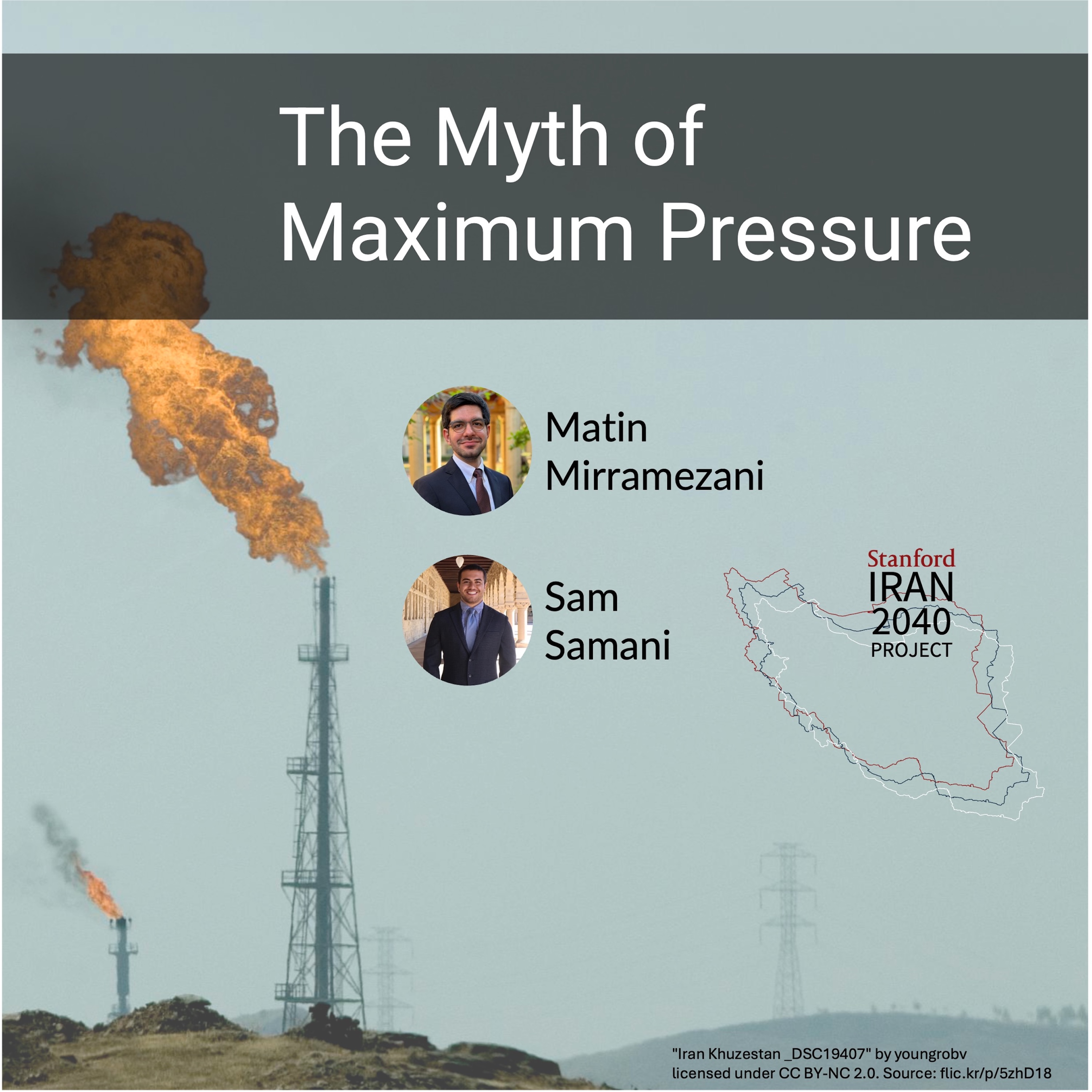
This is a recording of a webinar held by the Stanford Iranian Studies Program on April 15, 2026. This discussion evaluates the conventional wisdom surrounding U.S. sanctions on Iran. The paper in discussion from the Stanford Iran 2040 Project is available: https://iranian-studies.stanford.edu/publications/irans-exports-under-sanctions-myth-maximum-pressure
Data from this paper shows that Iran's oil exports have not only recovered from their lowest points under strict sanctions, but now surpass the peak levels seen during the JCPOA. The authors explore the primary causes behind this rebound. The discussion also dissects the intricate barter system that allows Iran to trade oil for goods, technology, and infrastructure projects, bypassing the international financial system. They analyze how this mechanism funnels resources to entities like the IRGC, fueling both domestic suppression and foreign aggression. Finally, they assess the future of this paradigm and its implications for Iran.
Matin Mirramezani manages the Stanford Iran 2040 Project and has been a contributor to the project since 2018. He studied economics at Stanford and co-founded the Generation Lab, a youth-focused data intelligence company. He is passionate about innovative research methods and policies that promote development. He is also the co-author of The Struggle for Development in Iran (SUP, 2022).
Sam Samani is a senior at Stanford University studying Political Science with a minor in Iranian Studies. His research focuses on Iranian elite politics, institutional continuity, and U.S. policy toward Iran, with particular attention to sanctions, succession dynamics, and state capacity. He has conducted research with the Hoover Institution and the Carnegie Endowment for International Peace and has professional experience at the U.S. Department of the Treasury.
Part of the Stanford Iran 2040 Project: goto.stanford.edu/iran2040
Fatima Baraghani, who is better known to history by her Shaykhi epithet, Qurrat al-‘Ayn, and her Babi penname, Tahira, was born in Qazvin in 1814 and executed in Tehran in 1852. A prominent follower first of Sayyid Kazim Rashti (d. 1843) and then the Bab (Sayyid ‘Ali-Muhammad Shirazi; executed 1850), Tahira played a significant role in the development and spread of both Shaykhism and Babism – two of the most radical movements to emerge out of Twelver Shi‘ism in Qajar Iran. As well as a charismatic orator and a learned theologian, Tahira was also an accomplished poet who used her original compositions and her reworkings of well-known poems by others to captivate her interlocutors and convince them of the veracity of her beliefs. In this lecture, Dr. Brookshaw will present poems by three of Tahira’s female contemporaries: a Shaykhi woman from Khurasan and two Qajar initiates of the Ni‘matullahi Sufi order. These women variously associated closely with Tahira in Karbala, Hamadan, and Tehran. Guided by their mentor, they joined the Babi movement. He argues that it is only through studying poets such as these that we can gain insight into the nature of the female-only social circles Tahira moved within that are hinted at in the vaguest terms in the extant chronicles and eyewitness accounts of the period.
Dominic Parviz Brookshaw is Professor of Persian Literature and Iranian Culture at the University of Oxford and Senior Research Fellow in Persian at Wadham College, Oxford. From 2011 - 2013, he was Assistant Professor of Persian and Comparative Literature at Stanford University. He has published widely on premodern and modern Persian literature, and his articles have appeared in peer-reviewed journals including Iranian Studies, Middle Eastern Literatures, and IRAN: Journal of the British Institute of Persian Studies. His most recent book, Hafiz and His Contemporaries: Poetry, Performance, and Patronage in Fourteenth-century Iran (Bloomsbury, 2019), won the Saidi-Sirjani Book Award in 2020. He serves currently as the President of the Association for Iranian Studies.
Part of the Stanford Festival of Iranian Arts
Panel discussion with Stanford scholars and students to discuss current events related to Iran.
Cosponsored by the Iran Democracy Project at the Hoover Institution.
PANELISTS (in order of appearance)
Larry Diamond is a senior fellow at the Hoover Institution and the Mosbacher Senior Fellow in Global Democracy at the Freeman Spogli Institute for International Studies (FSI) at Stanford University. He also chairs the Hoover Institution Project on Taiwan in the Indo-Pacific Region and is the principal investigator of the Global Digital Policy Incubator, part of Stanford’s Cyber Policy Center. For more than six years, he directed FSI’s Center on Democracy, Development, and the Rule of Law, where he now leads its Program on Arab Reform and Democracy. He is the founding coeditor of the Journal of Democracy and also serves as senior consultant at the International Forum for Democratic Studies of the National Endowment for Democracy.
H.R. McMaster is the Fouad and Michelle Ajami Senior Fellow at the Hoover Institution, Stanford University. He is also the Bernard and Susan Liautaud Fellow at the Freeman Spogli Institute and lecturer at Stanford University’s Graduate School of Business. McMaster holds a PhD in military history from the University of North Carolina at Chapel Hill. He is the author of multiple bestselling books and has published many essays, articles, and book reviews on leadership, history, and the future of warfare.
Abbas Milani is the Director of the Hamid and Christina Moghadam Program in Iranian Studies at Stanford University, Adjunct Professor and co-director of the Iran Democracy Project, and a research fellow at the Hoover Institution. His expertise is U.S.-Iran relations as well as Iranian cultural, political, and security issues. Milani has authored and translated numerous books in Persian and English and published more than 250 essays and book reviews in journals and papers. He is currently completing a book on Reza Shah.
Matin Mirramezani manages the Stanford Iran 2040 Project and has been a contributor to the project since 2018. He studied economics at Stanford and co-founded the Generation Lab, a youth-focused data intelligence company. He is passionate about innovative research methods and policies that promote development. He is also the co-author of The Struggle for Development in Iran (SUP, 2022).
Mobina Riazi is a master’s student in communications at Stanford University, with an emphasis on media studies. She earned her bachelor’s degree in political science, with a minor in Iranian studies, from Stanford University in 2025. Her research focuses on media, governance, and the law, with particular attention to digital repression and state power in authoritarian contexts.
Sam Samani is a senior at Stanford University studying Political Science with a minor in Iranian Studies. His research focuses on Iranian elite politics, institutional continuity, and U.S. policy toward Iran, with particular attention to sanctions, succession dynamics, and state capacity. He has conducted research with the Hoover Institution and the Carnegie Endowment for International Peace and has professional experience at the U.S. Department of the Treasury. Sam is currently completing an honors thesis on Iran’s political elite and is a course reader for Dr. Milani's courses on modern Iranian politics and U.S. relations with Iran.
Bailey Ulbricht, JD ’22, is the founding Executive Director at the Stanford Humanitarian Program, where she works on legal projects aimed at reducing harm in conflict settings and other insecure environments. Her research interests include laws governing the use of force and the intersection of technology and international humanitarian and human rights law, including how technology can be leveraged to gather evidence of possible legal violations.
Michael McFaul is the Ken Olivier and Angela Nomellini Professor of International Studies in Political Science, Senior Fellow at the Freeman Spogli Institute for International Studies, and the Peter and Helen Bing Senior Fellow at the Hoover Institution, all at Stanford University. He joined the Stanford faculty in 1995 and served as FSI Director from 2015 to 2025. He is also an international affairs analyst for MSNOW.
February 2, 2026
Mohsen B. Mesgaren
Matin Mirramezani
Mohsen Amiri
Read the report: http://goto.stanford.edu/tehranprotests
The contemporary history of Iran has been closely bound up with recurring waves of large-scale protests. From those preceding the Constitutional Revolution, the 1979 Revolution, as well as numerous demonstrations with demands ranging from the incremental to the radical, with a range of causes such as social, political, or economical. Iran’s capital, Tehran, has consistently served as a staging ground for crowds that have “poured into” the streets to voice their dissent.
Most existing studies of protests in Iran rely on individual narratives or media portrayals. In the vacuum of on-the-ground reporting and empirical evidence, the current understanding of protests in Iran primarily relies on speculations and anecdotes. This study adopts a data-driven approach by compiling a structured, open-sourced archive of protests in the capital city of Tehran as the foundation for deeper analysis.
This research is grounded in an original dataset of over 8,500 protest observations compiled by the authors. This comprehensive dataset was derived from a universe of about 120,000 visual documents and text-based news reports between 2009 and 2024. Each protest observation was systematically reviewed and tagged. We use this information to provide an overview of the temporal and spatial characteristics of the protests in Tehran and analyze the evolving discourse of dissent using chants from these protests. This granular data allows for an unprecedented, evidence-based look at how protest tactics and public sentiment have evolved in Iran's capital.
Mohsen B. Mesgaran is an Associate Professor at the University of California, Davis, and a Senior Research Fellow at the United Nations University Institute for Water, Environment, and Health (UNU-INWEH), where he leads the Ecological Modeling and Food Security. Prior to joining UC Davis, he was a Research Scientist at Stanford University's Iranian Studies Program (Stanford Iran 2040 Project), where he conducted large-scale, data-driven studies related to land and water resources in Iran, which culminated in the co-authorship of the book The Struggle for Development in Iran (SUP, 2022) https://www.sup.org/books/politics/st....
Mohsen Amiri is a researcher working on urban studies and data-driven analysis of protest and dissent in Iran. He has collaborated with the Stanford Iran 2040 Project on spatiotemporal datasets on protests and urban unrest, contributing to mapping protest dynamics in Tehran and other cities. His work combines GIS and discourse analysis to examine how space and power interact during mass mobilization. He is preparing to begin his PhD at the University of Sydney, focusing on urban revolt and repression in Iran between 2009 and 2022.
Matin Mirramezani manages the Stanford Iran 2040 Project and has been a contributor to the project since 2018. He studied economics at Stanford and co-founded the Generation Lab, a youth-focused data intelligence company. He is passionate about innovative research methods and policies that promote development. He is also the co-author of The Struggle for Development in Iran (SUP, 2022).
Part of the Stanford Iran 2040 Project
In this talk Prof. Ghadiri will discuss the beginnings of history and civilization in Iran based on recent scholarly theories; an examination of the causes behind the neglect of Iran’s authentic ancient past—one that extends far beyond the Median and Achaemenid eras—and an articulation of the benefits of adopting an informed and accurate understanding of Iran’s historical heritage.
Bahram Ghadiri was born in 1949 in Tehran, Iran. He graduated from Tehran University, where he studied under noted philosophers on Islamic and Persian art and architecture such as Titus Burkhardt, Henry Corbin and Hossein Nasr. His interest in the traditional art and architecture led him to engage in practical learning with master-masons and artists. At the age of 28 he became the Director of Niyavaran National Cultural Center, one of the most prestigious centers for art and architecture in Iran. Among his many projects in Iran are the restoration and revitalization of Akhavan Sigari Mansion (Yazd), Tajrish Municipal Libraries (Tehran), Main Entrance Gate to Bazaar Shishegar Khaneh (Tabriz), Seyed Aladin Hossein Mausoleum (a village near Hamadan), Miandasht Caravansary Complex (Miandasht on Silkroad), Dar Al-fonun School (Tehran), and Khan Bathhouse (Yazd Bazaar). In 2001, the Khan Bathhouse was the winner of the Aga Khan Foundation Award for Architecture prize. As a professor of Historic Preservation in the School of Architecture & Urban Planning, Shahid Beheshti University from 1986 to 2003, Prof. Ghadiri led 16 years of research on Persian bazaars, a first of its kind in the nation, involving over 800 graduate students. The result was a complete survey of the physical and non-physical elements, and developing a methodology for study of bazaars and their causes of decay. He also served as visiting professor at the School of Architecture & Urban Planning at Yazd University and Isfahan University (1995-2001). Prof. Ghadiri is the author of four books, 30 articles and over a half a dozen academic handouts on topics of conservation and preservation of Iranian historical building, city fabric, and bazaars. He is also the founder and president of Foundation for Persian Archaeological Studies.
December 2, 2025
Contrary to the widely held narrative portraying Iran and Saudi Arabia as cooperative partners during the reign of Shah Mohammad Reza Pahlavi, recently declassified diplomatic records and personal accounts from those close to the Shah reveal a far more complex picture. In the wake of Britain’s withdrawal from the Persian Gulf in 1971, the region entered a moment of uncertainty. One that seemed to offer both Iran and Saudi Arabia a chance to shape a new regional order. For a brief moment, the Shah appeared willing to engage in genuine partnership, seeking stability through coordination with Riyadh under the broader umbrella of the Nixon Doctrine.
Yet, this early openness soon gave way to a vision defined by hierarchy rather than cooperation. Convinced of Iran’s historical and strategic superiority, the Shah began to imagine a Persian Gulf order centered on Iranian dominance, in which Saudi Arabia would play a secondary, supportive role. His ambitions were encouraged by American security guarantees but constrained by the limits of dependence on them - a paradox that defined Iran’s fragile autonomy during the 1970s.
Drawing on newly accessible archives, including the Zahedi Papers at the Hoover Institution Library & Archives, and first-hand testimonies, this lecture traces how shifting regional power dynamics, personal rivalries, and the politics of prestige shaped Iran’s approach to its Arab neighbors. It revisits key turning points, including the 1971 island crisis, to show how mistrust between Tehran and Riyadh deepened despite superficial gestures of unity. Ultimately, the lecture asks why the promise of cooperation between the two states never materialized, and what this failed friendship reveals about the tension between ambition and constraint that continues to define Iran’s role in the Persian Gulf to this day.
Diba Mirzaei is a researcher at the German Institute for Global and Area Studies (GIGA) and a PhD candidate at the University of Hamburg. Her dissertation, “Iran’s Foreign Policy toward Saudi Arabia from 1968–1979: Fragile Autonomy under the Nixon Doctrine” (submitted in June 2025), explores how Iran’s policy toward Saudi Arabia intersected with interpretations of the Shah’s autonomy.
Mirzaei’s research interests include Iranian foreign policy and feminist approaches to international relations. Prior to her doctoral studies, she worked at the German Federal Foreign Office in the field of humanitarian assistance.
October 30, 2025
Speakers: Bailey Ulbricht, Allen Weiner, and Mobina Riazi.
Read their report: https://law.stanford.edu/publications/school-poisonings-in-iran-an-open-source-investigation/
On November 30, 2022, in the midst of protests around the country in Iran for the “Woman, Life, Freedom” movement, schoolgirls at Noor Conservatory Girls’ School in Qom City experienced a bizarre and terrifying event while at school. They smelled “poisonous gas” and experienced symptoms that sent 18 of them to the hospital. From November 2022 to May 2023, there were hundreds of similar poisoning incidents reported at schools around the country, the vast majority of them at girls’ schools. Videos captured by witnesses depicted girls coughing, vomiting, and struggling to walk in front of their schools. Yet at the same time, contradictory information began calling these incidents into question, casting doubt on the seriousness of the girls’ symptoms or claiming that the poisonings were psychological. Eventually, the Iranian government concluded in its own investigation that the vast majority of the alleged poisoning incidents were caused by girls’ anxiety or hysteria. But is that actually true?
Over the past year and a half, the Stanford Humanitarian Program, with support from the Hamid and Christina Moghadam Program in Iranian Studies, has conducted an open-source investigation into these poisoning incidents, working to uncover what actually happened and whether the Iranian government covered them up.
In this talk, Bailey Ulbricht, Allen S. Weiner, and Mobina Riazi present their newly released report on the poisoning incidents, including what happened, what the Iranian government did in response, and what the legal implications under international law are, including next steps for justice and accountability.
Bailey Ulbricht, JD ’22, is the founding Executive Director at the Stanford Humanitarian Program, where she works on legal projects aimed at reducing harm in conflict settings and other insecure environments. Her research interests include laws governing the use of force and the intersection of technology and international humanitarian and human rights law, including how technology can be leveraged to gather evidence of possible legal violations.
Allen S. Weiner, JD ’89, is an international legal scholar whose research and teaching focus primarily on the fields of international security and international conflict resolution. He also studies the challenges of online misinformation and disinformation. In the international security realm, his work spans such issues as international law and the response to contemporary security threats; the relationship between international and domestic law in the context of armed conflict; the law of war (international humanitarian law); just war theory, and international criminal law (including transitional justice). Weiner’s scholarship is deeply informed by experience; he practiced international law in the U.S. Department of State for more than a decade advising government policymakers, negotiating international agreements, and representing the United States in litigation before the International Criminal Tribunal for the former Yugoslavia, the International Court of Justice, and the Iran-United States Claims Tribunal. Senior Lecturer Weiner is director of the Stanford Program in International and Comparative Law, director of the Stanford Humanitarian Program, and director of the Stanford Center on International Conflict and Negotiation. Before joining the Stanford Law School faculty in 2003, Weiner served as legal counselor at the U.S. Embassy in The Hague and attorney adviser in the Office of the Legal Adviser of the U.S. Department of State in Washington, DC. He clerked for Judge John Steadman of the District of Columbia Court of Appeals.
Mobina Riazi is a master’s student in communications at Stanford University, with an emphasis on media studies. She earned her bachelor’s degree in political science, with a minor in Iranian studies, from Stanford University in 2025. Her research focuses on media, governance, and the law, with particular attention to digital repression and state power in authoritarian contexts.
October 24, 2025
The Sunbird and the Story of Kanun: Revisiting the Institute for the Intellectual Development of Children and Young Adults in Iran
In 1965, a visionary proposal by Lily Amir-Arjomand to Queen Farah Pahlavi—to establish a library for children in Iran—gave rise to The Institute for the Intellectual Development of Children and Young Adults, known in Iran simply as Kanun. Over the next thirteen years, under Amir-Arjomand’s leadership, more than 250 permanent and mobile libraries opened their doors in cities and villages across the country. Alongside them, cultural centers flourished, dedicated to publishing, cinema, theater, music, and animation for children. To mark Kanun’s 60th anniversary, Dr. Mandana Zandian's new book The Sunbird looks back at these formative years. The book unfolds in two parts, both in interview format: a long in-depth conversation with Lily Amir-Arjomand, and a collection of twenty-three short interviews with those who helped build Kanun’s diverse cultural centers or who were once members of its libraries.
Lily Amir-Arjomand is the founder and first Managing director of the Institute for the Intellectual Development of Children and Young Adults in Iran. She studied French Literature at the University of Tehran. After completing an intensive library science training program at the Iran-America Society, she joined in developing the newly established library of the National University. A few years later, she earned a master’s degree in library science and children literature from Rutgers University in the United States and returned to Iran with the vision of establishing a children’s library. Meanwhile she managed the library of the National Iranian Oil Company for three years. In collaboration with Marguerite Hopkins, a library consultant and instructor, and four other librarians, she helped draft the statutes of the Iranian Librarians Association and contributed to organizing the master’s program in Library Science at the University of Tehran. Amir-Arjomand also taught library science at the University of Tehran for one year. Ultimately, with the support of Empress Farah Pahlavi, she founded the Institute for the Intellectual Development of Children and Young Adults in 1965 and served as its managing director until leaving Iran in 1979. In 2021, the film magazine “Sight & Sound” included Lily Amir-Arjomand in its list of “100 Hidden Cinema Heroes,” recognizing her as one of the individuals who have shaped the course of filmmaking history.
Mandana Zandian graduated from Shahid Beheshti Medical School in 1997. She worked as a researcher at Cedars-Sinai Hospital in Los Angeles for 20 years, specializing in research on aggressive forms of advanced cancers. Dr. Zandian is also a published poet, author, and journalist, actively collaborating with "Rahavard" quarterly journal. Her books include: Omid o Azadi (Hope and Liberty, Los Angeles, 2012) on the life and works of Iraj Gorgin; Baz-khani-e Dah Shab (The Ten-Nights Revisited, Los Angeles, 2014); Ehsan Yarshater in Conversation with Mandana Zandian (Los Angeles, 2016); Persian Cypress and the Blooms of Modernity, in Conversation with Abbas Milani (Los Angeles, 2023). She also edited Yaddashtha (Diaries, Washington DC, 2021), a collection of notes written between 1986-2012 for the journals "Irannameh" and "Iranshenasi" by Dr. Ehsan Yarshater. Zandian's most recent collection of poems is titled Seda-ye Saye-haye Ham Boodim (Our Voice Echoed the Shadows of All, Los Angeles, 2019). Dr. Zandian is also the host and producer of a podcast on Persian Literature titled "A Window of Freedom." She collaborated on a section of Homa Sarshar's weekly radio program, introducing Persian contemporary poets, for 10 years. Zandian's latest book, Morgh-e Aftab (The Sunbird), revisits the establishment and the first 13 years of the Institute for the Intellectual Development of Children and Young Adults.
October 4, 2025
Hossein Amanat established his international reputation in 1966 when, as a recent graduate, he won a nationwide competition to design the Shahyad (now Azadi) Monument in Tehran—an architectural icon that has since become a symbol of modern Iran. This early success led to a series of prestigious commissions, including some of the most acclaimed modern buildings in Iran: the Persian Heritage Centre; the School of Management at the University of Tehran; the Aryamehr (now Sharif) University of Technology; the Iranian Embassy in Beijing—regarded as one of the architectural highlights of the city's diplomatic quarter—and the planning of Darya Kenar, a new town on the Caspian Sea.
Born in Iran in 1942, it was remarkable that such a young architect was entrusted with projects of this scale and importance. Even more significant is Amanat’s distinctive design philosophy: among the first Iranian architects to harmonize contemporary architectural principles with the rich legacy of traditional Persian design. At a time when Western cultural and artistic influence was dominant in Iran—and when many architects were following the International Style—Amanat was pioneering an original synthesis of modernity and tradition.
Amanat’s innovative practice, deeply rooted in Persian architectural heritage, was abruptly interrupted by the 1979 Islamic Revolution, marking a dramatic turning point in his life and career. As a member of the persecuted Baha'i faith, he and his young family were forced into exile. Following a brief stay in Europe, they immigrated to Canada in 1980, where Amanat established a renewed and diverse architectural practice.
Amanat’s work has earned many design awards and led to global invitations to lecture on architecture. He is among the founding faculty of the Baha’i Institute for Higher Education (BIHE), a grassroots institution established in response to the Iranian government’s systematic denial of education to Baha'is. He has also contributed to the University of British Columbia (UBC) as a visiting critic at the School of Architecture and Landscape Architecture, and recently served on a committee that successfully raised funds for a new tenure-track position in Persian Language and Iranian Studies.
In recognition of his lifetime achievements and contributions to architecture, Hossein Amanat was awarded an honorary Doctor of Letters by UBC in May 2024—a fitting tribute to a visionary architect whose work continues to inspire. Deeply engaged with Iranian history and literature, Amanat consistently draws on these cultural sources, demonstrating a remarkable ability to blend diverse traditions into his distinctive, enduring architectural language.
ABOUT THE BITA PRIZE FOR PERSIAN ARTS:
The annual Bita Prize for Persian Arts is awarded by the Stanford Iranian Studies Program to an artist of Iranian ancestry whose work, in the course of their lifetime, has exhibited singular achievements in both the realm of aesthetics and in the essence of defending the rights of artists to create, free from any fetters. The recipient is invited to Stanford University to give a public lecture and receive the prize. Since its inception in 2008, the Bita Prize has been awarded to outstanding Iranian scholars, artists and creators.
From 1932 to 1948, architects and engineers from the First Republic of Czechoslovakia, working under Skoda Works of Plzen, partnered with the Iranian government led by Reza Shah Pahlavi to support the country's ambitious modernization program. This collaboration focused on expanding industrial enterprises across key sectors, including electrical, agricultural, defense, and railway infrastructure. Alongside Scandinavian engineers from Kampsax and British experts from Anglo-Persian Oil, the Czechoslovakians became instrumental in shaping the industrial landscape of modern Iran. During this period, two Czechoslovak architects—Leopold Czihal and Stanislav Suva—who were strong proponents of the Vienna School of Architecture, worked closely with Reza Shah and Iran’s emerging architectural talent, including Mohsen Foroughi and Eugene Aftandilian. Drawing on the rationalist principles of Modernism and the legacy of Achaemenid architecture, they sought to create a distinct architectural identity for Iran. Their collaboration led to the design of iconic buildings such as the Ministry of War, the Ramsar Casino, the Palace of Justice, and the Ministry of Finance—structures that laid the groundwork for modern Iranian architecture. Based on research conducted by Reza Alirezaieyan for a book recently published by the Ministry of Culture of the Czech Republic, this presentation will, for the first time, present this remarkable history in detail.
Reza Alirezaieyan is an Iranian architectural historian residing in Dallas, United States. One might say he was destined to study the history of Iranian industry and architecture: on his father’s side, his ancestors helped construct oil refineries in Abadan, while on his mother’s, they participated in building the Trans-Iranian Railway. He has long been dedicated to investigating and documenting the pivotal transformation of Iranian architecture, and his unique perspective—merging technical expertise with a passion for history—offers a fresh and invaluable insight into a key period of Iran’s past.
September 5, 2025
On The Rocky Road Of Life is the richly detailed personal and professional memoir of Zakaria Hashemi—an artist whose life story unfolds across the alleys and seasons of Tehran, from the scorching heat to the biting cold, from the south to the north of the city during the reign of Mohammad Reza Pahlavi. The book traces his early days, growing up amid poverty in the neighborhoods of Shahr-e Rey and southern Tehran, where a spirit of athleticism and community prevailed, and follows his entry into cinema as a background actor in the early 1950s.
Hashemi’s gradual emergence into Iran’s intellectual circles begins with his encounter with Farrokh Ghaffari, leading to his involvement in landmark films like South of the City (1958) and Night of the Hunchback (1963). His pivotal meeting with Ebrahim Golestan and Forough Farrokhzad not only earned him the lead role in one of the most significant cultural films in Iranian cinema history (Brick and Mirror, 1965) but also inspired him to write novels such as The Parrot and The Crumpled Coloured Papers. In Golestan Studio, he emerged as one of the boldest voices in Iranian naturalist fiction, unafraid to write candidly about lived experience, all while preserving a lyrical tone rooted in the rhythm of spoken Persian.
The memoir is both a cinematic and literary journey. It charts the course of pre-revolutionary Iranian cinema—both popular and intellectual—while following Hashemi’s transformation from actor to filmmaker. Alongside his artistic development, the book delves into his personal and romantic life in a society experiencing rapid development but also plagued by opportunists and deceitful individuals, whose detailed accounts are shared without exaggeration but with insight into the social trust and naivety of the time.
Covering the entirety of Iran’s sociopolitical evolution during the Pahlavi era, the book also captures the confusion and stagnation that followed the 1979 Islamic Revolution for many artists, investors, and civil servants. It reflects on the waves of bans, censorship, war, and the radical rewriting of reality that eventually led to the author’s involuntary exile—an exile that has now lasted over forty years.
On The Rocky Road Of Life is not merely the story of one remarkable artistic life—it’s also a vibrant social document. Through vivid dialogue and detailed observations, Hashemi presents one of the most comprehensive portraits of everyday Iranians, from laborers, addicts, and athletes to poets, painters, filmmakers, and statesmen. For those who never lived through that era—or never had someone patiently recount it for them—this memoir is a rare and invaluable record. It is the heartfelt tale of an Iran once on the rise, later trapped in deadlock, told by a witness with clear eyes and an open mind.
Zakaria Hashemi is an acclaimed director, novelist, and actor. He has made several documentaries for Iranian national television. He has also directed three feature films, including Se Ghaap (1971). He was the lead actor in several Iranian films including Ebrahim Golestan’s Brick and Mirror (1965) and Amir Naderi’s Khodahafez Rafigh (1971). Mr. Hashemi has written seven books, including Tooti (1969), With Open Eyes (2004), and The Vagabond (2021). Mr. Hashemi’s writing skills were discovered by Forugh Farrokzad, while he was working at Studio Golestan in the 1960’s.
Book passage reading by Russell Parsi.
Part of the Stanford Festival of Iranian Arts