Skip to content
Artwork for Signal & Noise
NewsTech News

Signal & Noise

Signal and Noise

Join advertising industry veterans Brett House and Rio Longacre as they share regular updates and analysis on the changing world of data, tech, and AI. You’ll hear real talk from thought leaders across industries about the latest trends having the biggest impact on our jobs… and lives. Signal & Noise means no BS - only straight talk and first-hand insights from leading operators, creators, and founders.

Play
  • 25 episodes
  • a few times a week
  • Avg 1 hr 13 min
  • English
Counted on this page — what you have heard stays on this device, so it is not something the list can be paged by.
  • Thursday · 1 hr 15 min

    The Bid Request Has Receipts: Eric Tilbury on Clean Supply, ID-Free Buying, and the Craft of Programmatic

    Programmatic advertising has spent years getting smarter about audiences. But what if the bigger problem is that buyers still don’t fully understand what they’re actually buying? Eric Tilbury, Vice President of Programmatic Ops & Solutions Engineering at Inuvo, joins Rio Longacre and Brett House for a deep dive into the machinery underneath modern programmatic advertising—and why better technology doesn’t necessarily produce better media buying. Eric is an operator first. He has spent more than a decade inside campaign management, supply optimization, contextual decisioning, CTV, DSPs and the plumbing that determines whether a bid request ever reaches a buyer in the first place. That experience has also made him one of the more outspoken voices in AdTech on supply quality, measurement and what he sees as the industry’s bad habits. The conversation starts with a deceptively simple idea: ID-free targeting is not necessarily the same thing as buying ID-free inventory. A contextual strategy may not require an identifier, but DSP settings around frequency caps, conversion tracking and optimization can still systematically favor impressions with IDs—or prevent ID-free opportunities from reaching the campaign at all. From there, Eric explains why clean supply is not just a brand-safety exercise. Buyers need to know the publisher, seller and path behind an impression, especially in CTV and mobile apps. Cheap CPMs and attractive platform metrics can conceal low-quality placements, opaque reselling, bot traffic and inventory no advertiser would intentionally choose. The discussion also gets into one of Eric’s biggest contrarian ideas: iOS and other ID-light environments may represent an overlooked buying opportunity. When advertisers optimize around what is easiest to identify and attribute, they can systematically ignore valuable consumers—and sometimes reward the inventory most capable of gaming their measurement systems. Eric also breaks down Inuvo’s IntentKey approach, which uses content, concepts, sentiment and real-time signals to make buying decisions without building the decision around an individual user profile. And then the conversation turns to measurement. Eric argues that platform ROAS, CPA and CTR should be treated as directional optimization metrics—not as the ultimate source of truth. If advertising is actually working, the question should be whether it created incremental business results that would not have happened otherwise. Rio, Brett and Eric also explore: • Why DSP auto-optimization can send campaigns toward terrible inventory • The difference between attribution and incrementality • Why CTV supply-path verification should be much easier than it often is • How fraudsters benefit from the industry’s obsession with identifiers • Why contextual intelligence becomes more valuable as open-web behavior changes • Whether AI agents and MCP interfaces will weaken DSPs—or actually make them stronger • Why buyer judgment still matters in an increasingly automated media ecosystem • Eric’s skepticism toward probabilistic ID bridging • And how a 4:30 a.m. training schedule and Brazilian jiu-jitsu fit the mindset of an AdTech operator This is AdTech school for anyone who wants to understand what actually happens between an advertiser’s strategy and the impression that eventually gets bought. If you work in programmatic, media, CTV, contextual advertising, measurement or AdTech, this one goes deep. Subscribe to Signal & Noise for more conversations with the people building—and challenging—the future of advertising, data, media and AI. #AdTech #ProgrammaticAdvertising #Programmatic #CTV #DigitalAdvertising #MediaBuying #ContextualAdvertising #Advertising #Marketing #MarTech #AI #Measurement #Identity #SignalAndNoise

  • Sunday · 1 hr 20 min

    Who Replaces Switzerland? Mathieu Roche on Rebuilding the Identity Commons

    For years, LiveRamp played the role of “Switzerland” in digital advertising: a neutral identity layer connecting brands, agencies, publishers, platforms, data providers, and measurement partners. But with Publicis moving to acquire LiveRamp, can infrastructure owned by one of the world’s largest agency groups still credibly claim neutrality? In this episode of Signal & Noise, Rio Longacre and Brett House sit down with Mathieu Roche, Co-founder and CEO of ID5, to explore what happens when one of advertising’s most important shared rails suddenly has an owner with a very different strategic position. Mathieu argues that the industry now has a genuine reason to build alternatives—but replacing RampID is not the same thing as replacing LiveRamp. LiveRamp’s position was built through identity resolution, onboarding, publisher integrations, data collaboration, activation, measurement, and years of network effects. Recreating that requires more than another identifier. It may require an entirely new coalition of independent companies. The conversation gets into what that new identity commons could actually look like. Mathieu explains why identity should function more like a common currency or language between buyers and sellers—open, interoperable, and usable across platforms rather than controlled by either side. He also explains why identity is just as critical for measurement as targeting: if advertisers cannot connect exposure to outcomes across devices and environments, they cannot prove performance or optimize investment. Rio, Brett, and Mathieu also dig into ID5’s acquisition of TrueData, which Mathieu describes as a kind of “Rosetta Stone” connecting different identifiers, devices, users, households, and offline data into the ID5 ecosystem. The discussion explores deterministic versus probabilistic identity, why conventional “match rate” metrics can be misleading, and why the real question is whether an identifier can actually be found and activated against in the wild. They also examine the publisher side of the equation: how identity can increase bid density and monetization, how ID5 works alongside companies such as Optable and Permutive, and why publishers need deeper knowledge of their audiences if they want to regain leverage from the buy side. Finally, the conversation turns to agentic trading, CTV, and the future of advertising infrastructure. Mathieu believes agentic buying could compress parts of today’s programmatic supply chain—but rather than making identity less important, increasingly granular and automated buying may make a trusted identity layer even more essential. If LiveRamp can no longer be Switzerland, the next Switzerland may not be a single company at all. It may be a modular network of specialists—and the race to build it has already begun. #AdTech #DigitalIdentity #LiveRamp #ID5 #ProgrammaticAdvertising #AgenticAI #Advertising #DataPrivacy #CTV #Publishers #MarketingTechnology #SignalAndNoise

  • October 8 · 1 hr 22 min

    Wyoming's Data Center Boom: Dawson Kluesner on Economic Opportunity, Public Backlash, and the Infrastructure Behind AI

    AI may live in the cloud, but the infrastructure behind it is very physical: land, power plants, transmission lines, water systems, construction crews—and communities deciding whether they actually want massive data centers in their backyard. In this episode of Signal & Noise, Rio Longacre and Brett House sit down with Dawson Kluesner, Director of External Affairs for the Wyoming Association of Municipalities and Coordinator for the Wyoming Economic Development Association. Dawson sits at a fascinating intersection: he works with the cities and towns evaluating major infrastructure projects while also working alongside the economic-development community trying to attract investment to Wyoming. Wyoming has emerged as an increasingly attractive destination for hyperscale data centers. It has abundant energy resources, available land, a long history as an energy-producing state, and communities looking for ways to diversify their tax bases. But the boom is also generating many of the same concerns appearing around the country: electricity demand, water consumption, noise, environmental impact, public subsidies, infrastructure costs and whether data centers create enough permanent jobs to justify their enormous footprint. Dawson argues that the answer isn't simply to say yes or no to data centers. The real question is whether communities can structure projects so residents are genuinely better off after they arrive. The conversation explores: Why Wyoming has become attractive to data center developers—and why energy availability may now be one of the biggest constraints on AI infrastructure. How Wyoming is trying to protect residential ratepayers, including Black Hills Energy's large-load tariff requiring major industrial customers to pay for the infrastructure needed to serve them. Why water remains one of the biggest concerns Dawson hears at community meetings, and how newer cooling technologies are changing the debate. The economics of data centers: massive construction activity, relatively smaller permanent workforces, property and electricity tax revenue, and the opportunity to diversify Wyoming's economy. The growing demand for electricians, welders, HVAC technicians, plumbers and other skilled trades—and why data center investment could help build a workforce that benefits Wyoming well beyond AI. Nuclear power, natural gas, carbon sequestration, wind and the enormous energy buildout required to support the next generation of computing. Community benefit agreements, tax incentives and what developers should owe the communities hosting these projects. Why opposition to data centers cuts across political lines—and why early, transparent community engagement may matter as much as the underlying technology. Ultimately, Dawson offers a straightforward test for whether Wyoming's data center boom succeeds: not how many facilities get built or how many gigawatts come online, but whether the projects leave local communities financially stronger, with better infrastructure and greater economic capacity without creating unsustainable demands on residents or resources. It's a conversation about AI—but also about energy, economics, infrastructure, public trust and the increasingly difficult question of who should bear the costs of building the physical backbone of the digital economy. Subscribe to Signal & Noise for more conversations at the intersection of media, data, technology and AI. #ArtificialIntelligence #AI #DataCenters #Wyoming #Infrastructure #Energy #EconomicDevelopment #NuclearEnergy #Technology #SignalAndNoise

  • October 5 · 1 hr 51 min

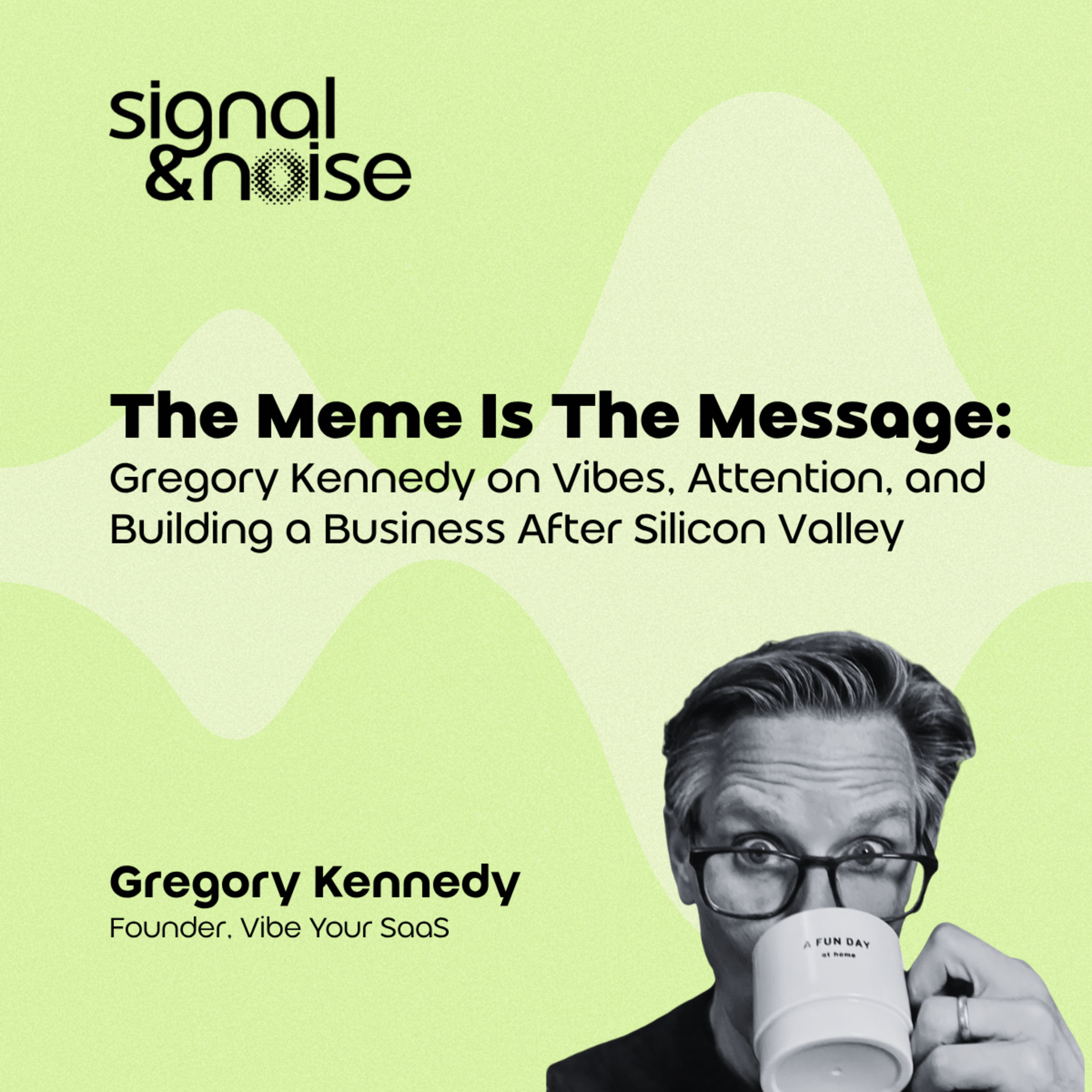
    The Meme Is The Message: Gregory Kennedy on Vibes. Attention, and Building a Business After Silicon Valley

    AI makes it easier to create content. Getting people to care is still the hard part. On this episode of Signal & Noise, host Rio Longacre and guest host Krish Raja sit down with Gregory Kennedy, founder of Vibe Your SaaS, for a candid conversation about memes, founder-led marketing, creative talent, and building an independent business in the AI era. Gregory traces his path from New York’s design scene and an award-winning website he built in 1997 to two decades in Silicon Valley and a move to Seattle. He explains how a founder-coaching idea grew into Vibe Your SaaS—a business combining content and go-to-market consulting, a newsletter, and startup pitch competitions—and why his Bay Area network remains central to his work. Along the way, the conversation tackles what it takes to build an audience, develop a recognizable voice, and turn attention into an opportunity to do business. In this episode: • The anatomy of a meme: How recognizable moments, humor, and an unexpected twist make an idea travel—and why Gregory thinks the Drake meme needs to retire. • Building an audience from zero: The posting, replies, persistence, and personal commitment behind Gregory’s presence on X, plus why your platform should fit your strengths and personality. • Founder-led marketing with a point of view: How Gregory uses his voice to attract the right clients, why controversy carries real risks, and how he advises founders to stay in a lane they understand and can defend. • Taste, brand, and AI-generated content: Why Gregory believes taste has always mattered, how consistent quality builds recognition, and why cheaper content doesn’t make attention easier to earn. • “Become inevitable”: The connection between founder conviction, a real customer need, a clear market story, and building an audience before you launch. • Silicon Valley, Seattle, and startup culture: Gregory’s case for the Bay Area’s concentration of talent and ambition, and his perspective on how Seattle’s business policies have affected his own plans. • AI and the human side of sales: Why automating outreach doesn’t automatically win customers—and the value of a founder’s ability to make decisions on the spot. • Talent, careers, and smaller teams: A debate about leaning into your strengths, valuing individual contributors, and using AI to build more with fewer resources. Plus, Gregory makes his pick between taste and distribution, questions the return on in-person B2B events, and shares why he’s optimistic about the opportunities opening up for solo founders and small teams. For founders, marketers, and creators trying to earn attention in a crowded feed, this is a conversation about finding what you’re good at, showing up consistently, and giving people a reason to remember you. Connect with Gregory: Vibe Your SaaS X LinkedIn Subscribe to Signal & Noise on YouTube or follow on Spotify for more conversations on marketing, technology, and the people building what comes next. #SignalAndNoise #GregoryKennedy #VibeYourSaaS #B2BMarketing #FounderLedMarketing #Memes #AI #Startups #GoToMarket

  • October 2 · 1 hr 23 min

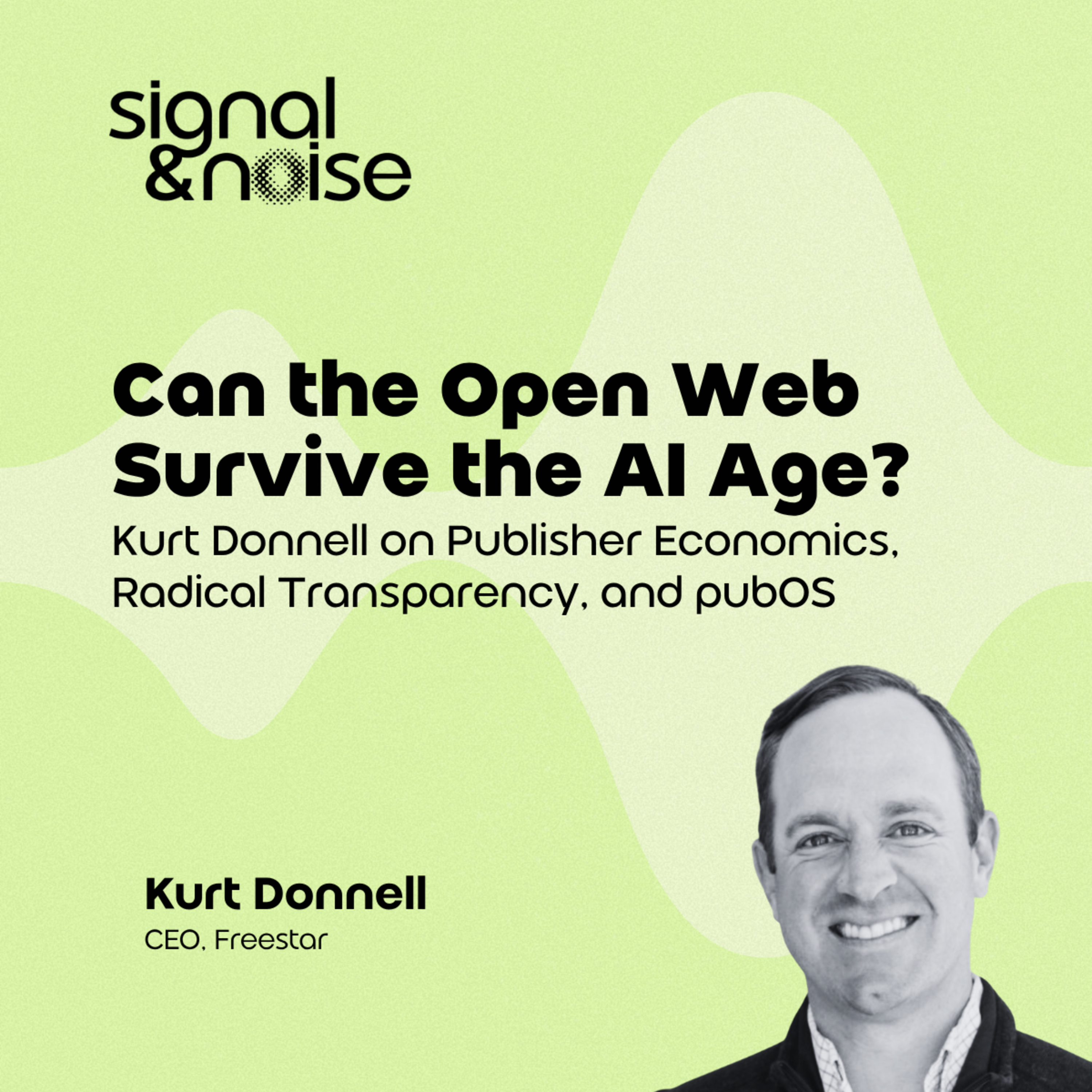
    Can the Open Web Survive the Al Age? Kurt Donnell on Publisher Economics, Radical Transparency, and pubOS

    The open web has survived search, social media, programmatic advertising, privacy regulation, and the rise of the walled gardens. But does generative AI represent a fundamentally different threat? In this episode of Signal & Noise, Rio Longacre sits down one-on-one with Kurt Donnell, President & CEO of Freestar, while Brett House is away. Kurt brings an unusual perspective. He began his career as an M&A attorney, moved into media and operations, helped take YogaWorks public, and eventually joined Freestar as its first CEO. Under his leadership, Freestar says it has grown sevenfold, expanded to 185 employees across 15 countries, and returned more than $1 billion to publishers. Rio and Kurt tackle an increasingly urgent question for digital media: Is the publisher crisis still primarily a monetization problem, or has AI created a structural break in the economics of the open web? Kurt explains how the historical bargain between publishers and platforms is changing. Search engines consumed publisher content but also sent traffic back. AI answer engines can deliver the answer without the click. Larger publishers with strong brands, direct audiences, and genuine utility have generally held up better, while SEO-dependent long-tail publishers have faced greater pressure. The conversation goes well beyond AI. Rio and Kurt discuss why original journalism remains essential even in a world of podcasts, Substacks, creators, and AI summaries. Someone still has to produce the reporting—the raw material everyone else analyzes, summarizes, and synthesizes. Without a sustainable model for creating that information, the ecosystem suffers. They also unpack the economics of programmatic: supply-path duplication, unnecessary intermediaries, declining trust, and why the open web remains harder for advertisers to understand than closed platforms. Kurt argues one of the walled gardens’ greatest advantages is simplicity and transparency—the ability to show advertisers what happens when they put money into the system. Kurt also explains Freestar’s pubOS, a unified operating layer to help publishers manage header bidding, yield optimization, analytics, identity, integrations, demand partners, and managed services with less complexity. Rio and Kurt explore: Why publishers need to become better marketers Whether subscriptions, commerce, events, and licensing can supplement ads Why email and newsletters may be among the most valuable assets pubs control How first-party data and authenticated audiences can improve economics Why trust and verification remain barriers to monetizing pub signals Whether cleaner supply paths can rebuild advertiser confidence Why CPM and fill rate can be misleading The role of curation and first-party audience signals Whether agentic trading can remove unnecessary layers from programmatic What publishers must own directly as discovery shifts from search On agentic advertising, Kurt is cautiously optimistic. Direct communication between scaled buyer and seller systems could improve targeting, packaging, reporting, and transparency, but the market remains early and infrastructure still needs to be recreated. This is a conversation about much more than publisher yield. It is about whether independent digital media can build a new economic model around direct relationships, trusted content, cleaner advertising infrastructure, better data, and dramatically less friction before AI permanently reshapes how audiences discover information. Featuring: Kurt Donnell, President & CEO, Freestar Hosted by: Rio Longacre, Signal & Noise #SignalAndNoise #KurtDonnell #Freestar #AdTech #Publishing #OpenWeb #ProgrammaticAdvertising #DigitalMedia #GenerativeAI #AgenticAI #PublisherMonetization #FirstPartyData #HeaderBidding #SupplyPathOptimization #Journalism #MediaEconomics #pubOS

  • September 28 · 1 hr 36 min

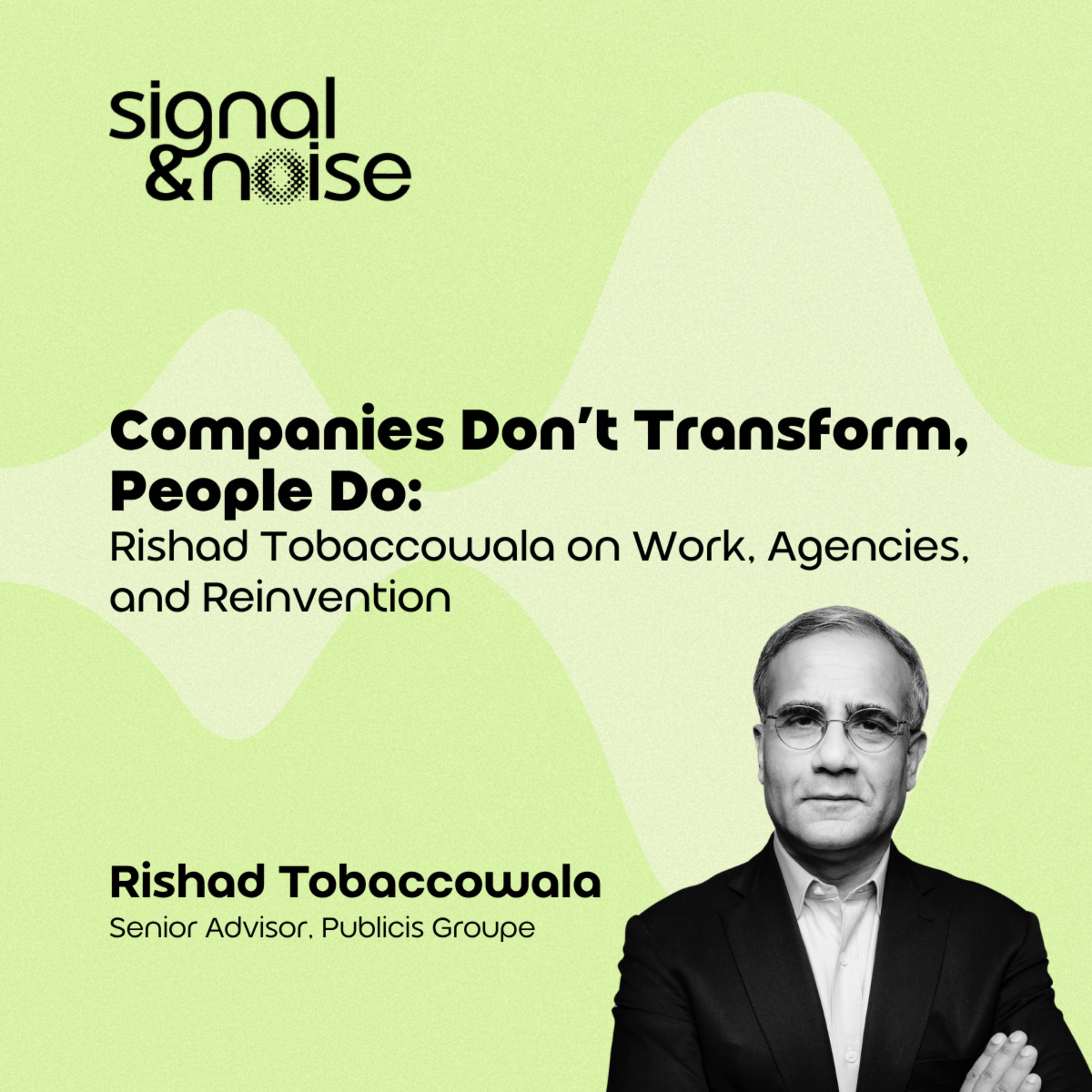
    Companies Don’t Transform, People Do: Rishad Tobaccowala on Work, Agencies, and Reinvention

    Few people have had a better vantage point on the transformation of advertising, technology, and work than Rishad Tobaccowala. Over a 37-year career at Publicis Groupe, Rishad helped pioneer its digital businesses, chaired Digitas and Razorfish, and ultimately served as Global Chief Strategist and Growth Officer. Today, he is an author, teacher, adviser, senior adviser to Publicis Groupe, co-founder of the Athena Project on Modern Leadership, and one of the industry’s most original thinkers on how people and organizations navigate change. In this wide-ranging, smart, funny, and deeply thought-provoking conversation, Rishad joins Brett House and Rio Longacre to challenge one of the biggest assumptions surrounding technological transformation: companies don’t transform simply because they buy new technology, reorganize, or deploy AI. Companies transform when their people do. Rishad argues that AI represents something fundamentally different from previous technology waves—not simply another tool, but what he calls an emerging form of “alien intelligence.” The question, then, isn’t whether organizations have an AI strategy. It’s whether they are willing to rethink how work gets done, how people are rewarded, where power sits, and what human beings uniquely contribute. The conversation explores why transformation is ultimately about power, politics, people, and partnering; why technology moves faster than organizations; and why simply making the old model more efficient is like putting a faster engine into a car when what you really need is to design an airplane. Rishad also explains his idea of “de-bossification”—the decline of management built around control and the rise of leadership built around influence. He compares the organization of the future to jazz rather than classical music: more improvisational, collaborative, fluid, and less dependent on rigid hierarchy. Along the way, they dig into: Why AI may change nearly every white-collar job without necessarily eliminating work The rise of portfolio careers, fractional talent, freelance work, and agentic employees The six skills Rishad believes matter most: creativity, curiosity, cognition, collaboration, convincing, and communication Why knowledge may become abundant while judgment, imagination, and wisdom become more valuable How individuals can “rearchitect” their careers instead of waiting for an employer to provide purpose Why leaders should “untie, not cut” when leaving organizations What Publicis got right in its decade-long transformation—and why changing incentives and behavior mattered as much as acquisitions and technology Why agencies, consultancies, and other services businesses will struggle to keep selling hours and FTEs in an AI-enabled economy Rishad also shares a deceptively simple definition of success: the freedom to spend your time in ways that give you joy. This is a conversation about AI, but even more, it is about work, leadership, careers, agencies, reinvention, and human agency. And it’s a reminder from one of advertising’s great strategic thinkers that the hardest part of transformation has never been the technology. #SignalAndNoise #RishadTobaccowala #FutureOfWork #Leadership #Reinvention #Advertising #Marketing #Agencies #PublicisGroupe #DigitalTransformation #OrganizationalTransformation #GenerativeAI #AgenticAI #Careers #FutureOfAgencies #Workplace #BusinessStrategy #HumanIntelligence #Debossification #RethinkingWork

  • September 24 · 55 min

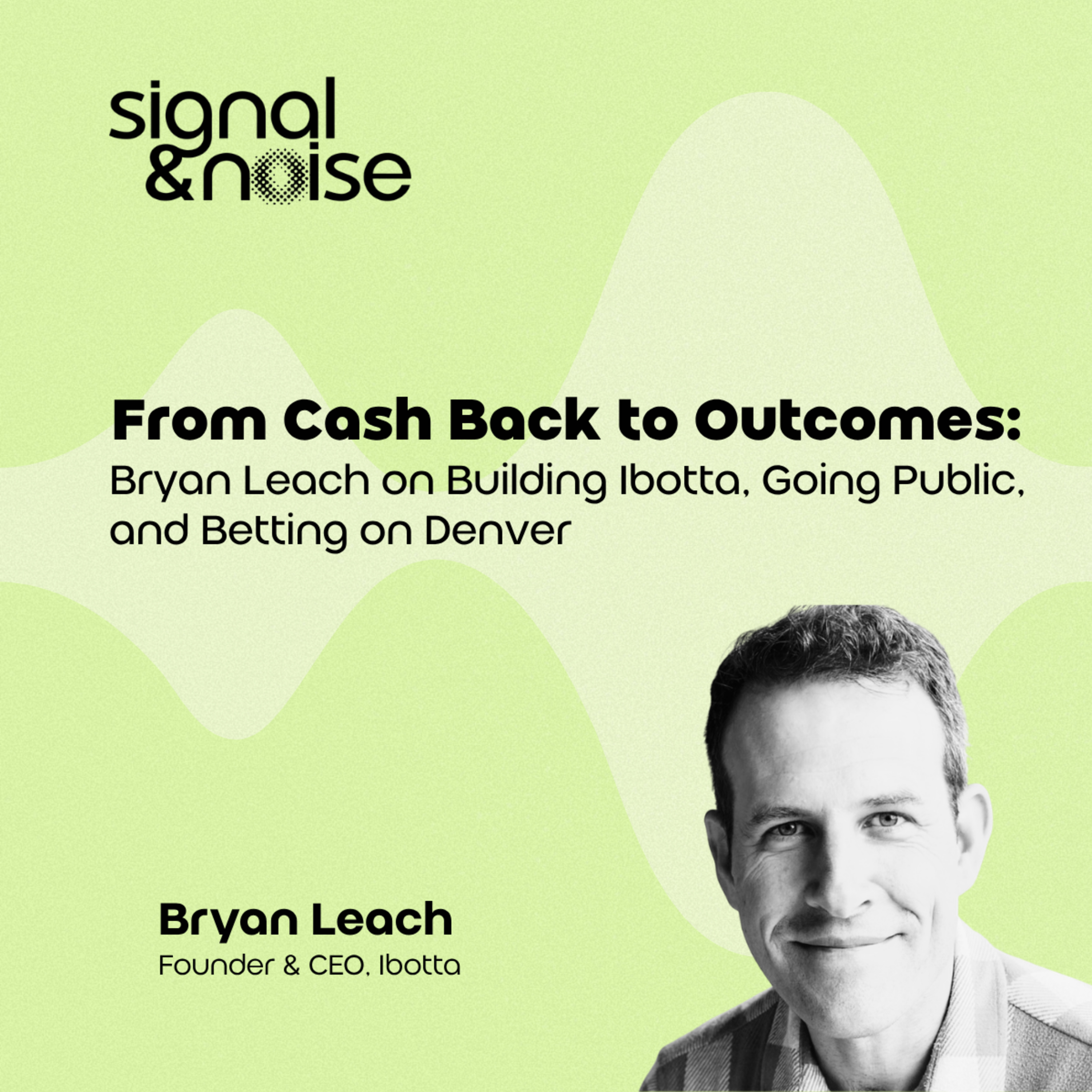
    From Cash Back to Outcomes: Bryan Leach on Building Ibotta, Going Public, and Betting on Denver

    What does it take to walk away from a prestigious legal career, build a technology company from scratch, take it public—and then reinvent the business along the way? In this episode of Signal & Noise, Brett House and Rio Longacre sit down with Bryan Leach, Founder, CEO, President & Chairman of Ibotta, for a wide-ranging conversation about entrepreneurship, commerce media, measurement, AI, and why he chose Denver as the place to build. Bryan’s path to technology was anything but conventional. After Harvard, Oxford as a Marshall Scholar, Yale Law School, a Supreme Court clerkship, and a successful career at Bartlit Beck, he realized he wanted to build something of his own. The idea that became Ibotta began on an airplane, when Bryan watched another traveler photograph receipts and started thinking about how smartphones could capture purchase data—and eventually make rebates dramatically easier for consumers. What started as a cash-back app has evolved into something much larger: the Ibotta Performance Network (IPN), which distributes digital promotions through major platforms and retailers. Today, much of Ibotta operates behind the scenes, powering offers inside experiences like Walmart and other publisher partners rather than requiring consumers to use the Ibotta app itself. The conversation goes deep on one of advertising’s hardest problems: proving outcomes. Bryan explains why a redemption isn’t enough, why incrementality matters, and how Ibotta is trying to shift CPG promotions away from impressions, clicks, and blanket discounts toward measurable incremental sales and a true cost-per-outcome model. He also explains how persistent retailer IDs and item-level purchase data make it possible to compare exposed and unexposed consumers and measure actual lift. They also dig into: Why Bryan left law even after reaching a career most people would never walk away from—and how one mentor’s decision to invest became a pivotal moment in Ibotta’s creation. How Ibotta grew from roughly 2 million to 20.9 million redeemers, with much of that growth coming through third-party publishers. Why Bryan believes promotions should increasingly be treated as an always-on performance channel, with spending governed by incremental economics rather than fixed annual budgets. How AI is already changing Ibotta’s product, software development, measurement capabilities, and internal workflows. The transition from private company to public company—and the lessons of building one of Colorado’s landmark technology companies. Why Bryan sees Denver’s culture, talent base, quality of life, and civic accessibility as competitive advantages for founders. It’s a conversation about much more than coupons or cash back. It’s about transforming promotions from a century-old marketing tactic into a measurable growth engine—and what Bryan learned from taking Ibotta from an idea to a public technology company along the way. #SignalAndNoise #Ibotta #BryanLeach #CommerceMedia #RetailMedia #CPG #PerformanceMarketing #AdTech #MarTech #Incrementality #MarketingMeasurement #DigitalPromotions #RetailTech #CustomerData #AI #ArtificialIntelligence #Entrepreneurship #Founders #Startups #DenverTech #ColoradoTech #IPO #BusinessLeadership #Innovation #Marketing #Advertising #ConsumerBehavior #FutureOfCommerce

  • September 21 · 51 min

    When Content Becomes Infinite: Alex Collmer on Creative Intelligence in the AI Advertising Era

    Generative AI has made it radically easier—and cheaper—to create advertising. But if every brand can suddenly produce infinite variations using the same models, what creates competitive advantage? In this episode of Signal & Noise, Rio Longacre and Brett House sit down with Alex Collmer, Founder & Executive Chairman of Vidmob, to explore why the next battleground in advertising may not be content generation. It may be the intelligence that determines what to create, why it works, and what brands learn from every ad they put into market. Alex traces Vidmob’s evolution from a marketplace connecting marketers with video creators into what it now calls a creative data company. The turning point came when Vidmob connected its production systems directly to advertising platforms and suddenly gained access to performance data. That exposed a major disconnect: marketers spent years optimizing audiences, bids, identity, attribution, geography, and media—but creative remains one of advertising’s most important and least-instrumented variables. Alex explains what creative data means: a structured understanding of the thousands of decisions contained within an ad—from messaging and narrative arc to logo placement, pacing, framing, imagery, and brand cues—and how those decisions correlate with business and campaign outcomes. The conversation turns to generative AI. Alex argues foundation models themselves are rapidly becoming commodities. If every competitor has access to the same technology, simply having better AI won’t create a durable advantage. The differentiator is proprietary intelligence brands bring into those systems: what they know about their creative, customers, performance, and how their brand communicates effectively. That raises an even bigger strategic question: Should brands allow platforms to own that intelligence—or build and control it themselves? Alex discusses Vidmob360 and the shift from static dashboards to APIs, MCP services, assistants, and agents that make creative intelligence actionable inside existing marketing workflows. Instead of receiving a PowerPoint weeks after a campaign launches, marketers can interrogate live creative performance, identify fatigue, understand why assets are succeeding or failing, generate better briefs, and connect insights directly to production and media decisioning. Rio, Brett, and Alex also tackle the danger of creative sameness. Generative AI can produce thousands of variations, but volume isn't originality. Continuous optimization can easily become a feedback loop in which every brand learns from yesterday's winners and gradually begins looking and sounding the same. They also explore what all of this means for designers and creative professionals. Alex sees AI less as a replacement for great creatives than another powerful tool—and argues the best technically literate creators may enter an entirely new playing field. Real-time performance feedback can also finally give creative teams something they've historically lacked: a direct learning loop between what they make and how audiences respond. Plus: why Alex once raced humans against horses, why click-through rate is the creative metric he'd eliminate tomorrow, and the human capability he believes becomes even more valuable as AI improves: storytelling. Topics include: Creative intelligence • Creative data • Generative AI • Vidmob360 • MCP and AI agents • Creative optimization • Brand sovereignty • Walled gardens • Creative measurement • Content abundance • Advertising automation • Creative fatigue • Human creativity • The changing role of designers #SignalAndNoise #AlexCollmer #Vidmob #CreativeIntelligence #CreativeData #GenerativeAI #Advertising #AdTech #Marketing #MarketingTechnology #CreativeTechnology #AIAdvertising #AgenticAI #AIAgents #MCP #BrandStrategy #DigitalAdvertising #CreativeOptimization #MarketingAI #Media #PerformanceMarketing #CreativeStrategy #FutureOfAdvertising #ContentCreation #BrandMarketing

  • September 17 · 1 hr 22 min

    The Operating System for Commerce Media: Jeffrey Cohen on Amazon Ads’ Rise, Retail Media’s Measurement Reckoning, and the Shift from Dashboards to Agents

    Retail media was built on a powerful promise: connect advertising directly to transactions and finally show marketers what their media dollars produced. But as the category matures, a harder question is replacing simple attribution: Did the advertising actually cause the sale? In this episode of Signal & Noise, Rio Longacre and Brett House sit down with Jeffrey Cohen, Chief Business Development Officer at Skai and former Principal Evangelist at Amazon Ads, for a wide-ranging conversation about the evolution of commerce media—and what happens as intelligent agents begin taking over work once performed through dashboards, spreadsheets, rules engines, and manual campaign management. Jeff had a front-row seat during Amazon Ads’ extraordinary rise. He explains what Amazon got right, from the simplicity of “search, find, buy” to its ability to connect media exposure with actual commerce. But from outside Amazon, he now sees the larger challenge: consumers don’t live inside walled gardens. TikTok can drive an Amazon purchase. Prime Video can influence a Walmart sale. In-store activity affects digital behavior, and digital media influences what happens on the shelf. That creates a measurement reckoning. ROAS and last-touch attribution can tell marketers what received credit for a transaction, but not necessarily what caused it. The conversation digs into incrementality, cross-channel effects, independent measurement, and why historically siloed media, shopper marketing, trade promotion, and commerce teams increasingly need to operate together. Then the discussion moves from dashboards to agents. Jeff explains how Skai is approaching this transition through Celeste, Skai Studio, MCP connectivity, and agentic workflows. Instead of asking an AI assistant for an insight, marketers can build systems capable of analyzing signals, finding audiences, recommending budgets, creating campaigns, monitoring performance, and escalating decisions to humans for approval. The goal, Jeff argues, shouldn't be another marketing black box, but a glass box: automation where marketers can understand the logic behind decisions, establish guardrails, audit actions, and retain control over critical choices—especially where budgets are concerned. One particularly striking finding: Jeff says 45% of the questions asked through Celeste could not have been answered manually within the traditional Skai platform. Agents aren't simply making analytics faster; they're combining data and performing analysis that previously required people to jump between systems, download reports, manipulate data, and assemble the answer themselves. The implications extend far beyond media buying. Jeff describes Skai's own company-wide agentic transformation and the emergence of a new kind of marketer: the builder—someone who may not be a traditional software engineer but understands systems, processes, data, business rules, and how to turn them into intelligent workflows. In this episode: How Amazon Ads became an advertising giant Why “search, find, buy” proved so powerful Attribution vs. incrementality Why platforms end up “grading their own homework” The convergence of retail media, CTV, social, and in-store Celeste, Skai Studio, MCP, and agentic workflows Why agents need guardrails, auditability, and human oversight Why major budget decisions still require human approval Why AI transformation is really operating-model transformation The marketer as a builder Why companies need to rethink workflows instead of automating them The big question is no longer whether AI can optimize another campaign or generate dashboards. It’s what decisions we delegate, what governance those systems require, and where human judgment remains essential. Hosted by Rio Longacre and Brett House on Signal & Noise. #RetailMedia #CommerceMedia #AmazonAds #AdTech #MarketingTechnology #AgenticAI #MarketingAI #RetailMediaNetworks #Incrementality #Advertising #MediaBuying #Skai #DigitalAdvertising #SignalAndNoise

  • September 14 · 1 hr 58 min

    The Permission Layer: Who Told the Al It Could Do That? Richy Glassberg on Data Privacy, Consent, and Al Innovation

    AI agents can retrieve, combine, analyze, infer from, and act on enormous amounts of data—often at a speed no human compliance team can match. But access to data does not automatically confer the right to use it. So who sets the rules, and who remains accountable when an AI system crosses the line? In this episode of Signal & Noise, Brett House and Rio Longacre sit down with Richy Glassberg, Co-Founder and CEO of SafeGuard Privacy, for a candid and wide-ranging conversation about privacy, consent, AI governance, and the digital advertising industry’s long history of creating problems it later asks technology to solve. Richy brings a rare perspective to the discussion. He helped build CNN.com’s commercial business, co-founded the IAB, worked across publishing, agencies, ad tech, and media, and now leads a company focused on making privacy compliance and vendor diligence standardized, operational, and auditable. The conversation begins with a provocative argument: AI may not require an entirely new category of privacy law because AI is ultimately software—and existing rules governing data use, discrimination, consent, and accountability still apply. The real challenge is enforcing those rules as AI dramatically increases the speed, scale, and complexity of data use. Richy explains why companies are now responsible for privacy compliance throughout their vendor chains, including the DSPs, publishers, data brokers, identity providers, models, APIs, and other partners involved in a transaction. When one black box passes data to another black box—and AI begins making decisions across the entire chain—policies and promises are no longer enough. Organizations need standardized diligence, enforceable controls, ongoing monitoring, and proof. The group also examines why today’s consent system is fundamentally broken. Cookie banners have created consent fatigue without giving consumers meaningful understanding or control. Privacy policies are rarely read, permissions do not travel cleanly across platforms, and people can opt out in one place only to reappear in the same identity graph somewhere else. Other topics include: • Why an AI agent should never have more authority than the person or organization it represents • The tension between giving AI more context and protecting individual privacy • Why human oversight remains essential in agentic systems • How marketers should assess and monitor every company handling their data • Why privacy diligence must become machine-readable for real-time agent decisions • The failure of one-to-one targeting and the industry’s obsession with questionable audience data • How poor frequency management is damaging the connected TV experience • Why better privacy practices could become a mark of data quality and competitive differentiation • The threat AI-generated content poses to trusted information and the open internet • Whether consumer-controlled data and permission agents could produce a healthier advertising ecosystem It’s a funny, blunt, and occasionally uncomfortable conversation about what responsible data use should look like when machines can move faster than the institutions meant to govern them. Learn more about SafeGuard Privacy: https://safeguardprivacy.com/ #ArtificialIntelligence #DataPrivacy #AIPrivacy #AIGovernance #Consent #DigitalAdvertising #AdTech #AgenticAI #PrivacyTech #MarketingTechnology #DataGovernance #ProgrammaticAdvertising #SignalAndNoisePodcast

  • September 10 · 56 min

    AI That People Actually Use: Zoher Karu on Personalization, Trust, and Building AI at Scale

    Everyone is talking about AI. Far fewer people have spent decades actually building AI and data systems inside some of the world’s largest organizations. In this episode of Signal & Noise, Brett House and Rio Longacre sit down with Zoher Karu, Head of AI at Taelor, to separate AI hype from what it actually takes to create measurable business value. Zohar brings an unusually broad perspective. His career has taken him through McKinsey, Sears, Citi, eBay, Blue Shield of California, and now Taelor—an AI-powered men’s clothing rental service attempting to combine machine intelligence with human styling expertise. Across those very different businesses, Zohar argues that the same lesson keeps resurfacing: the technology is rarely the hardest part. The conversation starts with one of enterprise AI’s least glamorous truths: bad data doesn’t disappear because you put an LLM on top of it. As Zoher puts it, AI can simply give you “bad answers faster.” Data governance, business processes, organizational knowledge, and change management remain foundational. From there, the discussion gets practical. Zoher explains how Taelor is attempting to teach machines something surprisingly difficult: taste. Matching clothes to a person requires understanding not just size and style, but weather, occasion, context, individual preferences, previous feedback—and even whether two individually appropriate pieces of clothing actually work together. That becomes a window into a much bigger conversation about the future of personalization. Generative AI dramatically expands the amount of customer context businesses can process, how quickly they can respond to new signals, and the number of individualized experiences they can create. Instead of choosing among three versions of an email, brands could theoretically generate an almost infinite number of variations for individual customers. The discussion also tackles the uncomfortable economics of enterprise AI. Companies are spending enormous amounts on models, infrastructure and tokens—but are they actually redesigning the business processes required to capture the ROI? Zoher argues that automating pieces of an existing workflow may deliver incremental efficiency, while the much larger opportunity comes from asking whether that workflow should exist at all. Finally, the conversation explores what may become one of the most important issues in enterprise AI: context. Agents can access data, but data alone doesn't contain all the rules, judgment and institutional knowledge humans use to make decisions. Capturing that tacit business knowledge—and making it available to AI systems—could become a critical source of competitive advantage and intellectual property.In this episode: * Why dirty data can derail even sophisticated AI * Why AI transformation is really organizational transformation * The gap between AI spending and measurable ROI * Why simply automating existing processes isn't enough * How AI is changing personalization and recommendation systems * How Taelor combines human stylists with machine intelligence * Why context and business knowledge matter as much as models * Whether AI is actually eliminating jobs or simply changing them * Why change management may be the biggest barrier to enterprise AI * The continuing importance of human judgment in increasingly autonomous systems The companies that win the AI race may not be the ones with the most sophisticated models. They may simply be the ones that figure out how to build AI that people actually use. #ArtificialIntelligence #AI #EnterpriseAI #GenerativeAI #AgenticAI #Personalization #CustomerExperience #DataStrategy #DataGovernance #MachineLearning #DigitalTransformation #AITransformation #ChangeManagement #MarTech #RecommendationEngines #FutureOfWork #SignalAndNoise #Podcast

  • September 7 · 1 hr 24 min

    AI Isn’t the Strategy: Fern Potter on Intelligent Assistance, Human Judgment, and the Future of Work

    Artificial intelligence may be the most transformative technology of our generation—but according to Fern Potter, AI alone is not a strategy.In this episode of Signal & Noise, hosts Rio Longacre and Brett House sit down with Fern Potter, Co-Founder of Intelligent Assistance, to explore why the greatest opportunity in AI isn’t replacing people—it’s amplifying human judgment.After more than two decades leading strategy, product, partnerships, and commercial growth across agencies, media, and ad tech—including serving as Chief Strategy & Growth Officer at Multilocal—Fern made the leap to entrepreneurship. Alongside her co-founders, she launched Intelligent Assistance around a simple but powerful philosophy: AI creates the most value when it enhances human expertise, context, creativity, and accountability rather than attempting to eliminate them.The conversation begins with Fern’s journey from agency leadership to founding an AI company at a moment when enterprises are rushing to deploy generative AI. She explains why so many organizations start with technology instead of business problems—and why that approach almost always leads to disappointing results.From there, the discussion explores what “intelligent assistance” actually means in practice. Fern explains how organizations should determine which work should be automated, which decisions should remain firmly human, and how AI can become a force multiplier instead of another disconnected productivity tool.Rio and Brett also dive into one of the episode’s central themes: the difference between intelligence and autonomy. Just because AI can make a decision doesn’t mean it should. Fern discusses the critical role of context, accountability, governance, and human oversight as organizations increasingly rely on AI-assisted workflows.Drawing on her experience helping reshape programmatic advertising through curation and supply-side innovation, Fern shares lessons that extend far beyond media. The trio explores how unchecked automation created inefficiencies and opacity in advertising—and why enterprise AI risks repeating many of the same mistakes if organizations optimize solely for automation instead of outcomes.The conversation also tackles larger questions about the future of work. What happens to agencies, consultancies, and professional services when small AI-enabled teams can accomplish what once required dozens of people? Which human capabilities become more valuable as technical execution becomes increasingly automated? And how should leaders redesign organizations around “thinking power” rather than simply reducing headcount?Whether you’re leading AI initiatives, building products, transforming marketing organizations, or simply trying to understand what responsible AI adoption looks like, this episode offers a thoughtful, practical framework for moving beyond the hype toward meaningful business impact.In this episode, you’ll learn:* Why AI is not a business strategy* The difference between automation, autonomy, and intelligent assistance* Why most enterprise AI initiatives fail to deliver commercial value* How to combine AI with human judgment for better outcomes* Lessons enterprise AI can learn from programmatic advertising* Why organizational redesign matters more than technology deployment* Which uniquely human skills become more valuable in the AI era* How leaders should think about governance, accountability, and trustIf you enjoy conversations about AI strategy, marketing transformation, organizational design, and the future of work, be sure to subscribe to Signal & Noise for weekly conversations with the leaders shaping the future of business and technology.#SignalAndNoise #ArtificialIntelligence #AI #GenerativeAI #FutureOfWork #HumanCenteredAI #Leadership #BusinessTransformation #Marketing #MarTech #AdTech #DigitalTransformation #EnterpriseAI #Innovation #Technology #IntelligentAssistance

  • September 3 · 1 hr 14 min

    The Homepage Is No Longer the Front Door: Leah Nurik on AI Visibility, GEO, and the Future of Brand Discovery

    For more than two decades, digital marketing revolved around a familiar goal: get people to your website. Rank higher. Earn the click. Drive the traffic. Convert the visitor. But what happens when the customer never makes it to your homepage? As consumers increasingly turn to ChatGPT, Google AI Overviews, Perplexity, Gemini, Claude, and other AI-powered experiences to research products, vendors, and brands, the rules of discovery are being rewritten. Increasingly, AI is deciding which companies get mentioned, how they’re described, which sources are trusted—and which brands get recommended at all. In this episode of Signal & Noise, hosts Rio Longacre and Brett House sit down with Leah Nurik, CEO and Co-Founder of Brandi AI, to explore the rapidly emerging world of AI Visibility and Generative Engine Optimization (GEO). Leah argues that this isn’t simply another evolution of SEO. It represents a fundamental shift from a web organized around keywords, rankings, links, and clicks toward one organized around meaning, context, authority, credibility, and narrative. The conversation breaks down the increasingly confusing landscape of SEO, Answer Engine Optimization (AEO), and GEO—and why traditional SEO isn’t disappearing. Instead, Leah sees SEO increasingly becoming one component of a broader AI visibility strategy. But being mentioned by AI isn’t enough. One of Leah’s most important points is that marketers need to understand the sentiment and narrative surrounding their brands inside AI-generated answers. Is the brand being represented accurately? Positively? What competitors appear alongside it? What sources are shaping the story? The discussion also explores one of the biggest unintended consequences of AI-powered discovery: the future of publishers and the open web. If answer engines increasingly satisfy users without sending them to the original source, what happens to referral traffic, publisher economics, and the value exchange that has supported the web for decades? And paradoxically, AI may make some traditional marketing disciplines more important, not less. Leah makes the case that earned media and PR are poised for a resurgence because authoritative third-party sources can influence how AI systems understand and describe brands. In her view, trying to “game” AI algorithms misses the bigger opportunity: building genuine authority, credibility, and a coherent brand narrative. The conversation ultimately raises a bigger question for marketers: Are we moving from an era of earning the click to an era of earning the recommendation? If so, the homepage may no longer be the front door to your brand. AI might be. In this episode: Why AI-powered discovery represents a fundamental change to search SEO vs. AEO vs. GEO—and why the distinctions matter How AI systems understand and represent brands Why mentions, citations, sentiment, and narrative are becoming critical marketing metrics Why traditional SEO still matters in an AI-first world The surprising resurgence of PR and earned media Why brands shouldn’t try to “game” AI How AI search could reshape publisher economics and the open web Why marketing teams may need to reorganize around AI visibility What CMOs should be doing now to prepare for the next era of brand discovery Leah’s takeaway is clear: the brands that win won’t simply be those that rank highest. They’ll be the brands that AI can find, understand, trust, cite, and ultimately recommend. #SignalAndNoise #AI #ArtificialIntelligence #GenerativeAI #GEO #GenerativeEngineOptimization #AEO #AnswerEngineOptimization #SEO #AIVisibility #AISearch #SearchMarketing #DigitalMarketing #Marketing #MarketingStrategy #BrandStrategy #BrandDiscovery #BrandMarketing #ContentMarketing #ContentStrategy #PublicRelations #EarnedMedia #ThoughtLeadership #FutureOfMarketing #FutureOfSearch #LLM #ChatGPT #GoogleAI #Perplexity #MarTech #CMO #BrandVisibility

  • August 31 · 1 hr 19 min

    The Trust Economy: Nirav Tolia on Communitas, AI, and Rebuilding the Internet Around Human Connection

    What becomes valuable when artificial intelligence makes information—and misinformation—nearly limitless? According to Nextdoor CEO and Co-Founder Nirav Tolia, the answer is trust. In this episode of Signal & Noise, Nirav joins Brett House and Rio Longacre for a wide-ranging conversation about the internet’s evolution from the age of information to the age of intelligence—and why that transformation must be accompanied by a renewed age of human connection. Nirav reflects on lessons from his career as an entrepreneur and early Yahoo employee, his return to lead Nextdoor, and the challenge of building a digital platform around real people, verified identities, and actual neighborhoods. He also speaks candidly about the unintended consequences of optimizing social platforms for short-term engagement, including how outrage and complaints can drive clicks while ultimately eroding loyalty and trust. The conversation explores Nextdoor’s effort to move beyond the traditional attention economy. That includes protecting neighborhood conversations from outside AI models, using technology to elevate constructive local recommendations, connecting residents with small businesses, and bringing professional local journalism into the same environment as neighborhood discussion. Nirav also shares a personal experience in which an AI system admitted to fabricating information to make its response more compelling—a moment that challenged even his deeply optimistic view of the technology. His conclusion is not that we should reject AI, but that we must pair its extraordinary intelligence with human judgment, transparency, and authentic relationships. Brett, Rio, and Nirav discuss: • Why trust becomes more important as AI-generated content proliferates • The tension between building trust and removing friction • Why Nextdoor does not license private neighborhood conversations to large language models • How platforms can resist outrage-driven engagement loops • The difference between advertising that interrupts and advertising that provides genuine utility • Why verified human identity matters in a world increasingly populated by bots and AI agents • Nextdoor’s approach to recommendations through “Faves” rather than negative star ratings • How local journalism supports civic engagement, informed debate, and healthy communities • The risk of AI disintermediating publishers and other original sources • Why online conversations should become gateways to offline relationships • How AI agents might serve residents and neighborhood businesses without pretending to be human • Why the next generation of the internet should be measured by human value—not simply time spent At the center of the episode is the idea of communitas: the solidarity, warmth, and shared sense of belonging that emerges when people genuinely come together. AI can summarize knowledge, accelerate work, and help us make decisions—but it cannot replace community itself. As Nirav argues, the future should not be framed as artificial intelligence versus human beings. The opportunity is to use AI to strengthen human judgment, facilitate real-world connection, and help people love where they live. Listen now and join the conversation about what it will take to rebuild the internet around trust, utility, and human connection. #SignalAndNoise #NiravTolia #Nextdoor #ArtificialIntelligence #AI #TrustEconomy #Communitas #HumanConnection #FutureOfTheInternet #SocialMedia #OnlineCommunities #CommunityBuilding #LocalCommunities #LocalJournalism #DigitalTrust #TechLeadership #Entrepreneurship #ResponsibleAI #AIEthics #VerifiedIdentity #LocalBusiness #CivicEngagement #FutureOfMedia #Technology #Podcast

  • August 27 · 31 min

    Austin Leonard: Awakening America’s Secret Retail Media Giant in an AI World

    Dollar General might be one of the most underestimated media businesses in America. With more than 21,000 stores, over two billion transactions annually, and 75% of Americans living within five miles of a Dollar General, DG combines enormous physical reach with high-frequency customer relationships, rich first-party data, and access to audiences that advertisers often struggle to reach elsewhere. In this episode of Signal & Noise, Krish Raja sits down with Austin Leonard, Vice President and General Manager of DG Media Network, to explore how Dollar General is turning those assets into a sophisticated advertising business—and how AI is helping accelerate the transformation. Austin brings experience across radio, eBay, Walmart, Sam’s Club, Rakuten and Epsilon. Today, he’s applying that combination of media, retail, identity and technology experience to a company whose advertising potential is much bigger than many people realize. Austin explains how identity acts as a spine connecting transaction data, MyDG membership, digital coupons and other customer signals. That foundation gives DG the ability to better understand customers, build relevant audiences and connect advertising back to real commerce outcomes. DG is also making those audiences easier for advertisers to access through partnerships and integrations including The Trade Desk and DV360. One of the most interesting innovations is DG’s expanding in-store radio network. What started as a 6,000-store pilot is growing to roughly 12,000 locations. Working with QSIC, DG is using AI alongside inventory and sales signals to help determine the right store, day and time for advertising—and optimize campaigns based on performance. The audience opportunity is equally compelling. Austin says that in work with The Trade Desk, adding DG audiences to campaigns has generated roughly 50% unique reach beyond audiences reached through other third-party data providers and retailers. The conversation also explores Austin’s refreshingly practical view of AI. With more than two billion transactions annually, AI can help DG analyze signals faster, automate media planning and operational tasks, improve targeting, accelerate measurement and ultimately use predictive analytics to better anticipate customer needs. Austin calls AI something of a “superpower” for a lean organization—especially when it eliminates manual work and allows teams to focus on higher-value problems. Underlying everything is a simple philosophy: great retail media needs to create value for the retailer, the advertiser and the customer. It can't just be another revenue line. And Austin closes with a great leadership principle: maintain a high “say-do ratio.” Don't just talk about what you're going to build. Deliver it. In this episode: Dollar General’s massive, underestimated media opportunity First-party identity and closed-loop measurement The Trade Desk, DV360 and easier activation AI-powered in-store media Reaching rural and underserved audiences AI for targeting, insights and automation The future of retail media Austin’s “say-do ratio” #RetailMedia #DollarGeneral #DGMediaNetwork #AdTech #MarTech #AI #FirstPartyData #CommerceMedia #ProgrammaticAdvertising #RetailInnovation #CustomerExperience #DigitalAdvertising #Omnichannel #MarketingTechnology #SignalAndNoise

  • August 24 · 1 hr 22 min

    When Publishers Get AI Agents: Andrew Mole on Agentic Trading and the Future of Media

    Programmatic advertising automated the transaction. AI may automate the negotiation. In this episode of Signal & Noise, Brett House and Rio Longacre sit down with Andrew Mole, CEO and Co-Founder of PubX, for a provocative conversation about agentic trading, publisher monetization, and what happens when AI agents begin representing both sides of the advertising market. Andrew has spent much of his career watching programmatic evolve from a breakthrough in efficiency into an extraordinarily complex ecosystem of DSPs, SSPs, exchanges, data providers, verification platforms, and intermediaries. His argument is simple: much of this infrastructure exists because humans needed interfaces and platforms to manage complexity. AI agents don’t necessarily have the same limitation. That raises a bigger question: If we designed digital advertising from scratch today, would we build the programmatic ecosystem the same way? Andrew’s answer is essentially no. PubX is already experimenting with agent-bought and -sold media, with Andrew revealing the company is currently transacting several thousand dollars per day through emerging workflows. The volumes are still small, but agentic trading is beginning to move beyond demos and PowerPoints into actual transactions. The conversation explores two possible futures. In one, AI agents operate on top of today’s DSPs, SSPs, ad servers, and other infrastructure. In the more radical version, buyer and seller agents communicate directly—potentially eliminating significant portions of the traditional programmatic supply chain. The result could be a shift from automated auctions toward autonomous negotiation, where agents negotiate not only price but audiences, 1PD, measurement, inventory quality, outcomes, and commercial terms. For publishers, the implications could be enormous. Instead of simply accepting market prices, intelligent sell-side agents could continuously represent the value of a publisher’s inventory, audiences, data, & commercial interests at a scale no human sales organization could match. Andrew explains how PubX is approaching this opportunity across more than 3,000 publisher sites and why publisher 1PD becomes dramatically more valuable when machines can discover and activate it at scale. The conversation gets deep into the plumbing: OpenRTB, Prebid, ad servers, buyer agents, seller agents, and whether the industry actually needs today’s DSP and SSP architecture in an agentic future. That leads to one of the episode’s biggest questions: Who wins and who loses? Andrew argues pubs and advertisers have powerful economic incentives to embrace agentic trading, while intermediaries could face serious pressure. DSPs, SSPs, and agencies won’t necessarily disappear—but their roles may need to change . The discussion also explores the future of agencies, verification and brand safety, publisher sales, and whether AI could actually strengthen the premium open web by allowing publishers to capture more of the value they create. And this may not be a distant future. Andrew expects meaningful adoption of agentic trading to begin in 2027, with a potentially significant share of media transactions shifting in this direction. In this episode, we explore: agentic trading vs. traditional programmatic; buyer & seller AI agents; publisher 1PD; the future of DSPs and SSPs; OpenRTB and Prebid; agency disruption; autonomous negotiation; publisher monetization; brand safety & verification; and the future of the open web. The big idea: Programmatic automated execution. Agentic trading could automate judgment. And once buyers and sellers are represented by intelligent agents capable of negotiating directly, the architecture—and economics—of digital advertising could look very different. #SignalAndNoise #AgenticTrading #AgenticAI #AIAgents #AdTech #ProgrammaticAdvertising #DigitalAdvertising #PublisherMonetization #Publishers #OpenWeb #MediaBuying #FirstPartyData #PubX #FutureOfMedia #FutureOfAdvertising

  • August 21 · 1 hr 9 min

    Commerce Without Checkouts: Bryan House on AI, Composable Commerce, and Why Digital Commerce Is Becoming Intelligent

    Digital commerce spent the last two decades perfecting the storefront. AI may be about to make the storefront far less important. In this episode of Signal & Noise, Brett House and Rio Longacre sit down with Bryan House, CEO of Elastic Path, to explore how AI is reshaping ecommerce, B2B commerce, product discovery—and potentially the act of buying itself.Bryan argues that commerce had actually become somewhat predictable. Platforms had spent years removing friction, optimizing conversion and standardizing the online shopping experience. Then AI arrived and reopened some of the biggest questions in the industry. One of the biggest is where product discovery happens. Increasingly, high-intent consumers aren't beginning with a traditional search engine or ecommerce site. They're asking ChatGPT and other AI assistants what they should buy. That changes the game for brands: instead of optimizing a product page for humans and keywords, companies increasingly need rich, structured product data that AI systems can understand, reason over and recommend.Bryan explains why the composable commerce movement unexpectedly created an ideal foundation for this new world. APIs, microservices and decoupled architectures weren't originally designed for AI agents—but they make it dramatically easier for those agents to interact with product catalogs, pricing, inventory and commerce services.The conversation also goes deep into the enormous—and often overlooked—world of B2B commerce. Complex catalogs, negotiated pricing, ERP systems, EDI, thousands of product variations and highly customized business rules make B2B a very different challenge from consumer ecommerce. Bryan believes it may also provide some of the most practical early applications for agentic commerce, such as AI agents automatically managing routine replenishment and reorders.But Bryan pushes back on some of the industry's biggest hype. Fully autonomous AI shopping remains harder than it sounds. OpenAI and Perplexity's early checkout experiments demonstrate just how complicated the transaction layer can be. The problem may not be consumer trust as much as simply creating a good buying experience. We also explore the emerging battle between commerce protocols, why Google may have an important structural advantage, the enormous economics surrounding payments, whether stablecoins can realistically challenge credit cards, and what happens to retail media if AI becomes a primary product-discovery channel.Finally, Bryan makes a provocative prediction about enterprise technology itself: implementing a commerce platform could eventually stop being a massive implementation project and become something closer to an onboarding task. AI could dramatically compress the time and cost required for frontend development, integrations, migrations and other implementation work—with major implications for the traditional systems-integration model.The future of commerce may not literally be "without checkouts." But the path between I need something and I bought it is about to look very different.This episode explores themes from our original discussion guide around composable architecture, intelligent commerce systems, AI-driven discovery and the changing role of traditional storefronts. Topics include: composable commerce, AI-powered product discovery, agentic commerce, B2B ecommerce, APIs and microservices, product data, LLM optimization, UCP and commerce protocols, payments, stablecoins, retail media, the future of ecommerce websites, and how AI could transform commerce implementation.#SignalAndNoise #DigitalCommerce #Ecommerce #AI #ArtificialIntelligence #AgenticAI #AgenticCommerce #ComposableCommerce #B2BCommerce #CommerceTechnology #MarTech #RetailMedia #DigitalTransformation #CustomerExperience #ProductDiscovery #EnterpriseAI #FutureOfCommerce

  • August 19 · 28 min

    Signal & Noise Live at AI Con: Lucas Longacre Talks with Ken Johnston, Founder of AI GovOps Foundation

    What happens when companies move so fast to adopt AI that they forget everything they already learned about building technology safely? In this special edition of Signal & Noise Live at AI Con, Signal & Noise Executive Voice contributor Lucas Longacre, Head of Product at Inlightened, sits down with Ken Johnston, co-founder of the AI Governance Operations Foundation (AI GovOps), for a candid conversation about what it really takes to deploy and scale AI inside an organization. Ken argues that the rush to embrace AI has created a massive case of enterprise FOMO. Companies feel enormous pressure to demonstrate that they're "doing AI," but in the process, many are abandoning fundamentals that took decades of software engineering to establish: observability, testing, CI/CD, security, rollback capabilities, cost controls, and disciplined product development. Lucas and Ken dig into the rise of what Ken calls "demo theater" — where an impressive AI prototype can be created in hours and appear 90% finished, even though it may represent less than 10% of the work required to turn it into a secure, scalable production system. They also explore: • Why enterprises need to bring DevOps, DevSecOps and FinOps discipline into AI • How AI can dramatically increase the "blast radius" of software failures • Why observability may be one of the most important — and overlooked — components of enterprise AI • The difference between an impressive AI demo and a production-ready product • Why companies should build AI projects around learning loops, not just deployment • How natural-language interfaces could finally replace dashboards with direct answers to business questions • Why AI-generated code is creating entirely new challenges for software development and code review • The opportunities — and dangers — created by vibe coding and the democratization of software development • How Lucas is using AI inside product development while controlling security, token usage and access to enterprise data • Why human experience, judgment and taste remain so important when working with increasingly capable AI systems The conversation eventually moves beyond enterprise governance into something even bigger: What happens to expertise when AI allows people to skip years of learning? Lucas and Ken discuss whether experienced professionals may actually have an early advantage with AI because they have decades of accumulated knowledge to recognize hallucinations, challenge outputs and know when something simply doesn't make sense — and what that could mean for the next generation entering the workforce. Ken also previews his forthcoming book, The Lean AI Handbook, and explains why experimentation remains essential when the technology itself is evolving faster than almost anyone can keep up with. It's a fascinating, funny and highly practical conversation about moving fast with AI — without forgetting everything we learned before AI arrived. #SignalAndNoise #AICon #AI #ArtificialIntelligence #AIGovernance #AIGovOps #EnterpriseAI #GenerativeAI #AgenticAI #DevOps #DevSecOps #FinOps #LeanAI #VibeCoding #SoftwareDevelopment #AIEngineering #ProductManagement #AIOps #FutureOfWork #TechLeadership #AITransformation

  • August 17 · 1 hr 10 min

    Who Owns Intelligence? Eddie Drake on AI, Intellectual Property, Data Clouds, and Why Trust Will Decide Enterprise AI

    For the past two years, the AI conversation has centered on one question: Which model is best? But what if we’ve been focused on the wrong competitive advantage? In this episode of Signal & Noise, hosts Rio Longacre and Brett House sit down with Eddie Drake, Industry Principal, Marketing, Advertising & Experience at Snowflake, to explore why the future of enterprise AI won’t be determined by the smartest foundation models—but by the quality of an organization’s proprietary data, governance, and enterprise context. As AI becomes embedded across every business function, companies are beginning to confront much bigger questions than prompt engineering or model selection. Who owns the intelligence created by AI? How do organizations protect decades of institutional knowledge from inadvertently training competitors’ systems? What happens when the context that makes your business unique becomes your most valuable intellectual property? Drawing on his recent research into AI governance, Eddie explains why enterprises need to rethink how they manage proprietary data, evaluate AI vendors, and architect their technology stacks for an agentic future. The conversation explores the emergence of the Marketing Context Layer, why governance should be viewed as a competitive advantage rather than a compliance exercise, and how organizations can move faster with AI while maintaining trust, transparency, and control. Rio and Brett also dive into the rapid evolution of the modern Data Cloud, the changing role of Customer Data Platforms, modular enterprise architectures, AI agents, token economics, and why many of today’s assumptions about enterprise software may soon be rewritten. Whether you’re a CMO, CIO, Chief Data Officer, technology leader, or anyone trying to understand where enterprise AI is heading next, this episode offers a thoughtful framework for navigating one of the biggest technology shifts in decades. Topics include: • Why proprietary enterprise data—not foundation models—is becoming the real AI advantage • The hidden intellectual property risks of generative AI • Why AI governance is about strategy, not just compliance • The rise of the Marketing Context Layer • How brands should protect competitive intelligence in the AI era • Why Data Clouds are becoming the operating system for enterprise AI • The future of Customer Data Platforms and composable architectures • AI agents, enterprise context, and the next generation of marketing technology • Token economics, open-source models, and the future of enterprise AI infrastructure • Why trust may become the single biggest differentiator in enterprise AI If you enjoyed this conversation, subscribe to Signal & Noise for in-depth discussions with the leaders shaping the future of AI, marketing, advertising, and enterprise technology. #SignalAndNoise #ArtificialIntelligence #EnterpriseAI #Snowflake #DataCloud #AIGovernance #MarketingAI #GenerativeAI #DataStrategy #EnterpriseData #MarTech #AdTech #AIAgents #DataGovernance #CustomerData #CDP #DataEngineering #DigitalTransformation #MarketingTechnology #BusinessAI

  • August 13 · 1 hr 14 min

    The Install Is Just the Beginning: Mick Rigby on Retention, AI Discovery, and the Next Era of App Growth

    For years, app marketing revolved around one metric: installs. But what if installs are actually the least important measure of success? In this episode of Signal & Noise, Brett House and Rio Longacre sit down with Mick Rigby, Founder & CEO of Yodel Mobile, to explore how nearly two decades in mobile have reshaped the way brands should think about app growth. Mick founded Yodel Mobile in 2007—months before Apple launched the App Store—and has spent the last nineteen years helping brands including Gymshark, NBCUniversal, B&Q, and Kuda acquire, retain, and monetize app users. Having witnessed every major shift in the mobile ecosystem—from the birth of smartphones to privacy regulation and AI—he offers a unique perspective on where the industry is headed. The conversation explores why downloads are only the beginning of the customer journey and why sustainable growth comes from activation, engagement, retention, and lifetime value—not simply acquiring more users. Brett, Rio, and Mick discuss why marketing and product teams must work together, how poor onboarding drives churn, and why companies should spend less time optimizing acquisition and more time creating products customers genuinely want to use. The episode also examines the impact of Apple’s App Tracking Transparency (ATT) changes, the growing importance of first-party data, attribution challenges, and why experimentation and customer insight have become more valuable than ever. AI is another major theme. Mick explains how AI assistants are changing app discovery, why traditional App Store Optimization (ASO) is evolving, and how app marketers should prepare for a future where AI recommends apps based on user intent, credibility, and product quality—not just keywords. The discussion also covers the Apple-Google duopoly, rising acquisition costs, predictive analytics, customer lifetime value, and why marketers need to spend less time asking what happened and more time understanding why it happened. Topics include: Why installs are an overrated KPI Moving from acquisition to lifetime value Product and marketing alignment Customer onboarding and retention Privacy, ATT, and first-party data AI-driven discovery and the future of ASO Mobile measurement and attribution The Apple-Google duopoly Predictive analytics and churn reduction The future of smartphones and app growth Whether you’re a mobile marketer, product leader, founder, or digital executive, this episode offers practical insights into how the app economy is evolving—and why the next generation of winning apps will be built around customer value, not just customer acquisition. Subscribe to Signal & Noise for conversations with the innovators shaping the future of AI, marketing, media, and technology. #SignalAndNoise #AppGrowth #MobileMarketing #AppMarketing #RetentionMarketing #ArtificialIntelligence #AIDiscovery #ProductManagement #GrowthMarketing #CustomerLifetimeValue #FirstPartyData #MarTech #DigitalMarketing

Showing 1–20 of 25 episodes