Skip to content
Artwork for Securing the Sanctuary-Christian Warrior Training
EducationReligion & SpiritualityChristianity

Securing the Sanctuary-Christian Warrior Training

Keith Graves

Join Christian Warrior Training for practical insights and training resources on church security. Our articles and videos empower church security teams to better protect their congregations and communities.

www.christianwarriortraining.com
Play
  • 29 episodes
  • Avg 16 min
  • English
Counted on this page — what you have heard stays on this device, so it is not something the list can be paged by.
  • Yesterday · 29 min

    Armed Parent Broke Oregon Law to Stop the Bend School Shooter

    These debriefs are made possible by paid subscribers. Please consider upgrading your subscription. Status as of Friday, October 16, 2026. Information is preliminary. Bend Police scheduled another press conference for this afternoon and said more information about the community member who stopped the suspect would likely be released today. Bottom Line Up Front (BLUF) On Thursday, October 15, a man sitting in a pickup in the Silver Rail Elementary School parking lot saw the suspect carrying a long gun toward the building and confronted him. The suspect fired multiple rounds into the truck, went over the school fence, and shot through the locked doors of the school’s secure entry vestibule. Witnesses place him in the special education area of the building. He killed three children and a teacher and critically wounded a child and a second teacher. An armed parent, reported to hold a valid concealed handgun license, saw him enter, followed him inside, and shot and killed him. Bend-La Pine Schools bans concealed handgun license holders from carrying on its school grounds, and Oregon law makes carrying there a crime. The only legal way to have a gun on that campus was unloaded and locked in a vehicle, and a parent who went to the car, loaded the gun, and came back inside to stop the suspect would still have broken the law. Bend Police officers arrived about three minutes after the first 911 call and found the suspect already dead. An armed parent carrying his firearm against Oregon law stopped this attack before police arrived. What Happened Silver Rail Elementary is a kindergarten through fifth grade school at 61530 SE Stone Creek Lane in southeast Bend with about 450 students and 40 staff. Shortly before 1:00 p.m. Pacific time, a man was sitting in his red Toyota Tacoma idling in the school parking lot when he saw the suspect carrying a long gun toward the building. The man confronted him. The suspect fired multiple rounds into the truck, putting at least five holes in the passenger side door and bed and shattering the rear passenger window. Reporting citing The Oregonian says the suspect then threw the gun over the school fence, climbed over after it, and moved toward the building. The driver called 911 at 12:59 p.m. and reported being shot at multiple times by a person with a long gun. Bend-La Pine Schools equips its buildings with secure entry vestibules. A visitor enters a locked outer area, signs in with photo identification, and is buzzed through a second electronic door. Bend Police Chief Mike Krantz said the suspect forced his way in by shooting at the locked doors, and The Oregonian reports he shot the locks out of the vestibule. Within the next minute, dispatchers received dozens of 911 calls that a shooter was inside, and at 1:00 p.m. dispatch sounded an alert tone to all law enforcement. A fifth-grade teacher, Kathy Sheil Smith, told KPTV she saw the gunman approaching the grounds with a long gun, called the school’s main office to report it, and moved her students into a corner of the room, where they stayed quiet. The school was directed into lockdown at 1:01 p.m. By that point the suspect was already inside. Witnesses told the Bend Source the gunman went into the special education area of the school, where at least three more shots were heard. The first Bend Police officers arrived at 1:02 p.m. Moments later an officer reported that the suspect had been shot by a community member who had seen him enter the school, pursued him inside, and engaged him. The initial emergency medical services radio dispatch said the shooter appeared to have been neutralized, possibly by a father at the school. Officers entered, confirmed the suspect was dead, cleared the building for other threats, rendered aid, and evacuated the school room by room. Three children, ages 5, 8 and 11, and one teacher were killed. A 7-year-old child and a 54-year-old teacher were taken to St. Charles Medical Center in Bend with critical injuries. Police said all victim families have been notified. No victim names have been released. Bend Police sent a public alert at 1:17 p.m. telling people to avoid the area, and about 10 minutes later announced that families should report to Journey Church, 61303 S Highway 97. All students and staff were transported to the church, and reunification ran until about 5:45 p.m. Nearby Caldera High School and Jewell Elementary also went into lockdown. The Federal Bureau of Investigation (FBI) Portland field office is assisting, agents from the Bureau of Alcohol, Tobacco, Firearms and Explosives (ATF) were reported en route, and federal officials told NBC News the Oregon State Police may become the lead investigating agency. Chief Krantz said investigators will remain at the school for several days. All Bend-La Pine Schools are closed today. Suspect Information Police have identified the suspect only as a 16-year-old male. He was killed at the scene. Police have not released his name, a motive, whether he attended Silver Rail, or whether he knew anyone there. Chief Krantz declined to name the weapon or the number of rounds fired, citing the investigation. The Associated Press, citing a law enforcement official briefed on the case, reported the weapon was a pump-action shotgun purchased by the suspect’s mother. Multiple law enforcement sources told CBS News the weapon was a shotgun. Bend Police have not confirmed either report. Who Stopped the Shooter A community member stopped the suspect before police arrived. Bend Police describe the person as a community member who saw the suspect enter the school, pursued him into the building, and engaged him. The Spokesman-Review, carrying reporting from The Oregonian, reports the community member is the parent of a student or students at the school, and the first emergency medical services dispatch described the person as possibly a father at the school. Fox News reported he holds a concealed carry permit. Police have not yet released his identity, permit status, weapon, carry method, or the number of rounds fired. Oregon Governor Tina Kotek publicly thanked the community member for intervening and acknowledged the emotional burden that person now carries. What Oregon Law and the School Policy Say Oregon Revised Statutes (ORS) 166.370(1)(a) makes it a Class C felony to intentionally possess a loaded or unloaded firearm in or on a public building, and Oregon’s definition of a public building includes schools. ORS 166.370(3)(g) gives concealed handgun license holders an affirmative defense to that charge. Senate Bill 554 (2021), now codified at ORS 166.377, lets a district school board adopt a policy that the license holder defense “does not apply to the possession of firearms on the grounds of the schools controlled by the board.” A board that adopts one must post a clearly visible sign at all normal points of entry to its school grounds and list the covered grounds on its website. When a license holder carries on school grounds covered by such a policy, Oregon law treats it as a Class A misdemeanor instead of a felony. Newsweek reported the penalty as up to one year in jail. The exact maximum for a Class A misdemeanor in Oregon is 364 days in jail under ORS 161.615 and a $6,250 fine under ORS 161.635. ORS 166.370(3)(j) still allows a firearm on school property that is unloaded and locked in a motor vehicle. Bend-La Pine Schools adopted Board Policy KGBB, “Firearms Prohibited,” in December 2021. It reads in part: “No person on grounds of the schools controlled by the Board of Directors for Bend-La Pine Schools Board (including in school buildings), will possess any firearm, except when said firearm is possessed by a person who is not otherwise prohibited from possessing the firearm, and is unloaded and locked in a motor vehicle. The exception provided in Oregon Revised Statute (ORS) 166.370(3)(g) for concealed carry licensees (see ORS 166.291 and 166.292) does not apply to the possession of firearms on grounds of the schools controlled by the Board.” The policy also states that anyone violating it “may be issued a trespass citation, ejected from the premises and referred to law enforcement officials.” Firearms under the control of law enforcement are permitted. Under that policy and state law, a license holder who carried a loaded handgun onto Silver Rail’s grounds and into the building committed a Class A misdemeanor. Whether a prosecutor would charge a parent who used that gun to stop a school shooting, and whether Oregon’s choice of evils defense under ORS 161.200 would apply, is a separate question that has not been addressed. The vehicle exception does not help. The policy allows a gun on school grounds only while it stays unloaded and locked in the car. A licensed parent who obeyed that rule, then went to the car, loaded the gun, and carried it into the building to stop the suspect would have committed the same Class A misdemeanor. Under Oregon law and this policy, no legal way existed for an armed adult on that campus to stop the attack. Idaho handles this differently. Idaho Code 18-3302D also makes it a misdemeanor to possess a firearm on school property, but subsection (4)(d) exempts a person complying with Idaho Code 19-202A, the state law protecting people who defend themselves or others. A parent in Idaho who stopped an attack like Silver Rail would have an exemption written into the school gun law itself. Oregon’s school gun law contains no exemption of that kind. The district also runs a school resource officer program with Bend Police and the Deschutes County Sheriff’s Office, with officers shared across several schools. A 2024 district safety review after a loaded gun was found at Pilot Butte Middle School recommended more dedicated school resource officers and decided against metal detectors and wireless panic alarms. It has not been reported whether a school resource officer was at Silver Rail on Thursday. Online Radicalization of Children Police have not released a motive, and nothing has connected this suspect to any group. Organized online networks are radicalizing children right now on the same gaming and chat platforms kids use every day, and some of them openly encourage attacks like this one. The best known is 764. Federal prosecutors say Bradley Cadenhead created it on Discord when he was 15. The FBI describes 764 as a Nihilistic Violent Extremist (NVE) network, and it targets children through Roblox, Minecraft, Discord, Telegram, Instagram, and X. Members groom and extort children, then coerce them into harming themselves, harming animals, and harming other children, and some push victims toward suicide. The network splinters and renames itself constantly, and the FBI Dallas field office reported this year that the FBI is investigating more than 450 subjects tied to 764 and similar networks. The wider cluster of these groups is often called “the Com.” Nihilistic Violent Extremism is the FBI’s category for people who want to cause chaos and tear down society without any particular political or religious cause. FBI Director Kash Patel reported a 300 percent increase in NVE cases between September 2024 and September 2025. The True Crime Community (TCC) is an online subculture on Roblox, Discord, and TikTok that glorifies mass shooters, trades fan art of school shooters, and encourages violence and self-harm. Extremism researchers classify it as a subculture of nihilistic violent extremism. Investigators have looked at possible links between members of these networks and real school attacks, including the January 2025 shooting at Antioch High School in Nashville. The involuntary celibate (incel) movement is an online subculture of young men who blame women and society for their lack of relationships. Several mass attackers have written incel grievances into their manifestos, including the 2014 Isla Vista attacker in California. For church teams and youth ministries, the warning signs are concrete. A child carving “764” or a username into their skin, drawings of school shooters, sudden secrecy about a Discord or Roblox account, and talk of admiring past attackers all warrant a conversation with the parents and, where there is a threat, a report to police. Your youth ministry leaders should know these names. Lessons for Church Security Teams Always be carrying, on the body The parent saw the suspect go into the building and followed him in. The gun was on him at the moment he made the decision. Compare that to the In-N-Out shooting in Twin Falls, Idaho, on August 1. A woman running from the restaurant took cover behind the attacker’s car and found the handgun he had dropped there. She picked it up, found it jammed, could not clear it, threw it down, and ran. She normally carries, and that day her own gun was in her car. I break that moment down in my In-N-Out video, and every team member who leaves a gun in a purse or a glove box should watch it. Idaho allows permitless carry, and at Twin Falls four people acted in the first minutes. An Idaho State Police officer inside the restaurant protected the employees. AJ Scott, a former officer, moved toward the gunfire and was shot. Another armed citizen fired at the attacker and pulled his attention away from the cars in the drive-thru. The woman tried the dropped pistol. In Bend, one armed parent ended the attack. In both cases, ordinary people with guns were the response while police were still minutes away. A gun in a purse, a glove box, or a console does not get you through a door behind a shooter. Oregon law steered every permit holder at Bend-La Pine schools toward leaving the gun unloaded and locked in the car. Nobody in this attack had three minutes to go get it, and a parent who did go get it would still have broken the law by bringing it inside. Carry in an inside the waistband or outside the waistband holster, worn on your beltline at the 12 to 3 o’clock position or the 9 to 12 o’clock position. Bend-La Pine Schools does not allow concealed carry permit holders to carry inside its buildings. I carry in denied areas. That includes schools. Idaho law prohibits carrying on school property, and I carry there anyway because a school is exactly where I worry an active shooter will show up. We are not telling anyone to break the law. I often go to high-risk venues where the chance of an active shooter is real, and when I do, I carry concealed in a way that nobody can see I am armed while I can still get to the gun. If you are caught carrying in a place where the law prohibits it, you can be fined or jailed, and you need to understand that risk before you make the choice. I personally accept that risk and will deal with it if it comes up, and I have no doubt this article would be brought up at a trial if it ever came to that. In a denied area you are going to be a hero or a zero: a hero if you save the children, and a zero if you have a negligent discharge because you were doing something stupid while carrying concealed where you were not supposed to be. If you carry in deep concealment, run your draw from that exact setup in dry practice until you can get the gun out cleanly under time pressure. Respond with what you have, right now Officers arrived at 1:02 p.m., three minutes after the first call. That is an excellent response time for any agency, and the suspect had still breached the building and killed four people. Your team will be on scene first. The parent moved toward the suspect with what was available, without waiting for police. The first armed response at your church will come from whoever is closest, and that person will be working alone for the first several minutes. Assign each armed team member a sector of the building and parking lot so each one knows they are expected to respond first in that area. Act on the first sighting of a gun This attack gave two warnings before the suspect reached the door. A man in the parking lot saw him walking toward the building with a long gun, and a fifth-grade teacher saw the same thing from her classroom and called the office. The lockdown order came at 1:01 p.m., after the suspect was inside. At your church, a report of a person carrying a long gun toward the building starts the response. Train your parking lot team and greeters to put it on the radio immediately in plain language, with location and direction of travel, and give the person at the door authority to lock the doors and call 911 without waiting for anyone’s approval. Shots fired in the parking lot get the same response. A resident near Silver Rail who heard the shots was not sure at first whether it was gunfire or construction noise. Train your team to treat any sound like gunfire as gunfire. A shotgun will open your door I have been monitoring active shooter events for decades. I have found very few where an attacker shot his way through a school’s doors, and the ones I have found involved glass. Silver Rail is one of the very few where an attacker used a shotgun to breach locked doors. I have training in shotgun breaching, I have trained others in it, and I have done it on real operations. Breaching a door with a shotgun is simple and easy. A breacher shoots the lock and latch area or the hinges, and a standard commercial door with one latch point gives way in a few rounds. Our churches are open and welcoming so people can come to Christ, and the sanctuary doors are not going to be locked on Sunday morning. Church schools, preschools, children’s wings, and offices are different, and many of them are locked during the day. Walk your church and your church school this week and look at every locked exterior door the way a breacher would. There are hardware changes that make a shotgun breach slower and harder: * Multiple locking points. A door held by a mortise lock plus a deadbolt, or by top and bottom rods, takes more rounds and more time than a single latch. * Lock reinforcement. A steel wrap plate around the lock and a reinforced strike plate fastened with long screws into the framing keep the door in the frame after the lock is damaged. * Hinge security. Security hinge studs on the hinge side of the door, non-removable hinge pins, or a continuous steel hinge keep the door in place even if the hinges are shot. * Steel doors and frames. A solid steel door in a steel frame anchored to the wall holds up far longer than a hollow or wood door. * Glass. Keep locks away from glass panels an attacker can shoot out and reach through. Security film anchored to the frame holds broken glass in place for a time, and ballistic-rated glazing in a church school vestibule stops rounds outright. * Interior doors. Classroom and nursery doors that lock from the inside give people a second barrier after the exterior door fails. Talk to your fire marshal before installing any barricade device so it meets fire code. None of this stops a determined attacker. Every one of these changes buys time for your team to respond and for people inside to lock down. Train for this exact scenario We have built a downloadable training scenario from this incident, with the scenario briefing you read to your team and the expected outcomes. It starts with a report of a person carrying a long gun across your parking lot, moves to shots fired at a car, then a breach at a locked door into your children’s wing. Before you run it, call your local law enforcement agency and tell them you are running a drill, search everybody for weapons, and use only blue guns or laser trainers. Run it with your parking lot post, your door post, your sanctuary post, and your children’s wing post. Practice moving toward the sound of gunfire, communicating your location by radio, and identifying yourself to arriving police with your hands visible and your gun holstered. A citizen who has just shot a suspect is a person with a gun when police come through the door. Be ready to serve as a reunification site Journey Church became the reunification site for Silver Rail. Police announced it about 25 minutes after the first call, every student and staff member was transported there, and it stayed open until about 5:45 p.m. When I was running complex operations, I liked picking churches. They had the space inside, parking outside, and the amenities inside, including a kitchen and bathrooms. Most importantly, they had welcoming people who loved their community and worshiped Christ. Churches were the best places for any big operation, whether it was a reunification, meeting up before a search warrant, or planning a complex operation where I needed everybody in one place. Your church should be ready for any of that. Start with an area survey. Map every school within two miles of your church, then call the school district’s safety office and your police department and ask whether your church is named as a reunification site in their plans. If it is, or if your building fits the description, start planning now so you can stand it up on a moment’s notice. Your plan needs a way to call in your safety team. We are all volunteers, and on a weekday afternoon nobody will be on duty. Build a call list so your team can come in, open the building, clear it, and secure it within 30 minutes. The police are going to be very busy, and your team can help them and help the church carry out the reunification. Police will see your team as trustworthy people they can hand minor tasks to. The plan should also name the staff member who authorizes opening the building and list who holds keys and alarm codes on a weekday. Lay out the parking lot with a lane kept open for buses and emergency vehicles. Designate one controlled entrance where police and district staff check identification before releasing a child to a parent. Assign separate rooms for students, for parents waiting, and for families being notified of a death. Stock water, chairs, and tissues, and keep media and onlookers outside the building. A reunification site puts hundreds of frightened parents and children in one place. In complex terror attacks, we know terrorists plan to hit the places where survivors and responders gather, including reunification sites. Silver Rail was not a terror attack, and that was clear quickly. Your plan still needs to account for a second attack. Post armed team members at the entrance and in the parking lot, and check in with the police supervisor on scene so officers know who your team members are and what they are wearing. Planning for that is taking care of the body of Christ. Biblical Perspective Proverbs 24:11–12 (ESV) Rescue those who are being taken away to death; hold back those who are stumbling to the slaughter. If you say, “Behold, we did not know this,” does not he who weighs the heart perceive it? Does not he who keeps watch over your soul know it, and will he not repay man according to his work? Solomon gives no exemption for the person who saw the danger and chose not to act. In Bend, the suspect was confronted in the parking lot by a man who took fire for it, and an armed parent followed him through the school door. For a church safety team, this passage removes the option of claiming you did not know. You know the threat exists and you have seen the timelines. God weighs what we did with what we knew. That obligation does not end if you are unarmed. Be prepared to take on the suspect with your hands. Attackers who are confronted, even by unarmed people, often stop, retreat, or kill themselves. The FBI’s study of 160 active shooter incidents from 2000 to 2013 found that 21 of them ended when unarmed citizens restrained the shooter, and 11 of those were at schools, where principals, teachers, staff, and students did it. You might get shot. Most people who are shot survive, and trauma care keeps getting better. We also all know where we are going if we pass. Our priority is those children. 2 Samuel 23:20 (ESV) And Benaiah the son of Jehoiada was a valiant man of Kabzeel, a doer of great deeds. He struck down two ariels of Moab. He also went down and struck down a lion in a pit on a day when snow had fallen. Benaiah went down into the pit with the lion, on a bad day, in bad conditions, with what he had. Scripture records it among the deeds of David’s mighty men because he went toward the danger. Remember your ABCs. In this case that means Always Be Carrying. If you have time, also remember the other ABCs: armor, bag, carbine. Final Assessment The suspect was seen carrying a long gun toward an elementary school, fired into a truck, went over a fence, shot through a secure vestibule, and killed four people in roughly three minutes. Bend Police arrived fast, and the attack was already over. A parent who saw the suspect, followed him inside, and shot him ended it. For church teams, the takeaways are to carry on the body and to prepare to respond alone before police arrive. A sighting of a long gun in your parking lot starts your response, and a shotgun will open a locked door in seconds. Churches near schools should also start reunification planning now. The four people killed at Silver Rail were killed before anyone could reach them, and the armed parent likely kept that number from going higher. Download the scenario and run it with your team. Leave a comment and tell us how your team would handle a breach at a locked door, and share this briefing with your pastor and your team leader. Sources: Bend Police Department press conference, October 15, 2026; Bend Police public alerts; Oregon Revised Statutes 161.200, 161.615, 161.635, 166.370, and 166.377; Bend-La Pine Schools Board Policy KGBB, Firearms Prohibited; reporting by ABC News, CBS News, CNN, NBC News, NPR, the Associated Press, The Oregonian as carried by the Spokesman-Review and the Daily Mail, KPTV, KTVZ, KATU, The Bulletin, the Bend Source, Newsweek, OPB, and TIME; FBI public statements on 764 and Nihilistic Violent Extremism; FBI, A Study of Active Shooter Incidents in the United States Between 2000 and 2013. This is a public episode. If you'd like to discuss this with other subscribers or get access to bonus episodes, visit www.christianwarriortraining.com/subscribe
  • Thursday · 12 min

    Armed Volunteer Security to Stand Trial for Bystander Killing

    For the price of a cup of coffee each month, you can help better protect the Body of Christ. Foreword This incident happened at a political protest, and I am asking you to set the politics aside. Whether you support or oppose the No Kings movement has no bearing on what happened in that street. We are reviewing it because the people on that safety team operated a lot like church safety teams do. They were volunteers. Some carried guns and some did not. They worked in pairs, talked on radios, and were responsible for thousands of people who had no idea who they were or what training they had. When one of them fired, he did it in a crowd, on partial information, under the same pressure armed church volunteers train for. We are looking at the mechanics of what happened and what church safety teams can learn from them. What Happened On the evening of June 14, 2025, a No Kings march in downtown Salt Lake City drew between 10,000 and 18,000 people, depending on the report. The organizers fielded a volunteer safety team in yellow vests that, according to charging documents, handled medical care, crowd management and de-escalation. At least two of those volunteers were armed, and one of them was Matthew Scott Alder. Richard Whitney, who organized the team, testified that he paired Alder, who was armed, with Nathan Bergstrom, who was not. Shortly before 8 p.m., the team’s radio carried a report of a “gun, AR-15” and a person in all black with a Confederate flag. Both descriptions referred to Arturo Gamboa, 24, who was openly carrying an AR-15-style rifle, which is legal in Utah. Bergstrom testified that Gamboa was “fishing in a bag” in an alley and acting “more than suspicious.” He said, “I thought it was somebody that was about to commit a mass shooting.” A second volunteer, Aaron Ferdig, drew his own handgun. The radio then carried “gun, gun, gun,” and Alder fired three rounds. Alder later told investigators he saw a man “ducked down as he was loading his rifle” and believed a mass shooting was about to happen. One round hit Gamboa and another hit his rifle. Arthur “Afa” Folasa Ah Loo, 39, was walking into the march about 160 feet from Alder, according to prosecutors. A police officer testified that cell phone video shows Ah Loo falling after the third shot, and he died at the hospital. Gamboa never fired his rifle. Police booked him on suspicion of murder and later released him, and Salt Lake County District Attorney Sim Gill declined to charge him, saying Gamboa was lawfully allowed to carry the rifle and broke no law. Accounts of what Gamboa did with the rifle still conflict. Police first said witnesses saw him raise it and run toward the crowd. Video later published by Fox 13, and a friend who watched a balcony video, show the rifle pointed at the ground until the shots started. At the October 13, 2026 preliminary hearing, Third District Judge Derek Williams found enough evidence that Alder acted recklessly and ordered him to trial. The judge noted that three or four people stood between Alder and the man he was shooting at. Alder has pleaded not guilty. His attorney, Neal Hamilton, argues the third round struck a gate box and ricocheted into Ah Loo, while the prosecution’s firearms expert testified that the recovered bullet was “nearly pristine,” which makes a ricochet less likely. A pretrial conference is set for December 11. Lessons for Church Security Teams Reading a Gun in Context Whether a visible gun signals a threat depends heavily on where you are. In Utah, a man walking down a public street with a rifle on his back is breaking no law, and Gill said exactly that when he declined to charge Gamboa. Texas allows open carry of long guns, and Florida’s open carry rules changed after a 2025 appeals court ruling. In most of California and New York, a man pulling an AR-15 out in public is so far outside the norm that it draws an immediate police response. Your team needs to know your state’s carry laws and what is normal in your community before deciding what a rifle in the parking lot means. Even where open carry is common, deadly force is justified by behavior: the person has the ability to kill, the opportunity to do it, and is acting in a way that shows they are about to. Bergstrom read “fishing in a bag” as the start of a mass shooting. That called for a radio report and closer observation. Train your team members to name the specific act that moved a person from suspicious to an imminent threat before they draw. Backstop At the hearing, Deputy Salt Lake County Attorney Josh Graves, who is no relation to me, argued that a backstop is of “vital importance” when shooting into a large crowd and that each shot should be a conscious decision. Every police firearms instructor in the country teaches the same thing. At 160 feet, a change of one degree in muzzle angle moves the point of impact almost three feet. That is my own arithmetic, offered as an illustration and not a figure from the testimony. Most church volunteers qualify with a handgun at seven to fifteen yards on a static range, if they qualify at all (you absolutely need to qualify; my qualification video is on courses.christianwarriortraining.com). In a sanctuary, the area behind an attacker holds pews, families and the hallway to the nursery. Walk your room with your team and identify the angles where a shot has no safe backstop. Then rehearse what each team member does from those spots, whether that means moving for a clean line, closing distance or holding fire. Radio Reports Whitney described the radio traffic in order: “gun, AR-15,” a man in all black with a Confederate flag, then “gun, gun, gun,” then gunfire. By the time Alder had eyes on Gamboa, three transmissions had already told him what he was looking at, and two volunteers had drawn their weapons. Once one person calls out a gun, the transmissions that follow tend to repeat and build on it. Teach your team to report what they observe in plain terms and leave the interpretation to the team leader. “Male, black hoodie, rifle on his back, walking east past the north doors” gives the next person facts to act on. “Active shooter” gives them a conclusion before they have seen anything. Have your team practice observation reports on the radio during regular Sunday services and review them in the debrief afterward. Written Policy for Armed Volunteers Sarah Parker, a national coordinator for the 50501 Movement, told the Associated Press that organizers asked all attendees, including safety volunteers, not to bring weapons. Police said the event permit did not provide for armed security. The organizer of the safety team still knew Alder was armed and paired him with an unarmed partner. Ah Loo’s widow has since sued the rally organizers, calling Alder an “untrained volunteer.” If your church allows armed team members, put that decision in writing. Have it approved by your elders, checked against your state’s law and your insurance carrier, and tied to a training and qualification standard you can produce on paper. Then make sure your team follows that policy on Sunday morning, because a written policy the team ignores gives no legal protection to the volunteer or the pastor who signed it. Legal Defense Coverage Alder is facing a criminal trial, and the organizers are facing a civil lawsuit. Anyone who carries on a church safety team could end up in the same position, whether the charge comes from a genuine mistake or from political pressure on a prosecutor. Keep serving. The church needs you on that post. Understand that a legal defense can be very expensive, and plan for it now. Right To Bear is the legal defense coverage I recommend for church security teams and concealed carriers. If you sign up through the Christian Warrior Training partner link, you get 10 percent off the Security Plan for the life of your membership, and the plan includes the Multi-State add-on covering all 50 states and the Bail Bond add-on. Keep the code CWT at checkout, where it is applied automatically. Biblical Perspective Proverbs speaks directly to the difference between weighing what you see and reacting to what you hear. Proverbs 14:15 (ESV) “The simple believes everything, but the prudent gives thought to his steps.” Solomon describes two people receiving the same information. The simple one accepts whatever reaches them and acts on it. The prudent one stops long enough to ask whether it is true and what the next step will cost. On June 14, the safety team in Salt Lake City heard “gun, AR-15,” a description of a man in black with a Confederate flag, and “gun, gun, gun.” Some of that was accurate, and some of it pointed toward a conclusion no one had confirmed. The prosecution made the same point at the hearing when it said each shot should be a conscious decision. A church safety volunteer who has been trained to test a radio report against what they can see is practicing what this verse describes. Proverbs 19:2 (ESV) “Desire without knowledge is not good, and whoever makes haste with his feet misses his way.” The desire to protect people is the reason every one of you volunteers. Solomon warns that desire without knowledge goes wrong and that the person who hurries misses the way. Alder wanted to stop a mass shooting. If the prosecution is right, he acted on partial knowledge and in haste, with three or four people between him and his target and a crowd beyond. One of his rounds struck Ah Loo. Sound judgment under pressure comes from training done ahead of time, from a written policy the team knows, and from prayer before the doors open. Those give a volunteer the time and discipline to confirm what they are looking at before they act. Final Assessment A safety volunteer saw a man with a rifle in a crowd of thousands, heard “gun, gun, gun” on the radio and fired three times. One of those rounds killed Afa Ah Loo, who had no part in what was unfolding. The man with the rifle was never charged, and the volunteer will stand trial for manslaughter. A jury will decide whether his conduct was reckless or negligent. Church safety teams work under many of the same conditions that safety team did: crowds, carry laws that differ from state to state, armed volunteers with uneven training, and radio traffic that can run ahead of the facts. Put in writing who may carry and the qualification standard they must meet. Teach the difference between a suspicious person and an imminent threat as it applies in your state. Walk your sanctuary and mark where no shot is safe. Train your team to report what they see on the radio, and get legal defense coverage in place before you need it. Join the Conversation If your team has worked through policy for armed volunteers or drilled backstops in your sanctuary, tell us how you did it in the comments. Share this with your pastor and your safety team leader before your next team meeting. Copyright © 2026 Keith Graves. All rights reserved. This is a public episode. If you'd like to discuss this with other subscribers or get access to bonus episodes, visit www.christianwarriortraining.com/subscribe
  • Wednesday · 1 hr

    He Survived an Active Shooter. Here’s What Saved Him.

    AJ was armed when he came face to face with the active shooter at the Twin Falls In-N-Out. He was shot, his arm was shattered, and when he tried to return fire, his gun went click. There was no round in the chamber. In this interview, the former police officer walks me through the attack, the actions his wife and friend took to keep him alive, and his ongoing recovery. We examine what went right, what went wrong, and the lessons every concealed carrier and church safety team should hear. 0:00 Coming Up 0:49 Back at the Twin Falls In-N-Out 1:57 The Interview 7:11 The Day of the Shooting 19:20 The Click: No Round in the Chamber 25:13 Saving AJ: The Tourniquet and the Drive to the Hospital 34:37 Lessons: What Went Right, What Went Wrong 45:48 Remembering Lt. Stephen Williams 53:39 The Road Back 57:00 A Call From In-N-Out This is a public episode. If you'd like to discuss this with other subscribers or get access to bonus episodes, visit www.christianwarriortraining.com/subscribe
  • October 6 · 15 min

    One Year After Grand Blanc, Is Your Church Ready?

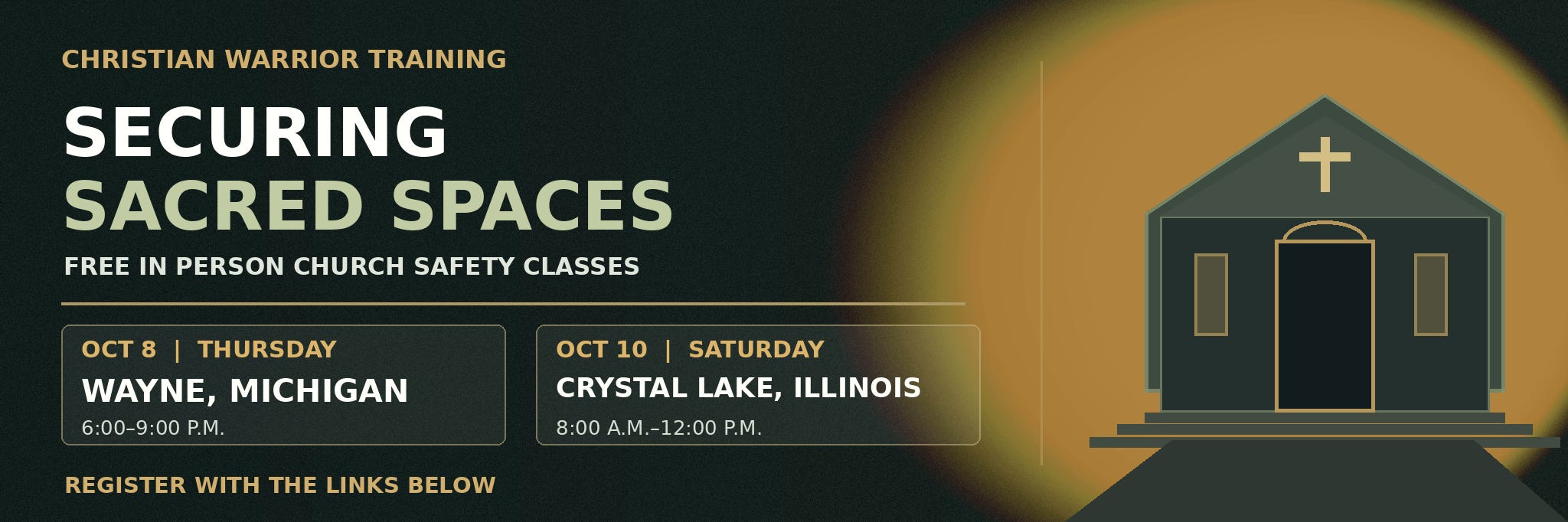
    Paid subscribers make this possible. Please consider upgrading your subscription to help us protect all churches. One Year After Grand Blanc, Is Your Church Ready? On September 28, 2025, four people went to church in Grand Blanc Township, Michigan, and never came home. Their names were Craig Hayden, John Bond, Thelma Armstrong, and William “Pat” Howard. A man drove a truck into their meetinghouse, opened fire, and deliberately set the building ablaze. An armed member confronted him before police arrived. The police chief credited that member with buying time for others to escape. Yet one year later, the LDS Church continues to prohibit ordinary members from carrying firearms on church property. That deserves direct criticism. Leadership has revised its security guidance, but the weapons restriction remains. Families attending an ordinary Sunday service are still denied an option that leadership recognizes as appropriate for meetings involving an increased threat. I believe that response is inadequate. When four people have been murdered in your building, every part of your protection model should be examined, including policies leadership would prefer to leave alone. Whether your church is Baptist, Catholic, or nondenominational, you need to study this incident. You may have different policies, but you have the same responsibility to take the protection of your congregation seriously. A fast police response still left people dead Thomas Jacob Sanford attacked the Grand Blanc congregation with a vehicle, gunfire, and fire. The FBI later described the attack as targeted violence believed to be motivated by hatred toward the Mormon religious community. This was a deliberate attack on people gathered for worship. The police response was fast. According to the timeline released by authorities, the first 911 call came from someone who had been shot in the stomach. Police were notified 16 seconds later. A conservation officer arrived in less than two minutes after dispatch, followed by a township officer. They confronted and killed Sanford. I spent 29 years in law enforcement. I understand what responding officers can accomplish, and I understand the limits imposed by travel time. Officers cannot protect someone inside your sanctuary while they are still driving toward your church. Call police immediately when an emergency develops. But your church also needs people prepared to act before officers arrive. Grand Blanc demonstrated how much damage an attacker can inflict during even a fast response. * Register for the October 8 class in Wayne, Michigan * Register for the October 10 class in Crystal Lake, Illinois An armed member bought time Greg Mikat, a hearings investigator with the Michigan Department of Corrections, was carrying a handgun that morning. After the truck struck the building, he went outside and encountered Sanford approaching with a rifle. Mikat fired five rounds. According to the police investigation, none struck Sanford. Sanford shot Mikat three times in the chest. Mikat survived. On the anniversary Sunday, he stood before his congregation and conducted the music. Grand Blanc Township Police Chief William “Bill” Renye described him as a hero and credited him with buying time for most of the congregation to escape through the back. The Deseret News anniversary report documents his actions and the chief’s assessment. Some people will focus on the misses and conclude that his handgun accomplished nothing. That ignores what the police chief said. Mikat confronted a man who was murdering people, and the chief believes that confrontation gave others time to get away. His courage deserves recognition. His misses also require an honest discussion about training. We can respect what he did while examining what every armed church security volunteer should learn from it. A carry permit does not establish your ability to stop an attacker. Neither does owning a good handgun or being the person everyone at church considers knowledgeable about firearms. You need to measure your performance. If you carry, train honestly I have recommended the Bill Drill for years because it gives you a measurable way to work on your draw, recoil control, and accuracy at speed. From the holster, draw and fire six rounds into the A zone, the center scoring area of a standard practical shooting target, at seven yards. The performance goal I recommend working toward is under two seconds, with all six rounds in that scoring area. All six hits count. A fast time with misses does not meet the standard. Build toward that goal at a pace you can safely control, and record both your times and your hits. The drill does not recreate Grand Blanc or establish that someone is prepared for every emergency. You still need judgment, communication, medical training, and practice with the people who will respond beside you. But if you carry a handgun to protect a congregation, avoiding meaningful evaluation of your shooting ability is unacceptable. People are depending on you. They deserve demonstrated competence and continued training. Be honest about what you can do today. Then put in the work to improve it. The policy needs to be challenged After Grand Blanc, the church security department sent a letter to leaders of more than 31,000 congregations, asking them to review security and emergency preparations. The church’s security guidelines updated March 16, 2026 include two greeters at entrances, paired patrols inside and outside, and emergency training that includes Run, Hide, Fight. Those measures have value. The same guidance calls for four to six current law enforcement officers at high profile meetings or during an increased threat environment. Meanwhile, General Handbook section 35.5.7.2 continues to prohibit firearms and other lethal weapons on church property, including concealed weapons, with an exception for current law enforcement officers. Leadership recognizes a role for armed protection. It recommends officers under certain circumstances while prohibiting ordinary members from carrying. Grand Blanc was a Sunday worship meeting. The attacker did not wait for a prominent visitor or a special event. He attacked families gathered for worship. Leadership should explain why those families cannot have trained, organized armed protection provided by qualified members where applicable law allows it. An ordinary Sunday deserves a serious protection plan. Hiring police can be part of that plan, but officers are not always available. Leadership still needs an answer for a service when none are present. Who is prepared to protect the congregation during the minutes before responding officers arrive? My recommendation is to change the policy to permit lawful armed protection by qualified members and establish trained, supported teams at the local level. Set standards, appoint accountable leaders, and provide the resources those teams need. After Grand Blanc, a letter and revised procedures should not end the discussion. The weapons restriction deserves direct examination. More fatal shootings followed On January 7, 2026, a shooting outside a funeral at an LDS meetinghouse in Salt Lake City killed two people and injured six others. Police described a dispute among people attending the funeral. Federal prosecutors later charged two alleged Tongan Crip gang members with firearms offenses related to the investigation. The initial reporting and Justice Department announcement describe those circumstances. On August 17, a funeral at an LDS meetinghouse in Kearns, Utah, ended with one man dead and two others critically injured. Attendees had warned police that trouble might develop. According to KSL’s reporting, officers were already at the location when they heard gunfire. Those two shootings and Grand Blanc left seven people dead in less than 11 months. The circumstances differed. The funeral shootings should not be presented as the same kind of targeted religious attack as Grand Blanc, but they demonstrate other threats that can reach church property. Your team needs to prepare for conflicts brought into funerals, threats against the congregation, and an attacker arriving during worship. Known disputes or gang connections belong in the security assessment before the service begins. Informal arrangements leave unanswered questions I have heard from LDS members who tell me they carry despite the policy. Others say they have formed informal teams. That tells me members are concerned enough to act without institutional support, and it raises questions leadership should resolve. Who knows who is armed? Who has been trained? Who is coordinating the response? Have those people ever trained together? A church should answer those questions through an organized program. Leaving members to private arrangements creates uncertainty during the emergency when clear responsibilities are essential. Give the team defined leadership and train together at least monthly. Brief other lawful carriers on expectations so they understand how to avoid interfering with the team or confusing responding officers. The church’s guidance includes fighting as a last resort. Leadership should examine what its weapons restriction leaves a member facing someone with a rifle. A folding chair may be what is available, but telling someone to improvise does not settle the question of whether qualified armed protection should have been permitted. Preparation starts outside Grand Blanc began with a vehicle reaching an occupied building. Every church should examine where a vehicle could drive directly into its sanctuary, classrooms, or gathering areas. Bring those vulnerabilities to leadership and discuss appropriate barriers with qualified professionals. I teach threat recognition through atmospherics. Know what normal looks like on your property so you can identify behavior that needs attention. Reckless driving, repeated circling, unusual parking, or an approach that does not fit normal activity should prompt observation and communication. Those behaviors do not automatically establish that someone is an attacker, but your team cannot assess what nobody is watching. Put a team member outside during services with a radio and a defined responsibility. Make sure that person can communicate a concern to someone with the authority to act. A vehicle striking a building may be an accident. It may also be the beginning of an attack. Your team needs to assess the situation, move people away from the impact area, and watch for additional danger. Your congregation needs a plan too Eyewitness reporting from Grand Blanc describes members helping people evacuate after the crash and facing gunfire as they escaped. The attacker also used gasoline to set the building ablaze. Your congregation should understand emergency procedures before something happens. Decide who can order an evacuation from the pulpit. Teach classroom leaders their exits and alternatives. Establish a rally point and a system for accounting for children. Work with your fire department on fire and smoke emergencies. A room used to shelter from gunfire can become dangerous when smoke enters or fire cuts off the exit. Your plan has to account for changing conditions. A security team cannot personally guide every family and every classroom at once. Members need enough preparation to make informed decisions when they are separated from the team. Review what your church publishes online as well. Post assignments, patrol schedules, camera locations, and detailed response procedures can expose information useful to someone planning violence. Teach members how to report concerns and respond to emergencies while keeping sensitive deployment details controlled. Faith does not excuse inaction In 2 Chronicles 32, Hezekiah learned that an enemy was approaching. He consulted his leaders, repaired defenses, prepared weapons and shields, and appointed commanders. He also encouraged the people to trust the Lord. Trusting God did not relieve him of the responsibility to repair a broken wall. He took practical steps to prepare the people under his care. Jeremiah 6:14 rebukes leaders who offered assurances of peace while treating a serious wound lightly. Jeremiah was addressing Judah in a particular historical setting, but that warning should cause us to examine our own leadership. Are we addressing demonstrated vulnerabilities? Are we taking responsibility for correcting them, or reassuring people while the same weaknesses remain? Four people were murdered at Grand Blanc. An armed member confronted the attacker, members helped one another escape, and responding officers stopped the killer. One year later, the weapons restriction remains. I believe leadership should reconsider it and establish trained, supported protection at the congregation level. The families attending an ordinary Sunday service deserve a plan that takes the demonstrated threats seriously. If you lead a church, bring this discussion to your leadership. If you lead a security team, examine your preparation. If you carry, be honest about your ability to deliver accurate hits and your willingness to train. Tell me in the comments whether your church has an organized team and whether leadership supports it. Keep operational details private, but share how your church is addressing these responsibilities. Pray for the families of Craig Hayden, John Bond, Thelma Armstrong, and William Howard. Pray for Greg Mikat and everyone still recovering from that morning. Pray also that people harboring hatred will turn to Christ before they hurt anyone. Remember the instruction in 1 Corinthians 16:13, ESV: “Be watchful, stand firm in the faith, act like men, be strong.” And remember your ABCs. Always Be Carrying. This is a public episode. If you'd like to discuss this with other subscribers or get access to bonus episodes, visit www.christianwarriortraining.com/subscribe
  • October 1 · 9 min

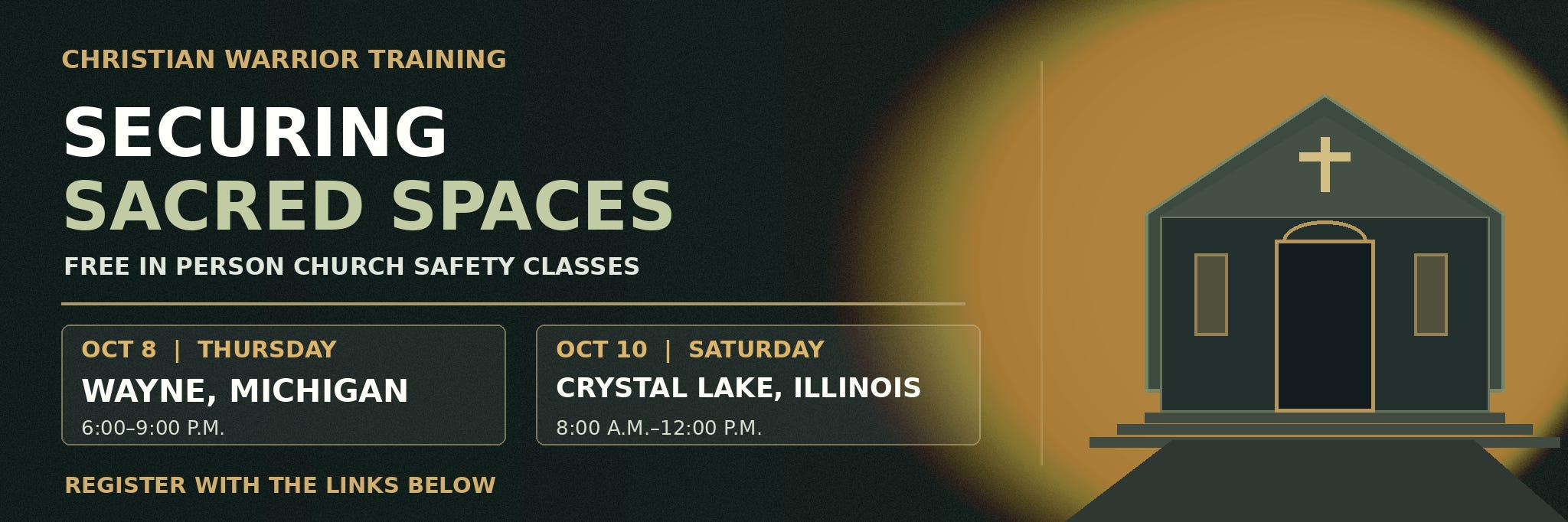
    Free Church Safety Classes and a New Instructor Certification

    Paid subscribers make this possible. Please consider upgrading your subscription to help us protect all churches. Seats Open for Our Free Michigan and Illinois Classes, and Applications Open for Active Shooter Instructor We still have seats in both of our free in-person church safety classes next month. The first is Thursday, October 8, from 6:00 to 9:00 p.m. Eastern Time at CrossPointe Community Church, 36125 Glenwood Road, Wayne, Michigan. The second is Saturday, October 10, from 8:00 a.m. to 12:00 p.m. Central Time at Immanuel Lutheran Church, 300 Pathway Court, Crystal Lake, Illinois. Both classes run the same material: recognizing warning signs before a situation escalates, de-escalation, building a team, access control, legal considerations, emergency action plans, working with local police, and keeping a church welcoming while it stays secure. Pastors, church leaders, safety team members, ushers, greeters and volunteers are all welcome, and so are the police officers who work with your church. There is no livestream or online option. Registration is through Eventbrite. Enter the promo code CWT at checkout and the class is free. * Register for the October 8 class in Wayne, Michigan * Register for the October 10 class in Crystal Lake, Illinois The Church Active Shooter Instructor Course (CASIC) CASIC is a three-day train-the-trainer certification course for church security team members. This is the first time we are running it. You spend three days learning to plan, teach and run active shooter response training, and you go home qualified to train your own team. Students write operations orders and lesson plans during the course, and the scenario days use blank-firing weapons. Dates: Wednesday, October 28, through Friday, October 30, 2026 Hours: 8:00 a.m. to 5:00 p.m. Mountain Time each day Location: Eagle, Idaho Tuition: $249 for all three days. The normal price of this course is $1,000. We set it at $249 because the mission of Christian Warrior Training is to keep training free or close to free for church security teams. Class size: 15 students This first class is aimed at churches in our region. Applicants from Idaho, eastern Oregon and eastern Washington get priority for the open seats. If seats remain after that, we will open them to applicants from anywhere. We plan to run CASIC in other parts of the country in 2027, so if you are farther away and do not get a seat this time, there will be more chances next year. NO REGISTRATIONS AT THE DOOR. DO NOT COME UNLESS YOU HAVE BEEN AUTHORIZED TO ATTEND. CASIC prerequisites CASIC is an instructor course for people who already know active shooter response, basic church security and safe firearms handling. Over three days it teaches you how to train your own team in that material. Every student has to meet the requirements below. A student who cannot document them is not admitted. We also recommend, but do not require, the following. They are not disqualifying if you do not have them. * Experience as an instructor in any setting: military, law enforcement, coaching or anything else * A Stop the Bleed, Tactical Combat Casualty Care (TCCC) or equivalent trauma care course * Defensive handgun training beyond a basic safety class * Knowing your state’s use-of-force law as it applies to armed church security What to send with your application Email the following to casic@christianwarriortraining.com: * Your church letter. Anyone in your chain of command can sign it, including your pastor, an elder, your safety director or your team leader. It needs to state that your church supports you attending CASIC, that you hold an active role on the security team or have authority to start one, and that you have passed a background check through your church. * Your training certificate from a church security or active shooter response course. * A copy of your concealed carry permit, or your law enforcement or military credential. * Your answer to this question, at least two paragraphs long: Describe your current active shooter training background, your role on your church security team, and what you intend to do with this certification at your church. Include your full name, your church, and your city and state in the email. The signed statement on felony and domestic violence convictions and the enrollment application are completed before the first day of class. If your training background falls short, we will tell you which course to take first so you can apply for a later CASIC class.What to bring * A laptop. You will write operations orders and lesson plans during the course. * A full-face mask for the blank-firing scenarios. * Your church load-out, including your radio, if you want to train in the gear you wear on Sunday. * A blue gun or a laser trainer such as a TitanX or SIRT pistol, if you have one. Do not bring firearms, ammunition, knives, pepper spray or any other weapon. None are allowed on site at any point during the course. The blue gun or laser trainer takes the place of your carry gun for every drill. If your church sits in Idaho, eastern Oregon or eastern Washington, get your letter written this week and send it to casic@christianwarriortraining.com. This is a public episode. If you'd like to discuss this with other subscribers or get access to bonus episodes, visit www.christianwarriortraining.com/subscribe
  • September 30 · 9 min

    The 10 Priorities Every Church Security Team Should Know

    Paid subscribers make this possible. Please consider upgrading your subscription to help us protect all churches. 10 Ways to Protect Your Church, in the Right Order If I walked into your church this Sunday, I might find three men carrying concealed firearms. If I walked around the building, I might also find a back door propped open, a children’s wing anybody can enter, and an alarm nobody has tested. Those men may be committed, trained, and willing to protect the congregation. But they cannot cover every unsecured entrance, screen every volunteer, or replace a medical response plan. There are other things your church needs to get working, and the order deserves some attention. Here are ten things you can do to protect your church. This is a way to set priorities, not a complete security plan for every building. Take it to your pastor and safety team, look honestly at what you have, and start with the first item that is unfinished. Paid subscribers help us keep church safety training available to churches that cannot afford it. If Christian Warrior Training has helped your team and you are in a position to support the work, please consider a paid subscription. 1. A Working Burglar and Fire Alarm Your building probably sits empty more hours than it is occupied. You need a monitored alarm that covers intrusion and fire, and somebody needs to know that it actually works. Test it regularly and keep the contact list current. Think about who gets called at two in the morning. I do not want the pastor walking into a building to find out whether a burglar is still inside. Have an appropriate response procedure, and put people on the list who will actually answer the phone. An alarm nobody acts on gives you very little protection. 2. A Useful Video System I want footage somebody can use after an incident. A well placed camera with a clear view of an entrance is more useful than a pile of cameras that show a blurry figure walking away. Resolution, placement, lighting, and distance all affect whether you can identify a person. Cover your entrances, children’s areas, offices, sanctuary, and parking lot. Aim for at least 30 days of storage if your system and budget allow it. Then have somebody on your team find a recording and export it. You do not want to discover after an incident that nobody knows how to retrieve the video. 3. Volunteer Screening and Written Safety Policies Some of the people who can harm a church are people the congregation already knows. That is why child protection and financial safeguards belong near the top of this list. Use appropriate background checks for each position, repeat them on a schedule, and use references, supervision, and a waiting period before a new attender serves with children. A background check will not catch everything. Put your rules in writing. Who can work with a child? Can someone be alone with a child? Who counts the money? Who receives a report when somebody raises a concern? If your staff and volunteers give different answers, you have work to do. We have free policy examples available at Christian Warrior Training to help you get started. 4. Control Your Doors Walk your building during a Sunday service and count the doors that are propped open, unlocked, or out of sight. Know which entrances people are supposed to use, and assign somebody to pay attention to them. That side door by the fellowship hall should not let somebody walk through the building unnoticed. Keep track of keys and access codes, and update access when somebody leaves a position. Every required exit still needs to work immediately from the inside. Have your fire marshal or the appropriate local authority review proposed door changes so controlling entry does not interfere with people getting out. 5. Exterior Lighting Go to your property after dark. Look at the parking lot, entrances, walkways, and corners around the building. Can someone leaving Wednesday night Bible study see where they are going? Can your cameras record a face, or do you get a black screen with two headlights in it? Good lighting helps people move safely and helps your team see what is happening. You can spot many of the first problems by taking a walk at night. Write them down and give somebody responsibility for getting them corrected. 6. Children’s Check In and Check Out Have a clear process for who drops a child off and who is authorized to pick that child up. Use matching tags or another reliable system. Decide ahead of time what happens when a tag is lost, adults dispute a pickup, or a custody restriction applies. Do not create an exception because the adult is well known and everybody feels uncomfortable saying no. Control access to the children’s area and assign someone to watch it while keeping emergency exits usable. Practice those awkward conversations before you have a parent standing at the door. The free scenario resources under the Training tab at Christian Warrior Training can help your team prepare. 7. A Trained Unarmed Safety Team Most church safety work happens long before anybody reaches for a weapon. Somebody greets people, watches the parking lot, and notices the person entering the children’s hallway who does not belong there. Somebody needs to speak calmly with a person in crisis and recognize when help is needed. Train your people to observe behavior, communicate, deescalate, and get the right help. Give each person a clear assignment. A safety team shirt does not tell a volunteer what to do, and good intentions do not replace training. 8. Medical Response People fall, have trouble breathing, and suffer medical emergencies during services. Your team needs to be ready to help. Put an AED where someone can get to it quickly, train people in CPR and AED use, and make trauma supplies accessible to trained responders. Send your team to Stop the Bleed training. Assign the jobs before the call happens. Who calls 911? Who brings the equipment? Who meets the ambulance and guides responders to the patient? Practice those assignments so your team can get moving when someone needs help. 9. Team Communications If a team member sees a problem in the parking lot, how does the person in the children’s wing find out? If the answer is that somebody will try to make a phone call, you need to test whether that is a dependable plan. Give your team radios or another reliable way to communicate throughout the property. Test communications in the rooms and hallways where signals tend to fail. Use plain language and practice the calls your team may actually make: a missing child, a medical emergency, a concerning person, or an entrance that needs attention. Having radios and knowing how to use them are two separate things. 10. Armed Team Members I believe armed response can be an important part of church safety. I have made that clear over the years. It is number ten because a firearm cannot secure an open door, screen a children’s volunteer, perform CPR, or tell the rest of the team what is happening. If your church authorizes armed team members, take that responsibility seriously. Establish written standards for selection, qualification, and ongoing training. Address use of force, communications, identification, insurance, and legal review. Make sure your pastor understands the program he is approving. A concealed carry permit by itself does not prepare someone for every responsibility of serving on a church safety team. Preparation and Humility Second Chronicles 26 describes Uzziah fortifying Jerusalem, building towers, securing water, and organizing his men. It also describes the weapons and equipment he provided. There is a lesson there about preparing several parts of a defense and getting people organized. But keep reading. Verse 16 tells us that when Uzziah became strong, he grew proud, and that pride led to his downfall. He stepped into a role God had not given him. That warning applies to me and to every person serving on a church safety team. If we begin enjoying the authority or the gear more than we care about the congregation, we need to examine ourselves. We serve the church under its leadership. The people God has placed in front of us are the reason we do this work. What to Do at Your Next Meeting Bring these ten items to your next safety team meeting. Mark which ones are actually working, then identify the first unfinished item. Maybe it is the alarm. Maybe it is the children’s checkout procedure. Maybe everybody has a radio, but nobody has tested it in the back hallway. Make that your next project and keep moving down the list. Tell me in the comments which number your church needs to work on and what is making it difficult. Your answers help me develop training that is useful to your team. Keep praying for the people who might threaten our churches. Pray that they turn away from violence and come to know Jesus Christ. Keep caring for the congregation, and remember your ABCs: Always Be Carrying. This is a public episode. If you'd like to discuss this with other subscribers or get access to bonus episodes, visit www.christianwarriortraining.com/subscribe
  • September 28 · 6 min

    Why Facebook Labeled Our Post 'Politically Divisive'

    Paid subscribers make this possible. Please consider upgrading your subscription to help us protect all churches. Christian creators should not have to fight a faceless system simply to warn churches about crime, but that is exactly what Christian Warrior Training is dealing with right now. Do social media companies discriminate against Christian creators and Christian channels? I will let you decide. I can only tell you what Christian Warrior Training is dealing with right now and show you the example Facebook gave me when I finally reached a real person. This is not a complaint about one post failing to perform well. It is about a platform restricting our ability to reach people, refusing to explain the original violation, and then labeling a basic church security warning as politically divisive. Register for the October 10 class in Crystal Lake, Illinois Register for the October 8 class in Wayne, Michigan How Facebook Helped Us Reach Thousands Facebook and Instagram have never produced much direct income for Christian Warrior Training. Together, they might bring in a couple hundred dollars in a month. Their real value was distribution. When Facebook shared our content with people who did not already follow us, those people could watch it, decide whether it was useful, and follow the page if they wanted more. That allowed us to reach Christians, church safety volunteers, pastors, Jewish followers, and others who wanted practical information about protecting their churches and families. When my daughter Caitlyn took over our Facebook work, the page grew from roughly 1,000 followers to 60,000 in about three months. The growth happened because Facebook was recommending our content. People saw the information, found value in it, and chose to follow us. Then, in April, everything changed. Restricted Without an Explanation Facebook demonetized the page and stopped recommending our content. The notice said we had violated community standards, but it did not tell me what we had posted that supposedly violated those standards. That leaves a creator trying to correct a problem that Facebook will not identify. You cannot remove the offending post, change your approach, or even make a meaningful appeal when no one will tell you what you allegedly did wrong. More recently, I received another notice telling me that I had 30 days to appeal or Facebook might take further action against the account. The notice did not clearly explain what that action would be. It could have meant another restriction, or it could have placed the entire Facebook and Instagram presence at risk. I clicked the appeal button. Nothing happened. That is a common problem for creators dealing with large social media companies. There is often no obvious phone number, no accessible customer service department, and no person who can explain why an account has been restricted. Paying for Access to Customer Service I belong to a Signal group with some of the largest firearms creators online. Several of them told me that purchasing Meta Verified could provide access to customer service. I paid $12.95, worked through the support process, and finally reached someone. The support representative called to confirm my identity. Communication was difficult at times, but we worked through it. I asked him to open the Christian Warrior Training page and show me the type of post Facebook considered a problem. The example he selected was a warning about thieves stripping copper, scrap metal, and air conditioning equipment from more than 30 churches in St. Louis. The post explained that police were seeing a renewed crime wave rather than a few isolated incidents. It warned church leaders about the repeated thefts and offered practical steps they could take to protect buildings that may sit empty for much of the week. Facebook classified that church crime warning as politically divisive. Read that again. A post warning churches about theft and helping them protect their property was presented as an example of politically divisive content. There was no political candidate in the post. There was no political party. There was no election argument. It was a church security warning based on reported criminal activity. I asked the representative a simple question: If someone is warning people about crime and giving them ways to protect themselves, should that not be the kind of useful information a social media company wants on its platform? He agreed. The Appeal Was Rejected While Support Was Helping Me Facebook then required me to upload identification. I provided a government issued ID while the representative was still helping me by phone. The system rejected it almost immediately. The representative was there with me, walking through the process, and the automated system still refused the identification. I spent about an hour on the phone trying to resolve a problem that should never have required this much effort. As I write this, I am still waiting to learn whether Facebook will accept my identification and restore the page’s ability to reach people. Why I Am Telling You This I am sharing this because most viewers never see what happens behind the screen. You may follow a page and assume you will continue to see its posts. That is no longer a safe assumption. A social media company can stop recommending a creator overnight. It can reduce the audience without clearly identifying the reason. It can threaten further action while providing an appeal button that does not work. The creator may have no meaningful way to reach a person unless he pays for a verification service. Firearms creators have dealt with these restrictions for years. Content related to the Second Amendment is routinely limited, demonetized, or removed. Christian creators face many of the same problems when they discuss faith, evil, crime, self defense, and the responsibility to protect innocent people. In this case, Facebook’s own example was not inflammatory or partisan. It was a factual warning intended to help churches prevent theft. I believe this is censorship. Whatever label Facebook places on it, the practical result is the same: fewer people receive information that can help them protect their church and family, and fewer people hear the message of Jesus Christ. Do Not Let an Algorithm Decide Whether We Stay Connected If you follow Christian Warrior Training on Facebook, Instagram, YouTube, or another platform, please like the page, subscribe, and turn on alerts. Those actions may help, but none of them guarantees that the platform will continue showing you our work. The best way to stay connected is to subscribe at ChristianWarriorTraining.com. I send only a few emails each week. I do not spam you, and I do not share your information. If a social media company removes Christian Warrior Training, the email list gives us a way to reconnect somewhere else with as little interruption as possible. If you can afford a paid subscription, it directly supports this work and helps us continue providing church security information, training, and intelligence. If you cannot afford one, stay on the free list. Take care of your family and tithe to your church first. The people who can support this ministry help keep the information available for those who cannot. Please pray for Christian Warrior Training. Pray that we can continue reaching the people who need this information. Pray also for the people making these decisions, that they will come to know Christ and understand the effect these restrictions have on others. This is a public episode. If you'd like to discuss this with other subscribers or get access to bonus episodes, visit www.christianwarriortraining.com/subscribe
  • September 24 · 11 min

    Certificates are Back: Active Shooter Instructor is Live!

    Paid subscribers make this possible. Please consider upgrading your subscription to help us protect all churches. Certificates are Back On, New CASIC and Leadership Class and More I wanted to give everyone an update on what is happening with Christian Warrior Training because there is quite a bit going on right now. The first thing many of you have been asking about is certificates for our online training. They are back. I had to temporarily shut the certificate system down because I learned that my insurance was not going to cover certain parts of the online training the way we were doing it. I was not willing to keep operating that way without proper coverage, so we stopped issuing certificates until I could get everything worked out. That has now been resolved, and certificates are turned back on. One thing to keep in mind is that the course system can be finicky. You may need to allow pop-ups in your browser before the certificate will download properly. I also want to explain something about Christian Warrior Training that I do not think I have ever really laid out before. When I say our training is free, I mean it is free to you. It is definitely not free to produce. My insurance alone is now about $10,000 a year. Last year, my expenses for Christian Warrior Training were more than $200,000. That includes cameras, computers, websites, email systems, insurance, travel, printing, software, research tools, equipment, and contractors when we need specialized help. There are a lot of expenses involved in keeping this operation going every day. I am not telling you that because I want everybody reading this to run out and buy a paid subscription. In fact, I want to say the opposite. If paying for Christian Warrior Training means taking money away from your family, do not do it. Take care of your family. If that money needs to go to your church, then give it to your church. Tithe to your church. I come last. My hope has always been that the people who can afford to support Christian Warrior Training will help make it possible for the people who cannot afford it to receive the same information and training. A paid subscriber may be helping a small rural church somewhere with almost no security budget get information they otherwise would not have access to. I could put everything behind a paywall. I could charge for every online class, every intelligence product, and every piece of training we produce. I do not want Christian Warrior Training to become a place where somebody has to decide whether they can afford information that might help them protect their church. That is especially important to me when we are talking about church security. We hear from churches all the time that started a safety ministry because of Christian Warrior Training, or that dealt with a serious incident using things they learned through our training. That is what keeps me focused on the mission. Christian Warrior Training did not start as a business plan. It started as a newsletter for my own church security team. I was putting information together for my guys, and they asked if they could share it with other churches. Those churches started sharing it, more churches began asking for it, and it just kept growing. Eventually, Christian Warrior Training became so large that I stopped doing law enforcement training and dedicated myself to this full time. Today, the core of Christian Warrior Training is basically four people: me, my wife Kari, my daughter Caitlin, and my son TJ. We bring in contractors occasionally when we need specialized help, but the four of us are the ones doing the work day after day. I spend about 60 hours a week working on Christian Warrior Training. I am able to do that because so many of you decided this work was worth supporting, and I am extremely grateful for that support. Two Free Classes Coming in October We have two free, in-person church security classes coming up in October. One is in Michigan and the other is outside Chicago in Illinois. The Michigan class is going to be unique because we will be teaching at the site of an actual active shooter event from last year. The attacker was stopped by the church security team in the parking lot before he was able to enter the church. We will be standing at that location talking about church security preparedness and looking at lessons we can learn from what happened there. That class was originally limited to 100 people and filled up very quickly. We were able to create more room inside the church and increase attendance to 200. If you tried to register before and were told the event was full, check again because additional seats have been opened. Register for the Michigan class here We also have our Illinois class outside Chicago. There are still seats available there as well, and I would love to see as many of you as possible. Register for the Illinois class here Both of these classes are free. Right To Bear Is Helping Make This Possible Right To Bear is covering my expenses for these training events and helping coordinate what goes into putting them together. I especially want to thank Johnny, Lana, Frank, and Perry for the work they have put in and the support they have shown Christian Warrior Training. I also want to say this clearly. Right To Bear is the self-defense protection company I use and recommend. I have gotten to know the people behind the company, looked closely at what they are doing, and spent time with the people involved. They understand the church security community and have supported what we are trying to accomplish. That recommendation is not simply because they are helping with these classes. I have looked at their program and I believe in what they are doing. CASIC Is Moving Forward Another project I am very excited about is the Church Active Shooter Instructor Course, or CASIC. We will conduct our first CASIC course here in Star, Idaho, at my home church. The course is designed to develop instructors who can go back to their own churches and communities and properly train church security teams for an active killer response. I am going to open a limited number of seats in this first course to people outside our own church organization. I will have more information on that soon. Beginning next year, my plan is to take CASIC on the road. I want to develop qualified instructors in different parts of the country so they can train churches in their own communities. CASIC will not be free. I wish I could make everything we do free, but an instructor-level course like this comes with significant expenses. Travel, insurance, printing, facilities, training materials, and the other costs involved in putting on this type of program add up quickly. I am going to keep the cost as low as I reasonably can. My goal has never been to build Christian Warrior Training around making a large profit. I want it to sustain itself so we can continue producing training, intelligence, and resources for churches. Where Christian Warrior Training Is Today Sometimes I still have a hard time believing how far this has grown. Something I started for my own church security team now reaches people in approximately 130 countries. Some of those people are in places like Iran, Iraq, North Africa, and the Sahel, where Christians can face serious persecution. I am honored that they choose to follow Christian Warrior Training and use what we produce. That reach is possible because of all of you. Some people support us financially. Some share our videos. Some forward our newsletters to another church. Some take one of our free courses and bring that information back to their team. Others pray for us, and I am always grateful for those prayers. Going forward, we are going to keep producing intelligence and training. I have new classes planned for next year, including the possibility of a live online leadership course taught over several weeks. We are also going to keep traveling and training churches in person whenever we can. My goal is to continue making as much of this information available as possible without putting a price tag between someone and information they may need to protect their congregation. I want the church with a large budget learning alongside the little rural church that barely has a security budget at all. I want both of them getting better, learning from the same information, and raising the standard of church security. Thank you to everyone who supports Christian Warrior Training, everyone who shares what we produce, and everyone who prays for us. I also want to thank Right To Bear for helping make these upcoming seminars possible, and I want to thank my family because none of this would happen without them. If you missed the Michigan registration the first time around, check it again because we have opened additional seats. If Michigan does not work for you, I hope I will see you outside Chicago. Register for Michigan Register for Illinois Until next time, please pray for the suspects we talk about here at Christian Warrior Training. Pray that they come to know Jesus Christ as their Lord and Savior, and remember your ABCs: Always Be Carrying. This is a public episode. If you'd like to discuss this with other subscribers or get access to bonus episodes, visit www.christianwarriortraining.com/subscribe
  • September 22 · 11 min

    Church Funeral Ends With a 12-Year-Old Killed in the Parking Lot

    Paid subscribers make this possible. Please consider upgrading your subscription to help us protect all churches. What Happened A 12-year-old girl died after a reversing SUV struck her on the property of Cedar Branch Missionary Baptist Church in Loris, South Carolina, on the night of Wednesday, September 16, 2026. Kantori Chestnut had attended a funeral at the church, 744 Cedar Branch Road, earlier that day. Just before 10 p.m., the driver of a 2026 Nissan Rogue was backing up on church property when the vehicle struck Kantori and then struck a building. Horry County Fire Rescue (HCFR) was dispatched at 9:53 p.m. Emergency Medical Services (EMS) took Kantori and the driver, who was alone in the vehicle, to the hospital, where Kantori died from her injuries. The South Carolina Highway Patrol (SCHP) is investigating. At the time of writing, SCHP has not released a cause, identified the driver, or announced charges. HCFR reported that three people were transported to the hospital, while SCHP has accounted for two. Reports also differ on why Kantori was still at the church at 10 p.m. The coroner’s office said the funeral took place hours earlier, while local law enforcement described her as leaving a church service. Kantori lived in Loris and attended Loris Middle School, where she was a cheerleader. She had played recreational softball in town since 2019. Woody Hinson, the Loris interim recreation director, told The Sun News she was one of the fastest kids he had ever seen and described her as outgoing and always laughing. Satellite imagery of the property shows a small L-shaped church set back from Cedar Branch Road on open grass. A dirt loop drive runs off the road and across the front of the building. There is a small concrete apron at the entrance, no paved lot, no marked parking spaces, and no visible parking lot lighting, and tree lines surround the property. At night, people leaving this church walk out the front door directly into the area where vehicles drive and park, with nothing marking where one ends and the other begins. No one in this incident set out to hurt anyone. The danger was an ordinary vehicle moving through a dark area where people were on foot. Pedestrians and Vehicles on Unmarked Ground I have been telling church security teams for years that pedestrian protection is part of their job, and for most churches it is still an afterthought. Teams staff the doors, the sanctuary, and the children’s wing. When the service ends, those posts close, and the congregation walks out to the parking area on its own. At dismissal, the entire congregation is on foot and moving between vehicles that are starting up and pulling out. A grass or dirt lot makes this worse. Without marked spaces, there are no drive aisles and no walking lanes. Drivers park wherever there is room and leave in whatever direction is open. Pedestrians walk wherever the cars are not, which changes every few seconds. A Nissan Rogue weighs well over a ton and a half, and at walking speed it can kill a child. You do not need to pave your lot to fix this. Cone off a walking lane from the main door to the parking area and keep people in it at dismissal. Mark the edges of the drive area with cones, rope, or temporary stakes so drivers and pedestrians can both see where vehicles belong. Keep children with an adult in the parking area. Make that a standing rule, announce it before dismissal at evening events, and have your team enforce it. The Same Exposure a Vehicle Attack Would Use This was not a terrorist attack, and nothing reported suggests it was anything other than an accident. It still shows how exposed the people in most church parking areas are. A crowd leaving a building on foot, mixed in with moving vehicles and with nothing between them, is the condition a vehicle ramming attacker looks for. At Cedar Branch, a vehicle moving in reverse at parking lot speed killed a child. A driver who wanted to hurt people could come off the road at 30 miles per hour and reach the front door with nothing in his way. Look at the area where your congregation gathers after services, usually right outside the main doors. Put something between that area and the drive lanes. Permanent bollards and heavy planters are the best option. Where the budget does not allow them, park a church van or a team member’s truck as a barrier at dismissal. Keep people from standing in groups in the drive area, and move conversations onto the sidewalk or into the building. Lighting for Pedestrian and Vehicle Safety Most churches think about exterior lighting in terms of burglary. Lighting also decides whether a driver can see a person standing behind his vehicle and whether a person can see a vehicle coming. A rural church surrounded by trees has no streetlights and no neighboring buildings to add light, so after sunset the parking area is only as bright as the church makes it. Walk your parking area at 10 p.m. on a night with no event. Stand where people park, at the far edges, and behind where vehicles sit, and look for places where a person would be hard to see from a driver’s seat. Install or repair lighting to cover the walking path from the door to the parking area first, then the drive area. Until permanent lighting is in place, put portable work lights out for evening events. Traffic Control Teams for Surge Events A funeral at a small rural church can bring several times the normal Sunday attendance onto a property built for far fewer vehicles. Visitors who have never been there park on the grass and in the drive lanes. Drivers are grieving and distracted. Adults stand among the vehicles talking long after the service, while children run around them. A repast keeps people on the property well after dark. Any event that draws a large crowd, whatever the size of your church, needs team members assigned to the parking area. Those team members need training before the event. Equip them with reflective vests and lighted wands or flashlights. Teach them standard hand signals and where to stand so they are never in a vehicle’s path, and give them radio contact with the team inside the building. Keep at least one team member in the parking area until the last vehicle has left the property. Your team controls traffic on church property only. In most states, volunteers have no authority to direct traffic on a public road. For large funerals, the church should request police at the road entrance. Cedar Branch Road connects to Highway 9 near the church, and a rural road at night with a line of vehicles turning out of a dirt drive is exactly where that request is needed. Coordinate the plan with the funeral director ahead of time, since funeral home staff will be directing the procession. Medical Response Until EMS Arrives A vehicle strike causes blunt trauma, crush injuries, and bleeding, and your team controls the minutes before the ambulance arrives. One team member calls 911 and gives the street address of the church. Responders in Loris were dispatched to an intersection area, which is common on rural roads, so post your church’s physical address at every door and put it in every team member’s phone. A second team member stays with the victim and does not move the injured person unless the scene is unsafe. That team member controls bleeding with direct pressure or a tourniquet, and someone brings the Automated External Defibrillator (AED) and the trauma kit to the scene. A third team member goes to the road entrance to meet the ambulance and guide it in, which is harder at night on an unmarked dirt drive. A fourth moves the crowd back, keeps witnesses on scene for police, and stays with the driver, who may also need medical care. If your team does not have Stop the Bleed training, schedule it this month. Biblical Perspective Ecclesiastes 9:12 For man does not know his time. Like fish that are taken in an evil net, and like birds that are caught in a snare, so the children of man are snared at an evil time, when it suddenly falls upon them. Kantori came to church to mourn someone else. By the end of the night, the congregation that gathered for one funeral was preparing for another. Solomon describes this exactly. Death does not send a warning, and it does not wait for a good time. Every church security team should read this verse as a plain statement about the ground it works on. 2 Samuel 12:22–23 He said, “While the child was still alive, I fasted and wept, for I said, ‘Who knows whether the LORD will be gracious to me, that the child may live?’ But now he is dead. Why should I fast? Can I bring him back again? I shall go to him, but he will not return to me.” David lost a child and grieved hard while there was still hope. When the child died, he got up, washed, worshiped, and ate. He called the loss what it was and stated his hope just as plainly: he would go to the child. A church offers a family the same thing after a death like this one. The family does not need explanations. It needs people who will sit with them and point them to the hope David held. Your team will be among the first people at the scene and among the last to leave, and the family and the driver will remember how your team treated them. John 11:9–10 Jesus answered, “Are there not twelve hours in the day? If anyone walks in the day, he does not stumble, because he sees the light of this world. But if anyone walks in the night, he stumbles, because the light is not in him.” Jesus said this on His way to the tomb of Lazarus, in a chapter about a family grieving a death. His point is about walking in Him, who is the light of the world. The image He uses is literal: a person walking at night cannot see what is in front of him. Everyone who walked across the property at Cedar Branch that night was in that position, driver and pedestrian alike. A church cannot give anyone the light Jesus is speaking of by installing fixtures. It can make sure the people of God can see the ground they walk on when they leave His house at night. Final Assessment Kantori Chestnut died on church property after a funeral, struck by a vehicle backing up in the dark. The investigation is ongoing and no cause has been released, so this review draws no conclusions about the driver. The property shows what most church security plans overlook: people leaving the building walk straight into the area where vehicles move, with no marked lanes, no separation, and no visible lighting. Most churches have the same exposure, paved or not. An accident killed a child here, and a deliberate attack would use the same open ground. Walking lanes, barriers near the doors, working lights, and a trained parking team cost little compared with what this congregation is now living through. Walk your parking area after dark this week, and assign and train a parking team before your next funeral or evening event. Leave a comment and tell us how your team protects pedestrians after funerals and evening services. Share this article with your pastor and your safety team leader. This is a public episode. If you'd like to discuss this with other subscribers or get access to bonus episodes, visit www.christianwarriortraining.com/subscribe
  • September 18 · 2 min

    Weekly Roll Call Briefing: Church Security HIGH ALERT-What Safety Teams Need to Know This Week

    This is a free preview of a paid episode. To hear more, visit www.christianwarriortraining.com Paid subscribers make this possible. Please consider upgrading your subscription to help us protect all churches. FREE, LIVE TRAINING IN ILLINOIS AND MICHIGAN Don’t forget to sign up for either the Michigan or Illinois classes. I’m giving these classes for free. It is in person only. Inside This Week’s Roll Call Briefing ✅ Current threat condition: HIGH / ORANGE ✅ Suspicious activity and possible surveillance at churches ✅ Armed and violent incidents involving churches ✅ Terrorism and intelligence developments ✅ September dates of significance and elevated-risk periods ✅ Training guidance for working elevated-risk dates This is meant to be read by your team, or as a reference for team leads as they address the troops, before starting your shift guarding the Body of Christ. Download The Briefing Here👇

  • September 9 · 17 min

    Christian Genocide Is Spreading Across Africa

    Paid subscribers make this possible. Please consider upgrading your subscription to help us protect all churches. American Christians have been hearing fragments of the Nigeria story for years. A kidnapped schoolgirl. A burned church. A Christmas massacre. What most believers in this country do not have is a clear picture of what is actually happening, who is driving it, and where it is headed. This article is built to fill that gap. Nigeria is currently the deadliest country in the world for Christians. Open Doors, in its 2026 World Watch List, reports that of the 4,849 Christians killed for their faith over the past reporting year, 3,490 of them were killed in Nigeria. That is more than seventy percent of the global total coming from a single country. The violence is not limited to one region or one group. It runs from the northeast, where Boko Haram first emerged, through the Middle Belt, where Fulani militia attacks have emptied entire villages, into the northwest, where ISIS-linked groups now move freely, and across the borders into Niger, Burkina Faso, Mali, Cameroon, and the eastern Democratic Republic of the Congo. This is a long article. I wrote it that way on purpose. A pastor, a security team leader, or a congregant who wants to understand this situation should be able to come back to a single piece and have the picture in front of them. The Scale of the Problem Nigeria is the most populous country in Africa with roughly 220 million people, split about evenly between Muslims in the north and Christians in the south. The Middle Belt sits between the two halves and has become the fault line where most of the killing occurs. The country sits at the southern edge of the Sahel, the arid band that runs across Africa from Senegal in the west to Sudan in the east. Every major jihadist movement currently operating in Africa touches that band somewhere. The Observatory for Religious Freedom in Africa documented 79,323 people killed across Nigeria between October 2019 and September 2025, of whom 42,033 were civilians. Forty-four percent of the civilian killings were attributed to Fulani militias, compared to twelve percent for Boko Haram and ISWAP combined. In the states where attacks occur, Christians were killed at a rate approximately 4.4 times higher than Muslims relative to their share of the population. The count was 22,835 Christian civilians killed against 10,519 Muslims. The numbers do not capture the displacement. Since 2019, more than 2.2 million Nigerians have been driven from their homes by the farmer-herder violence alone. That figure does not include the millions more displaced by Boko Haram, ISWAP, and the kidnapping gangs that now operate across large portions of the country. Entire Christian farming villages have been burned. Survivors are pushed into displacement camps with conditions that are hard for most Americans to picture. The Nigerian federal government has refused for more than a decade to name what is happening. In December 2025, Abuja finally classified Fulani militias, bandits, and armed gangs as terrorists under a new counterterrorism doctrine. Most Nigerian Christians view the move as too late and too narrow. Who the Fulani Are To understand the Middle Belt, you have to understand who the Fulani are. The American press almost always reduces them to a single word, “herdsmen,” which leaves out everything that matters. The Fulani, also called Fula, Fulbe, or Peul, are one of the largest ethnic groups on the African continent. Estimates place their population between 25 and 45 million, spread across at least twenty countries, with the largest concentrations in Nigeria, Mali, Guinea, Senegal, Niger, Cameroon, and Burkina Faso. About 17 million Fulani live in Nigeria. They are the largest nomadic pastoral community in the world. Roughly a third of them still live as traditional herders moving cattle across the Sahel. The rest are semi-settled farmers, traders, scholars, merchants, and in many countries, the ruling class. The Fulani were among the earliest sub-Saharan African peoples to convert to Islam, centuries before most of their neighbors. That early conversion shaped their identity and gave them a sense of religious superiority over the surrounding peoples they regarded as pagans. From the 1700s into the 1800s, Fulani clerics led a series of holy wars across West Africa. The most significant was the jihad launched in 1804 by Usman dan Fodio, a Fulani preacher who declared the existing Hausa kings insufficiently Islamic and called the population to revolt. His jihad swept through what is now northern Nigeria and built the Sokoto Caliphate, one of the largest Islamic empires Africa has ever seen. That caliphate lasted until the British arrived in the early 1900s. The Sokoto Caliphate is not history to the people in the region. The Sultan of Sokoto is still recognized as the traditional religious leader of Sunni Muslims across northern Nigeria. Many of Nigeria’s most powerful political figures have been Fulani or Hausa-Fulani, including former president Muhammadu Buhari. The Fulani are not a marginal people. They are historically the dominant political force in the north. Elements within the Fulani community view the Christian Middle Belt as territory that was not fully conquered during the original jihad, and there are factions now working to finish what Usman dan Fodio started. The Fulani are overwhelmingly Sunni Muslim. Settled, urban Fulani tend to be more devout and more supportive of religious activism. Pastoral Fulani have historically been less rigorous in their practice. That pattern has shifted in the past decade. How the Herder Conflict Became a Religious Campaign For generations, Fulani cattle herders and settled farmers across West Africa clashed over grazing land, water, and crop damage. These disputes were local and seasonal, and they were usually resolved through traditional mediation. Something changed in the mid-2010s. A few factors hit at the same time. Climate pressure pushed pastoral Fulani further south into the Middle Belt looking for water and grazing. The collapse of Libya in 2011 flooded the Sahel with military-grade weapons from Gaddafi’s armories. Boko Haram’s rise in the northeast made Islamist violence regionally normal. And the Miyetti Allah Cattle Breeders Association of Nigeria, a Fulani herders’ organization, has been accused by Nigerian Christians, law enforcement sources, and international observers of financing weapons distribution and coordinating attacks on Christian villages. In February 2026, nine Fulani leaders linked to Miyetti Allah were arraigned in Abuja on 57 terrorism counts for the June 2025 Benue massacre. Portions of the Fulani were radicalized inside that environment. Jihadist ideology teaches that Christians are infidels who must be subjugated, killed, or forced to convert. That ideology found receptive ground among some of the armed herders. Attackers began chanting “Allahu Akbar” as they raided Christian farming villages. In December 2023, Fulani militants attacked at least 25 Christian communities across three local government areas in Plateau State on Christmas Eve and Christmas Day and killed nearly 200 men, women, and children. The Nigerian Red Cross counted 84 communities affected and 29,350 people displaced. In June 2025, an attack on Yelwata village in Benue State killed between 200 and 270 people. In the first two weeks of 2026, Fulani militants killed at least 12 Christians in Plateau, 13 in Benue, and 10 in Taraba State. On January 18, Fulani militants stormed three churches in Kaduna State during Sunday services and abducted 177 Christians. Kaduna State officials initially denied the attack had happened and only admitted it two days later. The captives were released on February 5 after a joint security operation. The Nigerian government’s response to attacks like these has followed a consistent pattern. Denial. Reclassification as banditry. Arrests made, then released without charges. Very few prosecutions. Families in the Middle Belt no longer trust that anyone will ever answer for the slaughter of their children. Boko Haram, ISWAP, and the Sahel The Fulani militia violence did not develop in isolation. It grew up alongside two formally designated terror organizations that have made Nigeria one of the most dangerous countries in the world. Boko Haram emerged in Borno State in the northeast around 2002. The name is usually translated as “Western education is forbidden.” By 2009 the group was in open armed rebellion against the Nigerian state, bombing churches, kidnapping schoolgirls, and massacring Christian villages. The 2014 kidnapping of 276 girls from Chibok drew brief international attention. Most of those girls never came home. In 2015, Boko Haram pledged allegiance to the Islamic State. A faction formally rebranded as the Islamic State West Africa Province, known as ISWAP. ISWAP is now the more capable of the two groups. It has used drones against Nigerian military bases, seized weapons from government forces, and operates across the Lake Chad Basin where the borders of Nigeria, Niger, Chad, and Cameroon meet. After Niger exited the Multinational Joint Task Force in March 2025 and Chad threatened withdrawal, ISWAP exploited the gap and increased attacks on Nigerian military installations in Borno and Yobe states. A separate ISIS affiliate operates further west. It was originally called the Islamic State in the Greater Sahara and is now known as the Islamic State Sahel Province, or ISSP. ISSP operates mainly in the tri-border region where Mali, Burkina Faso, and Niger meet. Since 2024, it has pushed south along the Niger-Nigeria border into Sokoto and Kebbi states in Nigeria’s northwest. That is the region where, on Christmas Day 2025, American forces conducted airstrikes under President Trump’s order. The group that was struck was Lakurawa, an ISIS-linked faction that had moved into the northwest from the Sahel. The Sahel itself has become the global center of jihadist terrorism. The Global Terrorism Index reports that in 2024, more than half of the 7,555 terrorism deaths recorded worldwide occurred in the region. In 2025 the global total fell to 5,582, with the Sahel still accounting for nearly half. That is the third consecutive year the region has held that position. The military juntas now ruling Burkina Faso, Mali, and Niger have expelled French and American forces, turned to Russian mercenary groups for security support, and watched as jihadist groups expanded their control. Al-Qaeda’s Sahel affiliate, JNIM, launched its largest offensive in more than a decade in late April 2026, attacking security forces across Mali, killing the Malian defense minister, and capturing Kidal, the country’s northernmost regional capital. On January 30, 2026, ISSP militants attacked the international airport in Niger’s capital and the adjoining air base. JNIM struck the same airport again on June 18. The DRC and the Spread Eastward The same ISIS movement that drives the violence in West Africa has also taken root 2,000 miles to the east in the Democratic Republic of the Congo. A group called the Allied Democratic Forces, originally a Ugandan insurgency, pledged allegiance to ISIS in 2018. It is now known as the Islamic State Central Africa Province, or ISCAP. ISCAP operates in North Kivu and Ituri provinces in eastern Congo. It has massacred churchgoers during services, beheaded villagers who refused to convert, and imposed jizya, the Islamic tax historically demanded from Christians and Jews living under Islamic rule, on entire farming communities. In 2025 alone, the group killed at least 967 civilians, most or all of them Christian villagers. In February, fighters abducted 70 Christians from the village of Mayba, marched them to a Protestant church in Kasanga, and executed them with machetes. In July they killed 43 people at a church in Komanda. On September 8, they infiltrated a funeral wake in Ntoyo village in North Kivu and killed more than 60 mourners. Along the Niger-Burkina Faso border, jihadists have announced publicly that every male 15 and older who refuses to convert must pay 50,000 CFA francs in jizya. Christians have been told they will live as slaves if they pay, and that those who refuse may leave the village with nothing but the clothes they are wearing. In Mali’s Mopti region, an armed group imposed a monthly payment of 25,000 CFA francs on every Christian over 18 in the village of Douna-Pen, which is more than half the monthly income of most families in one of the poorest countries on earth. This is the same playbook ISIS ran in Iraq and Syria. It has been exported to Africa, and the African affiliates have proven harder to dislodge than the original. Where This Is Going A few trends will determine what happens next. The first is the collapse of Western security support across the Sahel. The United States withdrew from Niger in 2024. France has been pushed out of Mali, Burkina Faso, and Niger. Russian private military contractors have stepped into some of the space, but they have focused on protecting the juntas that hired them rather than rolling back jihadist control. Regional counter-terrorism cooperation has fragmented. The second is the evolution of the United States response. In late 2025, the Trump administration redesignated Nigeria as a Country of Particular Concern. On Christmas Day 2025, American forces struck ISIS targets in the country’s northwest. On January 22, 2026, AFRICOM Deputy Commander Lieutenant General John Brennan arrived in Abuja to launch a joint working group established in response to that designation. Whether any of this translates into protection for Middle Belt villages is a different question. Airstrikes work against fixed positions of formally designated terror groups. They do not work well against dispersed Fulani militia fighters who live among civilian populations. The third is the junction forming between ISSP in the Sahel and ISWAP in the Lake Chad Basin. Analysts with the Soufan Center and other counter-terrorism organizations have been tracking the growing connections between these two ISIS provinces. If they succeed in linking operationally across the northern half of West Africa, the result will be a continuous jihadist corridor stretching from the Atlantic coast to Lake Chad. The fourth is the ideological trajectory of the Fulani militias. What began as resource disputes has moved into identity-based violence with explicit religious framing. Attacks timed to Sunday services, coordinated assaults on Christmas, and the targeting of church leaders are not features of a grazing dispute. They are features of a religious war. The fifth is demographic. Nigeria’s population is projected to pass 400 million by 2050. If current patterns continue, the Middle Belt Christian population will either be displaced, converted, or killed over the course of a generation. Some Nigerian bishops and African scholars are using the word genocide. Others dispute it. Arguments over terminology do not save lives. A Biblical Lens Scripture does not promise that the faithful will be spared. Jesus told His followers plainly in John 15:18-19, “If the world hates you, know that it has hated me before it hated you. If you were of the world, the world would love you as its own; but because you are not of the world, but I chose you out of the world, therefore the world hates you.” Paul wrote to Timothy in 2 Timothy 3:12, “Indeed, all who desire to live a godly life in Christ Jesus will be persecuted.” That verse is not a metaphor. It is a description of what following Christ has always cost. The author of Hebrews describes those who came before us in Hebrews 11:37-38, “They were stoned, they were sawn in two, they were killed with the sword. They went about in skins of sheep and goats, destitute, afflicted, mistreated, of whom the world was not worthy, wandering about in deserts and mountains, and in dens and caves of the earth.” Our brothers and sisters in Nigeria’s Middle Belt villages are standing in that line. They are part of the body of Christ. Scripture also gives us the response. Paul commanded the church in Galatia in Galatians 6:2, “Bear one another’s burdens, and so fulfill the law of Christ.” That burden-bearing is not optional. It is what the law of Christ requires. Conclusion The persecution of Nigerian Christians is the deadliest ongoing attack on the body of Christ in the world today. It is driven by Fulani militia violence, Boko Haram, ISWAP, and the broader Sahel-wide expansion of ISIS-affiliated groups. It has roots going back to the Sokoto Caliphate of the 1800s. It has been shaped by the collapse of Libya, the radicalization of portions of the Fulani population, and the indifference or complicity of the Nigerian federal government. It is spreading, not contracting, and the entire arc of jihadist violence across Africa, from Senegal to the DRC, is part of the same network. Pray for the Nigerian church by name. Support the organizations reaching Christians on the ground with aid and protection. Keep pressure on Washington to maintain the pressure on Abuja. Share this with your pastor and your team. Leave a comment below and tell me what you have seen about Nigeria in your own church conversations. Then share this article with your pastor or team leader so they have it as a reference the next time the topic comes up. This is a public episode. If you'd like to discuss this with other subscribers or get access to bonus episodes, visit www.christianwarriortraining.com/subscribe
  • September 2 · 53 min

    What Really Happened at the Worst Church Shooting in America: Stephen Willeford Interview

    Paid subscribers make this possible. Please consider upgrading your subscription to help us protect all churches. Words can’t do justice when trying to describe what Stephen Willeford did that day. I have become friends with Stephen since this interview and what I have found out about him is amazing. Come join me as we talk about how he interrupted the worst church shooting in modern American history. This is a public episode. If you'd like to discuss this with other subscribers or get access to bonus episodes, visit www.christianwarriortraining.com/subscribe
  • August 26 · 12 min

    They Tried to Cancel Christian Warrior Training Over What I Teach: Right to Bear Saved Us.

    Paid subscribers make this possible. Please consider upgrading your subscription to help us protect all churches. An insurance underwriter put it in writing this summer: “It is a hard no, even if just in classroom. We do not intend to cover being told it is ok to use any weapon or how to use one.” Not live fire. Not force on force. Not putting a gun in anyone’s hand. Being told. A church security instructor standing in a classroom, explaining when the law allows a man to defend his congregation, is conduct that carrier will not touch. That sentence came from RSUI’s underwriter, relayed to me in writing by my broker on July 10, after I asked whether the weapons exclusion on their quote could be amended. I have the email. I will show it to you in the video that goes with this article. That quote is the end of the story. Here is the beginning. Five clean years, then one honest answer Graves and Associates has carried professional liability and general liability since July of 2021. Five years, zero claims, premiums paid on time. This spring the renewal quote came in at $3,621 and I did what I teach every one of you to do with any contract: I read the whole policy before signing. I found a terrorism exclusion that appeared to apply across every insuring clause, no cyber coverage at all, and a business activities description that did not clearly include the instructor training courses I plan to launch. So I asked six questions in writing before binding. Would a negligence claim be covered if a church I trained were attacked. What does the terrorism endorsement actually restore. Does the policy cover instructor certification. The carrier’s answer was to pull the renewal entirely. Their stated reason, word for word: “Given the significant changes to the risk profile, including hands-on training, potential safety and evasion guidance, general security advisory services, and product sales, together with our review of the additional website, the account unfortunately now falls outside of our underwriting appetite.” Safety and evasion guidance. Teaching people how to not die put me outside their appetite. They offered me an extension to August 1 for another $157 so I could go find somebody else. Everybody said no My broker marketed the account to the standard carriers: Liberty Mutual, The Hartford, Nationwide, Guard, Travelers. Every one declined. The nature of the business was outside their appetite. She went to the surplus lines markets, the specialty carriers that exist specifically for hard risks. Higher premiums, declines, or blocked submissions. A firearms industry program I applied to directly denied the application. By July 15 my broker told me plainly that she had reached the end of the companies she could approach. The one general liability quote she could secure came from RSUI, and it carried the weapons exclusion you read at the top of this article. When I asked if the exclusion could be removed for classroom instruction with inert training aids, laser trainers and blue plastic guns, nothing that fires anything, the answer was the hard no. Some of you are thinking there must be more to it. A claim, a lawsuit, something in the file. There is not. Five years, zero losses, and the loss runs to prove it. What changed was that I told the truth on a renewal application about where this ministry is headed. Honesty is what triggered all of it, and I would do it again, because a policy bound on an incomplete application is worse than no policy at all. Buried in the conditions of that same policy was an application warranty stating that any misrepresentation or non-disclosure renders the policy null and void and relieves the carrier of all liability. Plenty of trainers in this industry are paying premiums right now on policies their carriers would void the day a claim arrived, because the application never mentioned what they actually teach. The part that should make you angry The insurance industry does not treat church violence as a fringe concern. Carriers that serve churches publish active shooter preparedness guidance. They distribute security checklists. They recommend congregations assess their vulnerabilities and train their people. The industry’s own risk materials tell churches to prepare for exactly the attack my courses address. Then the trainer shows up to buy coverage and the same industry says no. They will insure the church that receives the training. They will publish the checklist telling the church to get it. They will not cover the man who provides it, and one of them will not even cover him for talking about it in a classroom. I spent almost thirty years in law enforcement and I have sat across the table from people doing things they knew were indefensible. They at least had the decency to look uncomfortable. This industry put its position on letterhead. How it got solved, and the disclosure that goes with it What cold submissions could not do, a relationship did. Most of you know I work with Right To Bear, and I will say plainly what I say every time: I am an affiliate, they sponsor this ministry, and there is a link below. Weigh that however you want. The facts are the facts either way. When I told them what was happening, their owner connected me with his brokerage, Moultrie Insurance, a firm that lives in the self defense world and was not scared of the words church security. Within weeks Moultrie placed what six months of shopping could not: general liability through Kinsale, an A rated carrier, and professional liability through Lloyd’s of London, written for a company whose application says in plain language that it teaches active shooter response and instructor courses. Classroom based, laser trainers and blue guns, no live fire, no simunition, all of it disclosed and all of it on the record. The price of being insured honestly is about $9,000 a year, roughly two and a half times what the old policy cost. That is the market telling you what this work is worth to insure when the carrier actually knows what you do. I will take accurate and expensive over cheap and void every day of the week. Two questions to send your broker this week If you train church security teams, or you are the safety director who brings trainers in, do not assume your coverage works. Claims made policies plus application warranties mean the policy you are paying for is only as good as what your application disclosed. So send your broker two questions in writing and keep the answers. Does my policy contain a weapons exclusion, and does it apply to instruction? Not range work, instruction. You now know at least one carrier reads that exclusion to bar being told how to use a weapon in a classroom. Does my carrier know exactly what I teach? Active shooter response, defensive tactics, firearms content, all of it, in writing, on the application. If the answer is no, fix it before you teach another class, because you will not find out what that omission costs until the worst day of your career, and by then the answer is already written into Condition 4. I got my answers the hard way so you can get yours with an email. Send it this week. This is a public episode. If you'd like to discuss this with other subscribers or get access to bonus episodes, visit www.christianwarriortraining.com/subscribe
  • August 17 · 1 min

    Was There Another Shooting at an LDS Church Today? Request For Information

    Paid subscribers make this possible. Please consider upgrading your subscription to help us protect all churches. Please watch the video. I am looking for info from followers on the shooting at a church in Kearns, UT today. This is a public episode. If you'd like to discuss this with other subscribers or get access to bonus episodes, visit www.christianwarriortraining.com/subscribe
  • August 16 · 13 min

    What I Carried at Church Today; Is Your EDC Adequate for Your Job?

    Paid subscribers make this possible. Please consider upgrading your subscription to help us protect all churches. In this video, I walk through what I carry to church and why I have chosen each piece of equipment. If you carry a firearm as part of a church safety team or simply as a concealed carrier attending church, I think you need to look seriously at whether your equipment matches the threat you believe you may have to face. I cover my normal handgun setup, a smaller concealed carry option, communications, less lethal options, body armor, medical gear, and the equipment I keep available if an incident requires me to move from a handgun to a rifle. You can carry capable equipment without walking into church looking like you are headed to a SWAT callout. The goal is to blend in during normal church activities while having the equipment, training, and options necessary to protect the congregation if something happens. Gear Mentioned in the Video Firearms and Firearm Equipment * Glock 45, 9mm * Glock 20, 10mm, my normal church carry handgun * Glock 43X, discussed as a smaller concealed carry option * .300 Blackout rifle/carbine * Speer Gold Dot 9mm ammunition * Trijicon SRO red dot optic * Aimpoint COA red dot optic, on the Glock 43X * Radian barrel and compensator * Radian Magwell * Streamlight TLR 1 HP X weapon light * Palmetto State Armory Dagger magazines, 15 round magazines used with my Glock 43X Holsters and Load Carrying Equipment * T.REX Arms inside the waistband holster GET 15% off with code CWT * T.REX Arms Bailout Bag / Active Shooter Bag GET 15% off with code CWT T.REX Arms discount: Use code CWT for 15% off eligible equipment. Body Armor * Premier Body Armor GT plates * Premier Body Armor soft body armor * T.REX Arms concealable hard armor / covert plate carrier * Security identification placards Communications * PocLink radio Less Lethal * POM MK 3 pepper spray Medical and Support Equipment * T Rex Arms Med Pouch (use code CWT for a 15% discount) Clothing and Footwear * Poncho button down shirt * KÜHL hiking pants * Altama shoes The specific clothing is less important than the concept behind it. I want clothing that allows me to blend in with the congregation while still being able to move, run, access my firearm, and carry the equipment I need without advertising everything I have on me. The video goes into considerably more detail about how these pieces work together and why I have different options available depending on what happens. My basic approach is simple: armor, bag, and carbine. This is a public episode. If you'd like to discuss this with other subscribers or get access to bonus episodes, visit www.christianwarriortraining.com/subscribe
  • August 14 · 17 sec

    Planned Church Hostage Attack and Family Shot At After Service: Weekly Roll Call Briefing

    This is a free preview of a paid episode. To hear more, visit www.christianwarriortraining.com Paid subscribers make this possible. Please consider upgrading your subscription to help us protect all churches. This week’s Roll Call Briefing examines a planned hostage attack against a Florida church and the warning signs investigators uncovered before the suspect could act. We also cover the shooting of a family returning home from church, several developing terrorism concerns, violent incidents affecting churches, and how safety teams should respond when an armed suspect takes hostages. * A Florida suspect who allegedly cased a church and planned to take hostages * A family’s vehicle struck by gunfire while they were returning home from church * ISIS claims involving the deaths of Christians in the Congo * Pro ISIS requests for explosives, poison, and drone instructions * Iranian cyberattacks against American water systems * A bomb threat, suspicious death, and sex offender case involving churches * Recognizing leakage and pre-attack reconnaissance * Understanding hostage and barricaded incidents * Psalm 144:1 and the responsibility to prepare DOWNLOAD THE ROLL CALL BRIEFING HANDOUT 👇

  • August 7 · 1 min

    Weekly Roll Call Briefing: WRCB-26-32

    This is a free preview of a paid episode. To hear more, visit www.christianwarriortraining.com Paid subscribers make this possible. Please consider upgrading your subscription to help us protect all churches. What Is In This Week’s Briefing ✅ Current threat level determination and the reasoning behind holding at Orange ✅ Alert posture for the week, including staffing and protocol guidance ✅ 3 intelligence items covering a mass shooting stopped by armed citizens, a foreign paid-attacker network now operating in North America, and juvenile self-radicalization targeting schools ✅ 4 church incidents from the past 3 weeks, each with the security lesson attached ✅ Training focus with 5 leader prompts you can read straight off the page at roll call ✅ Briefing intent with this week’s Scripture for your team ✅ Personnel assignment grid and the daily checklist Why The Paywall Is Back The Roll Call Briefing has always been a for those that are gracious enough to support CWT. If it weren’t for them, we could not do any of this. I opened it up in April because the threat picture at that time involved specific dangers I wanted in front of every church in the country, whether they paid or not. Those threats have passed. New ones have taken their place, but the picture is more settled, and the reason I opened the gate no longer applies. So the paywall returns. Understand what you are and are not losing. The underlying information is still free. Every incident in this briefing appears in the Saturday Church Crime Newsletter at no cost to you. What the paid briefing gives you is the format: a finished, printable sheet you can put in your team leader’s hand before he steps in front of his people to brief a shift. That work takes hours every week, and it is what the subscription pays for. It helps pay for the analysis and personnel who help me put this all together. The Training Stays Free The free training at christianwarriortraining.com is not moving behind a paywall and never will. Every intelligence analysis we publish carries a training element you can take straight to your team, and every year we release a training matrix you can use to schedule your people out for the full year. If your budget is tight, use those. They are there for you. If your church is getting value out of these briefings, forward this to your pastor or your team leader. Then drop a comment below and tell me what your team is working on this month. DOWNLOAD THE ROLL CALL BRIEFING SHEET BELOW👇

  • July 31 · 17 min

    Roll Call Briefing July 31, 2026: ISIS Claims 80 Christian Victims as Violence Hits U.S. Churches

    Paid subscribers make this possible. Please consider upgrading your subscription to help us protect all churches. Download the Briefing Here ↓ This week, ISIS claims more than 100 people killed or wounded, including 80 Christians, while eight separate incidents were reported at American churches. We also look at new attack material aimed at lone actors, four threats against U.S. churches, two shootings on or near church property, and how church safety teams can protect outdoor gatherings from vehicle attacks. This is a public episode. If you'd like to discuss this with other subscribers or get access to bonus episodes, visit www.christianwarriortraining.com/subscribe
  • July 29 · 9 min

    Your Odds of a Church Shooting: What the Data Actually Shows

    CWT publications and videos like this only happen because of paid subscribers. Without them, this all disappears. You Are a Ministry First: Church Security Without Fear Fear is a terrible commander. When fear leads, it distorts everything. It turns every stranger into a suspect. It slowly and quietly transforms the people of God into a team of threat assessors rather than ambassadors of the Gospel. And if we are not careful, fear can reframe the entire mission of the church away from what Christ called us to do and toward what we are terrified might happen. This article is a pushback against that fear. Not a dismissal of it. Not an excuse to be careless. A pushback grounded in data, in Scripture, and in a story that happened just this week at one of our campuses that reminded me exactly why we do what we do. What the Numbers Actually Say There are approximately 350,000 to 370,000 churches in the United States. Every single week, millions of believers gather across those congregations for worship services, many of them holding multiple services on a single Sunday. If we assume each congregation meets at least once per week, that is a minimum of 19,656,000 church services every year in the United States. Now let’s look at the threat against that backdrop. Between 2000 and 2025, researchers tracking violence at religious institutions recorded 246 shooting events across churches, synagogues, mosques, and temples combined, with 402 victims total. From 2000 to 2024, a separate dataset recorded 379 incidents and 487 deaths at religious congregations, most of them involving a single victim. Let that sink in. Nearly twenty million church gatherings every year, and across a quarter century, fewer than 500 deaths total across every type of religious institution in the country. When you narrow the lens to Christian churches specifically and compare the number of incidents against the number of services held, your odds of being in a church service where a shooting occurs are roughly 1 in 6,552,000. That number is not designed to make you feel invincible. It is designed to put reality back in its proper place. One of the enemy’s most effective weapons is not a firearm. It is intimidation. It is making the threat feel so large and so inevitable that the church begins to operate out of dread instead of faith. Prepared, Not Paralyzed Hear this clearly, because this is not an argument against training. The odds are absolutely in your favor that your congregation will never face a serious threat. But if your congregation does face one, the odds will not matter much in that moment. That is why we train. That is why we build teams, run drills, study behavior, and take this work seriously. The people sitting in those pews trust us with their lives, and we owe them our very best preparation. So yes, train hard. Be vigilant. Know your exits, know your sight lines, know your people. Build a team that can respond with speed and decisiveness if the moment ever demands it. But do not let the training become the mission. Do not let preparedness become paranoia. There is a critical difference between a church that is ready and a church that is afraid, and that difference shows up in how your team treats every person who walks through the door. The Story That Started This Article This past Sunday, something happened at one of our campuses that I have not been able to stop thinking about. A young man walked in and caught the attention of our security team. Something felt off about his demeanor and the way he was carrying himself. The team noticed and made contact. But instead of leading with suspicion, one of our guys looked at this young man and said simply: “You look like a man who needs a hug.” That is church security done right. That single approach, calm and compassionate and confident, accomplished two things at once. It made contact with someone who had been flagged as a potential concern, and it opened a door. It turns out this young man is not a threat at all. He is a young father with an infant at home and a marriage that is falling apart. He came to church because something drew him there, and I believe that something was the Holy Spirit. He did not know where else to go. Our team surrounded him with love and connected him with our men’s group. We welcomed him into the community. That is not a security failure. That is a ministry success, and it only happened because our team understood that their job is bigger than threat response. You Can Do Both One of the lies that creeps into security culture is the idea that you have to choose between being a security team and being a ministry. Either you are watchful or you are welcoming. Either you protect the congregation or you love the stranger at the door. That is a false choice, and experienced teams know it. The same awareness that allows a trained team member to identify a behavioral anomaly also allows them to recognize someone who is hurting. The same calm that keeps a person steady under pressure is the same calm that communicates safety to a broken young man who walked into your building desperate for help. Security team members are not bouncers. They are not law enforcement officers on loan to the church. They are members of the body of Christ carrying a responsibility that is both physical and spiritual. Sometimes that responsibility looks like stopping a threat. More often than we might expect, it looks like being the first person who made a desperate human being feel seen. Your team needs to understand both, and your training program should reflect both. What the Word Says God anticipated our fear. He did not ignore it or dismiss it. He addressed it directly. “Fear not, for I am with you; be not dismayed, for I am your God; I will strengthen you, I will help you, I will uphold you with my righteous right hand.” — Isaiah 41:10 (ESV) That verse is not a promise that nothing bad will ever happen. It is a declaration about who holds us when it does. Our security ultimately rests not in a team, a protocol, or a statistic, but in the sovereignty of the God we serve. We prepare because we are stewards. We train because lives matter. But we do not live in fear, because a church that operates out of dread has already lost something essential before a single shot is ever fired. The congregation is not a fortress to be defended. It is a place where broken people come looking for hope, and your security team is often the first face they see. The Charge Stay trained. Stay alert. Stay ready. But stay ministry-minded. Remember that the person walking through your door who looks different, acts nervous, or sets off your radar may not be a threat at all. They may be exactly who the church was built for. You can protect your congregation and still be the hands and feet of Jesus. You can run a serious, capable security operation and still be the person who looks a struggling young father in the eyes and says, “You look like a man who needs a hug.” That is not weakness. That is the Gospel lived out in real time by people who took their calling seriously enough to show up, get trained, and stay ready for whatever walks through the door. Train like a warrior. Love like a shepherd. Never let fear define what your church is supposed to be. Did this article challenge the way you think about your role on your security team? Leave a comment below and share it with your pastor or team leader. This is a conversation the whole church needs to have. This is a public episode. If you'd like to discuss this with other subscribers or get access to bonus episodes, visit www.christianwarriortraining.com/subscribe
  • July 24 · 14 min

    Roll Call Briefing/News & Intelligence for July 24, 2026

    It is free to you, but there is a real cost to put all of this together and it gets more expensive everyday. Upgrade your subscription, but only if you can afford it. TERRORISM AND INTELLIGENCE Islamic State Is Treating Churches as a Standing Target Set on Three Continents Indago’s Islamic State assessment for the week ending July 20 identifies attacks on religious sites as a coordinated strategy running across Nigeria, Syria, and the Democratic Republic of Congo. The assessment states that detained Islamic State members in Syria gave confessions outlining plans to bomb Christian churches and Shia shrines to deepen societal divisions, and that affiliates in West and Central Africa are systematically targeting Christian villages and burning homes alongside military assets. The report places churches on its priority target watchlist for Syria, Iraq, Lebanon, Nigeria, and the DRC, citing demonstrated planning and execution capability against Christian places of worship. It also assesses that Islamic State in Syria has shifted away from targeting armed opposition factions and toward religious minority sites in order to maximize sectarian friction in the post-Assad security vacuum. [Source: Indago Situation Report, Islamic State Weekly Update, 20 July 2026] 🛡️ My thoughts: this is something that I assessed long ago, but it’s nice to see another intelligence organization back it up. Many of you are running missions in these areas. You need to have a plan and you need to have safe houses that you can go to in the event of an emergency. I suggest that you get training in survival, evasion, resistance and escape before you go to one of these countries to help Christians. ISIS-K Poster Names the US Capitol and Ties the Call to the World Cup On July 14, the Islamic State Khorasan-linked al-Azaim Media Foundation released a poster depicting the United States Capitol and the Eiffel Tower as targets, carrying the message “Kill Them. Seize Them. Besiege Them” drawn from a Quranic verse. The release was timed to France’s Bastille Day and to the 2026 FIFA World Cup. Indago assesses the poster as direct incitement to attack soft targets in the United States and France during high-profile events, and notes Islamic State media has been calling for attacks on World Cup host cities and venues since June 18. The National Counterterrorism Center listed the same poster in its terrorist publications compendium for the week of July 16 through 22. Indago names lone-actor vehicle ramming, knife, and explosives attacks against crowd gatherings as the highest-probability threat vector. [Source: NCTC Counterterrorism Digest, 16 to 22 July 2026, and Indago Islamic State Weekly Update, citing MEMRI JTTM] 🛡️ My thoughts: this message is inciting lone actors within the United States. We saw that in New York City this week when a man did exactly what ISIS asked them to do. He poured gasoline and used fireworks as an IED to attack a federal building there. What if he decided to go after a church instead of the federal building? Would you be prepared for that? Some church security trainers are saying that I am over stating these threats. Ezekiel 33 tells us to sound the trumpet when we see danger. I am doing that now, and I think those trainers need to change their attitude and do the same. The chances of an attack at your church are very minimal, but it’s not zero. We know it will happen to somebody, I pray that they are prepared. Federal Data Shows Homegrown Islamic State Supporters Are Staying Home and Planning Here The NCTC spotlight this week summarizes research from the University of Nebraska at Omaha’s National Counterterrorism Innovation, Technology, and Education Center on American Islamic State supporters. The United States has federally charged 272 people with Islamic State-related crimes since 2014. Defendants ranged in age from 17 to 56 with an average age of 27, 83 percent held United States citizenship or permanent legal resident status, and 91 percent were male. Cases per year have been climbing since 2023. Roughly 35 percent of defendants in the post-caliphate period attempted to travel overseas, and no traveler has successfully reached a destination since 2019. The spotlight highlights the January 2026 indictment of Christian Sturdivant, 18, arrested in December 2025 after authorities determined he allegedly planned to use knives and hammers in a New Year’s Eve attack on a grocery store and a fast-food restaurant in North Carolina. [Source: NCTC Counterterrorism Digest, 16 to 22 July 2026, citing NCITE and the US Department of Justice] 🛡️ My thoughts: you should see a theme here. The danger to our church and synagogues is growing. Look at the information they put out and use that to help you in your threat assessments in your situational awareness while you’re working. Seven Federal Agencies Updated a Warning That Iranian Cyber Actors Are Inside US Utility Controls The FBI, CISA, NSA, EPA, Department of Energy, US Cyber Command, and Treasury updated a joint cybersecurity advisory on July 22 covering Iranian-affiliated cyber actors exploiting internet-connected programmable logic controllers across United States critical infrastructure. The advisory names Government Services and Facilities, including local municipalities, Water and Wastewater Systems, and Energy as affected sectors. Investigators found that after the actors extracted device project files, they modified and deleted program logic and manipulated the data shown on operator displays, and that the changes disabled shutdown and alarm logic so systems could enter unsafe conditions without alerting operators. The July 22 update expanded the manufacturer scope beyond Rockwell Automation to include Schneider Electric and Siemens controllers. The agencies state the targeting escalated in response to hostilities between Iran and the United States and Israel. [Source: Joint Cybersecurity Advisory AA26-097A, updated 22 July 2026] 🛡️ My thoughts: you should be very concerned about this report. It is a signal that they can shut off our power and water. Are you prepared for this? What if your region suddenly has no electricity? Our societal contract will start breaking down. Food and water shortages will occur. Access to medicine and health will be declined. I suggest you have 90 days of food and water on hand in a team of people that know how to survive. The government has been warning us and we should be listening and not dismissing it. The Bible tells us this is coming. Be a good steward to your people. Three European Cases This Month Involve Minors Building Devices and Selecting Religious Targets Munich prosecutors charged a 15-year-old Islamic State sympathizer from Augsburg, Germany with plotting a terrorist attack on a synagogue and with illegal handling of explosives, and stated the teen had obtained a large quantity of explosive material. In October 2025 that same teen detonated a homemade device that blew off two of his fingers and injured an associate. In Italy, the Polizia di Stato announced on July 17 the arrest of a 17-year-old Italian girl in Pavia for participation in an association with the purpose of international terrorism, after a search of her home recovered detailed instructions for making an explosive belt along with conversations with presumed Islamic State associates. In the United Kingdom, Kingston Crown Court convicted 16-year-old Yusuf Shah on July 15 of collecting terrorist materials and providing instruction in the preparation of acts of terrorism, with authorities stating he had expressed support for al-Qa’ida and the Pakistani Taliban on social media beginning at age 13. [Source: NCTC Counterterrorism Digest, 16 to 22 July 2026, citing the Munich Public Prosecutor’s Office, Polizia di Stato, and the UK Metropolitan Police] Islamic State Fighters Hit a Girls’ School at 1:30 in the Morning With Inside Help On July 19, Islamic State West Africa Province fighters attempted a mass abduction of students at the Federal Government Girls College in Monguno, Borno State, Nigeria. The assault came at roughly 1:30 a.m. against a facility being used as a hostel. Nigerian troops foiled the attack and rescued 46 students, though reporting states some were fatally struck during the firefight. Indago assesses the operation involved suspected collaborator assistance and signals intent to run complex, multi-element operations against soft civilian infrastructure. Nigerian forces separately arrested a suspected Moroccan Islamic State operative embedded with ISWAP on July 14 following a failed attack at Cross Kauwa, and Operation Hadin Kai troops arrested a woman at a Borno checkpoint on July 13 who had concealed 17 flashlights and 19 batteries inside her clothing intended for Boko Haram and ISWAP. [Source: Indago Islamic State Weekly Update, citing Channels Television, and NCTC Counterterrorism Digest, citing The Sun Nigeria] The Islamic State’s Own Weekly Ledger Counts Christians as Two Thirds of Its Victims Issue 556 of the Islamic State’s Arabic weekly newspaper al-Naba, dated 2 Safar 1448 and covering roughly July 9 through July 15, opens with a full-page infographic tallying the group’s claimed results. It claims 21 operations and more than 34 killed and wounded for the week. It sorts those casualties into three categories of its own choosing: 23 it labels Crusaders, a term it applies both to Christians and to the armies of Christian-majority governments, 10 it labels infidels and apostates, and 1 it labels Shia. It also claims 3 officers killed, 12 vehicles burned or disabled, and 4 military positions burned. Operations break down as 13 in West Africa, 5 in Central Africa, 2 in Mozambique, and 1 in Iraq, with casualties concentrated at 19 in Central Africa and 13 in West Africa. By the organization’s own bookkeeping, Christians account for roughly two thirds of everyone it claims to have killed or wounded that week. [Source: al-Naba issue 556, page 2 infographic, translated from Arabic] Islamic State Named the Christian Villages It Raided and Described Cutting Captives’ Throats Al-Naba 556 details raids on named Christian villages across two continents. In Borno State, Nigeria, fighters raided the village of Kautama on a Thursday, burned a vehicle and a number of homes, and took a motorcycle and other property. In Adamawa State they raided the village of Sura on a Monday, killed two Christians, and burned a vehicle, a motorcycle, and 10 homes. West Africa totals for the week include 3 Christians killed and 15 homes burned. The group separately states that on a Wednesday it shot and killed a member of a Christian organization after having captured him earlier on the road between Gubio and Kareto in Borno. In eastern Congo, fighters captured 5 Christians from around Beni village and killed them by cutting their throats, and the same day raided the Christian village of Mangina, killing at least 4 more and burning a home. That Mangina raid converts to July 14, the same date and the same village where Open Doors reported 6 killed including a church elder and a worship leader, covered in the International section below. Throughout, the publication calls these civilians “the fighting Christians,” which is the wording the organization uses to reclassify noncombatants as legitimate targets. [Source: al-Naba issue 556, pages 4 and 5, translated from Arabic] The Islamic State Published a Full Page on the Religious Merit of Standing Guard The back page of al-Naba 556 is an infographic devoted to the virtue of sentry duty, assembled entirely from classical hadith and scholarly commentary. It compiles narrations holding that a night spent on watch outweighs a month of fasting and night prayer, that the eye which keeps watch will not be touched by fire, that a guard standing post in a land of fear is better than the Night of Decree, and that a man who guards other people in a place where the enemy is feared earns the standing of one stationed at the frontier. The page carries no operational content and makes no claims of attacks. It exists to make guard duty feel spiritually valuable to the people performing it. [Source: al-Naba issue 556, page 8 infographic, translated from Arabic] 🛡️ My thoughts: That is dedication. Are you dedicated to protecting your church? We need to be more dedicated to our mission than the enemy. VIOLENT CRIME Five Shot Outside Detroit Church During Funeral — Detroit, Michigan Five people were shot outside Greater Love Tabernacle Church on Plymouth Road on Detroit’s west side on Friday, July 17, 2026. Police Chief Todd Bettison said a physical fight broke out at about 5:48 p.m. during a funeral at the church, and one man involved in the fight produced a handgun and fired into the crowd. Officers were already posted in the area because Detroit police had received information about threats of violence tied to a separate visitation at the O.H. Pye III Funeral Home across the street. An officer who responded to the fight witnessed the shooting and returned fire, striking the shooter. Four victims and the suspected shooter were struck in the lower extremities, all were expected to survive, and the suspect was taken into custody. Source 🛡️ My thoughts: Watch the video above for my thoughts. Gunfire Interrupts Funeral at Little Rock Church, Two Charged — Little Rock, Arkansas Little Rock police responded to a shots fired call at Fellowship Christian Church, 8923 Sunset Lane, at about 2:10 p.m. on Saturday, July 18, 2026, during the funeral of 18-year-old Dillan Cheeter. Detectives already near the scene heard the gunshots and saw a vehicle leave northbound toward Baseline Road. Officers followed and stopped the vehicle, which carried 21-year-old Maddison Jackson and an unidentified minor. Jackson was charged with unlawful discharge of a firearm, unauthorized use of another person’s property, furnishing a handgun to a minor, and contributing to the delinquency of a minor, and the minor was charged with unlawful discharge of a firearm and possession of a handgun by a minor. No one inside the church was injured, though mourners jumped over pews and ran for the doors, and the building was held as a crime scene. Cheeter had been fatally shot on July 5 in the 5100 block of Asher Avenue. Source 🛡️ My thoughts: Are you seeing the potential threats that funerals can have at your church? What are you proactively doing to protect your church during funerals? You need to determine how the person died, do they have family conflicts? If the dead is a gang member or criminal, expect rivals to come to take out friends that will show up. Man Found Dead Behind Frayser Church, Death Investigated as Homicide — Memphis, Tennessee Memphis police responded to a call just after 4 p.m. on Monday, July 20, 2026, in the 3700 block of North Watkins Street in the Frayser neighborhood, near Pursuit of God Church. Officers found a man behind the church, and he was pronounced dead at the scene. Police said the call came in as a report of a suspicious person. Investigators have not said how the man died, and the department is working the case as a homicide. No suspect has been named, and anyone with information is asked to call Crime Stoppers at 901-528-CASH. Source 🛡️ My thoughts: We don’t know how he died. What we do know: people that are fleeing danger often go to a church to seek refuge. We see this almost every week here. A 4k video system helps with security by having active monitoring AND it helps document crimes on the property and helps law enforcement find out what happened and who the perpetrators are. Man in Crisis Detained Outside Catholic Church — Laredo, Texas Laredo police responded to a call outside St. John Neumann Catholic Church at 102 West Hillside Road on Sunday, July 19, 2026. Officers said the call involved a man in crisis outside the church. Police detained the man and found no weapons. Authorities said the entire incident took place outside the building and that nothing occurred inside the church. The scene was cleared, and police have not released additional details. Source 🛡️ My thoughts: Not really a violent crime, but I’m putting it in here so you understand people in crisis come to the church for help. I see it at my church a couple of times a year. We need to help them. Sometimes we can’t and we need to call the police to help them. Just have a plan and keep this in your scenario line up. Man Charged With Terror Threats Against Willow Creek Community Church — South Barrington, Illinois Ryan Kang, 26, of Vernon Hills, Illinois, was charged with two counts of terrorism by false threat, a Class 1 felony, after police say he posted threats of violence on social media. The Vernon Hills Police Department opened the investigation after multiple people, including members of Kang’s own family, reported the posts. Deputy Police Chief Shannon Holubetz said the threats referenced school shootings, bombings, and acts of interpersonal violence, and were directed at Vernon Hills High School, Willow Creek Community Church in South Barrington, and several out-of-state residents. Police said Kang admitted to authoring the posts and that investigators determined he did not have the means or ability to carry out an attack. Kang was arrested on Saturday, July 18, 2026, and the department announced the charges on Tuesday, July 21. Willow Creek leadership said South Barrington police notified the church on Saturday and that there was no risk to Sunday services or other scheduled events. Source 🛡️ My thoughts: take these threats seriously! If somebody says that they’re going to do something to you, take it as a real threat. That means you have to respond to it in an appropriate way. Do not dismiss it and tell yourself that the person never really would do something. They absolutely would! That’s why they said it. If you dismiss that you are putting your people at risk. SEX CRIMES Church and School Leaders Charged in Pawleys Island Sex Offender Case — Pawleys Island, South Carolina Georgetown County Sheriff Carter Weaver announced criminal charges on Monday, July 20, 2026, against former Pawleys Island Community Church pastor Don Williams, his wife and church guest services director Ginny Williams, and Pawleys Island Christian Academy director Jennifer “Niki” Howard, and re-arrested Warren Perry, the registered sex offender whose probation violation arrest opened the case. Don Williams and Howard are charged with obstruction of justice, unlawfully placing a child at risk, and criminal conspiracy, and Ginny Williams and Perry are charged with obstruction of justice and criminal conspiracy. Weaver said Perry had worked at the church since roughly 2020 and was serving as a custodian seven days a week at the academy, which enrolls children from six weeks old through kindergarten. Investigators obtained sworn statements, search warrants, and photographs placing Perry in close proximity to children, and Weaver played video at the press conference of Don Williams telling a deputy that Perry had never been around minors. All three church and school leaders resigned on July 17, Perry was denied bond on July 21, Howard was granted bonds totaling $75,000, and four lawsuits have since been filed against the church and the academy. Source 🛡️ My thoughts: I really need to do a more in-depth article and video on this incident. What this church leadership did is more common than you think. There’s nothing in the Bible that tells you to hide any crime. To do so is unconscionable. If you find out, there was a sexual assault involving your church, your first call is to 911. Do that before you notify anybody at the church. Will they be upset with you for calling before telling them? Sure! But you’re protecting everybody by not giving them a chance to cover up the crime. Pastor Held on $17.5 Million Bail in Child Sexual Abuse Case — Monterey County, California The Monterey County Sheriff’s Office arrested Emmanuel Marchica, 51, of Hollister, California, on Friday, July 10, 2026, and released details of the case publicly the following week. Deputies said the investigation began July 5 after a report of ongoing sexual abuse of a child, and detectives identified several additional victims through witness interviews before serving multiple search warrants. Marchica was booked on felony counts including lewd or lascivious acts with a child, sexual penetration of a child, oral copulation of a child, and annoying or molesting a child. The sheriff’s office said Marchica was serving as a pastor and holding regular religious services at a community gathering center in the Hidden Valley community of San Benito County, and that he previously owned bakeries in Prunedale and Monterey and gyms in Sand City, Seaside, and Prunedale where he offered physical therapy and massage therapy and worked as a jiu-jitsu instructor. Investigators said one victim was allegedly molested during one of those therapy sessions, that victim disclosures date back to 2012, and that they believe additional victims exist. Bail was set at $17.5 million. Source 🛡️ My thoughts: more than likely, there will be more victims. If this person served at your church, you should start searching for victims and help them get justice. Christian Preschool Employee Charged With Soliciting a Minor — Easley, South Carolina The Easley Police Department arrested Heather Nichole Hill on Friday, July 17, 2026, on one count of criminal solicitation of a minor and eight counts of disseminating obscene material to a person under 18. Police confirmed Hill was employed at Siloam Christian Preschool on Siloam Road in Easley, South Carolina. A judge set bond at $10,000 on each charge, and jail records show she was released Sunday on a surety bond. The preschool said in a statement that its leadership team and church officials met Sunday afternoon and terminated her employment, and that the preschool and church contacted the Easley Police Department and pledged full cooperation. Police said the investigation is active. Source Pastor’s Wife and Son Charged in Abuse of 14-Year-Old Living in Their Home — Poplarville, Mississippi The Pearl River County Sheriff’s Office arrested Dawson James Brown, 27, and his mother Sabrina Brown, 54, on Friday, July 17, 2026. Investigators confirmed Sabrina Brown is the wife of a pastor at New Heights/College Heights Baptist Church in Poplarville, Mississippi, that Dawson Brown is their son, and that the victim was living with the Brown family at the time of the alleged offenses. The investigation began on or about June 30 after a referral from the Mississippi Department of Child Protection Services following an anonymous report that the girl was pregnant, and investigators estimate she became pregnant in October or November 2025, when she was 13. Dawson Brown is charged with one count of statutory rape, two counts of sexual battery, and one count of human trafficking, and Sabrina Brown is charged with conspiracy to commit tampering with evidence, attempted tampering with physical evidence, and felony child neglect. Court documents allege Sabrina Brown instructed the girl on fabricating and submitting a false DNA document to investigators. The girl’s mother, Kendrell Bowden, 32, was arrested Tuesday, July 21, and the sheriff’s office said the investigation remains active and additional arrests are possible. Source ARSON AND SUSPICIOUS FIRES Dennysville Church Fire Ruled Arson — Dennysville, Maine A fire at the Dennysville Edmunds Congregational Church at 17 King Street was reported shortly before 8 a.m. on Monday, July 20, 2026. The Maine Office of State Fire Marshal said the fire started outside near the rear of the building, and the Dennysville Fire Department knocked it down fast enough to hold the damage primarily to the exterior. A passerby saw the smoke and called 911. No one was inside the church at the time, and no injuries were reported. On Tuesday, July 21, the fire marshal’s office determined the fire was intentionally set and classified it as arson, and investigators have not publicly identified a suspect. Anyone who saw activity near King Street before 8 a.m. Monday is asked to call the fire marshal’s office at 207-973-3700. Source 🛡️ My thoughts INTERNATIONAL Woman Stabbed During Rosary Before Mass, Man Charged — Tramore, Ireland A woman in her 50s was stabbed inside Holy Cross Church in Summerhill, Tramore, County Waterford, at about 9:45 a.m. on Tuesday, July 21, 2026. Parish priest Fr Richard O’Halloran said the rosary was being recited ahead of 10 a.m. Mass with roughly 50 to 60 people present, and the woman was in the main body of the church when she was attacked. She received a single knife wound and was taken to University Hospital Waterford with serious but non-life-threatening injuries. Gardaí arrested a man at a nearby house and seized a knife for technical examination. Niall Cummins, 36, of the Willows, Clarinwood, Tramore, appeared at Waterford District Court on Wednesday, July 22, charged with Section 3 assault causing harm and with possession of a knife at the church, and the court heard he made no reply after arrest and caution. The Diocese of Waterford and Lismore commended the parishioners who assisted the victim. Source 🛡️ My thoughts Suspected Boko Haram Fighters Abduct Pastor’s Wife and Three Children — Borno State, Nigeria Gunmen suspected to be Boko Haram or Islamic State West Africa Province fighters stopped a commercial vehicle near Kareto village in Mobbar Local Government Area, Borno State, at about noon on Saturday, July 18, 2026. Community sources said the attackers ordered the wife of Rev. Moses G. Guguma and her three children off the vehicle, allowed the driver and remaining passengers to continue, and moved into the bush with the captives. Guguma leads a Church of Christ in Nations congregation in Damasak, about 156 kilometers north of Maiduguri along the road the family was traveling. Sources said the pastor’s wife had recently been discharged from a hospital in Maiduguri after a prolonged illness before making the trip. Damasak has been repeatedly attacked and occupied by Boko Haram and ISWAP in recent years, security agencies had issued no official statement at the time of reporting, and the family’s whereabouts remain unknown. Source Plateau Pastor Reports Death Threat Letter — Plateau State, Nigeria Rev. Ezekiel Dachomo, regional chairman of the Church of Christ in Nations for Barkin Ladi Local Government Area, said in a statement posted to his X account on Friday, July 17, 2026, that he and members of his church received a letter threatening to kill them. Dachomo said the letter was written in both Hausa and English, warned that he would soon be attacked and killed, and that copies had been handed to heads of security agencies in Plateau State. He tied the threat to the July 11 attack on the Kum and Wereng-Camp communities in Riyom Local Government Area, in which nine members of a single family, including a two-month-old infant, were killed. Punch reported that it could not independently verify Dachomo’s claim that those victims were his relatives. Dachomo has been a prominent public advocate for victims of attacks on Christian communities in Plateau State. Source Church Elder and Worship Leader Among 20 Killed in Three Attacks — Beni Territory, Democratic Republic of Congo Open Doors reported that three attacks in Beni Territory, North Kivu Province, between July 12 and July 16, 2026, left more than 20 people dead. An Open Doors field contact confirmed an attack on the rural commune of Mangina on July 14 in which six people were killed, including a church elder and a worship leader, six more were injured, one person is missing, and two houses were burned. News outlets reported that Allied Democratic Forces fighters attacked an area west of the city of Beni on July 12, killing seven civilians and three Congolese Armed Forces soldiers, and that 10 more people died in a separate attack at Mangina on July 16. Open Doors said movement restrictions tied to an Ebola outbreak in eastern DRC are making information difficult to verify. The ADF is an Islamist group with ties to the Islamic State and has targeted Christian communities in North Kivu and Ituri with massacres, kidnappings, and the destruction of churches. Source Cross-reference: the Islamic State claimed the July 14 Mangina raid in al-Naba issue 556, describing the village as Christian and stating its fighters killed at least 4 there and burned a home. See the Terrorism and Intelligence section above. Copyright © 2026 Keith Graves. All rights reserved. This is a public episode. If you'd like to discuss this with other subscribers or get access to bonus episodes, visit www.christianwarriortraining.com/subscribe
Showing 1–20 of 29 episodes