Skip to content
Artwork for Rethink Your Understanding

Rethink Your Understanding

Phil Clark

Rethink Your Understanding: AI-Driven Insights on Digital Transformation & Software Delivery

Welcome to Rethink Your Understanding, an AI-powered podcast where cutting-edge technology meets expert insights on digital transformation. We use AI to bring my articles and blog posts from rethinkyourunderstanding.com and Medium (https://medium.com/@rethinkyourunderstanding) to life, transforming written content into immersive audio episodes.

Each AI-presented episode provides a "Deep Dive" into strategies, lessons, and the impact of leadership in Agile, Lean, DevOps, Value Stream Management, and Flow Engineering. Occasionally, we explore software engineering. We present a fresh approach to my articles, delivering key concepts, practical advice, and insights from years in tech leadership.

Join us on Rethink Your Understanding—where AI amplifies expert voices to deliver the insights you need to lead your organization’s digital journey.

Connect with me on LinkedIn

Play
  • 21 episodes
  • Avg 21 min
  • English
Counted on this page — what you have heard stays on this device, so it is not something the list can be paged by.
  • S3 · E82
    Tuesday · 25 min

    AI Adoption Is a Team Sport. Shopify’s New AI Case Study.

    Shopify rebuilt a massive mobile application in just 12 weeks using small engineering teams and AI agents. But what does this remarkable achievement really tell us about the future of software development? In this episode, the AI hosts explore my article on Shopify’s AI-driven development approach and the lessons organizations can learn. The discussion looks beyond coding productivity to the supporting architecture, shared AI skills, automated workflows, security, and human oversight that made this possible. It also examines the growing pressure on smaller teams and why reducing task effort doesn't eliminate responsibility. Ultimately, successful AI adoption isn't simply about doing more with fewer people. It's about building a sustainable system that enables teams to deliver better outcomes. Link to the article: AI Adoption Is a Team Sport. Shopify’s New AI Case Study, originally published November 18, 2026. Connect with me on LinkedIn

  • S3 · E81
    Sunday · 24 min

    AI Adoption Is a Team Sport

    AI is helping individuals work faster, but are organizations missing the bigger opportunity to improve how entire teams operate? In this episode, the AI hosts explore my article on why successful AI adoption requires more than individual productivity gains. The discussion examines shared AI skills, reusable instructions, connected workflows, and the importance of making product knowledge accessible to both people and AI agents. By starting with a single cross-functional team and building on what works, organizations can reduce bottlenecks, retain valuable knowledge, and improve overall performance. Ultimately, AI adoption becomes far more valuable when teams learn, improve, and take ownership together. Link to the article: AI Adoption Is a Team Sport, originally published November 16, 2026. Connect with me on LinkedIn

  • S3 · E80
    Saturday · 22 min

    Giving Teams an Outcome Is Only the Beginning

    Giving teams ownership of business outcomes sounds like a step in the right direction. But what happens when organizations expect accountability without giving teams the authority to make decisions? In this episode, the AI hosts explore my article on why building an outcome-based culture requires more than assigning goals. The discussion examines team autonomy, organizational dependencies, leadership responsibilities, and the importance of measuring actual business results after delivery. Ultimately, leaders must examine whether the systems they've created truly enable teams to achieve the outcomes they're expected to own. Link to the article: Giving Teams an Outcome Is Only the Beginning, originally published November 15, 2026. Connect with me on LinkedIn

  • S3 · E79
    November 20 · 25 min

    When AI Agents Do the Work of Teams, Who Owns the Outcomes?

    What happens when a handful of people supported by AI agents can accomplish what once required entire teams? And who is accountable when something goes wrong? In this episode, the AI hosts explore my article on how autonomous AI agents could reshape traditional team structures, specialized roles, and management responsibilities. As AI takes on more execution, coordination, and decision-making, the discussion examines why organizations must rethink governance, oversight, and risk without sacrificing the benefits of automation. Ultimately, AI may dramatically reduce the number of people needed to do the work, but it doesn't reduce accountability for the outcomes. Link to the article: When AI Agents Do the Work of Teams, Who Owns the Outcomes?, originally published November 03, 2026. Connect with me on LinkedIn

  • S3 · E78
    November 20 · 25 min

    Are We Repeating Our Leadership Mistakes at AI Speed?

    AI is transforming software development faster than many organizations can adapt. But are leaders repeating the same mistakes made during previous Agile and DevOps transformations? In this episode, the AI hosts explore my article on the growing disconnect between individual AI productivity and the broader impacts on teams, quality, accountability, and management. As executives push for faster delivery and leaner organizations, the discussion examines why AI reduces task effort, not responsibility, and why leadership development, hands-on learning, and a willingness to challenge assumptions matter more than ever. Link to the article: Are We Repeating Our Leadership Mistakes at AI Speed?, originally published November 01, 2026. Connect with me on LinkedIn

  • S3 · E77
    November 7 · 14 min

    Start With Responsibilities. Then Design the Roles.

    Too often, organizations design roles and reporting structures before understanding the work that actually needs to get done. In this episode, the AI host explores my article on why effective organizational design starts with clearly defined responsibilities, balancing capability with capacity, and establishing accountability. From small teams wearing multiple hats to larger organizations introducing specialists and AI agents, the challenge remains the same: ensuring essential work has clear ownership. Adding people or technology doesn't eliminate responsibilities. It changes how they're distributed, and leaders need to understand those shifts. Link to the article: Start With Responsibilities. Then Design the Roles, originally published October 26, 2026. Connect with me on LinkedIn

  • S3 · E76
    November 6 · 23 min

    Outcome Engineering: Closing the Loop on Business Value

    Organizations have become increasingly effective at measuring software delivery, but how often do they measure whether that work delivers the expected business value? In this episode, the AI host explores my article on Outcome Engineering, a practical approach to connecting delivery performance with measurable business outcomes. From documenting anticipated value and tracking the Feature Factory Ratio to evaluating actual results after release, the discussion explores how organizations can close the loop without adding unnecessary bureaucracy. Shipping software is only part of the equation. Understanding whether it delivered the intended value is what drives learning, accountability, and better investment decisions. Link to the article: Outcome Engineering: Closing the Loop on Business Value, originally published October 17, 2026. Connect with me on LinkedIn

  • S3 · E75
    October 29 · 16 min

    Predictability vs. Outcomes: What Are We Actually Predicting?

    What good is predictable software delivery if the features we ship fail to deliver meaningful business value? In this episode, the AI hosts explore why organizations have become increasingly effective at forecasting delivery while paying far less attention to predicting and validating business outcomes. They examine how product discovery, evidence-based assumptions, and confidence levels can improve investment decisions before development begins. Just as engineering is accountable for delivery confidence, product and business leaders must establish anticipated outcomes, measure actual results, and learn from the differences. Ultimately, predictability must be a two-way street, connecting what teams deliver with the value their work creates. Link to the article: Predictability vs. Outcomes: What Are We Actually Predicting?, originally published October 14, 2026. Connect with me on LinkedIn

  • S3 · E74
    October 27 · 20 min

    The Art of the Possible

    How has software engineering evolved, and why do so many familiar challenges remain? In this episode, the AI hosts explore my reflections on a technology career spanning decades of change, from traditional software development to Agile, cloud computing, and AI. They examine the growing importance of business outcomes, delivery confidence, and the leadership behaviors that shape organizational success. Along the way, they explore how shared experiences, continuous learning, and the willingness to unlearn outdated practices reveal new possibilities for technology teams and the businesses they serve. Link to the article: The Art of the Possible, originally published October 05, 2026. Connect with me on LinkedIn

  • S3 · E73
    October 21 · 21 min

    Software Delivery Confidence: How to Build Trust in Commitments

    Why do software delivery commitments so often miss the mark? In this episode, The AI hosts explore why uncertainty is unavoidable in software development and how organizations can build greater delivery confidence through evidence-based forecasting, realistic capacity planning, and transparent communication. They examine the hidden impact of competing priorities, unplanned work, and shifting requirements, and why missed deadlines should prompt learning rather than blame. Ultimately, delivery confidence comes from communicating changes early enough for business leaders to make informed decisions and adjust course. Link to the article: Software Delivery Confidence: How to Build Trust in Commitments, originally published September 12, 2026. Connect with me on LinkedIn

  • S3 · E72
    September 4 · 22 min

    Yet Another Leadership Article

    In this episode, the AI hosts explore my article on the leadership gap that appears when strong individual contributors are promoted into management without meaningful preparation. So much has already been written and shared on leadership over the years. Yet, I found myself unexpectedly back in the conversation after a meetup dinner raised many of the same questions again. They examine why effective leadership is shaped by the experience of the people being led, and how psychological safety, autonomy, coaching, and deliberate development create the conditions for teams to thrive. The discussion also explores why soft skills and environmental enablement often matter more than technical expertise alone, and how strong leaders leave a lasting positive imprint by developing others who carry those lessons forward. Link to the article: Yet Another Leadership Article, originally published August 30, 2026. Connect with me on LinkedIn

  • S3 · E71
    September 3 · 22 min

    Fast Flow Happens When Friction Fades

    In this episode, the AI hosts explore my article on the Team Flow Improvement Loop and how teams can improve software delivery by finding and removing systemic friction. They examine how Flow Metrics can help expose bottlenecks without becoming performance quotas, why continuous experimentation and psychological safety matter, and how leaders can support team autonomy by clearing obstacles outside the team’s control. The discussion closes on an important point: fast flow creates the most value when it is connected to Realization and meaningful business outcomes. Link to the article: Fast Flow Happens When Friction Fades, originally published August 23, 2026. Connect with me on LinkedIn

  • S3 · E70
    September 2 · 22 min

    From Flow to Realization: Measuring What Matters

    In this episode, the AI hosts explore my short three-part series on the shift from delivery speed to meaningful business outcomes. They examine why producing more software does not automatically create more value, how leaders can work backward from the intended outcome to align technology with business strategy, and why artificial intelligence should be applied to specific problems rather than treated as the objective itself. The conversation brings these ideas together into a unified system of Flow and Realization, where teams understand both how efficiently work moves and whether that work ultimately creates real value for customers and the organization. Link to the articles: Eight Widgets Instead of Five. Did We Actually Get Better?, originally published August 13, 2026. Why We Keep Trying: The Art of the Possible in Digital Delivery, originally published August 16, 2026. Start With the Outcome, Then Work Backward, originally published August 18, 2026. Connect with me on LinkedIn

  • S3 · E69
    September 1 · 20 min

    AI Graph Engineering Looks Familiar for a Reason

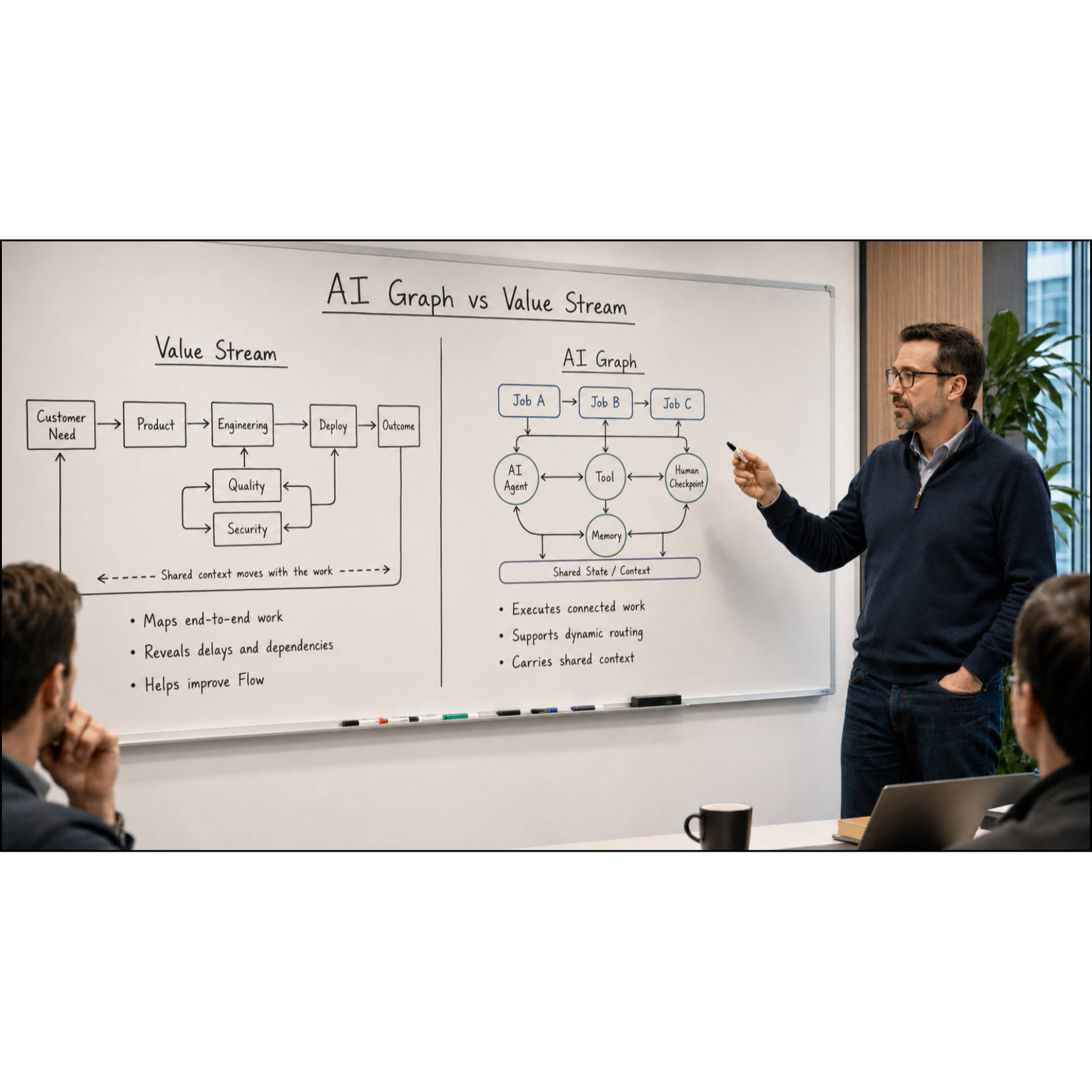
    In this episode, the AI hosts explore my article on why AI graph engineering may feel more familiar than new. They connect it to value stream mapping and established software delivery systems, where work, dependencies, and shared state have long been managed across a flow. The discussion looks at how AI agents can participate as workers, how shared memory can preserve context and reduce friction, and why human accountability still matters. The participants may be changing, but leadership still owns the responsibility for ensuring the work flows toward outcomes that create real value. Link to the article: AI Graph Engineering Looks Familiar for a Reason, originally published August 04, 2026. Connect with me on LinkedIn

  • S3 · E68
    August 28 · 24 min

    AI Is Changing Management, Not Reinventing It

    In this episode, the AI hosts explore my article on how artificial intelligence is changing the role of management without eliminating the need for strong leadership. They examine the difference between task coordination and human development, why AI agents and people require different forms of orchestration, and why human accountability remains essential. As teams become smaller and more efficient, the leadership challenge becomes distributing work intelligently while continuing to coach, mentor, and develop people. Link to the article: AI Is Changing Management, Not Reinventing It, originally published July 27, 2026. Connect with me on LinkedIn

  • S3 · E67
    August 27 · 21 min

    The Real Intellectual Property of Modern Software

    As AI generates more of the software we build, the value of intellectual property is shifting beyond the code itself. In this episode, the AI hosts explore my article on why competitive advantage increasingly comes from customer knowledge, decision history, traceability, and the strategic reasoning behind the software. They also examine why provenance and human accountability matter as organizations rethink how they define and protect proprietary value in an AI-driven world. Link to the article: The Real Intellectual Property of Modern Software, originally published July 22, 2026. Connect with me on LinkedIn

  • S3 · E66
    August 3 · 24 min

    The AI Didn’t Sign Your IP Agreement

    AI can write code, but it cannot sign an IP agreement. In this episode, the AI hosts explore my article on how AI-generated software introduces new ownership, copyright, and governance risks, and what engineering leaders must do to maintain accountability and protect their organization’s intellectual property. Link to the article: The AI Didn’t Sign Your IP Agreement, originally published July 11, 2026. Connect with me on LinkedIn

  • S3 · E65
    August 2 · 24 min

    AI Token Spend Is Becoming Product Economics

    In this episode, the AI hosts explore why token spend is becoming part of product economics, engineering capacity, and operational performance. The discussion covers connecting AI costs to business value, managing agentic workflows and comprehension debt, and preserving human accountability as AI accelerates software delivery. Link to the article: AI Token Spend Is Becoming Product Economics originally published June 19, 2026. Connect with me on LinkedIn

  • S3 · E64
    June 2 · 23 min

    The Flat Org That Still Had Managers

    In this episode, the AI hosts explore my article, which argues that a flat organization is not defined by fewer managers, but by where authority and decision-making reside. The conversation examines a model where self-managed teams own delivery while managers focus on coaching, development, and creating the conditions for autonomy to work. Link to the article: The Flat Org That Still Had Managers, originally published May 31, 2026. Connect with me on LinkedIn

  • S3 · E63
    May 29 · 12 min

    AI Can Shrink Your Team. It Cannot Shrink the Work

    AI can make teams faster, leaner, and more capable, but it does not make judgment, ownership, and accountability disappear. In this episode, the AI host explores my recent article on the leadership risk of mistaking reduced task effort for reduced responsibility. As teams become more AI-enabled, leaders must think carefully about technical depth, feedback loops, quality, cognitive load, and where accountability actually lives. The goal is not simply to create the smallest team. The goal is to design the smallest sustainable system. Link to the article: AI Can Shrink Your Team. It Cannot Shrink the Work, originally published May 22, 2026. Connect with me on LinkedIn

Showing 1–20 of 21 episodes