Skip to content
Artwork for Relatively Stable
Society & CultureRelationshipsPhilosophy

Relatively Stable

Kimberly Carter

In Relatively Stable we delve into the journeys of those who have faced challenges, uncovered their passions, and discovered resilience along the way. Whether you're here for the stories, seeking inspiration, or simply drawn to the wisdom we glean from horses—and life—you’re in the right place. Let’s dive into the narratives that remind us how to stay relatively stable, no matter what comes our way.

stableroots.substack.com
Play
  • 28 episodes
  • weekly
  • Avg 23 min
  • English
Counted on this page — what you have heard stays on this device, so it is not something the list can be paged by.
  • S2 · E17
    May 7 · 28 min

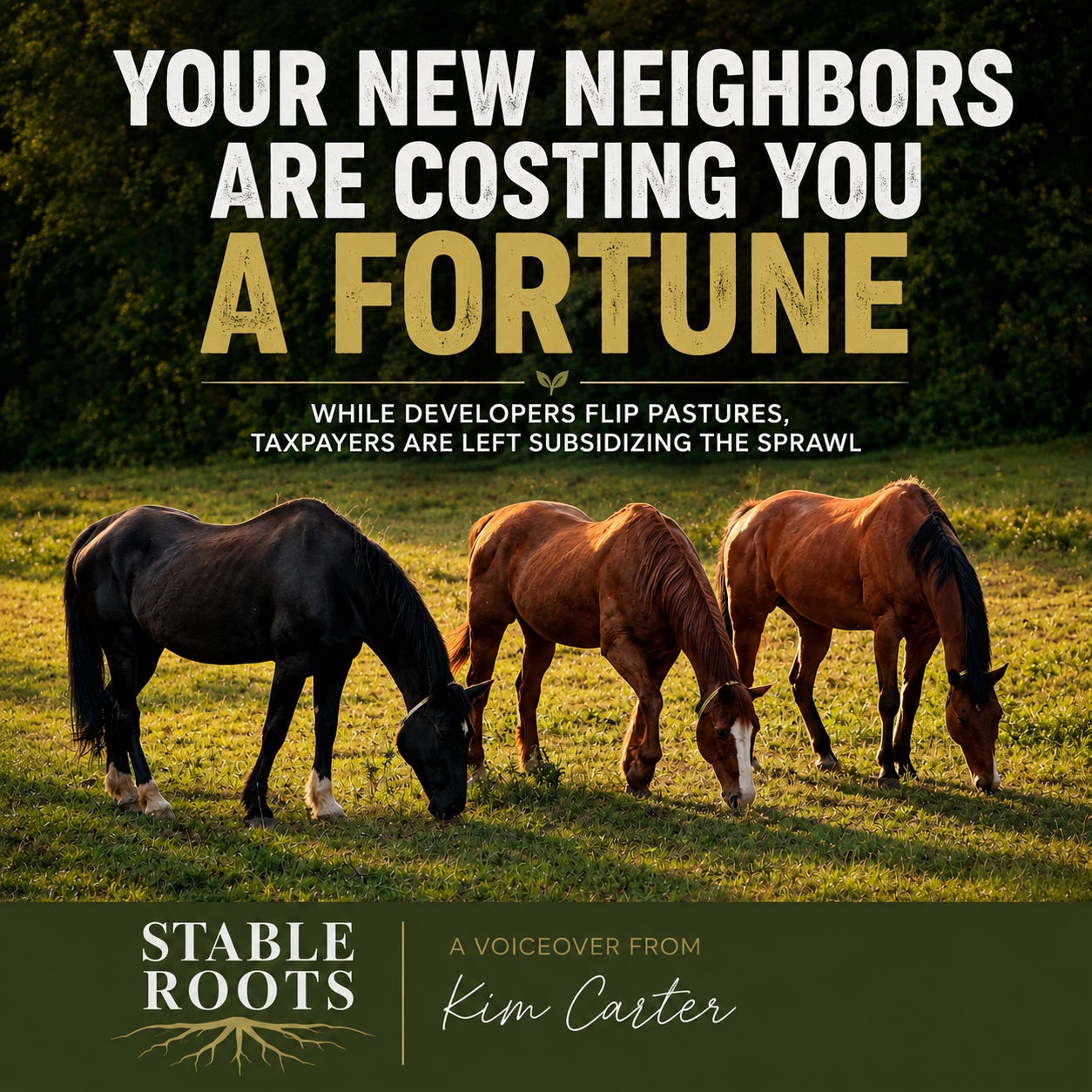
    Your New Neighbors are Costing You a Fortune

    In 2020, the world tilted on its axis. For the Upstate of South Carolina, that tilt sent a wave of 100,000 new residents crashing into our pastures. As we cross the milestone of one million neighbors, the infinite horizon of the American South has officially hit a bottleneck. This week, Kim dives into the canyon between agricultural value and development prices. From the ingenious survival strategy of European track systems to the personal desperation of cashing out a retirement to save her farm by purchasing thirty acres, we’re talking about the high cost of holding the line. Is a farm just a vacant lot waiting for a purpose, or is it the essential, self-sustaining lung of a growing city? In this episode, we discuss: The Million-Resident Milestone: The rapid expansion of the Greenville-Anderson-Greer, South Carolina metro area. The Mother of Invention: Why land scarcity in the Netherlands and the UK forced a smarter way to keep horses, and why we’re next. The Hidden Subsidy: The math that proves farms actually lower your taxes, while subdivisions send you the bill. Legislative Victories: A look at the Old White Horse Road Corridor victory and the new SC laws fighting to protect 7 million acres by 2050. Lavender Hill: A raw look at the survival of a 30-acre heart of a 1,100-acre legacy. Once our dirt is buried under six inches of concrete, the conversation is over. The soil doesn’t get a second chance. And neither do we. Connect & Support: Read the full essay and see the data: at Stable Roots on Substack Subscribe to Stable Roots: Join our community of land stewards and help us hold the line against the asphalt funnel. Follow on Facebook: @kim.carter.equestrian And on Instagram: @two_point About Stable Roots: Stable Roots is a weekly exploration of land, legacy, and the grit it takes to keep them both. Hosted by Kim Carter, a farm owner and advocate in the Upstate of South Carolina, we look at the intersections of agriculture, economics, and the equestrian life in an increasingly crowded world. This is a public episode. If you'd like to discuss this with other subscribers or get access to bonus episodes, visit stableroots.substack.com/subscribe
  • S2 · E16
    April 30 · 28 min

    We Are All Watching the Same Shoreline

    We Are All Watching the Same Shoreline This week I did something I don't usually do — I went down a rabbit hole that started with my clients asking about rain and ended at a United Nations report declaring global water bankruptcy. I work outside every day. I watch the same fields, the same fence lines, the same pond across the street from my kitchen window. And what I've been watching all winter is a shoreline that keeps moving in the wrong direction. Most people around me have no idea we're living inside the driest stretch this region has seen since 1895. They're caring, smart people but their water comes from a tap and their lawn starting to look brown feels like a southern summer rather than a symptom of something much larger. In this episode I'm reading the full piece from this week's Stable Roots. It covers the US Drought Monitor — which was built the same year our pond at Lavender Hill was excavated — the record-breaking drought numbers for the Southeast, what it would actually take to correct the deficit, and why a hurricane may be the only thing that fixes it. From there I zoom all the way out to the UN's January declaration of global water bankruptcy, the shrinking lakes and collapsing aquifers, the cities that are literally sinking, and the Colorado River agreements written for a river that no longer exists. Then I bring it back home. To the rain that fell on Saturday. To the oak grove in the cemetery pasture. To what my grandfather was really afraid of in 1999, and what he couldn't have known to fear. And to the clover fixing nitrogen into dry ground without any help from anyone, because the land is not done. Neither are we. All sources are footnoted in the full piece at Stable Roots. Links below. Read the full piece: Stable Roots on Substack Follow me on: Facebook | Substack | Instagram | If this episode resonated with you, share it with someone who lives indoors. This is a public episode. If you'd like to discuss this with other subscribers or get access to bonus episodes, visit stableroots.substack.com/subscribe
  • S2 · E15
    April 23 · 21 min

    You’re Not Lost, You’re Just Relocating

    You're Not Lost, You're Just Relocating We’ve been taught that running is a sign of weakness, a character flaw, or a symptom of fear. But if we look at the architecture of the horse, we see a different story. A horse doesn't run to disappear; it runs to gain the distance required to turn around and face the threat. In this episode, we dive into the "biology of the turn." We explore why we feel so exhausted by the modern world (it’s not the running—it’s the lack of resolution) and how to distinguish between chronic flight and the sacred movement toward perspective. Whether you are currently in a sprint or standing in the pause, this conversation is an invitation to stop accumulating threats and start gathering meaning. In This Episode: - The Architecture of Go: Why horses are built for speed, but designed for study. - The Ghost in the Graveyard: Reinterpreting Rumi’s advice on facing what haunts us. - Chronic Flight vs. Wise Distance: How to tell if your "running" is healing you or harming your relationships. - The Biology of the Turn: Why we cannot find clarity until we regulate our nervous systems. - Relocating, Not Lost: A reframe for those who have walked away from lives that no longer fit. Join the Greater World of Stable Roots: If this episode resonated with you, there are several ways to plant deeper roots in this community. - The Stable Roots Substack: Read the full essay and join the conversation in the comments. - Support the Farm: Our work is funded by readers and listeners like you. Become a paid subscriber to ensure the horses and humans here have a place to "turn and look." - Work with Kim: If you’re in the middle of a sprint and need someone to hold the wider view while you catch your breath, visit my new digital home. - Bramblewood Stables: See the landscape of the farm and the horses mentioned in today's episode. Connect with Kim: - Instagram: @two-point - Facebook: kim.carter.equestrian "The horse knows something that is immensely hard for people to understand—the body moves before clarity and choices come into focus." Subscribe/Follow on: [Apple Podcasts] | [Spotify] | [YouTube] This is a public episode. If you'd like to discuss this with other subscribers or get access to bonus episodes, visit stableroots.substack.com/subscribe
  • S2 · E14
    April 16 · 22 min

    The Witness

    Bearing Witness — What It Means to Be Seen, to See Others, and to See Yourself This week in Stable Roots, Kim Carter writes about witnessing — what it truly means to be present for someone, and how our instinct to fix things often gets in the way. After a surprise visit from two of the most important people in her life, Kim found herself thinking about the kitchen table, a hidden drawer full of medicine, and what it looks like when someone actually stays in the field of hard things with you instead of trying to move you through them. In this episode: → Why our instinct to help is often really our instinct to make our own discomfort stop → The Old English roots of the word "witness" — and why it was originally about knowing, not watching → What horses, elephants, and mares can teach us about co-regulation and presence → The difference between people who love the version of you that's winning and those who can love the version of you that's simply trying → How to become a witness to your own life while you're still living it There are witnesses to the medicine. This episode is one of them. — Stable Roots at Relatively Stable is written and hosted by Kim Carter. New episodes every week. Follow along on Substack | Facebook: Kim Carter This is a public episode. If you'd like to discuss this with other subscribers or get access to bonus episodes, visit stableroots.substack.com/subscribe
  • S2 · E13
    April 9 · 22 min

    The Biological Prayer

    The world is talking. It has always been talking. We are the only species that decided, somewhere along the way, to stop transmitting. This week's episode is the second in the Invisible Altar series — and it goes somewhere unexpected. We start in the barn, with the frozen silence of a person who has just been offered a list of options and can't locate, anywhere inside themselves, what they actually want. And we end with humpback whales singing across four hundred miles of open ocean, elephants grieving into the ground, wolves locating each other across valleys and forests, and a horse's hoof picking up seismic signals through the earth. These aren't separate subjects. They're the same one. IN THIS EPISODE Why consent and choice are the hardest exercises we do at Bramblewood Stables at Lavender Hill — and what that reveals about how far humans have drifted from their own signal The science of how humpback whales transmit evolving songs across entire ocean basins — and what MIT researchers recently discovered about a sperm whale phonetic alphabet How elephants grieve through infrasound frequencies the earth carries better than air, sending mourning through the ground from one set of feet to another What Pacinian corpuscles are, why horses have them in their hooves, and why you have them in your feet — and what it means that both of you have been standing on a transmitting earth this whole time Why the leaves coming in at Lavender Hill this week changed the frequency of the entire farm — and what the people who hadn't visited in two weeks felt in their bodies before they understood what had changed What happens to the body when we interrupt our own transmission long enough — and how the channel back is shorter than we think THIS WEEK'S PRACTICE At the end of the episode you'll find an audit and a practice. The short version: find one signal your body has been trying to send this week that didn't get to complete — a breath, a sigh, a walk, a hand on something living — and give it five unwitnessed minutes. The wolves don't explain the howl. You don't have to either. IF THIS EPISODE FOUND YOU Last week's episode — the first in the Invisible Altar series — introduced the idea of the farm as a place of practice, and Indigo the cat as an unlikely teacher. If you haven't heard it, it's a good place to start. Next week we go further in: what it means to build a practice around something you can't fully name yet, and why that might be exactly the point. FIND THE FULL ESSAY + SOURCES Read this week's essay on Substack. If Relatively Stable is finding you at the right moment, the best thing you can do is share it with one person who might need it too. Leave a review if your podcast app allows it — it matters more than the algorithms want you to think. And if you want the written version delivered to you each week, Stable Roots is where this all lives. Come find me there. Love, Kim This is a public episode. If you'd like to discuss this with other subscribers or get access to bonus episodes, visit stableroots.substack.com/subscribe
  • S2 · E12
    April 2 · 16 min

    The Invisible Altar

    A few weeks before our cat Indigo was diagnosed with FIP, she started purring constantly. Every night, pressed against me, making biscuits on the duvet. I thought she was finally at peace after the hardest year of our lives. I was wrong. A cat's purr vibrates between 25 and 150 hertz — a frequency clinically shown to stimulate bone density and accelerate tissue repair. She wasn't contented. She was in triage. Her body was running the only repair instrument it had, alone in the dark, while I lay there reading her distress as gratitude. I had been doing the same thing for months. This episode is about the place we go when the performance of wellness finally runs out of gas. Not the meditation cushion version. The real one — unglamorous, unwatched, and the only thing that actually works. It's about what the horses at Lavender Hill know about exhaling that we've largely forgotten. It's about the specific madness of being a nervous system coach while your own perimeter comes apart at the seams. It's about what two hundred years of floorboards sound like before dawn, and a cat named Indigo who fought something ancient and enormous with nothing but the instrument of her own frequency. The episode closes with two practice prompts: an audit for locating where you're performing okay while your nervous system is actually in triage, and a practice for finding the one private gesture that is purely yours — not for the optics, not for the audience, but for the bone-deep necessity of staying whole. This is the first essay in a four-part April series. Each piece stands alone. Together they form a complete arc — from the recognition of the private self, through the body's own repair, through what it means to stay in the room with someone else's hard thing, to the changed person who walks back into ordinary life carrying something new. Week 1 — The Invisible Altar: Who we are when no one is watching Week 2 — The Biological Prayer: What the body does there Week 3 — The Witness: What it means to stay Week 4 — The Return: What we carry back About 20 minutes. Best listened to anywhere you don't have to be performing anything for anyone. Read the full essay, subscribe, or share at Stable Roots, a weekly essay and audio publication written from Lavender Hill — a 200-year-old farmhouse and working stable. It lives at the intersection of nervous system work, honest writing, and what the horses keep insisting on teaching. New every Thursday. This is a public episode. If you'd like to discuss this with other subscribers or get access to bonus episodes, visit stableroots.substack.com/subscribe
  • S2 · E11
    March 19 · 25 min

    The Nutrients of Disruption

    The Nutrients of Disruption When we arrived at the new farm, I thought my first responsibility would be to maintain the tidy lawns and pastures that had been carefully tended for generations. My plan was simple: mow early, manage the weeds, and keep the landscape looking orderly. But spring had other ideas. Before I could get the mower started, the fields erupted with plants most people would call weeds—henbit, chickweed, dandelion, wild onion, violets, shepherd’s purse. As I paused long enough to identify them, I discovered that nearly every one of these early plants is edible and nutrient-dense, arriving at the exact moment when bodies—both human and equine—are depleted after winter. The horses noticed long before I did. Watching them move through the pasture like quiet herbalists began to change the way I thought about disruption, not just in the field but in life itself. In this essay, I explore how the natural world uses disturbance to restore balance: fire opening the seeds of pine forests, floodwaters replenishing soil across valleys, wind scattering life across landscapes, and grazing animals renewing grasslands through movement and pressure. What we often experience as destruction can also be part of a much longer cycle of renewal. This piece reflects on the strange wisdom of weeds, the forces of the elements, and the way disruption has shaped both the land and my own life here at the farm. Listen if you’re interested in: - how weeds restore nutrients to depleted soil - the ecological role of fire, flooding, wind, and grazing - what horses can teach us about seasonal nourishment - why disruption is often the beginning of renewal Subscribe to Stable Roots Stable Roots is a reader-supported publication exploring the intersection of land, horses, and the deeper lessons that emerge when life refuses to stay orderly. Free subscribers receive each essay in their inbox. Paid subscribers help support the writing and the work unfolding here at the farm. This is a public episode. If you'd like to discuss this with other subscribers or get access to bonus episodes, visit stableroots.substack.com/subscribe

  • S2 · E10
    March 12 · 24 min

    The Elephant in the Room

    The Elephant in the Room In this episode, I read a new essay from Stable Roots written in response to an anonymous letter that arrived at our farm. The letter accused me of harming my horses, misusing donations that supported the relocation of Bramblewood Stables, and failing the community that helped make our move possible. Rather than responding through rumor or secondhand conversation, I chose to answer the only way I know how: openly and in writing. This piece explores what transparency actually means when your work is visible, vulnerable, and deeply tied to the lives of animals and people who trust you. It touches on the realities of relocating a working horse farm, the loss of a beloved horse named Sheba, and the labor that continues every day behind the scenes at Lavender Hill. Most of all, it is a reflection on community — the people who showed up when our farm needed them most and who continue to stand beside this work. If you’d like to read the full essay or learn more about the work we are building here, you can find it at Stable Roots, where I document the realities of stewarding land, horses, and a community that continues to grow. Love, Kim This is a public episode. If you'd like to discuss this with other subscribers or get access to bonus episodes, visit stableroots.substack.com/subscribe

Showing 21–28 of 28 episodes