Skip to content
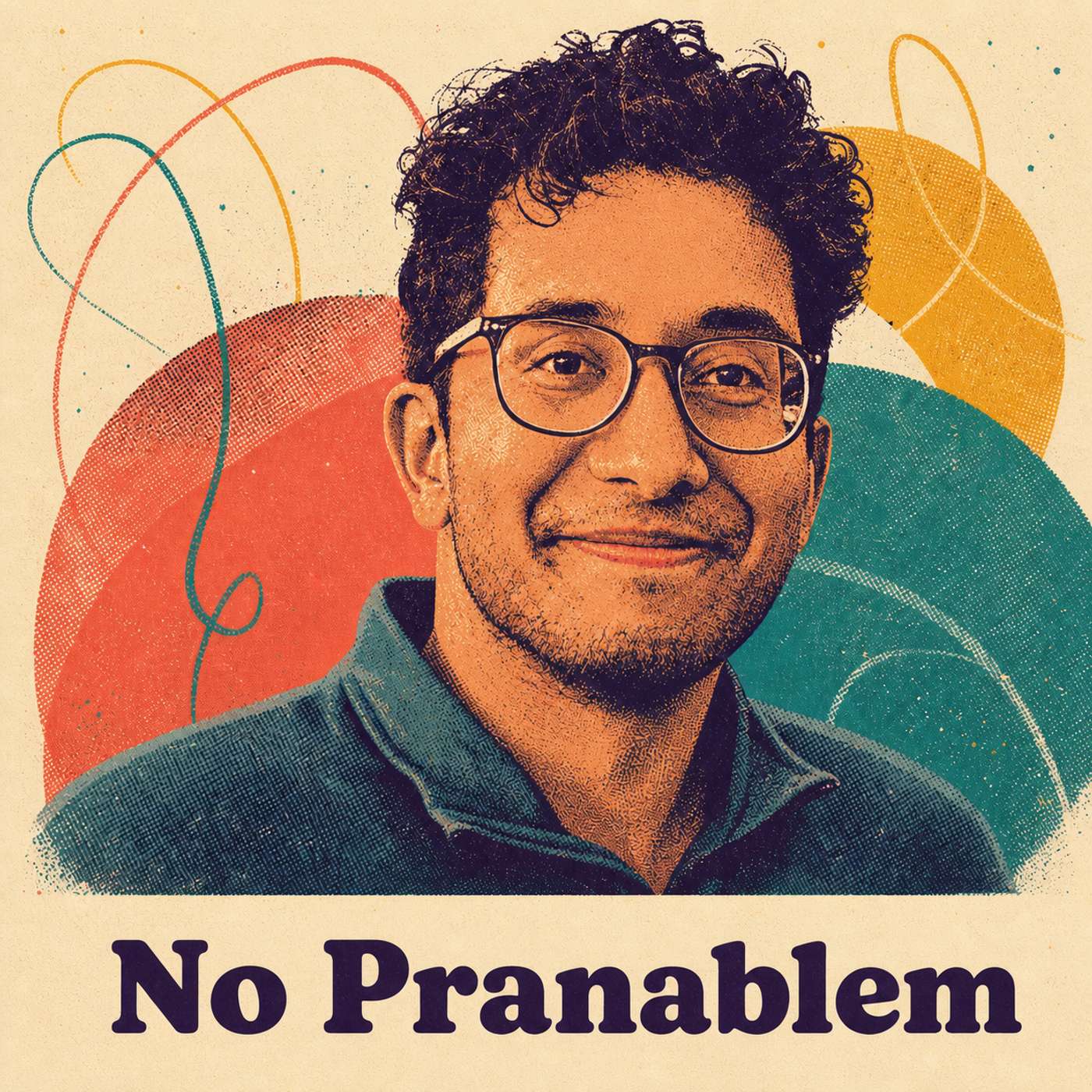
Artwork for No Pranablem
Health & FitnessMental HealthReligion & Spirituality

No Pranablem

Pranab Sachithanandan

Conversations about meditation, emotions, dharma, and how to apply them to our relationships and work. Curious, practical explorations on being and doing.

Play
  • 7 episodes
  • Avg 56 min
  • English
  • #7
    September 14 · 44 min

    Dan Grossman: Somatics, Psychedelics, and Scientific Rigor

    I spoke with Dan Grossman about how to take the somatic side of psychedelics and therapy seriously. Along the way, we explore the relationship between compelling narratives, meaningful experiences, and good science. Dan is a clinical psychology PhD candidate studying the bodily dimensions of psychedelic experiences, including shaking, movement, and vocalization, which many describe as central to their healing work. People can find these experiences deeply meaningful and healing, and it’s interesting that they seem to show up across different substances. But that doesn’t necessarily confirm the explanations we attach to them. Does the body literally store and release trauma? What evidence supports the idea that animals “shake off” traumatic experiences? And how should we approach frameworks like polyvagal theory when people find them useful, but their scientific claims remain contested? We also discuss parts work, the role of symbols and imagery in healing, and the relationship between meditation and therapy. Dan describes meditation as a form of “epistemic hygiene”: a way to engage with powerful experiences without taking every interpretation at face value. Throughout, we ask how the worlds of vibes and science might learn from each other. You can get in contact with Dan via LinkedIn at https://www.linkedin.com/in/daniel-grossman-906873119 This podcast is sponsored by Attention Copilot (attncopilot.com). You can spend all day working and still avoid the things that would make the biggest difference. Our somatic productivity coaches help you identify, prioritize, and face them. During an 80-minute to three-hour call, you settle in, share your screen, and do your actual work. Your coach helps you work through stress, make decisions, and stay clear-headed. Over time, you can feel more satisfied with your weeks, more confident taking on bigger things, and more at ease in your work.

    • Transcript
    • Chapters
  • #6
    August 23 · 54 min

    Scott Britton: Conscious Accomplishment and Using Work to Deepen Your Growth

    Scott Britton and I explore how ambition and spiritual practice can become one path. We talk about using resistance at work as data, widening the choices we can see, and building a culture where inner development supports meaningful action. Learn more through Scott’s website, his book Conscious Accomplishment, his recruiting firm Conscious Talent, and the EvolutionFM podcast. 0:00 Integrating ambition and spiritual practice 4:22 The limits of “succeed first, wake up later” 8:05 How business coaches make spiritual ideas usable 13:45 The outside-in paradigm behind achievement 19:04 Resistance is data, not proof of misalignment 22:24 How stress hides better options 25:24 Better thinking inside the box versus expanding the box 28:20 Awareness as a practical source of capacity 31:50 Holding truth lightly in disagreement 35:31 Hiring people who already value development 40:24 Self-leadership makes flatter organizations possible 41:52 AI raises the value of small, mature teams 46:53 Pausing work can be the higher-leverage move 48:54 Who Conscious Accomplishment is designed to help 52:46 The inverse journey: from spirituality back to action

    • Transcript
  • #5
    January 20 · 37 min

    Michael Taft: Intro to His Meditations and the Stack Model

    Michael Taft is a meditation teacher, creator of the podcast Deconstructing Yourself, and co-founder of the Berkeley Alembic meditation center. This podcast serves as an introduction to his teaching and how to engage with his hundreds of guided, nondual meditations on youtube. Resources: Michael's YouTube: https://www.youtube.com/@MichaelTaft108 Deconstructing Yourself: https://deconstructingyourself.com Michael's Courses: https://deconstructingyourself.org - Hacking the Stack starts January 26, 2026 Timestamps: 0:45 Why students come to Michael after other resources (apps like Waking Up, retreats like Goenka and Jhourney, and books like The Mind Illuminated) 2:40 Where Michael fits in the meditation ecosystem 5:34 Respecting traditions while being meta-systematic 7:51 Where can practice actually go? The real goals 9:23 A student with severe chronic pain (morphine pump story) 14:38 Emotional pain uses the same brain circuitry 15:02 The Stack model, and understanding "progress" in meditation 16:47 Level 1: Conceptual (thinking about experience) 17:06 Level 2: Phenomenological (qualia, direct sensation) 21:36 Level 3: Flux (everything is changing) 24:45 Level 4: Openness and emptiness 28:14 Vast Sky Mind and applying the stack to all sense gates 30:00 Why Michael uses mantra, chanting, and visualization 31:45 The arc of Michael's guided meditations on YouTube 33:02 How to engage with Michael's work 35:00 The power of sangha and community

  • #4
    Nov 22, 2025 · 1 hr 2 min

    Anne Laure Le Cunff: The Fallacy of “Follow Your Passion” and the Power of Tiny Experiments

    Anne-Laure is the author of Tiny Experiments: How to Live Freely in a Goal-Obsessed World. She also founded Ness Labs, a learning community for ambitious knowledge workers. You can learn more about her work at https://nesslabs.com 01:30 – Anne-Laure’s shift from Silicon Valley’s default success script 03:30 – Critique of the “follow your passion” fallacy 06:00 – Pranab’s personal experiment in meaningful work 11:20 – Cynicism as emotional self-protection 16:30 – Audience unpredictability and the paradox of online writing 18:30 – Pact method and intentional habit formation 24:00 – Four mindsets model: Cynicism, Escapism, Perfectionism, Experimentalism 45:30 – ADHD, hyper-curiosity, and evolutionary perspectives 53:10 – Mindful productivity and managing emotions in knowledge work 56:00 – Emotional coping strategies, interstitial journaling, and metacognition

    • Transcript
  • #3
    Aug 1, 2025 · 55 min

    Becoming a Sane Saint with Tucker Peck

    Dr. Tucker Peck is a meditation teacher, therapist, and author of "Sanity and Sainthood: Integrating Meditation and Psychotherapy". Check out his website (https://meditatewithtucker.com/) and Twitter (https://x.com/tucker_peck) where you can learn about his upcoming retreats, teachings (eg. Motivational Interviewing course which I highly recommend), and more. We talk about: - "content and process" in meditation and therapy, and how to tell when you're imbalanced on either side (hazy vs crazy) - compassion, warmth, and parts work re: The Mind Illuminated - where distinctions break down at the deep end of practice (eg. 8th jhana, Awakening vs. Liberation referencing @shamilch's work) 00:41 - Content vs Process: The core distinction between therapy and meditation 03:15 - Common traps: Going too hard in either direction 06:23 - Parts work failure modes: When IFS becomes reactive and narcissistic 09:03 - The role of warmth, compassion, and meta in practice 12:15 - Self-hatred as the "common cold" of globalized mental health 15:17 - View and intention: How dharma can become self-abuse 18:17 - The Mind Illuminated: Control vs acceptance based on individual needs 20:27 - Michael Taft's advice: "Cultivate more dullness" 23:54 - Do-nothing practice: From literal non-action to ego recognition 25:44 - When content and process blend together in advanced states 28:50 - The uncertainty principle: You can't observe both simultaneously 31:33 - Content exists at a "medium lens of analysis" 34:26 - Journey meditation and jhana "junkies" 37:03 - The unfabricated/deathless in Theravada tradition 41:40 - Awakening vs Liberation: Shamil Chandaria's model 45:26 - Going big vs going small: Different paths to awakening 48:12 - Tucker's experience: Big path leading to small path work 51:35 - Skillful refabrication: Buddhism vs New Age worldviews 53:48 - Raw data vs conceptual overlay: The breath example 55:47 - Staying grounded while gaining interpretive flexibility

    • Transcript
  • #2
    Aug 6, 2024 · 1 hr 9 min

    Peter McEwan: Tummo, Dzogchen, Lineage, and Healing

    Peter McEwen is a meditation teacher in Boulder, Colorado. Visit his site (https://thefield.us) or https://x.com/techgnostic to learn more about his work. 00:00:00 Introduction and Upcoming Course on Tummo 00:04:56 Fruitional View and Dzogchen Practice 00:09:15 Self-Improvement vs. Self-Acceptance 00:10:12 Role of Emotions in Teaching 00:10:24 Emotional Healing in Practice 00:13:10 Understanding Tummo Practice 00:14:00 Explanation of Tummo Practice 00:15:11 Trapping Air in Central Channel 00:21:22 Healing Trauma with Tummo 00:24:52 Influences and Trainings 00:29:23 Secrecy in Lineages 00:34:24 Value of Tibetan Lineages 00:34:39 Monastic Safety and Structure 00:41:28 Reflections on Trungpa’s Legacy 00:45:39 Bruce Tift as a Teacher 00:51:58 Unconditional Kindness vs. Relative Behavior 00:56:12 Tolerance for Well-being 00:59:21 Untangling Self-sabotage Patterns 01:06:16 Upcoming Course Details

    • Transcript
  • #1
    Mar 26, 2023 · 1 hr 9 min

    Christine (@christineist): Twitter, Journalling, IFS

    In this podcast, I talk to Christine about about the twitter community where we became friends, her experience with journalling, and our journeys with IFS (internal family systems therapy) as a lens on life. 0:00 Climbing & community 6:20 How did Christine get into Twitter? 11:30 Experiential difference between CBT & IFS (cognitive behavioral therapy & internal family systems) 16:00 Impro, act before you think 18:10 IFS & Journalling, relationship to journalling 25:00 Documentation & 2nd Brain stuff 28:00 Life Timeline, atheist to agnostic 31:45 What are your values? 34:30 On imaginal thinking & somatic vs. visual IFS 41:00 Recurring IFS characters, parts constellations (“garlic cloves”) 46:20 Journaling, IFS, & Existential Kink. Understanding shadow work & existential kink 54:50 Being held by your Self, Self Love 57:00 IFS as a helpful ontology & framework 58:20 Should parts always exist or occupy a new role? 1:00:30 Oneness with division, enjoying the journey. Feeling like an orchestra. 1:06:20 IFS multiplicity of mind vs. Dissociative Identity Disorder Further links: Christine's twitter: twitter.com/christineist Christine's mega Google doc: bit.ly/3IpZDtl - Includes links to her "Intro to Twitter/TPOT" guide, IFS threads, "Life Timeline" doc, and more She's also building a cozy, project-focused alternative to twitter called 3'rd space. Check it out: 3rdspace.app ----- Check out my Twitter (most active): twitter.com/nopranablem Read the newsletter (in progress): pranab.substack.com

Showing 1–7 of 7 episodes