Skip to content
Artwork for Mighty As A Mother
Health & FitnessMental HealthEducationSelf-ImprovementExplicit

Mighty As A Mother

Jenn Cohen + Laura Demuth

Mighty as a Mother is a safe space honoring the beautiful (and messy!) journey of raising children while pursuing your passions. As two executives juggling four toddlers, we may not be experts but we sure have learned a lot along the way! Alongside experts and like-minded mamas, we get real - sharing our own experiences on subjects ranging from maternal mental health, female friendships, marriage, wellness, and the juggle (and struggle!) of being a busy mom. Thank you for joining this honest, unfiltered community where we honor YOU. We're thrilled you're here!

Play
  • 21 episodes
  • fortnightly
  • Avg 43 min
  • English
Counted on this page — what you have heard stays on this device, so it is not something the list can be paged by.
  • October 6 · 41 min

    ADHD and Perimenopause: Why Your Brain Feels Different in Your 30s and 40s

    ADHD and perimenopause can overlap in ways that make a woman feel like a different person, and for many the questions start in their 30s and 40s. In this episode, board-certified naturopathic endocrinologist Dr. Jolene Brighten, author of ADHD and Women, joins us to talk about ADHD in women, masked ADHD, decision fatigue, and what estrogen and progesterone have to do with focus, memory, and mood. Have you ever snapped over something so small that you stood in your own kitchen afterward wondering what is wrong with you? The dishwasher, not the dishes. The dishwasher. Dr. Jolene Brighten is a board-certified naturopathic endocrinologist, Menopause Society Certified Practitioner, nutrition scientist, and certified sex counselor. She is the bestselling author of Beyond the Pill and Is This Normal?, and her new book, ADHD and Women, is out October 6. Dr. Brighten started noticing a pattern in her clinic. Patients with PMDD and PCOS would see their hormone symptoms improve, and some of their ADHD symptoms would ease too, though they did not disappear. At the time, she says, there was almost no research connecting the two, and plenty of women were being told that what they described was not real. Her answer was to listen, and then to build the framework she now shares in her book. What she brings to this conversation is a clinician's explanation of how estrogen, progesterone, and the brain's focus and memory chemistry interact, paired with a very practical read on what masked ADHD looks like from the inside. It matters to mothers, and to anyone carrying the mental load of a household, a team, or both, because the women who look the most capable are often the ones running the hardest on overcompensation, and the people around them rarely see the effort. Together we talk candidly about: What masked ADHD looks like in a woman who seems completely on top of it: rehearsing conversations before she walks in, arriving 30 to 60 minutes early, saying yes to everything How estrogen, progesterone, and dopamine interact, and why perimenopause can make focus, working memory, and mood feel unfamiliar The ice cream question: how a few small decisions in a row can look like indifference to the people around you Why a forgotten request can read as "I'm not important to her," and what a partner might ask instead How ADHD, anxiety, depression, and PMDD overlap, and why sorting through that takes the right mental health expert How to tell a rough season of nervous system overload from a lifelong ADHD pattern Libido, touched-out evenings, and why planning connection ahead of time can take pressure off both of you Sleep advice written for neurotypical brains, and what Dr. Brighten suggests instead Externalizing your working memory: a landing zone for your keys, one automated bill, a coffee maker you set up the night before Chill girl meal plans, ghee, leftover potato salad, and why we need a whole episode on the science of tacos You will walk away with language for the moments that do not make sense in the middle of a long day, a clearer sense of what to look for in a clinician who is literate in ADHD in women, and one small thing you can take out of your own head this week. As always, this conversation is for education and is not medical advice. Links and Resources: Dr. Brighten's Book ADHD & Women: https://drbrighten.com/adhd-and-women/ Dr. Brighten's Website: https://drbrighten.com Dr. Brighten's Instagram: https://www.instagram.com/drjolenebrighten Dr. Brighten's Youtube: https://www.youtube.com/@DrJoleneBrighten Dr. Brighten's Tiktok: https://www.tiktok.com/@drjolenebrighten Dr. Brighten's Facebook: https://www.facebook.com/drbrighten/ If this episode resonated, subscribe wherever you listen, leave us a review, and share it with a woman who needs to hear this.

  • September 15 · 37 min

    Redefining Success: What the Women Who Are Actually Thriving Do Differently

    Who's got that end of the week feeling? The one where you did everything right, answered the messages, kept every plate spinning, and still went to bed feeling like you came up short? Not tired in a way that sleep fixes. Tired in a way that has quietly become your baseline. Meghan French Dunbar calls herself a business anthropologist, which is a generous way of saying she has spent years studying how work actually works and who it actually works for. Whatever your work looks like, outside the home, inside it, or some impossible combination of the two, her answer lands the same way: the rules you have been exhausting yourself to follow were never written with you in mind. She got here the hard way. She studied journalism at a time when everyone was telling her print was dead. She went into nonprofits, then into magazines, and then one Friday night in 2014 she turned her phone off to be present at dinner with a friend. She woke up to more than sixty text messages from her boss and a one in the morning email telling her she had been fired for being unreachable. The next morning she told her husband she thought the universe wanted her to launch a print magazine about sustainable business. She crowdfunded it with a friend, and the first issue got picked up by every Whole Foods in the world. That became Conscious Company Media, which she co-founded and led as CEO. She has since interviewed more than a thousand business leaders, consulted with companies including Coach and Kate Spade, and founded the World-Changing Women's Summit. She also resigned as CEO in early 2020, weeks before lockdown, after coming back from maternity leave with significant postpartum depression on top of being completely burned out. Her recovery took about two years. Her book came out of wanting to know whether there was a way to do ambitious work without destroying yourself, and out of noticing that of all the high achieving women she met, roughly one in ten seemed to be genuinely thriving. Those were the women she set out to study. Together we talk candidly about: The one in the morning email that ended her magazine job, and the decision she made by the next morning Getting told print was dead, crowdfunding a magazine anyway, and landing in every Whole Foods Resigning as CEO after maternity leave, in the middle of postpartum depression and full burnout Why her burnout recovery took two years, not two weeks, and why that is the norm What the research actually says drives burnout, and why almost none of it is about how you show up Why imposter syndrome is not a confidence problem, and what happens when you stop treating it like one The one in ten women who seemed to be thriving, and what they were doing differently The joy question: if you had one day with nobody to take care of, what would you actually do with it Essentializing your time, your relationships, and what you let into your brain What she wants the woman who thinks she is just bad at balance to understand You will walk away with language for something you have probably been carrying privately, and with three or four things you can actually start this week without quitting anything or overhauling your life. Meghan's framing is the part that sticks: the return on investing in yourself is not selfish, and your kids will not remember the cookies you stressed over. They will remember how you showed up. LINKS AND RESOURCES Meghan's Book: This Isn't Working Website: https://www.meghanfrenchdunbar.com/ Instagram: https://www.instagram.com/meghanfrenchdunbar/ LinkedIn: https://www.linkedin.com/in/meghanfrenchdunbar/ Meghan's TedX talk: https://www.youtube.com/watch?v=GZfuHsa27yk If this episode resonated, subscribe wherever you listen, leave us a review, and share it with a mother who needs to hear this.

  • September 1 · 40 min

    It's Not Just Anxiety: How Women Can Advocate for Themselves in the Healthcare System

    Women's health self-advocacy is the heart of this episode, and Dr. Tracy Shevell, a board-certified high-risk OB-GYN with 25 years in academic medicine, is exactly the person to walk us through it. If you have ever been told your symptoms were "just anxiety" while your body kept insisting otherwise, this conversation gives you the language and the permission to be heard. When was the last time you told a doctor the whole truth, not the version you already softened because the appointment was running late and you did not want to be the difficult one? Dr. Tracy Shevell spent 25 years on the front lines of women's medicine. She trained at Albert Einstein College of Medicine, completed her residency at Mount Sinai and her Maternal-Fetal Medicine fellowship at Columbia, and spent 17 years as an attending and Director of Perinatal Ultrasound at Stamford Health. She has cared for the most complex, high-risk pregnancies you can imagine. Then she got sick herself, and her own doctors told her it was anxiety. That experience reshaped everything. After watching women's symptoms get minimized for two decades and then living it firsthand, she founded Blue Moon Perinatal, a concierge practice that helps women navigate the medical, emotional, and psychological weight of their care. Her community knows her as the internet's "doctor best friend," the one who tells the truth and gives you the words for the parts that are hardest to say out loud. Her forthcoming book, Labor & Deliverance: Reclaiming the Healing in Women's Health, comes out January 26, 2027, and argues something radical: that emotional health is clinically equal to the physical symptoms we all carry. Here is why this matters to us. About 80% of people diagnosed with an autoimmune disease are women (NIH), and research consistently shows women wait longer for diagnoses and are more likely to have physical symptoms filed under stress or anxiety. Dr. Tracy names all of it, and then she hands us something we can actually use. Together we talk candidly about: Why "becoming the quarterback of your own care" is not a slogan, it is a survival skill in a system that no longer holds you How to tell the difference between intuition and anxiety when your body is trying to tell you something is off The habit so many of us have of apologizing before we even ask a question, and the one sentence to stop rewriting What it actually means that emotional, physical, and spiritual health are linked, not separate lanes Using AI as a sounding board, never a diagnosis, so you walk into a 7-minute visit already prepared The people-pleasing, high-achieving patterns so many women carry, and what they may be quietly costing us Fatigue at baseline: when "I'm just tired" is worth a second look, and the new symptoms that deserve one Making guilt-free time for yourself when there is genuinely none left, and why it is not optional What the women who walked before us can teach us, and why intergenerational friendship matters more than we think Finding the passion that sustains you, no matter how full the season You will leave this one standing a little taller in the exam room, with a pen, a paper, and the belief that you deserve answers. Not because you are difficult, but because your body has been telling the truth all along. Links & resources: Book: Labor & Deliverance: Reclaiming the Healing in Women's Health (preorder): https://www.tracyshevellmd.com/book-media Website: https://www.tracyshevellmd.com Instagram: https://www.instagram.com/tracyshevellmd LinkedIn: https://www.linkedin.com/in/tracyshevellmd/ Substack, More than Medicine with Dr. Tracy: https://drtracyshevell.substack.com Blue Moon Perinatal: https://www.bluemoonperinatal.com If this episode resonated, subscribe wherever you listen, leave us a review, and share it with a woman who needs to hear this.

  • August 18 · 45 min

    Time Poverty, Busyness, and Finding Joy in the Back-to-School Rush, with Cassie Holmes

    The lunches are packed, the forms are signed, and the family calendar is already full through October. If the return to school has you feeling chronically behind, on time, on rest, on joy, you are in very good company. In this episode, we sit down with Cassie Holmes, chaired professor at UCLA's Anderson School of Management and bestselling author of Happier Hour, for a grounding conversation about why time feels so scarce every fall, and what actually helps. Cassie doesn't just study happiness and time poverty. She has lived it. As a working mom moving through every season from toddlers to teenagers (her son just started middle school), she brings both data and deep empathy to the question so many of us are asking as the school year ramps back up: why does it feel like there is never enough time, and how do we stop feeling so depleted by it? Together, we talk candidly about: What time poverty really is, and why mothers feel it most acutely when the school-year schedule returns Why saying yes to every playdate, practice, and sign-up sheet quietly leaves us more depleted, not more connected The surprising research behind giving time to get time How small mindset shifts, like "less doing, more being," can change how a hectic fall week actually feels Why connection, not productivity, is often the missing ingredient in our busiest seasons A simple way to rate your days so you can find the joy already hiding inside the time you have How to treat an ordinary Saturday like a vacation without adding a single thing to your to-do list Why happiness isn't selfish, and how caring for yours makes you a more present parent, partner, and leader This conversation is full of permission slips: to stop racing the drop-off clock, to stop saving joy for "someday," and to notice the ordinary moments that won't always be there. The slow morning before the bus comes. The bedtime cuddle. The shared chair at the beach before summer fully closes. Links & Resources 👉 Happier Hour by Cassie Holmes 👉 Research on time poverty, happiness, and well-being 👉 Cassie's website For more conversations like this one, subscribe to Mighty as a Mother on Apple Podcasts, Spotify, or wherever you listen, and follow along on Instagram and LinkedIn.

  • July 28 · 37 min

    Joy as an Inside Job: What Building a Brand for Mothers Taught Her About Presence Over Achievement

    What would you put on a necklace? Not the piece you bought because it was pretty, but the one you reach for on the hard days, the one that sits close enough to your heart that you feel it when you breathe. Melissa Clayton is the founder and CEO of Tiny Tags, the personalized jewelry brand made for mothers. A former CPA, she started the company hand-stamping necklaces at her kitchen counter while raising 3 boys, and grew it into a multi-million-dollar business with no outside investment, no debt, and 100% ownership still in her name. What makes Melissa worth listening to is not just that she built something, though she did, without a war chest or a headline raise, at a time when women are starting nearly half of all new US businesses. It is that she built it around a definition of success most of us are never handed. She measured growth against presence, not just revenue, and grew Tiny Tags slowly and on purpose so she would not miss the football games and the field trips. She is refreshingly honest about money, marriage, guilt, and gratitude, and she can hold the business lesson and the human one in the same hand. Together we talk candidly about: Why she believes kids do not need a perfect mother, just a present one, and how that became the whole brand Building the business slowly on purpose, so she would not miss the football games and the field trips What the necklace actually does on the hard days, and the "I have them" moment in the driveway Turning down investors for 15 years and still owning 100% of the company Saying no to brides, graduates, and every bigger market, and why that focus protected the mission Writing letters to her boys, and the empty-nester chapter she is walking into now How Target found her on Instagram, and why she almost said no What she wishes she had known when her kids were the age our listeners' kids are today You will walk away rethinking what you are actually optimizing for, and a little less convinced that faster and more is the only way to build. Whether you are growing a company, a career, or a family, Melissa's story is a reminder that presence can be a strategy, not a sacrifice. Links & resources: Tiny Tags: https://tinytags.com Instagram: @tinytags Melissa Clayton on LinkedIn: https://www.linkedin.com/in/melissa-clayton-817b568/ If this episode resonated, subscribe wherever you listen, leave us a review, and share it with a mother who needs to hear this. Check us out on Substack: mightyasamother.substack.com

  • July 14 · 37 min

    Fiber, Gut Health, and the Habits That Actually Move the Needle: What Really Supports Your Body Through Motherhood, Hormones, and Midlife.

    Registered dietitian and nutritional therapist Kim Shapira has spent nearly three decades helping people rebuild trust with food, and in this episode she tells us why the real problem was never willpower. Registered dietitian Kim Shapira breaks down what actually supports gut health and long-term wellness, and why fiber, not another diet, is the habit worth building. Have you ever wondered why "eat healthier" advice never seems to stick, no matter how many times you try? It might be because most of it was never actually about your health. Kim Shapira, MS, RD, is a celebrity dietitian and nutritional therapist whose Los Angeles practice has worked with clients across entertainment, hospitals, sports medicine, and addiction recovery for nearly three decades. She holds a B.S. in Exercise Kinesiology from Tulane University and an M.S. in Human Metabolism and Clinical Nutrition from Boston University. Kim built her career on a simple but radical idea: food isn't the enemy, and neither is your body. Early in her practice, a client who lost significant weight told Kim she was planning to gain it back, and that moment reshaped everything about how Kim approaches her work. She realized the real work was never about what people eat, but about the emotional patterns underneath, and the daily habits that actually support long-term health. That insight became the foundation of the Kim Shapira Method, her six-rule framework for eating without shame, and her book This Is What You're Really Hungry For, which features a foreword by longtime client Kaley Cuoco. Together we talk candidly about: Why health span, not just lifespan, is the more useful goal to focus on What actually supports gut health day to day, and what's just noise Simple, low-effort ways to build fiber into a busy day Why willpower isn't a sustainable strategy, and what actually helps people stick with change Kim's six rules, and how they replace restriction with trust How hormonal shifts through PMS, ovulation, pregnancy, and perimenopause affect hunger, mood, and body image What Kim reaches for when she's hungry and doesn't have time for a full meal By the end of this one, you may not walk away with a meal plan, and that's the point. You'll walk away with a clearer sense of what actually supports your health long term. Links & Resources: Book: This Is What You're Really Hungry For Website: kimshapiramethod.com Instagram: @kimshapiramethod LinkedIn: Kim Shapira Substack: kimshapiramethod.substack.com If this episode resonated, subscribe wherever you listen, leave us a review, and share it with a mother who needs to hear this.

  • June 30 · 41 min

    Knowing Your Body: Personalized Supplements and Advocating for Yourself in Women's Healthcare

    Personalized supplements for women's health are everywhere right now, but Suzie Welsh Devine, RN, MSN built the first one. In 2016 she founded Binto because she kept watching women get handed a generic prenatal, a one-size multivitamin, and a twelve-minute appointment, then sent home to figure out the rest on Google at midnight. In this episode we talk about what personalized actually means, how to read your own cycle, and what genuinely changes from your period years through perimenopause. When is the last time a provider asked what you actually need? Not the protocol. Not the standard dose. Not what they recommend to every woman your age. You. For a lot of us, the honest answer is never. That gap, between what women need and what we actually get, is the whole reason Suzie built Binto. Suzie Welsh Devine is the founder and CEO of Binto, the first personalized women's health supplement brand, formulated and founded by licensed providers. She is a former IVF and fertility nurse who spent years at the bedside before deciding to build the thing she kept wishing existed for her patients. What she brings to this conversation is a clinician's eye and a refusal to oversell. She reads labs before she recommends anything. She builds for prevention rather than prescription. And she will tell you plainly where supplements actually help and where they are just marketing dressed up as science. Together we talk candidly about: What "personalized" actually requires clinically, and what it does not mean The myth that a prescription prenatal is automatically better than what you can buy over the counter Why your menstrual cycle is a vital sign, plus a clear walk through all four phases What really shifts in perimenopause, and why brain fog is not in your head HRT after the black box warning came off, and what to keep supplementing alongside it Why vitamin D and K2 belong together Supporting your micronutrients if you are on a GLP-1 The standouts most women benefit from at a baseline, from a daily probiotic to omega-3s to inositol How to tell normal post-meal bloat from something worth taking to a doctor You will walk away knowing more about your own body than most of us were ever taught, and with a clearer sense of what to actually ask for the next time you are in front of a provider. Links & resources Binto: https://mybinto.com Suzie on Instagram: @nursesuziedevine Binto on Instagram: @mybinto Suzie on LinkedIn: https://www.linkedin.com/in/suzie-welsh-devine-3419178/ From our cabinet to yours: We have both been on our own Binto routines, and the thing that won us over is that it starts with what your body actually needs and skips what it does not. If you want a routine built around you instead of an average, listeners get 25% off with code maam25 at https://mybinto.com/discount/maam25 Code: MAAM25 If this episode resonated, subscribe wherever you listen, leave us a review, and share it with a mother who needs to hear this. Reviews genuinely help other women find the show: https://podcasts.apple.com/us/podcast/mighty-as-a-mother/id1687678053

  • June 16 · 37 min

    The Hidden Cost of Broken Trust at Work, at Home, and With Yourself: The Seven Trust Languages

    Trust is the hidden infrastructure underneath every relationship we have: at work, in our marriages, in our friendships, and with ourselves. In this episode of Mighty as a Mother, workplace trust expert and bestselling author Minda Harts walks us through her Seven Trust Languages framework and the real, hidden cost of broken trust for working mothers, including how to rebuild trust at work and at home, how to advocate for what you need, and why self-trust is where it all starts. What if the thing quietly eroding your closest relationships isn't a trust problem at all, but a communication one? That's the question Minda kept coming back to, and it reframed this entire conversation for us. Minda Harts is the creator of the Seven Trust Languages and the author of Talk to Me Nice, The Memo, Right Within, and You Are More Than Magic. She's an adjunct professor at NYU's Robert F. Wagner Graduate School of Public Service, the founder of The Memo LLC, and an award-winning filmmaker. LinkedIn named her its number one Top Voice in the Workplace, and Business Insider put her on its list of 100 People Transforming Business. She's helped teams at Nike, Google, Best Buy, and Zoom learn how to actually talk to one another. We wanted her at our table because trust isn't just a boardroom strategy. It shows up in your Slack messages and your group texts, in the way you ask for help and the way you don't. Minda spent years as "the only" in the room, having panic attacks she couldn't name, before she found the language she was missing. That search became the seven trust languages, and in this episode we widen the lens all the way from the office to the whole of a woman's life. Together we talk candidly about: Why trust rarely breaks in one big act of betrayal, and how it actually erodes in the small, quiet moments we sweep under the rug The seven trust languages, and how to identify your primary, secondary, and tertiary The stories we invent when we don't have the full picture ("my manager must hate me"), and how one honest conversation can dismantle them How to ask your boss for what you need without torching the relationship Why "clear is kind," and how your tone can change everything even when the words are identical Bringing the trust languages home: keeping your word with your kids, your partner, and your closest friends The generational trust gap at work, and why boomers and Gen Z experience the same workplace so differently What to do when you don't feel safe enough to even start the conversation The single question every leader, partner, and friend should be asking: "What do you need from me?" How to rebuild trust once it's fractured, and why demonstration always beats a quick apology You'll leave this one with language for things you've been feeling but couldn't name, and one small, doable thing you can do today to start repairing a relationship that matters to you. Links & resources Talk to Me Nice: The Seven Trust Languages for a Better Workplace by Minda Harts The Memo: What Women of Color Need to Know to Secure a Seat at the Table by Minda Harts Minda's website: mindaharts.com Minda on Instagram: @mindaharts Minda on LinkedIn: linkedin.com/in/mindaharts

  • June 2 · 41 min

    What Happens When You Stop Running and Start Living: Slow Travel, Boundless Life, and Raising Kids in the World

    When was the last time you let yourself fantasize about a different kind of life? Not a vacation. Not a long weekend. But a real, full-bodied reimagining of your days — one where your kids meet you. Where you meet yourself. Where the pace of life finally matches the pace of your heartbeat. Elodie Ferchaud did more than fantasize. She built it. Elodie is the Co-Founder and Chief Revenue Officer of Boundless Life — a global community that gives families the tools, the structure, and the community to live, work, and learn across some of the most beautiful destinations on earth. After 15 years building brands at L'Oréal and Procter & Gamble, living what looked like a successful international life, Elodie took a sabbatical that changed everything. What started as a deeply personal decision to slow down became a movement. Today, Boundless has welcomed more than 5,000 participants from over 50 countries across 8 destinations worldwide — Sintra, Portugal; Syros, Greece; Tuscany, Italy; Sanur, Bali; Kotor, Montenegro; Estepona, Spain; La Barra, Uruguay; and Kamakura, Japan. What makes Elodie's story so resonant for ambitious mothers isn't the travel. It's the truth underneath it: that the model of success we've been handed often doesn't fit the life we actually want. And that the hardest part of changing isn't logistics — it's letting go of external validation long enough to trust your gut. A French mother of four, raised by educators, Elodie co-founded Boundless Life alongside Mauro Repacci and Rekha Magon after first joining as a participating family herself. She knows this life from the inside out — the fear, the freedom, and everything in between. Together we talk candidly about: What life looked like before Boundless — the commutes, the missed school concerts, the feeling of being in the wheel with no exit Why she took a sabbatical that terrified her, and what she discovered on the other side The Gallup data showing that roughly 40% of American women ages 15 to 44 want to leave the US permanently — nearly double the rate of all US adults What slow travel actually feels like on the ground: walkable cities, spontaneous mornings, bumping into neighbors you know in the middle of Greece The Boundless program structure — from 3-week summer programs to 3-month academic cohorts to full 9-month stays Why kids don't need more toys — they need community and unstructured space to discover the world The mother who, at the end of her Tuscany cohort, said for the first time: "My kids got to meet their mother" How sibling bonds deepen through shared adventure and shared hardship The internal and external resistance Elodie faced — including her own father, a lifelong educator, who still struggles to accept the path she chose What she would tell any woman who feels trapped by the pace of her life but can't see a clear exit What you'll walk away with: Permission. Not the kind anyone else can give you — the kind that comes from hearing a woman who built something real say: you can always come back. The grind will wait. The life you're dreaming of? It won't. Links & Resources: Boundless Life website: boundless.life Boundless Life on Instagram: @boundlesslife Boundless Life on LinkedIn: linkedin.com/company/boundlesslife Elodie Ferchaud on LinkedIn: linkedin.com/in/elodieferchaud Explore Boundless Life 4-Week Summer Programs: boundless.life/4-week-getaway MAAM Links: Subscribe on Apple Podcasts: https://podcasts.apple.com/us/podcast/mighty-as-a-mother/id1687678053 Read more at Substack: https://mightyasamother.substack.com Shop our favorites: https://shopmy.us/shop/mightyasamotherpodcast

  • May 19 · 48 min

    Why You're Lonely Even When You're Surrounded by People: The Science of Female Friendship

    In this episode of Mighty as a Mother, we sit down with Shasta Nelson — friendship researcher, bestselling author, and one of the leading experts on adult female friendship and loneliness — to talk about why so many women feel disconnected even in their fullest lives, and what it actually takes to build the kind of close female friendships that sustain us. There's a kind of loneliness that doesn't look the way we picture it. It's not the woman alone in a dark apartment. It's the one running carpool, answering emails, texting a dozen people, and still going to bed feeling unseen. It's the mom surrounded by her kids, her colleagues, her neighborhood — and somehow starving for real connection. If that sounds familiar, this episode is for you. For more than 15 years, Shasta Nelson has studied how adults form and maintain friendships — what makes closeness thrive and why so many women feel deeply disconnected even in their fullest lives. She is the author of three acclaimed books on female friendship, a two-time TEDx speaker, and the former Chief Friendship Officer of the US Chamber of Connections. Her work blends research with lived experience, making the science of female friendship feel not just meaningful — but urgent. In this conversation, we explore why women's loneliness is so misunderstood, what close friendships actually require, and how to build the kind of relationships that carry us through every season — especially the hard ones. In This Episode, You'll Learn: Why up to 60% of people report feeling lonely regularly — and why the loneliest women are often the most socially connected What loneliness actually is (it's a biological signal, not a personal failing — and the shame around it is making the female friendship crisis worse) The 200-hour friendship rule: why it takes 200 hours to build a best friendship as an adult — and what to do with that number Shasta's Frientimacy Triangle — the three requirements every healthy female friendship needs: Positivity, Consistency, and Vulnerability How to diagnose which element of deep female friendship is missing in your closest relationships right now Why most adult friendships die when the "container" changes (the job, the school, the neighborhood) — and how to prevent it How to ask for more from a friendship — more honesty, support, or reciprocity — without making it awkward What modeling female friendship in front of your kids actually does for them — and why most of us are doing it in hiding About Shasta Nelson Shasta Nelson is one of the leading experts on female friendship and adult loneliness. She is the author of Frientimacy: How to Deepen Friendships for Lifelong Health and Happiness, Friendships Don't Just Happen, and The Business of Friendship, and has spoken at TEDx, corporations, and women's organizations worldwide. She is the former Chief Friendship Officer of the US Chamber of Connections and the founder of GirlFriendCircles.com — one of the first friendship-matching platforms for adult women. Links & Resources Mentioned: Shasta Nelson's website: www.shastanelson.com Shasta on Instagram: @shastanelson Shasta on LinkedIn: Shasta Nelson Books by Shasta Nelson: Frientimacy: How to Deepen Friendships for Lifelong Health and Happiness Friendships Don't Just Happen The Business of Friendship Previous MAAM episode on female friendship: Anna Goldfarb on friendship For more research-informed conversations on female friendship, motherhood, ambition, and wellness, subscribe to Mighty as a Mother: Apple Podcasts | Spotify | Substack

  • May 5 · 42 min

    Is That Normal? A Pelvic Floor Therapist Answers the Questions You're Too Embarrassed to Ask

    If you have ever crossed your legs before you sneezed, skipped a workout because something felt off, experienced pain during sex and assumed it was just part of life — this episode is for you. Jenn and Laura sit down with Dr. Allea Francis, pelvic floor physical therapist and co-founder of Tonic and Phasic in Costa Mesa, California, for a conversation that is long overdue on this show. This is a topic that touches nearly every woman — and almost nobody is talking about it honestly. Dr. Allea shares her own decade-long journey with chronic pelvic pain before discovering pelvic floor physical therapy — a field she has now dedicated her career to. Jenn opens up about seeing Dr. Allea as a patient herself: what began as debilitating back pain she was convinced required a neurologist turned out to be a pelvic floor issue. One session brought relief she hadn't felt in over a year. This conversation covers the pelvic floor in full — anatomy, symptoms, hormonal connections, and the exercises that actually help. Whether you have classic symptoms or none at all, you will leave this episode understanding your body in a way you likely never have before. What You'll Learn What the pelvic floor actually is — and why it is so much more than Kegels The full range of symptoms that indicate a pelvic floor issue (many will surprise you) Why back pain, hip pain, and sciatic pain can all be pelvic floor problems in disguise How leakage is common — but not inevitable — and what you can do about it How hormones across every life stage (pregnancy, postpartum, perimenopause, menopause) directly affect pelvic health Why strength training and flexibility are equally important — and which muscles most moms are unknowingly neglecting What to expect at your first pelvic floor PT appointment How to find a qualified pelvic floor physical therapist near you Why it is never too late to address pelvic health — even in your 80s The specific blood work Dr. Allea recommends and why timing in your cycle matters Links & Resources Find Dr. Allea Francis Tonic and Phasic — Practice Website Costa Mesa, California | Also offering virtual appointments Find a Pelvic Floor Therapist Near You Dr. Allea recommended these two accredited directories: PelvicRehab.com — Practitioner Directory Pelvic Guru — Practitioner Directory Mentioned in This Episode Dr. Stacy Sims — Roar (Book) Dr. Stacy Sims — Next Level (Book) Function Health — Comprehensive Lab Testing Connect With MAAM Substack — mightyasamother.substack.com Instagram — @mightyasamotherpodcast Apple Podcasts — Mighty as a Mother Spotify — Mighty as a Mother

  • April 21 · 45 min

    What Chronic Stress Is Really Doing to Women's Bodies

    What if the chronic exhaustion, hormonal imbalance, brain fog, and burnout you've been living with aren't just the cost of a busy life — but your body's signal that something deeper needs attention? In this episode of Mighty as a Mother, we sit down with Dr. Aviva Romm — Yale-trained physician, board-certified family medicine doctor, midwife, herbalist, NYT bestselling author, and one of the most trusted voices in women's integrative health and hormonal wellness — for a conversation that is equal parts science and permission slip. Dr. Aviva Romm has spent over three decades at the intersection of modern medicine, functional medicine, and women's hormone health — her own lived experience included. She is the author of The Adrenal Thyroid Revolution and Hormone Intelligence, two of the most widely read books on women's hormonal health, cortisol, adrenal function, and stress-related illness. Dr. Romm brings something genuinely rare to this conversation: a clinician who asks better questions, looks earlier at the root causes of women's health issues, and never reduces cortisol imbalance, burnout, or hormonal disruption to a quick fix or a trending protocol. This episode was born out of an honest conversation about what chronic stress actually does to a woman's body over time. We talked about the accumulated weight of caregiving, career pressure, perimenopause, family health crises, and the invisible labor that working mothers carry — and the very real biological consequences when that load goes unaddressed. Dr. Romm walks us through what cortisol — clinically known as the "wear and tear hormone" — does to a woman's sleep, weight, immune system, mood, and long-term health, and what it takes to start reversing the damage in real life, with real constraints. Together, we talk candidly about: What "weathering" is — and why chronic stress causes cumulative biological damage in women's bodies, not just emotional fatigue Why cortisol is called the wear and tear hormone, and how chronically elevated cortisol disrupts sleep, causes weight gain around the midsection, impairs decision-making, drives sugar cravings, and accelerates inflammation How unaddressed chronic stress in women can progress from burnout and hormonal imbalance to autoimmune conditions, metabolic syndrome, thyroid dysfunction, and cardiovascular disease The timeline approach Dr. Aviva Romm uses with patients to trace the root causes of hormonal disruption, adrenal fatigue, and stress-related illness — often years before a diagnosis Why perimenopause and postpartum hormonal shifts lower a woman's stress resilience — and what women in their late 30s and 40s need to know about protecting their health The specific lab markers every woman should request from her doctor as a baseline: CRP, ferritin, vitamin D, B12, hemoglobin A1C, TSH, and waist circumference as a proxy for chronic inflammation What the functional medicine world gets wrong about lab interpretation — and how to find an integrative women's health practitioner you can actually trust Why cortisol reduction, nervous system regulation, and community connection are among the most evidence-based interventions for women's hormonal health What working mothers are modeling for their children when they normalize running on empty — and why that reframe is often the one that finally creates change This one is for the woman in her late 30s or 40s who has been managing stress, hormonal symptoms, fatigue, anxiety, or that quiet sense that something is off — and hasn't been taken seriously yet. For the woman who Googled "adrenal fatigue," "perimenopause symptoms," "cortisol and weight gain," or "why am I so exhausted" and still left the doctor's office without answers. Dr. Aviva Romm reminds us that the body doesn't send five-alarm fires first. It sends quiet signals. And learning to hear them earlier — before chronic stress becomes chronic illness — may be the most important investment a woman can make in her long-term health. Links & Resources 👉 Dr. Aviva Romm: https://avivaromm.com 👉 The Adrenal Thyroid Revolution by Dr. Aviva Romm: https://avivaromm.com/books 👉 Hormone Intelligence by Dr. Aviva Romm: https://avivaromm.com/books 👉 Worry Watcher's Journal (mentioned in episode): https://avivaromm.com For more honest conversation about working motherhood, women's health, hormonal wellness, burnout, and the real experience of ambitious motherhood, subscribe to Mighty as a Mother on Apple Podcasts, Spotify, or wherever you listen — and follow along on Instagram @mightyasamotherpodcast, LinkedIn, and Substack.

  • April 7 · 52 min

    Why You Feel So Dysregulated (And How to Feel Grounded Again)

    What if healing wasn't about doing more, but about listening more closely to what your body has been trying to say all along? In this episode, we sit down with Nicole Lange, founder of Life Healing Life, acupuncturist, and women's health practitioner, for a deeply grounding conversation about fertility, trauma, nervous system regulation, and what truly holistic care can look like. Nicole originally thought she'd become a geneticist, studying the smallest units of human life. But after surviving profound personal trauma, her path shifted toward Chinese medicine, where she found a more expansive understanding of healing — one that honors the connection between mind, body, grief, stress, identity, and the stories we carry. With more than 20 years of experience supporting women through infertility, pregnancy loss, IVF, perimenopause, and major life transitions, Nicole brings both science and soul to this conversation. She's also refreshingly honest about the kind of care women actually deserve: care that is personal, patient-centered, trauma-informed, and never one-size-fits-all. Together, we talk candidly about: How chronic stress, grief, and unresolved trauma can leave women feeling dysregulated in their bodies Why so many women turn to acupuncture in moments of crisis — and what it can offer far beyond fertility support The connection between nervous system regulation, emotional health, and reproductive health What Chinese medicine understands about the mind-body connection that modern healthcare is finally catching up to How "doing everything right" can sometimes keep us further from the healing we actually need What acupuncture is really like if you've never tried it — and why it may be more supportive than you expect Why healing isn't about fixing yourself or forcing positivity, but learning how to honestly relate to what you're carrying How modeling real emotion for our children can become part of our own healing too This one is for the woman who feels stretched thin, emotionally flooded, physically depleted, or just plain off — and can't quite explain why. Nicole reminds us that dysregulation isn't a personal failure. It's often a signal. And getting grounded again may have less to do with pushing harder and more to do with feeling safe enough to soften. Links & Resources 👉 Nicole Lange / Life Healing Life: https://www.lifehealinglife.com/ 👉 Previous episode with Molly Dickinson / The Maternal Stress Project: https://podcasts.apple.com/us/podcast/e25-exploring-the-stress-of-modern-american/id1687678053?i=1000651881093 For more honest motherhood conversation, subscribe to Mighty as a Mother on Apple Podcasts, Spotify, or wherever you listen — and follow along on Instagram @mightyasamotherpodcast, LinkedIn and Substack

  • March 24 · 49 min

    Everything Women Were Never Told About Perimenopause with Dr. Mary Claire Haver

    Follow along on our new Substack here: https://mightyasamother.substack.com/ In this episode, we sit down with Dr. Mary Claire Haver — board-certified OB-GYN, certified menopause practitioner, founder of The Pause Life and Mary Claire Wellness, and one of the leading voices changing the conversation around perimenopause and menopause for women everywhere. Her bestselling book The New Menopause and upcoming book The New Perimenopause are helping women better understand what's happening in their bodies long before that one official day called menopause arrives. Together, we unpack what perimenopause actually is, why it can begin earlier than many women expect, and how symptoms like sleep disruption, anxiety, brain fog, weight changes, palpitations, and feeling unlike yourself are too often dismissed as stress, motherhood, or burnout. We also talk about the overlap between postpartum and perimenopause, why so many women spend months or years searching for answers, and what it looks like to advocate for yourself when your body is waving a flag and no one seems to be listening. This is a conversation every woman needs — not just the ones having hot flashes. Because for many of us, this story starts much earlier, much quieter, and with symptoms we were never taught to connect to hormones in the first place. Together, we talk candidly about: What perimenopause is — and why it's not the same thing as menopause Why women in their late 30s and early 40s may already be experiencing symptoms The overlap between postpartum, fertility journeys, and perimenopause Why so many women say, "I just don't feel like myself" The symptoms clinicians often miss, from sleep issues and anxiety to joint pain and dizziness How to advocate for yourself when your concerns are dismissed What hormone therapy actually is, and why fear around it has kept too many women from getting support The health habits that matter most for long-term strength, bone health, heart health, and aging well Why community, education, and honest conversations with other women matter so much in this season Dr. Haver also shares her own evolution — from longtime OB-GYN in academic medicine to building a menopause-focused practice and global platform that is helping women feel seen, believed, and better equipped to care for themselves. She also discusses her work with Midi Health, a virtual care platform focused on menopause and midlife care. This one is for the woman lying awake at 3:17 a.m., wondering why she can't sleep. For the woman who feels foggy, anxious, inflamed, or off — and keeps getting told it's just stress. For the woman trying to mother, lead, work, and hold it all together while quietly wondering what the hell is happening to her body. You are not imagining it. And you are definitely not alone. Links & Resources 👉 The New Menopause by Dr. Mary Claire Haver 👉 The New Perimenopause by Dr. Mary Claire Haver 👉 Mary Claire Wellness / The Pause Life (The 'Pause Wellness) 👉 Find a certified menopause practitioner through The Menopause Society (Menopause Practitioner) 👉 Learn more about Midi Health (Join Midi) 👉 Dr. Haver's Diary of a CEO conversation on menopause (YouTube) For more honest motherhood conversation, subscribe to Mighty as a Mother on Apple Podcasts, Spotify, or wherever you listen — and follow along on Instagram, LinkedIn and Substack.

  • March 3 · 51 min

    Parenting Boys Today: Emotional Regulation, Boundaries, and Big Feelings

    In a world where boys are told to "toughen up" before they even understand what they're feeling, how do we raise sons who stay connected to their hearts? In this episode, we sit down with writer, editor, and media critic Joanna Schroeder to talk about what it really means to raise emotionally healthy boys today. Not perfect boys. Not "alpha" boys. Not fragile boys. But boys who can feel. Together, we unpack what's often called the "boy crisis" — and move beyond headlines to the real, lived experiences happening in our homes. From emotional suppression to loneliness, from screen time to algorithm-driven messaging, we explore the cultural forces shaping our sons — and what we can actually do about it as parents. This conversation isn't about fear. It's about awareness. And responsibility. And repair. We talk candidly about: Why boys' mental health deserves our attention — without ignoring the bigger picture The subtle ways society teaches boys to disconnect from their emotions How to help boys regulate anger without shaming their feelings What emotional safety at home actually looks like (especially when we're dysregulated ourselves) How social media and online content shape boys' identity earlier than we think Practical boundaries around screen time, smartphones, and tech in the bedroom Why repair matters more than perfection in parenting How to raise boys who are both strong and soft One of our favorite takeaways? You don't have to protect your son from the world entirely. But you can make your home the safest place for him to land. This episode is for the moms raising sons. For the parents trying to break cycles. For anyone who has ever been told to "stop crying" and is determined to do it differently. The goal isn't to raise boys who never struggle. It's to raise boys who know they don't have to struggle alone. Links & Resources 👉 Joanna's book Talk to Your Boys: 16 Conversations to Help Tweens and Teens Grow into Confident, Caring Young Men 👉 Talk To Your Boys website 👉 Joanna on Instagram 👉 2024 Recap Episode (where we talk about trying to do it all) For more honest motherhood conversation, subscribe to Mighty as a Mother on Apple Podcasts, Spotify, or wherever you listen — and follow along on Instagram @mightyasamotherpodcast.

  • February 17 · 43 min

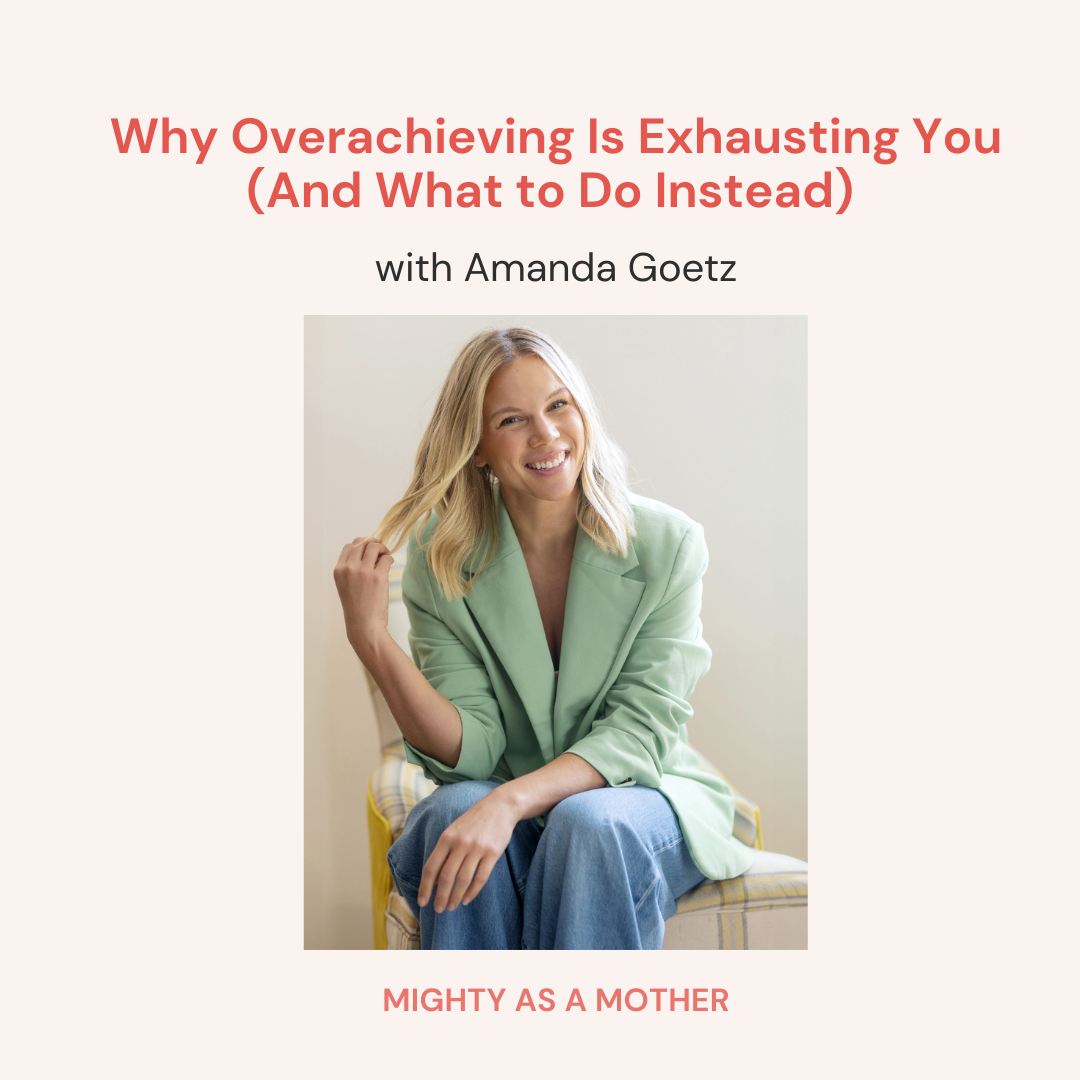
    Why Overachieving Is Exhausting You (And What to Do Instead)

    In a culture that still glorifies hustle and resilience, what happens when the very grit that built your success starts quietly depleting you? In this episode, Jenn sits down with Amanda Goetz—two-time founder, four-time CMO, mom of three, and author of Toxic Grit—for a conversation that feels like a deep exhale for ambitious women everywhere. Amanda has built brands, raised millions, navigated divorce, and reinvented herself more than once. And somewhere along the way, she realized that the same grit that fueled her rise was also quietly burning her out. Her book, Toxic Grit: How to Have It All and Actually Love What You Have, is already resonating with thousands of women questioning hustle culture and craving something more sustainable. Today, we go there with her. Together, we talk candidly about: The difference between healthy ambition and "toxic grit"—and how to know when you've crossed the line Why "alignment" can feel impossible when you're juggling multiple identities at once Amanda's Character Theory and how naming the different parts of yourself can reduce guilt and increase presence The concept of "spin cycles" and why intentional resets—both daily and seasonally—are essential for ambitious women How to set an "enoughness line" so you can push in one season without losing yourself in the process The seasonality of ambition—blooming, going back into the dirt, and trusting the cycle We also dive into practical rituals for transitioning between roles (from CEO to caregiver to partner to solo human), and how even small boundaries—like a commute bath or a 20-minute phone-free walk—can radically shift how you show up. This conversation is for the woman who's been praised for her grit. The steady one at home. The overachiever at work. The one who "just gets it done," even when she's running on fumes. It's for anyone who has quietly wondered why doing it all still doesn't feel like enough—and who is brave enough to imagine something different. Amanda reminds us that ambition isn't the enemy. But unchecked ambition without reflection, rest, and recalibration? That's where it gets dangerous. Balance, she argues, isn't about every day feeling even. It's about zooming out and honoring the macro rhythms of your life. If you've been living in hustle mode for longer than you'd like to admit, this episode might just be the permission slip you didn't know you needed. Links & Resources 👉 Toxic Grit: How to Have It All and Actually Love What You Have by Amanda Goetz 👉 Amanda's newsletter, Life's a Game 👉 Toxic Grit Workbook For more honest conversation at the intersection of motherhood, ambition, and identity, subscribe to Mighty as a Mother on Apple Podcasts, Spotify, or wherever you listen—and follow along on Instagram @mightyasamotherpodcast

  • February 3 · 47 min

    The Mental Health Realities of Motherhood

    What does burnout really look like for high-functioning women and mothers? In this powerful episode of Mighty as a Mother, we sit down with clinical psychologist and maternal mental health expert Dr. Lilit to unpack the emotional and physical toll of modern motherhood. Together, we explore why so many women feel exhausted, disconnected, and stretched too thin—and why those feelings often go unnamed and untreated. If you've ever asked yourself, Why am I so tired even after I sleep? Why do I feel like I'm falling apart even when things look fine?, this conversation is for you. Dr. Lilit brings both professional expertise and lived experience to our dialogue, offering real-world insight into how stress manifests in the body, why so many mothers struggle with identity loss, and what we can do—practically and compassionately—to feel more like ourselves again. In this episode, we explore: Signs of maternal burnout and chronic stress that often go unnoticed How emotional overload shows up in the body (think: shoulder pain, tight chest, irritability) The difference between functioning and feeling well How to create micro-moments of nervous system regulation, even in a packed day The importance of self-repair and modeling emotional honesty for our kids Why many moms carry guilt for simply needing a break—and how to release it Key topics we cover: maternal mental health support, burnout in motherhood, nervous system tools, mental load of parenting, working mom wellness, somatic signs of stress, how to set emotional boundaries, postpartum mental health, emotional regulation for moms Links & Resources 👉 The CDC on connected playtime and child development: Link 👉 Follow Dr. Lilit on Instagram: @dr.lilit 👉 Learn more about her practice: www.drlilit.com 👉 Jenn's favorite mindfulness tool: Calm App 👉 Our most-downloaded episodes on burnout: 🎧 E39: Boundary Setting, Beating Burnout, and Reclaiming Yourself – Part 1 👉 https://podcasts.apple.com/us/podcast/e39-boundary-setting-beating-burnout-and-reclaiming/id1687678053?i=1000679065346 (podcasts.apple.com) 🎧 E40: Boundary Setting, Beating Burnout, and Reclaiming Yourself – Part 2 👉 https://podcasts.apple.com/vn/podcast/e40-boundary-setting-beating-burnout-and-reclaiming/id1687678053?i=1000680685965 (podcasts.apple.com) ------------------------- For more conversations on motherhood, identity, and mental health, subscribe to Mighty as a Mother on Apple Podcasts, Spotify, or wherever you get your podcasts. Follow us on Instagram @mightyasamotherpodcast for more honest reflections on modern motherhood.

  • January 20 · 45 min

    Why You Never Feel Like You Have Enough Time (And How to Change That)

    In a world that rewards busyness and glorifies the grind, it's no wonder so many of us feel chronically behind—on time, on rest, on joy. In this episode, we sit down with Cassie Holmes, chaired professor at UCLA's Anderson School of Management and bestselling author of Happier Hour, for a deeply grounding conversation about why time always feels scarce—and what actually helps. Cassie doesn't just study happiness and time poverty. She's lived it. As a working mom navigating the seasons from toddlers to teens, she brings both data and deep empathy to the question so many women are asking: Why does it feel like there's never enough time—and how do we stop feeling so depleted by it? Together, we talk candidly about: What time poverty really is—and why women and mothers feel it most acutely Why busyness has become a badge of honor (and how it quietly erodes our happiness) The surprising research behind giving time to get time How small mindset shifts—like "less doing, more being"—can radically change how our days feel Why connection, not productivity, is often the missing ingredient The myth of needing more time—and the reality of finding joy inside the time you already have How to "time craft" your days and weekends so they feel more spacious and meaningful Why happiness isn't selfish—and how it actually makes us better partners, parents, and leaders This conversation is full of permission slips: to stop racing the clock, to stop saving joy for "someday," and to notice the ordinary moments that won't always be there—bedtime cuddles, slow mornings, shared chairs at the beach. Links & Resources 👉 Happier Hour by Cassie Holmes 👉 Research on time poverty, happiness, and well-being 👉 Cassie's website For more conversations like this one, subscribe to Mighty as a Mother on Apple Podcasts, Spotify, or wherever you listen—and follow along on Instagram and LinkedIn.

  • January 6 · 40 min

    The Career Moves That Matter Most After Becoming a Mother

    In a world that tells moms we can "have it all," most of us are sitting there like… cool, can I also have five uninterrupted minutes and a hot cup of coffee? In this episode, we sit down with journalist-turned-health-tech insider Christina (Chrissy) Farr to talk about the career moves that actually matter after becoming a mother—because postpartum isn't just a physical recovery. It's a full identity recalibration. Chrissy has built a rare career at the intersection of storytelling, strategy, and healthcare innovation—and she's refreshingly blunt about what changed for her once kids entered the picture: her relationship with time, the power of boundaries, and the shift from doing everything to doing the right things. Together, we unpack: Why motherhood makes you stop working "for exposure" (and start pricing your time like the precious resource it is) Chrissy's "high-visibility vs. low-visibility work" framework—and why it's a game changer when your life has daycare pickup baked into it The honest shift many women feel after having kids: wanting purpose and financial security (and not apologizing for either) Why women need to talk about money more—without shame, secrecy, or pretending we're "above it" How to model ambition and integration for our kids without turning our lives into a burnout highlight reel The reminder so many of us need: you don't need perfect timing to start—your life will expand around what matters This conversation is for the mom who's quietly renegotiating everything: her ambition, her calendar, her tolerance for unpaid labor, and what "success" even means now. Links & Resources 👉 Chrissy's newsletter, Second Opinion: https://secondopinion.media/ 👉 Chrissy's podcast, Lifers (Apple Podcasts): https://podcasts.apple.com/us/podcast/lifers-with-christina-farr/id1759267211 (Apple Podcasts) 👉 Scrub Capital: https://scrubcapital.com/ 👉 Chrissy's book, The Storyteller's Advantage: 👉 Follow Chrissy on LinkedIn: https://www.linkedin.com/in/christinafarr Listen & Follow Mighty as a Mother Subscribe to Mighty as a Mother on: Apple Podcasts: https://podcasts.apple.com/us/podcast/mighty-as-a-mother/id1687678053 Spotify: https://open.spotify.com/show/0rbxeBmjXSRFWXPkIoPcnb Follow along on Instagram: https://www.instagram.com/mightyasamotherpodcast/?hl=en Connect with us on LinkedIn: https://www.linkedin.com/company/mighty-as-a-mother-podcast/

  • Dec 23, 2025 · 45 min

    E65: Whole Person Coaching That Redefines You From the Inside Out with Dr. Natalie Underdown

    What if your leadership didn't start with a strategy—but with your nervous system? This week, we're joined by Dr. Natalie Underdown, organizational psychologist, executive coach, and founder of The Nu Company, for a conversation that flips the script on what it means to lead, evolve, and truly care for ourselves in high-stakes seasons of life. Natalie brings a whole-person approach to executive coaching—one that fuses neuroscience, trauma healing, identity work, and performance psychology. After burning out in corporate and navigating a health crisis rooted in toxic mold exposure, she redefined her own path. Now, she helps other ambitious women do the same—from the inside out. Together, we get real about: Why burnout isn't a badge—and how it often masks deeper misalignment How whole-person coaching helps you unlearn performance-based identity and reconnect with who you actually are What nervous system regulation has to do with emotional resilience, leadership, and even parenting The practical magic of shaking off stress (literally) and embracing somatic tools that work in real life—not just retreats Human Design as a tool for self-understanding and why it might explain your decision fatigue or energy dips If you're sitting at the edge of reinvention, or just trying to lead with more integrity and less adrenaline, this episode is your invitation to pause, breathe, and get curious about the stories you're still telling yourself. Links & Resources 👉 Dr. Natalie Underdown's Website – The Nu Company 👉 Follow Natalie on Instagram 👉 Our episode with Human Design expert Erin Claire Jones 👉 Book rec: The Body Keeps the Score by Bessel van der Kolk For more conversations like this one, subscribe to Mighty as a Mother on Apple, Spotify, or wherever you listen—and follow along on Instagram and LinkedIn.

Showing 1–20 of 21 episodes