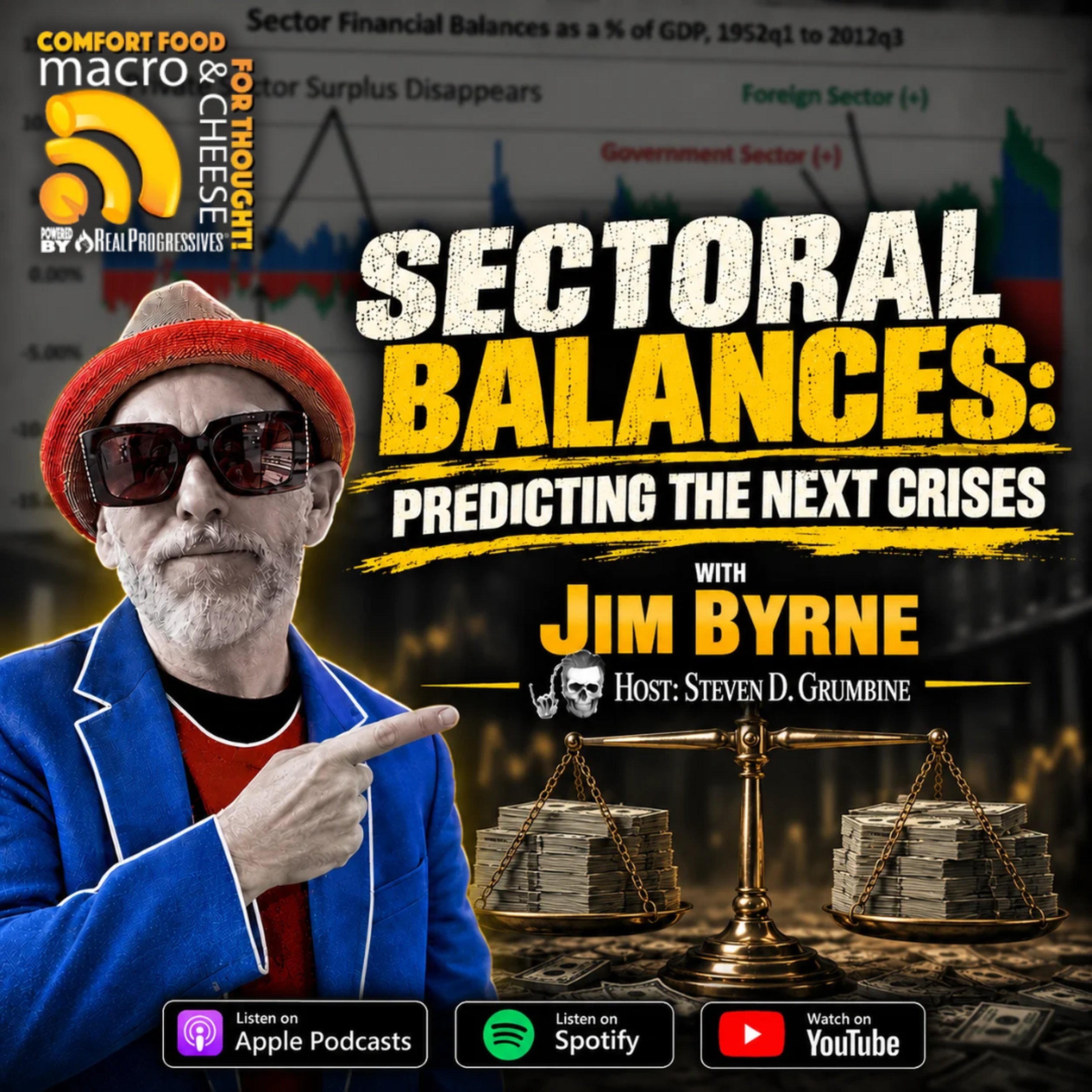
Ep 397 - Sectoral Balances: Predicting the Next Crises with Jim Byrne
Join us on Tuesday. Together we’ll listen to and discuss this episode in our virtual community gathering. Sept 22 at 8pm ET / 5pm PT. Register here: https://us06web.zoom.us/meeting/register/RuYdM1rUS_esV3lRK9-75A What do government deficits have to do with the money in our pockets? Returning guest Jim Byrne, of the MMT101.ORG podcast, joins Steve to demystify one of Modern Monetary Theory’s most important tools: sectoral balances. They unpack the accounting identity that let a handful of economists see the 2008 financial crash coming years before Wall Street or the Fed had a clue. Using simple, everyday analogies, Jim walks through why government deficits and surpluses are mirror images of what's happening in your own bank account — and why the conventional wisdom about government "living within its means" gets the whole picture backwards. Along the way, Steve and Jim dig into the real history: how nearly every attempt to pay down the national debt has been followed by a depression or recession, how a toxic mix of government surpluses, ballooning private debt, and banking deregulation set the stage for 2008, and how the subprime mortgage scheme was less an accident than a business model. The discussion turns to Jim’s native Scotland and the fiscal framework proposed for a future independent country. The Scottish Government plans initially to continue using the British pound, making Scotland a currency user rather than issuer, while also proposing fiscal rules aligned with the EU’s Stability and Growth Pact as it pursues EU membership. The EU framework retains reference values of a government deficit below 3 percent of GDP and public debt below 60 percent. Jim uses sectoral balances to show how imposing such limits, particularly in a country running an external deficit, would squeeze the domestic private sector, increasing household indebtedness and putting pressure on employment and public services. Accounting identities can tell us how much money is flowing between sectors, but that’s not the whole picture. Steve and Jim add the missing dimension of class and distribution. Sectoral balances give us the map; stratification and class analysis tell us where the money actually lands. Together, they provide a powerful way to cut through familiar myths about government debt and expose the political choices hidden behind supposedly neutral economic policy. Jim Byrne hosts the MMT101.ORG podcast, where he focuses on explaining Modern Monetary Theory, heterodox economics, and how public monetary systems really operate. Follow his work and the MMT101.ORG podcast at mmt101.substack.com @MMT101dotORG on X
- Transcript
- Chapters