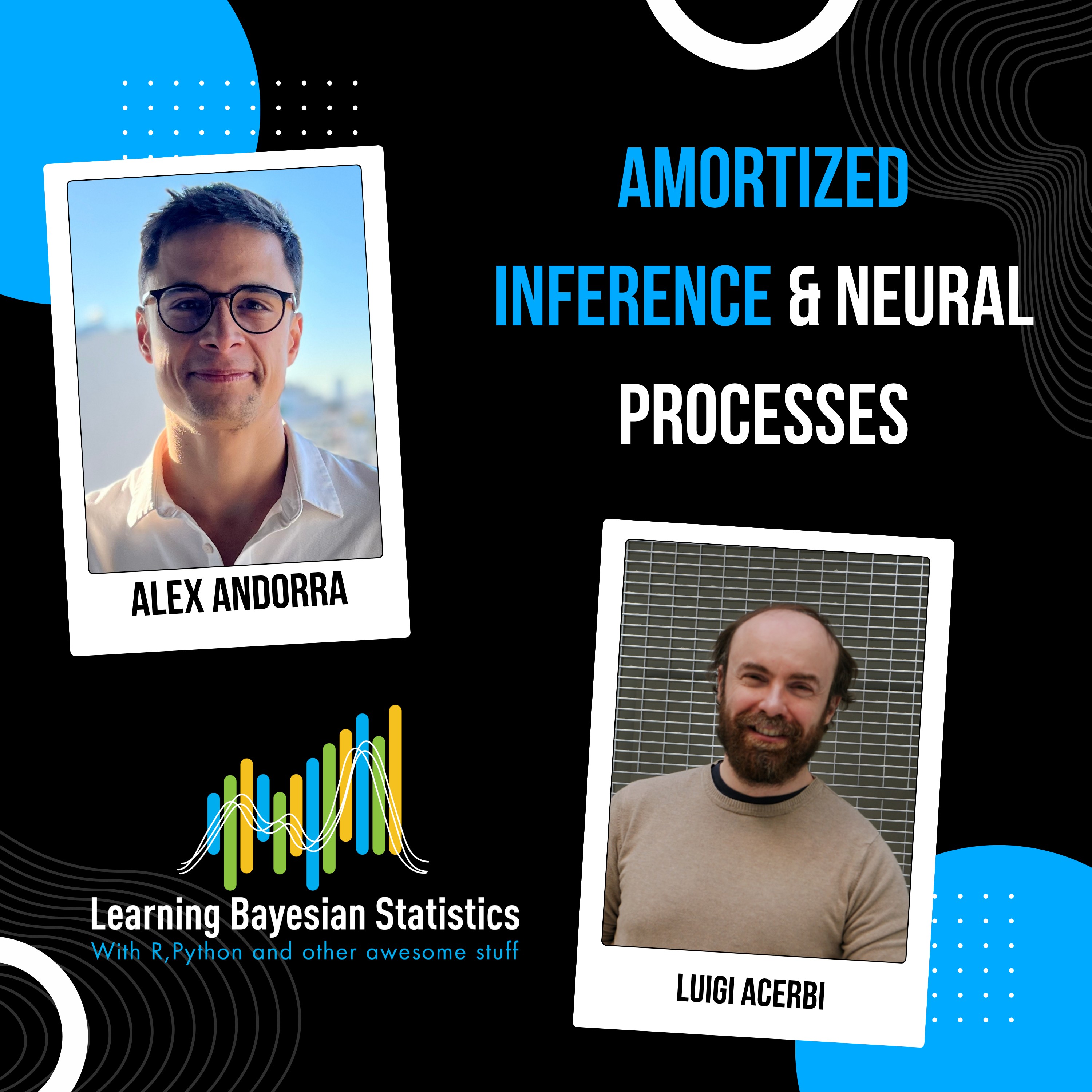
#168 Speech Perception & Multilevel Models, with Santiago Barreda
Support & Resources → Support the show on Patreon → Bayesian Modeling Course (first 2 lessons free) Our theme music is « Good Bayesian », by Baba Brinkman (feat MC Lars and Mega Ran). Check out his awesome work! Takeaways: Q: Why would a linguist switch from lme4 to Bayesian multilevel models? A: For Santiago, it was purely practical. Mixed-effects models fit with lme4 kept failing to converge, and they couldn't handle the complex repeated-measures structures his experiments needed. His friend Noah Silbert got him into Bayesian modeling around 2015, and only afterwards did he realize he agreed with the philosophy too. His analogy: the frequentist toolbox is a furniture store, and if it doesn't sell the bed you need, you settle for the nearest one; Bayesian modeling teaches you carpentry, so the model can match what you believe is going on in your data instead of squeezing the data into a standard structure. Q: Why teach Bayesian multilevel models before t-tests and ANOVA? A: Because in linguistics essentially all data are repeated measures: listeners judge hundreds of trials, and speakers produce many tokens. Yet students traditionally spend a year or more on one-sample t-tests, paired t-tests and ANOVAs they will never use in their own research. Santiago's book jumps straight to the multilevel version of the simplest case, a one-group model with many observations per listener, which he finds no harder to grasp than a t-test since there are no reference distributions or degrees of freedom to explain. Q: Do Bayesian and frequentist analyses give different results on typical phonetics data? A: With analogous models, largely no, at least with the amount of data phonetics experiments usually have. That's why the early chapters of Santiago's book end with a comparison to the equivalent frequentist analysis, to reassure readers. His rule of thumb: if you get dramatically different results, something has probably gone wrong. The gain from going Bayesian is not different point estimates, but models that actually converge, flexible error distributions and model structures, and much richer information about the so-called random effects, which in speech research describe how listeners vary within a speech community. Full takeaways here! Chapters: 09:09 Why did Santiago switch from lme4 to Bayesian multilevel models? 11:50 Why is Bayesian modeling like learning carpentry instead of shopping at IKEA? 18:10 How does Santiago's book differ from classic Bayesian textbooks? 21:11 Why do so many students wrongly decide they're bad at math? 24:01 Why is learning statistics more like learning the piano than memorizing facts? 29:53 What do listeners infer about a speaker from their voice, and why are they wrong in predictable ways? 43:59 How is vowel normalization like judging an object's size at a distance? 49:19 How do animals use their calls to signal body size? 56:15 Can we predict how accents and languages will change? 01:00:15 Why did Latin die, and what counts as a separate language? 01:07:28 What is Santiago working on next? Thank you to my Patrons for making this episode possible! Full links from the show here.
- Transcript