S1 · E256
Monday · 11 min

Tim Logan
We are stuck in an old paradigm, with institutional structures that were built for a world that no longer exists. Within education, passionate entrepreneurs & committed citizens are no longer waiting for these broken formal institutions to be reformed. All over the world, they're designing & building their own local responses with relationships at their core. These are the education ecosystems that our young people need and out of which new institutions will emerge. This podcast is an inquiry into these fundamental changes and an invitation to join the movement to help nurture positive change.
This is the last of 4 short episodes exploring Guy Claxton and Emily Poel's take on embodiment science that opens up to much-needed scrutiny our core concepts and deep grammars of schooling and education. Following on from episodes on intelligence, learning and memory, this is a deeper dive into what embodiment science has to say about thinking and reasoning. You can check out more of the background to this work in Chapters 5, 6, 7 and 8 in Guy and Emily's book 'Bodies of Learning' here: https://www.bodiesoflearning.org/
Most school reform efforts claim to be "research-based." But fewer are genuinely built with the people who have to live inside them every day. Building on some of the themes that I explored with Iwan Syahril on a recent episode, this week we're diving deeper into community-based design. Rather than starting with an expert’s blueprint, what happens when innovation starts with the community's own convictions about what its children deserve, and why that starting point often determines whether an idea actually takes root, or just gets installed and then quietly left to atrophy. As a fantastic example of that process working really well, we also discuss the Whole Child Model (https://www.wholechildmodel.org/), born exactly that way and now reaching thousands of students across the US and beyond. Cynthia Robinson-Rivers is a managing partner at Transcend (https://transcendeducation.org/ ) where she supports schools as they adopt the Whole Child Model that she developed while serving as head of school at Van Ness Elementary (DC Public Schools). Before her return to school leadership, Cynthia worked in the DCPS central office as the Director of Teacher Retention and Recognition. In that role, she developed projects to improve retention of highly effective teachers, including LIFT: Leadership Initiative for Teachers, a career ladder system for teachers. Prior to her work on teacher retention, Cynthia directed the DCPS master educator program during the inaugural year of IMPACT, the district’s teacher evaluation system. She holds a B.A. in Communication and Art from Stanford University, M.A. in Education from George Washington University, and EML from the McDonough School of Business at Georgetown University. She is a fellow with the first class of the Aspen-Pahara Teacher Leaders Fellowship, a recipient of the Rubenstein Award for highly effective leadership, and a 2020 Boulder Fund grantee. Cynthia and her husband live in Washington, DC with their three children who all attend(ed) DC Public Schools. Dr. Jeff Wetzler is co-founder of Transcend, former Chief Learning Officer of Teach For America, and a two-time author. Jeff’s career is dedicated to unlocking human potential by helping people learn more deeply and transform their mindsets to realize bold new possibilities for themselves, their organizations, and their communities. In 2015 Jeff co-founded Transcend, a leading organization for driving innovation in the education sector. Since its founding, Transcend has been one of the fastest growing and most diverse organizations in the field of education innovation, working with hundreds of cutting-edge schools and districts in over thirty U.S. states and a vibrant network of 10,000+ innovators. Under Jeff’s leadership as co-CEO until 2024, Transcend raised over $80M of investment. Its resources have been translated in multiple languages and have reached communities worldwide, from Estonia to India to New Zealand. Jeff currently serves as Head of Transcend Labs and is a Board member at Transcend. Prior to Transcend, Jeff served as Chief Learning Officer of Teach for America, one of the nation’s largest and most respected social impact organizations. Jeff is a Fellow in the Aspen Global Leadership Network and an Edmund Hillary Fellow. Jeff is the co-author of Extraordinary Learning for All: How Communities Design Schools Where Everyone Thrives, with Aylon Samouha and Jenee Henry Wood, and author of Ask: Tap Into the Hidden Wisdom of People Around You for Unexpected Breakthroughs In Leadership and Life. It has been widely endorsed by experts and leaders such as Jim Collins, Adam Grant, Kim Scott, Seth Godin, Bill George, and Amy Edmondson, who wrote the book’s foreword. More links:Transcend's conditions framework (last updated 2024) https://www.youtube.com/watch?v=CM0Ajp5f49M https://vimeo.com/1171159869/fffdc226a8?fl=tl&fe=ec https://vimeo.com/1157422544/2eb1dcf782?fl=pl&fe=sh
Welcome to this next episode in the series on the implications of Embodiment Science in education. After Episode 1 on intelligence and Episode 2 on learning, this is the third installment, where Guy Claxton and Emily Poel's take on what embodiment science has to say about how we understand memory and knowledge. This is a hugely important call to those who have forgotten that the dominant way we talk about memory in education is actually a metaphor. And a bad one at that, that the science is now telling us needs to be replaced with something biologically plausible.
Rather than the narrow definition of schooling, if you think of education broadly, as raising children to become members of a community and as capable, functioning people contributing to the life and strength of that community, then the roles of schools and teachers in community can take on real significance. But from another perspective, becoming an "educated" person is often the thing that pulls people away from their community as they travel to nearby towns or cities to attend schools, and universities and pursue other careers. My guest this week, Sonia Bautista León is working in and with communities, across the Sierra Mixe in Oaxaca, Mexico co-creating educational responses to the challenges and opportunities being lived there. Sonia is Senior Coordinator at Radix Education (https://www.radixeducation.org/) and since 2020, she has been working on the Nuevo Maestro Project (https://www.proyectonuevomaestro.org/) in the state of Oaxaca, an organisation that trains teachers in primary and upper secondary education. She has worked as an educational consultant in various educational institutions and civil society organisations and has taught at university level at the National Pedagogical University 201, Oaxaca. She is a member of the Mexican Assembly of Former US Embassy Scholars and has also served as a mentor for the Indigenous Leaders Programme at the University of the Americas Puebla (UDLAP). Originally from the Sierra Juárez region of Oaxaca and a speaker of the Zapotec language, she firmly believes that education is the most powerful means of transforming the lives of children and young people, as well as their communities. Her professional development has focused primarily on the education of women and youth in indigenous and rural communities in the state of Oaxaca. She holds a Bachelor’s degree in Educational Intervention from the National Pedagogical University 201, a Master’s degree in Educational Administration from La Salle University in Oaxaca, and a Master’s degree in Teaching at the Benito Juárez Autonomous University of Oaxaca. https://www.linkedin.com/in/sonia-bautista-le%C3%B3n-377a281a7/
After last week's inquiry into Guy Claxton and Emily Poel's theory of "real-world intelligence", this is the second of four short episodes exploring the fuller implications of embodiment science to our core concepts and deep grammars of schooling and education. Today we are exploring the concept of how learning might be described differently from an embodiment science perspective, and how it is an integral part of the process of making our way in the world intelligently, balancing concerns, capabilities and circumstances as we explored last week.
There is a lot of talk about increasing agency in education and schooling, for young people and for teachers and we've done many episodes over the last 6 years that touch on it. But there is a tendency sometimes for discussions of agency to lack a bit of clarity in exactly what we mean by this slippery concept! My guests this week, Profs. Gert Biesta and Mark Priestley, published a seminal book with Sarah Robinson in 2015 on the subject of teacher agency, which moved the field forward hugely. 'Teacher Agency: An Ecological Approach' has just been republished in its second edition last month so I was very keen to talk about it with them. But, while I am fascinated by the concept of agency for many reasons, what particularly attracted me to Gert and Mark's work on this was their 'ecological approach'. Taking an ecological approach to understanding the conditions that give rise to agency, or any other outcome in education for that matter, feels like a really vital way to be approaching our central questions. As a now 3 time guest, Gert is known well to listeners of the podcast, but his he has also recently been appointed as Professor of Education at the University of Melbourne, and since 2023 has served as ordinary member ('kroonlid') of the Education Council of the Netherlands (Onderwijsraad), the advisory body of the Dutch government and parliament on educational matters. He was previously Professor of Public Education in the Centre for Public Education and Pedagogy, Maynooth University, Ireland and Professor of Educational Theory and Pedagogy at the Moray House School of Education and Sport, University of Edinburgh. He is co-editor of the Asia-Pacific Journal of Teacher Education, and associate editor of Educational Theory, and previously co-editor of the British Educational Research Journal some time ago. Links: https://www.gertbiesta.com/ https://www.goodimpactlabs.com/podcast/prof-gert-biesta https://www.goodimpactlabs.com/podcast/gert-biesta Mark Priestley is Professor of Education at the University of Stirling whose research interests lie in the school curriculum – theory, policy and practice – and especially the processes of curriculum making across different layers of education systems. He is the Director of the Stirling Centre for Research into Curriculum Making, a member of the Scottish Government’s key education advisory committees, the Scottish Education Council and the Curriculum and Assessment Board, and a Co-Convener of the EERA network 3, Curriculum. Alongside 'Teacher Agency: An Ecological Approach', his publications include 'Curriculum making in Europe: policy and practice within and across diverse contexts'. Links: https://www.stir.ac.uk/people/255862 https://www.bloomsbury.com/uk/teacher-agency-9781350536333/
This is the first the 4 short episodes exploring the fuller implications of embodiment science to our core concepts and deep grammars of schooling and education. As you will have heard on a previous episode I did with Prof. Guy Claxton and Emily Poel, their book 'Bodies of Learning: How Embodiment Science Transforms Education' is a really significant statement of some of the work we need to do to excavate these unhelpful myths that are holding us back in the decisions and designs that we make for new educational approaches. In these four episodes, we're going to take a deeper look at the core concepts of intelligence, learning, memory & knowledge, and thinking & reasoning. And in this first episode, I ask guy and Emily, what does embodiment science have to say about the way that we think about intelligence.
A recent guest, Prof. Tony Chemero highlighted that anthropology is one of the more underestimated and often excluded of the ‘cognitive sciences’. I completely agree and since I discovered it in the early 2000s when I did my undergraduate degree at the University of Sussex, I have personally experienced anthropology not as a subject discipline, but rather as a way of approaching the world and cognition itself. That's why this week I was so happy to bring together four amazing anthropologists who care deeply about educational transformations to explore these questions. Pascale Mompoint-Gaillard, PhD Pascale is a social psychologist, trainer and facilitator, researcher and CEO of Learn to Change, Change to Learn, bridging theory and practice working in the area of collective intelligence, cooperative and transformative learning, with 30 years of professional practice. Pascale’s PhD (2021) focused on ‘Conversation as a learning ecology’ and how professionals develop through engaging in online professional learning communities. She has co-authored several handbooks of which the European Reference Framework of Competences for a Democratic Culture (RFCDC), (Council of Europe, 2018) and the TASKs for Democracy handbook, (Council of Europe, 2015) dedicated to student and teacher competence. https://pascalemompoint.com/ Conversation as an Ecology of Learning Education for change: https://share.google/8K1PEdbaYIgbRuRqF Developing intercultural education in schools: https://share.google/Of1MSlVTmedxoQ9Gm A European framework for Democratic citizenship in education: https://share.google/8QSEiz5cAmg3HQjHz Corina Enache Corina is the founder and system worker at Kotka (which means ‘eagle’ in Finnish and ‘female cat’ in Polish!) a consultancy helping living things grow well. She is also the host of The Human Show podcast. Corina’s work sits at the intersection of leadership development, organisational development, and anthropology, and unfolds through learning, dialogue, and real-time practice. She draws on experience across international corporate environments, consulting, academia and European projects, and work with different ways of knowing — thinking, sensing, and intuition — while staying close to what is actually happening in the system. https://www.linkedin.com/in/corinaenache/ https://kotka.world/ https://worldpodcasts.com/the-human-show/ Patrick Alexander Patrick is a social anthropologist specialising in education, childhood and youth studies. Patrick’s research and teaching interests include the sociology of schooling, youth and youth subcultures, gender, ethnography, and social theory. He is Reader in Education and Anthropology in the School of Education, Oxford Brookes University, as well as Research Lead for the School of Education, and Director of the Centre for Educational Consultancy and Development (CECD), where he leads consultancy and contract research activity in the field of education. Patrick is a Fulbright Scholar, Fellow of the RSA, HEA, Royal Anthropological Institute (RAI), and a Fellow of International Union of Anthropological and Ethnological Sciences (IUAES). Patrick is also Research Fellow at the Institute of Social and Cultural Anthropology, University of Oxford and Editor of the journal Teaching Anthropology (https://teachinganthropology.org/ ). https://www.brookes.ac.uk/profiles/staff/patrick-alexander https://patrickgalexander.org/about-3/ Zineb Mouhyi Zineb is a mother, daughter, writer, educator, scholar-activist, and PhD candidate in Anthropology and Social Change at the California Institute of Integral Studies. Zineb was also the co-founder of YouthXYouth, a global organisation that she set up with Valentina Raman, to convene youth-led action around transforming education systems. Young People are Reclaiming their Education and Making New Worlds Possible - A Conversation with Zineb Mouhyi (Ep185) Sarah Pink (2025). Futures Anthropology for the Polycrisis. Anthropological Forum, 1–18.
There aren’t many people who can say that they have learned their hard-won leadership lessons through the experience of steering an educational transformation across a whole country, let alone a country made up of nearly 300 million people across 17,000 islands! My guest in this episode, Dr. Iwan Syahril, has taken the time and care to reflect on some of these lessons in his fantastic new book, ‘Students, Students, Students!: The Human Journey in Leadership and System Transformation’. But he was also kind enough to join me to reflect on it on the podcast this week. As Iwan argues, the only way to align a massive, complex educational system transformation is a clear, simple purpose and to move away from bureaucratic jargon and complex policies to focus relentlessly on the child. And then for that transformation to be sustainable, it must be rooted in a society’s own values rather than imported models. For Indonesia, that meant drawing on the philosophy of Ki Hajar Dewantara and the spirit of gotong royong (mutual cooperation). Iwan is a global leader shaping the future of human-centered education in the age of AI. An authority on leading change at scale, he advises global organizations and governments on building resilient, future- ready systems. His expertise is grounded in his tenure as Director General at Indonesia's Ministry of Education, where he architected the Merdeka Belajar reforms, digitally empowering 3.3 million teachers and improving outcomes for 53 million students. A former Chair of the G20 Education Working Group, his strategic vision is informed by frontline experience teaching in Indonesia, the US, and Canada, and his leadership as Dean of Education at Sampoerna University. He holds graduate degrees from Columbia University, a dual PhD and Honorary Doctorate from Michigan State University, and a fellowship from HP-Cambridge. His work now sits at the frontier of policy, practice, and technology, helping education systems move faster, fairer, and with greater resilience. In his book, Students, Students, Students!: The Human Journey in Leadership and System Transformation, he outlines many of the powerful principles for leading complex change.Iwan’s wikipedia page: https://en.wikipedia.org/wiki/Iwan_Syahril Iwan’s website: https://sites.google.com/view/studentsstudentsstudents/ Instagram: https://www.instagram.com/iwan.syahril/ LinkedIn: https://www.linkedin.com/in/iwansyahril
Cognition is a strange word and not a very commonly used word by practicing educators. It feels academic and detached from the act of a group of young people learning in the world. But when you look at the dictionary definition of cognition – the "mental action or process of acquiring, storing, retrieving, and processing knowledge and understanding through thought, experience, and the senses" – this seems pretty fundamental to what we do as educators. But what if our understanding of what it means has been heavily biased by the Western modern scientific paradigm? For example, in the difference between learning the world and learning about the world via the linguistic labels and symbols that we create to represent aspects of it. My guest this week Jinan KB is offering a radically different description of what natural cognition or the biological roots of cognition actually are. I absolutely love these kinds of conversations as they challenge me right at the edge of my understanding given my own conditioning into particular ways of knowing about the world. It also feels like a really alive part of what we're being asked to do now more broadly, to explore more generously and expansively the space of what is possible in order to think differently about the educational and societal predicaments in which we find ourselves. Jinan is a researcher of natural cognition, cognitive autonomy, and the biological foundations of knowing. His work began with a simple but unsettling question: How do human beings naturally create knowledge? In 1991, Jinan stopped reading in order to investigate this question directly. For over four decades, he has explored this question through lived engagement with children, non-literate artisans, indigenous communities, design education, and everyday life. He is the author of Awakening Beauty and works with parents, educators, designers, researchers, and communities interested in recovering the conditions that allow human intelligence to flourish naturally. Website: https://www.jinankb.in/ LinkedIn: https://www.linkedin.com/in/jinan-kb-5386676/ Impact of literacy on consequence: https://youtu.be/WG9uJN-UoSc?si=0sMtaGuwLe4sn9Py How do Children Create knowledge? How teaching is detrimental to a child's learning: https://www.youtube.com/watch?v=s3A-8iI4Py4 What is Knowledge? Implicit and explicit knowledge: https://www.youtube.com/watch?v=3IhVFs4b8wA How schools and toys are damaging children? https://www.youtube.com/watch?v=z72rbcSpi7o Storytelling and Reading are damaging for children: https://www.youtube.com/watch?v=k4ZVLDpfzLI Word and the World form two different Cognitive systems: https://www.youtube.com/watch?v=4qHZNIEwio8&t=1s
"How do we learn what we already know?" (Carlos Alvarez Pereira). A lot of so-called innovation is old ideas, tried in a different place at a different time, packaged up in new wrapping to seem like a "new" idea. Whether it's from 50 years ago or 10000 years ago, there is a huge amount, if we're open to it, that we can learn from the accumulated wisdom of fellow humans making their way and learning in the world. My guest is this week is Richard Bawden who led Hawkesbury Agricultural College in Richmond, Australia in the 1970s and 80s. At that time and in that place, they were doing some incredible work using systemic and complexity-informed approaches to agriculture as rural development. There is so much resonance between the work that Richard and his colleagues were doing then and the changes taking place in educational ecosystems around the world today. Richard was a Professor Emeritus of Western Sydney University (WSU, previously the University of Western Sydney [UWS]), and an honorary research fellow in the Office of Sustainability at WSU. He was one of the foundation professors (of Systemic Development) of WSU (in 1989) and its inaugural Dean of the Faculty of Agriculture and Rural Development. For the decade preceding that, he was Head of the School of Agriculture at Hawkesbury Agricultural College which was incorporated into the then UWS at its establishment. Below you will find a range of Richard's, and other's, writings about Hawkesbury if you would like to find out more:1. Bawden, R.J. (2016). Transforming systems: The Hawkesbury initiatives in systemic development. https://www.tandfonline.com/doi/abs/10.1080/21528586.2015.1131192 2. Bawden, R.J. (2005). The Hawkesbury Experience: Tales from a Road Less Travelled. In: Pretty, J. (ed.) The Earthscan Reader in Sustainable Agriculture. Earthscan, London. 3. Bawden, R.J. and Packham, R.G. (1993). Systemic Praxis in the Education of the Agricultural Systems Practitioner. Systems Practice, 6(1): 7–19. [Paper first presented at the1991 annual meeting of the International Society for the Systems Sciences,Österund, Sweden] 4. Bawden, R.J. and Packham, R.G. (2023). Agriculture and the Environment: Ethical Issues. Chapter 6 in: Zimdahl, R. (ed.) Agricultural Ethics. Burleigh Dodds, London. 5. Bawden, R.J. and Packham, R.G. (undated). Soft Systems Thinking, Soft Systems Practice and the Evolution of Systemic Development. Unpublished manuscript.6. Bawden, R.J. (various / collected). Hawkesbury Chapters. Collected chapters including'The Community Challenge: The Learning Response', originally published in NewHorizons in Education, 99 (1999): 40–59; republished in Blackmore, C.P. (ed.)(2010). 7. Bawden, R.J. (2005). Systemic Development at Hawkesbury: Some Personal Lessons from Experience. Systems Research and Behavioural Science, 22: 151–164.
What are the questions we should be asking of the radically new and rapidly accelerating technologies that we are all living with now? Where are the possibilities? What are we hungry for? Where are the challenges and dangers? What are our responsibilities as care-givers, parents, educators and policy makers? How are we creating opportunities for our young people to really connect with themselves, with each other and with the world; to develop their own perceptual and relational capacities? This week’s episode is a wonderful reflective space exploring these profound questions with Nora Bateson, Zak Stein and Olli-Pekka Heinonen. This episode begins with a dialogue between Nora, Zak and Olli-Pekka, which was recorded as part of the Warm Data Lab Host training online earlier this year. The second part of this episode is then a dialogue that Nora, Zak and I shared on the way in which warm data is meeting many of the challenges being raised now by the ubiquitousness of advanced artificial intelligence in our young people’s lives and learning, as well as the very exciting ideas being shared by Nora, from her father Gregory Bateson’s work on ‘second order teaching’, being published in a new book edited by Phillip Guddemi, entitled Gregory Bateson's 'Ecology of Mind': The Course. Nora Bateson is the Founder and President of the International Bateson Institute (https://batesoninstitute.org/) and currently serves as President of the International Federation for Systems Research (IFSR). Nora is the author of Small Arcs of Larger Circles (2016), and Combining (2023), both published by Triarchy Press. Nora also wrote, directed and produced the award-winning documentary, An Ecology of Mind, a portrait of her father, Gregory Bateson: http://www.anecologyofmind.com/. Nora’s new book Belly is launching the same day that this episode is released, July 19th 2026, at a special event in London! You can find out more here: https://www.warmdata.life/belly-book-launch-2026. And you can pre-order a copy of the book here: https://www.triarchypress.net/belly.html. You can also find out more about Warm Data Lab Host training here: https://www.warmdata.life/wdtraining Also check out Ep116 'Warm Data in Education' (Sept '23). Dr. Zak Stein (https://www.zakstein.org/) is a philosopher of education, psychologist, futurist, and author. He is a founding member of the AI Psychological Research Coalition, The Civilization Research Institute and the The Consilience Project (a publication of the CRI), with Daniel Schmachtenberger. Zak is also co-founder of Lectica, Inc. (with Dr. Theo Dawson), and the Center for World Philosophy and Religion. Zak is the author of Social Justice and Educational Measurement and Education in a Time Between Worlds: Essays on the Future of Schools, Technology, and Society. Also check out Ep106 'The Philosopher and the Neuroscientist (with Mary Helen Immordino-Yang)' (May '23). Olli-Pekka Heinonen is a Finnish political leader, educator, and Director General of the International Baccalaureate (IB). He served as Finland’s Minister of Education and Science and later as State Secretary to the Prime Minister, before becoming Director General of the Finnish National Agency for Education. At the IB, he leads a global education organisation that reaches 2 million students annually in more than 160 countries. It is known for its rigorous programmes and its mission to develop inquiring, knowledgeable and caring young people. He is the author of the recently published and very popular book: Learning as If Life Depended on It: Why We Must See the World Anew, and Figure Out What Follows, published by Perspectiva Press (find out more here: https://www.opheinonen.com/) Also check out Ep41 'On Leading a Learning System' (March 2021) and Ep212 ‘Learning as If Life Depended on It’ (October 2025).
There are amazing people building innovative and responsive educational alternatives all over the world right now. They are seeing challenges in their communities and not waiting for others to act, or waiting for systems to change, but creating, connecting and building themselves. Today's episode is with one such person who is doing this incredible work in some of the most resource constrained environments in Nakivale Refugee Settlement. Munguzo Kapera is a refugee systems builder and educational entrepreneur, removing barriers to information, skills, and opportunity for displaced people. He is the founder of the CAMPUS Digital Hub (https://campusdigitalhub.org/) and creator of the ConnectRefugee app (https://play.google.com/store/apps/details?id=com.connectrefugee.userug&hl=en_GB). Munguzo is also an alumnus of the International Training Centre of the International Labour Organization (ITCILO) (https://www.itcilo.org/) and an advisory board member of Kiron (https://www.kiron.ngo/). LinkedIn: https://www.linkedin.com/in/munguzo-jean/
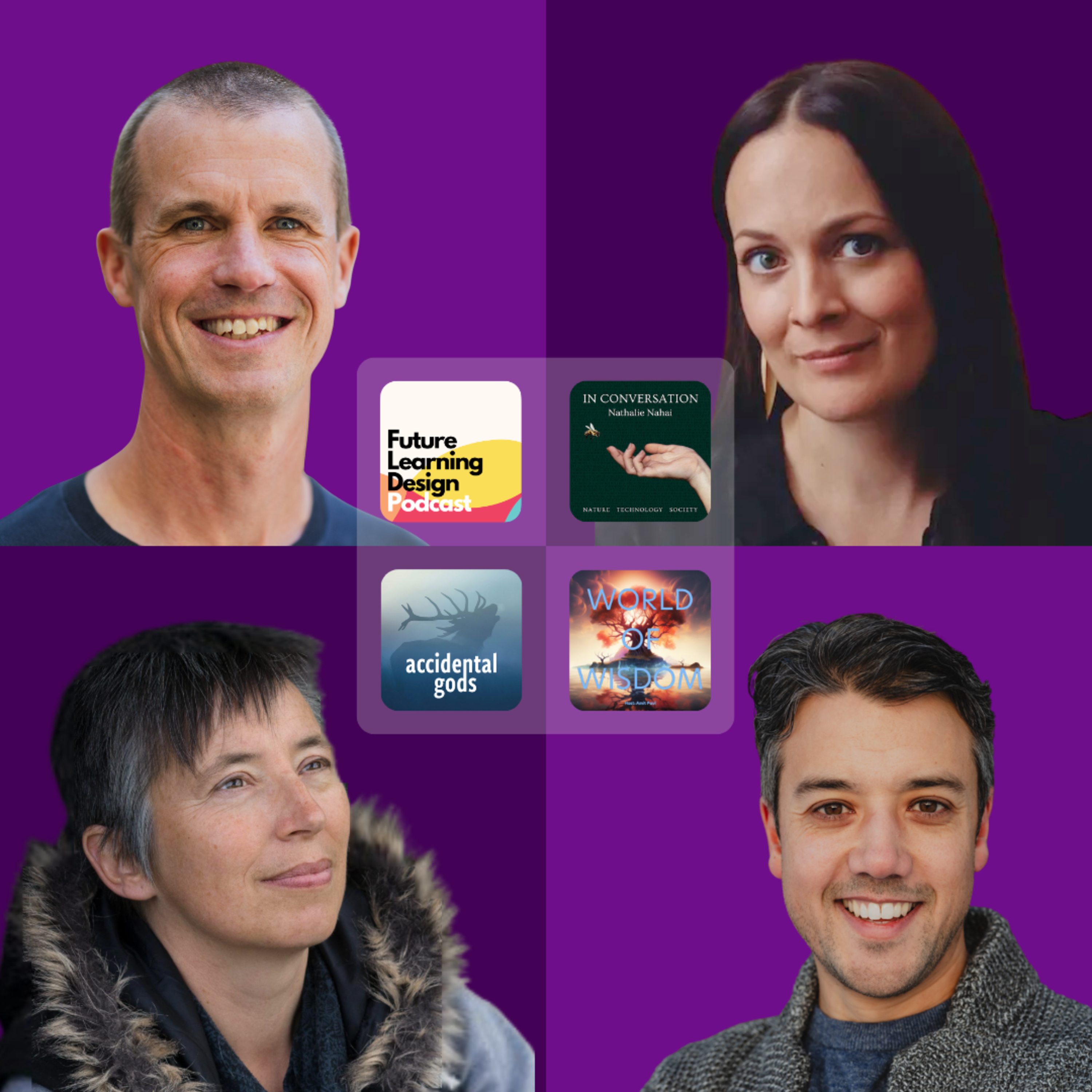
What are we learning about systemic change? There are lots of people talking about why we need it, climate and nature emergencies, exponential tech youth mental health crises etc. but how much is it actually happening? By definition, it’s not something that just happens in the education system, so I was really happy to gather together this week with three amazing podcasters and beautiful people who are coming at these same questions from many lenses, business, Thrutopian novel-writing, psychology, technology, economics, regenerative farming, political changemaking, architecture. Like me, they get to speak to some of the most amazing and insightful people in all of these fields and more, so I thought it would be a great idea to get together to see what we are learning collectively. Manda Scott is the host of the Accidental Gods podcast and has appeared on this channel a couple of times previously, Nathalie Nahai hosts her eponymous In Conversation podcast, and Amit Paul hosts the fabulous World of Wisdom podcast. Amit Paul is a former popstar and CEO of green chemicals company Paxymer AB turned systems dancer. No, he's co-founder of Innrwrks and host of World of Wisdom podcast, exploring how business can create a future we want for our kids. Amit hosts explorative conversations, facilitates group work and advices and supports companies navigating the current ecological, social and technological paradigm shifts. Nathalie Nahai is an author, keynote speaker and host of the Nathalie Nahai in Conversation podcast enquires into our relationship with one another, with technology and with the living world. She’s author of the international best-sellers Webs Of Influence: The Psychology of Online Persuasion and, more recently, Business Unusual: Values, Uncertainty and the Psychology of Brand Resilience which has been described as “One of the defining business books of our times”. She’s a consultant, artist and the founder of Flourishing Futures Salon, a project that offers curated gastronomical gatherings that explore how we can thrive in times of turbulence and change. Manda Scott - https://mandascott.co.uk/ ; https://www.linkedin.com/in/mandascottauthor/ Born in Scotland at 318ppm CO2, Manda was once a veterinary surgeon and is now a novelist, smallholder, contemporary shamanic trainer and podcaster. Her debut novel, Hen’s Teeth, was shortlisted for the Orange Prize. Subsequent works were shortlisted for the Edgar and Saltire Awards and won the McIlvanney Prize, but it is for her Boudica: Dreaming series that she is best known. More recently, Manda read for a Masters in Regenerative Economics at Schumacher College, the experience of which led her to set up Accidental Gods podcast (https://accidentalgods.life) and Membership Programme. In 2024 she published her sixteenth novel, Any Human Power, a ‘visionary’ contemporary political thriller that maps fictional – but plausible and workable – routes toward a future we’d all be proud to leave to the generations that come after us: human and more-than-human. And together, we are Podcasters United, at least for this episode - exploring systems change, what it means and how we can bring it about at scale and in time. Enjoy!
We often overlook sports as a site of learning, but it’s a massive part of so many people’s lives, whether playing, supporting, watching or teaching. And simultaneously, all of life happens in and around the sports arena. It is humanity in our most beautiful and, sometimes, ugliest manifestations. With all of the global sporting events happening right now, I wanted to bring this into our podcast conversations and there are few people better to do that with than player, coach, friend, and also pre-eminent scholar of the history and political economy of sports around the world, Professor Frank Andre Guridy. Frank is the Dr. Kenneth and Kareitha Forde Professor of African American and African Diaspora Studies. He is also Professor of History and the Executive Director of the Eric H. Holder Initiative for Civil and Political Rights at Columbia. He is an award-winning historian whose recent research has focused on sport history, urban history, and the history of American social movements. His most recent book, ‘The Stadium: An American History of Politics, Protest, and Play’ tells the story of the American stadium as an institution that has played a central role in American civic and political life and in the struggles for social justice from the 19th century until the present. His previous book, ‘The Sports Revolution: How Texas Changed the Culture of American Athletics’ explored how Texas-based sports entrepreneurs and athletes from marginalized backgrounds transformed American sporting culture during the 1960s and 1970s, the highpoint of the Black Freedom and Second-Wave feminist movements. Frank is also a leading scholar of the Black Freedom Movement in the United States and the Caribbean. His first book, Forging Diaspora: Afro-Cubans and African Americans in a World of Empire and Jim Crow (University of North Carolina Press, 2010), won the Elsa Goveia Book Prize from the Association of Caribbean Historians and the Wesley-Logan Book Prize, conferred by the American Historical Association. He is also the co-editor of Beyond el Barrio: Everyday Life in Latino/a America (NYU Press, 2010), with Gina Pérez and Adrian Burgos, Jr. He has also won awards for his teaching and service at multiple institutions, receiving the Regents’ Outstanding Teaching Award from the University of Texas at Austin in 2010, the Mark Van Doren Award for Teaching at Columbia in 2019, and the Faculty Service Award at Columbia in 2023. Frank’s books The Stadium: An American History of Politics, Protest, and Play (Basic Books, 2024) The Sports Revolution: How Texas Changed the Culture of American Athletics (Austin: University of Texas Press, 2021) Forging Diaspora: Afro-Cubans and African Americans in a World of Empire and Jim Crow (The University of North Carolina Press, 2010) Beyond El Barrio: Everyday Life in Latina/o America (NYU Press, 2010) Other links https://history.columbia.edu/person/guridy-frank/ https://www.linkedin.com/in/frank-guridy-401b87230/
There is a lot of discussions happening these days about the future of university and higher education in general. How does it keep pace with rapidly changing and disruptive technologies? How does it meet the needs of young people and become responsive and flexible enough to generate much needed transformations in research and development, knowledge creation, and capability building? And how does it adapt to the increasing volatility in all aspects of social, political, economic and ecological life that we are seeing everywhere? In October last year Monash University published a report called 'Advancing University Living Labs' (https://www.monash.edu/__data/assets/pdf_file/0010/4137481/Monash-University-Advancing-University-Living-Labs-Report-October-2025.pdf) on a fascinating new approach that universities and other communities and multi-stakeholder environments are taking in response to some of these fundamental questions. As I learned more about Living Labs I was introduced to more of the inspiring community of practitioners around the world who are using it. So this week it's my great pleasure to bring together a number of these Living Labs experts. If you're new to this approach, hopefully this episode will give you an overview, as well as some examples and use cases. And if you want to go deeper there are loads of links below. A big thank you to Lars Fuhrmann (https://www.linkedin.com/in/larsthimof/) for coordinating and bringing everyone together! Anja Overdiek: https://www.linkedin.com/in/overdiek12345/www.lulu.com/search?sortBy=RELEVANCE&page=1&q=Anja+overdiek&pageSize=10&adult_audience_rating=00 Sam Rye: https://www.linkedin.com/in/samrye/ Advancing University Living Labs (Report) ENoLL Origins, Developments & Future Perspectives Landscape Typology of Living Labs (fieldnote article) Dinda Ciptaviana: https://www.linkedin.com/in/anastasia-dinda-ciptaviana/ Kampung Kollektief: https://www.instagram.com/kampung_kollektief/ Linktree of projects from Kampung Kollektief including the 'What if Lab' and Living Lab: https://linktr.ee/kampung_kollektief Lotte Troost: https://www.linkedin.com/in/lottetroost/ NL Knowledge House Living Lab with Kampung Kollektief NL Knowledge House Living Labs Heleen Geerts: https://www.linkedin.com/in/heleen-geerts-911b354/ www.lulu.com/search?sortBy=RELEVANCE&page=1&q=Anja+overdiek&pageSize=10&adult_audience_rating=00 European Network of Living Labs (ENoLL): https://enoll.org/ OpenLivingLab Days 2026 coming up in September: https://enoll.org/events/openlivinglab-days-2026/
A big part of where I see shifts happening in education systems is encouraging young people to get out into the world, into their communities and make a difference to issues that they care about. There is so much learning that can happen in this process. I have shared a few episodes in the past with fantastic people like Cathrine Berger-Kaye, Daniela Papi-Thornton and Zoe Weil, supporting young people and educators in this kind of work. But there are also some fascinating and important considerations to be aware of when we step into this work, so that we really have the impact that we are hoping to, and don’t replicate past harms and unhelpful patterns. My guest this week, Anthea Lawson, has been working on the front line of this kind of work for decades and has learned through her own experience just how complex and entangled these issues are that we care about doing something about. And she has been sharing her gathered wisdom on it in her previous book The Entangled Activist, and very excitingly her new book, out this week, ‘How Not to Save the World: Doing good without annoying everyone’. George Monbiot has described it as a wise, rich and crucial book! And I can certainly recommend it myself. As a journalist, campaigner and writer, Anthea Lawson has fought for many issues over three decades including controls on the arms trade and an end to the financial secrecy offered by tax havens. She helped launch a campaign for transparency over company ownership which resulted in changes to the law in dozens of countries. After training as a journalist at The Times, she worked for campaign groups including Global Witness and Amnesty International. Her writing helps people who want to change the world think about the psychological, spiritual and philosophical foundations of what they’re doing, what’s getting in the way, and how they can be more effective. Links Anthea's website: https://www.anthealawson.uk/ 'How Not to Save the World' Book: https://www.anthealawson.uk/how-not-to-save-the-world 'The Entangled Activist' Book: https://www.anthealawson.uk/the-entangled-activist LinkedIn: https://www.linkedin.com/in/anthea-lawson/ Don't Talk About Politics: How to Change 21st-Century Minds by Sarah Stein Lubrano: https://www.bloomsbury.com/uk/dont-talk-about-politics-9781399413916/ More info about the Antidebate: https://systems-souls-society.com/praxis/antidebate/
This week is a huge privilege to have my good friends Emily Poel and Guy Claxton returning to the podcast in celebration of the release this week of their fabulous new book, Bodies of Learning: How Embodiment Science Transforms Education. It's a really significant book! that lays out, unlike any other, the deep implications of 4E cognitive science that support and strengthen the case for a more healthy, more human(e), moregenerative educational experience for our young people; which is everything this channel is about. Link to the book: https://www.bodiesoflearning.org/ Prof. Guy Claxton is a cognitive scientist, education thought leader, and author of The Future of Teaching and Intelligencein the Flesh among many other books, with decades of research on expanding human intelligence and applying learning science in real-world contexts. He has spent most of his working life based in a variety of UK universities including Oxford, Bristol, King’s College London and Winchester. Increasingly his work has taken a more practical turn, and he has been involved with a wide range of organisations where a better understanding of human intelligence is needed. For example, he has been: Consultant on education to the Royal Albert Hall; workshop leader for Premier League Youth Football Coaches; lecturer at the Siobhan Davies Dance School and the London College of Fashion; Inaugural lecturer at Her Majesty's Treasury Learning Centre; meditation teacher at Atsitsa holiday centre on the Greek island of Skyros (where I met my wife Judith); consultant to the Centre for Contemplative Education research project on mindfulness in European schools (under the auspices of HH The Dalai Lama); guest lecturer at the Harvard Learning Innovations Laboratory (LILA); consultant to the South Australian Department of Education and Child Development among many others. Links: https://www.guyclaxton.net/ Recent Deans Lecture Series, University of Melbourne: https://www.youtube.com/watch?v=qGFEswKBnMw Emily Poel is a Berlin-based embodiment practitioner who has taught internationally for over fifteen years, developing practical methods that show how movement and physical awareness shape creativity, thinking, and learning.Originally from Michigan and with a degree in contemporary dance performance and history, she's worked internationally as a performer, choreographer and creative advisor. In 2004 she shifted her focus to embodiment training and hasn’t stopped since. Over the last ten years she's developed a large collection of activities using physical awareness tools and movement training to better understand how creativity,learning and thinking actually work. Links: https://embodimentatwork.co/ Move4Schools - https://move4schools.com/ Previous episodes featuring Guy and Emily: We Need More Embodied Education! A Conversation with Arawana Hayashi, Prof. Guy Claxton, Dr. Akhil K. Singh, Emily Poel and Caroline Williams: https://www.goodimpactlabs.com/podcast/embodied-education Finding 'Aliveness' in Schools - A Conversation with Prof. Guy Claxton: https://www.goodimpactlabs.com/podcast/guy-claxton
If you think about which verbs dominate formal education you’ll probably come up with a list like learning, thinking, reasoning, remembering, knowing, and maybe behaving. Now think about what images come to mind when you consider those verbs, or do a google image search and see what you get! I’m willing to bet that the most common images coming up are of individual heads, maybe with a visible brain or cogs, doing the thinking, the reasoning, the learning, the cognition. And to emphasise the point further, when we want to highlight that it’s more than one thinker or reasoner doing the work, we have to put clarifying adjectives or nouns in front, like group cognition, collective learning or collaborative problem solving. But the fact is, we are actually already “intertwined creatures” in our entanglement with each other and the world. We think, learn and reason all the time with and through each other and the objects we interact with, and the places we are in. My guest this week, Professor Tony Chemero, has been a major proponent of ‘radical embodied cognition’ for his whole career as a professor of philosophy and psychology. His latest book, brilliantly titled, ‘Intertwined Creatures: The Embodied Cognitive Science of Self and Other’ is an amazing articulation of just how interconnected we are as creatures and learners in the world. Tony is a Distinguished Research Professor of Philosophy and Psychology at the University of Cincinnati, and a primary member of both the Center for Cognition, Action, and Perception[1] and the Strange Tools Research Lab. As well as many academic articles, he is the author of: Radical Embodied Cognitive Science (2009, MIT Press) - https://mitpress.mit.edu/9780262516471/radical-embodied-cognitive-science/ Phenomenology, with Stephan Käufer (2015, Polity Press; second edition, 2021) - https://www.wiley.com/en-be/Phenomenology%3A+An+Introduction%2C+2nd+Edition-p-9781509540662 Intertwined Creatures: The Embodied Cognitive Science of Self and Other’ (2026, Columbia University Press) - https://cup.columbia.edu/book/intertwined-creatures/9780231223195/ https://en.wikipedia.org/wiki/Anthony_Chemero https://researchdirectory.uc.edu/p/chemeray
There are lots of reasons why well-intentioned work, trying to do things differently and shift the way that systems currently operate, often struggle and fail. But one of the reasons that I find most interesting is to look at the "dark matter" or deep codes that are built into our current ways of working. These might be things like the way we do contracts, the way insurance functions, and legal precedents. Or the way that value is defined and accounted for, and the way money functions and flows. Most of the time these things are simply constraints that we are told we just have to deal with in our work. But as you might have heard in a previous episode with Indy Johar and Adam Purvis (https://www.goodimpactlabs.com/podcast/indy-johar-and-adam-purvis), organisations like Dark Matter Labs are not accepting this status quo and, in fact, are actively trying to work towards redesigning these deep codes. But then you might say: “Well that's fine for those kinds of organisations who get to do that work, but that's not something that I can get involved with.” My guests this week are colleagues of Adam and Indy at Dark Matter Labs, but they are taking it one stage further and asking the question, what does it mean to educate for building the capabilities and sensibilities for this kind of work. They are calling it “societal design” and in this conversation you'll hear them reflecting on the Masters programme that they are launching this September, in collaboration with Elisava Barcelona School of Design and Engineering. Applications are open until July 15th 2026. For further information about this and Emily and Martin’s other work, check out the links below. Martin and Emily’s ‘Anti-Brief’ website: https://anti-brief.org/ Further links about the Societal Design Master Degree Programme at Elisava, Barcelona at UVic: University of Vic - Central University of Catalonia. https://www.elisava.net/en/masters/master-in-societal-design/ https://anti-brief.org/about/ https://www.linkedin.com/company/societal-design-master-at-elisava/posts/ Martin on LinkedIn: https://www.linkedin.com/in/drmartinlorenz/ Emily on LinkedIn: https://www.linkedin.com/in/emily-harris-fca-3b381565/ Dark Matter Labs: https://darkmatterlabs.org/ Life-Enobling Economics microsite: https://lee.darkmatterlabs.org/ Cornerstone Indicators report (2023): https://drive.google.com/file/d/176CNiZYM1v2xcEzDVO4SHuEfRQoosCVL/view Cornerstone Indicators microsite: https://cornerstoneindicators.com/