Skip to content
Artwork for FDE Talks
TechnologyNewsTech News

FDE Talks

TheAIRuntime.com

Forward-deployed engineers on what it takes to be an FDE, run AI in production. Real customers, real reliability bars, real failure modes, real metrics. From The AI Runtime.

theairuntime.com
Play
  • 3 episodes
  • Avg 30 min
  • English
  • October 7 · 33 min

    What FDEs Own After the AI Demo Works

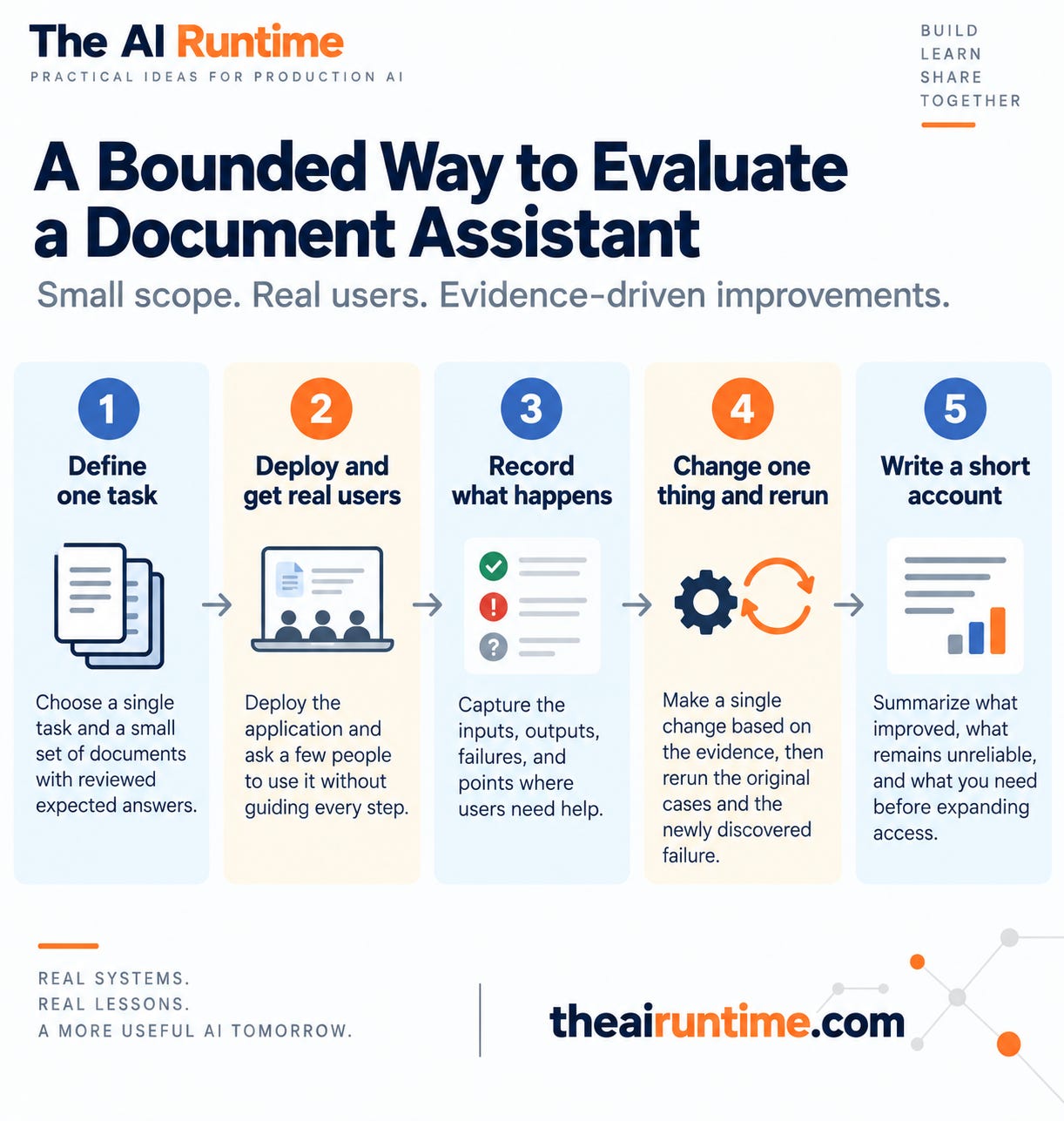
    Someone uploaded a 100-page document, and the application crashed. In my recent FDE Talks conversation, Akshay described an AI workflow his team had built during his time at Microsoft. It took a PDF containing a series of steps and produced a summary and action items. The demo worked with the inputs the team had tried. Then they opened it up to broader testing. A user uploaded a much longer document than the team had tested. They had assumed the system would handle it somehow: process what it could, fall back, or explain that the input was too long. Instead, it crashed. That example stayed with me because the team had considered what might happen. They had not verified what actually happened. It also captures a responsibility we kept returning to: an FDE helps turn a promising demonstration into a system that works for the customer, and stays involved long enough to understand whether it delivers value. Akshay joined me to discuss his move from software engineering into forward deployed engineering. We talked about discovering customer problems, using AI in delivery, and what aspiring FDEs can do before they have enterprise production experience. Learning to understand the problem before building Akshay was already doing parts of the job before he knew the title. At Microsoft, he worked on the Azure Support Copilot team. Alongside engineering, he helped other teams understand generative AI, ran training, advised on architecture, and supported their path to deployment. When a recruiter approached him about an FDE role, the responsibilities sounded familiar, even though the name did not. Moving into a customer-facing role still required a significant adjustment. As a software engineer, he had been used to a roadmap, sprint planning, and a structured process. In customer conversations, information arrived without that structure. Early on, he sometimes struggled to understand why he was in a particular meeting or what a customer’s description of a problem meant for the solution. He credited his onboarding with helping him develop a consultative approach: asking useful questions and adapting them to the people in the room. This resonated with my own customer-facing experience. A customer’s initial request may reveal only part of the problem. More context appears as you speak with other teams, understand their dependencies, and learn what they are trying to change. An accurate record of the first meeting will not contain information nobody thought to ask for. The engineer still has to recognize what is missing and follow up. Akshay described his engagements as moving through discovery, solution design and use-case scoping, then implementation and production. In his experience, the work continues through measuring the impact. He also emphasized that FDE responsibilities vary across companies and even across engagements within a company. That makes the scope of ownership more useful than the title when evaluating a role. Who helps choose the use case? Who builds it? Who stays involved when users encounter problems? Who checks whether the outcome justified the work? Where the time saved by AI goes I asked Akshay how AI had changed his own workflow and what he did with the time it saved. He described using AI coding tools to build solutions, meeting recordings and notes to revisit requirements, and tools that help create architecture diagrams. These activities had become faster for him. His answer about the saved time was more interesting: he spends more of it understanding the customer’s problem. A customer may describe a symptom before either side understands its cause. Faster implementation does not resolve that uncertainty. It gives the engineer more room to investigate it, provided they use the time that way. One practical application is to review a meeting summary against the proposed solution. Which requirements are addressed? Which statements are assumptions? Which questions still need a customer answer? This is a way to use the captured context to improve the next conversation. The same reasoning applies to product feedback. Akshay described FDEs as a connection between customers and product teams. Working directly on a customer problem gives him a different basis for feedback than he had when working primarily from the code. My recommendation is to make that feedback specific: explain the workflow the customer cannot complete, the limitation encountered, the workaround attempted, and its consequence. That gives the product team a concrete problem to assess. Testing the behavior you have assumed The PDF example makes the production discussion concrete. Akshay did not identify the technical cause of the crash or describe the eventual fix in our conversation. What his account does establish is that the team’s expected behavior had not been tested with that input. For a similar document application, I would turn those expectations into explicit checks: SituationDecision to makeEvidence to inspectA document exceeds the supported sizeReject it clearly or use a defined processing pathThe user receives the intended response and the application remains availableOnly part of a document can be processedDecide whether partial output is acceptable and how to disclose itThe output makes its coverage clearThe system extracts action itemsDefine what makes an action item correctCompare the output with a reviewed set of expected actionsProcessing failsDefine recovery and what the user should do nextThe failure is recorded and the user receives a useful next step These are proposed checks, rather than fixes Akshay reported implementing. They also separate two questions that can get mixed together: did the application handle the request, and was its answer useful and correct? A request can finish successfully while producing a poor summary. A good answer on a small test document does not establish how the application handles a larger one. During the conversation, I mentioned that I encourage customer teams to plan evaluations early. That means agreeing on examples and expected results so the team has something concrete to compare against as the system changes. Akshay also raised security controls and privacy constraints as concerns on the path to production. The scope is broader than improving a prompt: the surrounding application needs defined behavior, and the team needs evidence that it behaves that way. Preparing for the role without pretending you have done it already There is a difficult question for aspiring FDEs: how do you demonstrate production judgment when you have not yet owned a production system? Akshay’s advice was to go beyond describing the agent or prompt. Be able to explain deployment, evaluations, what you tried, what you learned, and what would need to happen next. He was not asking a new graduate to prove they had operated at enormous scale. He was asking whether they understood the path ahead and could discuss it honestly. My suggestion in the conversation was to put a project in front of real users. Make it available, let people try it, and learn from what they do. A small deployment is useful experience, although it does not establish enterprise readiness. For a document assistant, here is a bounded way to do that: * Define one task and a small set of documents with reviewed expected answers. * Deploy the application and ask a few people to use it without guiding every step. * Record what happens: the inputs, outputs, failures, and points where users need help. * Change one thing based on that evidence, then rerun the original cases and the newly discovered failure. * Write a short account of what improved, what remains unreliable, and what you would need before expanding access. If the new failure disappears but previously correct answers get worse, the change has introduced a tradeoff. If users still need you to explain how to complete the task, successful deployment has not yet established usability. Those observations give you something specific to discuss in an interview. The resulting project should help you answer Akshay’s most useful challenge: can you explain why you built the solution and how it addresses the problem? You can use AI to help write the code. You still need to understand the implementation well enough to explain its choices, limitations, and results to someone who has no background in the project. If you already have a demo, use your next iteration to collect that evidence. Choose a user, observe where the application falls short, and document the change you made because of it. Bring the working project and that account into your next FDE conversation. This is a public episode. If you would like to discuss this with other subscribers or get access to bonus episodes, visit theairuntime.com
  • August 28 · 29 min

    The FDE as the People Harness - With Michael Levan

    I sat down with Michael Levan, AI Architect and FDE at Solo, to unpack the role from discovery through production. We talk about why modern FDEs need to be technical generalists, how to uncover the real problem behind a customer’s feature request, when an FDE should influence product rather than build the feature themselves, and why AI security, sandboxing and observability are becoming major enterprise concerns. We also get into a less technical, but arguably more important part of the job: earning enough trust that customers want your opinion before they make the architecture decision. In this episode: * What an FDE actually does * Pre-sales vs. post-sales vs. full-cycle FDEs * Turning customer requests into product signals * How to perform deeper technical discovery * AI gateways, governance and agent sandboxing * Designing customer-specific demos * Using AI coding tools without losing technical depth * Why customer trust is an FDE’s most valuable asset * How engineers can prepare for FDE roles Companion article: The FDE Is the Harness This is a public episode. If you would like to discuss this with other subscribers or get access to bonus episodes, visit theairuntime.com

  • August 11 · 27 min

    The Champion Trap: When Your Best Stakeholder Sends the Build in the Wrong Direction

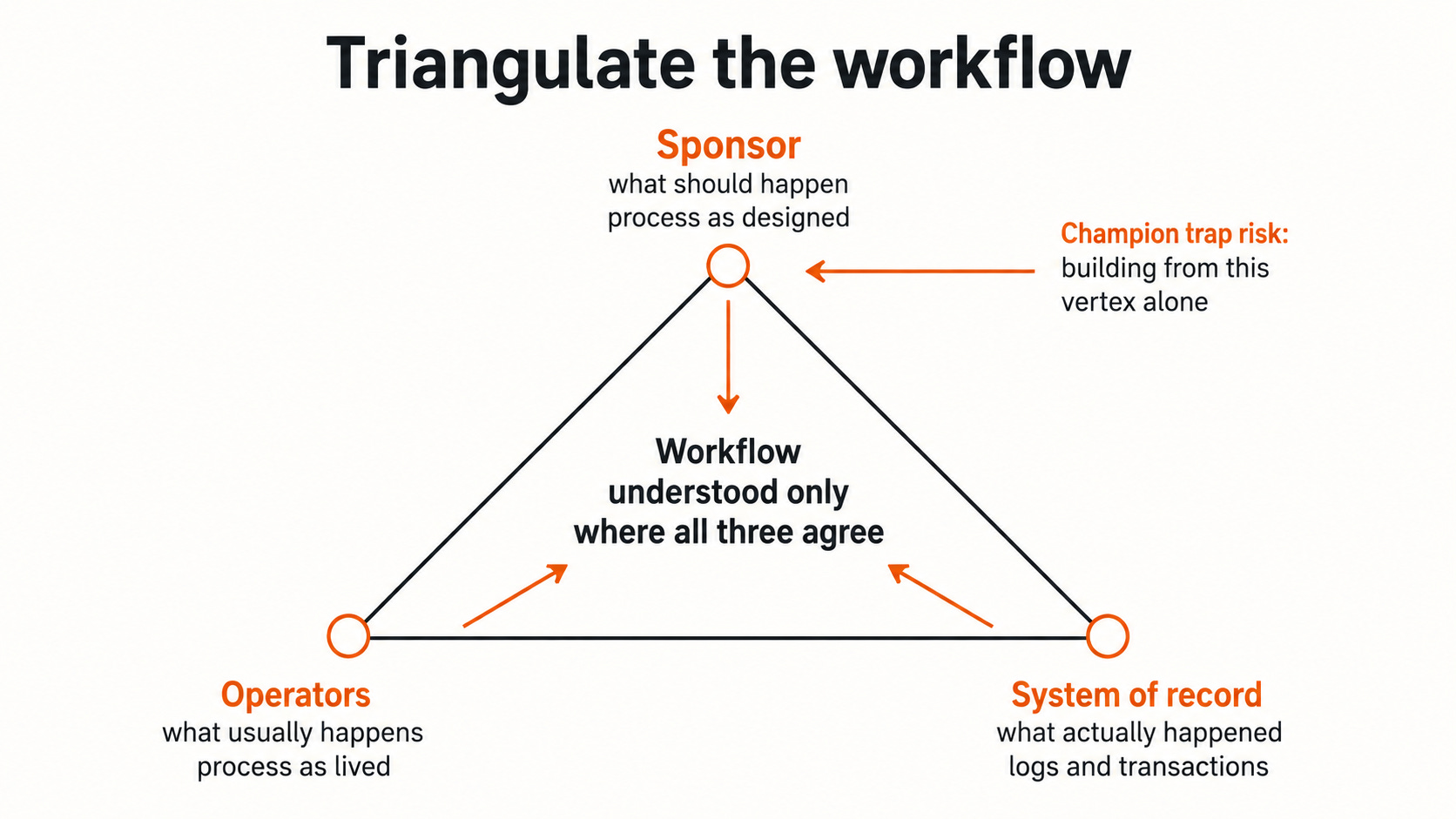
    TL;DR: In this episode of FDE Talks, the writer behind FDE Hub shares a pattern he saw repeatedly while working across more than 15 enterprise AI deployments: the stakeholder most eager to help can unintentionally give you an incomplete picture of the workflow. He calls it the champion trap. The fix is simple to describe and easy to skip: before you freeze the architecture, triangulate the workflow across the sponsor, the operators, and the system of record. Listen to the full conversation → Enterprise AI failures do not always begin with the model. Sometimes the model works perfectly against a workflow that does not actually exist. That was the lesson from an accounts payable automation project for a global music label operating across the UK, US, and the Netherlands. On paper, accounts payable looked like a straightforward automation problem. In reality, the company’s suppliers were music artists. Invoices arrived as PDFs, Word documents, Excel files, and occasionally handwritten notes. The company dealt with tens of thousands of suppliers, roughly 150 possible approval paths, and seven levels of approval hierarchy. One invoice captured the problem particularly well. The system rejected it because the purchase order number was missing. An operator asked the supplier to correct it. The invoice came back with the literal words “purchase order” entered where the number was supposed to be. That is the distribution your production system has to survive. The workflow you were told is rarely the whole workflow The project had what every FDE wants: a strong internal champion. She was senior, responsive, invested in the outcome, and willing to help the team navigate the organization. The project mattered to her personally. So the team built closely with her. For two months. Then they put the system in front of the people actually processing invoices, and discovered something important: operators were changing data directly inside the ERP. Nobody had mentioned it. The architecture had assumed data only needed to flow into the ERP. In reality, the system needed to detect and reconcile changes coming back from it. A one-way integration had to become a two-way sync. The team had misunderstood the business process rather than any technical requirement. That is the champion trap. The champion is essential and still insufficient None of this argues against having an executive sponsor. A strong champion is often the reason an enterprise deployment survives at all. They create access, remove blockers, secure resources, and protect the project when priorities change. But there is a fundamental difference between overseeing a process and operating that process all day. The champion can explain how the process is intended to work. The operator knows what happens when the PO is missing, when the supplier sends an Excel sheet instead of a PDF, when someone edits the ERP directly, or when the ten-year-old approval spreadsheet contains an exception nobody remembers documenting. Both perspectives are true. Neither is sufficient by itself. A mistake here quickly becomes an architecture decision. The wrong understanding of the workflow changes your integration pattern, data model, exception handling, human review strategy, and eventually the level of autonomy you can safely support. That is why discovery needs triangulation. Triangulate before you freeze the architecture For any workflow you plan to automate, check three versions of reality: * Sponsor: what should happen. This is the designed process: policies, documentation, kickoff decks, and management expectations. * Operators: what usually happens. This is the lived process: workarounds, exceptions, undocumented decisions, and institutional knowledge. * System of record: what actually happened. Logs, transactions, edits, timestamps, and historical records show the behavior that survived contact with reality. You understand the workflow once all three versions have been compared and the discrepancies explained. In the music label engagement, inspecting ERP history earlier could have exposed the direct edits before two months of architecture had accumulated around the wrong assumption. That is a discovery practice worth making explicit: do not freeze the architecture until you have compared the process as designed, the process as lived, and the process as recorded. Ask for the ugly data first There was another useful discovery technique in the conversation. Ask operators: “Show me the weirdest examples you have.” Skip the clean demo cases. Ask for the broken invoices. Missing values. Strange formatting. Old workarounds. Inputs that technically violate the schema but still arrive every week. Those examples are the beginnings of your evaluation set. The guest also uses what he calls the PhD intern framework: ask an operator to explain the workflow as though they were onboarding someone with multiple PhDs but zero knowledge of the business. That framing forces experts to unpack statements such as: “Then it gets approved.” Who approves it? How do they decide? What happens if the amount is above a threshold? What if the approver is unavailable? What if the supplier data changed? What information makes the operator stop and investigate? Those hidden micro-decisions eventually become agent instructions, validation rules, escalation paths, and evaluations. Do this with more than one operator. Otherwise you risk creating a smaller version of the champion trap around one person’s interpretation. Autonomy is earned in stages A second story from the conversation shows what happens when discovery gaps survive into production. A capacity-planning agent had progressed from human-reviewed recommendations toward full autonomy. The remaining error rate was only a few percentage points. But the operators saw those errors immediately. The system was missing constraints they understood intuitively but had never documented. Trust fell. Instead of continuing forward, the team moved the system back to a more supervised stage. That was the right move. Autonomy should progress through observed reliability: advisory → human-reviewed execution → greater autonomy. And the direction does not always have to be forward. Moving backward after discovering a new failure mode can be how you earn the trust required to move forward again. Another deployment from the same portfolio illustrates the difference between building software and deploying it. The sales-order automation took roughly three weeks to build. It took roughly three months before operators trusted it enough to rely on it. That second number belongs in the implementation plan too. Don’t automate the spreadsheet just because it exists The music label project uncovered one more problem. The approval workflow contained roughly 150 possible paths accumulated over years. Initially, the team tried to reproduce them. Eventually they asked a more important question: do all 150 paths need to exist? That changed the engagement. Instead of treating the current process as a specification, the team treated it as something that could itself be redesigned. The approval flow was simplified, and that simplification remained valuable beyond the AI project. This is an important distinction in forward deployed work. If you automate a complicated process without questioning it, you may simply make the old complexity run faster. Sometimes the highest-value technical decision is deciding not to encode part of the existing process at all. What the FDE actually brings back The interesting outcome of these engagements went beyond working customer-specific code. Patterns discovered in the field became reusable product primitives: human review, workflows for requesting missing information, configurable approval flows, and better exception handling. That is one of the clearest expressions of the FDE model. The customer gives you the messy reality. The FDE discovers what is actually generalizable. The product absorbs the reusable pattern. The reusable asset is the pattern you learned because production behaved differently from the specification. Before your next enterprise AI build Pick one workflow your team is automating. Ask the sponsor to describe how it should work. Sit with an operator and watch how it actually works. Then inspect the last few months of transactions, logs, and edits. Look specifically for disagreement. Because the most expensive discovery mistake may have nothing to do with the model. It may be confidently building the right system for the wrong workflow. That is the champion trap. And the best time to find it is before the architecture makes it expensive. FDE Talks is The AI Runtime’s conversation series about the FDE role and the craft of deploying AI inside real organizations: the architecture decisions, customer dynamics, failures, and lessons that rarely appear in product demos. Listen to the full conversation → This is a public episode. If you would like to discuss this with other subscribers or get access to bonus episodes, visit theairuntime.com

Showing 1–3 of 3 episodes