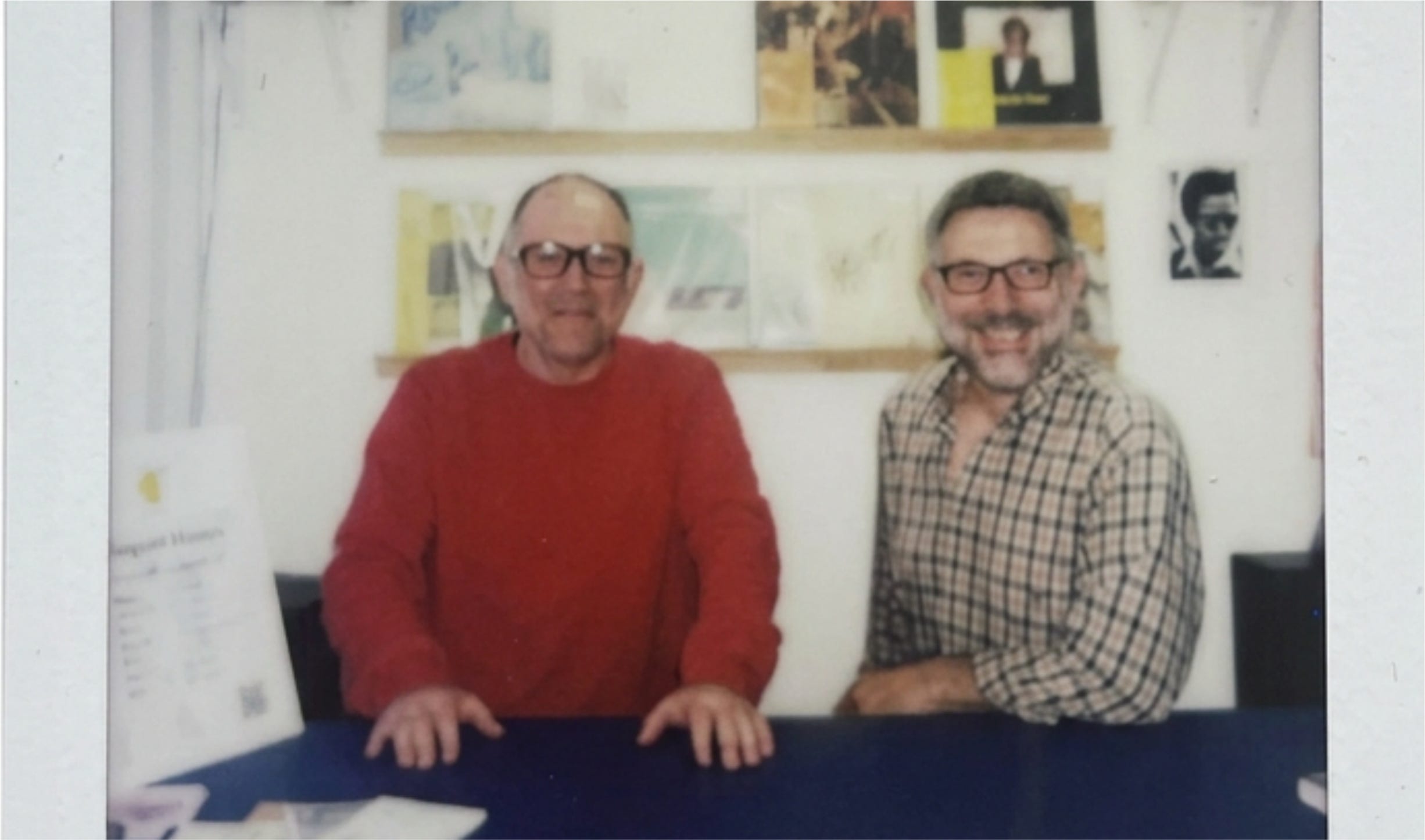
Record Story #10: Umbrella Vinyl, Edinburgh 🏴
When I talked to store owners in Spain and Croatia, they told me stories about the lengths they went to just to order records from the UK. Sending pounds in an envelope from Yugoslavia, risking prison time for handling foreign currency, or, a bit less intense, getting a cassette with song samples from the store before ordering. The grass is always greener though. The owners of Umbrella Vinyl had Led Zeppelin and Pink Floyd easily accessible on vinyl, but they were looking for something different. Curiosity and a love of eclectic sound led them to Hong Kong, where the three of them came together, with their respective vinyl projects, before opening a record shop in Edinburgh. Laura couldn’t make it this time, but I met with two thirds of the Umbrella Vinyl crew, Nick and Josh: You all met in Hong Kong, and you each had your own vinyl projects back then. Could you give us Umbrella’s origin story? JOSH: Laura and I went out to Hong Kong in 2010, and from that point onwards I had a record label called Platinum Metres, which specialised in art music. When I was out there I was working a lot on that, making my own musical instruments and my own music, and then luckily went into publishing music by other people. It was while I was putting those records out that Laura and I met Nick, who was selling records at a music festival, Clockenflap, which was Hong Kong’s answer to Glastonbury. If Glastonbury was a question, that would have been the answer. Nick was selling records and he was quite interested in publishing music as well, so it seemed like we should exchange ideas. We ended up working on a release together and that conversation just kept on growing. After we moved back to the UK, we came to Edinburgh, and Nick followed. We’d been thinking about what we wanted to do with all this knowledge and enthusiasm for records, because we’re all record collectors as well. So we released a tune called MRA by Chris McGregor’s Brotherhood of Breath, the South African group who moved to Europe and then the UK. We put out that record, and it blossomed into this shop. And it was for a good cause, right? JOSH: Yeah. To acknowledge the awful situation those musicians were put in, exiled from South Africa because of the apartheid system, we thought it would only be fitting to pay a percentage of the income to charities that help migrants, in this case migrant musicians. And Nick, how did you end up selling records in Hong Kong? NICK: I’d been in Hong Kong with my family since 2005 and was gradually transitioning out of my career and looking for new things to do. And I literally ended up buying 10,000 records and having them delivered to Hong Kong on three pallets, and then having to move them into my apartment in cardboard boxes. It was fantastic and awful at the same time, but mostly fantastic. I started going through them and thought there has to be a business in this. There was amazing music. I started selling and got involved in the local network in Hong Kong, which is enormous for vinyl. You wouldn’t imagine it, but it’s big. Then getting invited to Clockenflap and meeting Josh and Laura. That’s where it came from. JOSH: Nick was also running record fairs in central Hong Kong. Like he says, there’s this huge network, and the network matters more there than bricks and mortar shops. These fairs would bring vinyl enthusiasts from far and wide. Laura and I would DJ, and Nick would shift wax. A real carnival atmosphere. How's the Hong Kong vinyl scene? NICK: It’s very interesting. I found people selling records in coffee shops, doing very small record fairs. And that developed into the monthly fairs that I was organising, inviting anybody who wanted to sell and everybody who wanted to buy. They ended up being really busy Saturday afternoons for a few hours in a bar in central Hong Kong. But the one interesting thing there was a Facebook group with several thousand members. And all week there would be transactions happening. And then we would meet at one of the underground stations, the MTR stations, on a Wednesday evening, six o’clock, and 50 or 60 people would meet in the public area. So you’re sort of mixed between actually being in the stations, behind and in front of the ticket barrier. And all of these boxes of records would be there. I would take a box of records down and give them out to 10 or 20 people. And then I’d be buying from other people. It was a real community, really fantastic, all based on trust. Occasionally people didn’t show up, but it was just a fantastic way to meet people and find out what was going on. One of my great memories of Hong Kong was this rare thing where there was some equity between locals and expatriates. It’s very easy to move within an expatriate circle of people and not meet any locals. And there were lots of musicians there as well. So you’d find out about these gigs that were going on in these underground places that would actually be on the 43rd floor of some disused factory building, and you needed a secret handshake to get in. The access that dealing with the record community afforded me to the music that was happening in Hong Kong was truly amazing. So you were invited into the underground scene. NICK: Yeah. Especially when the protests started, there were all sorts of restrictions on being able to get visas for foreign musicians, and licences to make music in venues. And it was a great luxury to be afforded that access as an expat there, because I might often be the only non-local person at some of these gigs. And I saw some tremendous music. And that led to one other venture that Josh and I did with a friend in Hong Kong, which was to produce a zine about music in Hong Kong. Not necessarily Hong Kong music, it might be music that was coming to Hong Kong. And we published this beautiful hard copy zine, very limited. And we were able to use that to talk to artists and venue owners and record producers. It was a fabulous time. And it was a shame it came at the end of our times, respectively, in Hong Kong, and the start of the protests in 2019. And that led to your own label as well? NICK: It resulted in working with Josh on a joint release, and then my label growing into something that was looking at making physical releases on a not-for-profit basis for Hong Kong musicians, whether they were expatriates or local locals. I’ve made so many great friends in this network. I had a bunch of releases there, all on vinyl, and then latterly a couple of cassettes. That turned into a global thing. I’ve picked up contacts in North America, Canada, all over China and Southeast Asia, and Japan. When we started setting up the shop, that whole world thing became something for us. And how did you come up with the name? NICK: As we thought about the logo and the name and what the shop would be, we had our tagline: Global Sounds Under One Umbrella. That’s the way we look at music and records from all over the world. What we want to do here in Edinburgh is bring global sound under one umbrella for everyone. JOSH: As Nick says, this love of music is a real social leveller. Not that music is a universal language, but you can universally unite through the love of it. And the umbrella, beyond the obvious metaphor of keeping us all under it, is also a reference to the protest movement in Hong Kong, which was unfolding while we were there. Lots of layers. How did the fascination with African sounds start? Were you always into music from all over the world, even as teenagers, or did it start in Hong Kong? JOSH: My mum was a bit of a hippie, into the world music scene. So when I was a child we had records by the Bhundu Boys and King Sunny Adé, and I had a taste for it. But I don’t think it was until later life that I heard people like Fela Kuti, or the heavier Afrobeat, the more obscure stuff like Tunji Oyelana. We’ve got all sorts of records by people like Blo and Witch. It was always there as a rhythm. NICK: My dad was a great influence. I ended up with old blues records from him, and more modern stuff like Muddy Waters. That made me explore the roots of music, which is probably a dreadful term. But I was just exploring drum beats from Africa, and then thinking about how that moved around the world. One of the things I did in Hong Kong, I was connected with some volunteer educational groups and ended up giving English classes. One year I decided we’d talk about music, because the students were all interested in it. It forced me to have a good think about music in a way I hadn’t before. And I’ve seen that with the shop as well. The music that comes in sets us off exploring different things, and there’s so much of it I’ve never come across before. It’s influencing the kind of music I play at home, and what I play out when we’re DJing. You were showing them music they wouldn’t normally pick up themselves, blues or African music. How did the kids react? NICK: They loved it. They wanted to be making old diddley bows in class. I would play them the modern version and then the original. There’s an old blues track, Black Betty, which refers either to a prison van or a whip, something used to imprison people. And they loved the original blues version over the rockier Ram Jam version. It opened their minds beyond the background music they were listening to on Spotify or YouTube. These were teenage students. They hadn’t explored this, or weren’t even aware that this kind of music existed. How about yourselves as teenagers? Did you listen to any music that made your parents say, "What are those kids listening to these days?" JOSH: My mum was very tolerant of the kind of music that I liked. I was really into Derek Bailey, very into free jazz, Sonic Youth and I guess noise music. So I’d be blaring out things like Machine Gun by Peter Brötzmann. And she’d be thinking, kids and their music. NICK: My first record was Pretty Vacant on 45 by the Sex Pistols. So that’s where I was going, despite my father’s better influences. And then I found the radio, which I listen to so much less these days. There was one show done by Frank Zappa as a guest DJ on Radio One, and it’s accessible on the web, you can see the tracklist. That sent me down these enormous wormholes of music that I’d never come across. Black Sabbath, Edgard Varèse, all of this amazing music just in this one show. And everything was like a trigger to find something. If Google had been around in those days, and other places to go and buy records online, my record collection would have just exploded. Talking about radio, you and Laura have your own radio show, right? JOSH: Yeah, Laura and I have a show called Vinyl Voyages, which we started off in Hong Kong. That was a pre-recorded show on a station called Radio Lantau, and it was weekly. When we moved here to Edinburgh, we got a show on community radio, EHFM, and that broadcasts live. So we were doing six shows a month. And now we just do the show monthly on EHFM, which is a really fantastic station, an incredibly broad range of shows from spoken word to experimental soundscapes to us playing global music. Is it available online? JOSH: Yeah, absolutely. It’s available to listen again on the EHFM website and on Mixcloud, and that’s updated every day with all of their shows. So you can listen back to thousands of hours of radio. When did you start collecting records? JOSH: We all started listening to music and collecting music in the days where you’d have to catch the title of a tune on the radio and then carry it to record shops, or ring them up. Or you’d have to hum the tune to whoever owned the shop. And it could be years before you heard it again. It’s an amazing luxury now. If you hear something you can Shazam it. That would have been witchcraft 30 years ago. It’s easy to say that takes some of the fun out of it, but the drudgery I don’t miss. If we really think that music unifies people, then the more access you have to it, the better life is. NICK: But there’s still that moment, once you’re in the record shop and they’ve got two records that you want. When I was a kid it was, which one can I get? Because I can only have one. And that still happens. I get into record shops and there’s three or four and I can’t buy them all. And what do I leave behind? That’s one of the things we wanted to create here. You come in and there’s so much good music and you want all the records, but you can’t take them all. Will it be here next time I come in? For continental Europe, the UK was the place to go for records. JOSH: For the kind of music that we really love, continental Europe is possibly a bit better. It’s good for jazz. Reggae is a lot more available in the UK, but African records are much easier to get, say in the south of France or in Spain. This goes back to colonial networks, which is clearly grim. But it’s really interesting. Say you go to Sweden, there’s a whole different set of jazz records, a whole different jazz vocabulary than if you go to Portugal, where there’s another set of musicians. And I guess that’s the excitement of being a record collector travelling around the world, because you always find these interesting quirks of history. NICK: But that exploring around Europe and working out where the good records are has actually helped us build a network of suppliers for the shop. Almost everyone we’re buying from overseas is a new relationship for us, from Panama and São Paulo and Japan and around Europe and Asia. It’s extraordinary where we can get records from, and work closely with people that are just as enthusiastic as us. To a T, the people that we deal with overseas, if they came here, we would love them to come and play records in the shop. Do you still buy records for yourselves, or does it all go to the shop? JOSH: It’s two different networks, really. All three of us are always buying. I have bought at least two records every week since I was 18. So I don’t still own all of them. But as you might imagine, that’s an awful lot of records, because I’m not a young man anymore. NICK: I think it’s really important to say that we’re so excited about records, about what we find in the wild elsewhere and about the stock that comes into the shop. But there’s a salient point, that we don’t get to pick out of our own stock. Anything that comes into this shop is available for customers before it’s available to Josh and Laura and myself. And no matter what, it can be heartbreaking, seeing something you’ve just discovered, and it’s fantastic to see it go out. And that’s it, you might not ever see another copy again. But that’s what we want for other people. Come in here, find some amazing music, and know that our enthusiasm for it is 100% genuine. JOSH: Speaking of enthusiasm, my background is in visual art. I trained as a painter. And I still think that the record is the greatest single art object. It’s the confluence of sound and image and text. Even if it’s not a concept album, there’s all this coded information about the times it came from, the cultures it emerged from. So records, even if you are not a fan of the music, are endlessly fascinating. Depositories of information. I’ll never not be in love with the vinyl format. Sharing it, talking about it, looking at it, listening to it, reading it. It’s magical. What are the places that surprised you the most on your digging trips? NICK: I’m not like a lot of record collectors. I don’t have a huge want list that I carry around. I like going in and choosing a record by its cover or the artist, something I haven’t seen before or something unusual. And especially secondhand records. I like the fact of, who’s touched this record? Who’s played this record? Somebody’s put newspaper cuttings in here from when the concert was in Edinburgh. I love all of that about it. And to me the story is through the lifetime. We’ve got records in here that are older than I am. How many hands have they been through? Who’s played them? Have they been enjoyed? That’s fascinating. JOSH: The last time I was really surprised record buying was maybe the first time we went on a trip to Japan, a proper digging trip, going to Shinjuku in Tokyo. They have Disk Union out there. And this was pre-smartphone, so I had to draw a little map, and the addresses in Tokyo are so confusing. Getting there and finding the shop, realising that each floor was dedicated to a separate genre, and not just a separate genre, a sub genre. So this one building, all seven floors, are different types of rock. It could be punk crossover, it could be blues rock on one floor. But I’m a jazz guy, so I find the jazz shop, and each floor has a different sub genre. And just flicking through these records, which you never see anywhere else in the world in such quantities, in such incredible condition. And most importantly, it’s such a low price. And having to buy extra suitcases to carry the records back is absolutely wild. I know the pain. And speaking of jazz, you literally wrote a book about the topic: Jazz Explosion (A Panorama of Jazz in Britain), the 50s to the 70s, right? JOSH: Specifically 1948 through to 1968, which were two key dates in the UK. 1948 was the British Nationality Act, which granted citizenship to people throughout the Commonwealth. The idea was that these citizens of Commonwealth countries would come to the UK and help rebuild after the Second World War. That influx of musicians changed British culture massively for the better. I would insist it changed jazz, which was the dominant music at the time, in ways that we’re still getting to grips with and understanding. And then 1968 is a key date because it was the first time that the Arts Council of Great Britain, which coincidentally had been started just post-war, gave money to a jazz musician. That symbolically pulled us out of the basement bars and brought it into the concert halls. So it was an extraordinary period of exchange and development. You’ve got two decades where the music goes from being acoustic to electric, from being all white to being multiracial. And in terms of jazz, that means it’s more true to itself. It should be multiracial. It should be about exchange. What are the British jazz artists you would recommend from the last decade? JOSH: Oh, there’s so many. When people are talking about jazz in the UK, they tend to think about Peckham in 2010 or thereabouts, the scene that Gilles Peterson helped bring up. And there are incredible musicians coming out of that, like Shabaka Hutchings. At the moment, I would say Scotland is just a powerhouse of jazz. Some of the best performers coming out there. And you’ve got great producers like Rebecca Vasmant and her label, Rebecca’s Records, with a great roster of artists. You’ve got corto.alto, they were just brilliant. At the moment, Kai Reesu would probably be my favourite group, the one to watch. They’re a jazz group, but they’re also a hip hop outfit. And their first album, KOMPROMAT vol. i, which was launched in the shop, coincidentally, I would recommend to everyone. It’s a phenomenal album. NICK: And squaring that circle, I’d add in Mama Terra as well. And that brings it back to the Gilles Peterson reference, because it’s on Acid Jazz. They’ve just launched their third album. They’re all fantastic. And a Glasgow band. I know you have to open soon, so lastly, what’s next for Umbrella Vinyl? JOSH: We signed NDAs, we can't tell you 😁 We’ve got loads and loads of great things coming. Lots of events in the shop and lots of events out of the shop. The store filled up right after we finished talking. I walked out with the MRA single on the shop’s own label and a copy of The Supremes’ 1975 self-titled album, which is playing as I write this. Bruntsfield has a few more stores I got to visit, and plenty of great food to keep the energy levels up for crate digging. I’ll be sharing some videos and a full Edinburgh report soon! The Umbrella crew posts a video of recommendations every day the store is open. You can find five records representing the store below, and if you’re hungry for more, follow @umbrellavinyl for a daily dose of records from around the world. Thanks for reading! Subscribe for free to receive new posts and support my work. This is a public episode. If you would like to discuss this with other subscribers or get access to bonus episodes, visit digginit.substack.com