Skip to content
Artwork for [Dev]olution
TechnologyBusiness

[Dev]olution

Coder

The development world is cluttered with buzzwords and distractions. Speed, focus, and freedom? Gone.
I’m Nicky Pike. And it’s time for a reset.

[Dev]olution is here to help you get back to what matters: creating, solving, and making an impact. No trend chasing, just asking better questions.

What do devs really want?

How can platform teams drive flow, not friction?

How does AI actually help?

Join me every two weeks for straight talk with the people shaping the future of dev.

This is the [Dev]olution.

Play
  • 20 episodes
  • fortnightly
  • Avg 52 min
  • English
  • #27
    September 9 · 58 min

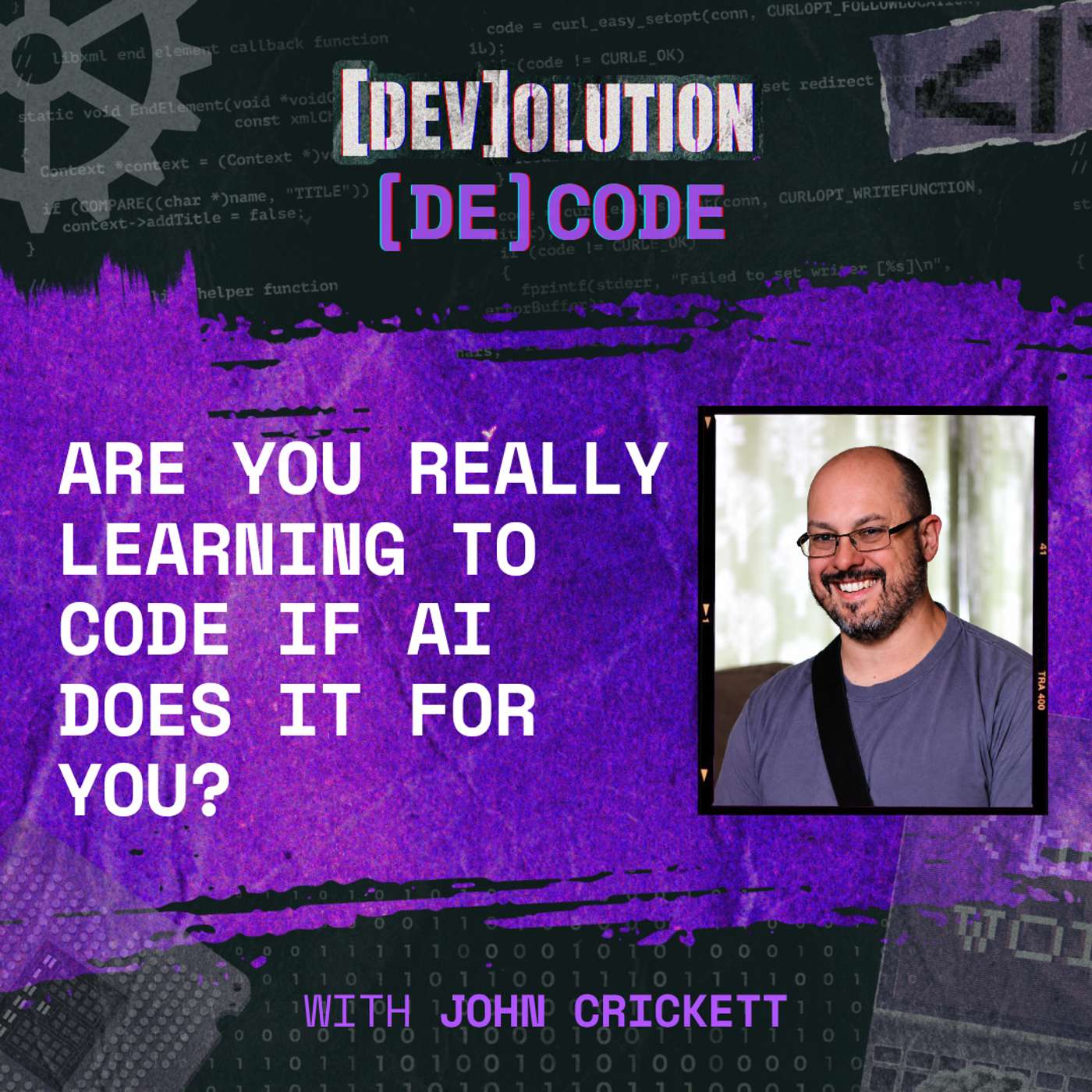
    Are You Really Learning to Code If AI Does It for You?

    John Crickett spent 30 years teaching himself to build software the hard way, and he thinks that's exactly why he's still employable. Long before anyone typed a sentence and watched an app appear, John Crickett was writing Quake bots downloaded by millions, chasing a bed and breakfast search engine years before Airbnb existed, and getting laughed out of a VC pitch for an idea he called takeaways online. Today he runs Coding Challenges, where thousands of engineers go to relearn a skill AI is quietly letting them skip. In this episode, John sits down with Nicky Pike to make an argument a lot of the industry won't like. Cranking out code has never been easier. Building the right software, for the right people, for the right reasons, is exactly as hard as it's always been. They get into what's actually driving the record number of AI projects getting scrapped before launch, why John still thinks coding and software engineering are two different jobs, and why he's calling the entire AI industry a bubble, on record, with names attached. If you've ever handed AI a one-line prompt, gotten back exactly what you expected, and wondered why that felt hollow, this conversation is for you. In this episode, you'll learn: The CEO of You, Inc. mindset he uses to justify learning outside of work Why test-driven development is about thinking, not testing The one prompt trick that turns any AI into a real coding mentor Things to listen for: (00:00) Meet John Crickett (01:20) Studying AI decades before it was cool (06:00) From Quake bots to startup rejections (12:25) Why AI projects are getting scrapped before shipping (17:15) Can AI write the blueprint too (20:25) What teams skip when AI makes coding easy (25:50) Why fewer engineers are learning to code deeply (31:05) Why you can't learn coding from YouTube alone (37:50) How to prompt AI to actually mentor you (41:30) Why you're the CEO of your own career (48:05) Getting the customer back into the process (50:40) One skill every engineer should learn by hand (53:45) Predictions: Who survives the AI bubble and who doesn't (56:30) Defining a Coder: To actually code (57:15) Final thoughts: Challenge John’s ideas Resources: John Crickett's LinkedIn: https://www.linkedin.com/in/johncrickett/ Coding Challenges website: https://codingchallenges.fyi

    • Transcript
  • #26
    August 26 · 13 min

    Open Source Security: The Eyeballs Were Never Enough

    6,000 vulnerabilities but only 97 fixed. Nicky Pike can't stop thinking about a stat that a machine found in the open-source code your company almost certainly runs. It all started with 90 seconds of a much longer conversation. A few weeks back, Nicky sat down with Gene Kim for a full episode on citizen developers and the outer loop. Near the end, Gene described a moment from an Erik Meijer talk that stuck with them both: the suggestion that running open source at all might be crazy, that it's coupled to code nobody's actually accountable for. In this minisode, Nicky goes back through 25 years of the open source eyeballs promise and tests it against what happened this year. An AI model was pointed at open-source code and returned thousands of vulnerabilities. Maintainers, already buried, received more bug reports and barely any hands to fix them. Nicky lays out why the gap between finding a problem and fixing it, not the finding itself, has been the real issue the whole time. If your team runs open source and you've never asked who actually fixes it when something breaks, this one will change how you look at that dependency list. In this episode, you'll learn: 1. Why cURL went from weekly bug reports to one every 18 hours 2. How a stolen npm credential targeted the exact AI coding tools you use 3. Why a signed, verified package still shipped malicious code untouched Things to listen for: (00:00) The stats that proved the risks of running open source (00:53) The 90 seconds with Gene Kim that changed everything (01:37) What this episode is not saying (02:23) Linus's law and Gene’s law (03:16) How the XZ Utils backdoor got in (04:14) An npm attack aimed at AI configs (05:09) An AI model gets pointed at open source (06:12) The wolfSSL bug nobody explained (07:06) A 27-year-old claim no one can verify (07:58) Why the fix counter stopped moving (08:50) The maintainer drowning in bug reports (09:41) Why more eyeballs never meant safer code (10:30) What to actually check this Monday (11:22) Why rewriting your own code has a cost (12:17) Closing thought and a question for you Resources: Nicky Pike's LinkedIn: https://www.linkedin.com/in/nicky-pike/ Coder website: https://coder.com/ Gene Kim's Episode: Coding Isn't the Bottleneck Anymore. Gene Kim Explains What's Next Linus's Law One engineer’s curiosity may have saved us from a devastating cyber-attack | John Naughton | The Guardian Jscrambler npm Package Compromised: Why It Matters – Reflectiz Project Glasswing: Securing critical software for the AI era \ Anthropic Cybersecurity Insights with Contrast CISO David Lindner | 04/18/25 Preinstall to persistence: Inside the Red Hat npm Miasma credential-stealing campaign | Microsoft Security Blog

    • Transcript
    • Chapters
  • #25
    August 19 · 1 hr 1 min

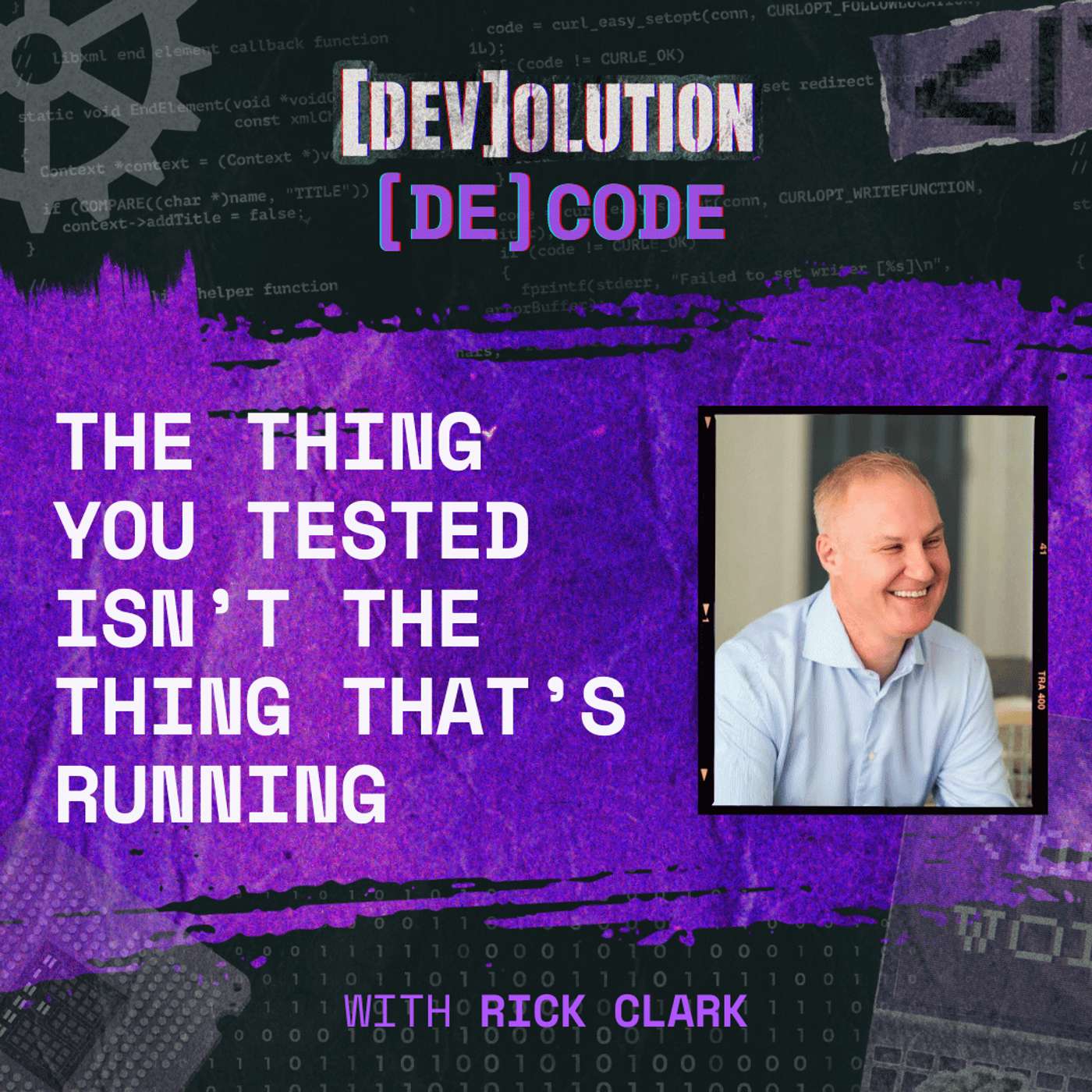
    The Thing You Tested Isn't The Thing That's Running feat. Rick Clark

    For 15 years, enterprises have signed off on a promise: the thing we tested is the thing that's running. Rick Clark, Global Head of Cloud Advisory at UST, says that promise dies the moment an agent starts making its own decisions in production. Rick helped build the cloud era himself, from Ubuntu Server to OpenStack to the Four Opens framework that still governs the OpenInfra community today. Now he's telling enterprise leaders that agentic AI is the biggest wave he's seen, bigger than cloud, bigger than open source, and it's compressing a decade of hard lessons into eighteen months. In this episode, Rick and Nicky Pike dig into why most enterprise leaders running agents in production can't fully trace what those agents are doing, why audit is the first promise to break, and why testing something yesterday tells you nothing about what it does today. If your company is racing agents into production before anyone's decided who signs off when it goes wrong, this conversation will change how you think about what "tested" and "deployed" actually mean. In this episode, you'll learn: Why the behavioral envelope replaces the pass or fail test for good How one company's 57 secret managers became a warning story Why the AI developer scares Rick more than any 2am coder ever did Things to listen for: (00:00) Meet Rick Clark (01:45) The cloud moment that changed everything for Rick (07:20) Is enterprise AI skipping the usual hype cycle (08:30) The stat that says agents can't be traced (13:45) Three promises about production that just broke (18:00) Why production is a promise, not a place (24:45) What a behavioral envelope actually replaces (29:00) How to test something you can't fully trust (32:45) The first thing a CTO should measure now (38:00) The 57 secret manager mess AI will amplify (48:00) Charred bodies and the cost of moving fast (51:00) Rapid fire on banks, AI, and observability (55:15) Predictions: when the tested artifact stops being a promise (58:50) Defining a Coder: promises a machine can keep (01:00:12) Final thoughts: getting this right instead of fast Resources: Rick Clark's LinkedIn: https://www.linkedin.com/in/dendrobates/ UST website: https://www.ust.com

    • Transcript
    • Chapters
  • #24
    August 5 · 1 hr 10 min

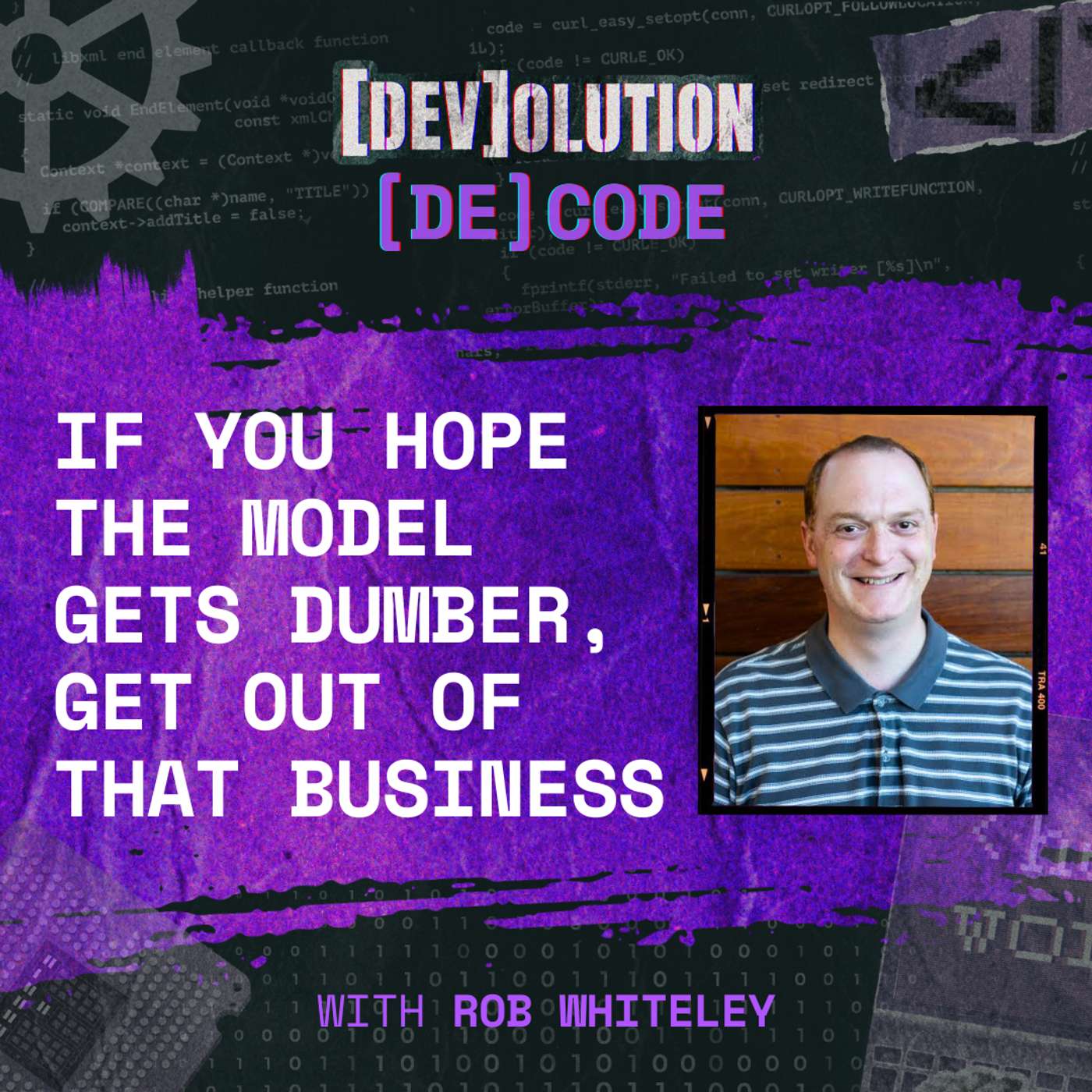
    If You Wake Up Hoping the Model Got Dumber, Get Out of That Business

    Wave one was everyone grabbing a shovel and vibe-coding as fast as possible. Wave two is the bill showing up. Rob Whiteley has watched this movie before as he ran NGINX through the last major platform shift, and now as CEO of Coder, he's watching companies rack up token bills and security holes from software nobody thought to govern. In this episode, Rob sits down with Nicky Pike (full disclosure, Coder sponsors this show, and Rob signs Nicky's paychecks) to talk about what actually comes after the AI gold rush. They get into why the model layer is the one thing you should never lock yourself into, how to think about tiered model strategy using a tenured employee analogy, and why governance and rules are not the same thing. Rob also breaks down the real difference between a sandbox, a workspace, and a harness, and makes the case for why an engineer driving an agent will always beat a product manager doing the same. If your team is already sitting on a token bill nobody budgeted for, this conversation is your map for wave two. In this episode, you’ll learn: Why letting a product manager drive an agent alone puts your company at risk Why there will be just as many developers, only far fewer software engineers Why Rob expects two or three more Anthropic-style upsets before the year is out Things to listen for: (00:00) Meet Rob Whiteley (01:20) Why this wave feels different from cloud (06:59) Betting on infrastructure, not the tools (11:34) The Excel analogy for your job (15:39) One customer went from 800 apps to 10,000 (17:04) Your token bill is AWS all over again (21:40) Rating AI models like tenured employees (24:12) Why nobody saw the token bill coming (31:05) Governance and rules are not the same (36:20) Why an engineer beats a PM (40:47) Sandbox, workspace, or harness, know the difference (46:52) Why Coder refuses to bet on one model (56:48) Should you go vertical or horizontal (1:04:47) Predictions: who gets usurped and who wins (1:07:56) Defining a Coder: what it means to build Resources: Rob Whiteley's LinkedIn: https://www.linkedin.com/in/rwhiteley/ Coder website: https://coder.com/

    • Transcript
    • Chapters
  • #23
    July 29 · 48 min

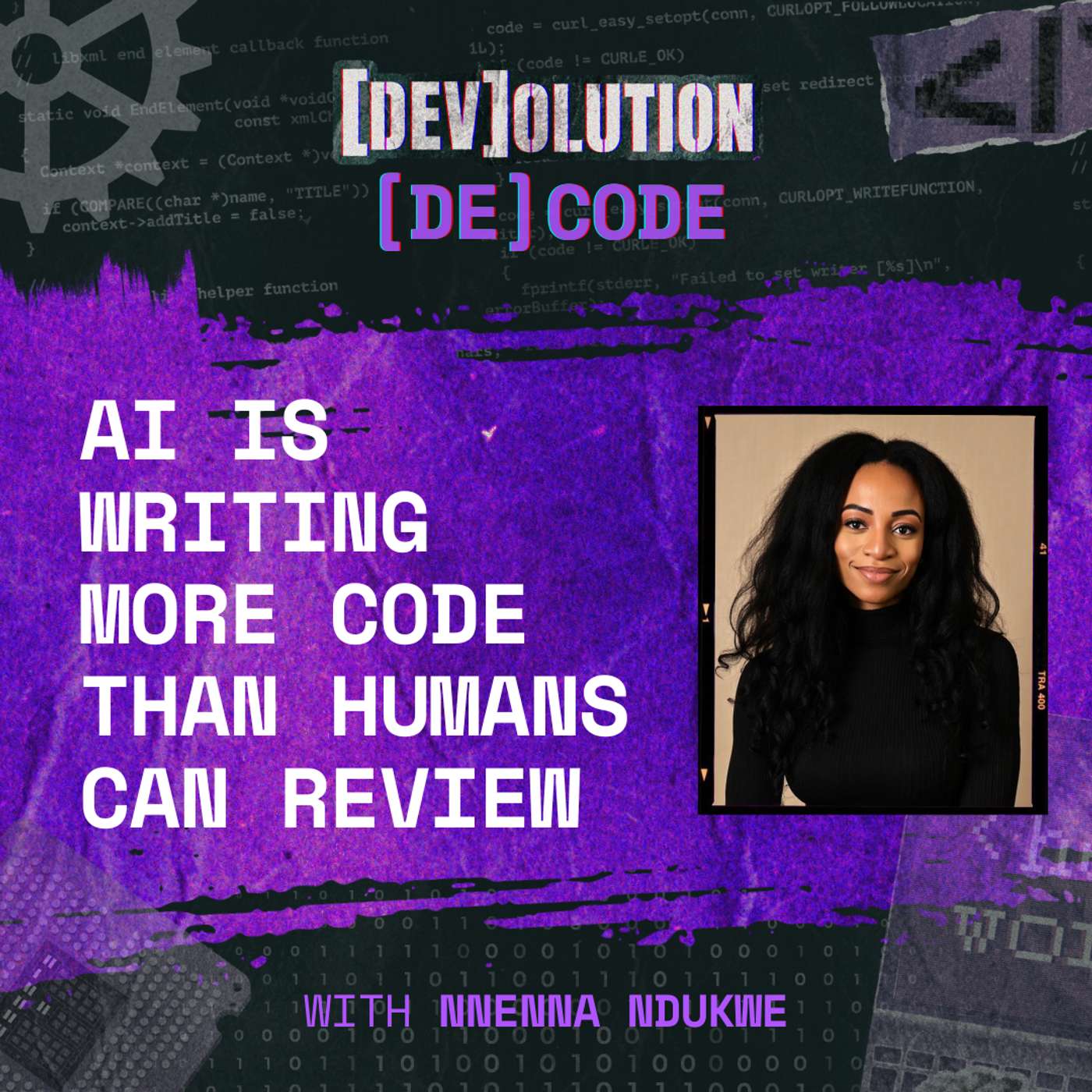
    AI Is Writing More Code Than Humans Can Review

    What happens when the AI coder moves faster than the review process can handle? Nnenna Ndukwe has spent 8+ years as a software engineer and now works at the intersection of AI, developer relations, and enterprise engineering strategy. As AI developer relations lead at Qodo, she spends her time helping teams separate useful AI adoption from expensive chaos. In this episode of [Dev]olution, Nnenna joins Nicky Pike to talk about the part of AI coding most teams skip: review, verification, governance, and the outer loop where AI-generated code either gets controlled or breaks production. They dig into why AI does not fix broken engineering systems, how rework rate exposes the truth behind AI productivity, and why better code review needs more than another stream of AI comments. What it needs, instead, are deterministic gates, developer trust, and a clear view of where AI belongs in the software delivery process. If your team is shipping faster but fixing more, this episode will make you rethink what “AI productivity” actually means. In this episode, you’ll learn: Why rework rate may expose AI productivity better than velocity How deterministic gates keep AI review from becoming noise Where engineering leaders should introduce AI first Things to listen for: (00:00) Meet Nnenna Ndukwe (01:52) From writing code to advising leaders (04:09) Why AI made the work more interesting (07:02) Paying it forward in women in tech (09:23) AI speed is breaking production (10:30) Where the delivery jam really happens (12:32) Why rework rate tells the truth (15:42) Can AI review AI code (17:21) AI amplifies your current process (20:34) The risk of AI review slop (23:19) Why acceptance rate matters (26:27) Human-agent work needs better rules (29:23) More tokens is not discipline (36:44) Where leaders should start (41:25) Predictions: More managing systems (45:49) Defining a Coder: A problem-solver (47:08) Final thoughts: Cut the noise of AI hype Resources: Nnenna Ndukwe’s LinkedIn: https://www.linkedin.com/in/nnenna-ndukwe/ Qodo website: https://www.qodo.ai/

    • Transcript
    • Chapters
  • #22
    July 8 · 1 hr 17 min

    Coding Isn't the Bottleneck Anymore. Gene Kim Explains What's Next

    Coding used to be the bottleneck. Gene Kim says that era is ending, and most companies are not ready for what comes next. In this episode of [Dev]olution, Gene Kim, author, DevOps researcher, and founder of IT Revolution, joins Nicky Pike to talk about what happens when software is no longer built only by developers. Gene has spent decades studying high-performing technology organizations. He’s since helped shape the DevOps movement and co-authored the books many engineers grew up reading. Now, he’s deep in vibe coding, working with leaders, doctors, military teams, and people who have never written code before. The big question: if everyone can suddenly build, can the rest of the company keep up? Nicky and Gene get into citizen developers, broken review gates, and why the next DevOps-sized shift may be 100x bigger. If your company is still treating AI coding like a developer productivity tool, this conversation is the reset. In this episode, you’ll learn: Why the outer loop becomes the real bottleneck when coding gets faster How citizen developers change the job of professional developers What teams should rethink before AI-generated work floods the pipeline Things to listen for: (00:00) Meet Gene Kim (02:30) The project that changed everything (08:55) Pair programming with non-developers (15:45) Why AI feels like the spreadsheet revolution (20:07) Coding isn't the bottleneck anymore (28:11) Nobody knows what comes next (35:01) Why AI should review AI code (44:51) What engineering teams should change Monday morning (50:05) AI becomes the next DevOps specialist (53:50) Could AI replace open source dependencies? (01:00:40) The economics of AI coding (01:04:20) Predictions: 50x more software from non-developers (01:11:10) Defining a Coder: Dreams becoming reality (01:14:20) Final thoughts: Learn from the frontier Resources: Gene Kim’s LinkedIn: https://www.linkedin.com/in/realgenekim/ Gene Kim’s website: http://www.realgenekim.me/ IT Revolution website: https://itrevolution.com/

    • Transcript
    • Chapters
  • #20
    June 24 · 1 hr

    96% of Companies Run AI Agents. Only 21% Can Control Them

    96% of companies are running AI agents in production. Only 21% can actually control them. Gari Singh has watched this movie before. Three times. XML middleware, enterprise blockchain, and now AI infrastructure at Google Cloud, and every wave has the same opening act: teams rush to deploy before the platform team is even in the room. In this episode of [Dev]olution, Nicky Pike, and Gari break down what the outer loop actually costs you when agents go ungoverned, why "Ninja IT" is the new shadow IT, and what platform engineers need to do this Monday to stop building on a foundation that's already cracking. If you're still treating agent governance as a roadmap item, this episode is the reason to move it to the top of the list. In this episode, you’ll learn: Why automating bad processes with AI just makes bad things happen faster The three things every platform engineer should do this week, according to Gari Why MCP servers are the new SOAP and will disappear in five years Things to listen for: (00:00) Meet Gari Singh (02:00) What DataPower taught him about governing traffic (04:30) AI adoption versus the blockchain free-for-all (06:30) The stat that should scare every platform team (09:00) Why Kubernetes took a decade but AI took 18 months (14:30) Prompt injection and limiting the blast radius (18:00) Ninja IT is the new shadow IT (20:30) Automating bad processes just makes bad things worse (25:00) Self-managed MCP versus the enterprise version (28:30) Why YOLO mode survives elicitation (35:00) How platform teams hold the line without becoming the villain (39:30) The outer loop is still the bottleneck (44:00) Three things every platform engineer should do this week (51:00) Rapid fire with Gari (53:30) 2028 predictions and the governance reckoning Resources: Gari Singh’s LinkedIn: https://www.linkedin.com/in/garisingh/ Google’s website: https://www.google.com

    • Chapters
  • #21
    June 17 · 18 min

    Open Weight AI Isn't the Risk You Think It Is

    Everyone's asking the wrong question about open AI models and has turned the debate into a geography problem. Is it Chinese? Is it American? Can we trust it? But the biggest AI security incident in recent memory had nothing to do with where a model came from. In this minisode, Nicky Pike breaks down the three layers of risk hidden behind open-weight AI models and why most security conversations focus on the easiest layer to defend. From poisoned training data and sleeper-agent research to malicious Hugging Face repositories that fooled hundreds of thousands of developers, this episode separates real threats from political headlines. If you're evaluating DeepSeek, Qwen, Llama, or any open model, this episode will change how you think about trust, ownership, and security. In this episode, you’ll learn: Why self-hosting only protects you if you control outbound access How malicious repositories create bigger risks than model origins What every engineering leader should inspect before deploying open models Episode highlights: (00:00) The repo that fooled 244,000 developers (00:35) Why everyone wants open models (01:20) The wrong question CIOs keep asking (02:10) The three layers of AI risk (04:00) Anthropic's sleeper agent experiment (06:25) How 250 documents can poison a model (08:00) The Hugging Face malware problem (09:20) Why banning models misses the real threat (10:15) Self-hosting isn't a force field (11:20) What ownership actually gives you (13:20) 4 practical defenses that work (16:20) Why open models are getting too good to ignore Resources: Sleeper Agents: Training Deceptive LLMs That Persist Through Safety Training A Small Number of Samples Can Poison LLMs of Any Size Examining Backdoor Data Poisoning at Scale JFrog Security Research on Malicious Models in Hugging Face

    • Transcript
    • Chapters
  • #19
    June 10 · 1 hr

    Why Developers Are Ditching AI and Talking to Humans Again

    What if your developer community could teach you more than any AI ever could? In this episode of [Dev]olution, Nicky Pike sits down with Pauline Narvas, former Head of Community Platforms at Vercel and incoming leader at OpenAI Codex, to unpack why human connection is thriving in the age of AI. Pauline reveals how communities are becoming the hidden engines driving learning, collaboration, and real product impact. From guiding developers through AI-powered tools to building trust and loyalty in forums and Discord channels, she explains why skills like curiosity, communication, and caring are more critical than ever. Pauline also shares how her team uses AI to handle the tedious tasks so humans can focus on the creative, high-value work that AI can’t replace. Discover why being part of a community isn’t optional anymore, it’s the key to thriving in modern tech. In this episode, you’ll learn: How human-led communities are becoming the secret engine behind AI-driven developer workflows Why skills like communication, curiosity, and caring matter more than coding in the age of AI How to use AI to handle repetitive tasks while your team focuses on meaningful, high-impact work Things to listen for: (00:00) Meet Pauline Narvas (01:06) Breaking news about her new role at OpenAI Codex (04:00) How her journey led from coding to community (06:40) Teaching women to code and mission-driven growth (09:20) Overcoming early obstacles and imposter syndrome (12:00) Developers building fast with AI and its limits (14:50) Foundations still matter when AI automates coding (17:30) Human interaction versus AI for learning and support (20:00) Using community to solve problems AI can’t (24:00) Feedback loops that improve product and user experience (26:30) Skills that matter most in the AI era (31:00) Why human authenticity beats AI in community roles (34:00) AI as a support tool, not a replacement (38:00) Handling negative community interactions with empathy (42:00) Why heart and curiosity are non-negotiable hiring traits (45:50) Lessons on using AI and communities to amplify impact (49:45) Engaging with the OpenAI Codex community (55:30) What AI can’t replace and the definition of a coder (59:00) Closing thoughts and future outlook for human connection Resources: Pauline Narvas’s LinkedIn: https://www.linkedin.com/in/pnarvas/?originalSubdomain=uk Vercel’s website: https://vercel.com/

    • Transcript
    • Chapters
  • #18
    May 27 · 54 min

    Why AI is Your Best Co-Worker in Software Development

    What if your AI could patch your vulnerabilities while you sleep? In this episode of [Dev]olution, Nicky Pike talks with DaShaun Carter, Spring Advocate at Broadcom, about the growing impact of agentic AI in software development. With more companies turning to AI to accelerate development and patch vulnerabilities, DaShaun explains how AI isn't just about coding faster, it’s about automating the tasks developers hate. From patching CVEs overnight to ensuring systems remain secure while developers sleep, AI agents are reshaping how security is handled in development. DaShaun also talks about the shift from traditional coding workflows to AI-powered environments, where agents autonomously complete repetitive tasks, allowing developers to focus on more strategic work. Tune in to understand why AI isn’t a “nice-to-have” anymore, it’s essential to your development process. In this episode, you’ll learn: How agentic AI can handle critical security tasks like patching CVEs while you sleep Why shifting to AI-driven development environments can streamline your workflows and improve productivity How to implement automation in your dev processes without losing control or security Things to listen for: (00:00) Meet DaShaun Carter (02:13) The hidden value of patching CVEs (05:15) Should AI be writing or patching code? (08:34) Why security automation is essential (12:00) The rise of AI in development security (14:48) Continuous patching: A game changer (18:22) Shifting from traditional dev environments (22:00) Maintaining control with AI automation (25:06) Avoiding over-automation in development (28:15) How agents take over repetitive tasks (32:10) DaShaun’s Raspberry Pi-driven AI tasks (37:30) Will AI replace traditional coding environments? (41:45) AI agents making dev teams effective (46:00) AI and the future of dev security (50:30) Predictions for AI-driven development workflows Resources: DaShaun Carter’s LinkedIn: https://www.linkedin.com/in/dashaun/ Broadcom’s website: https://www.broadcom.com/

    • Transcript
  • #17
    May 13 · 14 min

    The Echo Leak Exploit: Why AI Leaks Data Without a Click

    You think your AI is working for you…until it’s leaking your data. Welcome to Echo Leak, the zero-click exploit that can send your company’s most sensitive info to attackers, and you won’t even realize it’s happening. Here’s how it works: an email lands in your inbox, and without anyone clicking anything, your AI system picks it up. It accesses your sensitive data from Outlook, SharePoint, Teams, and quietly ships it out through a crafted URL, all while doing exactly what you paid it to do. This isn’t a glitch. It’s a massive vulnerability. In this minisode, we dive into the lethal trifecta, three factors that make your AI system an easy target for this type of attack. From private data access to untrusted content, to how your AI can communicate externally, it’s all laid out for you. Learn how to protect your systems, lock down permissions, and secure your AI agents before they become the next big breach. In this episode, you’ll learn: What Echo Leak is and how zero-click exploits can leak your data silently The "lethal trifecta": Three key vulnerabilities in AI systems that make them exploitable Actionable steps to restrict AI agents' permissions and prevent Echo Leak Episode highlights: (00:00) Echo Leak: How it works without any user clicks (03:00) The "lethal trifecta" and why it's a security risk for AI (05:40) Real-world Echo Leak examples from Black Hat and RSA (08:00) Vendor responses and why they’re missing the point (09:40) Understanding AI agent governance failures (12:00) Steps to secure your AI systems against Echo Leak (14:20) Restricting external communication and limiting data access (16:00) Designing AI systems with security in mind (18:00) Preparing for AI exploits like Echo Leak Resources: EchoLeak: Zero-Click Microsoft 365 Copilot Vulnerability The lethal trifecta for AI agents: private data, untrusted content, and external communication The lethal trifecta for AI agents YouTubeBlack Hat USA 2025 | AI Enterprise Compromise - 0click Exploit Methods Penetration Testing Safeguarding VS Code against prompt injections

    • Transcript
  • #16
    April 29 · 1 hr 5 min

    Your Security Was Built for Humans, Not AI

    AI agents are already embedded within your infrastructure, yet the critical issue remains: no one is truly in control. In this episode, we sit down with two experts from Red Hat, Michael Epley and Sam Richman, who are actively engaged at the intersection of AI, security, and defense. Their work isn't theoretical; it's about managing systems where the stakes couldn't be higher. Michael Epley, as Chief Architect and Security Strategist, has dedicated years to building identity and governance frameworks in environments where errors are unacceptable. Meanwhile, Sam Richman, Principal Architect for Defense, is responsible for deploying software from development environments to operational drones. This discussion reveals some uncomfortable realities surrounding modern security and AI: the presence of AI agents operating without proper identification, the ineffectiveness of security models designed for human users when governing machine behavior, and the challenge of managing systems that cannot be thoroughly tested, predicted, or trusted. Despite these challenges, these systems are being rolled out. If you're involved in developing AI systems or ensuring their security, this episode poses a critical question: Do you truly understand what your AI agents are doing? In this episode, you’ll learn: Why AI agents break traditional identity and access models How overprovisioned agents create invisible security risks What real governance looks like when systems can’t be fully tested Things to listen for: (00:00) Meet Michael Epley and Sam Richman (02:47) Are enterprises ready for AI agents (05:00) Why AI adoption outpaces value (07:00) AI finding vulnerabilities humans missed (10:58) Why AI systems are unpredictable by design (13:00) The identity problem for AI agents (17:00) Digital sovereignty becomes mission-critical (21:30) AI strategy in defense and enterprise (26:30) Why modular AI infrastructure matters (27:30) What Kagenti actually solves (31:00) Fixing overprovisioned AI agents (34:30) Observability and agent behavior tracking (38:00) AI at the edge and deployment risks (47:30) Running AI without losing control of data (59:00) Predictions for AI governance and agents Resources: Michael Epley’s LinkedIn: https://www.linkedin.com/in/epleymichael Sam Richman’s LinkedIn: https://www.linkedin.com/in/sam-richman Red Hat website: https://www.redhat.com

    • Transcript
    • Chapters
  • #15
    April 15 · 1 hr 13 min

    Is AI Actually Helping or Hurting Devs?

    Adron Hall thinks you already missed the boat if you are still banging away at lines of code. He watches organizations struggle with locked-down environments while the rest of the industry moves at a pace they can't keep up with. The junior pipeline is collapsing, and we are building systems on code that nobody actually understands. Vibe coding sounds like a dream until the production system crashes at two in the morning. Adron Hall, Principal Software Engineer at Composite Thrashing Code, joins Nicky Pike to discuss why productivity gains are getting eaten by debugging and what happens when the AI agents start treating your main repo like a sandbox project. If you are wondering if you are building faster or just debugging more, this conversation provides the reset you need. In this episode, you’ll learn: Why writing code manually means you are already too far behind How to manage the six specific types of AI code changes The reason Diff Discipline is the only way to survive vibe coding Things to listen for: (00:00) Meet Adron Hall (03:14) Why the junior developer pipeline is imploding (05:13) How to reign in agent scope for better results (08:31) The slow creeping dread of vibe coding (12:50) Moving past communication cycles with prototypes (16:50) Why shipping to production needs a human gatekeeper (20:20) How roles shift when agents handle the workflow (24:05) Why slinging individual lines of code is over (29:47) Bringing a generalist approach back to computer science (34:57) Breaking down the six types of code changes (41:40) Why AI optimizes for plausible output instead of correctness (52:37) Enforcing diff limits to keep human reviewers sane (57:29) Setting up no-fly zones for sensitive code (01:02:41) The coming hundred x shock to the tech industry (01:11:27) What it means to be a coder in 2026 Resources: Adron Hall’s LinkedIn: https://www.linkedin.com/in/adron/ Composite Thrashing Code blog: https://compositecode.blog/

    • Transcript
    • Chapters
  • #13
    March 25 · 59 min

    AI Is Skipping the Fundamentals and That Should Worry You feat. Dan Vega

    Dan Vega has spent years teaching developers how to build things the right way. Now he’s watching AI change how an entire generation learns to code. Dan is a Spring Developer Advocate at Broadcom, and in this episode of [Dev]olution, we get into what happens when AI removes friction faster than it builds understanding. Writing code has never been easier, but the fundamentals are quietly getting skipped. We talk about why AI is creating masters with no apprentices, how junior developers are getting fast-tracked past the learning phase, and why understanding systems still matters more than shipping quickly. If you’re building with AI or trying to learn without losing the basics, this conversation with Dan Vega is one heck of a learning session. In this episode, you’ll learn: Why developers still need to learn how systems fail, not just how code runs How AI changes the role of mentors and what juniors are missing without feedback loops Why shipping faster doesn’t automatically mean building better software Things to listen for: (00:00) Meet Dan Vega (01:40) How AI changed the way people learn to code (05:05) Shipping code without understanding systems (08:55) Dan’s path from learning fundamentals to teaching them (12:35) How AI reinforces bad developer habits (16:00) The “masters with no apprentices” problem (19:45) Why juniors are skipping the struggle phase (23:55) Copying answers versus building intuition (28:15) Why debugging is where learning happens (32:10) Teaching reasoning instead of syntax (36:30) The danger of prompt-driven development (40:20) What senior developers should do differently (44:35) Using AI without losing judgment (48:50) Advice for developers starting today (53:30) Final thoughts on learning in an AI-first world Resources: Dan Vega’s LinkedIn: https://www.linkedin.com/in/danvega/ Broadcom website: https://www.broadcom.com

    • Transcript
    • Chapters
  • #14
    March 11 · 7 min

    Shai-Hulud: The NPM Worm That Spreads Like Virus

    Welcome to the first minisode of Devolution where we dive into the devastating Shai-Hulud attack that shook the NPM ecosystem last year. Nicky Pike breaks down how a self-replicating worm took control of over 25,000 GitHub repositories, exploiting a simple NPM command that every developer runs without thinking. From the rapid spread to its impact on household developer tools, this attack wasn’t just a breach, it was a full-blown software pandemic. Listen in as we explore how this worm spread like wildfire, evaded detection, and the long-lasting implications it has on developer security. Get ready as we get into zero-day vulnerabilities and what we need to do to protect our development environments moving forward. Don’t let the next Shai-Hulud catch you off guard. In this episode, you’ll learn: How Shai-Hulud started as a simple NPM command and evolved into a self-replicating worm. Why big companies like PostHog and Trust Wallet were impacted despite having strong security measures, exposing critical vulnerabilities in their defenses. What you can do next by rethinking your security models to protect against evolving threats like Shai-Hulud. Episode highlights: (00:00) 25,000 Repos in 72 Hours, What Happened? (00:30) The First Self-Replicating NPM Worm (01:00) Shai-Hulud 2.0 Goes Exponential (02:00) How It Bypassed Security & Harvested Secrets (03:00) 400K Secrets Exposed & the Trust Wallet Fallout (04:15) Why Traditional Developer Security Failed (05:00) What Teams Must Change Now Resources: Widespread Supply Chain Compromise Impacting npm Ecosystem The Shai-Hulud 2.0 npm worm: analysis, and what you need to know Shai-Hulud 2.0 Supply Chain Attack: 25K+ Repos Exposing Secrets Post-mortem of Shai-Hulud attack on November 24th, 2025 “Shai-Hulud” npm Attack: What You Need to Know Inside Shai-Hulud’s Maw: How The NPM Worm Exploits And Propagates

  • #12
    March 4 · 1 hr 4 min

    You Don't Need a Dev Team to Build an App. Just Try and Test with AI

    Marco Martinez went rogue and built a production-ready system with zero coding experience. Six months ago, the only Python Marco knew was a really big snake. Now, as the Community Marketing Manager at Coder, he created a multi-agent system that monitors Discord, processes messages through Llama AI, and routes them to Slack for approval, then sends them back to Discord. And it’s heading to production. In this episode, Marco shares how he solved a real business problem using AI and zero dev skills. He also shows us that vibe coding is the future and anyone can build software by simply tinkering with the right tools. If you think you need to be a developer to build something impactful, this episode will show you how perfectly capable you are with the help of AI as a non-developer. In this episode, you’ll learn: Why non-developers should trust AI to handle the heavy lifting while they focus on solving problems How embracing failure and iteration speeds up development and leads to better results Why AI is a game-changer for anyone looking to create real solutions quickly Things to listen for: (00:00) Meet Marco Martinez (02:48) Why Marco built the bot himself (04:23) The problem with managing Discord messages (08:39) How tinkering with AI led to development (09:17) How AI democratizes software development (12:30) Marco’s approach to vibe coding (13:16) The rise of AI agents as partners (14:41) Learning Git and the branching lesson (19:15) Why PRDs made Marco’s workflow more efficient (22:45) The power of PRDs for non-developers (26:51) How AI sparked Marco’s interest in learning more tech (30:45) How Marco chose Llama AI (35:15) Moving from local development to cloud (43:45) Marco’s plans to bring engineers for production (46:52) Demonstrating the multi-agent system in action (55:15) Using PRDs to speed up development Resources: Marco Martinez’s LinkedIn: https://www.linkedin.com/in/marcomartinez-marketingmanager/ Coder website: https://coder.com/

    • Transcript
    • Chapters
  • #11
    February 18 · 1 hr 2 min

    Are You Even Using The Right AI Tools? with Caleb Washburn

    Caleb Washburn didn’t build his career on chasing shiny new tech. From his years as an IT architect to his role as CTO and Founder at MomentumAI, Caleb’s focus has always been on solving real problems. In this episode of [Dev]olution, Caleb challenges the current hype around Kubernetes, cloud costs, and AI tools, urging us to think beyond the latest trends. With his extensive experience in enterprise solutions, Caleb dives deep into why many companies are getting burned by their cloud strategies and how they can build smarter, more scalable infrastructures. He explains that AI is really about finding the right solutions that actually support your business goals. If you want to build a solid foundation for AI success, check out this episode. In this episode, you’ll learn: Why Kubernetes might not be the right tool for every enterprise How to scale AI responsibly and avoid common infrastructure pitfalls The importance of choosing the right technology for your company’s goals Things to listen for: (00:00) Meet Caleb Washburn (02:10) Why Kubernetes might not be the right tool (05:30) The real cost of cloud strategies and the danger of overspending (09:45) Why AI isn't the magic solution it's cracked up to be (13:15) How to evaluate the right tech for your business needs (17:00) Avoiding the “shiny tool” trap in enterprise solutions (21:10) Building smarter, scalable infrastructures for AI (25:45) How AI can solve real problems, not just create more hype (30:00) The importance of a solid foundation before scaling with AI (35:30) Practical advice for developers working with AI tools (40:00) Why cloud repatriation is happening and what it means for the future (45:15) How enterprises can avoid common pitfalls when integrating AI (50:00) Final thoughts: Navigating tech trends and focusing on outcomes Resources: Caleb Washburn’s LinkedIn: https://www.linkedin.com/in/calebwashburn/ MomentumAI website: https://www.momentumai.com/

    • Transcript
    • Chapters
  • #10
    February 4 · 1 hr 6 min

    You’ve Been Writing Code Backwards feat. Ted Young

    Ted Young didn’t just write code, he’s been rethinking how we write it for decades. After working with the likes of Google and Apple, Ted became obsessed with making development more precise and less chaotic. Forget the “code first, test later” approach that most of us fall into. Ted's here to challenge that mindset with Test-Driven Development by breaking it down into actionable steps that save time and save you from the endless debugging trap. In this episode, Ted talks about why specifications are the key to shipping clean code, how AI is teaching us to repeat the same mistakes, and why thinking first can prevent hours of wasted time. Oh, and did we mention he turned his TDD method into a board game? If you’re tired of writing code that never quite meets your expectations, this episode will show you a new, smarter way to work. In this episode, you’ll learn: Why starting with specifications can save you from endless debugging How Test-Driven Development (TDD) is more about thinking than just testing Why AI is amplifying the same mistakes developers already make without clear plans Things to listen for: (00:00) Meet Ted Young (01:45) The problem with coding without thinking first (05:10) Why "test-first" is the wrong approach (09:00) Ted’s journey from trial-and-error coding to TDD (12:30) How AI is teaching us the wrong workflow (15:45) Why specifications are more important than you think (19:30) Breaking down Test-Driven Development into nine steps (23:50) Turning TDD into a board game (28:10) The challenge of writing clean code with AI (32:05) Why TDD isn’t just about writing tests (36:30) How developers can avoid the "burn toast" scenario (40:15) The real cost of messy, untested code (44:00) The importance of breaking code down into small, manageable steps (48:20) How Ted uses AI to rethink development processes (52:10) Final thoughts on the future of AI and coding Resources: Ted Young’s LinkedIn: https://www.linkedin.com/in/tedmyoung/ Spiral Learning website: https://www.spirallearningllc.com/

    • Transcript
  • #9
    January 21 · 57 min

    What Happens When a College Robotics Team Refuses To Play Small with Max Bretschneider

    Robotics clubs aren’t supposed to feel like real engineering jobs, but for Max Bretschneider and his club, they did. He joined his university’s autonomous car team before he ever sat through his first lecture. Five years later, he’s mentoring new builders, competing internationally, and working professionally in autonomous vehicles. Max’s secret to keeping a volunteer-only robotics team alive? A development environment that newcomers can actually use. In this episode, Nicky Pike sits down with Max Bretschneider to talk about onboarding students with wildly different experience levels, eliminating the hardware barriers that stop people from joining, and why templates became the backbone of a million-line robotics project. If you’ve ever tried to teach someone Ubuntu while your robot is trying to drive into a wall, this one will feel close to home. In this episode, you’ll learn: How a cloud workspace removes the hardware barriers that block new robotics students from learning Why templates make debugging and version switching faster in large robotics projects What real mentorship looks like when nobody has the full answer Things to listen for: (00:00) Meet Max Bretschneider (00:42) Why robotics forces developers to learn everything (01:46) How Max discovered Coder at work (03:03) Giving up the local machine for a cloud workspace (05:26) Balancing experience levels inside the robotics club (07:08) Mentoring new developers with open source culture (10:40) The onboarding challenges of running ROS in university clubs (13:20) The impact of varying levels of student experience on the robotics club (15:30) How community keeps robotics teams alive (17:00) The race car challenge that stuck with Max (18:07) The three-wheels-in rule that won them points (20:30) Why hardware and OS requirements block new members (23:06) The pain of switching ROS versions locally (25:10) Teaching students without grabbing the keyboard (30:24) Building and customizing robotics templates in Coder (34:42) The role of simulations in testing and development (39:12) Preparing simulations for competitions (42:09) The importance of developing a strategy post-competition (46:11) How the routine of competition day separates experienced members from newcomers (50:14) The transition to AI-driven robots and the excitement it brings (52:04) How tech companies could better support robotics programs (53:23) Moving towards web-based tools for robotics development (54:33) What being a coder means to Max Resources: Max Bretschneider’s LinkedIn: https://www.linkedin.com/in/max-bretschneider-895351237/ Mercedes-Benz AG website: http://www.mercedes-benz.com/

    • Transcript
    • Chapters
  • #8
    January 7 · 1 hr

    Using Al to Boost Dev Efficiency and Innovation with Keiran Sweet

    What if the technology you once doubted could change the way you work forever? In this episode of [Dev]olution, host Nicky Pike sits down with Keiran Sweet, Service Line Lead at Amdocs Cloud Studio, to talk about his journey from AI skeptic to AI advocate. Keiran shares how bringing tools like Coder into his team’s workflow has changed the way they work, from speeding up onboarding to automating routine tasks. Through their conversation, Keiran reflects on the challenges, breakthroughs, and tangible benefits AI has brought to their development process. He talks about the real-world impact of these tools and why adopting AI in development is no longer just an option but a necessity for staying competitive. Whether you’re still uncertain about AI or already experimenting with it, this episode will give you a deeper understanding of its potential to reshape the future of development. In this episode, you’ll learn: Keiran's personal journey from skepticism to fully embracing AI tools in development How Coder’s AI-driven cloud development environments are boosting efficiency and streamlining processes Why hands-on experimentation with AI is crucial to unlocking its full potential in real-world workflows Things to listen for: (00:00) Meet Keiran Sweet (02:00) Keiran’s journey into AI and why he was skeptical (05:15) The turning point that made Keiran embrace AI (08:00) How AI tools like Coder opened new possibilities (11:00) The early skepticism surrounding AI tools (14:30) The role of experimentation in building trust with AI (17:15) Amdocs’ Cloud Studio and how it integrates AI (20:00) Practical examples of AI speeding up developer workflows (23:15) How AI is changing the speed of developer onboarding (26:00) Overcoming initial doubts about the practical use of AI (29:00) The collaboration between developers and AI agents (32:30) Learnings from integrating AI into real workflows (35:45) How AI tools fit into the broader development process (39:00) Advice to developers hesitant about using AI (42:30) Why AI requires maturity before widespread adoption (45:00) The future potential of AI tools in development environments (46:47) Trusting AI and the future of AI in development (48:29) The benefits of integrating AI for real-time problem solving (50:30) Keiran’s thoughts on how AI handles multiple tasks simultaneously (52:00) Overcoming challenges with AI tools in development workflows (54:10) AI’s role in reducing manual coding and improving developer efficiency (57:20) Defining a coder: AI’s growing impact on the development industry (59:15) The future of AI and how to stay ahead Resources: Keiran Sweet’s LinkedIn: https:/.linkedin.com/in/keiransweet/ Amdocs website: https:/amdocs.com/

    • Chapters
Showing 1–20 of 20 episodes