CyberCode Academy · August 6 · 22 min
Course 40 - Web Scraping with Python | Episode 26: Framework Overview and Core Architecture
0:00-22:01
transcript
show notes
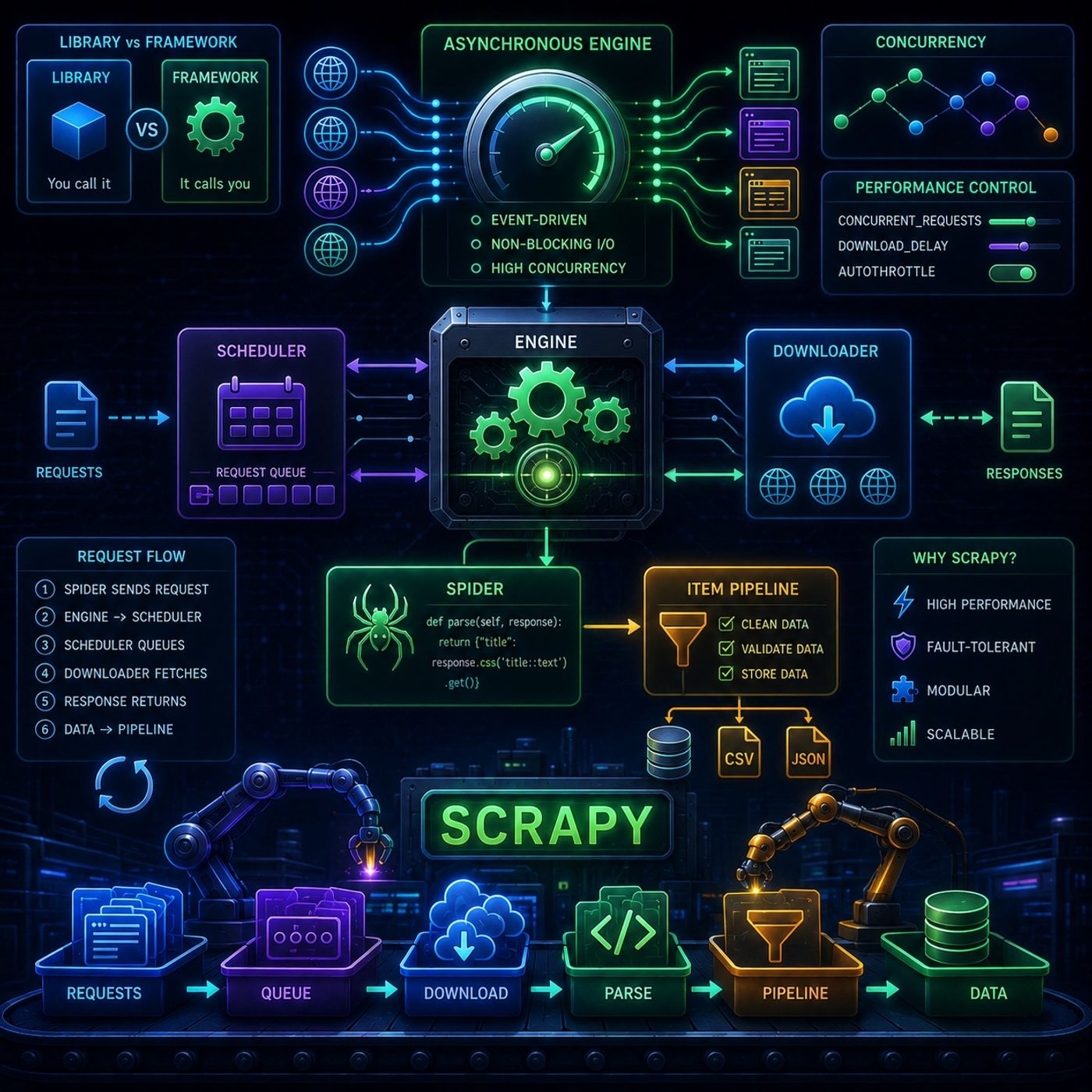
In this lesson, you’ll learn about: what makes Scrapy a framework (not just a library), how its asynchronous engine works, and how its core components cooperate to deliver fast, scalable web scraping1. Library vs Framework (Core Concept)🔹 Who Controls the Flow?🔹 Key Difference
Scrapy is a framework because it controls execution (Inversion of Control)2. Asynchronous Power (Why Scrapy is Fast)🔹 Event-Driven Architecture🔹 What Makes It Powerful
Scrapy doesn’t scrape pages one-by-one—it handles many at once3. Scrapy Architecture (Big Picture)🔹 How Components Interact4. Core Components Explained🔹 1. Engine
Each component has one responsibility → modular & scalable5. Request Flow (Step-by-Step)
Speed without control = getting blocked7. Why Scrapy is Production-Ready
You can listen and download our episodes for free on more than 10 different platforms:
https://linktr.ee/cybercode_academy
- Library → you call it when needed
- Framework → it calls your code
Scrapy is a framework because it controls execution (Inversion of Control)2. Asynchronous Power (Why Scrapy is Fast)🔹 Event-Driven Architecture🔹 What Makes It Powerful
- Uses event-driven networking
- Handles many requests simultaneously
- Doesn’t wait (non-blocking I/O)
Scrapy doesn’t scrape pages one-by-one—it handles many at once3. Scrapy Architecture (Big Picture)🔹 How Components Interact4. Core Components Explained🔹 1. Engine
- Central controller
- Manages request/response flow
- Your custom logic
- Extract data from responses
- Queues requests
- Decides what to crawl next
- Sends HTTP requests
- Retrieves web pages
- Cleans data
- Validates data
- Saves data (DB, CSV, etc.)
Each component has one responsibility → modular & scalable5. Request Flow (Step-by-Step)
- Spider sends request
- Engine forwards to Scheduler
- Scheduler queues it
- Downloader fetches page
- Response returns to Spider
- Data sent to Pipeline
- Limit concurrent requests
- Control request delays
- Enable auto-throttling
Speed without control = getting blocked7. Why Scrapy is Production-Ready
- ⚡ High performance (async)
- 🔄 Fault-tolerant (handles failures)
- 🧱 Modular architecture
- 🎯 Precise data pipelines
- 🏭 Engine → manager
- 🕷 Spider → worker extracting data
- 📦 Scheduler → task queue
- 🌐 Downloader → fetcher
- 🧹 Pipeline → cleaner & packager
- Massive speed via asynchronous processing
- Clean architecture for scaling
- Full control over performance and behavior
You can listen and download our episodes for free on more than 10 different platforms:
https://linktr.ee/cybercode_academy
links1