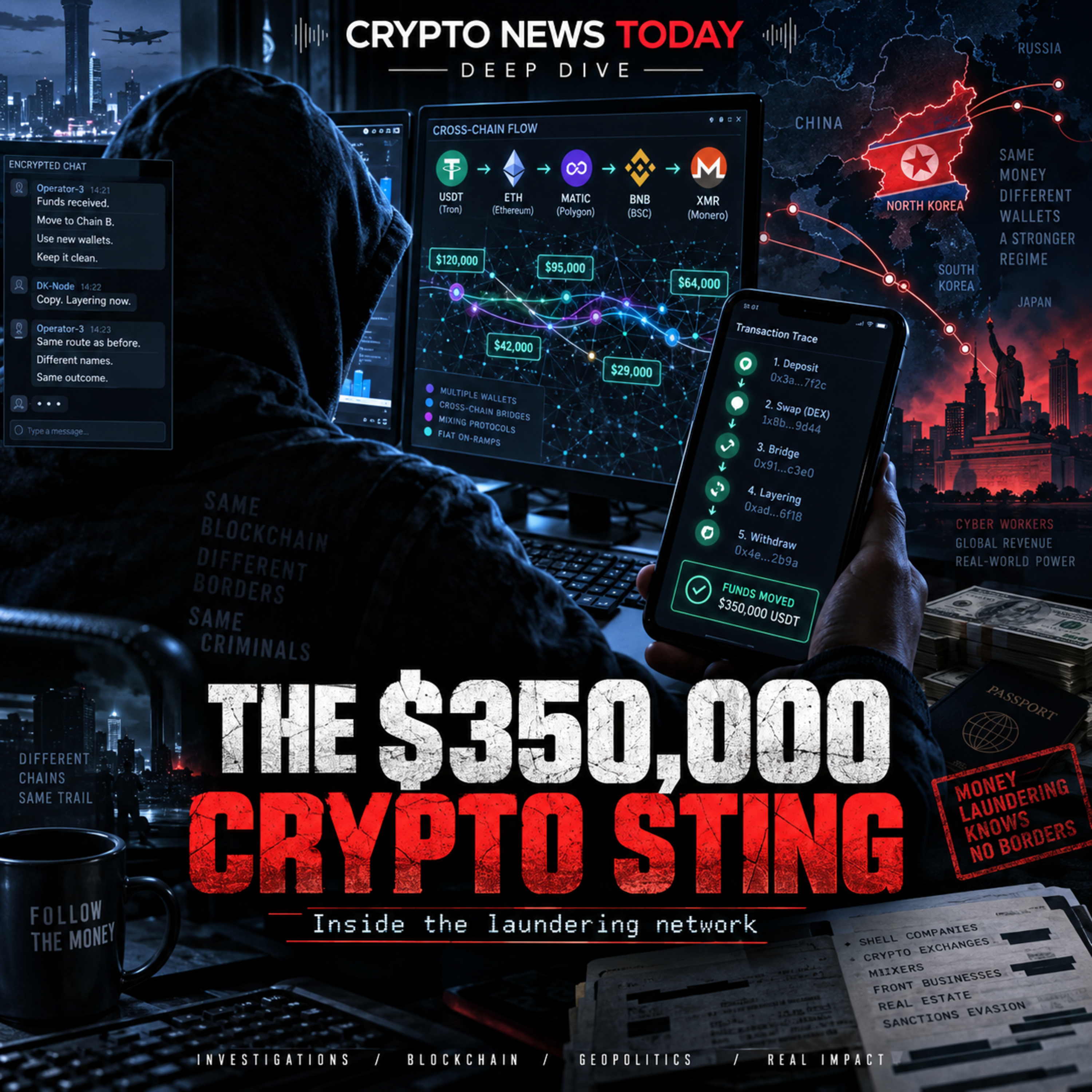
The $350,000 Crypto Sting: How ZachXBT Infiltrated a North Korea-Linked Laundering Network | Daily Crypto Deep Dive
🟣 Kraken: https://kraken.pxf.io/c/6563010/687155/10583 Sign up through our Kraken link and support Crypto News Today. We’re also offering 20 XRP to qualifying new sign-ups. 🔐 Ledger: https://shop.ledger.com/?r=59fe6e05c254 🛡️ NordVPN: https://go.nordvpn.net/aff_c?offer_id=612&aff_id=143753&url_id=14830 🎧 Listen on Spotify: https://open.spotify.com/show/4gu4MrqbGVZeNNNbAuvSmR 🌐 Crypto News Today: https://cryptonewstoday.io 🐦 Follow us on X: https://x.com/cryptonewshq What happens after somebody steals more than a billion dollars in cryptocurrency? In today’s Crypto News Today Deep Dive, we investigate the extraordinary account from blockchain investigator ZachXBT, who says he went undercover as a customer of a Chinese money-laundering network allegedly connected to funds stolen by North Korea’s Lazarus Group. ZachXBT says he put approximately $349,700 in stablecoins through the operation, knowingly accepting losses in order to build trust with an alleged operator known as “Jimmy Green”. What followed reportedly gave him a rare look inside the infrastructure used to move stolen cryptocurrency across wallets, blockchains and OTC networks. We go back to the massive $1.5 billion Bybit hack, which U.S. authorities attributed to North Korean-linked actors, and follow what happens once hundreds of millions of dollars of stolen crypto begins moving across the blockchain. We explain how crypto laundering actually works — from wallet splitting and cross-chain bridges to decentralised exchanges, stablecoins, OTC brokers and the crucial problem criminals eventually face: how do you turn stolen crypto into something you can actually spend? We also look at one of the great contradictions of cryptocurrency crime. Blockchain allows money to move around the world incredibly quickly without relying on traditional banks — but those same public blockchains can leave investigators with a permanent record of where the money travelled. The criminal creates another wallet. Investigators identify it. The funds move to another blockchain. Investigators follow. The assets move into stablecoins. Issuers may freeze them. The money reaches an intermediary. Investigators start trying to identify who is behind it. And according to ZachXBT, this investigation eventually went beyond simply following transactions. He says people inside the alleged laundering network began discussing movements of North Korean-linked funds before those movements appeared publicly on-chain. That turns this from a blockchain investigation into something resembling a genuine undercover operation. We break down: • How ZachXBT says he infiltrated the alleged laundering network • Why he was willing to risk nearly $350,000 in stablecoin transactions • The connection to the $1.5 billion Bybit hack • How stolen crypto is moved between different blockchains • Why OTC brokers can be crucial to laundering operations • How stablecoin issuers can freeze suspected criminal funds • Why North Korean cybercrime has become a major geopolitical issue • And why stealing $1 billion of crypto may actually be easier than successfully spending it This is not simply another story about somebody hacking a cryptocurrency exchange.