
Skip to content
Artwork for Crossing the Valley
TechnologyGovernment

Crossing the Valley

Frontdoor Defense

Few companies make it from pilot to production in the defense market. Those who do often change the industry in the process. How do they do it? What lessons can startups take from their trials, successes, and failures? Crossing the Valley tells the stories of the trailblazers who are forging a new path for America's defense.

www.valleycrossers.com
Play
  • 22 episodes
  • weekly
  • Avg 44 min
  • English
Counted on this page — what you have heard stays on this device, so it is not something the list can be paged by.
  • #94
    September 16 · 49 min

    Ep. 94: A Replicator Retrospective

    Building Replicator: What it Took, and What it Meant Nobody in Washington gets promoted for grading their own homework in public. Dr. Kathleen Hicks and Aaron Sherman did it anyway. Three years after Replicator launched, they sat down and wrote an insiders’ history of the initiative. It’s called Move Fast and Scale, published by the Belfer Center, and it landed just at a moment when it seems that the whole building is racing to run some version of the same play (albeit with a lot more money behind it). I’ve been wanting to have this conversation for a while, in part because of my own exposure to successors of Replicator, in the form of the Drone Dominance Program and Project Swarm Forge, two challenge-based acquisition initiatives focused on small, one-way attack drones. So I opened by asking Dr. Hicks for the single most important takeaway she’d pass along to someone trying to replicate Replicator. She didn’t talk authorities, and she didn’t mention contract vehicles. She said: “I think it’s for senior leaders, whatever that means in the particular context, to be as fascinated by the execution as they are by the rollout.” Or put another way, “If your boss is interested in something, you should be fascinated by it.” About Kath Hicks and Aaron Sherman Dr. Kathleen Hicks was the 35th Deputy Secretary of Defense (aka the person who actually ran the Pentagon day to day). Before that, seven years at CSIS, and a PhD from MIT. She has been in and around the Pentagon long enough to have watched this kind of fight go south before. Aaron Sherman was her speechwriter. He was inside the small group that built and launched Replicator, which means he wrote a lot of the words that the building, the Hill, industry and Beijing all read at the same time. That is an unusual seat, and the holder of the pen is also the first author of the policy. About Replicator In late August 2023, the Department of Defense launched what it called a “pathfinder initiative” to rapidly find, acquire and field new technologies. The target was multiple thousands of attritable autonomous systems, across multiple domains. The goal was to get them in warfighters’ hands inside 18 to 24 months. At the moment they announced the initiative, they named no systems. They identified no immediate “on-ramp” for companies. And they didn’t give Congress much of a heads-up. But they got a TON of attention. The first tranche included AeroVironment’s Switchblade 600. Upon leaving DIU, T.S. Allen, the former Director of Replicator-1 said in August 2025, “we were able to deliver…hundreds of drones to war fighters” and “put thousands more on contract.” But one thing both make clear is that drones were never the fully story. Hicks describes Replicator as a pathfinder: the idea was to pick one capability area, drag it through every blocker in the system inside a two-year appropriation cycle, and leave the road wider for everything behind it. Authority to operate. Clearances and SCIF space for new entrants. Cyber hardening for small companies who become PRC targets the day they get named in public. Every one of those blockers had been quietly taxing non-traditional contractors for a decade. The only times they got solved were when a leader couldn’t unlock a program they cared about. Read the Report: https://www.belfercenter.org/research-analysis/move-fast-and-scale-brief-insiders-history-replicator-initiative Follow Crossing the Valley: www.valleycrossers.com Follow Dr. Kath Hicks: https://www.linkedin.com/in/kathleen-h-hicks/ Follow Aaron Sherman: https://www.linkedin.com/in/aaron-sherman-04017817/ Follow Noah Sheinbaum: https://www.linkedin.com/in/noahsheinbaum/ This is a public episode. If you would like to discuss this with other subscribers or get access to bonus episodes, visit www.valleycrossers.com


  • #93
    September 9 · 55 min

    Ep. 93: Building Minimum Useful Products

    How Chariot Defense Replaced Product Market Fit With a Weight Test Adam Warmoth took this interview from Fort Carson. A division commander had called him the Friday before and asked him to be in Colorado on Monday, so he was in Colorado, sitting in a vehicle with a Starlink terminal doing the work of an internet connection. Ross Fubini, who wrote Chariot’s first check, opened by pointing out that this is every call he has ever had with Adam. One guest measuring things in the field, while the other measures the field. Both agreed to be unusually specific about how they make their decisions. About the guests Adam Warmoth is the founder and CEO of Chariot Defense. He started in the Stanford lab of Ilan Kroo, who had just come back to teaching after founding the first electric aircraft company on Larry Page’s money. That led to Kitty Hawk, then to Uber Elevate as one of the early employees, then to Anduril at roughly 200 people, where he built the counter intrusion business unit and then took over counter UAS air defense. Ross Fubini is the founder and managing partner of XYZ Venture Capital. He was first money into Anduril and first money into Apex Space. A very long time ago he introduced Palantir’s first employee to its second. When he started XYZ almost ten years ago, the premise was simply that he should back people coming out of the Palantir ecosystem. He describes that premise as having been correct, “shockingly so.” About the company Chariot Defense builds the power layer for the battlefield. The Amphora systems are modular, high voltage, and low signature, and they charge and run the things that now go forward with a unit: drones, radars, comms, sensors, directed energy. Founded in late 2024 and headquartered in San Francisco, Chariot came out of stealth in July 2025 with an $8M seed led by General Catalyst, and announced a $34M Series A led by Andreessen Horowitz in February 2026. XYZ was in both. Systems have been through JIFX at the Naval Postgraduate School, up to Alaska with the 11th Airborne, out to a National Training Center rotation with the Black Jack Brigade, and onto DIU Project GI. Adam’s framing of the market is that there are three critical infrastructure layers under any robotic modernization story: comms, compute, and power. He thinks Palantir has taken the network layer and Anduril has taken edge compute, and that power is the third slot, and that after those three there are not really any more slots. Chariot Defense: Website | LinkedIn XYZ Venture Capital: https://www.xyz.vc Crossing the Valley: https://www.valleycrossers.com Adam Warmoth: https://www.linkedin.com/in/adamwarmoth/ Ross Fubini: https://www.linkedin.com/in/fubini/ Noah Sheinbaum: https://www.linkedin.com/in/noahsheinbaum/ This is a public episode. If you would like to discuss this with other subscribers or get access to bonus episodes, visit www.valleycrossers.com

  • #92
    August 26 · 39 min

    Ep. 92: Conductor AI is building the layer between Law and Action

    Conductor AI: Building the Layer Between Law and Decision About Zach Long and Eric Schwartz Zachary Long and Eric Schwartz are the co-founders of Conductor AI. Both spent seven years at Palantir, where they met on a Department of Justice project supporting large-scale fraud prosecutions. But this wasn’t “start a company at first sight.” After collaborating, they split: Eric moved toward law enforcement and other USG components, then took what he calls “a bit of a rumspringa” into health tech; Zach went deeper into the Department of Defense. When Zach decided to leave Palantir, the two reconnected. Ben, the third co-founder, knew Zach from college and originated the idea with him; Eric joined shortly after as the first employee and built out the company. The founding insight came from Zach’s own frustration. He wanted to write up a meeting in a Slack channel and was told he could not. He asked why. The internal security team said no, and there was no mechanism to challenge it. “Show me the document,” he said. Nobody could. Multiply that across the defense supply chain and you have put your finger on the systemic over-classification that riddles the national security enterprise. With a bit of good luck (and good timing), the LLM era arrived, and Zach found his solution. About Conductor AI Conductor AI builds software for high-stakes government decision workflows: security classification and declassification, foreign disclosure, export licensure, FOIA, and evidence review on the justice side. The platform ingests complex policy documents and institutional tradecraft, then orchestrates the decision tree a human expert would walk. The goal is for the product to generate more than just an answer; it also shares an underlying policy that supports it, so the reviewer can show the math to a starred superior. Their customers are some of the least glamorous and most under-resourced offices in national security. One person at Nellis Air Force Base handles the entire technical manual transfer review process for the Air Force: 500,000 pages. One GS-13 adjudicates roughly $40 billion in export license approvals a year. These offices ask for more people annually and receive rotational staff who take six months to train and serve twelve months in seat. The company has solid early traction: a direct-to-Phase-II Air Force Open Topic SBIR, deployment on classified networks with multiple releases per week, and two multinational exercises this summer. Those exercises were big wins, as they were able to take reviews that typically take a day down to an hour. Learn more about Conductor AI: conductorai.com Follow Zach: https://www.linkedin.com/in/zachary-long-20a78a21/ Follow Eric: https://www.linkedin.com/in/epschwartz/Follow Noah: For more Crossing the Valley: www.ValleyCrossers.com This is a public episode. If you would like to discuss this with other subscribers or get access to bonus episodes, visit www.valleycrossers.com

  • #91
    August 19 · 51 min

    Ep. 91 - John Conafay, CEO of Integrate

    Overview They were four people. They had ~$150,000 in the bank. And John Conafay wrote a check to an accreditation partner. That check was easily a double-digit percentage of the company’s value at that moment. And he risked it all on the conviction that a Space Force contract was going to land. Well, this is Crossing the Valley, so you already know that it did. Three years later that relationship became a $25 million, five year SBIR Phase III with Space Systems Command. We’ve covered a lot of acquisition orthodoxy these last few years on CTV. This conversation was fun because of how John went a different path, and bucked convention. He spent money he didn’t have. He started the transition conversation before he’d delivered value. He hired strangers to knock on doors for him. And he pitched the hardest version of his product first. Here’s a bit more from my awesome conversation with John Conafay. About John John is a US Air Force veteran and the founder and CEO of Integrate. He enlisted after a failed run at a metal and hardcore record label he started in high school, and spent his service in COMNAV fixing AWACS on the flight line in Alaska. He calls it “a swift swift kick” that he needed. Those early days on the flight lane have paid dividends to this day, by helping the “business guy” hold his own in engineering conversations. After leaving the Air Force John studied economics at Arizona State, where he took over the national chapter of Students for the Exploration and Development of Space (SEDS). It was during this time that he ran a coordinated campaign to win a donation from one particular individual: Mr. Jeff Bezos, himself a former SEDS chapter president. John and team had no idea they’d succeeded until Bezos folded up his $250,000 Heinlein Prize check and announced that it should go to SEDS instead. His career spanned a variety of startups, including joining BryceTech, becoming employee number eight (roughly) at Astranis, Director of Business Development at Spaceflight, and Head of Business Development at ABL Space Systems. And he did all this before founding Integrate. About Integrate Integrate builds multiplayer program management software for organizations that build complex hardware. Founded in early 2022 and based in Seattle, the company sells what John describes as “a schedule that many organizations can share, without seeing each other’s private data.” John describes the status quo they’re up against as “Microsoft Project,” a piece of software that shipped in 1984. The company won a $1.25 million SBIR Phase II with the Space Systems Command Mission Manifest Office in 2023, then a $25 million five year Phase III in June 2025. It reached IL6 accreditation and deployed into a classified environment in under twelve months. For More: * Integrate: integrate.co * John Conafay on LinkedIn: linkedin.com/in/conafay This is a public episode. If you would like to discuss this with other subscribers or get access to bonus episodes, visit www.valleycrossers.com
  • #90
    August 12 · 56 min

    Ep. 90: Friends Don't Let Friends Start Drone Companies

    Josh Giegel has spent his career on what he calls “the wrong side” of the software-hardware divide. He built rocket engines at SpaceX. He built supercritical CO2 power cycles in Ohio. He built a hyperloop and then climbed inside it. So when he tells you not to build hardware, it should mean something. Josh started Gambit in 2023, in the middle of the drone gold rush, and deliberately did not build a drone. Set against the backdrop of the drone “gold rush,” that fundamental decision has shaped the company he’s built, and the impact they’re having just a few years into the journey. About Josh Josh grew up in Pittsburgh, the son of a nuclear reactor engineer and an electrical engineer. His sister is an engineer. His wife is an engineer. His brother-in-law is an engineer. Suffice to say, the dude has forever been surrounded by tech nerds. His formative moment came at twelve, in the garage, watching his dad fix the car. Josh assumed his father was the smartest man alive who knew everything. But his dad corrected him that day: he actually did not know how to fix the car. But he knew how to solve the problem. Josh went to Penn State, then Stanford for grad school, and interned at NASA Glenn at 21, which he describes as “underwhelming compared to the movies.” A colleague pointed him toward a small space company in Los Angeles, so he found himself interviewing with an up-and-coming entrepreneur named Elon Musk in the window between Falcon 1’s third and fourth flights, before SpaceX had ever reached orbit. Musk described building a reusable rocket engine rated for a hundred flights. Josh asked why anyone would want that. The answer was that they were going to land the rocket. Josh went on to become one of about five engineers who built the Merlin 1D. It sits in the Smithsonian now. He left when SpaceX had grown from 400 people to 2,500 (still the largest company he ever worked for), because he could tell the founding-level experience was no longer available there. Then came Virgin Hyperloop, where he served as CTO and later CEO across roughly seven years. Six years after starting, he sat inside the vehicle his team had built and put his own life on the line. About Gambit Gambit builds a platform-agnostic software layer that lets one operator orchestrate many autonomous systems across air, ground, and sea. The thesis is that robots are commoditizing, platforms are proliferating, and no single manufacturer is going to rule them all. The constraint becomes less about machine availability and more about the people to run them. Gambit thinks about their product as an entire robot workforce rather than a “better robot.” Each entity is a specialist that works together toward a cohesive whole, much the same way a soccer team has forwards and a goalie, or a band has a guitarist and a lead singer. The product architecture reflects the thesis: roughly ten software containers, from behavior building to composition to runtime interfaces, that can be split apart and sold in pieces. Behaviors are solved by platform class rather than by manufacturer, so a quadcopter class or a fixed wing class covers many vendors with a parameter file rather than a bespoke integration. The company exited stealth in January 2026 with partnerships including AWS, L3Harris, RTX, and Sierra Nevada. Since then it has announced two multi-million dollar Air Force contracts, an Army GVSC OTA for counter-UAS simulation, a red force as a service partnership with the Pendleton UAS Range, and integrations with ModalAI and Psionic. For more on Gambit: https://www.gambit.us For more Crossing the Valley: https://www.youtube.com/@crossingthevalley Follow Josh Giegel: https://www.linkedin.com/in/josh-giegel/ Follow Noah: https://www.linkedin.com/in/noahsheinbaum/ This is a public episode. If you would like to discuss this with other subscribers or get access to bonus episodes, visit www.valleycrossers.com

  • #89
    August 5 · 41 min

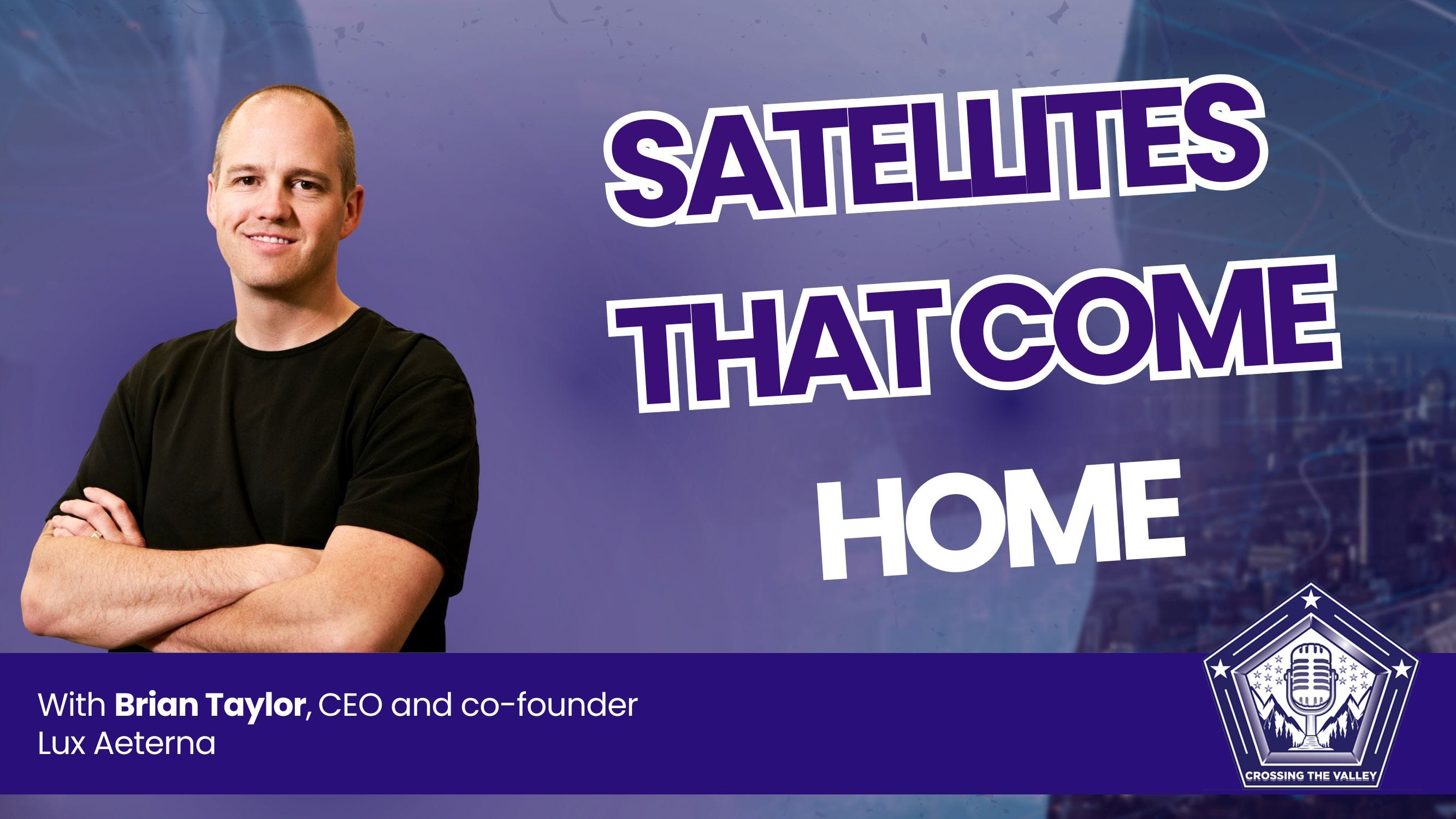
    Ep. 89: Lux Aeterna

    How Lux Aeterna Is Building a Market the Pentagon Didn’t Ask For About Brian Brian Taylor spent about fifteen years as a mechanical engineer before he ever sat in the founder’s chair. He came up through aviation and aerospace, then landed at SpaceX, where he did development, qualification, and testing on Starlink satellites, including the structural qualification of the first stack of 60. From there it was Amazon’s Project Kuiper for high rate satellite production, then Loft Orbital. But despite this tour d’force through a who’s who of space companies, by his own admission, Brian was never a space nerd. It really bugged him that you would work that hard on something, and unless you happen to be an astronaut, you would never see the hardware again. You do not get to iterate on it. You do not get to enjoy the fruits of your labor. An engineer who wants his hardware back. That frustration became a company. About Lux Aeterna Lux Aeterna builds fully reusable satellites. While there’s been lots of attention heaped on the rockets, Brian and Lux are focused on the satellite itself. The goal is to fly the mission, survive re-entry, land intact, refurbish it, put a new payload on it, and send it back up. Brian founded the company in Denver in August 2024. It came out of stealth in June 2025 with a $4 million pre-seed led by Space Capital, and closed a $10 million oversubscribed seed led by Konvoy in March 2026, bringing the total to $14 million. The company’s first vehicle is called Delphi. It is roughly 200 kilograms, built around a rigid conical heat shield that doubles as the satellite’s primary structure, with a parachute assisted return. It will fly on a SpaceX Transporter rideshare in Q1 2027, with recovery at the Koonibba Test Range in South Australia through a partnership with Southern Launch. The company holds a Space Act Agreement with NASA Ames and two CRADAs supporting the re-entry and thermal protection work, and has stood up a Defense Advisory Board. The entire payload capacity for that first mission is already sold out, across civil, defense, and commercial customers, hardware and software, small companies and large. Also worth noting for the culture watchers: he did this interview from inside a sauna. An actual, off the shelf sauna, sitting on the production floor, because it was cheaper than the fancy sound-proof pods that Google puts all over its offices. The idiot index on that thing has to be excellent. For more on Lux Aeterna: https://www.luxaeterna.com/ Follow Brian: https://www.linkedin.com/in/brianjtaylor/ For more Crossing the Valley: www.valleycrossers.com Follow Noah: https://www.linkedin.com/in/noahsheinbaum/ This is a public episode. If you would like to discuss this with other subscribers or get access to bonus episodes, visit www.valleycrossers.com
  • #88
    July 15 · 46 min

    Ep. 88 - Method Security

    Background Cyber operations have always lived in the shadows of the national security conversation. In the wake of the Department of War suspending CMMC Level 2 guidance, this episode unpacks the essential, high-stakes, and rarely understood world of cyber security, as Sam Jones, CEO and co-founder of Method Security, joins Noah to talk about building autonomous offensive and defensive cyber capability for the U.S. government and the country’s most critical enterprises. We go deep on why the “post-Mythos” moment has changed the calculus for every CISO in America. About Sam Sam Jones is the CEO and co-founder of Method Security. His path into cyber started early: an internship at GDIT the summer after high school introduced him to network penetration testing and defensive systems work, and a SMART scholarship later routed him into Air Force Cyber in San Antonio as a civilian operator, where he progressed from a GS-7 to a GS-11 …in just one year. He left convinced the government's real problem wasn't talent acquisition but talent retention. ("It's nice to have these short tour duties to get people in, but you want to create the criteria to keep people around.") Sam had wanted to work at Palantir since he was 18, after stumbling on early Gotham demos on YouTube. Rejected from his first internship application in 2010, he came back and joined after leaving government in 2014, spending five years there building cyber products and meeting his two future co-founders, Sean and Dan. After Palantir, Sam joined Shield AI as roughly its 25th employee, working on autonomy for robots operating in real-world, no-fail missions. This experience planted the seed for Method’s core idea: applying that same flavor of self-directed autonomy to cybersecurity. That idea sat dormant, passed back and forth between Sam and his future co-founders for years, until GPT-4 arrived in 2023 and gave them the technical ingredient they’d been missing. Within six hours of Sam raising the idea, both co-founders were in, and the three quickly quit their jobs to found Method Security. About Method Security Method Security builds autonomous cyber systems for the U.S. government and critical enterprises, applying autonomy to a blend of offensive and defensive missions, from red teaming to vulnerability research and penetration testing. The company’s core bet is that organizations need to move faster than adversaries without sacrificing trust, governance, or control, and that this capability needs to be operator-owned and enterprise-governed. The unifying question: how do you secure systems faster, in-house, to outpace adversaries, while keeping the human operator in command? Founded in September 2023 by three Palantir alumni, Method quickly closed a seed round with Andreessen Horowitz within about a week of pitching. Rather than immediately going to market, they went heads-down for roughly six months focusing entirely on building the product they knew they needed. When they finally came up for air, they quickly landing their first Fortune 500 design partner (around nine months in), and their first federal contract soon followed, in the form of a direct-to-Phase-II SBIR with the Space Force (around eleven months in). Deliberately, Method has never split its team into separate commercial and federal go-to-market functions — Sam describes it as intentionally absorbing the “pain” from both markets into one product organization so that tension shapes the platform from the ground up. Today, Method serves both government and Fortune 500 customers, with a particular focus on institutions that have the most to lose. Top 5 Takeaways * People are more important than the idea. Method’s founding team spent nearly five years trading startup ideas back and forth in shared Notion docs before landing on the one that stuck. The team and the working relationship mattered more than any single idea. Early stage investors are quick to highly cofounder pairings as a key determinant of success or failure, and Method’s team had de-risked their relationship through years of collaboration at Palantir and beyond. * One team, two markets. It is rather unusual to see a single team tackle both sides of “dual use” simultaneously, without hiring differently. Cybersecurity is likely one of the few markets in which such an approach could succeed. Method intentionally runs a single product team that feels pressure from both markets simultaneously. Sam compares it to the strongman “Hercules Hold” — enduring the pain of both sides at once and translating it directly into product. * Heads-down beats over-iterating. After closing their seed round, the founders deliberately limited outside feedback and focused on building conviction around what the market needed, rather than chasing every piece of user input. Too much feedback, too early, can pull a founding team away from the thing they were actually built to build. * The “post-Mythos” moment reshaped the market. As frontier-class AI models become available to adversaries, boards are now directly asking their CISOs what their response plan is. That question has become one of Method’s most effective go-to-market unlocks. At the same time, Sam is wary of blanket regulation of large language models themselves, arguing the real risk lies in how models get wielded by software platforms, not in the models alone, and that overregulating relative to unregulated open-weight alternatives could put U.S. companies at a disadvantage. * A correct prediction is worth more than a fast pivot.It’s worth reiterating that Method didn't iterate its way to product-market fit. The co-founders deeply studied the market for a decade, formed strong opinions, and stayed heads-down through a dark first year while outside voices pushed different directions. When the moment came, Method was an obvious answer with a deep, already-published technical answer. That kind of conviction is a massive unlock. For more on Method Security: www.method.security For more on Crossing the Valley: www.valleycrossers.com Follow Sam: LinkedIn | X Follow Noah: LinkedIn | X Crossing the Valley is a podcast on technology, defense, and national security. Watch the full conversation with Sam Jones on YouTube, and find Method Security’s careers page if you’re interested in joining their mission. This is a public episode. If you would like to discuss this with other subscribers or get access to bonus episodes, visit www.valleycrossers.com

  • #87
    July 8 · 53 min

    Ep. 87 - How Turion Space is Turning a Trillion-Dollar Vision Into a Fundable Company

    About Ryan Westerdahl Before starting Turion, Ryan spent nine years as an engineer at SpaceX, joining not long after the company’s sixth flight and working under Kevin Wu — an engineering leader Ryan credits as one of the best of his generation (now leads engineering at Relativity Space). Ryan’s interest in space dates back to 2002, when he first saw an NPR segment about the discovery of exoplanets that set him on his life mission. About Turion Space Turion Space is a space technology company built around a long-term vision: extracting economic value from space beyond satellite communications — ultimately, asteroid mining. Rather than raising all of the (massive) capital that vision would require up front, Turion is executing what it calls the “Starforge” strategy: decomposing that future architecture into discrete, scalable business portfolios — tactical space, space logistics, geospatial/ISR, and an underlying mission software and ground-operations stack (branded Starfire OS) — each capable of generating revenue and proving technology on its own timeline. Turion went through Y Combinator after months of rejection from accelerators and VCs unfamiliar with space’s capital requirements. Since then, the company has closed an oversubscribed $85M Series B, secured a STRATFI, and won a position on Space Systems Command’s RG-XX IDIQ — a program for next-generation proliferated surveillance and reconnaissance in geosynchronous orbit. For more Turion Space: https://www.turionspace.com/ For more Crossing the Valley: LinkedIn | YouTube Follow Ryan: https://www.linkedin.com/in/rwesterdahl/ Follow Noah: X | LinkedIn This is a public episode. If you would like to discuss this with other subscribers or get access to bonus episodes, visit www.valleycrossers.com
  • #86
    July 1 · 48 min

    Ep. 86: In the Whitespace

    About Jackie Barbieri Jackie is the founder and CEO of Whitespace. She began her career supporting the counter-IED mission during the surge in Iraq, working as a red-team analyst. She was a threat emulator who studied the tactics, ideology, and bomb-making techniques of adversary networks, often in Arabic on the dark web, then fused that with classified collection. That experience, and witnessing what timely intelligence does for operators downrange, became the through-line of everything she’s built since. Jackie returned to grad school to study what changed after 9/11, and got pulled into an R&D community around Activity-Based Intelligence (ABI) — a methodology that made trained analysts roughly 300x more effective. Notably, Jackie has a liberal arts background, not an engineering one. And, fun fact: she founded Whitespace in 2014 when her first child was six months old (there’s something about young parents as founders…) About Whitespace Founded in 2014 and headquartered in Alexandria, VA, Whitespace builds sensemaking AI for defense and intelligence. The company bootstrapped for roughly a decade, funding technology development through consulting revenue, before raising a small seed round in 2025 (~$3.2M per public reporting) backed by family offices and a few VCs. Its early IP, Worldline, is a simulation engine that creates a digital twin of a city-sized population observed by a synthetic sensor architecture, to generate realistic, multi-sensor training data. That capability won Whitespace its first prime contract with the National Geospatial-Intelligence Agency (NGA) in 2017 to build the ABI curriculum for the entire intelligence community, which the company then instructed for nearly eight years. The flagship product today is Iris: an agentic AI “analyst” that lets operators self-serve pattern-of-life intelligence in natural language. Under the hood, Iris is built on ABI tradecraft translated into a toolkit of deterministic algorithms, wrapped in an agentic system carrying the persona and judgment of experienced analysts. Iris can run standalone, alongside human SMEs, or headless via API — and is designed for a future where her biggest user group may be other agents and autonomous platforms, not people. Notably, by the time the company raised venture capital, it had flipped from ~80% services / 20% product to ~80% product / 20% services, 4X’d ARR, doubled revenue, and roughly doubled headcount. For more on Whitespace: inthewhitespace.com Follow Jackie: https://www.linkedin.com/in/jackie-barbieri/ For more Crossing the Valley: valleycrossers.com | youtube.com/@CrossingTheValley Follow Noah: https://www.linkedin.com/in/noahsheinbaum/ This is a public episode. If you would like to discuss this with other subscribers or get access to bonus episodes, visit www.valleycrossers.com
  • #85
    June 24 · 41 min

    Ep. 85 - Building a first check partnership

    About Phil Duong Phil Duong is the CEO and co-founder of Noda AI. The son of Vietnamese immigrants who arrived in the U.S. with little money and speaking little English, he grew up in a family of service members who had fought for their freedom. His heritage left him with a deep sense of patriotism and a drive, as he puts it, to repay the country “multiple lives’ worth.” He won a spot at West Point but walked away from it when a childhood medical issue blocked him from branching aviation, calling the Marine Corps instead because they needed pilots and were willing to give him a shot. After leaving active duty, he built a career at enterprise-AI company C3, rising to general manager of its federal practice before leaving to start Noda. He frames himself first and foremost as “a Marine and patriot,” a self-description that shapes how he runs the company and what he’s willing to say in public. About Paige Craig Paige Craig is the founder and general partner of Outlander VC. Growing up homeless, and raised in what he describes as a violent world, he was named for a grandfather who rose from enlisted soldier to an officer under General Patton. Paige was recruited to West Point — where he claims the distinction of being the most-punished cadet in his class — and left in his third year, recognizing he was “the wrong guy” for the institution’s barracks mentality. He moved on to the Marine Corps and the intelligence community, and in 2003 built a private military company operating at and beyond the forward edge in Syria, Afghanistan, and Africa, which he sold. As an investor, his entire lens is the founder and the mission, evaluated against a proprietary 38-point framework built around vision, intelligence, character, and execution. About Noda AI Noda AI is a startup building the orchestration and decision layer for autonomous warfare. Rather than building drones or vehicles, Noda aims to overlay government-designed tactics and strategy onto the autonomous platforms other companies are building. Their software seeks to re-create what a strike cell or operations center does today, fast enough to run in real time as robots take over more of the battlefield. The idea is that battle plays for defeating advanced threats need to be baked into deployable algorithms in advance, ready to push down to autonomous boats, planes, and submersibles the moment competition turns to conflict. The company started as a five-person team that prototyped for roughly a year unpaid, and is now working across what Phil will only describe as “very topical” combatant commands. Find them at NodaIntelligence.ai. About Outlander VC Outlander VC is an early-stage venture firm focused on writing first checks into exceptional, often low-signal founders others haven’t yet recognized. The firm runs a high-volume, high-selectivity funnel. Paige says that over 10,000 founders come in through the top of the funnel each year, with roughly 5,000 passing AI filters to a first call, a few hundred meeting the team in person, and 10 to 12 ultimately receiving funding. Paige keeps more than half his calendar deliberately unscheduled so he can take long walks with founders and go deep on the person rather than the pitch deck. The firm now has seven partners Craig has trained. For more about… * Noda AI: https://www.nodaintelligence.ai/ * Outlander VC: https://outlander.vc/ * Crossing the Valley: www.valleycrossers.com Follow: * Phil Duong: LinkedIn * Paige Craig: X | LinkedIn * Noah Sheinbaum: X | LinkedIn This is a public episode. If you would like to discuss this with other subscribers or get access to bonus episodes, visit www.valleycrossers.com
  • #84
    June 17 · 45 min

    Ep. 84 - Cape

    When it comes to the defense tech sales G.O.A.T. debate, John Doyle is one of the most oft-mentioned names in the business. From his days at Palantir, to his robust advisory portfolio, John is both successful and generous. His appearance on Crossing the Valley has been a long time coming! This week, John joined us to talk about Cape — a privacy-first cellular carrier he started in 2022 after a decade at Palantir and a tour as a Green Beret communications leader. The simple version of the story is “ex-Palantir guy builds secure phone company.” The truth, of course, is a whole lot more interesting. For more on… Cape: https://www.cape.co/ John Doyle: https://www.linkedin.com/in/john-doyle-48633227/ Crossing the Valley: LinkedIn | YouTube Noah Sheinbaum: LinkedIn | X This is a public episode. If you would like to discuss this with other subscribers or get access to bonus episodes, visit www.valleycrossers.com
  • #83
    June 3 · 47 min

    Ep. 83 - Nominal

    How Nominal Turned the Pentagon’s Slowest Gate Into a Growth Engine Featuring Cameron McCord, CEO and co-founder of Nominal About Cameron Cameron McCord has seen the defense ecosystem from more seats than most. He started his career as a young submarine officer, operating, in his words, with “the best of 1980s technology” and learning what it feels like to be beholden to antiquated tech when the mission is on the line. He carried that frustration into operating roles at Anduril and Saildrone, where he watched fast-growing hardware companies scale and saw the same testing problem appear at every one of them. Then he went to Lux Capital, where he saw the same pain across a thousand more companies and turned a hunch into a thesis. Today, that thesis is a company called Nominal, one of the fastest growing, well-capitalized, and highly touted defense tech companies in the industry. About Nominal Nominal is a software and data platform for hardware testing operations. The hardware test market is a bit anathema for us non-technical folks. But the reality is, anyone who builds anything in the real world, whether for a commercial market or the warfighter, has to test and validate it. Until recently, that was mostly done via spreadsheets, MATLAB scripts, and hard-to-reach data. Nominal took many of the processes that befuddle founders and seasoned executives alike, and automated them. The company was incubated at Lux Capital. They intended to serve both commercial and defense customers from day one. And they’ve been on a tear, recently announcing a sole-source $53 million IDIQ for the Air Force Test Center. Today, Nominal is active in the Navy at Pax River, developed partnerships with MIT, and has some exciting news with DARPA. After speaking time with Cam, I left convinced that Nominal really is going after the single biggest (remaining) roadblock to meaningful acquisition reform. If we don’t solve test, we cannot meaningfully shrink the divide between cool ideas in R&D and capabilities that are validated and safe to deploy. If we’re entering a tech boom cycle (and if you’re even a slightly AI-pilled reader, it’s not hard to imagine that we are), then the need to quantify risk, readiness, and the value of a test (especially one you can skip) becomes a whole lot clearer. Cameron’s whole approach is a bet that the way across the valley of death is not to test less or test faster in a vacuum, but to finally be able to prove, with data, exactly how much testing is enough. For more on Nominal: LinkedIn | Website | X For more Crossing the Valley: valleycrossers.com | YouTube Follow Cam: LinkedIn | X Follow Noah: LinkedIn | X This is a public episode. If you would like to discuss this with other subscribers or get access to bonus episodes, visit www.valleycrossers.com
  • #82
    May 27 · 47 min

    Ep. 82 - Machina Labs

    How Machina Labs Compressed 4-Year Lead Times Into 1 Week About Ed Mehr Ed Mehr is the CEO and co-founder of Machina Labs. A builder since childhood (he attended a school that emphasized welding, carpentry, and craft) Ed started his career in software before crossing over into hardware as an early engineer at SpaceX in the early 2010s. The cultural shock of moving from “ship a prototype in days” software to “wait months for a single iteration” hardware became the founding wound that drove him toward agile manufacturing. After SpaceX, he joined Relativity Space to work on 3D-printed launch vehicles, then founded Machina Labs to build the missing infrastructure he believed was the real bottleneck to America’s next industrial age: a general-purpose manufacturing platform that didn’t require part-specific tooling or CapEx. He’s a self-described capitalist and car guy, and prints small batches of his own shirts when an idea strikes him. Kinda badass. About Machina Labs Machina Labs is building “RoboCraftsman.” These are autonomous robotic cells that form sheet metal parts the way a potter shapes clay. Two robots come at a flat sheet of metal from either side and progressively deform it into complex 3D geometries, eliminating the need for the dies, molds, and multi-story stamping presses that have defined sheet metal manufacturing for a century. The company serves a dual-use customer base spanning commercial (Toyota is both a major customer and an investor) and defense (Air Force depots, missile primes, NASA). Machina has already deployed production cells at Air Force depots, where they’re making C-130 panels and other legacy aircraft parts that previously required hunting down donor airframes in junkyards or waiting four years for new tooling. The company is roughly 70–80 people, hiring aggressively, and approaching the end of qualification testing with parts on track to fly soon. Machina is now entering its scale phase, and Ed teases that a missile-program prime announcement is imminent… For more on Machina: * Careers: machinalabs.ai/careers * Follow Ed: X | LinkedIn For more Crossing the Valley: * Follow Noah: https://www.linkedin.com/in/noahsheinbaum/ * Substack: valleycrossers.com * YouTube: https://youtu.be/_WN-GJaCbGs This is a public episode. If you would like to discuss this with other subscribers or get access to bonus episodes, visit www.valleycrossers.com
  • #78
    May 13 · 25 min

    Ep. 81 - Revolutionizing Thermal Imaging with Obsidian Sensors

    Rebuilding America’s Thermal Imaging Supply Chain About John Hong and Tallis Chang John Hong is CEO and Tallis Chang is COO of Obsidian Sensors. The two have worked together for over 40 years, with backgrounds in aerospace before joining Qualcomm. At Qualcomm, they were part of the team that spent nearly a decade developing low-power displays using MEMS (Micro Electro Mechanical Systems) built on glass substrates. When Qualcomm decided the program no longer fit its core business, John and Tallis were given the runway to find a new application for the manufacturing know-how they had built. That pivot became Obsidian Sensors. About Obsidian Sensors Obsidian Sensors, headquartered in San Diego, manufactures microbolometers — the core sensor inside thermal imaging cameras — using a fundamentally different platform than the rest of the industry. Where incumbents builds them on silicon wafers, Obsidian builds these sensors on display glass, leveraging LCD fabrication infrastructure in Japan and Taiwan that already produces millions of phone and watch displays. This shift dramatically reduced unit cost while preserving sensor performance. The company spun out of Qualcomm in 2017 with seed capital, transferred equipment, seven team members, and five patent applications. It initially targeted the automotive market before pivoting to defense after receiving a DIU OTA at the start of COVID. Today, Obsidian is a critical supplier of thermal cameras to the US drone ecosystem, with production scaling from 5,000 units in 2025 to a planned 1 million units per year by the end of 2026 at its Top Gun Street facility in San Diego. A Phase 2 facility targeting 10–20 million units annually is planned for 2028. Follow John: https://www.linkedin.com/in/john-h-973b372/ Follow Tallis: https://www.linkedin.com/in/tallischang/ Learn more about Obsidian: https://www.obsidiansensors.com/ Follow Noah: https://www.linkedin.com/in/noahsheinbaum/ Follow Crossing the Valley: YouTube | LinkedIn This is a public episode. If you would like to discuss this with other subscribers or get access to bonus episodes, visit www.valleycrossers.com
  • #80
    May 6 · 43 min

    Ep. 80 - Persistent Systems (very first podcast!)

    About Brian Spurlock Brian Spurlock is VP of Growth and Strategy at Persistent Systems, and a self-described “boomerang” employee, meaning he’s had two separate tenures at the company. He came up as a Special Operations acquisitions officer at Fort Bragg, which means he’s seen the Persistent Systems story from both sides: as the government buyer evaluating the technology and as the company executive selling it. He left for a stint at AWS, returned, and is now the one figuring out how to bring tactical mesh networking from Special Operations into Army divisions. He is based in the Fort Bragg / Pinehurst area of North Carolina. About Persistent Systems Persistent Systems builds tactical mesh networking hardware and software: specifically, the Wave Relay and Cloud Relay systems, delivered on hardware called the MPU (currently MPU5, with MPU6 in development). The idea is simple and hard: create a mobile RF network that moves with operators, passes real data at real speeds, and requires zero thought from the person holding the radio. Founded in 2007 by two Johns Hopkins PhDs — Herb Rubens and Dave Holmer — the company has never taken outside capital. It manufactures in Manhattan. It has customers across U.S. Special Operations, conventional Army (currently scaling into division-level exercises with 4th Infantry Division), the Air Force, NATO allies, and public safety. It is on the verge of Army program-of-record status after nearly 20 years. Follow Brian: https://www.linkedin.com/in/spurs/ For more Persistent Systems: https://persistentsystems.com/ For more Crossing the Valley: * LinkedIn: https://www.linkedin.com/company/crossing-the-valley/ * YouTube: https://www.youtube.com/@crossingthevalley This is a public episode. If you would like to discuss this with other subscribers or get access to bonus episodes, visit www.valleycrossers.com

  • #79
    April 29 · 38 min

    Ep. 79 - Inside GrayMatter Robotics

    Building the Physical AI Platform for the Industrial Base ABOUT ARIYAN KABIR Ariyan Kabir is the co-founder and CEO of GrayMatter Robotics. He started the company in early 2020 alongside two co-founders, building on PhD research conducted at USC’s Center for Advanced Manufacturing, where he and one co-founder studied the intersection of robotics and AI. The third co-founder, chief scientist Satyandra K. Gupta, has spent more than 35 years working at the intersection of AI, robotics, and manufacturing and sits on multiple national boards. Ariyan’s framing of the problem is shaped by a realization that came from the academic environment: that manufacturing (long assumed to be “solved”) is in fact one of the largest unaddressed application areas for modern AI. The US is currently short half a million skilled manufacturing workers, a gap projected to reach four million in seven years and put $2 trillion of annual GDP at risk. ABOUT GRAYMATTER ROBOTICS GrayMatter Robotics builds the autonomy layer for high-mix, high-variability manufacturing, the roughly 90% of factory work that cannot be addressed by traditional pre-programmed robotics. The company’s robots perform tool-manipulation tasks: sanding, grinding, polishing, buffing, coating, blasting, and inspection. Underneath the robots sits the company’s real differentiator: a foundation model for materials and processes, trained on what Ariyan describes as the largest manufacturing process dataset in the world: 7 petabytes of multimodal sensor data spanning 14–18 modalities per cell. The business is now six years old. This interview was recorded at the company’s 100,000 sq ft Physical AI Experience Center in Carson, California, which is the company’s fifth facility. Today, GrayMatter’s customers include Boeing, Raytheon, Oshkosh, Caterpillar, Riddell, the US Navy, the US Air Force, and Huntington Ingalls Industries, where GrayMatter is a partner on the HYPR (High Yield Production Robotics) program designing the next-generation American shipyard. The company sells outcomes, not hardware. Robots are deployed on a subscription basis with multi-year commitments, and performance compounds quarterly through software updates, recipe upgrades, and hardware refreshes. KEY TAKEAWAYS 1. Sequence the market. Commercial first, defense second. GrayMatter spent its first three-plus years building almost entirely in the commercial world, despite the obvious dual-use relevance of factory automation. Their reasoning was that defense customers tolerate zero failure, and an unproven autonomy stack cannot debug itself inside an aircraft program. By the time the company turned toward national security work, they had already validated the technology, the business model, and the deployment muscle. 2. The business model can be the product. Performance Composites — GrayMatter’s first customer — had been searching for a robotic sanding solution for five years before the conversation with GrayMatter. IT wasn’t so much a capability they were missing as it was a different risk appetite: manufacturers cannot tie up millions of dollars in Capex on unproven technology. GrayMatter’s response was to invert the deal entirely: zero upfront cost, deployment first, subscription payments only after the system was producing value in production. In exchange, the customer committed to a multi-year contract. The structure became the wedge that opened the entire Fortune 100. 3. Adoption became the geostrategic moat. Asked how 7 petabytes of US manufacturing data compares to South Korea or Shenzhen, Ariyan reframed the question. The race isn’t about dataset size. The US ranks near the bottom of the top 10 in robot-to-worker adoption ratios; South Korea is #1 and China is climbing fast. Tonnage-wise, China has built more ships in the last 12 months than the US has built since WWII. This reframing has direct strategic implications: a defense industrial base strategy that focuses on technology sovereignty without obsessing over diffusion velocity will lose to one that does the opposite. 4. GrayMatter builds AI into every layer. GrayMatter identifies eight distinct layers of engineering work that sit between a customer problem and a delivered outcome: industrial engineering, solution engineering, process recipe engineering, cell design, tool/fixture design, implementation, sustainment, and digital-twin operations. Most robotics companies put AI in one layer: the robot. This means the other seven can become bottlenecks. But GrayMatter is now deploying domain agents at every layer, coordinated by an orchestration layer the company calls Factory Super Intelligence (FSI). The focus on under-appreciated elements of the solution set has helped them differentiate. 5. Hire from the intersection. The mixing room doesn’t work. GrayMatter’s most expensive hiring lesson was that you cannot assemble a great physical AI team by recruiting the best AI specialists, the best manufacturing engineers, and the best roboticists into a room. The translation cost is too high; each discipline optimizes for its own definition of the problem. What does work is hiring people who already live at the intersection of at least two of the three domains, then leveling them up on the third. The company’s head of customers came from Tesla. Their head of aerospace and defense was two steps below Boeing’s CTO. Their head of hardware also came from Tesla. This was a counterintuitive lesson, but one that stuck with me most from the conversation. Follow Ariyan: https://www.linkedin.com/in/ariyankabir/ For more GrayMatter: https://factory.graymatter-robotics.com/ For more Crossing the Valley: www.valleycrossers.com This is a public episode. If you would like to discuss this with other subscribers or get access to bonus episodes, visit www.valleycrossers.com
  • #78
    April 8 · 48 min

    Ep. 78 - How HavocAI is solving a $2.3B problem

    About Ben Ben Cipperley spent 26 years in the Navy. The first 18 he served as an Explosive Ordnance Disposal office, with three tours across the Indo-Pacific, three years between Iraq and Afghanistan, and command in Guam. Which is to say, he has more experience than most. What makes his background unusual isn’t the operational experience; plenty of veterans make the transition. It’s the Pentagon chapter that came after. A fellowship at the Stimson Center led to a resource sponsor role writing the Navy’s budget, which led to being pulled onto the team drafting the 2022 National Defense Strategy (mid-process, while Russian forces were marshaling in Belarus). Which led to working under the CNO on what became the Navy’s first force design document in 50 years. It’s a classified vision for the fleet in 2045 that, he notes, had quite a few robots in it. He put an “Open to Work” banner on LinkedIn when he retired. The CEO of Havoc called him 20 minutes later. About Havoc AI Havoc AI is a collaborative autonomy software company. The pitch is deceptively simple: one operator, thousands of autonomous systems. The technology is the connective tissue, the software layer that lets a surface drone, an aerial drone, and a ground vehicle share a common operational picture and respond to commands from a single interface, rather than requiring separate operators, separate control systems, and separate data pipes for each platform. The company was born from a conference convened by then-Undersecretary of Defense Heidi Shyu around the concept of “Hellscape,” IndoPaCom’s deterrence concept for a Taiwan scenario involving massive swarms of autonomous systems. The question in the room wasn’t whether the platforms existed. It was: how do you make thousands of them work together when a human brain can only track so many things at once? Founders Paul Lwin and Joe Turner quit their jobs the next day and started building the answer. Early validation came through Silent Swarm, an exercise run by Naval Surface Warfare Center Crane. Havoc showed up with 12 prototypes of their Rampage platform. Representatives from NIWC Atlantic watched, then bought the prototypes on the spot. Those units shipped to Portugal to support Task Force 66. That’s the loop Havoc is now trying to close, and why they recently acquired Mavrik (air) and Teleo (ground) to make good on the multi-domain part of the pitch. The business model is worth understanding clearly. The government is bad at buying software. It tends to need software wrapped in a hardware container before it can conceptually acquire it. Havoc has internalized this and partnered with eight different maritime platform builders, plus air and ground hardware partners, so that their autonomy stack arrives pre-integrated with best-of-breed hardware. They’re not trying to be the OS layer that makes everyone else’s platforms work together. But they’ll sell you the hardware too, because that’s how you get the check. For more about Havoc AI: https://havocai.com/ Follow Ben: https://www.linkedin.com/in/bencipperley/ For more Crossing the Valley: valleycrossers.com Follow Noah: https://www.linkedin.com/in/noahsheinbaum/ Crossing the Valley explores the journey from proof of concept to production in defense technology. New episodes weekly. This is a public episode. If you would like to discuss this with other subscribers or get access to bonus episodes, visit www.valleycrossers.com
  • #77
    March 25 · 43 min

    Ep. 77 - Tasking a Satellite in Seconds

    About Luke Fischer Luke Fischer is the CEO and co-founder of SkyFi. He is a former U.S. Army helicopter pilot and Special Operations veteran who transitioned through DIU (Defense Innovation Unit), Uber Elevate (as Head of Flight Operations), and Joby Aviation (leading government operations) before founding SkyFi in late 2021. He also spent time as an Entrepreneur in Residence in VC, which gave him direct exposure to what gets funded — and what doesn’t. That multi-domain journey across military, Big Tech, and venture is core to how he built SkyFi. About SkyFi SkyFi is a geospatial intelligence marketplace and platform that aggregates satellite imagery and analytics from hundreds of commercial satellite operators — making it accessible to any customer, anywhere, via web or mobile app. Rather than owning or launching satellites, SkyFi sits at the aggregation layer: abstracting away which provider owns the satellite and letting users task imagery or pull analytics with a button press. The business is currently approximately 80% government / 20% commercial, serving customers ranging from top global hedge funds and agriculture companies to Special Operations Forces, NATO, and allied governments across Asia. SkyFi closed its Series A in December 2024. For more SkyFi: skyfi.com For more Crossing the Valley: valleycrossers.com Follow Luke: https://www.linkedin.com/in/lukemfischer/ Follow Noah: https://www.linkedin.com/in/noahsheinbaum/ This is a public episode. If you would like to discuss this with other subscribers or get access to bonus episodes, visit www.valleycrossers.com
  • #76
    March 18 · 45 min

    Ep. 76 - WHOOP: Wearables at War

    About Todd Stiefler Todd Stiefler is VP of Enterprise at WHOOP, overseeing the company’s B2B and B2G business lines. He brings an unusually cross-functional background to the role: a decade as a Senate defense staffer focused on missile defense and strategic nuclear deterrent, followed by product and commercial leadership roles at GE’s industrial IoT division, LMI, and Palantir. A self-described “tech nerd” and ultra-marathoner who finished the Leadville 100 in 27 hours, Todd found WHOOP the way most people find things that change their lives — by accident, scrolling LinkedIn late one night. He’s been building the company’s defense business ever since. About WHOOP WHOOP is a Boston-based wearable technology company focused exclusively on human performance and health optimization. Unlike general-purpose smartwatches, WHOOP does one thing: continuously measures high-fidelity physiological data — heart rate variability, resting heart rate, respiratory rate, skin temperature, and strain — and translates it into actionable metrics around sleep, recovery, and readiness. Its early customers included elite professional athletes, and it has since grown into a mass-market product worn by hundreds of thousands of consumers and, increasingly, military personnel. WHOOP is actively pursuing the DOD enterprise market, partnering with programs like SOCOM’s POTD and the Army’s Holistic Health and Fitness (H2F) initiative. The company’s enterprise division, led by Todd, handles everything from individual unit programs to large-scale institutional deployments. Key Takeaways 1. Build for your most demanding user first. In contrast to the “minimally viable product” framework, WHOOP’s early decision to build exclusively for elite athletes — with LeBron James and Michael Phelps among their first 100 customers — wasn’t a marketing stunt, but a product strategy. By targeting the most demanding performance environment, they built something rigorous enough to eventually serve everyone else. That same logic attracted special operators before conventional forces, and conventional forces before institutional DOD programs. They solved for the “edge cases” first rather than the average user, because they were solving their distribution challenge through their product design. 2. But the right product alone isn’t enough… you still have to solve the process. Todd was direct about what WHOOP got wrong in its early defense push: they had a best-in-class product but hadn’t built the surrounding infrastructure. No contract vehicles. No data sharing agreements. No pricing architecture tuned to government procurement. “The DOD buys from people that solve their process, not their problem.” Getting that right — not just shipping a great device — is what actually enables scale. So while many of us laugh at high-ceiling IDIQs without real funding, the vehicle is a key ingredient. 3. The wearable itself is actually not the intervention. This was one of the most important points from the episode: motivated, self-selected consumers who buy WHOOP on their own are signaling their desire to change their behavior. Warfighters handed a device in a conference room, with no context, no coaching, and no program design, often won’t. Even though the average warfighter may be more attuned to their body than the average civilian, in this case, if the warfighter doesn’t opt in, the product won’t deliver. This insight is why Todd never sees WHOOP going to a “push to all” rather than a “pull” based sales motion. If it’s foisted upon people, it will not produce the desired effect. 4. In federal sales, relationships and strategic partnerships beat conference booths. Todd assesses that in the defense market, niche events where you can have real conversations, and partnerships with athlete management system providers who can pull WHOOP into their stack, have been the most valuable sources of leads. Trade show booths? Much less effective. As always, your mileage may vary, but it’s another reinforcing data point suggesting deep, niche relationships beat a larger breadth with high impressions. 5. Sell sustainable programs, not hardware deployments. Todd’s north star for WHOOP’s next 12 months is helping customers build programs that will still be running in five years. That means bringing in WHOOP’s human performance experts and solution architects early, co-designing integration with existing data platforms, and being the vendor who asks, “What are you actually trying to achieve?” before taking the purchase order. For more Crossing the Valley: valleycrossers.com | LinkedIn For more on WHOOP: WHOOP.com Follow Todd: https://www.linkedin.com/in/toddstiefler/ Follow Noah: https://www.linkedin.com/in/noahsheinbaum/ This is a public episode. If you would like to discuss this with other subscribers or get access to bonus episodes, visit www.valleycrossers.com

  • #75
    March 11 · 16 min

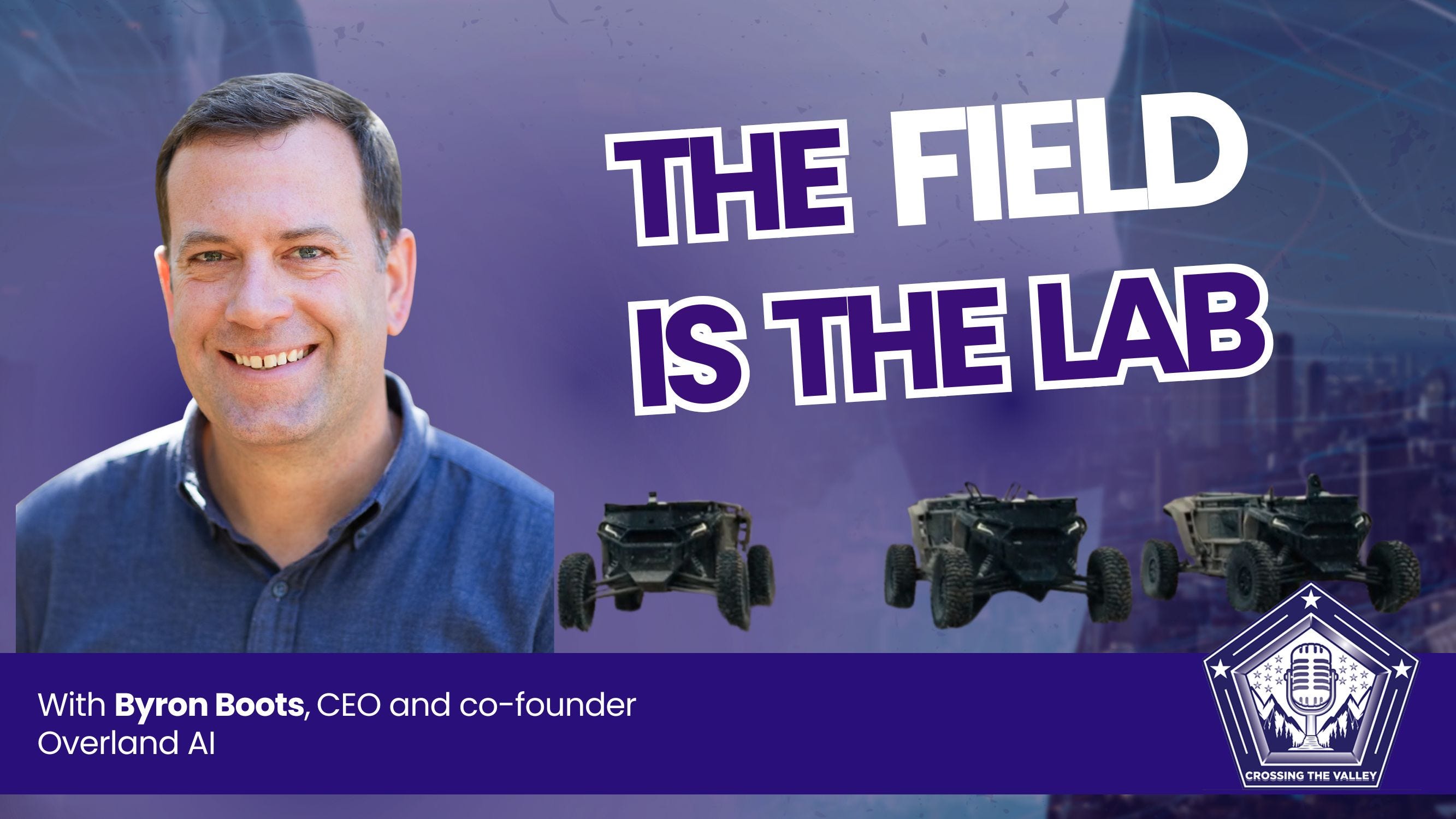
    Ep. 75: The Field is the Lab for Overland AI

    About Byron Boots Byron Boots is the co-founder and CEO of Overland AI. Prior to starting the company, he was an associate professor in computer science at the University of Washington, where his research focused on machine learning and robot autonomy. Byron served as principal investigator on DARPA’s Racer program, one of the most ambitious off-road ground autonomy challenges the agency has run since its landmark Grand Challenge series in 2004–2005. It was in that role — out in the field, iterating under adversarial test conditions — that the insight and technology behind Overland AI took shape. About Overland AI Overland AI builds autonomous ground vehicle software and systems for the U.S. military. Their flagship platform, ULTRA, is a purpose-built unmanned ground vehicle with upgraded suspension, miniaturized compute, and a suite of sensors including stereo cameras, LiDAR, thermal cameras, and Starlink — capable of GPS-denied navigation in extreme off-road terrain. The company operates across four primary concept of operations: ISR (intelligence, surveillance, and reconnaissance), logistics and resupply, layered protection (including counter-UAS), and breaching. Their go-to-market approach has been almost entirely driven by demonstrated field performance. Initially this came through DARPA experiments, then through DIU and direct work with Army and Marine Corps units. Overland has won contracts including the DIU Ground Vehicle Autonomous Pathways program and is currently focused on scaling into formations and establishing a permanent operational presence with the services. Key Takeaways Five principles from Byron’s journey that apply broadly to defense tech founders: * Field, first. One of the most counterintuitive decisions Byron made at University of Washington was to hire strong vehicle mechanics as some of his first team members. It’s a simple but counterintuitive logic. You don’t have to build the perfect software in the lab before you put it on the vehicle because if vehicles could be repaired rapidly in the field, the software team could test more aggressively, fail faster, and iterate without fear. Thus, the vehicle mechanics gave the rest of the team leverage. * The best BD is performance (with the lights on). Overland AI’s early business development was almost entirely organic. I pressed him on DARPA’s checkered history of transitioning programs, but in this case, DARPA invited the other services to watch their field experiments. Those experiments were credible, because the company often didn’t know what was coming. It wasn’t a PowerPoints brief or a table top conversation; it was an opportunity for customers to see the tech in action. That credibility dramatically accelerated their sales path. * Build on top of what works. Byron’s framework for capability development is deliberate: get one robot working reliably, then add a second, then build multi-vehicle coordination. Don’t architect for the end state. Prove each layer before adding the next. This mirrors successful product development in commercial software but is even more important in defense, where integration failures in the field are immediately visible and costly. * “If it’s not seamless, it won’t survive contact with the warfighter.” Despite the old saying “good enough for government work,” the operational bar for defense products is actually quite amorphous. Byron observed that “a slow or unreliable robot simply gets abandoned.” In other words, your project might die without you even knowing. The product actually has to perform well enough that operators don’t think about it. Only then can you expand the mission set, add payloads, or introduce multi-vehicle coordination. * It’s not about your tech. The sooner you embrace this, the faster you’ll win. Winning a contract gets you in the door, but a contract isn’t the same thing as winning warfighter trust. Byron draws a clear distinction between them. Overland's next 12 months aren't going to be defined by new contracts as much as they are going to be defined by creating "a permanent presence" with Army and Marine Corps units. I love this point because it suggests a totally different motion. It’s not about closing the deal or renewing it. It’s not about another slide or another meeting. It’s about doing things that don’t scale, having people side by side with the mission owners, and obsessing over the question of how to make your technology invisible inside existing workflows rather than celebrated as a novelty. For more Crossing the Valley: valleycrossers.com For more on Overland AI: www.overland.ai Follow Byron: https://www.linkedin.com/in/byron-boots/ Follow Noah: https://www.linkedin.com/in/noahsheinbaum/ This is a public episode. If you would like to discuss this with other subscribers or get access to bonus episodes, visit www.valleycrossers.com

Showing 1–20 of 22 episodes