Skip to content
Artwork for CrashCourse
EducationScienceSociety & CultureDocumentary

CrashCourse

CrashCourse

At Crash Course, we believe that high-quality educational videos should be available to everyone for free! Subscribe for weekly videos from our current courses! The Crash Course team has produced more than 60 courses on a wide variety of subjects, ranging from the humanities to sciences and so much more! We also recently teamed up with Arizona State University to bring you more courses on the Study Hall channel.

Links:
Support us on Patreon!: http://patreon.com/crashcourse
Instagram: https://www.instagram.com/crashcourse
Bluesky: https://bsky.app/profile/thecrashcourse.bsky.social
TikTok: https://www.tiktok.com/@crashcourse
Facebook: http://www.facebook.com/YouTubeCrashCourse

Play
  • 1,191 episodes
  • daily
  • Avg 17 min
  • English

Episodes 1,191

Counted on this page — what you have heard stays on this device, so it is not something the list can be paged by.
  • November 8 · 14 min

    Pragmatics: Crash Course Linguistics #6

    We don’t always say exactly what we mean, and yet we’re still pretty good at understanding each other. That’s because we don’t just use meaning to figure out what’s going on, we also use context. This episode of Crash Course Linguistics is all about pragmatics, the area of linguistics that deals with context. We’ll cover the four main assumptions we make about context in language, also known as Grice’s Maxims, as well as the ways that languages can use grammar to convey politeness, and the different types of conversational styles within and between languages. Want even more linguistics? Check out the Lingthusiasm podcast, hosted by the writers of Crash Course Linguistics: https://lingthusiasm.com/ Carefree by Kevin MacLeod Link: https://incompetech.filmmusic.io/song/3476-carefree License: http://creativecommons.org/licenses/by/4.0/ *** Watch our videos and review your learning with the Crash Course App! Download here for Apple Devices: https://apple.co/3d4eyZo Download here for Android Devices: https://bit.ly/2SrDulJ Crash Course is on Patreon! You can support us directly by signing up at http://www.patreon.com/crashcourse Thanks to the following patrons for their generous monthly contributions that help keep Crash Course free for everyone forever: Catherine Conroy, Patty Laqua, Leonora Rossé Muñoz, Stephen Saar, John Lee, Phil Simmons, Alexander Thomson, Mark & Susan Billian, Junrong Eric Zhu, Alan Bridgeman, Jennifer Smith, Matt Curls, Tim Kwist, Ron Lin, Jonathan Zbikowski. Jennifer Killen, Sarah & Nathan Catchings, Brandon Westmoreland, team dorsey, Trevin Beattie, Eric Prestemon, Sam Ferguson, Yasenia Cruz, Eric Koslow, Indika Siriwardena, Khaled El Shalakany, Shawn Arnold, Tom Trval, Siobhán, Ken Penttinen, Nathan Taylor, William McGraw, Justin Zingsheim, Andrei Krishkevich, Jirat, Brian Thomas Gossett, SR Foxley, Ian Dundore, Jason A Saslow, Jessica Wode, Mark, Caleb Weeks, Sam Buck -- Want to find Crash Course elsewhere on the internet? Facebook - http://www.facebook.com/YouTubeCrashCourse Twitter - http://www.twitter.com/TheCrashCourse Tumblr - http://thecrashcourse.tumblr.com Support Crash Course on Patreon: http://patreon.com/crashcourse CC Kids: http://www.youtube.com/crashcoursekids Learn more about your ad choices. Visit megaphone.fm/adchoices

  • November 8 · 13 min

    Doing Solids: Crash Course Chemistry #33

    In which Hank blows our minds with the different kinds of solids out there and talks about why they're all different and have different properties. Today, you'll learn about amorphous and crystalline solids, types of crystalline solids, types of crystalline atomic solids, properties of each type of solid, and that the properties depend on the bond types. Pssst... we made flashcards to help you review the content in this episode! Find them on the free Crash Course App! Download it here for Apple Devices: https://apple.co/3d4eyZo Download it here for Android Devices: https://bit.ly/2SrDulJ -- Table of Contents Amorphous and Crystalline Solids 1:27 Types of Crystalline Solids 4:07 Types of Crystalline Atomic Solids 5:17 Properties of Each Type of Solid 4:16 Properties Depend on Bond Types 6:17 -- Crash Course is on Patreon! You can support us directly by signing up at http://www.patreon.com/crashcourse Want to find Crash Course elsewhere on the internet? Facebook - http://www.facebook.com/YouTubeCrashCourse Twitter - http://www.twitter.com/TheCrashCourse Instagram - https://www.instagram.com/thecrashcourse/ CC Kids: http://www.youtube.com/crashcoursekids Learn more about your ad choices. Visit megaphone.fm/adchoices

  • November 6 · 13 min

    Productivity and Growth: Crash Course Economics #6

    Why are some countries rich? Why are some countries poor? In the end it comes down to Productivity. This week on Crash Course Econ, Adriene and Jacob investigate just why some economies are more productive than others, and what happens when an economy is mor productive. We'll look at how things like per capita GDP translate to the lifestyle of normal people. And, there's a mystery. Crash Course is on Patreon! You can support us directly by signing up at http://www.patreon.com/crashcourse Thanks to the following Patrons for their generous monthly contributions that help keep Crash Course free for everyone forever: Mark, Jan Schmid, Simun Niclasen, Robert Kunz, Daniel Baulig, Jason A Saslow, Eric Kitchen, Christian, Beatrice Jin, Anna-Ester Volozh, Eric Knight, Elliot Beter, Jeffrey Thompson, Ian Dundore, Stephen Lawless, Today I Found Out, James Craver, Jessica Wode, Sandra Aft, Jacob Ash, SR Foxley, Christy Huddleston, Steve Marshall, Chris Peters Want to find Crash Course elsewhere on the internet? Facebook - http://www.facebook.com/YouTubeCrashCourse Twitter - http://www.twitter.com/TheCrashCourse Tumblr - http://thecrashcourse.tumblr.com Support Crash Course on Patreon: http://patreon.com/crashcourse CC Kids: http://www.youtube.com/crashcoursekids Learn more about your ad choices. Visit megaphone.fm/adchoices

  • November 6 · 14 min

    Mars: Crash Course Astronomy #15

    The fourth planet from the sun and the outermost of the terrestrial planets, Mars has long been a popular spot for missions and imagination. Phil walks you through the planet's topography, core, and features. We'll take a look back at Mars's past and makes predictions for its future, including the possibilities for human life. Check out the Crash Course Astronomy solar system poster here: http://store.dftba.com/products/crashcourse-astronomy-poster -- Chapters: Introduction: Mars 00:00 Mars is Red, Rusty, and Dusty 1:19 Surface Features of Mars 2:01 Mars's Polar Ice Caps 3:29 Martian Atmosphere 3:50 Martian Moons: Deimos and Phobos 5:09 Is There Water on Mars? 6:03 Was There Life on Mars? 7:09 Martian Missions 8:01 Review 9:26 -- PBS Digital Studios: http://youtube.com/pbsdigitalstudios Follow Phil on Twitter: https://twitter.com/badastronomer Crash Course is on Patreon! You can support us directly by signing up at http://www.patreon.com/crashcourse Want to find Crash Course elsewhere on the internet? Facebook - http://www.facebook.com/YouTubeCrashCourse Twitter - http://www.twitter.com/TheCrashCourse Instagram - https://www.instagram.com/thecrashcourse/ CC Kids: http://www.youtube.com/crashcoursekids -- PHOTO/VIDEO SOURCES Planets https://en.wikipedia.org/wiki/Solar_System#/media/File:Planets2013.jpg [credit: Wikimedia Commons] Terrestrial Planets https://en.wikipedia.org/wiki/Venus#mediaviewer/File:Terrestrial_Planets_Size_Comp_True_Color.png [credit: Wikimedia Commons] Curiosity’s view of martian soil https://en.wikipedia.org/wiki/Martian_soil#/media/File:PIA17944-MarsCuriosityRover-AfterCrossingDingoGapSanddune-20140209.jpg [credit: NASA/JPL-Caltech/MSSS] Mars Topography http://www.jpl.nasa.gov/spaceimages/details.php?id=PIA02820 [credit: NASA/JPL] Tharsis http://upload.wikimedia.org/wikipedia/commons/thumb/2/22/Tharsis_-_Valles_Marineris_MOLA_shaded_colorized_zoom_32.jpg/1280px-Tharsis_-_Valles_Marineris_MOLA_shaded_colorized_zoom_32.jpg [credit: NASA / JPL-Caltech / Arizona State University] Olympus Mons http://upload.wikimedia.org/wikipedia/commons/0/00/Olympus_Mons_alt.jpg [credit: NASA] Valles Marineris https://en.wikipedia.org/wiki/Valles_Marineris#/media/File:Mars_Valles_Marineris.jpeg [credit: NASA/USGS] Cappuccino swirls at Mars south pole http://www.esa.int/var/esa/storage/images/esa_multimedia/images/2015/02/cappuccino_swirls_at_mars_south_pole/15243840-1-eng-GB/Cappuccino_swirls_at_Mars_south_pole.jpg [credit: ESA/DLR/FU Berlin / Bill Dunford] The Mars Reconnaissance Orbiter image 1 http://static.uahirise.org/images/2015/details/cut/ESP_039148_1980.jpg [credit: NASA] The Mars Reconnaissance Orbiter image 2 http://photojournal.jpl.nasa.gov/figures/PIA19127_fig1.jpg [credit: NASA/JPL] Dunes, image 1 http://mars.jpl.nasa.gov/gallery/press/20090317a/ESP_011909_1320.jpg [credit: NASA/JPL-Caltech/University of Arizona] Dunes, image 2 http://www.nasa.gov/sites/default/files/pia17981.jpg [credit: NASA/JPL-Caltech/Univ. of Arizona] Serpent Dust Devil http://www.nasa.gov/mission_pages/MRO/multimedia/pia15116.html [credit: NASA/JPL-Caltech/Univ. of Arizona] Tattooed Mars http://www.nasa.gov/multimedia/imagegallery/image_feature_1500.html [credit: NASA, HiRISE, MRO, LPL (U. Arizona)] Avalanche http://www.uahirise.org/ESP_016228_2650 [credit: NASA/JPL/University of Arizona] Deimos https://en.wikipedia.org/wiki/Moons_of_Mars#/media/File:Deimos-MRO.jpg [credit: NASA/JPL-Caltech/University of Arizona] Phobos https://en.wikipedia.org/wiki/Moons_of_Mars#/media/File:Phobos_colour_2008.jpg [credit: NASA/JPL-Caltech/University of Arizona] Mars' Moon Phobos Eclipses the Sun, as Seen by Curiosity https://www.youtube.com/watch?v=OyZoD7BRTtg [credit: NASA Jet Propulsion Laboratory] Material Excavated by a Fresh Impact and Identified as Water Ice http://www.jpl.nasa.gov/spaceimages/details.php?id=PIA12220 [credit: NASA/JPL-Cal Learn more about your ad choices. Visit megaphone.fm/adchoices

  • November 6 · 17 min

    How a Banana Sold for $150,000 : Modern Art

    Our cultural perspectives shape how we perceive art, including who we see as contributing to its most important movements. In this episode of Crash Course Art History, we’ll get to the truth behind the creation of modernism and bust the myth of its European beginning. We’ll show how modernism was a truly global movement, in which far-flung artists responded to a rapidly changing world. Crash Course Art History #15 Introduction: "The Comedian" 00:00 How Modernism Started 00:54 Modernism's Influences 04:10 Decentering Europe 06:55 Multiple Modernisms 09:23 Review & Credits 10:47 Image Descriptions: https://docs.google.com/document/d/1ETiCxe4GrVzFii7dBhF42oHx1EUCCh5y12wbtUjsH8A/edit Sources: https://docs.google.com/document/d/1GW2NKzhpMNMmRyAFJVhFJG9cSfUOMRL-QrcWuHcWcIA/edit?usp=sharing *** Support us for $5/month on Patreon to keep Crash Course free for everyone forever! https://www.patreon.com/crashcourse Or support us directly: https://complexly.com/support Join our Crash Course email list to get the latest news and highlights: https://mailchi.mp/crashcourse/email Get our special Crash Course Educators newsletter: http://eepurl.com/iBgMhY Thanks to the following patrons for their generous monthly contributions that help keep Crash Course free for everyone forever: Emily Beazley, Brandon Thomas, Forrest Langseth, oranjeez, Rie Ohta, Jack Hart, UwU, Leah H., David Fanska, Andrew Woods, Ken Davidian, Stephen Akuffo, Toni Miles, Steve Segreto, Kyle & Katherine Callahan, Laurel Stevens, Krystle Young, Burt Humburg, Scott Harrison, Mark & Susan Billian, Alan Bridgeman, Breanna Bosso, Matt Curls, Jennifer Killen, Jon Allen, Sarah & Nathan Catchings, team dorsey, Bernardo Garza, Trevin Beattie, Eric Koslow, Indija-ka Siriwardena, Jason Rostoker, Siobhán, Ken Penttinen, Nathan Taylor, Barrett Nuzum, Les Aker, William McGraw, ClareG, Rizwan Kassim, Constance Urist, Alex Hackman, kelsey warren, Katie Dean, Stephen McCandless, Wai Jack Sin, Ian Dundore, Caleb Weeks, Vaso __ Want to find Crash Course elsewhere on the internet? Instagram - https://www.instagram.com/thecrashcourse/ Facebook - http://www.facebook.com/YouTubeCrashCourse Twitter - http://www.twitter.com/TheCrashCourse CC Kids: http://www.youtube.com/crashcoursekids Learn more about your ad choices. Visit megaphone.fm/adchoices

  • November 6 · 19 min

    E1 and E2 Reactions: Crash Course Organic Chemistry #22

    We’ve spent the last few episodes talking about substitution reactions, but now it’s time to talk about a related type of reaction: elimination reactions! Elimination reactions are super important because they are the main way we can make compounds with double and triple bonds in organic chemistry. In this episode of Crash Course Organic Chemistry we’re going to cover… a lot, including a review of substitution reactions, E1 and E2 mechanisms, Zaitsev’s rule, and more. And of course, we’ll finish with some practice problems. Episode Sources: Chemguide.co.uk. Dehydration Of Ethanol To Give Ethene. [online] Available at: https://www.chemguide.co.uk/mechanisms/elim/dhethanol.html [Accessed 21 September 2020] Hornback, J. M. (1998). Organic Chemistry, Brooks. Series Sources: Brown, W. H., Iverson, B. L., Ansyln, E. V., Foote, C., Organic Chemistry; 8th ed.; Cengage Learning, Boston, 2018. Bruice, P. Y., Organic Chemistry, 7th ed.; Pearson Education, Inc., United States, 2014. Clayden, J., Greeves, N., Warren., S., Organic Chemistry, 2nd ed.; Oxford University Press, New York, 2012. Jones Jr., M.; Fleming, S. A., Organic Chemistry, 5th ed.; W. W. Norton & Company, New York, 2014. Klein., D., Organic Chemistry; 1st ed.; John Wiley & Sons, United States, 2012. Louden M., Organic Chemistry; 5th ed.; Roberts and Company Publishers, Colorado, 2009. McMurry, J., Organic Chemistry, 9th ed.; Cengage Learning, Boston, 2016. Smith, J. G., Organic chemistry; 6th ed.; McGraw-Hill Education, New York, 2020. Wade., L. G., Organic Chemistry; 8th ed.; Pearson Education, Inc., United States, 2013. *** Watch our videos and review your learning with the Crash Course App! Download here for Apple Devices: https://apple.co/3d4eyZo Download here for Android Devices: https://bit.ly/2SrDulJ Crash Course is on Patreon! You can support us directly by signing up at http://www.patreon.com/crashcourse Thanks to the following patrons for their generous monthly contributions that help keep Crash Course free for everyone forever: Christine Phelan, Nick, DAVID MORTON HUDSON, Perry Joyce, Scott Harrison, Mark & Susan Billian, Junrong Eric Zhu, Alan Bridgeman, Jennifer Smith, Matt Curls, Tim Kwist, Jonathan Zbikowski, Jennifer Killen, Sarah & Nathan Catchings, Brandon Westmoreland, team dorsey, Trevin Beattie, Eric Koslow, Indika Siriwardena, Khaled El Shalakany, Shawn Arnold, Siobhán, Ken Penttinen, Nathan Taylor, William McGraw, Laura Damon, Andrei Krishkevich, Eric Prestemon, Jirat, Brian Thomas Gossett, Ian Dundore, Jason A Saslow, Justin, Jessica Wode, Mark, Caleb Weeks __ Want to find Crash Course elsewhere on the internet? Facebook - http://www.facebook.com/YouTubeCrashCourse Twitter - http://www.twitter.com/TheCrashCourse Tumblr - http://thecrashcourse.tumblr.com Support Crash Course on Patreon: http://patreon.com/crashcourse CC Kids: http://www.youtube.com/crashcoursekids Learn more about your ad choices. Visit megaphone.fm/adchoices
  • November 6 · 16 min

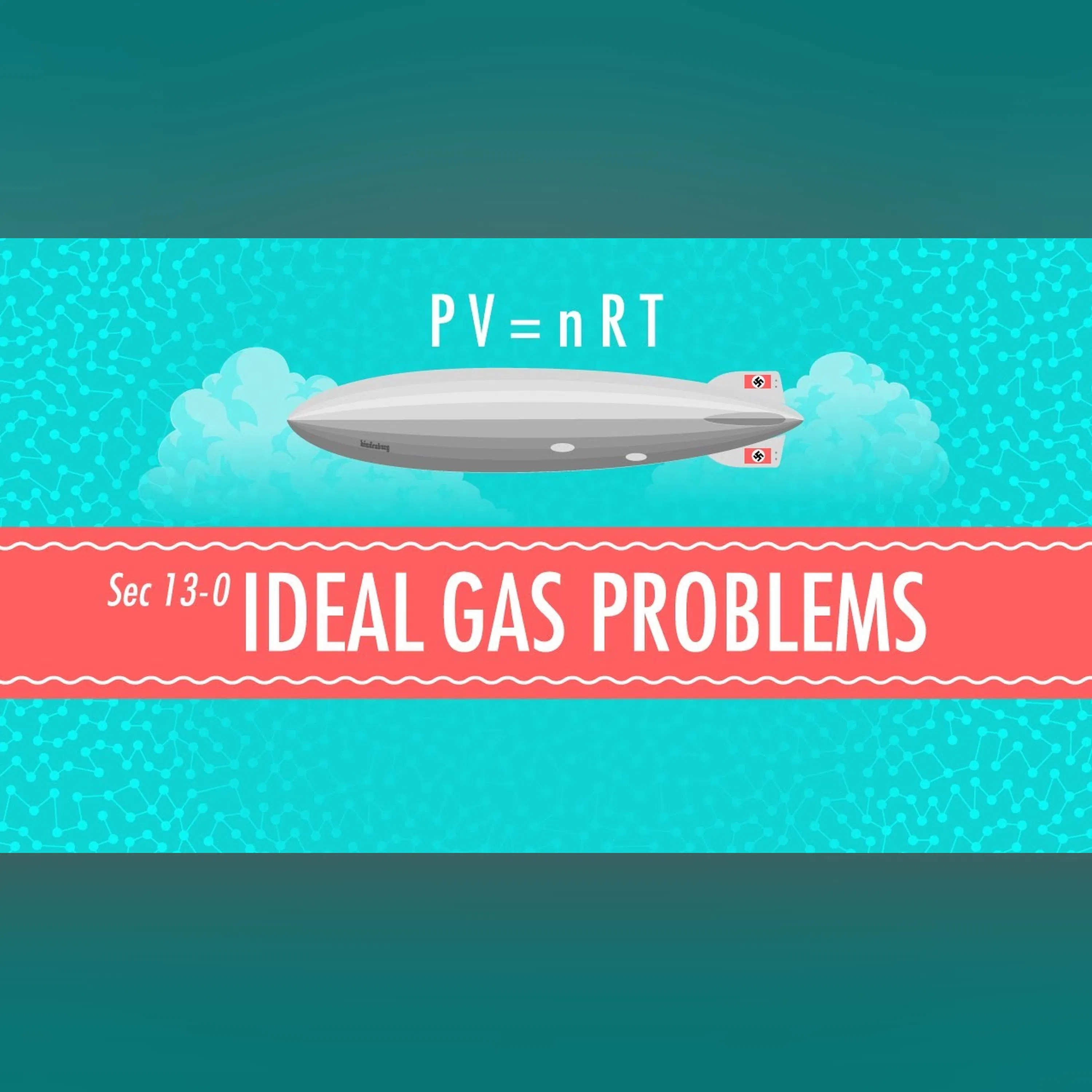
    Ideal Gas Problems: Crash Course Chemistry #13

    We don't live in a perfect world, and neither do gases - it would be great if their particles always fulfilled the assumptions of the ideal gas law, and we could use PV=nRT to get the right answer every time. Unfortunately, the ideal gas law (like our culture) has unrealistic expectations when it comes to size and attraction: it assumes that particles do not have size at all and that they never attract each other. So the ideal gas "law" often becomes little more than the ideal gas estimate when it comes to what gases do naturally. But it's a close enough estimate in enough situations that it's very valuable to know. In this episode, Hank goes through a bunch of calculations according to the ideal gas law so you can get familiar with it. Pssst... we made flashcards to help you review the content in this episode! Find them on the free Crash Course App! Download it here for Apple Devices: https://apple.co/3d4eyZo Download it here for Android Devices: https://bit.ly/2SrDulJ Table of Contents Large Size + Attraction to Others 3:36 Mendeleev to the Rescue 2:30 The Hindenburg Disaster 6:19 Helium vs. Hydrogen 7:33 Making Fire with Cotton and Your Fist 10:15 Crash Course is on Patreon! You can support us directly by signing up at http://www.patreon.com/crashcourse Want to find Crash Course elsewhere on the internet? Facebook - http://www.facebook.com/YouTubeCrashCourse Twitter - http://www.twitter.com/TheCrashCourse Instagram - https://www.instagram.com/thecrashcourse/ CC Kids: http://www.youtube.com/crashcoursekids Learn more about your ad choices. Visit megaphone.fm/adchoices
  • November 6 · 13 min

    Cycles in the Sky: Crash Course Astronomy #3

    This week we build on our naked eye observations from last week and take a look at the cyclical phenomena that we can see at work in the universe. Check out the Crash Course Astronomy solar system poster here: http://store.dftba.com/products/crashcourse-astronomy-poster -- Chapters: Introduction 00:00 Cycles in the Sky 0:42 The Zodiac 2:10 Planetary Movement 2:59 The Earth's Axis 3:36 Precession 6:09 Things We've Learned From Naked Eye Observations 7:09 Review 8:40 -- PBS Digital Studios: http://youtube.com/pbsdigitalstudios Follow Phil on Twitter: https://twitter.com/badastronomer Crash Course is on Patreon! You can support us directly by signing up at http://www.patreon.com/crashcourse Want to find Crash Course elsewhere on the internet? Facebook - http://www.facebook.com/YouTubeCrashCourse Twitter - http://www.twitter.com/TheCrashCourse Instagram - https://www.instagram.com/thecrashcourse/ CC Kids: http://www.youtube.com/crashcoursekids -- PHOTOS http://en.wikipedia.org/wiki/Right_ascension#mediaviewer/File:Stars_and_ra.png http://en.wikipedia.org/wiki/File:Ecliptic_path.jpg http://commons.wikimedia.org/wiki/File:Sagittarius_Hevelius.jpg http://en.wikipedia.org/wiki/Scorpius#mediaviewer/File:Sidney_Hall_-_Urania%27s_Mirror_-_Scorpio.jpg http://en.wikipedia.org/wiki/Libra_(constellation)#mediaviewer/File:Sidney_Hall_-_Urania%27s_Mirror_-_Libra.jpg http://en.wikipedia.org/wiki/Virgo_(constellation)#mediaviewer/File:Sidney_Hall_-_Urania%27s_Mirror_-_Virgo.jpg http://commons.wikimedia.org/wiki/File:Leo_Hevelius.jpg http://en.wikipedia.org/wiki/Cancer_(constellation)#mediaviewer/File:Sidney_Hall_-_Urania%27s_Mirror_-_Cancer.jpg http://en.wikipedia.org/wiki/Globe#mediaviewer/File:GEO_Globe.jpg http://sailornanny.weebly.com/uploads/1/0/5/0/10509307/4835516_orig.gif http://www.slate.com/content/dam/slate/blogs/bad_astronomy/2013/04/28/earth_elliptical_orbit.jpg.CROP.original-original.jpg http://en.wikipedia.org/wiki/Pole_star#mediaviewer/File:Precession_N.gif Learn more about your ad choices. Visit megaphone.fm/adchoices

  • November 5 · 16 min

    Unit Conversion and Significant Figures: Crash Course Chemistry #2

    A unit is a frequently arbitrary designation we have given to something to convey a definite magnitude of a physical quantity and every quantity can be expressed in terms of the seven base units that are contained in the international system of units. Hank thinks this is a thrilling subject, and while you may not agree, it is a subject that is very important if you want to be a scientist and communicate with accuracy and precision with other scientists. So listen up and learn something or Hank might have to kill you! (NOT REALLY!) Watch this video in Spanish on our new Crash Course en Español channel! https://youtu.be/aMrxhohbkVA Pssst... we made flashcards to help you review the content in this episode! Find them on the free Crash Course App! Download it here for Apple Devices: https://apple.co/3d4eyZo Download it here for Android Devices: https://bit.ly/2SrDulJ Table of Contents Unit Conversion 02:27 Scientific Notation 03:26 Sig Figs 07:40 Crash Course is on Patreon! You can support us directly by signing up at http://www.patreon.com/crashcourse Want to find Crash Course elsewhere on the internet? Facebook - http://www.facebook.com/YouTubeCrashCourse Twitter - http://www.twitter.com/TheCrashCourse Instagram - https://www.instagram.com/thecrashcourse/ CC Kids: http://www.youtube.com/crashcoursekids Learn more about your ad choices. Visit megaphone.fm/adchoices

  • November 5 · 16 min

    The Natives and the English - Crash Course US History #3

    In which John Green teaches you about relations between the early English colonists and the Native people they encountered in the New World. In short, these relations were poor. As soon as they arrived, the English were in conflict with the native people. At Jamestown, Captain John Smith briefly managed to get the colony on pretty solid footing with the local tribes, but it didn't last, and a long series of wars with the natives ensued. This pattern would continue in US history, with settlers pushing into native lands and pushing the inhabitants further west. In this episode, you'll learn about Wahunsunacawh (who the English called Powhatan), his daughter Pocahontas, King Philip's (aka Metacom) War, and the Mystic Massacre. By and large, the history of the Natives and the English was not a happy one, even Thanksgiving wasn't all it's cracked up to be. Hey teachers and students - Check out CommonLit's free collection of reading passages and curriculum resources to learn more about the events of this episode. The English tried and failed for a decade to establish a foothold in the New World in Native territory, leading to the lost colony of Roanoke: https://www.commonlit.org/texts/settling-a-new-world-the-lost-colony-of-roanoke-island When Jamestown was finally established in Virginia in 1607, the local Powhatan tribes sought friendly relations with the settlers, which quickly deteriorated: https://www.commonlit.org/texts/chief-powhatan-s-address-to-captain-john-smith Chapters: Introduction 00:00 Native Americans' Relationship to English Settlers 0:28 Trade Between Europeans and Natives 1:36 Pochahontas 2:23 Conflict, Uprisings, and the Failure of the Virginia Company 3:10 The Puritans' Relationship with Native Americans 4:21 The Pequot War 5:45 King Phillip's War 6:35 Mystery Document 8:24 How Native Americans Resisted Colonization 9:49 Credits 10:54 Crash Course is on Patreon! You can support us directly by signing up at http://www.patreon.com/crashcourse Want to find Crash Course elsewhere on the internet? Facebook - http://www.facebook.com/YouTubeCrashCourse Twitter - http://www.twitter.com/TheCrashCourse Instagram - https://www.instagram.com/thecrashcourse/ CC Kids: http://www.youtube.com/crashcoursekids Learn more about your ad choices. Visit megaphone.fm/adchoices

  • November 5 · 14 min

    Introduction to IP: Crash Course Intellectual Property #1

    This week, Stan Muller launches the Crash Course Intellectual Property mini-series. So, what is intellectual property, and why are we teaching it? Well, intellectual property is about ideas and their ownership, and it's basically about the rights of creators to make money from their work. Intellectual property is so pervasive in today's world that we thought you ought to know a little bit about it. We're going to discuss the three major elements of IP: Copyright, Patents, and Trademarks. ALSO, A DISCLAIMER: The views expressed in this video do not necessarily reflect those of the United States Copyright Office, the Library of Congress, or the United States Government. The information in this video is distributed on an "as-is" basis, without warranty. While precaution has been taken in the preparation of the video, the author shall not have any liability to any person or entity with respect to any loss or damage caused or alleged to be caused directly or indirectly by any information contained in the work. This video is intended for educational purposes only and is not intended to be, nor should it be construed as, legal advice. Intellectual property law is notoriously fact-specific, and this video (or any other single resource) cannot substitute for expert guidance from qualified legal counsel. To obtain legal guidance relevant to your particular circumstances, you should consult a qualified lawyer properly licensed in your jurisdiction. You can contact your local bar association for assistance in finding such a lawyer in your area. The Magic 8 Ball is a registered Trademark of Mattel Citation 1: Brand, Stewart. Quote from a speech given at the first Hackers' Conference, 1984 Citation 2: Plato, Phaedrus. 390 BC p. 157 Thanks to the following Patrons for their generous monthly contributions that help keep Crash Course free for everyone forever: Suzanne, Dustin & Owen Mets, Amy Fuller, Simon Francis Max Bild-Enkin, Ines Krueger, King of Conquerors Gareth Mok, Chris Ronderos, Gabriella Mayer, jeicorsair, Tokyo Coquette Boutique, Konradical the nonradical *** Crash Course is on Patreon! You can support us directly by signing up at http://www.patreon.com/crashcourse Want to find Crash Course elsewhere on the internet? Facebook - http://www.facebook.com/YouTubeCrashCourse Twitter - http://www.twitter.com/TheCrashCourse Instagram - https://www.instagram.com/thecrashcourse/ CC Kids: http://www.youtube.com/crashcoursekids Learn more about your ad choices. Visit megaphone.fm/adchoices

Showing 1,181–1,191 of 1,191 episodes