Skip to content
Artwork for CrashCourse
EducationScienceSociety & CultureDocumentary

CrashCourse

CrashCourse

At Crash Course, we believe that high-quality educational videos should be available to everyone for free! Subscribe for weekly videos from our current courses! The Crash Course team has produced more than 60 courses on a wide variety of subjects, ranging from the humanities to sciences and so much more! We also recently teamed up with Arizona State University to bring you more courses on the Study Hall channel.

Links:
Support us on Patreon!: http://patreon.com/crashcourse
Instagram: https://www.instagram.com/crashcourse
Bluesky: https://bsky.app/profile/thecrashcourse.bsky.social
TikTok: https://www.tiktok.com/@crashcourse
Facebook: http://www.facebook.com/YouTubeCrashCourse

Play
  • 1,077 episodes
  • Avg 16 min
  • English

Episodes 1,077

Counted on this page — what you have heard stays on this device, so it is not something the list can be paged by.
  • November 6 · 11 min

    Search and Seizure: Crash Course Government and Politics #27

    This week Craig talks about police searches and seizures. Now, the fourth amendment says that you have the right to be protected against "unreasonable searches and seizures" but what exactly does this mean? Well, it's complicated. The police often need warrants issued with proof of probable cause, but this isn't always the case - such as when you're pulled over for a moving violation. We'll finish up with the limitations of these protections and discuss one group of people in particular that aren't protected equally - students. Produced in collaboration with PBS Digital Studios: http://youtube.com/pbsdigitalstudios Support is provided by Voqal: http://www.voqal.org All attributed images are licensed under Creative Commons by Attribution 2.0 https://creativecommons.org/licenses/... Want to find Crash Course elsewhere on the internet? Facebook - http://www.facebook.com/YouTubeCrashCourse Twitter - http://www.twitter.com/TheCrashCourse Tumblr - http://thecrashcourse.tumblr.com Support Crash Course on Patreon: http://patreon.com/crashcourse CC Kids: http://www.youtube.com/crashcoursekids Learn more about your ad choices. Visit megaphone.fm/adchoices

  • November 6 · 19 min

    Where US Politics Came From: Crash Course US History #9

    In which John Green teaches you where American politicians come from. In the beginning, soon after the US constitution was adopted, politics were pretty non-existent. George Washington was elected president with no opposition, everything was new and exciting, and everyone just got along. For several months. Then the contentious debate about the nature of the United States began, and it continues to this day. Washington and his lackey/handler Alexander Hamilton pursued an elitist program of federalism. They attempted to strengthen the central government, create a strong nation-state, and leave less of the governance to the states, They wanted to create debt, encourage manufacturing, and really modernize the new nation/ The opposition, creatively known as the anti-federalists, wanted to build some kind of agrarian pseudo-paradise where every (white) man could have his own farm, and live a free, self-reliant life. The founding father who epitomized this view was Thomas Jefferson. By the time Adams became president, the anti-federalists had gotten the memo about how alienating a name like anti-federalist can be. It's so much more appealing to voters if your party is for something rather than being defined by what you're against, you know? In any case, Jefferson and his acolytes changed their name to the Democratic-Republican Party, which covered a lot of bases, and proceeded to protest nearly everything Adams did. Lest you think this week is all boring politics, you'll be thrilled to hear this episode has a Whiskey Rebellion, a Quasi-War, anti-French sentiment, some controversial treaties, and something called the XYZ Affair, which sounds very exciting. Learn all about it this week with John Green. Hey teachers and students - Check out CommonLit's free collection of reading passages and curriculum resources to learn more about the events of this episode. Much of America's politics came from debates between democratic republican Thomas Jefferson and federalist Alexander Hamilton: https://www.commonlit.org/texts/alexander-hamilton While Jefferson would go on to become president, Hamilton heavily influenced President George Washington who set many American political ideals in his farewell address that Hamilton helped craft: https://www.commonlit.org/texts/washington-s-farewell-address Chapters: Introduction 00:00 Alexander Hamilton's Vision for America 0:26 Thomas Jefferson's Vision for America 2:10 Democratic-Republicans vs. Federalists 3:32 George Washington and the First U.S. Presidential Election 4:33 Hamilton's Five-Point Plan 5:04 Republican Opposition to Hamilton's Economic Plan 6:20 The Whiskey Rebellion 7:02 Early U.S. Foreign Affairs 7:31 The End of Washington's Presidency 8:36 Mystery Document 9:21 John Adams' Presidency 10:48 The Alien and Sedition Acts 11:56 Credits 13:24 Crash Course is on Patreon! You can support us directly by signing up at http://www.patreon.com/crashcourse Want to find Crash Course elsewhere on the internet? Facebook - http://www.facebook.com/YouTubeCrashCourse Twitter - http://www.twitter.com/TheCrashCourse Instagram - https://www.instagram.com/thecrashcourse/ CC Kids: http://www.youtube.com/crashcoursekids Learn more about your ad choices. Visit megaphone.fm/adchoices

  • November 6 · 14 min

    The Importance of Preserving, Restoring, and Conserving Art

    Art tells the story of humanity across societies and cultures, but keeping that art around for future generations can be a monumental task. In this episode of Crash Course Art History, we’ll learn how art historians preserve, restore, and conserve art that tells the story of who we are and who we want to be. Introduction: "The Last Supper" 00:00 Preservation 00:53 Restoration 02:27 "Ecce Homo" 04:03 Conservation 06:19 Review & Credits 09:31 Image Descriptions: https://docs.google.com/document/d/1ETiCxe4GrVzFii7dBhF42oHx1EUCCh5y12wbtUjsH8A/edit Sources: https://docs.google.com/document/d/1GW2NKzhpMNMmRyAFJVhFJG9cSfUOMRL-QrcWuHcWcIA/edit?usp=sharing *** Support us for $5/month on Patreon to keep Crash Course free for everyone forever! https://www.patreon.com/crashcourse Or support us directly: https://complexly.com/support Join our Crash Course email list to get the latest news and highlights: https://mailchi.mp/crashcourse/email Get our special Crash Course Educators newsletter: http://eepurl.com/iBgMhY Thanks to the following patrons for their generous monthly contributions that help keep Crash Course free for everyone forever: Brandon Thomas, Emily Beazley, Forrest Langseth, Rie Ohta, oranjeez, Jack Hart, UwU, Leah H., David Fanska, Andrew Woods, Ken Davidian, Stephen Akuffo, Toni Miles, Steve Segreto, Kyle & Katherine Callahan, Laurel Stevens, Krystle Young, Burt Humburg, Perry Joyce, Scott Harrison, Mark & Susan Billian, Alan Bridgeman, Breanna Bosso, Matt Curls, Jennifer Killen, Jon Allen, Sarah & Nathan Catchings, team dorsey, Bernardo Garza, Trevin Beattie, Eric Koslow, Indija-ka Siriwardena, Jason Rostoker, Siobhán, Ken Penttinen, Nathan Taylor, Barrett Nuzum, Les Aker, William McGraw, ClareG, Rizwan Kassim, Constance Urist, Alex Hackman, kelsey warren, Katie Dean, Stephen McCandless, Wai Jack Sin, Ian Dundore, Caleb Weeks __ Want to find Crash Course elsewhere on the internet? Instagram - https://www.instagram.com/thecrashcourse/ Facebook - http://www.facebook.com/YouTubeCrashCourse Twitter - http://www.twitter.com/TheCrashCourse CC Kids: http://www.youtube.com/crashcoursekids Learn more about your ad choices. Visit megaphone.fm/adchoices

  • November 6 · 16 min

    Synthesis and Column Chromatography: Crash Course Organic Chemistry #25

    Even though all living things have a lot in common, different organisms can have very different reactions to the same organic chemicals. That means it’s really important for organic chemists to be able to purify chemicals and separate the products we want from reactions, from the side products we don’t. In this episode of Crash Course Organic Chemistry, we’re heading into the lab to learn about one of the ways we can separate chemicals in a mixture: chromatography! Episode Sources: Mahdi, J. G. (2010). Medicinal potential of willow: A chemical perspective of aspirin discovery. Journal of Saudi Chemical Society, 14(3), 317-322. Dempsey, D.A., Klessig, D.F. How does the multifaceted plant hormone salicylic acid combat disease in plants and are similar mechanisms utilized in humans?. BMC Biol 15, 23 (2017). https://doi.org/10.1186/s12915-017-0364-8 Still, W. C., Kahn, M., & Mitra, A. (1978). Rapid chromatographic technique for preparative separations with moderate resolution. The Journal of Organic Chemistry, 43(14), 2923-2925. Pastre, J. C., & Duarte Correia, C. R. (2006). Efficient Heck arylations of cyclic and acyclic acrylate derivatives using arenediazonium tetrafluoroborates. A new synthesis of the antidepressant drug (±)-Paroxetine. Organic letters, 8(8), 1657-1660. Series Sources: Brown, W. H., Iverson, B. L., Ansyln, E. V., Foote, C., Organic Chemistry; 8th ed.; Cengage Learning, Boston, 2018. Bruice, P. Y., Organic Chemistry, 7th ed.; Pearson Education, Inc., United States, 2014. Clayden, J., Greeves, N., Warren., S., Organic Chemistry, 2nd ed.; Oxford University Press, New York, 2012. Jones Jr., M.; Fleming, S. A., Organic Chemistry, 5th ed.; W. W. Norton & Company, New York, 2014. Klein., D., Organic Chemistry; 1st ed.; John Wiley & Sons, United States, 2012. Louden M., Organic Chemistry; 5th ed.; Roberts and Company Publishers, Colorado, 2009. McMurry, J., Organic Chemistry, 9th ed.; Cengage Learning, Boston, 2016. Smith, J. G., Organic chemistry; 6th ed.; McGraw-Hill Education, New York, 2020. Wade., L. G., Organic Chemistry; 8th ed.; Pearson Education, Inc., United States, 2013. *** Watch our videos and review your learning with the Crash Course App! Download here for Apple Devices: https://apple.co/3d4eyZo Download here for Android Devices: https://bit.ly/2SrDulJ Crash Course is on Patreon! You can support us directly by signing up at http://www.patreon.com/crashcourse Thanks to the following patrons for their generous monthly contributions that help keep Crash Course free for everyone forever: Aziz, Christine Phelan, Nick, DAVID MORTON HUDSON, Perry Joyce, Scott Harrison, Mark & Susan Billian, Junrong Eric Zhu, Alan Bridgeman, Jennifer Smith, Matt Curls, Tim Kwist, Jonathan Zbikowski, Jennifer Killen, Sarah & Nathan Catchings, Brandon Westmoreland, team dorsey, Trevin Beattie, Eric Koslow, Indika Siriwardena, Khaled El Shalakany, Shawn Arnold, Siobhán, Ken Penttinen, Nathan Taylor, William McGraw, Laura Damon, Andrei Krishkevich, Eric Prestemon, Jirat, Brian Thomas Gossett, Ian Dundore, Jason A Saslow, Justin, Jessica Wode, Mark, Caleb Weeks __ Want to find Crash Course elsewhere on the internet? Facebook - http://www.facebook.com/YouTubeCrashCourse Twitter - http://www.twitter.com/TheCrashCourse Tumblr - http://thecrashcourse.tumblr.com Support Crash Course on Patreon: http://patreon.com/crashcourse CC Kids: http://www.youtube.com/crashcoursekids Learn more about your ad choices. Visit megaphone.fm/adchoices

  • November 6 · 9 min

    Crash Course Out-Takes Chemistry #1

    Sometimes words can be hard to say. Crash Course is on Patreon! You can support us directly by signing up at http://www.patreon.com/crashcourse Want to find Crash Course elsewhere on the internet? Facebook - http://www.facebook.com/YouTubeCrashCourse Twitter - http://www.twitter.com/TheCrashCourse Instagram - https://www.instagram.com/thecrashcourse/ CC Kids: http://www.youtube.com/crashcoursekids Learn more about your ad choices. Visit megaphone.fm/adchoices

  • November 6 · 14 min

    What's the Difference Between Cults and Religion?: Crash Course Religions #3

    What is a cult? How are cults different from religions? And why do many religious scholars say we shouldn’t even use that label? In this episode of Crash Course Religions, we’ll learn why the line between cults and religions is much fuzzier than it seems. Introduction: Is This a Cult? 00:00 From Cult to Religion 00:36 Brainwashing 03:03 Qualities of Cults 04:04 Ditching the "Cult" Label 05:40 Harms of the "Cult" Label 07:29 Review & Credits 08:50 Sources: https://docs.google.com/document/d/1IRPhziWfx72dIlGC1xIuEPWqb_uwnumdtYnmmsR4jto/edit?usp=sharing *** Support us for $5/month on Patreon to keep Crash Course free for everyone forever! https://www.patreon.com/crashcourse Or support us directly: https://complexly.com/support Join our Crash Course email list to get the latest news and highlights: https://mailchi.mp/crashcourse/email Get our special Crash Course Educators newsletter: http://eepurl.com/iBgMhY Thanks to the following patrons for their generous monthly contributions that help keep Crash Course free for everyone forever: Brandon Thomas, Emily Beazley, Forrest Langseth, Rie Ohta, oranjeez, Jack Hart, UwU, Leah H., David Fanska, Andrew Woods, Ken Davidian, Stephen Akuffo, Toni Miles, Steve Segreto, Kyle & Katherine Callahan, Laurel Stevens, Krystle Young, Burt Humburg, Perry Joyce, Scott Harrison, Mark & Susan Billian, Alan Bridgeman, Breanna Bosso, Matt Curls, Jennifer Killen, Jon Allen, Sarah & Nathan Catchings, team dorsey, Bernardo Garza, Trevin Beattie, Eric Koslow, Indija-ka Siriwardena, Jason Rostoker, Siobhán, Ken Penttinen, Nathan Taylor, Barrett Nuzum, Les Aker, William McGraw, ClareG, Rizwan Kassim, Constance Urist, Alex Hackman, kelsey warren, Katie Dean, Stephen McCandless, Wai Jack Sin, Ian Dundore, Caleb Weeks __ Want to find Crash Course elsewhere on the internet? Instagram - https://www.instagram.com/thecrashcourse/ Facebook - http://www.facebook.com/YouTubeCrashCourse Twitter - http://www.twitter.com/TheCrashCourse CC Kids: http://www.youtube.com/crashcoursekids Learn more about your ad choices. Visit megaphone.fm/adchoices

  • November 6 · 14 min

    Supply and Demand: Crash Course Economics #4

    In which Adriene Hill and Jacob Clifford teach you about one of the fundamental economic ideas, supply and demand. What is supply and demand? Well, you’ll have to watch the video to really understand it, but it’s kind of important for everything economically. Supply and demand sets prices, and indicates to manufacturers how much to produce. Also, it has a lot to do with strawberries. Crash Course is on Patreon! You can support us directly by signing up at http://www.patreon.com/crashcourse Thanks to the following Patrons for their generous monthly contributions that help keep Crash Course free for everyone forever: Mark, Jan Schmid, Simun Niclasen, Robert Kunz, Daniel Baulig, Jason A Saslow, Eric Kitchen, Christian, Beatrice Jin, Anna-Ester Volozh, Eric Knight, Elliot Beter, Jeffrey Thompson, Ian Dundore, Stephen Lawless, Today I Found Out, James Craver, Jessica Wode, Sandra Aft, Jacob Ash, SR Foxley, Christy Huddleston, Steve Marshall, Chris Peters Want to find Crash Course elsewhere on the internet? Facebook - http://www.facebook.com/YouTubeCrashCourse Twitter - http://www.twitter.com/TheCrashCourse Tumblr - http://thecrashcourse.tumblr.com Support Crash Course on Patreon: http://patreon.com/crashcourse CC Kids: http://www.youtube.com/crashcoursekids Learn more about your ad choices. Visit megaphone.fm/adchoices

  • November 6 · 18 min

    Water and Solutions - for Dirty Laundry: Crash Course Chemistry #7

    Dihydrogen monoxide (better known as water) is the key to nearly everything. It falls from the sky, makes up 60% of our bodies, and just about every chemical process related to life takes place with it or in it. Without it, none of the chemical reactions that keep us alive would happen - none of the reactions that sustain any life form on earth would happen - and the majority of inorganic chemical reactions that shape the surface of the earth would not happen either. Every one of us uses water for all kinds of chemistry every day - our body chemistry, our food chemistry, and our laundry chemistry all take place in water. In today's Crash Course Chemistry, we use Hank's actual dirty laundry (ew) to learn about some of the properties of water that make it so special - its polarity and dielectric property; how electrolytes can be used to classify solutions; and we discover how to calculate a solution's molarity as well as how to dilute a solution using the dilution equation. Pssst... we made flashcards to help you review the content in this episode! Find them on the free Crash Course App! Download it here for Apple Devices: https://apple.co/3d4eyZo Download it here for Android Devices: https://bit.ly/2SrDulJ Table of Contents Polarity 02:40 Dielectric Property 04:13 Electrolytes 04:29 Molarity 08:46 Dilution 10:56 Crash Course is on Patreon! You can support us directly by signing up at http://www.patreon.com/crashcourse Want to find Crash Course elsewhere on the internet? Facebook - http://www.facebook.com/YouTubeCrashCourse Twitter - http://www.twitter.com/TheCrashCourse Instagram - https://www.instagram.com/thecrashcourse/ CC Kids: http://www.youtube.com/crashcoursekids Learn more about your ad choices. Visit megaphone.fm/adchoices

  • November 6 · 16 min

    The Dred Scott Decision: Crash Course Black American History #16

    In this video, we'll learn about the US Supreme Court decision in Scott vs Sanford, handed down in 1857. The case ultimately rejected the idea that Black people could be citizens of the United States, and this helped entrench the institution of slavery, denied a host of rights to a huge number of people (both enslaved and free), and increased the tensions between abolitionists and enslavers. Clint's book, How the Word is Passed is available now! https://bookshop.org/a/3859/9780316492935 VIDEO SOURCES https://www.britannica.com/event/Missouri-Compromise Don E. Fehrenbacher, The Dred Scott Case: Its Significance in American Law and Politics (Oxford University Press, 1978). https://www.npr.org/2020/09/18/914465793/ice-a-whistleblower-and-forced-sterilization https://www.aclu.org/news/immigrants-rights/immigration-detention-and-coerced-sterilization-history-tragically-repeats-itself/ The Historical Construction of Race and Citizenship in the United States - https://www.unrisd.org/80256B3C005BCCF9/(httpAuxPages)/8A0AE7EACD11F278C1256DD6004860EA/$file/Fredrick.pdf THIND V. UNITED STATES​ (1923) Watch our videos and review your learning with the Crash Course App! Download here for Apple Devices: https://apple.co/3d4eyZo Download here for Android Devices: https://bit.ly/2SrDulJ Crash Course is on Patreon! You can support us directly by signing up at http://www.patreon.com/crashcourse Thanks to the following patrons for their generous monthly contributions that help keep Crash Course free for everyone forever: Shannon McCone, Amelia Ryczek, Ken Davidian, Brian Zachariah, Stephen Akuffo, Toni Miles, Oscar Pinto-Reyes, Erin Nicole, Steve Segreto, Michael M. Varughese, Kyle & Katherine Callahan, Laurel A Stevens, Vincent, Michael Wang, Jaime Willis, Krystle Young, Michael Dowling, Alexis B, Rene Duedam, Burt Humburg, Aziz, DAVID MORTON HUDSON, Perry Joyce, Scott Harrison, Mark & Susan Billian, Junrong Eric Zhu, Alan Bridgeman, Rachel Creager, Jennifer Smith, Matt Curls, Tim Kwist, Jonathan Zbikowski, Jennifer Killen, Sarah & Nathan Catchings, Brandon Westmoreland, team dorsey, Trevin Beattie, Divonne Holmes à Court, Eric Koslow, Jennifer Dineen, Indika Siriwardena, Khaled El Shalakany, Jason Rostoker, Shawn Arnold, Siobhán, Ken Penttinen, Nathan Taylor, William McGraw, Andrei Krishkevich, ThatAmericanClare, Rizwan Kassim, Sam Ferguson, Alex Hackman, Eric Prestemon, Jirat, Katie Dean, TheDaemonCatJr, Wai Jack Sin, Ian Dundore, Matthew, Justin, Jessica Wode, Mark, Caleb Weeks __ Want to find Crash Course elsewhere on the internet? Facebook - http://www.facebook.com/YouTubeCrashCourse Twitter - http://www.twitter.com/TheCrashCourse Tumblr - http://thecrashcourse.tumblr.com Support Crash Course on Patreon: http://patreon.com/crashcourse CC Kids: http://www.youtube.com/crashcoursekids #crashcourse #history #dredscott Learn more about your ad choices. Visit megaphone.fm/adchoices

  • November 6 · 14 min

    What Are the Different Types of Cyclones? Crash Course Geography #12

    Today we’re going to talk about two types of cyclones: mid-latitude cyclones and tropical cyclones. Mid-latitude cyclones are huge weather systems that bring day-to-day weather in the mid-latitudes. They're the reason the weather is often unpredictable. We'll focus on the Northern Hemisphere and how these cyclones form along the polar front. Then, we'll shift to tropical cyclones also called hurricanes or typhoons - those smaller spinning vortices of air usually originating in the tropics that can cause widespread damage to coastal communities. We'll talk about the Bhola cyclone, which as of 2021 is the deadliest tropical cyclone in history, and we'll take a closer look at the Sundarbans in the low-lying coastal areas of Bangladesh and India to see how mangroves play a crucial role as a natural ecological barrier to these storms. Watch our videos and review your learning with the Crash Course App! Download here for Apple Devices: https://apple.co/3d4eyZo Download here for Android Devices: https://bit.ly/2SrDulJ Crash Course is on Patreon! You can support us directly by signing up at http://www.patreon.com/crashcourse Thanks to the following patrons for their generous monthly contributions that help keep Crash Course free for everyone forever: Rene Duedam, Burt Humburg, Aziz, Nick, DAVID MORTON HUDSON, Perry Joyce, Scott Harrison, Mark & Susan Billian, Junrong Eric Zhu, Alan Bridgeman, Jennifer Smith, Matt Curls, Tim Kwist, Jonathan Zbikowski, Jennifer Killen, Sarah & Nathan Catchings, Brandon Westmoreland, team dorsey, Trevin Beattie, Eric Koslow, Indika Siriwardena, Khaled El Shalakany, Shawn Arnold, Siobhán, Ken Penttinen, Nathan Taylor, William McGraw, Laura Damon, Andrei Krishkevich, Sam Ferguson, Eric Prestemon, Jirat, Brian Thomas Gossett, Ian Dundore, Jason A Saslow, Justin, Jessica Wode, Mark, Caleb Weeks __ Want to find Crash Course elsewhere on the internet? Facebook - http://www.facebook.com/YouTubeCrashCourse Twitter - http://www.twitter.com/TheCrashCourse Tumblr - http://thecrashcourse.tumblr.com Support Crash Course on Patreon: http://patreon.com/crashcourse CC Kids: http://www.youtube.com/crashcoursekids #CrashCourse #Geography #Cyclones Learn more about your ad choices. Visit megaphone.fm/adchoices

  • November 6 · 16 min

    What is the Future of Art?

    How do smartphones and 3-D models change how we experience art? And even history itself? In this episode of Crash Course Art History, we’ll learn how technology is shifting the ways we think about art’s past, present, and future. Crash Course Art History: Episode #22 Introduction: Trendy "Museums" 00:00 The Mosul Lion & Digital Karnak 00:55 "Migration Series" 03:42 Social Media & Art 05:43 The Future of Art 07:22 Review & Credits 09:28 Image Descriptions: https://docs.google.com/document/d/1ETiCxe4GrVzFii7dBhF42oHx1EUCCh5y12wbtUjsH8A/edit Sources: https://docs.google.com/document/d/1GW2NKzhpMNMmRyAFJVhFJG9cSfUOMRL-QrcWuHcWcIA/edit?usp=sharing *** Support us for $5/month on Patreon to keep Crash Course free for everyone forever! https://www.patreon.com/crashcourse Or support us directly: https://complexly.com/support Join our Crash Course email list to get the latest news and highlights: https://mailchi.mp/crashcourse/email Get our special Crash Course Educators newsletter: http://eepurl.com/iBgMhY Thanks to the following patrons for their generous monthly contributions that help keep Crash Course free for everyone forever: Brandon Thomas, Emily Beazley, Forrest Langseth, Rie Ohta, oranjeez, Jack Hart, UwU, Leah H., David Fanska, Andrew Woods, Ken Davidian, Stephen Akuffo, Toni Miles, Steve Segreto, Kyle & Katherine Callahan, Laurel Stevens, Krystle Young, Burt Humburg, Perry Joyce, Scott Harrison, Mark & Susan Billian, Alan Bridgeman, Breanna Bosso, Matt Curls, Jennifer Killen, Jon Allen, Sarah & Nathan Catchings, team dorsey, Bernardo Garza, Trevin Beattie, Eric Koslow, Indija-ka Siriwardena, Jason Rostoker, Siobhán, Ken Penttinen, Nathan Taylor, Barrett Nuzum, Les Aker, William McGraw, ClareG, Rizwan Kassim, Constance Urist, Alex Hackman, kelsey warren, Katie Dean, Stephen McCandless, Wai Jack Sin, Ian Dundore, Caleb Weeks __ Want to find Crash Course elsewhere on the internet? Instagram - https://www.instagram.com/thecrashcourse/ Facebook - http://www.facebook.com/YouTubeCrashCourse Twitter - http://www.twitter.com/TheCrashCourse CC Kids: http://www.youtube.com/crashcoursekids Learn more about your ad choices. Visit megaphone.fm/adchoices

  • November 5 · 18 min

    Conflict in Israel and Palestine through 2015: Crash Course World History #223

    *This video was published in 2015 and therefore does not reflect recent historical events, nor context about the ongoing conflict between Israel and Palestine.* In which John Green teaches you about the conflict in Israel and Palestine. This conflict is often cast as a long-term beef going back thousands of years, rooted in a clash between religions. Well, that's not quite true. What is true is that the conflict is immensely complicated, and just about everyone in the world has an opinion about it. John is going to try to get the facts across in under 13 minutes. Note: We mispronounced the Arabic word "nakba" at 6:06. Sorry about that! Citation 1: Arthur James Balfour, Balfour Declaration (letter to Baron Rothschild, leader of British Jewish community). 1917. Crash Course is on Patreon! You can support us directly by signing up at http://www.patreon.com/crashcourse Want to find Crash Course elsewhere on the internet? Facebook - http://www.facebook.com/YouTubeCrashCourse Twitter - http://www.twitter.com/TheCrashCourse Instagram - https://www.instagram.com/thecrashcourse/ CC Kids: http://www.youtube.com/crashcoursekids Thought Café's series on the subject: https://www.youtube.com/channel/UCGAL9TcH76MBKR5hywFZ4CA Learn more about your ad choices. Visit megaphone.fm/adchoices

  • November 5 · 16 min

    Brown Dwarfs: Crash Course Astronomy #28

    While Jupiter is nowhere near massive enough to initiate fusion in its core, there are even more massive objects out there that fall just short of that achievement called brown dwarfs. Brown dwarfs have a mass between giant planets and small stars. They were only recently discovered in the 1990s, but thousands are now known. More massive ones can fuse deuterium, and even lithium, but not hydrogen, distinguishing them from “normal” stars. Sort of. Correction: In the illustration at 9:30, the numbers listed after the star names are the year of discovery, not distance. Check out the Crash Course Astronomy solar system poster here: http://store.dftba.com/products/crashcourse-astronomy-poster -- Chapters: Introduction: Brown Dwarfs 00:00 L Stars & The Lithium Test 2:50 Discovering the First Brown Dwarfs 4:14 What Color Are Brown Dwarfs? 6:24 Physical Characteristics of Brown Dwarfs 7:30 Small Stars vs. Big Planets 8:11 Review 10:17 -- PBS Digital Studios: http://youtube.com/pbsdigitalstudios Follow Phil on Twitter: https://twitter.com/badastronomer Want to find Crash Course elsewhere on the internet? Facebook - http://www.facebook.com/YouTubeCrashCourse Twitter - http://www.twitter.com/TheCrashCourse Tumblr - http://thecrashcourse.tumblr.com Support CrashCourse on Patreon: http://www.patreon.com/crashcourse -- PHOTOS/VIDEOS The sun in extreme ultraviolet https://en.wikipedia.org/wiki/File:The_Sun_in_extreme_ultraviolet.jpg [credit: NASA, ESA / Wikimedia Commons] Jupiter http://www.spacetelescope.org/static/archives/images/screen/heic1410a.jpg [credit: NASA, ESA, and A. Simon (Goddard Space Flight Center)] Forming a Planetary Gap http://www.spitzer.caltech.edu/video-audio/691-ssc2004-08v3-Forming-a-Planetary-Gap [credit: NASA/JPL-Caltech/R. Hurt (SSC/Caltech)] Exoplanet http://uanews.org/sites/default/files/story-images/exoplanet.jpg [credit: NASA/JPL-Caltech] A Trio of Brown Dwarfs (L/T/Y) http://www.nasa.gov/mission_pages/WISE/multimedia/pia14722.html [credit: NASA/JPL-Caltech] Artist's concept of a T-type brown dwarf https://en.wikipedia.org/wiki/Brown_dwarf#/media/File:2MASSJ22282889-431026.jpg [credit: NASA/JPL-Caltech] Brown Dwarf Gliese 229B https://en.wikipedia.org/wiki/File:Brown_Dwarf_Gliese_229B.jpg [credit: NASA / Wikimedia Commons] Gliese 229B Spectrum - image provided by Phil Plait [credit: NASA/ESA/Hubble/Al Schultz et al] Artist's vision of a T-dwarf https://en.wikipedia.org/wiki/Brown_dwarf#/media/File:T-dwarf-nasa-hurt.png [credit: R. Hurt/NASA - R. Hurt/NASA, Wikimedia Commons] First Ultra-Cool WISE Brown Dwarf http://wise.ssl.berkeley.edu/gallery_firstbd.html [credit: NASA/JPL-Caltech/WISE Team] Brown Dwarf Comparison http://www.nasa.gov/mission_pages/WISE/multimedia/pia12462.html [credit: NASA/JPL-Caltech/UCB] Storms Expected on Brown Dwarfs http://www.spitzer.caltech.edu/images/5718-sig14-001-This-Just-In-Storms-Expected-on-Brown-Dwarfs [credit: NASA/JPL-Caltech/T. Pyle (IPAC)] Stars and brown dwarfs closest to the Sun https://en.wikipedia.org/wiki/Luhman_16#/media/File:PIA18003-NASA-WISE-StarsNearSun-20140425-2.png [credit: NASA/Penn State University] Learn more about your ad choices. Visit megaphone.fm/adchoices

  • November 5 · 19 min

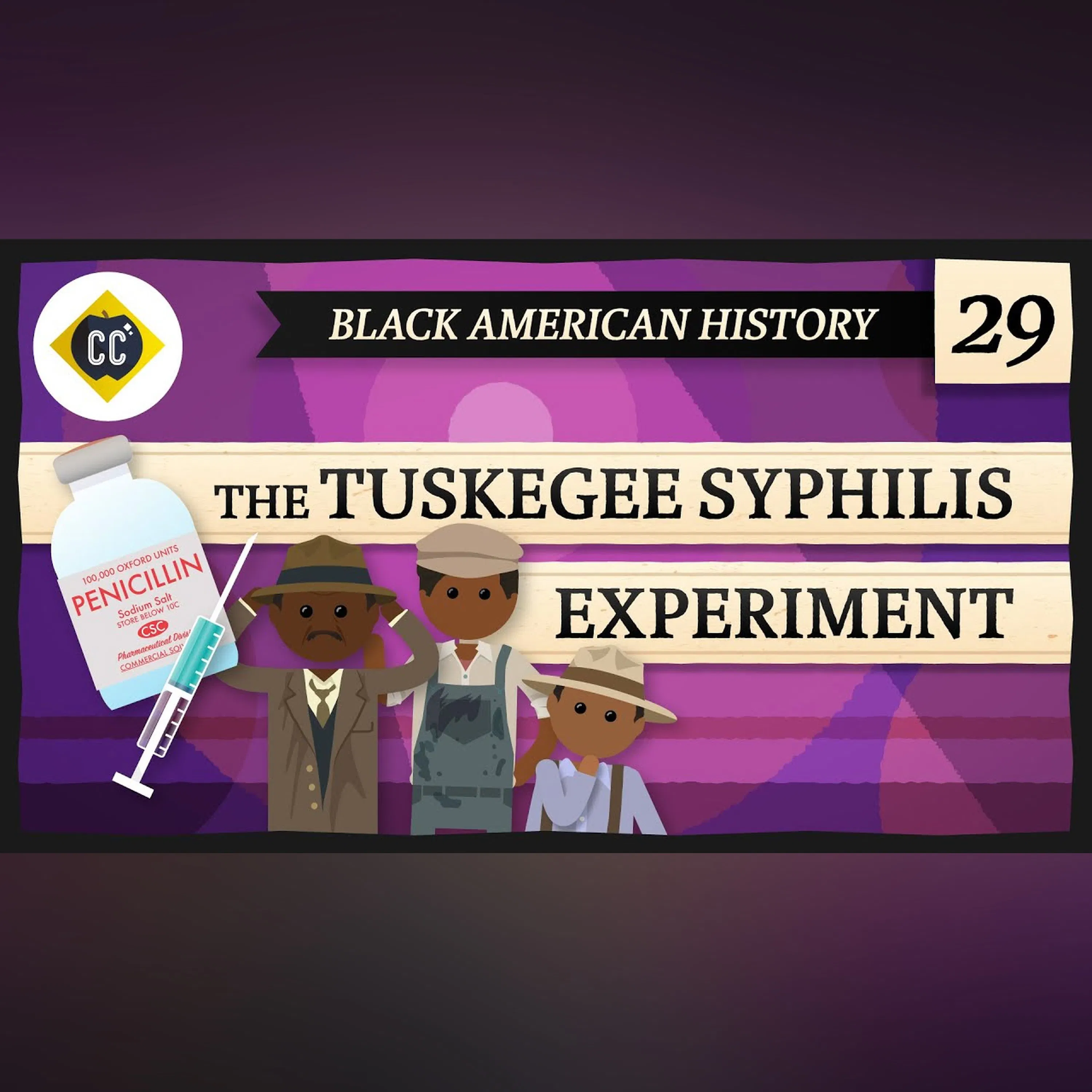
    The Tuskegee Experiment: Crash Course Black American History #29

    From 1932 to 1972, the United States Public Health Service and the Centers for Disease Control and Prevention operated an extremely unethical medical experiment on the effects of outcomes of untreated syphilis. Hundreds of poor Black men from Macon County, Alabama were enrolled in the study, and treatment for syphilis was withheld from them. Even after antibiotics became available that could cure syphilis, these men were left to suffer from the disease and expose their families to syphilis as well. Today we're learning about the Tuskegee Syphilis Experiment, a shameful example of racism in American medicine, and a tragedy that still impacts how many Black Americans think about healthcare today. Clint's book, How the Word is Passed is available now! https://bookshop.org/a/3859/9780316492935 VIDEO SOURCES ● Susan Reverby, Examining Tuskegee: The Infamous Syphilis Study and Its Legacy (Chapel Hill, N.C.: University of North Carolina Press, 2009). ● Susan Reverby ed., Tuskegee’s Truth’s: Rethinking the Tuskegee Syphilis Study (Chapel Hill, N.C.: University of North Carolina Press, 2000). ● Harriet A. Washington, Medical Apartheid: The Dark History of Medical Experimentation on Black Americans from Colonial Times to the Present (New York: Penguin Random House, 2008). Nia Johnson. Expanding Accountability: Using the Negligent Infliction of Emotional Distress Claim to Compensate Black American Families Who Remained Unheard in Medical Crisis. Hastings Law Journal. (Forthcoming, Summer 2021). Brandt, Allan M. 1978. "Racism and research: The case of the Tuskegee Syphilis study." The Hastings Center Report 8(6): 21-29. Tuskegee's Truths: Rethinking the Tuskegee Syphilis Study (edited by Susan M. Reverby) https://www.npr.org/sections/health-shots/2021/03/23/974059870/stop-blaming-tuskegee-critics-say-its-not-an-excuse-for-current-medical-racism Watch our videos and review your learning with the Crash Course App! Download here for Apple Devices: https://apple.co/3d4eyZo Download here for Android Devices: https://bit.ly/2SrDulJ Crash Course is on Patreon! You can support us directly by signing up at http://www.patreon.com/crashcourse Thanks to the following patrons for their generous monthly contributions that help keep Crash Course free for everyone forever: Dave Freeman, Hasan Jamal, DL Singfield, Jeremy Mysliwiec, Shannon McCone, Amelia Ryczek, Ken Davidian, Stephen Akuffo, Toni Miles, Erin Switzer, Steve Segreto, Michael M. Varughese, Kyle & Katherine Callahan, Laurel A Stevens, Vincent, Michael Wang, Stacey Gillespie, Jaime Willis, Krystle Young, Michael Dowling, Alexis B, Burt Humburg, Aziz Y, DAVID MORTON HUDSON, Perry Joyce, Scott Harrison, Mark & Susan Billian, Junrong Eric Zhu, Alan Bridgeman, Rachel Creager, Jennifer Smith, Matt Curls, Tim Kwist, Jonathan Zbikowski, Jennifer Killen, Sarah & Nathan Catchings, Brandon Westmoreland, team dorsey, Trevin Beattie, Divonne Holmes à Court, Eric Koslow, Jennifer Dineen, Indika Siriwardena, Khaled El Shalakany, Jason Rostoker, Shawn Arnold, Siobhán, Ken Penttinen, Nathan Taylor, Les Aker, William McGraw, Andrei Krishkevich, ThatAmericanClare, Rizwan Kassim, Sam Ferguson, Alex Hackman, Jirat, Katie Dean, NileMatotle, Wai Jack Sin, Ian Dundore, Justin, Jessica Wode, Mark, Caleb Weeks __ Want to find Crash Course elsewhere on the internet? Facebook - http://www.facebook.com/YouTubeCrashCourse Twitter - http://www.twitter.com/TheCrashCourse Tumblr - http://thecrashcourse.tumblr.com Support Crash Course on Patreon: http://patreon.com/crashcourse CC Kids: http://www.youtube.com/crashcoursekids #crashcourse #history #tuskegee Learn more about your ad choices. Visit megaphone.fm/adchoices

  • November 5 · 14 min

    Tissues, Part 3 - Connective Tissues: Crash Course Anatomy and Physiology #4

    On today's episode of Crash Course Anatomy & Physiology, Hank continues our exploration of tissues, with an introduction to your connective tissues. Pssst... we made flashcards to help you review the content in this episode! Find them on the free Crash Course App! Download it here for Apple Devices: https://apple.co/3d4eyZo Download it here for Android Devices: https://bit.ly/2SrDulJ Chapters: Introduction 00:00 What is Connective Tissue? 2:14 Four Classes of Connective Tissue 2:34 What Makes Connective Tissues Different From Other Tissue Types? 3:25 The Extracellular Matrix 4:07 Types of Fibers 5:34 Connective Tissue Cells 6:34 How Marfan Syndrome Affects Connective Tissue 8:31 Review 9:37 Credits 10:08 Crash Course is on Patreon! You can support us directly by signing up at http://www.patreon.com/crashcourse Want to find Crash Course elsewhere on the internet? Facebook - http://www.facebook.com/YouTubeCrashCourse Twitter - http://www.twitter.com/TheCrashCourse Instagram - https://www.instagram.com/thecrashcourse/ CC Kids: http://www.youtube.com/crashcoursekids Learn more about your ad choices. Visit megaphone.fm/adchoices

  • November 5 · 6 min

    🦀 Crash Course Zoology Preview

    Welcome to Crash Course Zoology! In this fourteen-episode series made in partnership with PBS and Nature, Crash Course Zoology will take a rapid deep dive into the weird and wonderful biology of animals. Host, wildlife ecologist, and conservation scientist, Dr. Rae Wynn-Grant will guide us across the tree of life as we endeavor to answer what makes an animal an animal anyway? We’ll explore the current state of the world and how it's evolving with in-depth looks at particular animals, show how the science is applied, and even take you along for the journey with day-in-the-lives of some astonishing creatures. 🦔🐒🐝🐛🐘🐍🐀🐠 🐢🐋🐅🦓🦇🦜🐜🪱🦑 🦀🐊 Learn more about Rae here! https://www.raewynngrant.com Watch our videos and review your learning with the Crash Course App! Download here for Apple Devices: https://apple.co/3d4eyZo Download here for Android Devices: https://bit.ly/2SrDulJ Crash Course is on Patreon! You can support us directly by signing up at http://www.patreon.com/crashcourse Thanks to the following patrons for their generous monthly contributions that help keep Crash Course free for everyone forever: Rene Duedam, Burt Humburg, Aziz, Nick, DAVID MORTON HUDSON, Perry Joyce, Scott Harrison, Mark & Susan Billian, Junrong Eric Zhu, Alan Bridgeman, Jennifer Smith, Matt Curls, Tim Kwist, Jonathan Zbikowski, Jennifer Killen, Sarah & Nathan Catchings, Brandon Westmoreland, team dorsey, Trevin Beattie, Eric Koslow, Indika Siriwardena, Khaled El Shalakany, Shawn Arnold, Siobhán, Ken Penttinen, Nathan Taylor, William McGraw, Laura Damon, Andrei Krishkevich, Sam Ferguson, Eric Prestemon, Jirat, Brian Thomas Gossett, Ian Dundore, Jason A Saslow, Justin, Jessica Wode, Mark, Caleb Weeks __ Want to find Crash Course elsewhere on the internet? Facebook - http://www.facebook.com/YouTubeCrashCourse Twitter - http://www.twitter.com/TheCrashCourse Tumblr - http://thecrashcourse.tumblr.com Support Crash Course on Patreon: http://patreon.com/crashcourse CC Kids: http://www.youtube.com/crashcoursekids #CrashCourse #Zoology #PBSNature Learn more about your ad choices. Visit megaphone.fm/adchoices

  • November 5 · 18 min

    The Constitution, the Articles, and Federalism: Crash Course US History #8

    In which John Green teaches you about the United States Constitution. During and after the American Revolutionary War, the government of the new country operated under the Articles of Confederation. While these Articles got the young nation through its war with England, they weren't of much use when it came to running a country. So, the founding fathers decided to try their hand at nation-building, and they created the Constitution of the United States, which you may remember as the one that says We The People at the top. John will tell you how the convention came together, some of the compromises that had to be made to pass this thing, and why it's very lucky that the framers installed a somewhat reasonable process for making changes to the thing. You'll learn about Shays' Rebellion, the Federalist Papers, the elite vs rabble dynamic of the houses of congress, and start to find out just what an anti-federalist is. Hey teachers and students - Check out CommonLit's free collection of reading passages and curriculum resources to learn more about the events of this episode. Founding Fathers debated over how to govern the new nation, beginning with the Articles of Confederation: https://www.commonlit.org/texts/articles-of-confederation When the Founding Fathers finally wrote the Constitution, they realized that they needed to add The Bill of Rights to get citizens on board with the new government: https://www.commonlit.org/texts/the-bill-of-rights Want to learn more about our government's structure? Watch Crash Course US Government & Politics here: https://www.youtube.com/watch?v=lrk4oY7UxpQ&list=PL8dPuuaLjXtOfse2ncvffeelTrqvhrz8H For a deeper look into The US Constitution, the 3/5 Compromise, and the Slave Trade Clause, check out Episode 9 of Crash Course Black American History: https://youtu.be/57xUbch1viI Chapters: Introduction 00:00 The Articles of Confederation 0:34 What did the Articles of Confederation Accomplish? 2:10 Shay's Rebellion 3:12 The United States Constitution 4:24 The Great Compromise Establishes the Bicameral Congress 6:14 The 3/5ths Compromise 7:13 Checks and Balances 8:04 The Federalist papers 9:31 Mystery Document 10:16 What is the Second Amendment? 10:59 Anti-Federalists 11:32 Credits 12:31 Crash Course is on Patreon! You can support us directly by signing up at http://www.patreon.com/crashcourse Want to find Crash Course elsewhere on the internet? Facebook - http://www.facebook.com/YouTubeCrashCourse Twitter - http://www.twitter.com/TheCrashCourse Instagram - https://www.instagram.com/thecrashcourse/ CC Kids: http://www.youtube.com/crashcoursekids Learn more about your ad choices. Visit megaphone.fm/adchoices

  • November 5 · 14 min

    Zora Neale Hurston: Crash Course Black American History #30

    The Harlem Renaissance produced many remarkable artists, writers, and thinkers. Today we'll talk about one of the most interesting minds of the time, Zora Neale Hurston. Hurston was an anthropologist by training and spent much of her career studying and documenting the lives of Black people in the southern US. She later went on to write several remarkable novels, including Their Eyes Were Watching God, which we discussed in Crash Course Literature. https://www.youtube.com/watch?v=4kF0U8kIMp4&t=1s Clint's book, How the Word is Passed is available now! https://bookshop.org/a/3859/9780316492935 VIDEO SOURCES Susan Reverby, Examining Tuskegee: The Infamous Syphilis Study and Its Legacy (Chapel Hill, N.C.: University of North Carolina Press, 2009). Susan Reverby ed., Tuskegee’s Truth’s: Rethinking the Tuskegee Syphilis Study (Chapel Hill, N.C.: University of North Carolina Press, 2000). Harriet A. Washington, Medical Apartheid: The Dark History of Medical Experimentation on Black Americans from Colonial Times to the Present (New York: Penguin Random House, 2008). “Alice Walker ~ Alice Walker Shines Light on Zora Neale Hurston | American Masters | PBS.” 2014. American Masters. January 30, 2014. https://www.pbs.org/wnet/americanmasters/alice-walker-film-excerpt-walker-puts-zora-Neale-hurston-back-in-spotlight/2869/. Burke, Marion C. 2012. “Zora Neale Hurston’s ‘Sweat’ and the Black Female Voice: The Perspective of the African-American Woman.” Inquiries Journal 4 (05). http://www.inquiriesjournal.com/articles/646/zora-Neale-hurstons-sweat-and-the-black-female-voice-the-perspective-of-the-african-american-woman. Hemenway, Robert E. n.d. “UI Press | Robert E. Hemenway | Zora Neale Hurston: A Literary Biography.” Accessed June 23, 2021. https://www.press.uillinois.edu/books/catalog/75wfe2mn9780252008078.html. “John Simon Guggenheim Foundation | Zora Neale Hurston.” n.d. Accessed June 23, 2021. https://www.gf.org/fellows/all-fellows/zora-Neale-hurston/. “Zora Neale Hurston | Biography, Books, Short Stories, & Facts.” n.d. Encyclopedia Britannica. Accessed June 23, 2021. https://www.britannica.com/biography/Zora-Neale-Hurston. Salamone, Frank A. "His Eyes Were Watching Her: Papa Franz Boas, Zora Neale Hurston, and Anthropology." Anthropos 109, no. 1 (2014): 217-24. Accessed July 4, 2021. http://www.jstor.org/stable/43861696. https://www.c250.columbia.edu/c250_celebrates/remarkable_columbians/zora_hurston.html Propaganda and aesthetics : the literary politics of Afro-American magazines in the twentieth century. Johnson, Abby Arthur. / Amherst : University of Massachusetts Press, 1979 Watch our videos and review your learning with the Crash Course App! Download here for Apple Devices: https://apple.co/3d4eyZo Download here for Android Devices: https://bit.ly/2SrDulJ Crash Course is on Patreon! You can support us directly by signing up at http://www.patreon.com/crashcourse Thanks to the following patrons for their generous monthly contributions that help keep Crash Course free for everyone forever: Dave Freeman, Hasan Jamal, DL Singfield, Jeremy Mysliwiec, Shannon McCone, Amelia Ryczek, Ken Davidian, Stephen Akuffo, Toni Miles, Erin Switzer, Steve Segreto, Michael M. Varughese, Kyle & Katherine Callahan, Laurel A Stevens, Vincent, Michael Wang, Stacey Gillespie, Jaime Willis, Alexis B, Burt Humburg, Aziz Y, DAVID MORTON HUDSON, Perry Joyce, Scott Harrison, Mark & Susan Billian, Junrong Eric Zhu, Rachel Creager, Matt Curls, Tim Kwist, Jonathan Zbikowski, Jennifer Killen, Sarah & Nathan Catchings, Brandon Westmoreland, team dorsey, Trevin Beattie, Divonne Holmes à Court, Eric Koslow, Jennifer Dineen, Indika Siriwardena, Khaled El Shalakany, Jason Rostoker, Shawn Arnold, Siobhán, Ken Penttinen, Nathan Taylor, Les Aker, ThatAmericanClare, Rizwan Kassim, Sam Ferguson, Alex Hackman, Jirat, Katie Dean, Avi Yashchin, NileMatotle, Wai Jack Sin, Learn more about your ad choices. Visit megaphone.fm/adchoices

  • November 5 · 14 min

    Blood, Part 2 - There Will Be Blood: Crash Course Anatomy and Physiology #30

    It's time to start talking about some of the terrible things you can do to your own body, like blood doping. We'll start by explaining the structure and function of your erythrocytes, and of hemoglobin, which they use to carry oxygen. We'll follow the formation and life cycle of a red blood cell, including how its levels are regulated by EPO and its signaling molecules. We'll wrap up by looking at how blood doping works and how it is truly a recipe for disaster. Pssst... we made flashcards to help you review the content in this episode! Find them on the free Crash Course App! Download it here for Apple Devices: https://apple.co/3d4eyZo Download it here for Android Devices: https://bit.ly/2SrDulJ Chapters: Introduction: Blood is Powerful Stuff 00:00 Form and Function of Erythrocytes (Red Blood Cells) 1:34 Hemoglobin 2:30 Formation of a Red Blood Cell: Hematopoiesis 4:11 How Erythropoietin (EPO) Regulates Blood Oxygen Levels 5:43 How Red Blood Cells Die 6:54 Don't Dope Your Blood! 7:53 Review 9:00 Credits 9:35 *** Crash Course is on Patreon! You can support us directly by signing up at http://www.patreon.com/crashcourse Thanks to the following Patrons for their generous monthly contributions that help keep Crash Course free for everyone forever: Mark, Jan Schmid, Simun Niclasen, Robert Kunz, Daniel Baulig, Jason A Saslow, Eric Kitchen, Christian, Beatrice Jin, Anna-Ester Volozh, Eric Knight, Elliot Beter, Jeffrey Thompson, Ian Dundore, Stephen Lawless, Today I Found Out, James Craver, Jessica Wode, Sandra Aft, Jacob Ash, SR Foxley, Christy Huddleston, Steve Marshall, Chris Peters -- Want to find Crash Course elsewhere on the internet? Facebook - http://www.facebook.com/YouTubeCrashCourse Twitter - http://www.twitter.com/TheCrashCourse Tumblr - http://thecrashcourse.tumblr.com Support Crash Course on Patreon: http://patreon.com/crashcourse CC Kids: http://www.youtube.com/crashcoursekids Learn more about your ad choices. Visit megaphone.fm/adchoices

  • November 5 · 9 min

    Congressional Delegation: Crash Course Government and Politics #13

    In which Craig Benzine teaches you about delegation and informal powers. What are all these federal agencies about? Well, the President has a lot of stuff to do as the chief executive, and as much as Americans like to talk about personal responsibility, the President can't really do all this stuff alone. Because it's a huge job! Same deal with Congress. So, they delegate authority. This is where all the government agencies and stuff come from. Congress creates them to actually get around to enforcing laws. You'll learn about stuff like OSHA, the FDA, and maybe even the FCC. Although you hear an occasional complaint about bureaucracies and such, the business of government wouldn't get done without agencies and delegation. Support is provided by Voqal: http://www.voqal.org This episode is sponsored by Squarespace: http://www.squarespace.com/crashcourse Chapters: Introduction: Delegation 00:00 What is delegation? 0:39 How Congress limits an agency's discretion 1:37 Why Congress delegates power 2:45 Congressionally delegated powers: key takeaways 4:37 Credits 5:44 Crash Course is on Patreon! You can support us directly by signing up at http://www.patreon.com/crashcourse Want to find Crash Course elsewhere on the internet? Facebook - http://www.facebook.com/YouTubeCrashCourse Twitter - http://www.twitter.com/TheCrashCourse Instagram - https://www.instagram.com/thecrashcourse/ CC Kids: http://www.youtube.com/crashcoursekids Learn more about your ad choices. Visit megaphone.fm/adchoices

Showing 921–940 of 1,077 episodes