From Tools to Agents: How Agentic Engineering Workflows Are Reshaping Simulation-Driven Product Development
transcript
show notes
CDFAM Computational Design Symposium — Washington DC 2026
Andrew Acuff · SimScale
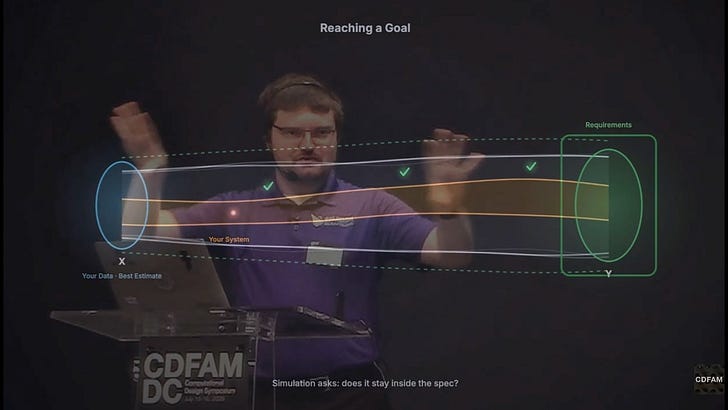
Simulation is central to engineering decision-making, yet in many organizations it remains an expert-driven activity rather than a scalable capability embedded across new product introduction (NPI). As product complexity grows and timelines compress, the key challenge shifts from solver accuracy to workflow coordination: when to simulate, at what fidelity, and how results inform decisions.
This talk introduces agentic engineering workflows — AI-driven systems that guide simulation tasks, recommend appropriate model fidelity, and support interpretation while remaining grounded in validated physics. By combining Engineering AI with Physics AI, these workflows move beyond static automation toward context-aware orchestration of design and validation processes.
Examples include AI assistants that assess simulation readiness — reviewing mesh quality, boundary conditions, and convergence behavior — and CAD-triggered workflows that initiate physics-based validation and surface performance trade-offs. Engineers remain in control, with AI operating within defined guardrails.
Agentic workflows enable earlier and broader use of simulation while preserving traceability, verification standards, and domain expertise. Rather than replacing traditional CAE, they represent an evolutionary step in how simulation insight is generated, reused, and governed across the product lifecycle.
Links
Talk page with full transcript
Search the full text of every recorded CDFAM presentation
This is a public episode. If you would like to discuss this with other subscribers or get access to bonus episodes, visit www.designforam.com