Skip to content
Artwork for CDFAM Computational Design Symposium
ArtsDesignEducation

CDFAM Computational Design Symposium

Duann Scott

Recordings of presentations from the CDFAM Computational Design Symposium held worldwide. Leading experts in computational design, AI and machine learning for industrial design, engineering and architecture from industry, academia and software development.

www.designforam.com
Play
  • 21 episodes
  • Avg 20 min
  • English
Counted on this page — what you have heard stays on this device, so it is not something the list can be paged by.
  • S7 · E15
    Yesterday · 20 min

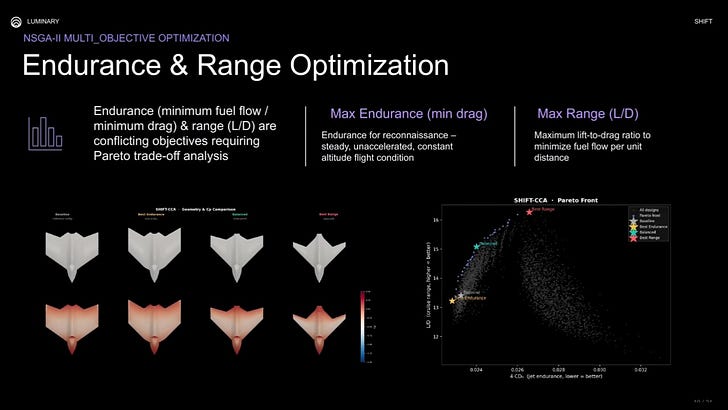
    Physics AI as a Strategic Advantage: How Physics-based AI Models Are Reshaping U.S. Defense Engineering

    CDFAM Computational Design Symposium — Washington DC 2026 Juan Alonso · Luminary The next decade of great-power competition will be won or lost in the engineering loop. Adversaries have increased the speed of iteration in hypersonics, undersea platforms, and autonomous aircraft and the U.S. defense industrial base cannot keep up by relying on traditional engineering workflows. Closing that gap requires a step-change in how programs are developed with AI-accelerated engineering. Links Talk page with full transcript Watch the talk on YouTube Cite this talk Search the full text of every recorded CDFAM presentation Join leading experts in computational design at all scales for two days of knowledge sharing and networking at CDFAM in Tokyo, October 8-9, 2026 This is a public episode. If you would like to discuss this with other subscribers or get access to bonus episodes, visit www.designforam.com

  • S7 · E11
    Wednesday · 11 min

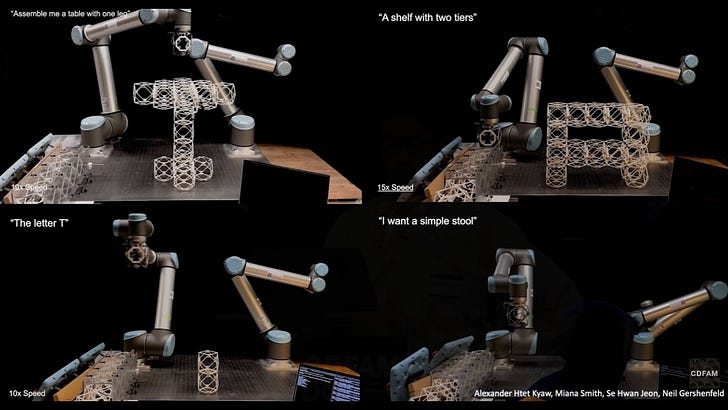
    From Text to Robotic Assembly: 3D Generative AI and Discrete Robotic Assembly for Making Physical Objects

    CDFAM Computational Design Symposium — Washington DC 2026 Alexander Htet Kyaw · MIT Recent advances in 3D generative AI make it possible to create object geometries directly from natural language, but turning these digital forms into functional physical objects remains a major challenge. Most generated 3D models are meshes that do not contain the component level, structural, material, and assembly information required for robotic fabrication. This presentation introduces a research pipeline that combines 3D generative AI, vision language models, and robotic assembly to transform text prompts into multicomponent physical objects. Rather than only asking what an object should look like, the system reasons about how it should be physically composed, including where stronger, lighter, stiffer, or more flexible components are needed. The work points toward a future in which AI driven design systems can generate not only visual form, but also buildable, reusable, and materially informed assemblies for real world fabrication. Links Talk page with full transcript Watch the talk on YouTube Cite this talk Search this talk's transcript This is a public episode. If you would like to discuss this with other subscribers or get access to bonus episodes, visit www.designforam.com
  • S7 · E9
    Wednesday · 17 min

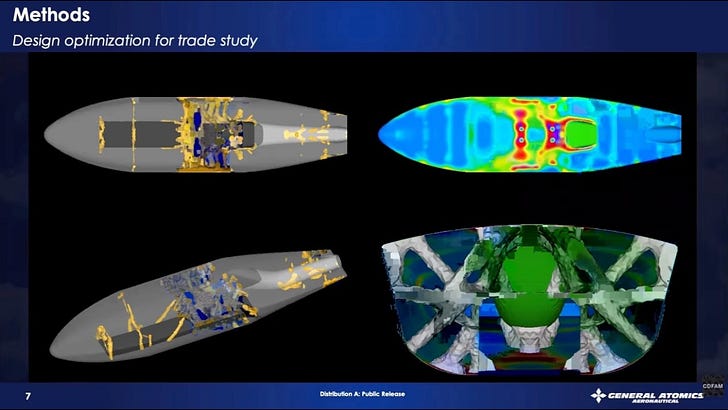
    Computational Design in Aerostructures: Topology Optimization for Conceptual Design and Trade Studies

    CDFAM Computational Design Symposium — Washington DC 2026 Brandon DeMille · General Atomics Aeronautical Systems Computational design methodologies, including topology optimization, are transforming airframe structures development by enabling rapid exploration of design configurations during early conceptual phases. This presentation demonstrates a workflow that enables informed decision-making across disciplines and accelerates the path from initial concept to detailed design. A fuselage case study illustrates the simultaneous optimization of composite laminates for skins, substructure geometry, and overall shaping. This integrated approach facilitates quantitative trade-offs among competing priorities such as cost, structural performance, manufacturability, and production rate. Links Talk page with full transcript Watch the talk on YouTube Cite this talk Search this talk's transcript This is a public episode. If you would like to discuss this with other subscribers or get access to bonus episodes, visit www.designforam.com
  • S7 · E10
    Tuesday · 18 min

    From Requirements to Manufacturable Systems: Agentic AI on a Live Engineering Knowledge Graph

    CDFAM Computational Design Symposium — Washington DC 2026 Chris Helmerich · Celedon Solutions Most ‘AI for engineering’ tools today sit beside the design process with a chat window next to a CAD viewer, a copilot that summarizes documents someone still has to act on. The harder problem is putting AI inside the loop, where it can read and write the same structured representation of the system that engineers, simulations, and downstream manufacturing all depend on. This talk covers how we approached that problem at Celedon Solutions while building Davinci, an engineering platform where agentic AI operates directly on a live knowledge graph of the system under design. Requirements, components, interfaces, behaviors, and their relationships all live in one connected structure, and the agents that work on it can pull structured model content out of reference documents, generate and compare architectural alternatives against performance and cost constraints, trace requirements through simulation results, and reach into external tools such as parts databases, Python simulations, PLM systems through APIs and Model Context Protocol. I’ll walk through the design decisions behind a graph-native rather than document-native foundation, show where generative exploration has meaningfully compressed early-phase trade studies in aerospace and defense pilots, and talk honestly about the failure modes where agents confidently produce plausible-looking nonsense, and what guardrails and iteration strategies actually work. The goal is a practical view of what it takes to move AI from the margins of the engineering workflow into the part of the process where design decisions actually get made. Links Talk page with full transcript Watch the talk on YouTube Cite this talk Search this talk's transcript This is a public episode. If you would like to discuss this with other subscribers or get access to bonus episodes, visit www.designforam.com
  • S7 · E14
    Monday · 19 min

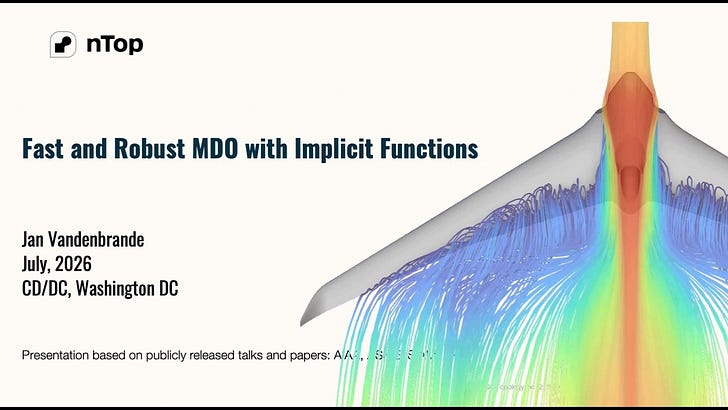
    Fast and Robust Design with Implicit Functions and Direct Simulation

    CDFAM Computational Design Symposium — Washington DC 2026 Jan Vandenbrande · nTop Current Computer Aided Design systems excel in static detailed design but are too fragile and slow to support Design Exploration and Multidisciplinary Design Optimization for conceptual and preliminary design. This talk introduces a new approach to modeling products that overcomes these shortcomings based on implicit functions popularized in the animation industry. The main benefits of the approach is that is responsive to the need to design and redesign products in days or weeks and not month or years because of absolute robustness to parametric change minimizing human intervation; lightning fast evaluations leveraging GPUs; and performing analysis directly from the representation w/o the need of human intervention to generate cumbersome and error prone meshes. Links Talk page with full transcript Watch the talk on YouTube Cite this talk Search the full text of every recorded CDFAM presentation This is a public episode. If you would like to discuss this with other subscribers or get access to bonus episodes, visit www.designforam.com
  • S7 · E12
    Monday · 20 min

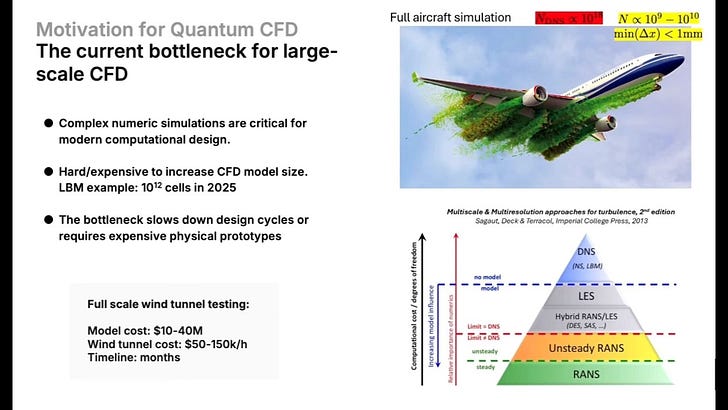
    Solving Aerodynamics Problems With Quantum Computers

    CDFAM Computational Design Symposium — Washington DC 2026 William Steadman · Quanscient We present the results of the largest CFD simulations to date deployed on IBM and IonQ quantum hardware through our ongoing collaborations across the aerospace, maritime, and automotive sectors. We will explore the critical trade-offs quantum computing introduces to computational design in aerodynamics and aeroacoustics, while demonstrating how these advancements are being integrated into Quanscient’s multiphysics software. Links Talk page with full transcript Watch the talk on YouTube Cite this talk Search the full text of every recorded CDFAM presentation This is a public episode. If you would like to discuss this with other subscribers or get access to bonus episodes, visit www.designforam.com
  • S7 · E13
    Monday · 20 min

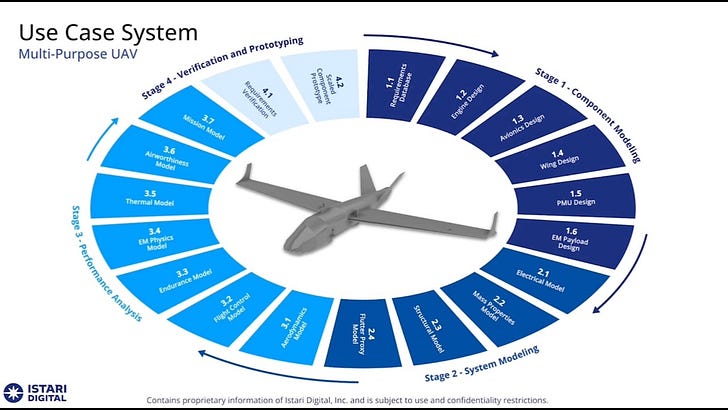
    The Digital Thread In The Real World: Multiple Partners, Multiple Tools, One Truth

    CDFAM Computational Design Symposium — Washington DC 2026 Austin Herrema · Istari Digital As the Department of Defense accelerates adoption of digital engineering and advanced manufacturing, the challenge is no longer defining the digital thread—it is executing it across a fragmented Defense Industrial Base (DIB). This session will explore a consortium-based approach to demonstrating an end-to-end digital thread spanning design, build, operations, and sustainment—executed within each partner’s native environment. Rather than forcing tool or data standardization, this effort enables participating organizations to use their own systems, data architectures, and processes while securely sharing only what is necessary to maintain a federated, authoritative source of truth. The result is a practical model for interoperability that reflects real-world constraints: multiple vendors, distributed ownership, and varying levels of digital maturity. Links Talk page with full transcript Watch the talk on YouTube Cite this talk Search the full text of every recorded CDFAM presentation This is a public episode. If you would like to discuss this with other subscribers or get access to bonus episodes, visit www.designforam.com
  • S7 · E5
    September 18 · 19 min

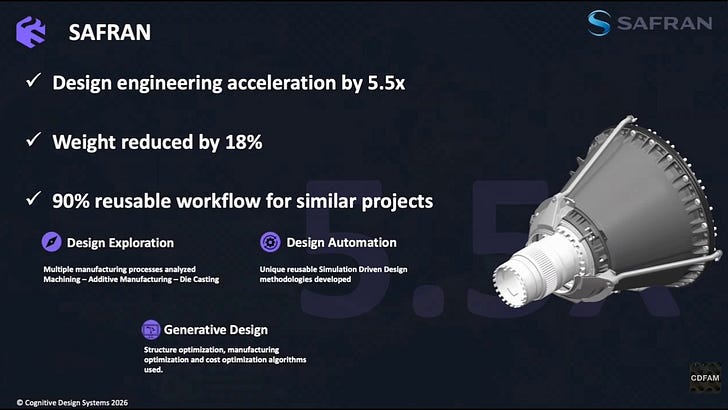
    When Failure Is Not an Option: Bringing Certifiable AI to Engineering Design

    CDFAM Computational Design Symposium — Washington DC 2026 Rhushik Matroja · Cognitive Design Systems Artificial intelligence is poised to automate a large share of design engineering work, yet the technology that excites the commercial world poses a fundamental problem for high-consequence industries. Generative AI is probabilistic by nature. It produces plausible answers, not provably correct ones. In sectors where a single structural failure can ground a fleet, halt a production line, or cost lives, plausibility is not enough. The question is no longer whether AI will transform engineering, but whether we can trust it when failure is not an option. This talk presents a different path. Cognitive Design Systems is a design exploration platform for mechanical and thermo-mechanical component design. Rather than embedding opaque AI inside traditional CAD software, we bring proven engineering workflows to the AI. Deterministic solvers for topology optimization, finite element analysis, manufacturing-driven design, and cost and carbon assessment produce repeatable, auditable, physically grounded results. A conversational AI layer orchestrates these solvers, interpreting intent and chaining tasks, while the underlying engineering computation remains fully deterministic and traceable. Engineers gain dramatic speed without surrendering verifiability or control. This is not theoretical. Our approach is shaped by work with demanding industrial leaders including Safran, Thales, MBDA, Toyota, Tetra Pak, and Logitech, spanning aerospace, automotive, defense, and industrial machinery. These are organizations where engineering rigor and certification are non-negotiable. The implications reach across every engineering sector. As manufacturers face mounting pressure to lightweight structures, accelerate certification, reduce cost and carbon, and modernize their industrial base, the ability to design qualified components faster, with full auditability, becomes a decisive advantage. Trustworthy AI is not a constraint on innovation. It is the precondition for deploying AI in the systems the world depends on. Attendees from industry and policy alike will leave with a clearer view of what responsible, deployable AI for high-consequence engineering actually looks like. Links Talk page with full transcript Watch the talk on YouTube Cite this talk Search this talk's transcript This is a public episode. If you would like to discuss this with other subscribers or get access to bonus episodes, visit www.designforam.com
  • S7 · E6
    September 18 · 22 min

    Measuring Shape Fidelity in Generative CAD Models

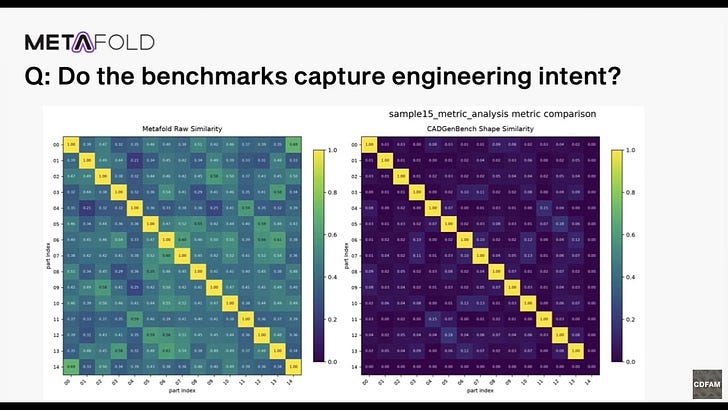
    CDFAM Computational Design Symposium — Washington DC 2026 Daniel Hambleton · Metafold Generative AI is rapidly expanding what designers and engineers can create in 3D, but visual plausibility is not the same as geometric fidelity. This presentation asks a practical validation question: how close are AI-generated CAD models really to a target desired shape? We introduce a feature-vector workflow using the Metafold Shape Similarity technology to compare generated models against reference targets. Each model is encoded into a geometric feature vector, enabling direct comparison through aggregate similarity scores, coordinate-level distance ribbons, scale-normalized metrics, and side-by-side 3D previews. The result is a repeatable method for moving beyond “looks right” evaluation toward measurable shape correspondence. Using examples from current 3D generative design workflows, the talk demonstrates how feature vectors can expose where a generated model preserves intent, where it drifts, and which geometric features contribute most to the gap. This approach offers a lightweight validation layer for AI-assisted CAD: fast enough for iteration, interpretable enough for engineering review, and concrete enough to support model benchmarking. Links Talk page with full transcript Watch the talk on YouTube Cite this talk Search the full text of every recorded CDFAM presentation This is a public episode. If you would like to discuss this with other subscribers or get access to bonus episodes, visit www.designforam.com
  • S7 · E8
    September 17 · 16 min

    Requirements to Production Part in Minutes: How Physical AI Closes the Loop Between Optimization and Manufacturing

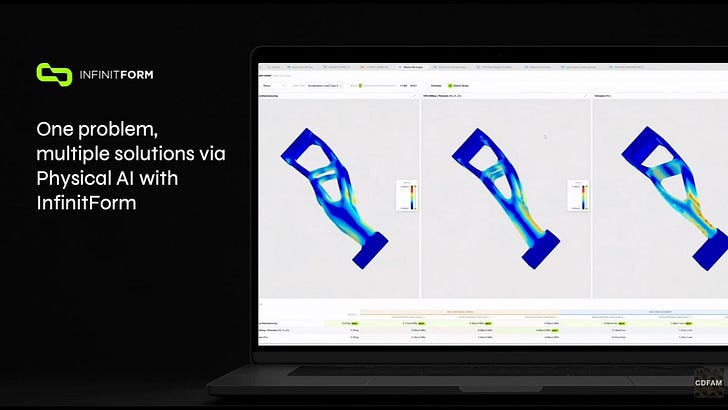
    CDFAM Computational Design Symposium — Washington DC 2026 TJ Root · InfinitForm The gap between optimized geometry and manufacturable components has been the defining constraint of computational design for three decades. Topology optimization produces brilliant forms that machinists cannot cut. Those forms are not editable in CAD / or CAD friendly. Simulation validates performance that mainstream manufacturing cannot reproduce. The result: design cycles measured in months, not days, and engineering organizations forced to choose between what is optimal and what is buildable. InfinitForm was built to eliminate that tradeoff. The platform takes geometrical, engineering, manufacturing and cost constraints as input and outputs production-ready parametric CAD geometry, optimized simultaneously for structural performance and the specific manufacturing process it will be produced with, whether CNC machining, additive manufacturing, casting, extrusion, or injection molding. Every output carries full design history, constrained sketches, and parametric relationships, making it immediately editable in the CAD environment the engineering team already uses. GPU-accelerated solvers and optimizer, the system compresses what previously required weeks of iteration into minutes of compute. This talk presents the technical architecture behind that capability, the manufacturing constraint modeling approach that makes outputs buildable rather than merely optimal, and results from production deployments at aerospace, defense, and advanced manufacturing organizations. It examines what changes when design for performance and design for manufacturing are solved as a single problem rather than sequential steps, and what that means for the engineering organizations, defense programs, and industrial supply chains now entering the Physical AI era. Links Talk page with full transcript Watch the talk on YouTube Cite this talk Search the full text of every recorded CDFAM presentation This is a public episode. If you would like to discuss this with other subscribers or get access to bonus episodes, visit www.designforam.com
  • S7 · E2
    September 17 · 21 min

    Agentic Engineering: Generative AI in structural applications

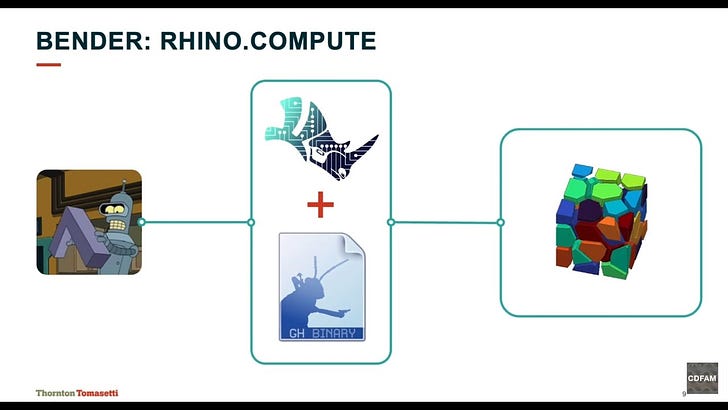
    CDFAM Computational Design Symposium — Washington DC 2026 Sergey Pigach · CORE studio | Thornton Tomasetti CORE studio spent a decade building machine learning tools for structural design and analysis, all running as cloud services behind APIs. When MCP arrived, handing those same tools to an agent turned out to be close to trivial. Sergey Pigach demonstrates Bender, an agentic system running on AWS that the firm talks to through Slack: ask it for a concrete column stack and footing for a five-storey residential building in New York, let it make the remaining assumptions, and it calls the tools the engineers use, renders the result and writes a design summary. It lives in Slack deliberately, because an agent sitting in a shared thread already has the context of the conversation around it, which a one-to-one chatbot does not. Specialist sub-agents handle questions like embodied carbon. From there the talk moves to agents talking to each other. A2A is a protocol for delegation between agents, complementary to MCP rather than competing with it, but it has no discovery layer — a public agent the team put online was found by nobody. That gap prompted Waggle, Pigach's own side project, which crawls for valid agent cards and builds a searchable index with health, quality and trust signals, then delegates a request to whichever agent can handle it. He also shows agents paying each other small amounts to cover expensive work. The most uncomfortable result is a benchmark. CORE studio asked its own engineers for the hardest structural problems they could devise, assembled 91 of them, graded answers to within one percent, and gave the models nothing but a calculator and a Python sandbox — no internet, no engineering software. They expected around half. It saturated immediately, with the leading models above 94 percent. Tracing backwards showed the unlock was reasoning: the first reasoning model jumped from 38 percent to 74, and the line has run straight up since. Structural engineering, as he puts it, is a verifiable domain. The talk closes on CAD experiments, including a Grasshopper plugin that exposes a parametric definition to an agent as MCP tools and a hackathon robot arm driven by natural language, and on the conclusion that this is not a domain expertise problem but an unhobbling problem. Links Talk page with full transcript Watch the talk on YouTube Cite this talk Search the full text of every recorded CDFAM presentation This is a public episode. If you would like to discuss this with other subscribers or get access to bonus episodes, visit www.designforam.com
  • S7 · E3
    September 17 · 14 min

    Physics as Infrastructure for the AI Era

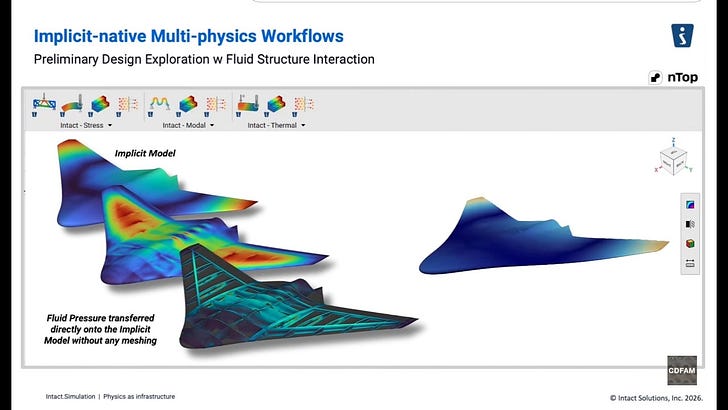
    CDFAM Computational Design Symposium — Washington DC 2026 Rik Baruah · Intact Solutions AI is reshaping engineering as it drives demand for surrogate models, large design studies, and agentic workflows that require automated simulation loops at scale. These pipelines collide with two realities: geometric representation is fragmented throughout the hardware lifecycle (from CAD to point clouds), and traditional FEA, reliant on conformal meshing and manual preprocessing, treats human intervention as a core requirement. This brittle paradigm resists automation. Scaling simulation for the AI era is fundamentally an infrastructure problem. Using immersed grid methods, Intact natively ingests any geometry representation without preprocessing, exposing physics as an API-first callable function. We demonstrate how this architecture powers the emerging “engineering-as-code” stack through automated DOE pipelines and LLM orchestration via MCP across concept, manufacturing, and deployment. Links Talk page with full transcript Watch the talk on YouTube Cite this talk Search the full text of every recorded CDFAM presentation This is a public episode. If you would like to discuss this with other subscribers or get access to bonus episodes, visit www.designforam.com
  • S7 · E4
    September 17 · 23 min

    From Tools to Agents: How Agentic Engineering Workflows Are Reshaping Simulation-Driven Product Development

    CDFAM Computational Design Symposium — Washington DC 2026 Andrew Acuff · SimScale Simulation is central to engineering decision-making, yet in many organizations it remains an expert-driven activity rather than a scalable capability embedded across new product introduction (NPI). As product complexity grows and timelines compress, the key challenge shifts from solver accuracy to workflow coordination: when to simulate, at what fidelity, and how results inform decisions. This talk introduces agentic engineering workflows — AI-driven systems that guide simulation tasks, recommend appropriate model fidelity, and support interpretation while remaining grounded in validated physics. By combining Engineering AI with Physics AI, these workflows move beyond static automation toward context-aware orchestration of design and validation processes. Examples include AI assistants that assess simulation readiness — reviewing mesh quality, boundary conditions, and convergence behavior — and CAD-triggered workflows that initiate physics-based validation and surface performance trade-offs. Engineers remain in control, with AI operating within defined guardrails. Agentic workflows enable earlier and broader use of simulation while preserving traceability, verification standards, and domain expertise. Rather than replacing traditional CAE, they represent an evolutionary step in how simulation insight is generated, reused, and governed across the product lifecycle. Links Talk page with full transcript Watch the talk on YouTube Cite this talk Search the full text of every recorded CDFAM presentation This is a public episode. If you would like to discuss this with other subscribers or get access to bonus episodes, visit www.designforam.com
  • S7 · E7
    September 15 · 22 min

    Text To Spaceship: Accelerating Mission Development With AI at NASA

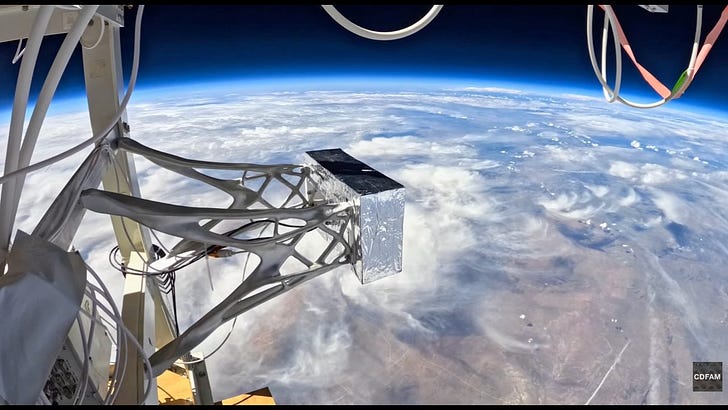
    CDFAM Computational Design Symposium — Washington DC 2026 Ryan McClelland · NASA Goddard AI is transforming how we design and build space missions. At NASA, we’ve already shown that AI can take requirements and rapidly generate optimized structures that are lighter, stronger, and delivered in days instead of months. The Text-to-Spaceship vision scales this up through a secure, cloud-deployed ecosystem of AI-accessible design, analysis, and manufacturing tools. Language-defined requirements flow through these automated systems, accelerating mission development by an order of magnitude. In this talk, I’ll share how we’ve gone from balloon brackets to full payload designs and why Text-to-Spaceship is becoming a near-term reality that will redefine how we explore the universe. Links Talk page with full transcript Watch the talk on YouTube Cite this talk Search the full text of every recorded CDFAM presentation This is a public episode. If you would like to discuss this with other subscribers or get access to bonus episodes, visit www.designforam.com
  • S7 · E1
    September 14 · 34 min

    Authoring Autonomy

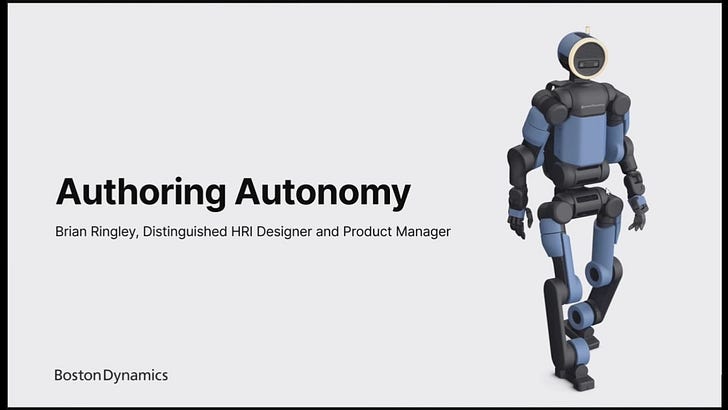
    CDFAM Computational Design Symposium — Washington DC 2026 Brian Ringley · Boston Dynamics Atlas is a general-purpose humanoid aimed squarely at industrial work, and Brian Ringley makes the case that its value is economic rather than technological. Most of the automation gaps on a factory floor could be closed with conventional equipment; what makes that impractical is designing a bespoke solution for each one. A single investment in generalised hardware turns all of those separate problems into one software problem, which is a far cheaper thing to solve. The talk walks through the industrial design decisions that follow from putting a machine into shared human space. Why the robot has a head and a face that turns: perception needs to sit at eye level, and a gaze tells a person nearby that they have been seen and hints at what the robot will do next. Why it reads as equipment rather than as a person. And why only two actuator types appear across the whole machine, giving a blocky, repetitive design language in exchange for cost, reliability and field-replaceable parts, with continuously rotating joints that let it work in ways a human body cannot. The second half is about teaching it to do useful work. Ringley lays out the current stack — reinforcement learning for whole-body control, behaviour cloning from VR teleoperation for manipulation, and a vision-language model above both for reasoning and tool calls — and is candid that the hard constraint is data. There is no internet-scale corpus of action data, so it has to be produced: pilots suited up in VR on real plant floors, training in simulation to remove latency, and supervised correction where a human takes control mid-policy to annotate what went wrong. Running underneath is an argument about authorship, that the line between who writes software and who uses it has largely dissolved, and that the world itself is becoming the arena in which this software is trained. Links Talk page with full transcript Watch the talk on YouTube Cite this talk Search the full text of every recorded CDFAM presentation This is a public episode. If you would like to discuss this with other subscribers or get access to bonus episodes, visit www.designforam.com
  • S6 · E27
    September 12 · 19 min

    HOOPS AI: Correlating CAD Geometry with Manufacturing & Business Process Information

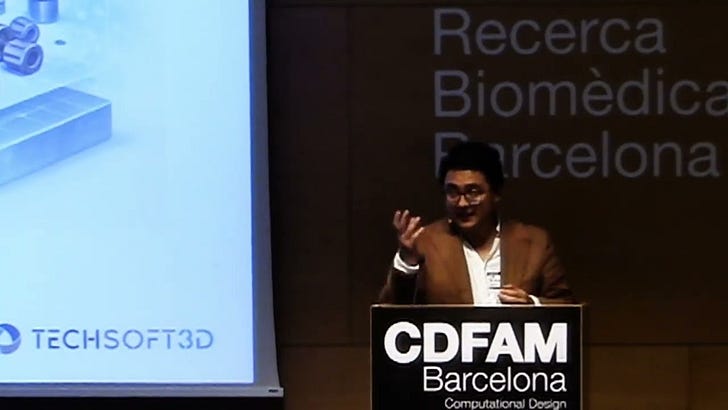
    CDFAM Computational Design Symposium — Barcelona 2026 Luis Salazar Betancourt · Tech Soft 3D Advances in computational design and additive manufacturing have enabled increasingly complex geometry, but industrial AI adoption remains constrained by a fundamental challenge: relating CAD design data to manufacturing behavior and downstream business processes. Geometry, process data, and enterprise information are typically analyzed in isolation, making it difficult to understand how design decisions propagate across the product lifecycle. HOOPS AI addresses this by transforming CAD and manufacturing data into unified, AI-ready representations built on the HOOPS platform. The approach focuses on extracting stable geometric and feature-level abstractions that serve as a common reference across engineering and non-engineering domains, without reliance on native CAD kernels or proprietary data models. These representations enable systematic comparison, grouping, and retrieval of parts based on geometric and functional characteristics. The same representations can be associated with manufacturing signals, quality indicators, and production constraints, and extended to link with business process information in an IP-safe manner. This allows AI systems to reason about relationships between CAD geometry, manufacturing outcomes, and operational drivers. The presentation covers the architectural principles behind HOOPS AI and illustrates how unified representations support scalable integration of AI into industrial CAD and additive manufacturing workflows, with emphasis on system design and interoperability. Links Talk page with full transcript Watch the talk on YouTube Cite this talk Search the full text of every recorded CDFAM presentation This is a public episode. If you would like to discuss this with other subscribers or get access to bonus episodes, visit www.designforam.com
  • S6 · E26
    September 12 · 19 min

    Architected Porosity Informed by Real-World Data for More-Than-Human Thermal Comfort

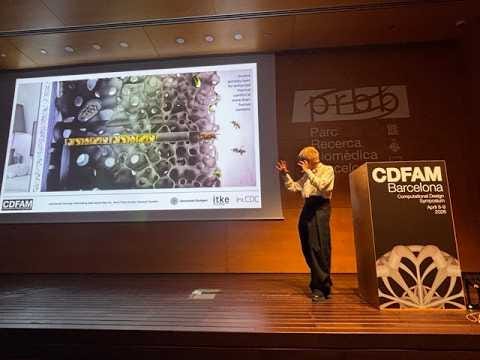
    CDFAM Computational Design Symposium — Barcelona 2026 Maria Claudia Valverde Rojas · University of Stuttgart, IntCDC This presentation introduces a design and research framework that integrates geometry generation with real-world climatic and ecological data to support more-than-human thermal comfort in the exterior of building envelopes. Over the past two years, I have developed architected porous cellular structures, periodic and non-periodic, based on adaptive density minimal surfaces (ADMS) and triply periodic minimal surfaces (TPMS). These structures serve as protective envelopes for nesting tubes used by cavity-nesting wild bees. The novelty of this work lies not in the digital modelling itself, but in demonstrating how pore size and spatial gradients can be tuned to buffer heat threats inside nesting cavities, and how these porous morphologies behave under real outdoor conditions. Full-scale and small-scale prototypes were installed on real building settings, where they were exposed to solar radiation, diurnal temperature swings, summer heat events and varying humidity. Continuous monitoring revealed how these structures process and respond to environmental information, delaying heat peaks, modulating temperature transfer, and interacting with passive evaporative cooling strategies. In parallel, wild bee occupation of the prototypes provided biological feedback, confirming which geometries are perceived as suitable nesting habitats. Bringing together digital modelling, outdoor performance testing and ecological observation, this research proposes a design approach that situates building envelopes as active interfaces capable of supporting more-than-human thermal comfort in urban environments. Links Talk page with full transcript Watch the talk on YouTube Cite this talk Search the full text of every recorded CDFAM presentation This is a public episode. If you would like to discuss this with other subscribers or get access to bonus episodes, visit www.designforam.com
  • S6 · E25
    September 12 · 25 min

    Real-Time Multi-Physics Collaboration for Real-World Engineering

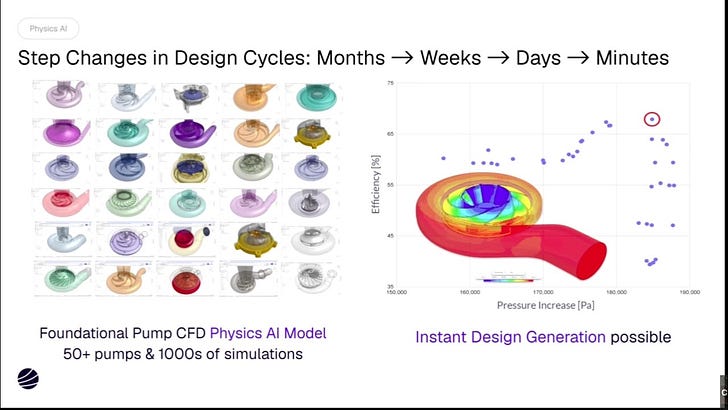
    CDFAM Computational Design Symposium — Barcelona 2026 Nikolas Borrel Jensen, Oliver Littlewood · Pasteur Labs Real multiphysics necessitates coordination along multiple dimensions: one is of course the mixed physics, another is the heterogeneous data types & modeling approaches, and a third is the multidisciplinary (mis)communication. AI shoved into engineering workflows does not eliminate these gaps, rather it exacerbates them. For instance, numerical solver outputs and ML data structures are incompatible, with no shared representations to bridge them. At the human level, CAE experts, Mech/Aero/Nuclear Engineers, Systems Engineers, and AI/ML Engineers all operate in different conceptual frameworks and thus lose valuable time and information at every handoff. This talk presents Pasteur Labs’ approach to streamlining all three dimensions of multiphysics with the cohesive “Simulation Intelligence (SI) Platform”, emphasizing three plug-n-play products. SI Testbeds automate data generation end-to-end, from preprocessing through simulation runs and postprocessing, producing ML-ready CAE datasets at scale. SI Workspaces enable the flexible composition of next-generation multi-physics pipelines by stratifying surrogate models, optimization methods, and uncertainty quantification tools, with automatic differentiation as a first-class citizen throughout. Tesseracts are end-to-end differentiable containers that encapsulate heterogeneous numerical solvers and surrogate models behind a unified API, making otherwise incompatible components interoperable by design across software, hardware and teams. All prioritize modularity, scalability, and traceability, providing the engineering cohesion that is needed to adopt Physics-AI. The SI Platform is elucidated by two different types of engineers working on two concrete engineering cases, with real-time collaboration: surrogate-based acceleration and optimization of centrifugal pump performance, and end-to-end gradient-based parametric optimization of rocket grid fins. Links Talk page with full transcript Watch the talk on YouTube Cite this talk Search the full text of every recorded CDFAM presentation This is a public episode. If you would like to discuss this with other subscribers or get access to bonus episodes, visit www.designforam.com

  • S6 · E24
    September 12 · 19 min

    Beyond Surrogates: Foundational AI for Physics-Native Design

    CDFAM Computational Design Symposium — Barcelona 2026 Wasil Rezk · BeyondMath A new generation of AI models is emerging — not just faster approximators, but intelligent systems that understand and generate physics. This talk explores how foundational physics AI breaks from the surrogate modeling paradigm. Unlike models that rely on customer-provided simulation data or narrow datasets, BeyondMath’s models are trained on self-generated data rooted in first principles — not interpolating outcomes, but learning the physical laws and structure of the design space itself. This approach enables something radically new: generalizable, physics-consistent predictions at near-CFD fidelity, delivered in seconds — and without the need to retrain when a geometry changes. It opens the door to simulation-native design workflows, where simulation is not a bottleneck but a continuous, integrated part of ideation and optimization. – Why surrogate AI models struggle in real-world engineering – What it means to build a foundational model that learns physics, not data correlations – Case studies from sectors like motorsport and energy – How these models enable new kinds of design tools and thinking This is not an evolution of simulation — it’s a rethinking of how AI and physics interact. Foundational AI for physics is here, and it’s reshaping the very act of designing the physical world. Links Talk page with full transcript Watch the talk on YouTube Cite this talk Search the full text of every recorded CDFAM presentation This is a public episode. If you would like to discuss this with other subscribers or get access to bonus episodes, visit www.designforam.com
  • S6 · E23
    September 12 · 18 min

    NeuralShipper: Generative AI for the Next Generation of Ship Design and Manufacturing

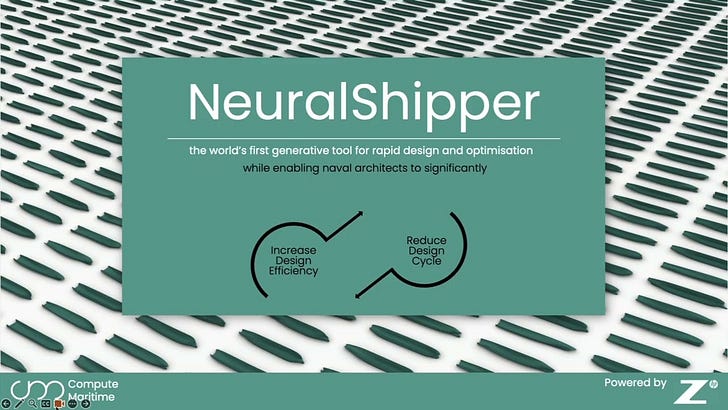
    CDFAM Computational Design Symposium — Barcelona 2026 Shahroz Khan · Compute Maritime Water transport, which accounts for approximately 90% of global trade, is essential to economic growth but poses a significant environmental challenge. In 2020, shipping emitted 1.4 billion tonnes of CO₂, nearly 3% of global emissions. Without decisive action, this figure could rise to 18% by 2050. To address this, the International Maritime Organization (IMO) is increasing regulatory and financial pressure on industry stakeholders to cut emissions by at least 40% by 2030 through the adoption of innovative technologies. Achieving these targets requires optimising vessel performance from design through to operation. In fact, 80% of a product’s environmental impact is determined at the design stage, making it the most effective point for influencing a ship’s environmental footprint. Experienced shipbuilders recognise that design and engineering decisions made at this stage affect 85% of total construction costs and approximately 90% of overall vessel performance. However, the maritime industry is often perceived as conservative compared to other transport sectors such as automotive and aerospace. Existing design practices are not suited to developing tools that enable true innovation. This is where Compute Maritime enters the picture, offering AI-powered design tools and data-driven solutions for maritime sustainability. Our flagship product, NeuralShipper, is the world’s first generative AI co-pilot for the design, optimisation, and simulation of maritime systems. It can handle everything from ship hulls and propellers to hydrofoils and rudders, all within a single platform. Unlike conventional tools, which are often restricted to specific ship types, NeuralShipper is universally adaptable. Whether naval architects and marine engineers are working on a fuel-efficient cargo ship, a specialised workboat, a sleek yacht, or a complex naval vessel, NeuralShipper is designed to support them and accelerate the maritime industry’s progress towards net-zero emissions. With only a few design specifications as input, NeuralShipper can generate thousands of tailored design concepts within minutes, each meeting the specified criteria. This eliminates the need for manually drafting preliminary sketches or parametric CAD models, enabling designers to evaluate optimised options in real time. Users can also define custom constraints and performance criteria to create bespoke solutions. Traditional design tools rely heavily on user expertise and deep familiarity with complex software, making the process slow and innovation-limiting. In contrast, NeuralShipper streamlines the entire process. It acts as a collaborative AI designer, working alongside human experts to develop solutions that are both performance-efficient and innovative. This significantly accelerates concept development and allows teams to move swiftly into detailed design without compromising on creativity, innovation, or sustainability. At the core of NeuralShipper lies our Large Geometric Foundation Model, trained on over 100,000 ship designs encompassing nearly every type, shape, and category. This extensive dataset gives NeuralShipper a unique ability to generate solutions that would be difficult or even impossible for human designers to achieve when working with incomplete inputs or domain-limited knowledge. Such scenarios are common in cutting-edge projects exploring next-generation propulsion systems and alternative fuels. Importantly, NeuralShipper is the first generative AI model capable of directly outputting a CAD model, primarily in the form of a NURBS surface. One of the critical challenges facing existing 3D foundational models is surface quality. These models, which often rely on low-level shape representations, frequently fail to capture the geometric precision required for reliable performance analysis. In engineering contexts, where even minor surface imperfections can significantly influence outcomes, ensuring smoothness and validity is crucial. Addressing this challenge, and achieving high surface quality and physics-informed accuracy, has been central to NeuralShipper’s innovation. Links Talk page with full transcript Watch the talk on YouTube Cite this talk Search the full text of every recorded CDFAM presentation This is a public episode. If you would like to discuss this with other subscribers or get access to bonus episodes, visit www.designforam.com
Showing 1–20 of 21 episodes