Skip to content
Artwork for Beyond the CMS - A Content Management Podcast
TechnologyBusinessMarketing

Beyond the CMS - A Content Management Podcast

Chris Bryce | Dotfusion Digital

Beyond the CMS is about content operations and the future of content: how enterprises create it, scale it, and get it found by people and AI. Hosted by Chris Bryce, Partner at Dotfusion, the show has just passed 50 episodes of conversations with the people building that future.

It started as a show about CMS platforms, and that conversation never stopped. Guests have come from Contentful, Storyblok, Agility CMS, Squiz, Bloomreach, ButterCMS, StreamX, BILDIT, CrafterCMS, React Bricks, and Magnolia, talking through what headless and composable architecture actually gets you. But the range has grown well beyond platform comparisons. Recent episodes cover Answer Engine Optimization (AEO) and how AI search engines decide what to cite, MCP (Model Context Protocol) servers that connect AI agents directly to a CMS, agentic content operations workflows, accessibility, and what it takes to govern content at the scale of a university managing tens of thousands of edits a week. Episode 50 brought on Olivier Dobberkau of the dkd/TYPO3 Association to dig into semantic search and retrieval-augmented generation (RAG).

The CMS is still the hub. It's just not the whole story anymore. If you're a CMO, IT Director, or Chief Digital Officer trying to figure out how your content gets made, published, and found, by people and by AI, this is where those conversations happen.

#contentoperations #answerengineoptimization #aeo #aisearch #headlesscms #contentful #storyblok #agilitycms

Play
  • 22 episodes
  • Avg 34 min
  • English
Counted on this page — what you have heard stays on this device, so it is not something the list can be paged by.
  • S1 · E51
    November 6 · 35 min

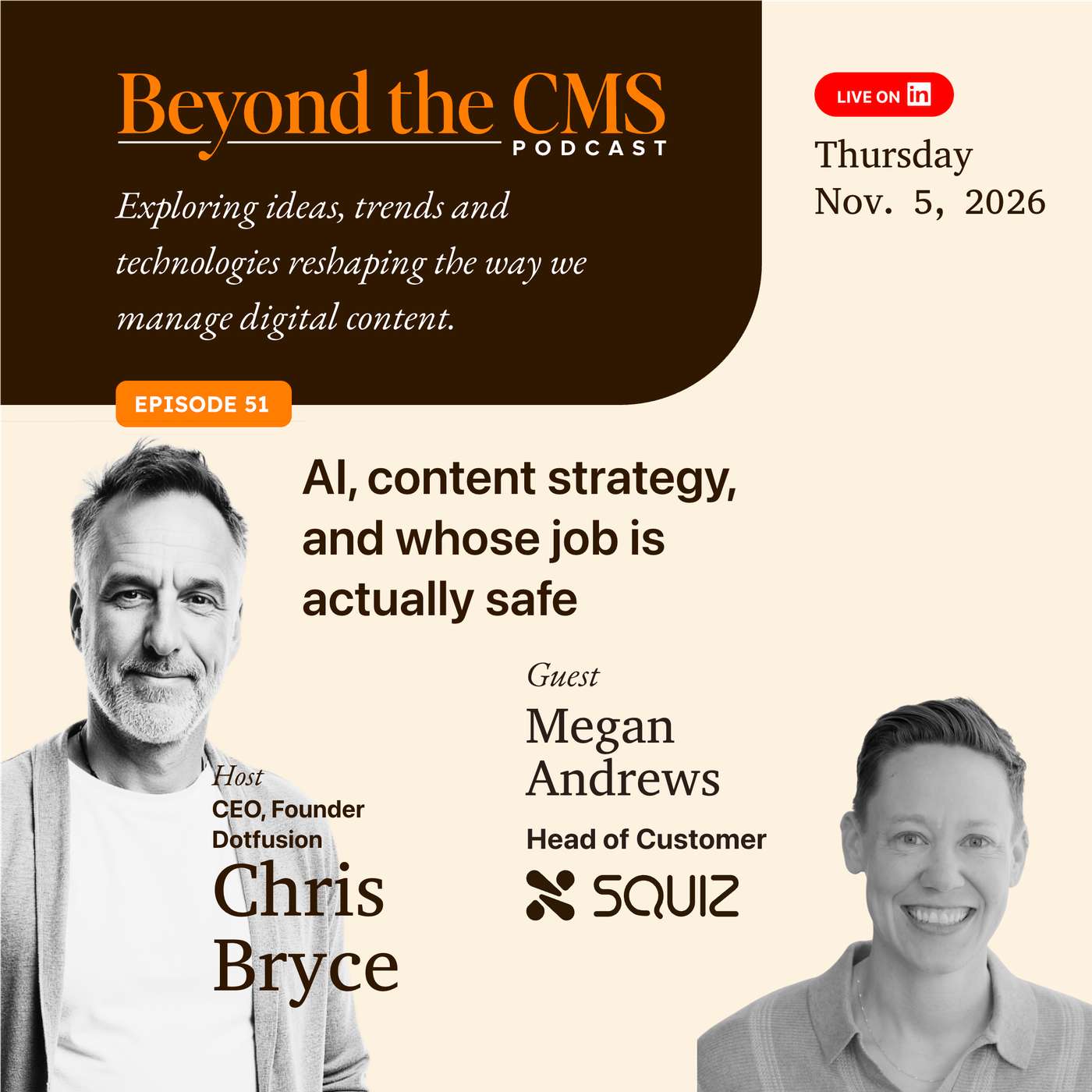
    Making AI Search Useful Starts with Better Content: Megan Andrews of Squiz

    Useful AI search starts with content people and machines can understand. Megan Andrews, Head of Customer, U.S. at Squiz, joins Chris Bryce to explore the content work behind conversational website experiences. Megan demonstrates Squiz Content Intelligence, including accessibility findings, topic-level AI-readiness checks and recommendations for contradictory, ambiguous or missing information. The conversation also covers DXP and headless tradeoffs, student feedback, human oversight and the limits of external answer-engine optimization. What you will learn How to weigh an integrated DXP against a headless stack and your team's capacity Why real student feedback matters more than assumptions about AI adoption How Squiz Content Intelligence groups content into topics and flags weak answers Where accessibility fixes and AI-readable content overlap, without treating them as guarantees How to test important user questions and inspect the source pages behind an answer Why fresh information, human review and content ownership still matter Chapters 0:00 Welcome to Beyond the CMS Episode 51 1:24 Megan Andrews and Squiz 2:30 DXP vs headless: team capacity and integration tradeoffs 5:57 Who Squiz serves: higher education and government 7:52 Thoughtful AI and humans in the loop 11:23 What students actually want from AI search 12:45 Synthetic personas and real-user blind spots 15:31 Conversational website interfaces 17:10 Squiz conversational search demo 18:30 Why AI makes content strategy more important 21:05 Content Intelligence accessibility walkthrough 23:06 AI readiness: contradictions, ambiguity and gaps 25:21 University of Montana search example 26:50 SEO vs AEO: control what you can control 28:53 Test real questions and trace the source pages 30:57 Related content, freshness and unresolved limits 34:21 Connect with Megan and closing thoughts About Megan Andrews Megan is Head of Customer, U.S. at Squiz, overseeing client expansion, renewals and customer growth strategy. Her work spans enterprise technology, SaaS and digital transformation. Links Watch the episode on YouTube Squiz Content Intelligence Squiz Connect with Megan on LinkedIn Beyond the CMS archive Beyond the CMS is hosted by Chris Bryce, founder of Dotfusion.

    • Transcript
  • S1 · E50
    October 5 · 41 min

    Search Is the Interface: Semantic Search and RAG with Olivier Dobberkau

    What happens when website search evolves from a keyword box into an intelligent interface? In Episode 50 of Beyond the CMS, Chris Bryce speaks with Olivier Dobberkau, CEO and founder of dkd Internet Service GmbH and president of the TYPO3 Association, about how enterprise search is moving from keyword matching toward semantic search, retrieval-augmented generation (RAG), conversational experiences and agent-readable interfaces. Olivier explains why AI search begins with content quality, metadata and retrieval. They discuss Apache Solr for TYPO3, embeddings, document chunking, grounding, hallucination risks, search feedback and the difference between a generic chatbot and specialized search capabilities routed by user intent. In this episode: Why search is becoming an interface rather than only a search box How keyword search differs from semantic search and RAG How Apache Solr supports TYPO3 search Why poor content creates poor AI-search results How chunking can remove important context Why specialized search capabilities can outperform generic chatbots How real questions, zero-result searches and user feedback improve retrieval Why organizations should repair content before adding generated answers Chapters 0:00 Welcome to Beyond the CMS Episode 50 2:06 Olivier Dobberkau, dkd and the TYPO3 ecosystem 5:32 Apache Solr search for TYPO3 7:23 Why search is becoming the interface 11:21 From keywords to conversational and agentic search 13:47 Content quality, grounding and search quality 19:46 Why chatbots are not always the right experience 22:37 Specialized search capabilities and intent routing 24:02 Question-based website search in practice 26:19 Repairing content before adding RAG 28:33 Retrieval, metadata, feedback and supervision 31:25 RAG explained: indexing, embeddings and retrieval 34:16 Chunking, context and grounded answers 36:39 Open source, access and the TYPO3 community About Olivier Dobberkau Olivier Dobberkau is CEO and founder of dkd Internet Service GmbH and president of the TYPO3 Association. His work spans open-source CMS development, TYPO3 search, Apache Solr and the transition from keyword search toward intelligent content discovery. Connect with Olivier on LinkedIn Learn about dkd's TYPO3 work Learn about Dotfusion

    • Transcript
  • S1 · E49
    September 18 · 32 min

    How Limena Helps Recover Revenue Lost to Web Accessibility Barriers

    Most accessibility tools tell you what is broken. Limena helps teams understand which accessibility barriers are disrupting valuable customer journeys, what those failures may be costing the business, and who owns the fix. Ryan Short, founder of Limena, joins Chris Bryce to explain how accessibility intelligence turns a long list of WCAG failures into business priorities. Limena connects accessibility barriers to customer journeys, conversion points, organizational ownership, and continuous verification. They discuss: Why accessibility work keeps losing to the product backlog How to connect accessibility barriers to customer journeys and revenue How Limena prioritizes issues by business impact Why closing a development ticket does not prove the barrier is gone Why widgets and point-in-time audits are not enough Where accessibility overlaps with SEO, AEO, and content quality How Limena fits into Git-based and composable delivery workflows Watch the episode: YouTube Learn more about Limena: limena.app Connect with Ryan: LinkedIn Learn more about Dotfusion: dotfusion.com

    • Transcript
  • S1 · E48
    September 4 · 35 min

    Sustainable Digital Transformation at Scale: Joyce Peralta on McGill's Content Model

    McGill University runs a thousand sites on its central platform, 500 more custom builds, and tracks 6,000 to 8,000 content edits a week. Joyce Peralta, Manager of Digital Communications at McGill, joins Chris Bryce to talk about the content model project addressing all of it. The number that anchors this conversation: 61 different terms used across the university for the exact same program component. Joyce's central point is that AI does not cause content inconsistency, it amplifies inconsistency that already exists. The inaccuracy people see in AI answers comes from information presented differently across websites, not from information that is wrong. McGill looked at building a separate content repository just for AI and turned it down, because a second repository means a second governance and synchronization problem. Joyce points to Dries Buytaert's markdown experiment, which found AI bots still hit the website itself the majority of the time. The content model work is federated across about 50 subject matter experts from departments across the university. Rollout runs concept by concept, with a timeline Joyce estimates at five years or more. Her real point on success: this cannot be a Communications project or an IT project alone, it has to be both working as one team, with alignment across the whole institution. Also in this one: the student usability panel that tracks how AI use among students changes year over year, why Drupal and the Drupal EDU Slack group are a real source of leverage, and what a taxonomy problem looks like at university scale. Chapters 0:00 Welcome to Episode 48 1:05 Meet Joyce Peralta, McGill University 1:38 The velocity of change since Beyond the CMS launched 2:35 Inside McGill's web services team: comms and IT as one team 4:12 Who owns the university's content model 5:56 The vision behind McGill's content transformation 9:34 Taxonomy at scale: a thousand sites, 500 custom builds, 6,000 to 8,000 edits a week 14:33 Federated with 50 subject matter experts: the 61-term problem 16:19 AI amplifies inconsistency, it does not cause it 17:19 Why McGill rejected a separate AI-only content repository 19:10 How McGill actually uses AI in the content model project 21:35 Concept by concept: a rollout Joyce estimates at five years or more 24:02 Open source, Drupal, and the Drupal EDU Slack group 26:49 Three feedback groups, including the student usability panel 29:50 The human side of technology as AI reshapes expectations 31:32 Lessons for higher ed teams just starting this work 33:38 Where to find higher ed thought leadership 34:52 Wrap-up Click here to watch a video of this episode. Links Joyce Peralta on LinkedIn Dotfusion headless CMS services Chris Bryce on LinkedIn Click here to view the episode transcript.

    • Transcript
  • S1 · E47
    July 15 · 32 min

    Killing Copy and Paste: MCP Servers and Agentic Content Ops with Joel Varty of Agility CMS

    Enterprise content supply chains run 15 to 19 steps. Joel Varty, CTO of Agility CMS, thinks AI can get that down to six, so people are the only bottlenecks left. Chris Bryce and Joel dig into the MCP server that connects Claude directly to your CMS and kills the copy-paste layer of content operations. Joel has spent 21 years building Agility, the Canadian headless CMS behind Cineplex, Scotiabank country sites, school boards, and higher education. He explains why Agility deliberately did not build an AI agent inside the CMS, and instead meets teams inside the AI they already use: Claude, Copilot, or Gemini. The MCP server now runs the full loop: content models for developers, a content pipeline that pushes up to 250 items per batch, and bulk publish, unpublish, and delete. Plus metadata vs JSON-LD schema in plain language, AEO, blogging from a phone with a Claude project, and content ops through a CLI for regulated industries that need sign-off and audit logs. Click here to watch a video of this episode. Links: Agility CMS: https://agilitycms.com Connect your AI agent to Agility: https://mcp.agilitycms.com Dotfusion (Agility Partner): https://dotfusion.com/services/agility-cms-development-agency Chris on LinkedIn: https://www.linkedin.com/in/cbryce Joel Varty on LinkedIn: https://www.linkedin.com/in/joelvarty/ Creators & Guests Chris Bryce - Host Joel Varty - Guest Click here to view the episode transcript.

    • Transcript
  • S1 · E46
    June 24 · 32 min

    Is Your Content AI-Ready? Query Fanout & AEO with Joel Goodman of Squiz

    Most enterprise sites are not ready to be found by AI search, and the fix starts before you ever migrate. Chris Bryce talks with Joel Goodman, VP of Growth Strategy at Squiz, about content intelligence, query fanout, and what makes a composable DXP AI-ready. Joel spent 13 years running an agency in higher education before joining Squiz, a 26-year-old Digital Experience Platform built in Australia with a growing North American presence. We get into what makes Squiz different from a traditional headless CMS, why accessibility is now the same problem as AI discoverability, and how Squiz Content Intelligence audits your content the way an AI search engine reads it. The sharpest idea: query fanout. Ask one question in ChatGPT and it breaks into 40, 50, sometimes 60 sub-queries your content has to answer, queries you never see. Click here to watch a video of this episode. Links: Squiz: https://www.squiz.net Dotfusion (Squiz Partner): https://www.dotfusion.com Chris on LinkedIn: https://www.linkedin.com/in/cbryce Joel Goodman on LinkedIn: [ADD URL] Creators & Guests Chris Bryce - Host Click here to view the episode transcript.

    • Transcript
  • S1 · E45
    June 11 · 37 min

    Getting Off Legacy CMS the Right Way: A Live AMA with Contentful's Luke Wertz and Nick Switzer

    Legacy CMS platforms lock your front end and back end together, so every new channel becomes its own project. In this live AMA, Chris Bryce sits down with Luke Wertz and Nick Switzer of Contentful to talk about what it actually takes to move off WordPress, Drupal, Sitecore, or AEM and into a modern, composable content stack. Luke manages Contentful's commercial mid-market solution engineering team in North America. Nick manages the enterprise side from Denver. Between them they have close to four decades in the CMS space, and they walk through Contentful's founding story in Berlin, where updating a single word in a native mobile app used to mean shipping a whole new version of the app. We get into the honest difference between legacy, monolithic, and composable platforms, what a migration actually looks like in 2026, why content modeling is the foundation that makes everything downstream faster, why Contentful stays rigid on structured JSON delivery while building flexible tools for editors, and how Contentful's AI Actions and API first management layer let agents like Claude create, scale, and govern content directly inside the platform. (00:00) - Welcome to Episode 45: the "Car Guys" origin story (01:29) - Meet Luke Wertz and Nick Switzer of Contentful (03:53) - Contentful's founding story (06:18) - A Dotfusion case study: one hub for app, web, and in-store screens (06:43) - Defining headless: content infrastructure over jargon (08:05) - Headless in plain English (09:33) - The developer view: content models and the job of your content (13:05) - Where a Contentful site actually lives (16:49) - Legacy, composable, and monolith: mapping the CMS market (18:53) - Why teams migrate once content needs to do something (20:38) - Choosing Contentful when your team is lean (22:09) - AI inside the platform versus AI acting on the platform (23:09) - API first for delivery and for management (25:17) - Live question: have we passed the tipping point for composable? (27:10) - Rigid on delivery, flexible for humans (29:24) - Claude and Contentful: a week of content ops down to an hour (31:11) - What's next: agentic analytics and closing the loop (33:40) - The next two problems: scale and governance (35:50) - A third M for the roadmap: agentic migration (36:49) - Wrap-up: see you in Episode 46 Click here to watch a video of this episode. Links: Contentful: https://www.contentful.com Dotfusion (Contentful Partner): https://dotfusion.com/services/contentful-development-agency Chris on LinkedIn: https://www.linkedin.com/in/cbryce Luke Wertz on LinkedIn: https://www.linkedin.com/in/lukewertz/ Nick Switzer on LinkedIn: https://www.linkedin.com/in/nickswit/ Creators & Guests Chris Bryce - Host Click here to view the episode transcript.

    • Transcript
    • Chapters
  • S1 · E44
    May 1 · 32 min

    Beyond The CMS #44 - Chris Bryce (Dotfusion) with Derk Majoewskij (Storyblok)

    Derk Majoewskij is Senior Product Strategist at Storyblok, where he leads product discovery and roadmap prioritisation across the full product cycle. In four-plus years at the company he has worked across product management and product marketing, shipping features end-to-end from problem discovery through engineering delivery to go-to-market. He was the primary voice behind FlowMotion, Storyblok's native automation and orchestration layer built on n8n, and has been closely involved in Storyblok's AI direction including the MCP server and the Strata semantic vector layer. The conversation starts where most CMS conversations don't: not at the platform decision, but at what happens to content after the site goes live. Derk and Chris dig into the gap between a CMS that holds content and one that actively operates it, and why that distinction is becoming the difference between brands that show up in AI-driven search and those that don't. Derk frames it directly: content used to be static and humans made every change. The shift underway moves the human into a loop where agents, automation, and semantic indexing do the operational work. Chris walks through Dotfusion's own 140-node agentic content workflow, from AEO-informed topic selection through research, writing, governance, schema refactoring, and social distribution, all orchestrated through n8n and Storyblok. Together they cover the real upfront cost of building AI content infrastructure properly, why automation native to the CMS handles enterprise IT requirements that external tools can't, and how voice-to-content workflows are already running in production for franchise and retail clients. Key topics include: FlowMotion: Storyblok's n8n-based automation layer, built natively inside the CMS with custom Storyblok triggers and actions already in place. One publish event can trigger translation, republishing, and a Slack notification with no external setup required — and no IT overhead for enterprise teams. Strata: Storyblok's built-in vector database, in active development, that makes an entire content history semantically readable by AI tools rather than just keyword-searchable. Essential for any brand managing GEO visibility across years of published content. MCP Server: Storyblok's Model Context Protocol integration that connects AI models directly to a Storyblok space, enabling natural language content operations, story search, and content updates without leaving the platform. The 25x rule: Building AI content infrastructure properly takes roughly 25 times longer than writing a single post. The argument is that teams investing now build a permanent operational advantage that compounds while others are still starting. Living vs. static content: Derk's framework for the shift from a CMS where humans manage every update to one where content is automatically updated, optimised for AI search, and made semantically available to agents while the human remains in the loop. Voice-to-content in production: How franchise and retail brands are using a phone, a store ambassador, and a FlowMotion governance model to turn raw audio captured on the floor into polished, on-brand content without stripping the authentic voice out of it. The infrastructure decision you make now about your CMS determines whether your team is spending its time on strategy or on operations, and whether your content is visible to AI tools or invisible to them. 🎧 Listen now and join the conversation!

  • S1 · E43
    April 10 · 34 min

    Beyond The CMS #43 - Chris Bryce (Dotfusion) with Preston So (React Bricks)

    Preston So is the Chief Commercial Officer at React Bricks and the founder of Decoupled Days, a nonprofit conference on headless CMS, AI, and content operations now in its ninth year (August 6-7 in Montreal). Over 22 years in the CMS industry, spanning Oracle, Acquia, Drupal, platforms written in Java and PHP, and now React-native tooling, Preston has watched every architectural wave move through enterprise content teams. His perspective on where things are actually breaking right now is one of the sharpest in the market. This conversation lands on a problem most enterprise teams are living but not quite naming: the collaboration breakdown between designers, developers, and content editors. Both monolithic DXPs (priced at six or seven figures, bundled with tools most organizations never touch) and composable headless platforms (fragmented, developer-heavy, expensive to integrate) have failed to maintain what Preston calls the "through line" — the shared context that connects design systems, content, and code. Now that AI agents need to operate across all three simultaneously, the absence of that through line is no longer just an inconvenience. It is an architectural gap. React Bricks answers this with what they call a design system native CMS: built on modern React frameworks like Next.js and Astro, with visual in-page editing that keeps marketers within brand guardrails, and AI features shipping this month that generate complete landing pages from a short prompt — not just individual text fields — while keeping every component tied to design tokens and brand colors. Preston demos this live in the episode, including a real-time page build and a hiccup that makes it even more honest. Key topics include: The composable overcorrection: Headless platforms solved vendor lock-in but created a new problem: fragmented architecture and a collaboration layer no one fully owns. Preston argues the market is now swinging back toward something with more structural cohesion. Design system native CMS: Treating the design system as a first-class citizen in the CMS, not an afterthought. This matters for marketers who need brand consistency and for AI agents that need a stable, structured context to operate within. Vibe coding has a ceiling: AI-assisted website generation works well for a static site you are willing to rebuild from scratch. A colleague of Preston's recently shared data with a clear inflection point: once a company reaches $1M ARR, the clean-sheet approach breaks down. Stability, governance, and design system fidelity become non-negotiable. AI page generation vs. AI field generation: Text field automation, alt text, metadata — these are table stakes now. Every CMS does them. The harder frontier is generating complete pages within a design system from a short natural language prompt. React Bricks is shipping this now. The through line problem: Both monolithic and headless CMS architectures severed the connection between designers, developers, and content editors in different ways. With AI agents now operating at every junction, that connection has to be rebuilt deliberately. The CMS is the layer where it has to happen. Decoupled Days 2025: The ninth annual nonprofit conference on headless CMS, AI, and content operations runs August 6-7 in Montreal. Dotfusion is a sponsor and Chris Bryce is speaking. Tickets are $35 CAD (early bird, available while sessions are still being announced). decoupledays.com Preston's central argument: as AI takes over more of the production layer, the collaboration infrastructure — who can edit what, within what constraints, across which personas — becomes the most important architectural decision a team can make. That is what the CMS has to solve for now. 🎧 Listen now and join the conversation!

  • S1 · E42
    April 5 · 40 min

    Beyond The CMS #42 - Chris Bryce (Dotfusion) with Joel Varty (Agility CMS)

    In Episode 42 of Beyond the CMS, host Chris Bryce, founder of Dotfusion, is joined by Joel Varty, CTO at Agility CMS. Joel recently celebrated his 21st anniversary at Agility — a bootstrapped, Canadian headless CMS that has never taken a dollar of venture capital and still counts customers from nearly its founding days. That long arc gives him a uniquely grounded perspective on where the CMS industry has been and where it is actually going, as opposed to where investors want it to go. The conversation opens on a question that sounds simple but isn't: what is headless, really? From there, Joel walks through why enterprises are finally abandoning monolithic DXP platforms en masse, why the composable model the MACH Alliance promotes is different from those platforms trying to rebundle the same features under a new name, and why the best AI workflows are being built around headless systems right now. He also shares a live demonstration of publishing a personal blog post directly from Claude on his phone, straight into Agility CMS, using an MCP server connection and a pre-built skill — no copy-paste required. Key topics include: Why bootstrapped beats venture-funded for CMS longevity: Agility has never taken outside capital, which means product decisions are driven by customer needs rather than growth-at-all-costs mandates. Joel argues this is directly why their average customer lifetime exceeds 15 years. Headless as the AI-ready architecture: Adding AI onto an API-first, headless system is dramatically easier than retrofitting it onto a monolithic DXP. Every headless CMS has been able to take advantage of MCP servers and AI agents specifically because content and code are already separated. MCP: the layer that teaches AI how to use your tools: The Model Context Protocol is not just a wrapper on an API. It contains human-readable instructions that explain what every field type actually means — so AI agents can act on your CMS without a developer interpreting the API for them. Skills as the next standard for AI agents: Joel predicts that Claude-style "skills" — pre-configured prompt contexts scoped to a specific task like "create blog post" — will become a universal standard. His team has already built org-wide skills that pull simultaneously from Jira, Figma, and Agility MCP servers. Content Operations, redefined: The content operations pipeline has always been idea to draft to CMS to publish. What's changed is that AEO (Answer Engine Optimization) and GEO have replaced the SEO ranking game as the reason content quality matters. AI models cite based on truth and structure, not keyword density. Why DXPs are creating the problem headless was built to solve: Several major DXP vendors are now acquiring personalization, search, and analytics tools to capture more revenue — which is exactly the monolithic bloat that composable architecture was designed to escape. Joel says Agility is staying focused: content, done exceptionally well. Data sovereignty as an enterprise buying signal: Canadian government websites, Scotiabank's Latin American properties, and Cineplex are all on Agility in part because of data residency control. With CFOs and legal teams now actively asking where AI tools process their data, this is becoming a board-level conversation, not just an IT checkbox. The CMS as a diamond: Agility's product philosophy is subtraction. Their director of product frames the CMS as a diamond — and the job is to keep chipping edges off. Every recent update removes steps rather than adding features. Joel's example: a locales update that reduced the number of clicks for multi-locale teams, which sounds minor until you manage 30 locales like Epson does. Stop making marketers fill out fields: The long-form piece is the only thing a marketer should have to write. AI should handle field population, metadata, and content model mapping automatically. When publishing is that frictionless, teams actually produce more content — Joel went from occasional to blogging two or three times a week. Joel's bottom line is that the CMS is not where AI should live. AI should live in the agents your teams already use — Claude, ChatGPT, Gemini — and those agents should connect to your CMS through MCP. The CMS is the foundation. The cleaner and more structured that foundation is, the more powerful every AI workflow built on top of it becomes. 🎧 Listen now and join the conversation!

  • S1 · E41
    March 19 · 32 min

    Beyond The CMS #41 - Chris Bryce (Dotfusion) with Mike Vertal (Crafter CMS)

    In Episode 41 of Beyond the CMS, host Chris Bryce, Partner at Dotfusion, is joined by Mike Vertal, CEO of Crafter CMS. Crafter is an enterprise-grade headless content platform running major digital properties for brands like eBay, Papa John's, and Marriott. Before building Crafter, Mike co-founded a digital agency similar to Dotfusion, grew it to serve large enterprises, and sold it to Capgemini — giving him a rare, dual perspective on both the agency side and the CMS product side of the industry. The conversation starts with what makes Crafter architecturally different from every other headless CMS: it stores all content in Git instead of a database. From there, Mike walks through exactly why that decision matters now that AI has entered the picture, and how it shapes the way authors, developers, and site visitors all experience a digital property. He also introduces Crafter Q, a brand-new standalone product that puts a custom, brand-controlled AI conversational agent on any website, regardless of the CMS powering it. The discussion goes well beyond product features and into the broader strategic questions every digital team is wrestling with right now: How do you prepare your CMS for AI? Where does your content live versus where should it live? And as browsing gives way to searching, and searching gives way to conversing, what does that mean for the websites you're building today? Key topics include: • Git as a Content Repository: Why building around Git instead of a database removes environment-syncing headaches, improves security and scalability, and turns out to be naturally AI-friendly. • Headless vs. Decoupled: The important distinction between decoupling the front-end presentation from the back-end versus decoupling the authoring system from the delivery system entirely. • Headless Plus: The extra capabilities Crafter layers on top of a basic content API: embedded search, server-side scripting, and a full WYSIWYG authoring experience. • AI for Content Authors: How MCP (Model Context Protocol) integration and a native AI chatbot inside the authoring interface help teams draft content, populate metadata, and stay current with SEO and GEO best practices. • AI for Developers: Using AI coding tools like Cursor, enhanced with CMS-specific AI skills, to go from HTML template to a fully CMS-enabled site in minutes, and collapsing migration timelines from months to days. • AI for Site Visitors: Why every website will eventually need a custom conversational agent trained only on your content, constrained to what you give it, and styled to reflect your brand's personality. • Crafter Q: A deep look at the new standalone SaaS product, its beta results (higher engagement, lower bounce rates, reduced support load), pricing tiers ($30 to $400/month), and the enterprise private-hosting option for teams with strict data residency needs. • Owning the Conversation: Why letting ChatGPT or other public LLMs "converse about" your site means giving up control of the experience, the brand, and the backend analytics on what your visitors are actually asking. • Browsing → Searching → Conversing: The evolution of how people find what they need online, and what the shift to conversation means for CMOs and digital strategists. • MACH Compliance Without the Alliance: How Crafter approaches composable, API-first, microservices-based architecture without formal membership in industry alliances, and why that's a deliberate choice. • Built-In Personalization and 60+ Integrations: Content targeting with persona support right out of the box, plus a marketplace of integrations for more advanced personalization and A/B testing needs. • Three Ways to Get Started: Open source download, self-hosted enterprise, or SaaS cloud trial, and what the right fit looks like depending on your team's size and setup. Mike's core argument is that AI readiness isn't a feature you bolt on. It's an architectural decision you make at the foundation. Whether you're evaluating your next CMS, accelerating a site migration, or figuring out how to put a branded conversational experience on your website, this episode gives you a clear and practical framework for thinking about all three. 🎧 Listen now and join the conversation!

  • S1 · E40
    March 13 · 39 min

    Beyond The CMS #40 - Chris Bryce (Dotfusion) with Tom Cranstoun (Digital Domain Tech Ltd)

    In Episode 40 of Beyond the CMS, host Chris Bryce, Partner at Dotfusion, is joined by Tom Cranstoun of Digital Domain Tech Ltd, also known as "the MX guy." This conversation ventures beyond traditional user experience to explore the critical new frontier of Machine Experience (MX)—the practice of optimizing web content for the AI agents and bots that increasingly act as gatekeepers to information. With deep expertise in Adobe Experience Manager (AEM) and building large-scale corporate websites, Tom explains why the visually engaging, interactive elements designed for human users can be roadblocks for AI. He breaks down how machines parse content differently, why most websites are unintentionally failing to communicate with these "invisible users," and how this failure leads to missed traffic, poor AI-powered search performance, and lost business opportunities. The discussion moves past high-level theory and into the technical and strategic shifts required to make your content machine-ready. Tom provides a clear framework for understanding how to build for both human and AI audiences simultaneously. Key topics include: • What is Machine Experience (MX)? Understanding the fundamental differences between UX and MX. • Invisible Users: Why AI agents and bots are your new, most important audience. • Human-Centric vs. Machine-Readable: How interactive elements like accordions and JavaScript-heavy features can confuse AI. • The Power of Structured Data: A clear breakdown of metadata, schema.org, and JSON-LD and their role in providing clarity for bots. • Lessons from Accessibility: How designing for users with disabilities (WCAG) provides a powerful blueprint for MX. • Headless Architecture Hurdles: The potential downsides of headless CMS when AI agents don't execute JavaScript. • The Common Crawl: What it is, how it trains the world's AI models, and why your presence in it is crucial. • The 5 Stages of AI Readiness: From discoverable to transactable, the steps required for an AI agent to interact with your site. • Sovereign Data: The importance of owning your own data (like customer reviews) rather than leaving it siloed on third-party platforms. • SEO vs. GEO: Understanding the difference between historical Search Engine Optimization and immediate Generative Engine Optimization. • The MX Audit: A look into Tom's tool for analyzing a site's machine-readiness and identifying areas for improvement. • Content Freshness: Why updating old blog posts and historical content is critical for maintaining relevance. • The Universal Commerce Protocol (UCP): How standards are emerging to help agents perform transactional tasks. • Cultural Nuances in Data: How differences in date and number formats can lead to AI confusion and hallucinations. • Rethinking Your Content Strategy: Why MX requires a foundational shift in how businesses present themselves digitally. Tom argues that optimizing for machines isn't about gaming an algorithm; it's about creating clarity, structure, and consistency. The same principles that lead to better accessibility and a more organized content strategy are the keys to unlocking visibility in the age of AI. Whether you're a marketing leader wondering why your brand isn't surfacing in AI-generated answers, a developer building next-generation web experiences, or a content strategist preparing for the future, this episode delivers an essential guide to what Machine Experience means for your organization. 🎧 Listen now and join the conversation!

  • S1 · E39
    February 6 · 36 min

    Beyond The CMS #39 - Chris Bryce (Dotfusion) with Joel Goodman (Squiz)

    In Episode 39 of Beyond the CMS, host Chris Bryce, Partner - Strategy at Dotfusion, sits down with Joel Goodman, VP - Growth Strategy at Squiz, to unpack what it actually takes to make enterprise content discoverable in AI-powered search engines and answer platforms. Joel brings over 13 years of experience running a digital agency serving higher education before joining Squiz, where he now helps organizations modernize their content platforms and optimize for both human and AI audiences. He explains why traditional SEO practices fall short when ChatGPT, Perplexity, and Google AI Overviews are reshaping how people search, and what organizations need to do differently to stay visible. The discussion goes beyond surface-level advice and explores the structural, strategic, and technical realities of Answer Engine Optimization. Joel explains how large language models interpret content differently than traditional search bots, why speed and structure matter more than ever, and how content contradictions across a website can kill discoverability entirely. Key topics include: • How AI search differs from traditional SEO and why LLMs parse content in fundamentally different ways • What Answer Engine Optimization means in practice and why it starts with content strategy, not tactics • Why Squiz built conversational search on top of 15+ years of proven search algorithms instead of bolting AI onto generic tools • How content intelligence tools surface contradictions, readability issues, and structural problems that block AI visibility • The role of schema markup and structured data—and how to implement it at scale without manual tagging • Why web performance directly affects AI discoverability and what a 499 error code means for your content • How to balance brand experience with the highly structured, parsable content that AI engines require • Why accessibility, readability, and content clarity benefit both human users and AI simultaneously • The tension between beautiful UX design and content built for machine interpretation—and where both still matter • How Squiz's hybrid CMS approach combines traditional page-building tools with full headless API flexibility • The integration of conversational search, personalization, A/B testing, and customer data platforms within a single DXP • Real use cases across higher education, professional services, legal firms, government, and content-heavy enterprises • Why composable architectures can create unpredictable costs and operational overhead—and when a unified DXP makes more sense • What content contradictions are, how they emerge across large sites, and why they destroy AI trust and rankings • Why slow websites get skipped by LLMs and how the 499 error code signals abandonment by AI crawlers • The Guardian Agent model Squiz uses to validate AI-generated responses before delivering them to users • Why conversational search on your own site matters as users expect the same AI-native interactions they experience elsewhere • How Squiz's Funnelback search platform works standalone or integrated—and why domain-specific search beats generic web-scale algorithms Joel explains that making content AI-ready is not about chasing a new trend or gaming a new algorithm. It's about returning to foundational content strategy principles: clarity, structure, consistency, accessibility, and performance. The same work that improves human comprehension and meets accessibility standards also makes content legible to AI systems. Whether you're a CMO trying to understand why your brand doesn't appear in ChatGPT results, a digital leader evaluating CMS and DXP platforms, a content strategist rethinking taxonomy and information architecture, or an enterprise operator preparing for the shift toward AI-native discovery, this episode delivers practical insight into what works and what doesn't. 🎧 Listen now and join the conversation!

  • S1 · E38
    January 23 · 36 min

    Beyond The CMS #38 - Chris Bryce (Dotfusion) with Matt Hudson (BILDIT)

    In Episode 38 of Beyond the CMS, host Chris Bryce sits down with Matt Hudson, Founder of BILDIT, to explore how AI is changing the game for content creation and delivery, and why the traditional website as a traffic destination is quietly dying. Matt brings years of experience building digital experiences for enterprise retail at Belk, mobile app platforms for Charles Schwab and Sam's Club, and e-commerce systems that operate at scale. He explains how BILDIT started from a simple problem: there was no true content management system designed for mobile apps that treated code itself as content. What began as a mobile first platform evolved into what BILDIT now calls a visual experience engine, a system that manages layout, templates, and front-end experiences instead of just data schemas. The conversation cuts through the AI hype and examines what is actually changing, what is not, and where brands need to prepare for a future where content distribution happens inside ChatGPT and Perplexity rather than on their own websites. Key topics include: • Why AI is fundamentally just typing for you and why human context, judgment, and authenticity remain irreplaceable • How weak content strategies are being exposed by AI generated slop and what that reveals about underlying problems • Why BUILDIT manages layout and front-end code, not just data schemas, and how that differs from traditional headless CMS platforms • The philosophy of code as content and why HTML is the true content layer for modern digital experiences • Giving marketers independence from IT while empowering engineers to build sophisticated reusable templates • How AI generated components, carousels, and animations can be deployed directly by marketers without developer tickets • Front-end personalization strategies that scale without exploding API costs or backend dependencies • The MACH Alliance explained: composable architecture, vendor independence, and when monoliths still make sense • Total cost of ownership reality: why composable is not always cheaper upfront but wins on flexibility and future proofing • Model Context Protocol UI: delivering rich brand experiences directly inside AI chat interfaces • Why click-through rates from Google search have dropped 50 percent and what that means for content distribution strategy • The future of promotional content and interactive experiences embedded natively in ChatGPT and AI answer engines Matt argues that the era of websites as primary content destinations is ending. As AI platforms increasingly own the glass, the screen where users interact, brands must shift from driving traffic to delivering embedded native experiences wherever customers are having conversations. BUILDIT's architecture positions marketers to scale content production, personalization, and experimentation without the usual trade-offs between speed, sophistication, and IT dependency. Whether you are a CMO navigating AI driven content workflows, a digital leader evaluating headless versus composable architectures, or an enterprise marketer frustrated by schema driven CMS limitations, this episode delivers practical insight and clear frameworks for the next era of content delivery.

  • S1 · E37
    Dec 12, 2025 · 32 min

    Beyond The CMS #37 - Chris Bryce (Dotfusion) with Marta Cukierman (StreamX)

    In Episode 37 of Beyond the CMS, host Chris Bryce sits down with Marta Cukierman, Co Founder of StreamX and CEO of Dynamic Solutions, to unravel one of the most complex and misunderstood challenges in global digital operations. The conversation focuses on what it really takes to deliver fast, reliable, and compliant digital experiences inside mainland China. Marta brings more than a decade of experience leading Adobe Experience Manager engineering teams and delivering enterprise scale implementations. She explains why global brands struggle with performance and reliability when serving Chinese audiences, and why traditional solutions such as CDNs, cloud hosting, or headless CMS platforms often fail once traffic crosses the border into China. The discussion moves past simple explanations about slow load times and dives into the deeper architectural, regulatory, and infrastructural realities that shape digital performance within China. Key topics include: • Why China functions as a separate internet and how the Great Firewall affects speed, consistency, and content rendering • The purpose of the ICP license, who needs it, and how it complicates global domain and hosting strategy • The real reasons cross border requests fail, including throttling, packet loss, DNS filtering, and unstable caching • How enterprise CMS patterns break when backend systems sit outside China • How StreamX uses event driven content propagation to remove the need for real time fetching across borders • Why manufacturers, automotive companies, and global B2B organizations are hit hardest by China performance issues • How precomposed content delivery creates predictable and extremely fast experiences for Chinese users • How the same event driven architecture supports AI enrichment, vector search, and LLM based workflows • What it means to build a website that stays available and performant even if the CMS, DAM, or PIM goes down • How other countries are beginning to mirror China in adopting data sovereignty controls and content isolation models Marta explains that solving the China challenge is not about temporary fixes. It requires a shift in how global content is distributed and how dependencies are managed. StreamX fills a critical gap by enabling organizations to push content changes in near real time, maintain autonomy between regions, and deliver consistent digital experiences without relying on brittle cross border connections. Whether you are a CMO preparing to enter the Chinese market, a digital leader dealing with international performance issues, or an enterprise architect evaluating modernization strategies, this episode provides clear and practical insight into a global challenge that most organizations underestimate.

  • S1 · E36
    Nov 28, 2025 · 31 min

    Beyond The CMS #36 - Chris Bryce with William Borg Barthet (Bloomreach)

    In Episode 36 of Beyond the CMS, host Chris Bryce welcomes William Borg Barthet, CMS Practice Lead at BloomReach, for a deep dive into how generative AI is transforming enterprise content management and what it takes to deploy AI at scale without losing control. William brings 15 years of CMS expertise and Java architecture experience to discuss BloomReach's approach to serving large enterprises including global banks, government agencies, and national health services. The conversation moves beyond surface-level "AI features" to explore what meaningful AI integration actually looks like in production environments. Key topics include: Why context-setting separates real AI integration from "ChatGPT in another tab" The shift from bundled LLMs to enterprise-curated models with organizational guardrails How AI connects across CMS, CDP, ticketing systems, and Confluence for deeper insights Use cases beyond content generation: lifecycle management, compliance checking, and design system validation Why enterprises aren't ready to trust fully AI-generated experiences (yet) and what needs to change Architectural patterns for integrating PIM data with CMS content using AI synthesis The reality of AI discoverability: why good SEO hygiene matters more than ever for LLM crawlers Signs of retrenchment from headless/microservices architectures in traditional enterprises How personalization at scale requires CDP integration and machine learning-driven segmentation Server custody concerns driving European enterprises toward non-US cloud alternatives BloomReach's roadmap: DOM-level analysis, accessibility auditing, and content lifecycle AI William emphasizes that successful AI adoption in the CMS isn't about adding chat interfaces. It's about connecting organizational context, enforcing governance, and making AI work within existing enterprise workflows. For large organizations managing hundreds of websites across brands and markets, this means treating the LLM as shared infrastructure rather than siloed features. The conversation also touches on emerging challenges: preparing content for AI crawlers, the tension between AI-generated personalization and brand control, and whether the traditional web might eventually give way to agent-first interfaces. Whether you're a CMO evaluating AI capabilities, a digital leader managing complex multi-site operations, or an enterprise architect planning your next-generation content stack, this episode delivers practical perspective on making generative AI work at enterprise scale.

  • S1 · E35
    Nov 25, 2025 · 32 min

    Beyond The CMS - #35 - Mario Lenz (Hygraph) - Velocity at Scale for Complex Content

    In Episode 35 of Beyond the CMS, host Chris Bryce sits down with Mario Lenz, CPTO at Hygraph, to dig into what it really takes to deliver velocity at scale when your organization manages highly complex content across regions, markets, products, and platforms. Mario brings deep product leadership experience from years of building enterprise systems and shares how Hygraph is redefining content orchestration through GraphQL-native architecture, content federation, and new AI-powered workflows that support both marketers and developers—without creating chaos. Key topics include: • What “headless” really means today and why front-end independence matters more than ever • How GraphQL introspection enables cleaner data access, faster development, and AI readiness • The rising importance of making content usable for LLMs and “AI-first” consumer behavior • What makes content “complex”—and why many brands underestimate the challenge • How global retailers, gaming companies, and manufacturers unify content across markets and devices • Content Federation: eliminating duplication and pulling real-time data from PIMs, ERPs, and commerce tools • Using Hygraph for structured content modeling across product, marketing, and transactional sources • AI governance, agent workflows, and the need for safeguards when scaling LLM-driven operations • How MCP servers unlock “Bring Your Own AI” architectures inside enterprise environments • Best practices for migrating away from legacy CMS ecosystems (including messy multi-site WordPress setups) Mario emphasizes that managing complexity isn’t about making things “simple”—it’s about making them manageable with the right architecture, guardrails, and federation strategy. Hygraph’s approach enables global teams to move faster while reducing duplication, risk, and technical debt. Whether you're a CMO navigating content sprawl, a digital leader modernizing your stack, or an enterprise team exploring AI-enabled workflows, this episode offers clear, practical insight into the future of complex content operations.

  • S1 · E34
    Nov 25, 2025 · 31 min

    Beyond The CMS - 34 - Michael Sonier (ButterCMS) - Smarter CMS for CMOs

    In Episode 34 of Beyond the CMS, host Chris Bryce sits down with Michael Sonier, GM at ButterCMS, to explore what it means to build a truly approachable content management platform in an era of AI transformation and composable architecture. Michael brings over 15 years of experience in content management technology, primarily in the commerce space, and shares how ButterCMS is focused on giving marketing teams the control, flexibility, and autonomy they need to move fast without overwhelming complexity. Key topics include: • Why "approachable" matters more than feature lists when choosing a CMS • Moving beyond the "headless" buzzword to focus on real marketing value • The five core jobs marketers need to accomplish with modern content platforms • How AI is reducing developer dependency even further and enabling new content workflows • Personalization expectations and the challenge of creating content variants at scale • Building an integration ecosystem for the era of MCP servers and AI-powered automation • Navigating the best-of-breed vs. all-in-one debate and total cost of ownership • When to consider a modern CMS and how to start with a crawl-walk-run approach • Content workflows, permissions, and governance for complex organizations • The future of content management in an AI-first world (AEO, GEO, and beyond) Michael emphasizes that migration to modern CMS architecture doesn't have to be a massive IT project. ButterCMS takes a partnership approach, offering white-glove onboarding and focusing on "time to first value" to help teams see results quickly. Whether you're a CMO evaluating platforms, a digital leader modernizing your stack, or an agency partner looking to understand the evolving CMS landscape, this episode offers practical insights into making content management work for marketing teams—not the other way around.

  • S1 · E33
    Oct 6, 2025 · 33 min

    Beyond The CMS 33 - Pieter Versloot (Plate CMS) - Empowering Business Users

    In Episode 33 of Beyond the CMS, host Chris Bryce welcomes Pieter Versloot, co-founder of Plate CMS and Plate Delta, to discuss a modern approach to multi-site content management and structured content governance. Pieter shares how Plate evolved from a Dutch website builder into a powerful CMS platform addressing the challenges of organizations managing large, content-heavy websites. He explains how Plate and Plate Delta empower teams to create content freely while maintaining control and consistency, and how structuring unstructured content enables reuse, accuracy, and AI-readiness across enterprises. Key topics include: • How Plate evolved from a website builder to a multi-site CMS platform • Solving multi-site governance challenges for content-heavy organizations • The role of “Content Analysis Services” in structuring content and maintaining accuracy • Balancing creative freedom with organizational control across teams • Practical approaches for implementing Plate or Plate Delta with partners or as a standalone solution • How structured content can power AI applications and future-proof digital experiences • Why AI is both an opportunity and a risk for content creation, discovery, and marketing strategies Whether you’re a CMO, content leader, or digital strategist, this episode offers an inside look at how organizations can streamline content management, improve governance, and prepare for the AI-driven future of digital experiences.

  • S1 · E32
    Sep 9, 2025 · 36 min

    Beyond The CMS 32 - Daniel Serrano (Griddo) - Digital Agility in Higher Education

    In Episode 32 of Beyond the CMS, host Chris Bryce welcomes Daniel Serrano, Chief Partnerships Officer at Griddo, to discuss the only Digital Experience Platform built exclusively for higher education. Daniel shares how Griddo was born out of real-world university challenges—fragmented websites, governance issues, accessibility requirements, and the need for speed and scale in digital transformation. He explains why higher ed institutions are uniquely complex ecosystems and how empowering marketing and content teams can shift entire organizations from “powerless to powerful.” Key topics include: • Why higher education needs a tailored DXP (and how it differs from a CMS) • The challenge of multi-site governance across departments, faculties, and programs • How design systems and modular content unlock both scalability and brand control • Practical team requirements for adopting Griddo (https://griddo.io/en/) in universities • Partner ecosystems and collaboration with agencies worldwide • The role of AI in metadata, personalization, and the future of student experiences • Why personalization excites students but worries marketers—and how to balance both Whether you’re a CMO, CIO, or digital leader in higher education, this episode offers a front-row look at how universities can streamline their digital ecosystems, scale quickly, and create richer, more accessible student experiences.

Showing 1–20 of 22 episodes