
Skip to content
Artwork for Better Thinking
EducationExplicit

Better Thinking

Nesh Nikolic

Better Thinking is a podcast of conversations with experts exploring all things psychology. Canberra clinical psychologist Nesh Nikolic talks with researchers and clinicians about anxiety, trauma, relationships, the brain, therapies including ACT, and how it all applies to everyday life. Nesh has provided more than 25,000 hours of one-on-one therapy since 2007. Episode pages at neshnikolic.com include guest bios and resources. General information only, not a substitute for your own health professional. Need support now? Lifeline 13 11 14, or 000 in an emergency.

Play
  • 23 episodes
  • fortnightly
  • Avg 1 hr 18 min
  • English
Counted on this page — what you have heard stays on this device, so it is not something the list can be paged by.
  • Sep 4, 2025 · 1 hr 22 min

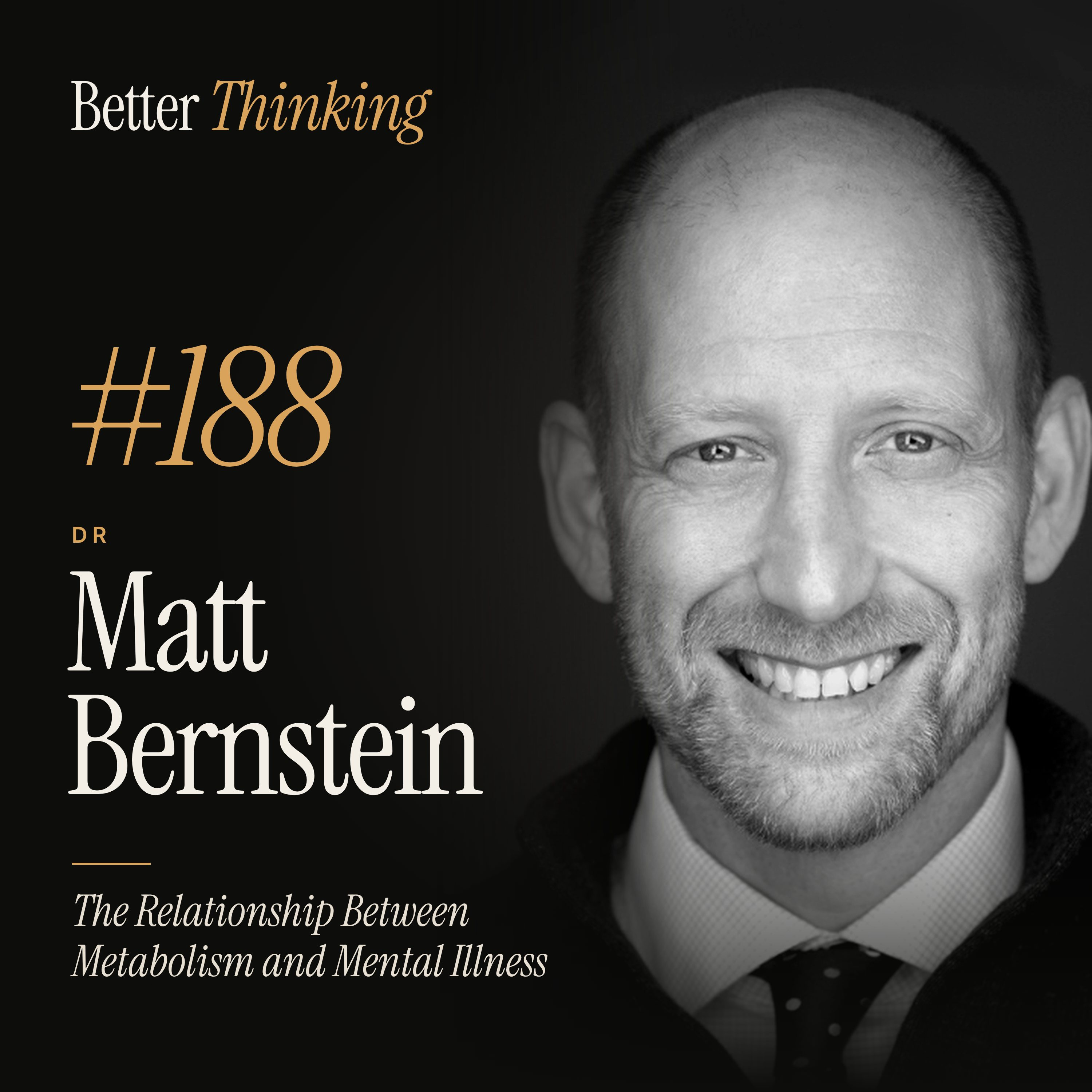
    #188 – Dr Matt Bernstein on The Relationship Between Metabolism and Mental Illness

    In this episode of Better Thinking, Nesh Nikolic speaks with Dr Matt Bernstein about the emerging field of metabolic psychiatry and how metabolism, nutrition, and lifestyle factors influence mental health. Dr. Matt Bernstein is a respected clinical psychiatrist for more than 20 years. He is also Accord’s chief executive officer and one of the leading voices in the emerging field of metabolic psychiatry. After graduating summa cum laude from Columbia University in New York, N.Y., with a bachelor’s degree in English literature, he received his medical degree from the Perelman School of Medicine at the University of Pennsylvania in Philadelphia, PA. Dr. Bernstein then trained at the MGH McLean Psychiatry Residency Program in Belmont, Mass., where he served as chief resident. He remained at McLean Hospital after residency as a psychiatrist-in-charge and later served as assistant medical director of its schizophrenia and bipolar inpatient program. Dr. Bernstein has developed his passion for community-based care as the chief medical officer at Ellenhorn, a sister program of Accord, where he has pursued alternative ways (such as a focus on metabolism, nutrition, circadian-rhythm biology and exercise) to help individuals achieve their best levels of functioning without relying solely on traditional psychiatric approaches. In addition to serving on the clinical advisory board at Metabolic Mind, Dr. Bernstein is known for organizing the first-ever public conference on metabolic psychiatry in 2023.
  • Aug 21, 2025 · 1 hr 13 min

    #187 – Dr Joanna Moncrieff on her book: Chemically Imbalanced: The Making and Unmaking of The Serotonin Myth

    In this episode of Better Thinking, Nesh Nikolic speaks with Dr Joanna Moncrieff about her latest book: Chemically Imbalanced: The Making and Unmaking of The Serotonin Myth. Dr Joanna Moncrieff is a practising psychiatrist, part-time academic, and author with a deep interest in the history, philosophy, and politics of psychiatry. Her work focuses particularly on the use, misuse, and misrepresentation of psychiatric drugs. She became interested in drug treatment because of its dominance in contemporary approaches to managing the suffering and disturbances labeled as mental disorders. She recognised that embedded in the understanding of drugs such as ‘antipsychotics’ and ‘antidepressants’ was an unexamined assumption: that these drugs ‘work’ by correcting a hypothetical abnormality or ‘chemical imbalance.’ Moncrieff has termed this the ‘disease-centred’ model of drug action and has developed an alternative ‘drug-centred’ model, which highlights the ways psychiatric drugs alter brain and body function, modify feelings and behaviour, and interact with the difficulties associated with mental disorders. Alongside colleagues from around the world, Moncrieff has worked to expose the misconceptions that arise from the disease-centred model, clarify the effects psychiatric drugs produce, and question the narratives that sustain current prescribing practices. She also emphasises that psychiatry is a profoundly political enterprise, shaped by social and political imperatives to neutralise distress and manage disturbing behaviour. Beyond her work on psychiatric drugs, she is interested in how emotional and behavioural problems might be conceptualised differently, as well as the broader politics of healthcare.

  • Aug 7, 2025 · 1 hr 9 min

    #186 – Jacqueline Anderson on Understanding Traumatic Brain Injuries

    In this episode of Better Thinking, Nesh Nikolic speaks with Associate Professor Jacqueline Anderson about the long-term impact of traumatic brain injuries and how they affect cognition, identity, and daily life. Jacqueline Anderson, PhD, is an Associate Professor in Clinical Neuropsychology in the Melbourne School of Psychological Sciences. She is also the Convenor of the School’s flagship postgraduate training program in Clinical Neuropsychology. As well as undertaking research in the area of clinical neuropsychology, she has more 25 years of experience working as a Clinical Neuropsychologist in both the public and private health sectors; for most of this time she has also provided training to postgraduate clinical neuropsychology students. Clinical work roles have primarily been in acute tertiary referral public hospitals, but have also included roles in rehabilitation settings; she has worked in private practice for many years, including undertaking medico-legal work. A/Prof. Anderson’s research program specialises in abnormal cognitive functioning. She and her lab members use a combination of clinical and laboratory-based tools to investigate adult patient populations with neuropsychological disorders. Her research interests primarily relate to outcome after mild traumatic brain injury (mTBI) in community-based adults. In particular, she is focused on investigating the neuropsychological (cognitive, behavioural, psychological) and neuropathological aetiologies of individual patient variation in outcome after mTBI as well as developing interventions for individuals who experience poor recovery. She has a further specific interest in abnormalities of attention and memory, executive function and subcortical cognitive networks in the context of neuropsychological disorders.

Showing 21–23 of 23 episodes