

Skip to content
Artwork for Best Practice
TechnologyBusinessEntrepreneurship

Best Practice

George Hannah

Best Practice delivers the world's best insights in Legal AI

bestpracticeai.substack.com
Play
  • 13 episodes
  • Avg 41 min
  • English
  • Monday · 41 min

    Will Chen on What Open Source Changes for Legal AI

    * Guest: Will Chen * Role: Founder, Mike OSS & LawProf * Website: mikeoss.com This episode is brought to you by Aline. Try Aline’s trusted and verified legal AI today for free. I spoke with Will Chen, a former Latham & Watkins lawyer who is now building Mike OSS, an open-source legal AI platform, alongside LawProf, the legal education platform he originally built while at university. Will has become one of the most-followed voices in the Legal AI space; particularly around open source, the economics of legal AI platforms and whether law firms should be building more technology themselves. We discussed: → Why Will decided to open source Mike OSS, and whether open-source legal AI can become commercially sustainable. → Whether legal AI platforms are really differentiated products or, in Will’s words, increasingly competing on deployment, distribution and access to models. → Why law firms may need to start hiring and paying top engineering talent very differently if they want to build serious technology internally. → The rise of open-weight and Chinese AI models, and what a rapidly moving model frontier means for companies trying to post-train their own legal models. → Will’s advice for junior lawyers entering the profession as AI becomes significantly more capable. We also spoke about vibe coding, why lawyers still need strong fundamentals even as AI improves. I hope you enjoy listening just as much as I did recording it! Want to feature in the Best Practice podcast? Email me at george@georgehannah.com Timestamps: 01:03 Introduction and Will’s background in law and AI 03:34 Why Open Source Legal AI Matters 08:17 Coding, AI, and Legal Judgment 14:17 The Value of Legal AI Vendors 22:47 Build vs. Buy for Law Firms 29:10 The Rise of Chinese AI Models 33:02 Career Advice for Future Lawyers Get full access to Best Practice at bestpracticeai.substack.com/subscribe


  • August 18 · 32 min

    Why More Companies Are Using Fractional Lawyers

    * Guest: Kenzo Onumonu * Role: Founder, Correm * Website: correm.ai This episode is brought to you by Aline. Try Aline's trusted and verified legal AI today for free. I spoke with Kenzo, a former Bird & Bird lawyer and in-house GC who is now building Correm, a platform for companies to access and manage fractional legal talent. Having sat on both sides of the legal market, Kenzo has seen first-hand how difficult it can be for businesses to get the right legal support at the right time. Correm is built around a different model, combining flexible legal talent with technology, automated billing and AI tools to make it easier for companies to build legal capacity around the work they actually have. We discussed: → Why fractional legal teams are becoming a viable alternative to traditional hiring. → What Kenzo learned going from private practice to becoming a GC, and then a founder. → How AI changes the economics of flexible legal work and what the legal team of the future could look like. → Why lawyers may increasingly need to think about their careers as a collection of skills and experiences rather than one linear path. → Kenzo’s tips for junior lawyers navigating their career in an AI landscape. I hope you enjoy listening just as much as I did recording it! Want to feature in the Best Practice podcast? Email me at george@georgehannah.com Get full access to Best Practice at bestpracticeai.substack.com/subscribe

  • July 10 · 48 min

    Are you selling Software or a Service?

    Guest: Jake Jones Role: Co-founder and COO, Flank LinkedIn: https://www.linkedin.com/in/jake-jones-b8769b75/ Website: flank.ai This episode is brought to you by Aline. Try Aline's trusted and verified legal AI today for free. Sources mentioned in the episode: * Flank — flank.ai * Insights portal — insights.flank.ai * The Intake (Substack, Flank's team blog) — intakezero.substack.com I spoke with Jake Jones, co-founder and COO of Flank. He’s spent years at the forefront of legal AI across what he counts as four different paradigms and half a dozen hype cycles. He started the business in 2018 as Legal OS, modelling how experienced lawyers make decisions as knowledge graphs, built on his co-founder's father's academic work, and sold it to German law firms doing M&A. In 2021 he moved the business in-house, rebuilt it on LLMs, and now Flank runs agentic legal work inside enterprise legal teams under a model where they don't get paid until the outcome is live. We discussed: → Why vendors are already moving beyond "agentic AI" to full end to end outcomes. → The difference between selling software and selling an outcome, and why so many legal AI vendors are stuck between the two. → His theory that legal is heading toward the same moment retail banking hit with digital challenger banks in 2015, and what Big Law should do about it before it's too late. I hope you enjoy listening just as much as I did recording it! Want to feature in the Best Practice podcast? Email george@georgehannah.com Get full access to Best Practice at bestpracticeai.substack.com/subscribe

  • June 15 · 48 min

    How this ex GC's frustration with legal software turned into a startup

    Guest: Brent FareseRole: CEO and Co-Founder, AlineWebsite: aline.co This episode is brought to you by Aline. Try Aline’s trusted and verified legal AI today for free. I spoke with Brent Farese, CEO and co-founder of Aline, an agentic legal AI platform built exclusively for in-house teams. Brent trained as an IP attorney with a mechanical engineering and computer science background, then worked as Assistant General Counsel one of the world’s leading enterprise blockchain companies. We discussed: → The three tiers of document search (keyword, semantic, agentic) and why getting this right is the hard engineering problem nobody talks about→ Why legal AI is roughly two years behind agentic coding — and what infrastructure still needs to be built before it catches up→ Why frontier model providers entering legal is actually a tailwind for specialist platforms→Why making legal work cheaper and faster is likely to produce more legal work, not less→ Why “building the GitHub for law”, with proper version control, is needed in 2026. I hope you enjoy listening just as much as I did recording it. Want to feature in the next Best Practice podcast? Email george@georgehannah.com Get full access to Best Practice at bestpracticeai.substack.com/subscribe

  • June 5 · 24 min

    Is owning the data still the moat in Legal AI? Sean Fitzpatrick, CEO of LexisNexis Legal

    Is owning the data still the moat in legal AI?I spoke to Sean Fitzpatrick, a senior leader at LexisNexis - one of the largest legal AI companies in the world.Sean Fitzpatrick is CEO of the Global Legal Business at LexisNexis. He has been there for 21 years, growing up through the shifts from digital to cloud to AI, after starting out as a consultant at McKinsey.We discussed:→ Whether 200 billion proprietary documents are still a defining asset - or whether the nature of the moat has changed.→ Why "probably right" is the standard for frontier models, and why that standard fails in law.→ How their partnership with Harvey actually works.→ Sean's thoughts on hallucinations in legal AI.→ What happens to the junior lawyer apprenticeship model when the grunt work that builds judgment disappears.Sean has watched every major technology shift in legal over two decades, and makes the case for why content plus technology is far harder to displace than either alone. It was an honour to speak to Sean, and I hope you take something useful away from this. Know someone, or want to feature on the Best Practise Podcast? Email george@georgehannah.com Get full access to Best Practice at bestpracticeai.substack.com/subscribe

  • May 12 · 48 min

    Andrew Thompson on What Legal AI Can Learn From Software Engineering

    Guest: Andrew Thompson Role: CTO, Orbital LinkedIn: https://www.linkedin.com/in/andrewmatthewthompson/ Website: www.orbital.tech (company) | www.andrewthompson.co (personal blog) This AI platform powered over 200,000 property transactions last year and raised $60M in January to expand even further. I spoke with Andrew Thompson, CTO at Orbital. Andrew previously built the Caffè Nero app, ran product and tech at Appear Here, founded his own AI company, and now leads engineering, product and a team of in-house real estate lawyers at Orbital. We discussed: → How Orbital mix both generalist LLM’s and their own classical ML into one product. → Why legal is roughly 12-18 months behind software engineering, and how to use that lag. → What “ship early and often” actually looks like inside a regulated industry. → Andrew’s tips and advice for Andrew is an absolute genius in everything LLM’s and how to make the most of it in the physical space around us. I really hope you take away something useful from this. Want to feature in the Best Practice podcast? Email george@georgehannah.com Sources mentioned in the episode: * Orbital’s $60M Series B (Jan 2026, led by Brighton Park Capital): https://tech.orbitalwitness.com/posts/2026-01-23-series-b-announcement/ * Caffè Nero (Andrew’s previous build): https://caffenero.com * Appear Here (Andrew’s previous build): https://www.appearhere.co.uk * Seedcamp (where Andrew was a startup mentor): https://seedcamp.com * ElevenLabs (referenced re: agentic insurance): https://elevenlabs.io * Legalweek New York 2026 (referenced throughout) * McKinsey research on automatable legal work (referenced) * OpenAI ChatGPT and GPT-4 (referenced as the inflection point) * Anthropic Claude (referenced) * Google BERT and T5 (Orbital’s pre-LLM stack) Get full access to Best Practice at bestpracticeai.substack.com/subscribe

  • May 1 · 37 min

    Meet The Startup Building AI For The Messiest Part of Law

    “Crack the chronology, crack the case.” That’s what Gregory Mostyn‘s father - a barrister, then judge for 42 years - was told on his first day in chambers. Decades later, it’s the founding insight behind Wexler. I spoke with Gregory Mostyn, co-founder and CEO of Wexler, the fact intelligence platform now used by huge massive circle firms in their litigation teams. Greg isn’t a lawyer. He grew up watching his father - who handled some of the highest-profile family cases in England - come home with ten ring binders to read before court the next morning. That image, plus a stint at Entrepreneur First, became Wexler. The company has 20x’d ARR since pre-seed and just raised $5.3m led by Pear VC. We discussed: → Why Wexler went deep on litigation when every other legal AI startup was going broad → The “verification tax” and where fully agentic legal AI actually breaks down → Why consumption pricing beats per-seat for litigation work (and how they structure it) → How his 67-year-old father is now vibe-coding apps for his tennis club → What it takes to close a Big Law deal in a week I absolutely loved recording this episode and I hope you enjoy listening to it just as much as I did. Know someone that might want to come on the Best Practice Podcast? Email me at george@georgehannah.com Get full access to Best Practice at bestpracticeai.substack.com/subscribe

  • April 17 · 51 min

    Meet the Startup Building the Matter Management Layer Legal AI Forgot About

    I keep hearing about legal AI tools that do the work better. What I haven’t heard, until now, is anyone building the tool that remembers what the work is actually for. In this episode I chat with Dillon Hirandiran, founder and CEO of Counsel (gc.inc) Dillon previously worked in investment banking, then built his first startup during Covid. The experience of navigating legal work as a founder - seed rounds, Delaware flips, cap tables - is what first drew him to the problem Counsel is now solving. Counsel is an autonomous matter management system for law firms - reading every email, every message, and maintaining a persistent context layer across everything a firm has going on. We discussed: → Why the hardest problem in legal AI has never really been document generation, but instead it’s CONTEXT retention across matters. → Why clients can’t always evaluate the quality of legal work, only its responsiveness → What a “10x attorney” actually looks like when AI handles the document layer, and why being a workhorse is the worst thing a junior lawyer can be right now → Why the biggest risk to Big Law isn’t pricing pressure from in-house or AI, but is actually their own talent leaving. Want to sponsor or feature on the Best Practice Podcast? Email george@georgehannah.com Get full access to Best Practice at bestpracticeai.substack.com/subscribe

  • April 3 · 40 min

    How this ex Amazon and Replit lawyer built the Legal AI platform she always wanted.

    Cecilia Ziniti’s started as a paralegal at Yahoo in the early 2000s, when Yahoo was competing with Google and the internet was still being shaped by questions about content moderation, trust and safety, and what it meant to serve millions of users. She went to law school, then joined Morrison & Foerster, where she represented big brands like Apple. At Amazon, she was the founding lawyer on Alexa - she remembers getting excited about the first user review for a product that would eventually ship billions of devices. She eventually became general counsel at Replit, the developer platform used by millions of programmers. It was at Replit, in early 2022, that things changed. Cecilia had access to a pre-ChatGPT version of GPT through a deal she herself had negotiated between Replit and OpenAI. She tried it on a legal question. The result gave her chills. Her boss at the time, Replit CEO Amjad Masad, eventually noticed her attention had shifted. He asked whether her head was still in it. It was not. She left Replit and founded GC AI a week later, alongside co-founder and CTO Bardia Pourvakil, a fellow Replit alumnus. The company has since raised $73 million in total funding, including a $60 million Series B led by Scale Venture Partners and Northzone. It now powers over 1,400 companies, from Zscaler to Liquid Death. Cecilia was recently named to Inc.’s 2026 Female Founders 500 list. Would you, or anyone that you know like to feature on the Best Practise podcast? Email: george@georgehannah.com Get full access to Best Practice at bestpracticeai.substack.com/subscribe
  • March 27 · 28 min

    How this YC-backed startup are reinventing the law firm from the ground up

    I spoke with Javed Qadrud-Din, co-founder and CTO of General Legal - the AI-native law firm backed by Y Combinator, built to serve growth-stage companies. Javed has been coding since the age of nine. He went to Harvard, detoured into law at Fenwick & West, then decided he’d rather build things than advise on them. He got deep into deep learning in 2014, built what’s been described as the first semantic search system in legal at CaseText - before GPT existed - and was part of the team behind a multi-million exit to Thomson Reuters in 2023. Now at General Legal, Javed is rebuilding how legal services are delivered: flat fees, and a three-hour turnaround time. We discussed: → Javed’s extraordinary background and how General Legal came about → The difference between being AI-native and being AI-powered → What the economics of flat-fee legal services look like under pressure, and whether $500 per contract goes down as AI improves. → Why founders using free ChatGPT to draft contracts are “yoloing it”. → His vision for what the legal industry looks like in 2030 - and what lawyers should be doing today to prepare. I hope you enjoy! Want to feature on the Best Practice Podcast? Contact george@georgehannah.com Get full access to Best Practice at bestpracticeai.substack.com/subscribe
  • February 19 · 31 min

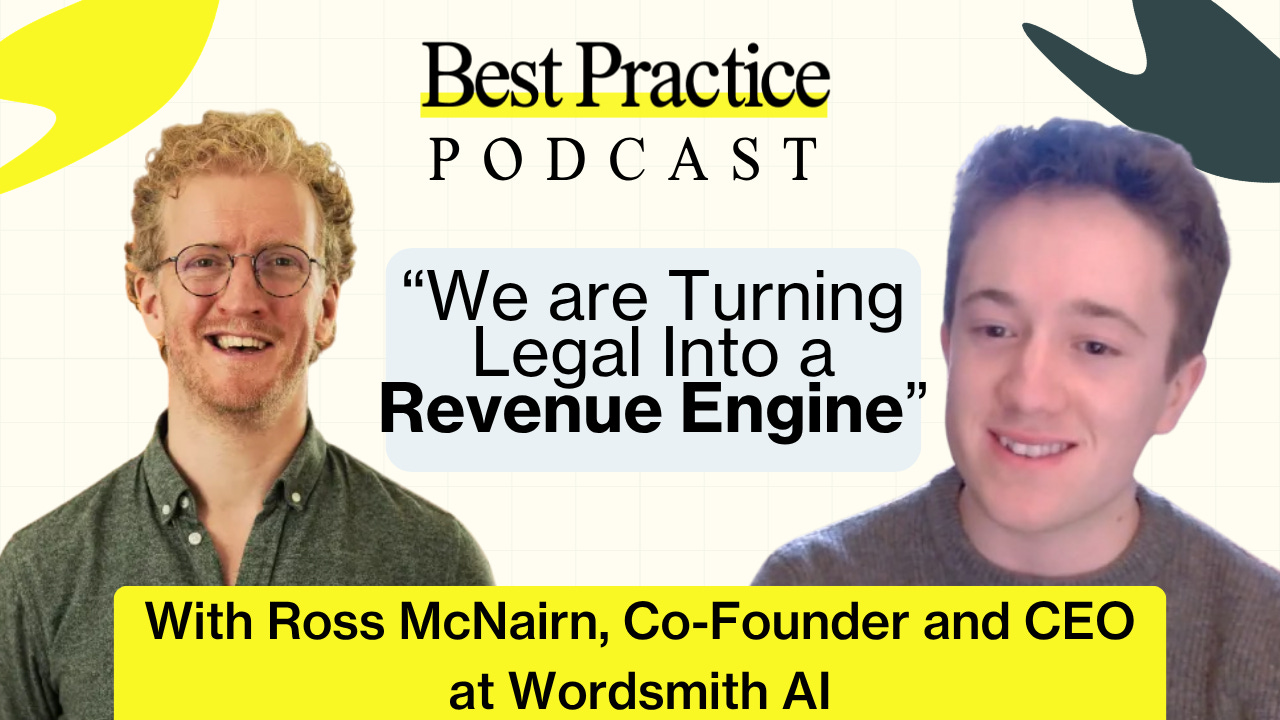
    How Wordsmith AI Turned In-House Legal Into A Revenue Engine

    I spoke with Ross McNairn, co-founder and CEO of Wordsmith AI, who trained as a lawyer, retrained as a software engineer, and spent over a decade scaling companies like Skyscanner and TravelPerk. When he got early access to OpenAI’s AI tool, he quit his CTO role to get building in legal AI. Wordsmith is built exclusively for in-house teams - connecting legal to the business through AI-powered workflows. We discussed: → How the relentless focus on going after "in-house" led them to build the product they have today. → The difference between building AI for law firms versus in-house teams. → Why Wordsmith aren't worried about OpenAI or Anthropic "going vertical". → What Ross looks for when hiring new employees at Wordsmith. → His vision for what the future of an in-house lawyer role will look like. Get full access to Best Practice at bestpracticeai.substack.com/subscribe
  • January 22 · 41 min

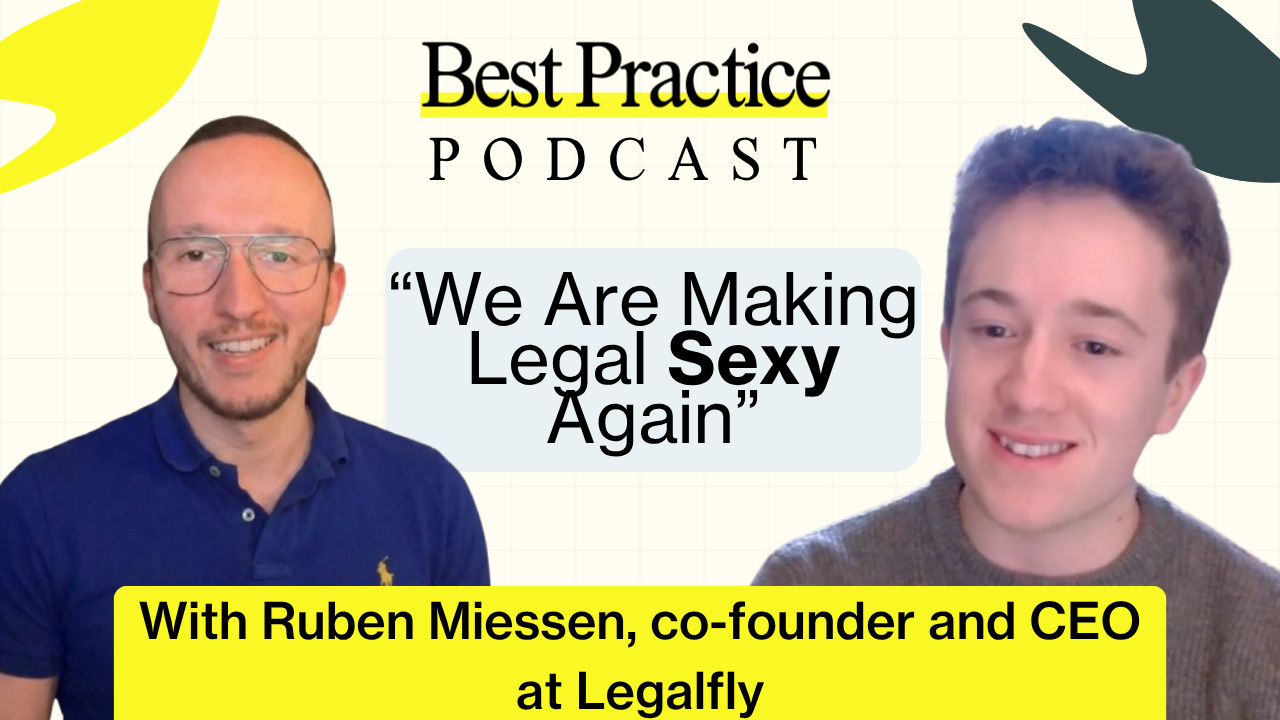
    What My Time At Tinder Revealed About Legal AI

    Ruben Miessen spent years leading the product teams at Tinder and Match Group, where sitting through weekly legal committee meetings helped him develop a deep understanding of the processes that caused bottlenecks and frustrations. Rather than build another generalist legal AI tool, Ruben co-founded LegalFly in 2023 with a laser focus on in-house legal and procurement teams at enterprises in highly regulated industries. The Belgian startup now employs over 50 people across Ghent, London, and Dubai, and closed 2025 with 600% year-over-year growth - with 80% of clients coming inbound rather than through outbound sales. In this episode, I ask Ruben: * Why he built exclusively for in-house teams instead of law firms - and why that choice shaped everything from product to go-to-market. * The role European data privacy regulations played in LegalFly’s product architecture and competitive positioning. * His predictions for legal AI consolidation in 2026 - and why he thinks data quality will matter more than ever. * Plus, the roadmap for LegalFly’s Series B and US expansion plans. Get full access to Best Practice at bestpracticeai.substack.com/subscribe

  • Dec 8, 2025 · 1 hr 2 min

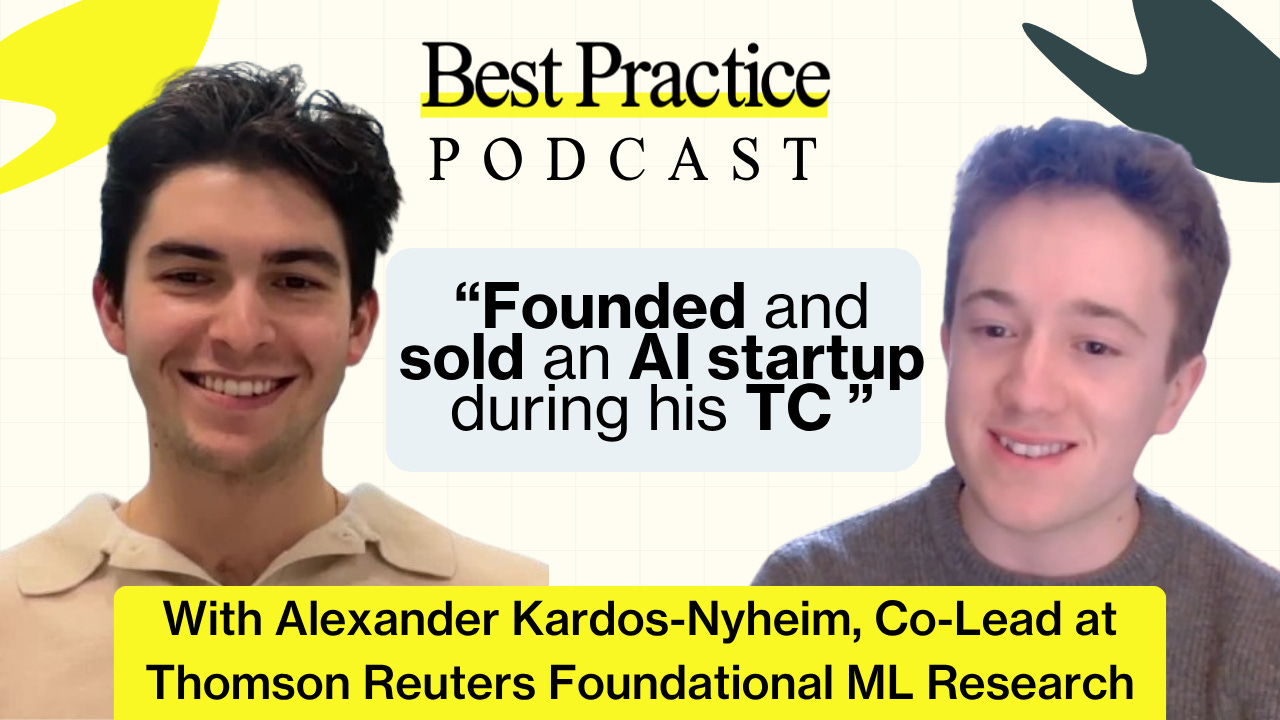
    Why Legal Al's Next Phase Will Look Different: Alexander Kardos-Nyheim on Models, Markets, and 2026 predictions

    Alexander founded and led Safe Sign Technologies, a frontier AI startup specialising in Legal LLMs whilst he was training at Allen & Overy. The Cambridge- and MIT-based start-up was acquired in a blockbuster exit by Thomson Reuters in August 2024. In this first episode, I ask Alexander: How he built a successful legal AI company while managing the intense workload of a Magic Circle training contract. The critical debate for legal tech - is the future in off-the-shelf LLMs or custom-training foundational models? Why Big Tech's verticalisation (like DocuGPT) is creating a market squeeze for new legal AI startups. The potential collapse of the law firm 'pyramid' as AI handles the work of the £150k+ junior associate. Plus, predictions for the legal AI landscape in 2026 and the changing risk-reward for law students. Get full access to Best Practice at bestpracticeai.substack.com/subscribe

Showing 1–13 of 13 episodes