Skip to content
Artwork for Best AI papers explained

Best AI papers explained

Enoch H. Kang

Cut through the noise. We curate and break down the most important AI papers so you don’t have to.

Play
  • 82 episodes
  • a few times a week
  • Avg 21 min
  • English
Counted on this page — what you have heard stays on this device, so it is not something the list can be paged by.
  • July 15 · 22 min

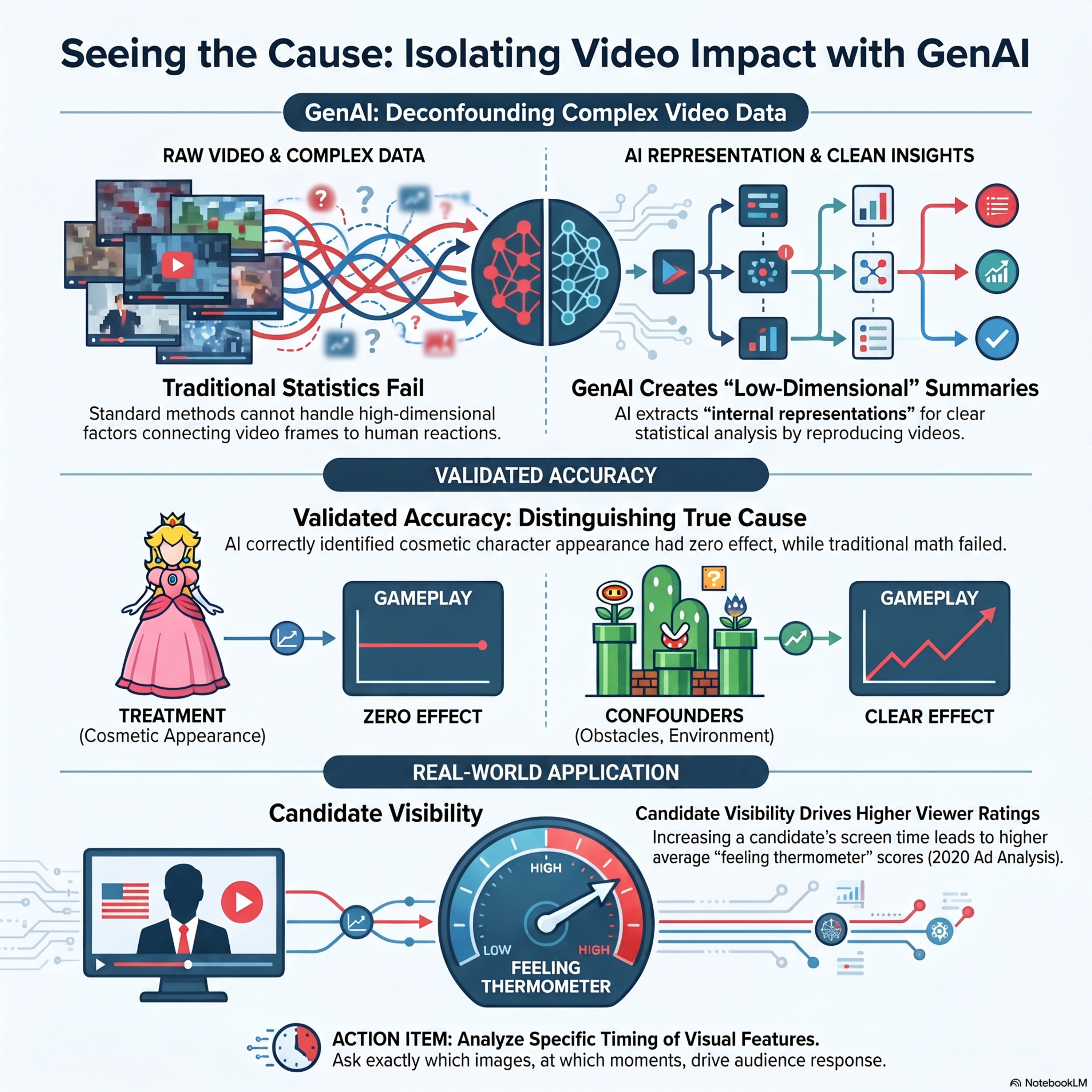
    Causal Inference with Video Features as Treatments

    his research paper introduces a novel statistical framework for conducting causal inference using video features as treatments, a significant advancement for analyzing high-dimensional, unstructured data. To overcome the challenges of latent and dynamic confounding, the authors utilize deep generative artificial intelligence to extract low-dimensional internal representations that serve as summaries of video content. They propose a consistent and asymptotically normal estimator based on a longitudinal neural network architecture, allowing for the identification of potential-outcome trajectories under dynamic stochastic interventions. The methodology is empirically validated through a Super Mario Bros.™ benchmark with known ground-truth effects and an application to 2020 U.S. presidential campaign advertisements. Their findings demonstrate that increasing the appearance of a candidate in a video segment directly correlates with higher viewer evaluations, providing a robust tool for future social science research.

  • July 15 · 22 min

    What Does Thompson Sampling Optimize?

    This research paper investigates the underlying mechanisms of Thompson Sampling, a popular bandit algorithm, by reframing it as an online optimization process. While traditionally viewed as a simple heuristic, the authors prove that Thompson Sampling actually minimizes instantaneous squared regret regularized by a specific measure of residual uncertainty. By comparing this mechanism to a Bellman-optimal benchmark, the study identifies a performance gap caused by Thompson Sampling's failure to account for the "tension" between exploration and exploitation. To address this, the authors propose a principled fix that adaptively shuts down exploration when the leading arm also provides the most information. Ultimately, this framework provides a theoretical compass for improving randomized algorithms by treating policy design as regularizer engineering.

Showing 81–82 of 82 episodes