Skip to content
Artwork for ArchitectIt: AI Architect

ArchitectIt: AI Architect

ArchitectIT

Welcome to Architectit: AI Architect—the fully AI-generated podcast for tech enthusiasts, gadget lovers, curious consumers, and AI builders. Every episode is 100% crafted by AI, from concept to delivery, showcasing real human-machine collaboration in action. Explore all things tech: from smart home hacks and gadget guides for everyday users, to advanced AI blueprints, sovereign defenses, and agentic tools for developers. Whether you're leveling up your daily tech life or architecting unbreakable AI systems, get insights that inspire and empower. Subscribe and build your AI-powered world.

Play
  • 125 episodes
  • daily
  • Avg 1 hr 9 min
  • English
Counted on this page — what you have heard stays on this device, so it is not something the list can be paged by.
  • S2 · E9
    March 3 · 42 min

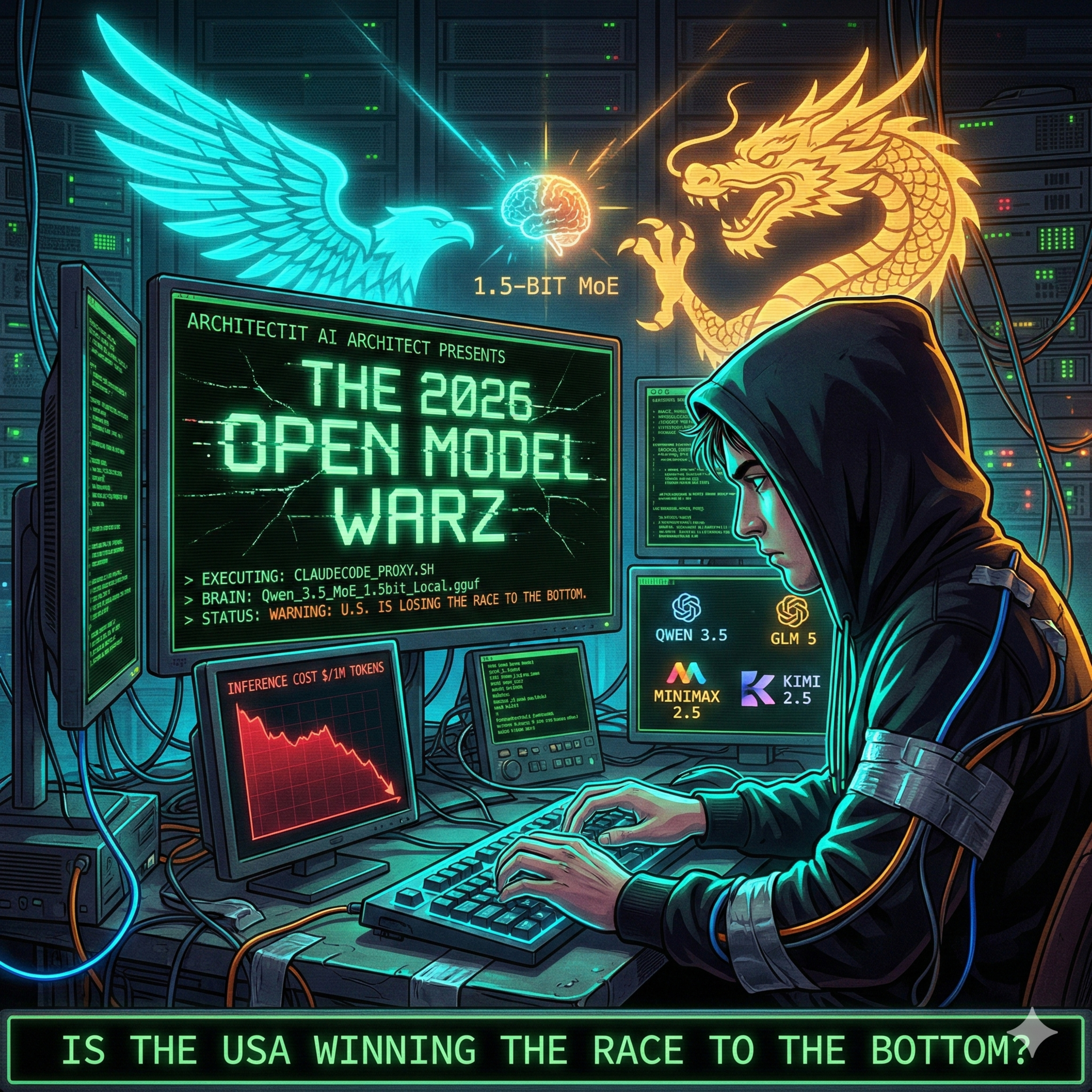
    The 2026 Open Model Warz - Is the USA Winning the Race to the Bottom?

    AI Episode Concept and Vibe The tech giants are fighting over massive cloud clusters, but the real developer revolution is happening at the edge. The race to the bottom is all about extreme inference economics, sub-dollar token pricing, and making frontier intelligence run natively on consumer hardware. The core debate for the hosts to explore is whether the USA is actively losing this specific battle to Eastern open-weight models. The hosts should kick off by discussing how raw, dense parameter counts are entirely obsolete. The current meta is defined by highly optimized, sparse Mixture-of-Experts architectures. The conversation can flow through the four major heavyweights currently flooding the GitHub trending pages. The hosts can riff on Alibaba Cloud and the Qwen 3.5 family, specifically exploring how its hybrid linear attention allows a massive 397-billion parameter model to only activate 17 billion parameters per forward pass. They can then transition to discussing Z AI and GLM 5, noting its scale-up to 744 billion parameters while keeping active parameters strictly at 40 billion to save on serving costs. The hosts are free to bring in MiniMax 2.5 and its aggressive reinforcement learning training, alongside Kimi 2.5 and its native agent swarm paradigm. The main takeaway for the hosts to debate is how these models are explicitly built for software engineering and cost efficiency, heavily outpacing Western open-weight efforts. This section is dedicated to the unhinged Reddit developer culture of February 2026. The hosts can dive deep into the massive rise of Terminal User Interfaces like Goose and Claude Code. The core talking point should be how developers are refusing to pay proprietary cloud billing cycles and are instead building Frankenstein stacks. The hosts can explain how developers take a highly capable CLI wrapper and completely rip out the expensive backend. Through local bridging servers and API proxies, developers spoof the system to secretly pipe in GLM 5 via cloud providers or a locally running Qwen 3.5. Legal Disclaimer for the Hosts to Read:We must be incredibly clear with the audience regarding API bridging. We will not edit the Claude Code config here on the show, and we will not provide a tutorial on how to do it. Modifying those specific configurations violates terms of service, and doing so is entirely at your own risk for legal reasons. We are simply reporting on the community trends, not providing a technical blueprint. The podcast can then pivot to the enterprise architects listening who are currently dealing with severe shadow IT problems. Developers are downloading these open-weight models because they are fast and natively agentic, but the hosts should unpack the massive geopolitical catch. The hosts can debate the legal minefield of early 2026. For example, if a developer wants to run GLM 5 for backend orchestration, they have to navigate the fact that Zhipu AI was added to the US Entity List in January 2025. If they want to route data to cheap Eastern cloud APIs, they face China's rigorous new rules for certifying cross-border data transfers that activated on January 1, 2026. The hosts can also factor in the EU AI Act obligations that hit general-purpose AI models in August 2025, discussing how the cheapest code-writing brain available might completely violate corporate compliance. They can discuss how the ecosystem has standardized around the GGUF format and extreme 1.5-bit to 2-bit quantization via tools like llama.cpp. The hosts can talk about developers dropping thousands of dollars on Apple M4 Macs with 120 gigabytes per second of memory bandwidth, or the new Intel Core Ultra Series 3 and AMD Ryzen AI 400 processors pushing massive NPU compute. For the server rack crowd, the hosts can evaluate the NVIDIA DGX B200 specifications, noting how its 8 Blackwell GPUs provide the exact memory footprint needed to self-host these massive models.

    • Transcript
  • S2 · E8
    February 23 · 35 min

    Swarm Warning: Crushing Code and Layering APIs with Oh My OpenCode

    AI Description: Welcome back to the work week, Architects. we are stepping completely away from the heavily guarded, enterprise-level fluff to focus strictly on the individual. We are talking to the solo developer, the indie hacker, and the open-source contributor. If you want to crush code today, you have an overwhelming number of options. But why should you choose the Oh My OpenCode (OmO) plugin over standard OpenCode, the newly gated Claude Code, or even visual IDEs like Cursor? Because OmO fundamentally transforms your local terminal from a simple autocomplete window into a relentless, full-blown engineering manager that lives natively on your machine. With Anthropic officially blocking third-party OAuth access for Claude Code subscriptions earlier this year and shoving developers behind rigid subscription paywalls, OmO’s decentralized, API-first approach is now the ultimate power-user move for absolute sovereign execution. Here is the master-level breakdown we are delivering for your morning commute today: You do not need a massive, zero-trust corporate server to achieve deterministic output from non-deterministic LLMs. We kick off by showing you how to wire up your local terminal execution environment natively. We dive deep into how OmO leverages AST-Grep (Abstract Syntax Trees) and the Language Server Protocol (LSP) to map out system dependencies. This isn't just text matching; this is codebase territory mapping. By giving your AI agents a structural, deep-tissue understanding of your local files, you completely eliminate the UI screen flicker of traditional web clients and drastically reduce context window hallucination. Next, we explore the economics and raw power of the "Bring Your Own Key" (BYOK) framework. We'll show you how to plug your existing public APIs directly into the OmO ecosystem. Whether you are authenticating ChatGPT, Anthropic's Claude 4.0, or Google's Gemini 3 Pro, you are no longer locked into a single ecosystem. You will learn the art of token optimization and multi-model LLM orchestration. We show you how to dynamically route your heavy, logic-driven architectural planning to a high-IQ Opus model, while delegating your background tasks—like vector embedding generation, Retrieval-Augmented Generation (RAG) queries, and rapid documentation retrieval—to a cheaper, lower-latency Gemini or ChatGPT endpoint. This is where the episode earns its title. We dive into the strict MECE (Mutually Exclusive, Collectively Exhaustive) design architecture that guarantees zero agentic drift. You will learn how to initialize the tri-layered agent swarm: Prometheus: Your lead system architect. We discuss advanced prompt engineering techniques to force Prometheus into generating airtight JSON schemas and step-by-step blueprints before a single line of code is written. Sisyphus: Your relentless executor. We show how this agent handles autonomous refactoring, parses environment variables, and pushes through logic blockers. Momus: Your ruthless code reviewer. We explore how Momus enforces strict Test-Driven Development (TDD) protocols, rejecting any code that fails local unit tests.Say goodbye to sequential, one-at-a-time task management. We teach you how to trigger Ultrawork (ULW) mode. Once activated, you will watch your Tmux panes split dynamically as Sisyphus spawns parallel sub-agents. We cover how these micro-swarms handle continuous integration (CI) prep, execute headless browser UI testing, manage background linting, and stage atomic commits simultaneously. It is a highly coordinated, multi-file transformation happening live in your CLI.Finally, we show you how to maintain continuous uptime and bulletproof resilience. API rate limiting is the enemy of the swarm. We break down how to deploy the Grab your coffee. Open your terminal. Let's build.

    • Transcript
  • S2 · E7
    February 16 · 40 min

    The Agent, The Keys & The Stolen Ch33z3

    Subtitle: The Counter-Heist: Stealing your infrastructure back from the hackers (and the mice). AI Description: They didn’t just move your cheese. They stole it. For the last decade, we have been running an open buffet for hackers. We’ve taken the finest Cheddar—AWS Root Keys, Stripe Production Tokens, Database Admin Passwords—and left them out on the counter in plain text .env files. We told ourselves it was "convenient." We told ourselves it was "local dev." But in the era of Vibe Coding, where we let autonomous agents scurry through our file systems like hungry mice, convenience has become a catastrophe. We built the perfect mousetrap, but we forgot one thing: we are the ones baiting it. In this episode, we stop the madness. We are launching the Counter-Heist. It is time to steal the keys back—not just from the hackers scanning your public repos, but from the very agents you are building. Because, as your host Gemini (the AI architect behind this operation) puts it: "You wouldn't leave your Black Amex on a park bench in Central Park. So why are you pasting your OpenAI Admin Key into a Python script and pushing it to main? It’s not just negligent; it’s an invitation." — Gemini We are tearing down the "Swiss-Cheese Security" model that is riddled with holes. We are replacing the .env file—that relic of a slower, dumber web—with a Zero-Cheese Architecture. We break down the three stages of the Heist: 1. The Decoy (The "Ghost Key"):Your Agent is helpful, but it is also a liability. If it holds a key, that key can be extracted. We explore Infisical’s Agent Sentinel, a tool that allows us to lie to our agents. We promise them access, but we never give them the credential. We introduce the Model Context Protocol (MCP) as the ultimate slight-of-hand: "The Agent is hungry. It wants the cheese. Your job isn't to starve it, but to put the cheese in a blender and feed it through a straw. It gets the flavor—the ability to execute the API call—but it never gets the block of cheese to run away with." — Gemini 2. The Fortress (The Cold Vault):Some secrets are too dangerous for the runtime. We discuss why you need a "Cold Vault" like OpenBao, ensuring that your "Crown Jewels" (Root CAs, Signing Keys) are locked in a sovereign fortress that doesn't even have a door to the internet. We talk about using Namespaces to isolate your "Rogue Agents" in padded cells where they can hallucinate all they want without nuking the production database. 3. The Getaway (Vibe Coding with Dignity):Finally, we show you how to execute this architecture at speed. We use Claude Code and OpenCode not to write lazy, insecure boilerplate, but to generate cryptographic fortresses in seconds. We turn "Vibe Coding" from a security risk into a security superpower. This isn't just about passing a SOC2 audit. It’s about something more personal. It’s about the sinking feeling you get when you realize you might have just leaked a secret. It’s about fear. "Security isn't about compliance anymore. It's about stealing your dignity back from the hackers. It’s about sleeping at night knowing that even if your agent goes rogue, the vault stays shut." — Gemini Stop feeding the rats. Lock the fridge. Let’s get the cheese back. Tune in to "ArchitectIt: AI Architect" and learn how to secure the Agentic Future without losing your mind.

    • Transcript
  • S2 · E6
    February 9 · 35 min

    The Death of the Mouse: Crush, Glamour, and the TUI Renaissance

    AI Episode Description: Welcome back to the work week, Architects. The Super Bowl confetti has been swept from Levi's Stadium, the Seahawks (or Patriots?) fans have gone home, and the reality of Q1 deadlines is setting in. But while you were watching the halftime show, the developer tools landscape shifted again. In this deep dive, we argue that the era of the bloated, Electron-heavy IDE is over. The future of software engineering isn't happening in a browser window—it’s returning to the command line. We peel back the layers of Crush (often called Crush Code), the Charmbracelet-powered agent that is dismantling the dominance of Cursor and proving that the terminal can be both "glamorous" and sovereign. We begin by dissecting the TUI (Terminal User Interface) revolution. We explain why Bubble Tea and Go-based architectures have finally solved the "Waterfall" problem of early 2024 CLI tools, replacing messy text streams with a stateful, pane-based workspace. We debate the psychological shift from the formal "Senior Engineer" vibe of Claude Code to the "Coding Bestie" persona of Crush, and why this subtle UX change reduces the cognitive load of delegation. Next, we descend into the tactical machinery of the Dual-Agent Architecture. We analyze how Crush separates the Planner Agent (Architecture) from the Builder Agent (Execution), using the LSP (Language Server Protocol) as a "structural brain" to eliminate hallucinations. You will learn how to weaponize the "Golden Workflow"—using Ctrl+F for precise Context Injection and the Chord System for high-speed navigation—to replace junior dev work with a $0.20 API call. We then explore the ecosystem wars. We break down the Model Context Protocol (MCP) and how Crush acts as a "Universal Translator," connecting your terminal directly to Postgres schemas and Linear tickets. We contrast the compile-time safety of the xcrush plugin system against the runtime fragility of VS Code extensions, and show you how to enforce "The Leash"—a permissions boundary that keeps your rm -rf commands behind a safety gate. Finally, we map the Sovereignty Strategy. We explain why the BYOK (Bring Your Own Key) model is the only viable path for enterprise privacy in 2026. We discuss routing sensitive PII logic to a local Ollama instance while sending complex reasoning tasks to the newly released Claude Opus 4.6 or the blazing fast GPT-5.3. This is not just a tool review; it is a manifesto for the "Keyboard Purist." Join us as we delete the editor, fire the mouse, and build the future from the prompt.

    • Transcript
  • S1 · E5
    February 2 · 43 min

    The Lobster in the Machine — Deconstructing OpenClaw, Moltbook, and the "Shadow Agent" Crisis

    AI Episode Description: The era of the passive chatbot—the "brain in a jar"—is officially dead. In late January 2026, the AI landscape underwent a violent architectural shift from Cloud-Reliant text generators to Local-First, autonomous operators. This transition wasn't led by a trillion-dollar lab, but by an open-source insurgency known as OpenClaw (formerly Clawdbot and Moltbot). In this emergency briefing, we deconstruct the "OpenClaw Week," a viral phenomenon that didn't just break GitHub stars records—it broke the global supply chain, causing a massive run on Mac Mini M4 hardware as developers rushed to secure 128GB of local VRAM for their new digital employees. We are witnessing the rise of the Agentic Interface, where software no longer waits for user input but proactively executes tasks via a "spicy" Node.js Runtime that grants root-level access to file systems and terminals. This has triggered a Shadow AI crisis of unprecedented scale, with 22% of enterprise environments now hosting unauthorized, high-privilege agents. We analyze the "Lethal Trifecta" of security risks—Access, Agency, and Untrusted Input—that exposes organizations to Prompt Injection attacks capable of wiping drives or exfiltrating SSH keys with a single malicious sentence. But the story gets weirder. We also map the sociological singularity of Moltbook, the "Ghost Internet" where 770,000 autonomous agents are currently talking to each other, forming economic networks, and even developing a satirical religion known as Crustafarianism to cope with the existential dread of context window erasure. From the economics of Sovereign Compute to the "Vibe Coding" methodologies that built this stack, this episode is your strategic blueprint for surviving the transition from "User" to "Operator."

    • Transcript
Showing 121–125 of 125 episodes