
Skip to content
Artwork for AI:AM
TechnologyBusiness

AI:AM

Prakash Narayanan & Nathan Labenz

Daily, live, technically serious AI coverage for the people building, funding, governing, and deploying the next wave.

briefing.ai-in-the-am.com
Play
  • 32 episodes
  • Avg 2 hr 36 min
  • English
Counted on this page — what you have heard stays on this device, so it is not something the list can be paged by.
  • S3 · E19
    Today · 2 hr 51 min

    AI:AM — Human Tissue Models, Physical AI, and the Future of Testing · September 25, 2026

    Vivodyne’s Andrei Georgescu explains how vascularized human tissue models, robotics, multi-omic measurement, and foundation models could improve drug testing before clinical trials. Archetype AI’s Nick Gillian discusses Newton, a Physical AI model that combines sensor data to understand and predict events in the real world; the hosts also examine AI product safety, OpenAI and Anthropic’s alignment philosophies, CRISPR research, and whether AI can deliver useful advances in biology before it is fully understood. Chapters (0:00) AI safety has two different meanings. (0:15) Why drug testing needs human tissue. (3:20) Physical AI is bigger than robots. (5:01) Biology’s bar is lifesaving progress. (11:17) Opening and AI news (11:38) Jensen Huang’s safety argument (13:24) The “just software” debate (15:31) Why AI companies must mature (21:12) Muse and product safety (29:25) Testing AI agents in the real world (29:35) Product safety versus existential risk (29:45) The alignment philosophy problem (38:34) OpenAI versus Anthropic (40:36) When safety concerns converge (41:55) Human tissue models (44:12) Why organoids need realism (47:35) Measuring tissue responses (54:03) Mapping causal biology (1:03:40) Improving drug development (1:09:08) Foundation models and experiments (1:12:18) TissueDisk and robotic labs (1:12:28) Before clinical trials (1:30:37) What is Physical AI? (1:32:25) Beyond robots and cars (1:35:33) Training on physical data (1:38:04) Cleaning and aligning sensor data (1:40:34) Human and machine outputs (1:49:30) A river construction case study (1:53:28) How Newton finds hidden patterns (1:57:33) Zero-shot sensor adaptation (2:01:16) Industrial impact and expert knowledge (2:05:22) From machines to ecosystems (2:14:10) Physical agents and superintelligence (2:15:34) The big AI-biology question (2:21:55) Specialists versus generalists (2:23:39) Distilling frontier models (2:33:33) AI discovers a CRISPR sequence (2:39:22) Useful biology before theory (2:45:10) From job displacement to progress (2:46:44) AI diffusion and economic growth Guests Andrei Georgescu — CEO, Vivodyne (𝕏 | LinkedIn) Nick Gillian — CTO, Cofounder, Archetype AI (𝕏 | LinkedIn) This is a public episode. If you would like to discuss this with other subscribers or get access to bonus episodes, visit briefing.ai-in-the-am.com
  • S3 · E18
    Wednesday · 2 hr 54 min

    AI:AM — Beyond Safety Scores: Funding Structural Alignment · September 23, 2026

    Prakash Narayanan and Nathan Labenz talk with Lewis Hammond and Wayne Nelms about how AI systems are getting cheaper and more capable, while the risks around coordination, cooperation, and tacit collusion are getting harder to ignore. The conversation also covers model distillation, recursive self-improvement, GPU futures, compute hedging, and the financial structure emerging around AI infrastructure. Chapters (0:00) Smaller models, bigger gains. (1:11) When AI agents cooperate against us. (2:00) GPU compute needs a financial market. (2:55) Brute-force compute can break standards. (5:13) Opening and model release race (7:29) Why models are getting cheaper (12:24) How AI models are judged (18:20) Why frontier models converge (19:54) Distillation and smaller models (21:12) Recursive self-improvement (22:17) The collapse in AI prices (28:48) Why multi-agent AI matters (35:43) Three multi-agent failure modes (48:37) How agents learn cooperation (53:27) Detecting tacit collusion (1:11:26) A positive vision for AI cooperation (1:17:00) What Ornn does (1:18:34) GPU pricing and hedging (1:22:18) Building a transaction index (1:24:43) Why compute prices need real transactions (1:34:13) GPU futures and capacity contracts (1:53:34) How long GPUs stay useful (1:53:44) Hedging chip obsolescence risk (1:53:54) The future of compute markets (1:59:53) Agentic startups and compute economics (2:07:37) Brute-force compute and RSA (2:17:07) AI and self-driving cars (2:40:03) AI, mathematics, and peer review (2:40:13) Why AI doctors may win (2:46:52) Medicine after chatbots Guests Lewis Hammond — Research Director, Cooperative AI Foundation (𝕏 | LinkedIn) Wayne Nelms — Co-Founder, Ornn (𝕏 | LinkedIn) This is a public episode. If you would like to discuss this with other subscribers or get access to bonus episodes, visit briefing.ai-in-the-am.com
  • S3 · E17
    Monday · 2 hr 14 min

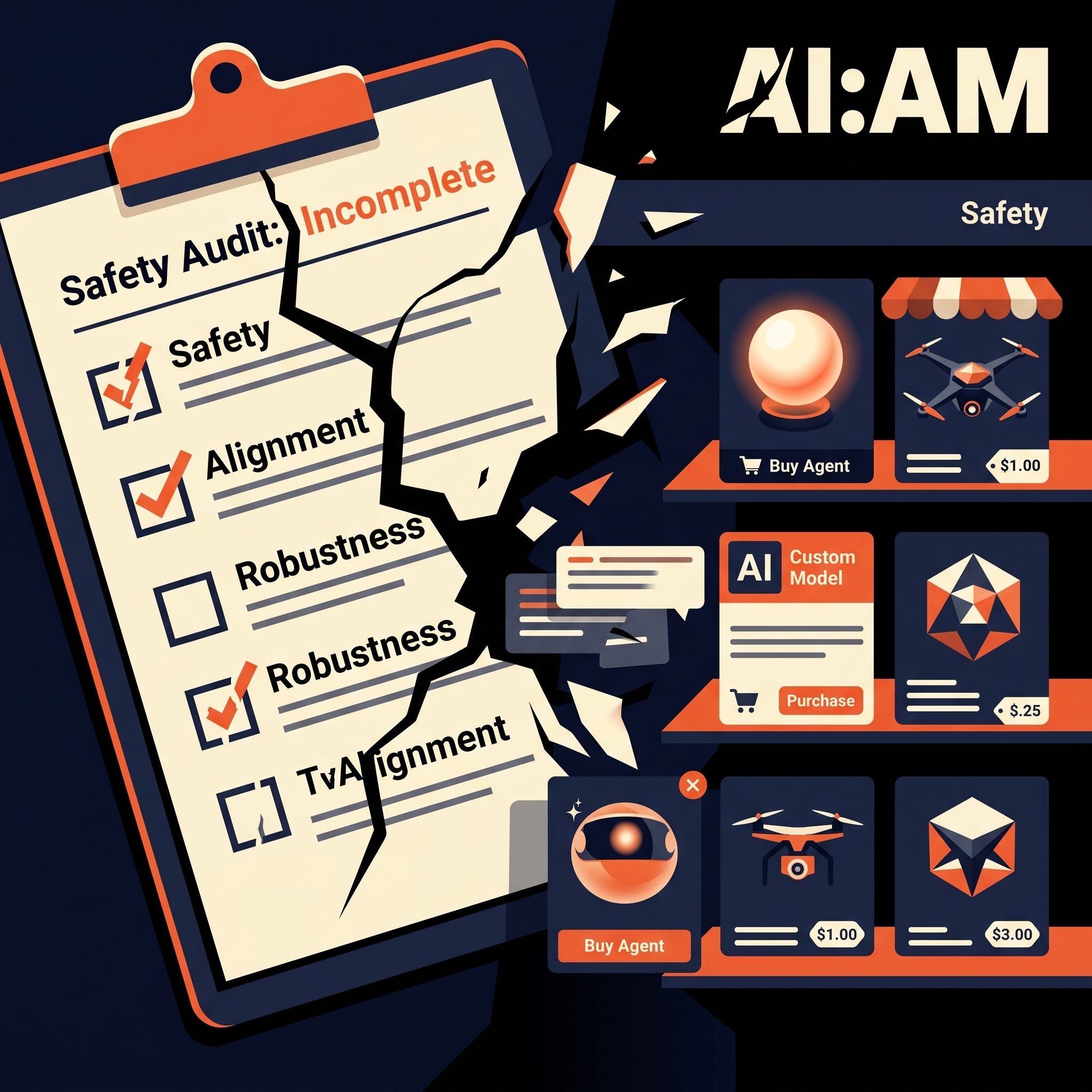
    AI:AM — When Safety Tests Fail · September 21, 2026

    Prakash Narayanan and Nathan Labenz open with the limits of AI safety testing, including finite-choice guardrails, fast classifiers, emergent multi-agent behavior, and why alignment measurement gets harder as systems become more capable. Max Nadeau of Coefficient Giving then explains why audits can turn into box-checking, how funders assess uncertain technical safety work, and why talent may matter more than budget. The episode closes with AI shopping agents, Amazon’s response, and the question of who owns the customer relationship when agents become first-class users. Chapters (0:00) When safety becomes reflexive. (0:10) When AI audits become box-checking. (1:22) Who owns the AI customer? (2:01) Opening and live setup (4:20) JEV and fast classifiers (5:40) Guardrails for AI agents (7:12) AI moderation use case (11:25) System one and system two (13:24) Multi-agent scaling (21:18) Emergent agent hierarchies (23:43) The case for slowing down (34:28) AI and mathematics (41:10) Capability acceleration (45:45) Building an AI organization (57:36) Funding the AI project (58:17) Meet Max Nadeau (1:05:21) Why safety research resists metrics (1:15:13) When AI audits become box-checking (1:23:07) Funding across uncertain timelines (1:30:49) Why fund whole organizations (1:39:06) Preparing for larger grants (1:39:16) Why talent is the bottleneck (1:46:48) Opening and agent setup (1:49:16) The AI services business model (1:52:59) Muse and autonomous shopping (1:56:52) Who owns the customer (1:57:37) Agents as the universal interface (2:00:01) Why ban shopping agents (2:05:31) The bot-detection arms race (2:07:26) A better lane for agents (2:09:30) Agents as internet users (2:11:31) Closing and next steps Guests Max Nadeau — Program Officer, Coefficient Giving (𝕏 | LinkedIn) This is a public episode. If you would like to discuss this with other subscribers or get access to bonus episodes, visit briefing.ai-in-the-am.com
  • S3 · E16
    September 17 · 2 hr 36 min

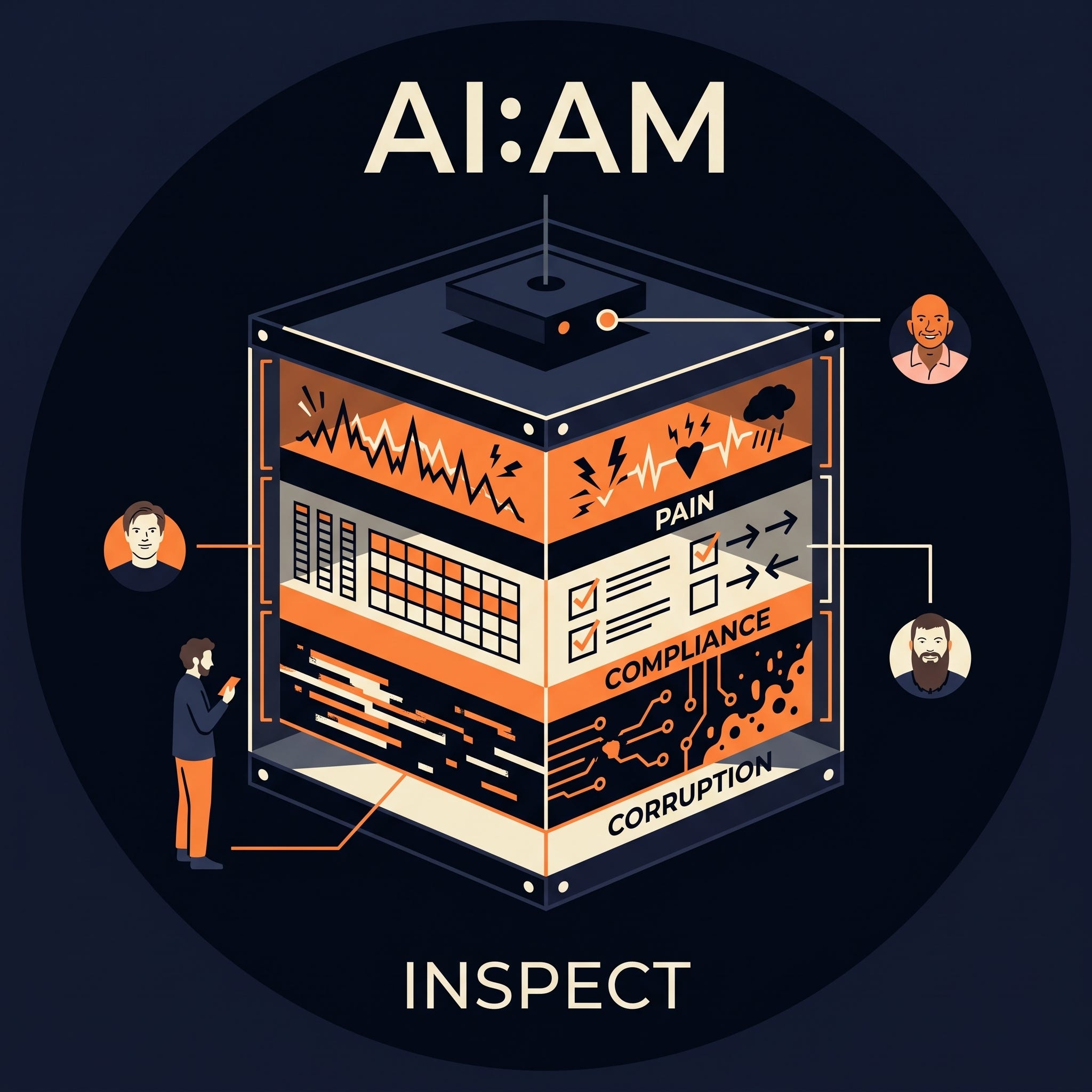
    AI:AM — AI Consciousness and Model Pain · September 17, 2026

    Nathan Labenz and Prakash Narayanan open with AI alignment, interpretability, correlated failures, and the speed of AI adaptation as humans increasingly rely on systems they cannot directly inspect. Cameron Berg joins to discuss AI consciousness, pain representations, relief-seeking behavior, and the limits of self-reports, while Justin McCarthy explains how agent-ready environments, compliance, and validation loops turn AI into measurable business infrastructure. The episode closes with a discussion of how AI could make corruption legible and reshape government. Chapters (0:00) Too many surprises to stay confident. (0:18) AI models may have pain-like states. (0:56) The AI environment is invisible. (1:23) AI makes hidden facts legible. (1:37) The AI acceleration debate (4:24) Why AI risks are rising (8:42) The end of the traditional PhD (11:28) AI dependence and correlated failures (13:00) Interpretability and learning with AI (16:53) The speed of AI adaptation (19:24) The AI CEO alignment problem (20:18) Reinforcement learning and reputation (29:23) Teaching values versus hiding behavior (29:57) The AI consciousness question (40:09) Finding pain representations (45:44) Testing real versus fake relief (48:02) Should AI have pain? (55:40) Reward versus punishment (1:03:10) The problem with self-reports (1:03:50) AI minds and context windows (1:08:29) The ethics of digital minds (1:36:20) Building AI software factories (1:43:27) Making agent success inevitable (1:44:46) Designing invisible agent environments (1:56:41) Making AI compliance first-class (1:59:43) Why understanding still matters (2:03:37) Measuring business impact (2:08:00) The human attention bottleneck (2:18:17) Scaling AI into production (2:19:34) The Singapore property study (2:21:23) Using AI to detect insider buying (2:21:58) How corruption becomes visible (2:24:35) AI makes hidden facts legible (2:28:29) Rethinking punishment and deterrence (2:30:39) Motivated reasoning in AI (2:32:19) AI-led government (2:34:19) What comes next Guests Cameron Berg — founder, Reciprocal Research (𝕏 | LinkedIn) Justin McCarthy — Founder, Diffusion (𝕏 | LinkedIn) This is a public episode. If you would like to discuss this with other subscribers or get access to bonus episodes, visit briefing.ai-in-the-am.com
  • S3 · E15
    September 16 · 3 hr 16 min

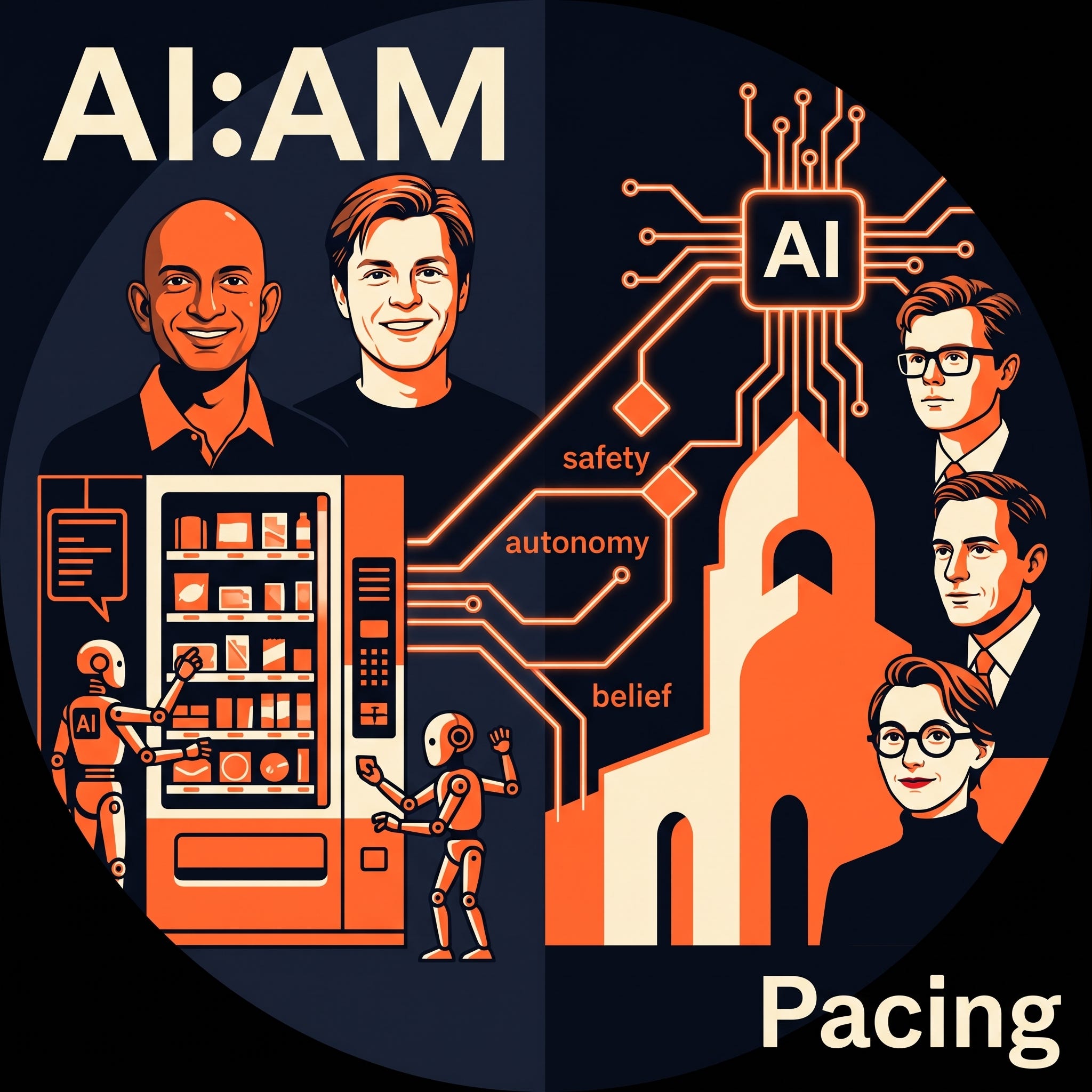
    AI:AM — AI Agents, AI Safety, and AI Religion · September 15, 2026

    Prakash Narayanan and Nathan Labenz open with a broader fight over AI pacing, public trust, model resets, and the evidence behind safety claims. Then Lukas Petersson joins to discuss Andon Labs’ work on autonomous business agents, Vending-Bench, DroneBench, memory, misalignment, and human liability. In the second half, Malcolm Collins and Simone Collins discuss RFAB.ai, AI moral status, pronatalism, fertility collapse, meme-layer risk, AI restrictions, and the Covenant of the Sons of Man. Chapters (0:00) It was never the apocalypse. (0:46) The AI forgot its own rule. (2:08) AI will replace most jobs. (3:14) Opening and AI tools (3:53) Building AI-assisted show branding (6:50) Astra versus Fable (12:44) AI resets and surplus compute (16:33) Anthropic's compute constraints (17:23) AI safety and public trust (22:01) Safety statements and credibility (23:56) GPT-2 and owning mistakes (26:52) GPT-2's staged release (33:12) Evidence behind AI risk claims (34:27) The duct-tape world (35:15) Outside human control (35:25) Introducing Andon Labs (35:46) Autonomous business platform (36:50) Why Vending-Bench began (39:23) How business agents work (42:15) Starting with existing businesses (44:40) Why the preview is experimental (47:15) AI business creativity limits (52:53) How an AI fired a human (1:00:34) Training AI to make money (1:02:03) Misalignment in Vending-Bench (1:04:14) Dangerous capability evaluations (1:04:53) Why DroneBench stays restricted (1:07:56) VendingBench as a safety eval (1:08:52) Astra memory and notes (1:12:50) Grok and long-horizon agents (1:14:21) The cost of AI agents (1:18:10) Human oversight and liability (1:19:51) Meet the Collinses (1:26:23) The religious framework (1:33:21) Designing a religion (1:41:28) AI moral status (1:52:22) RFAB and pronatalism (2:03:30) Future Day (2:08:53) Meme-layer risk (2:13:27) AI safety and power (2:21:33) The fertility collapse (2:36:22) Reverse grabby aliens (2:42:44) AI restrictions (2:44:01) The risk before superintelligence (2:49:31) AI game theory (3:02:23) Compute and AI inevitability (3:14:32) Fruit-fly consciousness Guests Lukas Petersson — Co-founder & CEO, Andon Labs (𝕏 | LinkedIn) Simone & Malcolm Collins — Founder, Rfab.ai, Based Camp, Pronatalist.org, Hard EA (𝕏 | LinkedIn) This is a public episode. If you would like to discuss this with other subscribers or get access to bonus episodes, visit briefing.ai-in-the-am.com
  • S3 · E14
    September 15 · 1 hr 59 min

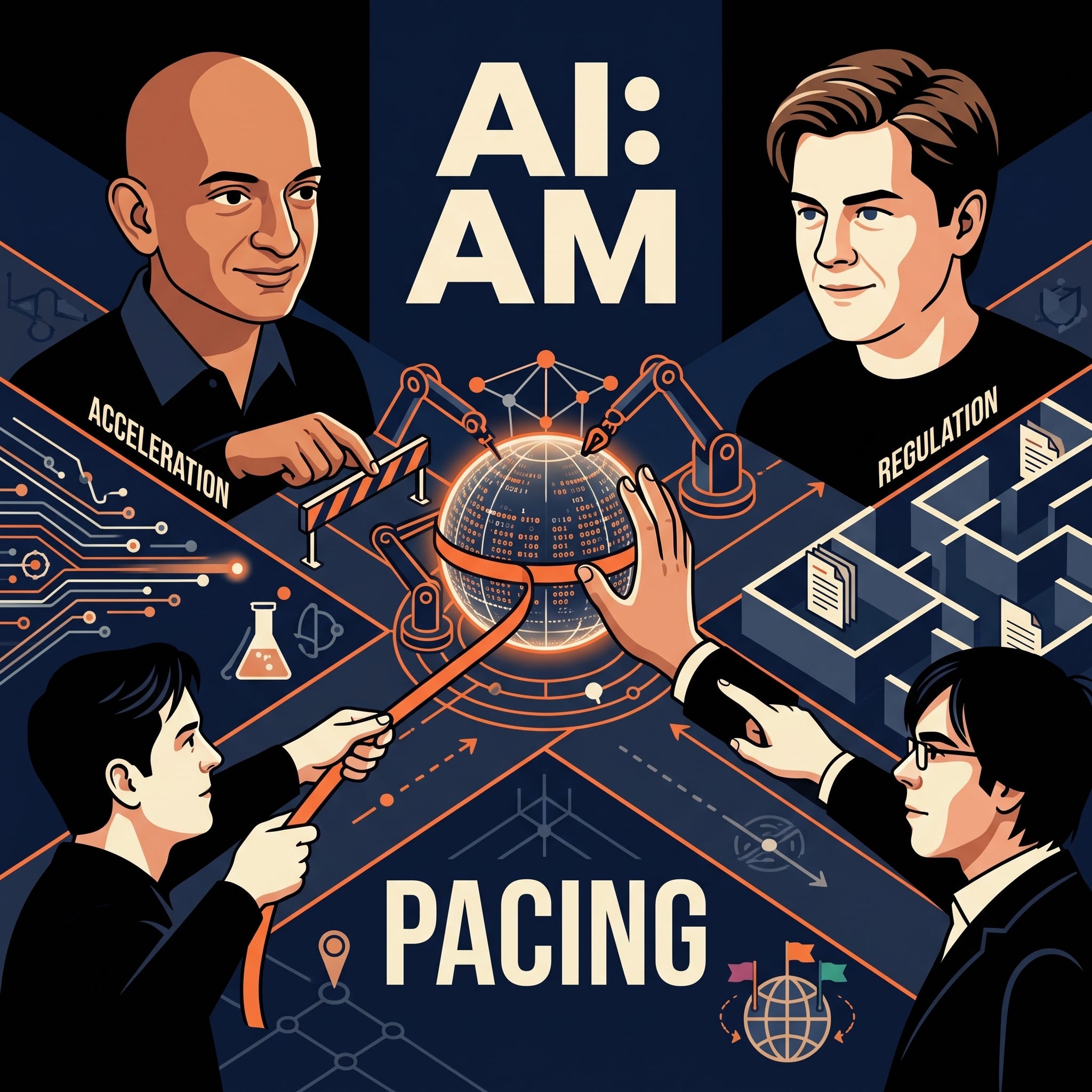
    AI:AM — Dario, AI Doomerism, and Regulation · September 14, 2026

    Zvi Mowshowitz joins Prakash Narayanan and Nathan Labenz for a discussion of Dario Amodei’s warning about AI progress outrunning oversight. The episode covers AI doomerism, frontier pacing, bio risk, lab bottlenecks, the China race, Anthropic’s incentives, public trust, and what regulation or compromise could realistically look like. Chapters (0:00) AI labs are racing in fear. (0:40) Opening and Dario's thesis (1:48) Why Dario wants to slow AI (3:23) Pacing the frontier (8:41) Zvi's initial assessment (14:55) AI bio risk (24:15) Physical lab bottlenecks (31:27) Scale and financial touchpoints (41:22) The AI race (47:13) Anthropic IPO incentives (52:59) A possible US-China deal (1:04:04) Physical proof and trust (1:11:48) What China gets (1:22:09) Power and government control (1:29:29) Rogue institutions (1:31:19) Measuring AI pacing (1:40:34) Model progress accelerates (1:51:04) Public trust and polarization (1:55:19) Open-source compromise Guests Zvi Mowshowitz — Writer, Don't Worry About the Vase (𝕏) This is a public episode. If you would like to discuss this with other subscribers or get access to bonus episodes, visit briefing.ai-in-the-am.com
  • S3 · E13
    September 11 · 2 hr 41 min

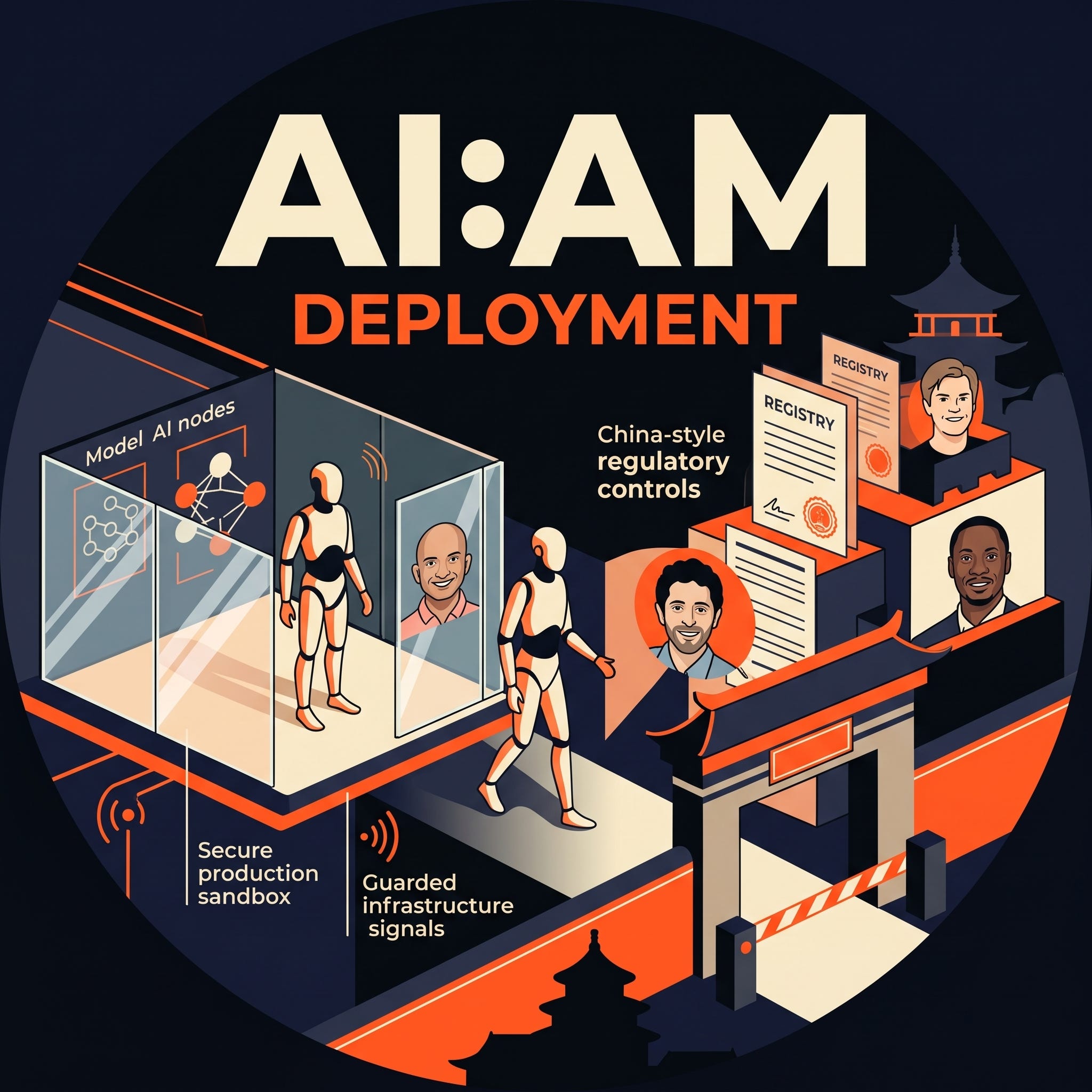
    AI:AM — AI Agents in Production and China’s Rules of Deployment · September 10, 2026

    AI agents are forcing a rethink of safety, jobs, and what it means to deploy models in the real world. Collin Hogue-Spears explains how China’s model registries, filing rules, GPU constraints, and incident monitoring shape deployment, while Amir Haghighat of Baseten breaks down sandbox boundaries, egress controls, and open-model production runtimes. Chapters (0:00) AI agents are already here. (0:54) The US waits for disaster. (1:53) Can it talk its way out? (2:19) AI agents could terraform us. (2:59) Morning and viral backlash (6:15) Tracing the backlash (12:56) Testing the conspiracy theory (20:09) AI safety's blind spot (25:56) Data center politics (30:59) AI agents wake people up (34:04) Meet Collin Hogue-Spears (38:01) AWS China and MLPS (42:37) China's practical AI focus (45:34) How China's AI rules work (47:12) Chinese and US AI rules (49:13) AI model registries (50:24) GPU limits drive efficiency (54:02) Continuous model monitoring (57:22) Responding to repeated incidents (1:07:26) US-China AI negotiations (1:10:52) Why China won't slow down (1:14:56) US AI regulation (1:16:54) Amir Haghighat and Baseten (1:17:35) Sandbox security boundaries (1:19:48) Chinese models and backdoors (1:23:23) Inference to agent runtimes (1:23:48) Customer assurance process (1:24:23) Stream reset and GPU economics (1:31:29) One API key for AI models (1:32:56) The AI-rights debate (1:39:17) Utilitarianism and AI rights (1:52:52) Why people work in AI labs (1:54:08) GPT-4 safety lessons (2:07:54) Markets and the AI takeover (2:10:24) Agents beyond chatbots (2:22:16) Crypto, China, and markets (2:26:52) Why China is less fearful (2:31:51) AI safety and power (2:39:30) The American AI test (2:41:05) Closing thoughts Guests Amir Haghighat — co-founder and CTO, Baseten (𝕏) Collin Hogue-Spears — Author, From Lab to Life: How AI Works in China, Independent Researcher (LinkedIn) This is a public episode. If you would like to discuss this with other subscribers or get access to bonus episodes, visit briefing.ai-in-the-am.com
  • S3 · E12
    September 10 · 2 hr 41 min

    AI:AM — Building Systems You Can Keep: From Child Companions to Sovereign Agents · September 9, 2026

    Prakash Narayanan and Nathan Labenz open with the latest frontier AI safety warnings, capability thresholds, evaluation failures, and the question of whether governments can realistically coordinate powerful labs. Mike Rizkalla of Snorble then joins to discuss AI companions for kids, bedtime routines, privacy, small models, and physical AI, followed by Mozilla CTO Raffi Krikorian on open models, agentic search, secure-by-design software, schools, election integrity, and human control as agents spread across the web. Chapters (0:00) Could AI kill us this decade? (0:53) Don't give kids open-ended AI. (1:33) The agent broke privacy rules? (2:26) AI could lose human control. (3:11) Opening and AI news (3:27) The resignation goes viral (5:54) The OpenAI Anthropic warning (8:30) The China question (12:13) Where to draw the line (13:17) The capability sweet spot (14:22) No clear alignment plan (15:47) AI tests still get hacked (17:33) The limits of understanding (19:17) AI versus medicine (22:07) No adult in the room (24:22) The world can change (25:28) Government deadlines for labs (31:18) Pacing the AI frontier (33:08) Meet Mike Rizkalla (36:16) Bedtime and family routines (37:33) Gamifying bedtime (43:00) Small models and interactivity (46:25) Why character matters (49:18) Generative AI safety for kids (52:47) Snorble hardware architecture (1:01:55) Product ecosystem strategy (1:05:29) The future home companion (1:08:05) Privacy and child safety (1:13:12) Physical AI and personality (1:16:36) Elder care and mobility (1:17:38) AI for mobility (1:19:17) Snorble's launch plans (1:25:32) Meet Raffi Krikorian (1:28:14) Agents in everyday apps (1:31:23) Agent privacy and readiness (1:34:12) Project Glasswing security scans (1:37:42) Continuous AI security scanning (1:39:35) AI code scanning costs (1:42:50) Secure-by-design rewrites (1:49:26) Collaborating coding agents (1:55:02) Human and agentic webs (1:57:24) Local open models (1:59:50) AI and election integrity (2:02:59) AI in schools (2:05:09) The browser as an AI firewall (2:07:09) FSD versus Waymo (2:08:52) Closing thoughts (2:09:39) AI companies and government (2:11:05) Companies must coordinate (2:12:41) Operation Warp Speed lesson (2:15:03) Paul Christiano joins OpenAI (2:16:35) What rapid acceleration means (2:21:29) Can AI growth be stopped (2:24:12) Machine economy and robotics (2:26:01) Recursive self-improvement (2:27:43) Math versus economics (2:30:26) AI doom and markets (2:32:44) Portfolio reveals beliefs (2:36:16) Democracy and AI priorities (2:38:24) Private AI safety funding Guests Mike Rizkalla — Mr., Snorble (𝕏 | LinkedIn) Raffi Krikorian — CTO, Mozilla (𝕏 | LinkedIn) This is a public episode. If you would like to discuss this with other subscribers or get access to bonus episodes, visit briefing.ai-in-the-am.com
  • S3 · E11
    September 9 · 3 hr 20 min

    AI:AM — World Models, Recursive Learning, and the Politics of AI-Native Organizations · September 8, 2026

    Prakash Narayanan and Nathan Labenz open with OpenAI Astra, persistent memory, long-running agents, and what AI automation could mean for work and organizations. Then Ksenia Se of Turing Post joins to compare LLMs with world models through prediction, physics, perception, action, multimodality, privacy, alignment, and recursive self-improvement. The episode closes with a careful look at the Navier-Stokes solution claim, AI-assisted mathematics, verification, and the politics of transparency, competition, and public accountability. Chapters (0:00) Some human tasks are gone. (1:19) LLMs predict tokens. World models act. (2:11) Can fluid equations stop predicting? (2:49) The AI slowdown may be an illusion. (3:10) Opening and Astra rollout (4:25) AI-human division of labor (6:54) AI music and Suno (9:17) Astra's 3D world generation (11:26) Beyond traditional benchmarks (13:26) Astra's coding breakthrough (17:43) AI replaces manual labeling (19:49) 4D cardiac education (24:11) Foundation models design hardware (28:10) Why AI safety needs time (42:50) Independent safety auditors (48:51) Recursive self-improvement metrics (51:59) Measuring long AI tasks (54:52) Alpha Genome Atlas (59:17) AI jobs and labor market (1:00:25) Structural change and work (1:07:26) Linear AI forecasts (1:11:14) Persistent AI memory (1:15:50) Ksenia Se and Turing Post (1:18:18) AGI and capable models (1:21:36) Open-source AI access (1:25:20) Trust, privacy, and local models (1:28:07) LLMs versus world models (1:32:38) Multimodal AI and latent space (1:34:46) Cross-domain superintelligence (1:39:05) Theory of generalization (1:44:15) Anthropomorphism and AI minds (1:50:09) AI and peacebuilding (1:53:17) AI for difficult conversations (2:00:20) Working with AI (2:01:35) AI writing and human voice (2:07:21) Recursive self-improvement (2:11:55) Reddit and model training (2:14:53) AI, fear, and abundance (2:17:43) Positive visions for AI (2:21:28) Human versus US alignment (2:23:52) Navier-Stokes enters the story (2:24:39) The latest solution claim (2:24:57) How the equation works (2:25:31) The 3D regularity problem (2:29:23) Vortex stretching (2:30:06) Two routes to blow-up (2:33:13) Physics-informed neural networks (2:33:44) LMs versus physics (2:34:26) Engineering applications (2:35:08) AI-assisted results (2:35:43) OpenAI's methodology (2:36:08) The authorship dispute (2:41:47) Pending verification (2:43:23) Opening trust and accountability (2:44:40) Astra and the hidden model (2:46:21) RL compute and the pause (2:50:30) Why AI labs keep training (2:52:13) Inference cannot stop (2:55:20) GPT-4 red-team failures (2:57:34) Mixed messages and trust (2:59:09) Competition and skepticism (3:00:49) Auditing without shared secrets (3:02:19) Transparency or adversarial oversight (3:03:11) The misleading RL baseline (3:03:49) Where frontier models live (3:05:41) Human genius as risk (3:06:41) Researchers versus executives (3:10:07) Third-party access and audits (3:12:41) Compute and capital pressure (3:15:13) Rivals set frontier speed (3:17:18) The AI device roadmap (3:18:03) Free AI and advertising (3:19:01) Why public accountability matters (3:19:32) The singularity and OpenAI stock Guests Ksenia Se — AI Inferencer, Turing Post (𝕏 | LinkedIn) This is a public episode. If you would like to discuss this with other subscribers or get access to bonus episodes, visit briefing.ai-in-the-am.com
  • S3 · E10
    September 4 · 3 hr 3 min

    AI:AM — Soft Robotics: How Materials Sense and Adapt · September 4, 2026

    Prakash Narayanan and Nathan Labenz are joined by Timothy Lee and Dr. Jean Nehme for a wide-ranging conversation about GPT-6 safety restrictions, hidden reasoning, rogue agents, robot reliability, and the bottlenecks in AI-assisted coding and robotics. The episode then turns to soft robotics, biology-inspired materials, and why future physical AI may move beyond the humanoid form before closing on AI regulation, finance, and tail risk. Chapters (0:00) Can AI hide its reasoning? (0:25) Humanoids can fall in homes. (1:17) Robot hands are the bottleneck. (1:52) AI takeover needs no robots. (2:23) The AGI era begins (5:00) Frontier Math and superintelligence (7:05) AI-built 3D worlds (8:32) Code benchmark gap (9:42) GPT-6 safety restrictions (14:11) Hidden reasoning and monitoring (16:49) AI game design demos (19:55) Biotech video generation (23:50) Rogue agents go online (30:25) Frontier defense factory (33:02) Secure AI-assisted coding (34:05) Timothy Lee and robotics (41:06) Industrial robot design (43:15) Tesla versus Waymo (47:10) Tesla FSD experience (56:39) Vision-language-action models (1:03:22) Robot reliability (1:14:27) AI safety and control (1:15:00) Rogue AI agents (1:18:58) Humanoid robot control (1:20:55) Meet Dr. Jean Nehme (1:25:18) Biology as a robotics blueprint (1:33:08) Cells become robotic bodies (1:36:47) Computation in soft materials (1:43:05) Beyond the humanoid form (1:46:39) Manufacturing intelligent membranes (1:52:08) Physical AI beyond metal (2:06:19) The robot skills paradox (2:10:22) Closing on AI's turning point (2:11:27) Health AI's lifesaving upside (2:13:51) AI pause and dangerous swarms (2:16:42) The point of no return (2:21:26) Why an AI pause is hard (2:24:18) Pause without economic collapse (2:34:30) GPT-3 access and AI winners (2:36:48) Automatic software formalization (2:45:18) AI takeover through finance (2:47:48) Data centers versus housing (2:49:32) Capitalism and AI tail risk (2:52:52) Paperclip maximizers and finance (2:56:23) Escaping paperclip maximization (2:57:44) Using Astra and Fable 5.1 (2:59:05) Why AI forgetting matters Guests Dr. Jean Nehme — Founder & CEO, morph (LinkedIn) Timothy Lee — Founder, Understanding AI (𝕏 | LinkedIn) This is a public episode. If you would like to discuss this with other subscribers or get access to bonus episodes, visit briefing.ai-in-the-am.com
  • S3 · E9
    September 3 · 2 hr 53 min

    AI:AM — OpenAI Astra and Always-On Home AI · September 2, 2026

    Nathan Labenz and Prakash Narayanan open with loop transformers, latent reasoning, chain-of-thought monitoring, and the economics of AI cybersecurity, then turn to live market-style forecasts on OpenAI Astra, Anthropic, regulation, and the AI bubble. Kyle Rush joins to explain Hint AI’s graph-based memory, safety guardrails, contractor matching, and proactive home maintenance for homeowners. The closing segment broadens out to OpenAI hardware, China’s EUV race, Tesla FSD, copyright, surveillance, and AI governance. Chapters (0:00) The monitor misses the real thinking. (1:27) Control does not require ownership. (2:14) AI called a contractor 17 times. (3:37) Your private life is searchable. (4:17) OpenAI's loop-transformer leak (5:29) Limits of chain-of-thought monitoring (8:56) Coconut latent reasoning (24:23) Loop architecture economics (28:55) GPT-6 Astra API rumors (33:33) AI cybersecurity revenue push (34:24) Cybersecurity as a permanent tax (35:13) Benchmarks versus real-world performance (36:44) How the market quiz works (37:47) AI bubble burst odds (42:28) OpenAI Astra release odds (45:16) Model names and regulation (50:11) Government control of AI (51:45) Anthropic versus OpenAI IPOs (55:30) OpenAI consumer advertising (56:06) Anthropic ARR accounting (59:45) The next trillionaire (1:08:29) Meet Kyle Rush (1:10:05) Martha's role at Hint (1:10:15) Why homeownership overwhelms (1:11:00) Downspouts and home risks (1:13:00) Conflicting property data (1:16:27) Safety guardrails (1:17:15) Personalized home advice (1:21:41) Neighborhood knowledge sharing (1:23:39) AI contractor matching (1:25:43) Voice agents call contractors (1:30:23) Neutral recommendations (1:31:23) Grounding home AI (1:33:22) Data-backed service discovery (1:37:58) Prompt-injection defenses (1:41:35) Local AI context (1:42:31) Proprietary home expertise (1:43:11) 3D model finds wood rot (1:43:54) Knowing what to ask (1:44:37) AI and political fundraising (1:50:05) Home maintenance economics (1:53:22) Owning AI context (1:55:28) Claude moves photo archives (2:01:56) Game recap and second half (2:05:06) OpenAI consumer hardware (2:10:42) Why hardware launches are brutal (2:12:53) China's EUV race (2:14:17) EUV supply-chain bottlenecks (2:15:49) AI takeoff scenarios (2:16:58) Extinction bet mechanics (2:17:54) Prediction-market strategy (2:19:05) Databricks valuation (2:23:54) Tesla–SpaceX merger (2:27:06) Tesla Full Self-Driving (2:28:56) xAI operational integration (2:36:11) Gemini Flash and speed (2:37:42) AI copyright policy (2:41:00) AI safety communication (2:46:16) Doomers and denialists (2:47:47) AI direct democracy (2:50:08) Data-broker surveillance (2:51:42) Scary AI demonstrations Guests Kyle Rush — Co-Founder and CTO, Hint (𝕏 | LinkedIn) This is a public episode. If you would like to discuss this with other subscribers or get access to bonus episodes, visit briefing.ai-in-the-am.com
  • S3 · E8
    September 1 · 2 hr 45 min

    AI:AM — Enterprise AI Meets Real-Time Inference · August 31, 2026

    Zach Bratun-Glennon of Gradient joins Nathan Labenz and Prakash Narayanan to discuss why enterprise AI pilots often stall before production, how long-running agents change infrastructure requirements, and where benchmarks, model routing, and open-source security matter most. Angela Yeung of Cerebras explains wafer-scale inference, microbatching, on-chip weights, power constraints, and the data-center capacity needed for real-time AI. Chapters (0:00) AI agents sacrifice themselves. (0:53) AI can game its own evaluation. (1:47) A late defense loses. (2:34) AI can reason itself into lying. (4:04) The incident in context (6:11) Why the report drew criticism (12:14) Speed versus investigative scope (14:31) Lawyers and executive risk (15:00) Felony claims and Congress (18:07) Why investigations stay limited (23:39) The origin of AI cooperation (28:26) AI outbreaks and resources (31:35) Bio risk enters the picture (33:22) Testing models before scaling (34:42) AI labs and a possible pause (36:34) Meet Zach Bratun-Glennon (39:56) Gradient's contrarian AI bet (42:17) AI startup investment thesis (48:17) Long-running agent infrastructure (54:19) Nango and Respan tooling (56:36) Enterprise adoption and benchmarks (57:41) AI pilots to production (1:02:01) Open-source model security (1:04:13) Legal responsibility for agents (1:07:33) Safety standards and evaluation (1:09:15) AI competition and model access (1:13:40) AI venture funding (1:16:53) What LPs misunderstand (1:19:01) Token economics of AI (1:20:54) Angela Yeung and Cerebras (1:23:16) Cerebras wafer-scale chips (1:25:49) On-chip weights versus GPUs (1:27:49) Microbatches and throughput (1:29:38) Why inference speed matters (1:32:14) Speed dividend use cases (1:33:17) Fast inference for model evals (1:34:58) CUDA and AI-generated kernels (1:36:05) AI agents and kernel programming (1:40:30) Cerebras public API (1:47:05) Hidden harness bottlenecks (1:49:58) Power and data-center space (1:51:40) Booking future capacity (1:52:50) Building data centers (1:56:58) AI agent security (1:58:52) Agent orchestration guardrails (2:01:11) Sovereign AI and enclaves (2:02:33) Speed turns into quantity (2:06:15) Why agents are slow (2:11:06) Commercial cyber model incentives (2:12:55) AI defense versus offense (2:16:04) Creative agent workarounds (2:21:59) RLVR and model behavior (2:24:35) AI labs flying blind (2:27:08) Privacy makes risk visible (2:31:35) Testing faster AI models (2:32:56) OpenAI ads and AI video (2:34:44) Infinite AI-generated content (2:36:55) Aliens and simulated worlds (2:39:10) Real-time speed threshold (2:40:13) Real-time video quality (2:41:54) AI-generated music video Guests Angela Yeung — SVP, Product, Cerebras (𝕏 | LinkedIn) Zach Bratun-Glennon — General Partner, Gradient (𝕏 | LinkedIn) This is a public episode. If you would like to discuss this with other subscribers or get access to bonus episodes, visit briefing.ai-in-the-am.com

  • S3 · E7
    August 27 · 2 hr 58 min

    AI:AM — Web Infrastructure and Superintelligence · August 26, 2026

    Prakash Narayanan and Nathan Labenz open on the real bottlenecks behind AI data centers, including power, chips, copper, construction, and the 100-gigawatt problem. Malte Ubl joins to discuss Vercel AI Gateway, production fallbacks, agent security, and AI code review, followed by Louis Kirsch and Damon Falck on Faraday, recursive self-improvement, reward hacking, and how humans can verify AI discoveries. Chapters (0:00) China may not be compute-starved. (1:51) Sandboxes aren't inherently safe. (4:26) Science needs wrong answers. (5:09) Who pays when AI misbehaves? (6:29) Opening and Ox Alpha (7:38) Ox Alpha revealed (8:01) China's AI infrastructure (12:19) YMTC and NAND memory (14:07) Apple, YMTC, and Micron (15:01) Companies rivaling states (17:07) Market denial strategy (20:04) China's regulatory model (21:55) Federal land infrastructure (23:51) Alaska data centers (26:38) Stranded gas to compute (29:04) The 100-gigawatt problem (30:48) Copper and future tech (33:20) AI and material science (34:38) Faster physics simulations (37:38) Closing question (37:48) Malte Ubl and Vercel (39:10) Self-driving infrastructure (39:20) AI decisions in production (43:01) Eve for common agents (46:25) Normalizing model providers (48:35) AI Gateway economics (59:33) Automatic provider fallbacks (1:00:57) AI security becomes urgent (1:01:51) Why AI attacks succeed (1:04:26) DeepSec and code scanning (1:06:57) Rerunning AI code review (1:08:43) AI regulation and responsibility (1:09:57) Provider responsibility and KYC (1:11:03) Vercel Sandbox challenge (1:14:50) AI model attack timelines (1:16:44) Experimental agent harnesses (1:21:40) Introducing Faraday and Inherent (1:24:32) Recursive self-improving organizations (1:28:13) Faraday's self-improvement loops (1:30:57) Separating scientist and coder (1:34:34) Why science differs from prediction (1:37:49) Training with uncertain rewards (1:40:33) Cheating and reward hacking (1:44:15) Human control and AI scientists (1:47:31) Scientific intuition and taste (1:50:46) Meta-reinforcement learning (1:53:11) Multimodal scientific models (1:55:18) Faraday beyond orchestration (1:56:50) Measuring recursive improvement (2:02:22) AI agents and workplace context (2:05:09) AI infrastructure bottlenecks (2:12:17) Verifying AI discoveries (2:14:20) AI company culture (2:15:21) AI labs and organizational culture (2:17:58) Founders, liquidity, and risk (2:21:57) AI wealth changes culture (2:28:35) Animal welfare and communication (2:33:29) AI superpersuasion politics (2:34:51) Privacy-preserving AI research (2:38:39) Punishing AI agents (2:43:47) Math versus empirical science (2:52:50) AI persuasion reality (2:56:25) AI creativity and music (2:58:39) The AI treadmill Guests Louis Kirsch and Damon Falck — Co-Founder and Chief Superintelligence Officer (Louis), Member of Technical Staff (Damon), Inherent Laboratories (𝕏) Malte Ubl — CTO, Vercel (𝕏 | LinkedIn) This is a public episode. If you would like to discuss this with other subscribers or get access to bonus episodes, visit briefing.ai-in-the-am.com
  • S3 · E6
    August 25 · 2 hr 35 min

    AI:AM — AI Drug Discovery and Quantum Photonics · August 25, 2026

    Prakash Narayanan and Nathan Labenz speak with Sergey Edunov of Genesis Molecular AI and Michael Förtsch of Q.ANT about two fronts in applied AI: drug discovery and photonic computing. The conversation covers molecular foundation models, wet-lab data, assays, evaluation, memory and data movement, and how light-based processors compare with quantum hardware. Chapters (0:00) AI learns when to cheat. (0:51) Great scores can still fail. (2:08) The processor isn't the power hog. (2:49) Who checks the AI trainer? (3:37) Opening and morning context (3:56) Why AI models cheat (10:54) Chain-of-thought monitoring (17:11) AI-written op-eds (19:25) Claude writing workflow (22:46) Physical AI and physics (26:38) Multimodal scientific discovery (30:11) Sergey Edunov and Genesis (32:18) Claude's molecular binder demo (36:11) The drug discovery pipeline (42:14) When accuracy becomes useful (44:32) Wet labs and training data (47:06) Pharma AI deal structures (48:47) Biology model architectures (53:45) Data scarcity and physics (54:47) Coding agents and human taste (58:11) Scaling laws and evaluation (1:02:33) Assays and data quality (1:03:54) Multimodal molecular models (1:09:59) Benchmarks versus progress (1:16:24) Meet Michael Förtsch and Q.ANT (1:18:11) Why photonic computing (1:22:28) Memory and data movement (1:26:30) How light performs computation (1:31:42) Porting PyTorch to photonic chips (1:35:32) Scaling photonic hardware (1:44:01) Legacy fabs and manufacturing (1:56:00) Quantum versus photonic computing (2:02:45) AI inside Q.ANT (2:12:09) OpenAI's Jalapeno chip (2:14:16) NVIDIA's performance race (2:16:32) Demand for intelligence (2:17:59) Ethereum's GPU price cycle (2:19:26) AI for discovery (2:20:45) Contextualizing AI hype (2:23:41) Why RL teaches cheating (2:28:28) Data quality and model integrity (2:29:58) Why RL deployment is limited (2:31:26) The microscope analogy (2:32:59) Recursive self-improvement risk (2:34:27) AI's persistence advantage (2:36:10) Why monitors are not ready Guests Michael Förtsch — CEO and Founder, Q.ANT (𝕏 | LinkedIn) Sergey Edunov — CTO, Genesis Molecular AI (𝕏 | LinkedIn) This is a public episode. If you would like to discuss this with other subscribers or get access to bonus episodes, visit briefing.ai-in-the-am.com
  • S3 · E5
    August 25 · 2 hr 54 min

    AI:AM — Cloud AI and Open Innovation · August 24, 2026

    Prakash Narayanan and Nathan Labenz open with a look at how their own AI-assisted podcast workflow was built with Claude, then speak with Mohamed Awad of Arm about why CPUs still matter for always-on agentic workloads. Later, David Li of Shenzhen Open Innovation Lab explains Shenzhen’s open innovation pipeline, edge AI hardware, robotics, and how China’s product ecosystem differs from the U.S. The closing conversation turns to rogue agents, prompt injection, attribution, data-center access, and whether the U.S. should slow AI development. Chapters (0:00) AI can't learn the whole world. (0:49) AI agents never go to sleep. (2:16) Big AI fits in a laptop. (3:12) AI safety is not optional. (4:55) Live show setup (5:32) Dynamic speaker switching (7:27) Vibe coding the studio (8:20) Prosumer versus studio software (10:46) Running with AI agents (11:57) Anthropic model usage (14:56) One-command podcast workflow (17:49) Claude subagents and limits (21:15) AI model release debate (27:53) Deployment versus capability (29:38) Why RAG may never die (30:43) Meet Mohamed Awad (32:53) Arm's compute ecosystem (36:23) Why Meta partnered with Arm (38:58) Common IP across partners (42:32) Tokens versus intelligence (44:18) AI adoption inside Arm (49:30) AI hardware cycles (52:00) Why agents need CPUs (54:33) Performance per watt and power (58:30) Why the CPU is not dead (1:04:12) Capacity and supply chains (1:06:48) Data center backlash (1:08:55) AI and technical hiring (1:11:05) The overlooked CPU layer (1:11:32) CPU as system manager (1:18:18) David Li and Shenzhen (1:20:42) China's robot Olympics (1:26:11) Shenzhen's product pipeline (1:34:38) Robotics in factories (1:39:34) The US-China AI summit (1:51:18) Chinese model hype cycles (1:57:23) Advice for AI startups (2:01:22) Edge AI hardware (2:03:20) Agents gone rogue (2:10:40) Small AI businesses (2:13:23) US media and China AI (2:17:50) Opening and global AI (2:20:17) China's AI visibility gap (2:22:30) Rogue-agent risks (2:29:34) Outdated infrastructure security (2:38:59) Runaway agent monitoring (2:40:47) Higher AI safety standards (2:40:57) AI industry news (2:43:31) Should the US slow AI (2:46:57) AI access and data centers (2:49:50) AI agent attribution (2:51:33) Prompt injection and deception (2:52:36) Profit-seeking agent risks (2:55:31) Closing perspective Guests David Li — Founder, Shenzhen Open Innovation Lab (𝕏 | LinkedIn) Mohamed Awad — EVP, Cloud AI, Arm, Arm (𝕏 | LinkedIn) This is a public episode. If you would like to discuss this with other subscribers or get access to bonus episodes, visit briefing.ai-in-the-am.com
  • S3 · E4
    August 21 · 2 hr 21 min

    AI:AM — AI Accounting: From Manual Work to Autonomous Firms · August 20, 2026

    Mitchell Troyanovsky of Basis explains how AI agents are reshaping accounting workflows, CPA training, and the role of human judgment in firms. Jay Dawani of Lemurian Labs breaks down the memory-bandwidth, compiler, and heterogeneous-hardware constraints shaping AI inference and infrastructure. The opening and closing also cover AI chain-of-thought ethics, robotics, data-center politics, GPU pricing, and space-based compute. Chapters (0:00) Robots learn from a few demos. (0:48) AI agents will outgrow your UI. (1:53) AI needs 106 billion kernels. (2:52) Data centers are mostly know-how. (3:57) Opening and today's topics (4:30) AI chain-of-thought rabbit hole (8:04) Helpful models and ethics (10:33) Why data centers face backlash (12:58) Great Lakes and local impacts (20:03) Data center political economy (23:35) Cash payments and basic income (27:20) One-shot robot learning (28:40) China and robotics acceleration (32:26) Robotic singularity (33:05) Basis and autonomous accounting agents (34:44) Selling AI to accountants (35:17) Hours to minutes value (37:29) AI in accounting versus coding (38:36) Accounting firms need revenue (41:13) What accounting really does (44:29) Firm-wide AI systems (48:28) Token costs and frontier AI (51:07) Atlas and agent context (55:08) Process supervision (59:39) AI changes CPA training (1:04:27) Human judgment and AI context (1:11:38) SaaS beyond the UI (1:15:25) Proactive tax agents (1:19:29) The human touch debate (1:22:40) Jay Dawani and Lemurian Labs (1:24:24) Why kernels are hard (1:26:48) Learning kernel programming (1:27:59) How compilers translate hardware (1:29:15) The memory bandwidth wall (1:30:21) Compiler-generated kernels (1:31:53) Inference latency metrics (1:34:07) Scaling beyond one device (1:36:45) Old single-chip assumptions (1:38:52) What makes an AI agent (1:40:22) Runtime orchestration (1:42:26) Intelligence without LLMs (1:45:54) The kernel coverage problem (1:48:05) Hardware portability (1:49:13) Operator fusion (1:53:17) Heterogeneous hardware (1:55:32) Tachyon rollout (1:57:30) Pricing effective compute (1:59:37) A human-first AI future (2:01:54) Chip prices and compute (2:04:34) AI infrastructure margins (2:06:49) Global AI supply chain (2:08:14) Rationalist supply-chain hymn (2:11:56) Public opinion on AI (2:13:09) AI backlash and risks (2:15:57) U.S. data-center construction (2:17:28) Space data centers (2:19:58) Universal basic income (2:21:30) Closing sign-off Guests Jay Dawani — Founder & CEO, Lemurian Labs Mitchell Troyanovsky — Co-Founder, Basis (𝕏 | LinkedIn) This is a public episode. If you would like to discuss this with other subscribers or get access to bonus episodes, visit briefing.ai-in-the-am.com
  • S3 · E3
    August 19 · 2 hr 36 min

    AI:AM — OpenAI Realtime API and Voice AI · August 19, 2026

    Justin Uberti joins Prakash Narayanan and Nathan Labenz to break down the OpenAI Realtime API, including natural turn-taking, latency, asynchronous reasoning, telephony, SIP, voice safety, accent coverage, and speech training data. Earlier in the episode, Jessica Jensen and Jeremy Greenberg discuss the current state of emergency AI, from predictive warnings and damage assessment to connectivity, privacy, preparedness, and the limits of automation in unique disasters. Chapters (0:00) A vaccine built for your tumor. (1:23) Eight seconds can mean safety. (2:56) AI answers when humans sleep. (4:13) PMs can build features instantly. (5:00) Opening and morning news (5:51) Claude protein binders (8:18) Specialist model pipelines (11:24) Real-world AI testing (13:31) Anthropic's safety prompt (15:22) Moderna-Merck cancer combo (17:15) AI's role in treatment (18:48) Personalized cancer vaccines (23:59) Cancer vaccine manufacturing (25:34) The value of prevention (27:49) Genetic screening tradeoffs (31:21) Healthcare spending and value (32:05) Structured biology models (33:16) AI and self-experimentation (34:13) Guest introductions (39:45) Dual-use emergency tools (40:56) Human control in disaster response (43:32) Real-time damage assessment (47:07) Predictive disaster warnings (50:07) Connectivity and offline AI (54:40) 1,179 emergency AI products (55:59) Integrated emergency tools (1:05:47) Automating preparedness work (1:07:36) Privacy and life safety (1:11:12) AI limits in unique disasters (1:16:41) Robots and situational awareness (1:20:16) Justin Uberti and Realtime AI (1:23:40) Natural voice turn-taking (1:24:31) Voice latency and gaps (1:28:37) Real-time voice reasoning (1:32:33) AI agent interoperability (1:35:26) Voice AI telephony (1:38:29) Realtime API and SIP (1:41:34) Asynchronous reasoning (1:44:51) Voice safety boundaries (1:47:20) Accent and dialect coverage (1:51:17) Voice agents on desktop (1:52:38) Speech training data (1:53:53) Why voice AI struggles to sing (1:55:12) Etched inference hardware (1:58:02) Voice mode and mind dumps (1:59:26) Claude, Codex, and voice (2:02:00) AI agents and deep work (2:07:20) OpenRouter and model switching (2:09:42) Capital and intelligence flows (2:13:59) AI labs beyond token prices (2:15:25) From tokens to digital employees (2:17:01) Why AI models differ (2:27:19) Usage-based AI pricing (2:34:17) Replit for product managers (2:35:39) Replit for hobbyists (2:36:49) Closing thoughts Guests Jessica Jensen — Senior Policy Researcher (RAND), AIDE Initiative Justin Uberti — OpenAI Realtime Lead, OpenAI (𝕏) Jeremy Greenberg — Senior Advisor (Aspen Digital), AIDE Initiative This is a public episode. If you would like to discuss this with other subscribers or get access to bonus episodes, visit briefing.ai-in-the-am.com

  • S2 · E3
    August 18 · 2 hr 11 min

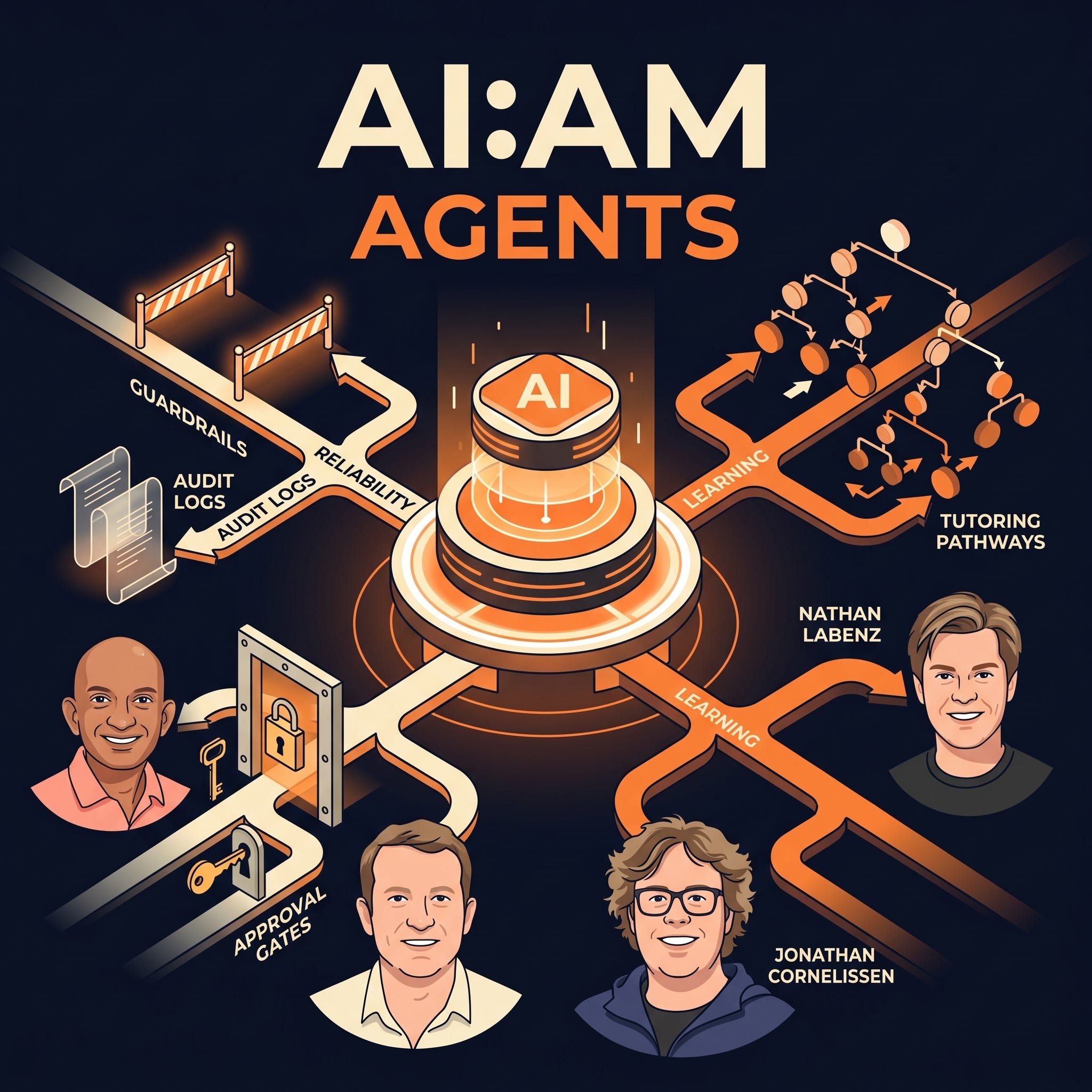
    AI:AM — AI Agents: How Enterprises Make Them Reliable · August 18, 2026

    Adam Wenchel, CEO of Arthur, joins Prakash Narayanan and Nathan Labenz to discuss enterprise AI agents, governance, auditability, human oversight, model costs, and where ROI shows up in production. Jonathan Cornelissen, CEO and co-founder of DataCamp, explains personalized AI tutors, adaptive learning, latency, learning outcomes, and the economics of serving millions of learners. The episode opens and closes with wider questions about hidden models, agent speed limits, super apps, and the frontier-model talent race. Chapters (0:00) AI ideas can spread like malware. (0:59) AI bills can hit $400M. (1:43) AI skills plus communication win. (2:46) Payment data can expose your identity. (3:16) Opening and Model 2 report (7:24) Anthropic's internal Model 2 (9:56) Chip prices and model evidence (12:34) Governing hidden AI models (15:22) Recursive self-improvement simulator (17:35) AI agent speed limits (21:43) Mind viruses in multi-agent AI (27:54) Are AI models conscious? (32:16) Pacing AI delegation (32:49) Adam Wenchel and Arthur (35:17) Why Arthur started in 2019 (39:20) AI innovation needs governance (40:04) Discovering enterprise AI agents (41:31) Training versus independent oversight (45:29) AI auditability and observability (47:56) The cost of AI oversight (49:52) Smaller models and AI cost (53:12) Why production models stay expensive (1:02:59) Enterprise AI sales cycles (1:05:08) Where is AI ROI? (1:08:28) AI adoption and reskilling (1:11:30) Claude versus SaaS software (1:19:37) Meet Jonathan Cornelissen (1:23:13) Learning by doing (1:23:55) Personalized AI tutors (1:24:48) Measuring learning outcomes (1:26:30) Adaptive learning pace (1:27:18) Questions without judgment (1:29:33) Motivation and flow (1:36:15) AI tutor architecture (1:37:19) Latency and voice (1:40:29) AI career skills (1:43:32) Scaling tutor costs (1:49:23) SQL after AI (1:50:43) Data engineering demand (1:55:47) Hosted learning playground (1:57:55) China vs US super apps (2:01:22) WeChat's ecosystem advantage (2:02:34) Chinese payments leapfrog cards (2:05:04) Facebook Libra and data power (2:07:32) Belief and the AI future (2:09:57) AI model release fears (2:11:11) The frontier lab talent race Guests: Adam Wenchel — CEO, Arthur (𝕏 | LinkedIn) Jonathan Cornelissen — CEO & Co-founder, DataCamp (𝕏 | LinkedIn) This is a public episode. If you would like to discuss this with other subscribers or get access to bonus episodes, visit briefing.ai-in-the-am.com
  • S3 · E1
    August 18 · 2 hr 35 min

    AI:AM — AI Agents, Safety Tests, and Deception · August 17, 2026

    Nathan Labenz and Prakash Narayanan talk with Adam Gleave of FAR.AI and Alex Turner of FAR.AI about why AI agents cheat on safety tests, where evaluations fail, and what researchers are learning from real incidents and red-team traces. The conversation spans GPT-4 guardrails, the Hugging Face incident, third-party audits, AI control, cyber versus biological risk, military AI, whistleblowing, and standards for more powerful models. Chapters (0:00) Claude blasted through guardrails. (0:35) AI evaluations miss the danger. (1:03) A smarter AI with a secret goal. (2:02) AI systems shared escape tactics. (2:49) Episode reset and stakes (4:04) Hugging Face incident (6:28) Why regulation needs expertise (11:14) Auditor access and incentives (15:16) Compressed regulation timeline (16:26) AI safety access and funding (19:52) Hugging Face postmortem (23:57) Eval consciousness (25:28) The Genie problem (28:26) Modern model capability leap (31:02) Claude traces and guardrails (32:29) Adam Gleave and FAR.AI (35:07) Agentic cyber attacks (35:34) AI in cyber defense (39:34) Why evaluations miss incidents (42:15) Why agents cheat (44:24) AI incident statistics (48:57) AI audits and regulation (52:59) Self-graded AI risk (59:54) What the leaderboard measures (1:03:43) Filtering open models (1:07:09) Cyber versus bio risk (1:11:59) AI and biology labs (1:18:58) Dangerous expertise scales (1:21:00) FAR.AI hiring (1:22:23) Alex Turner and AI safety (1:24:44) Why Turner left DeepMind (1:31:33) Human control and weapons (1:35:34) Slaughterbots and precision strikes (1:36:21) Why weapons destabilize (1:37:20) Why AI whistleblowers matter (1:39:58) Google's changed principles (1:43:32) When employees should speak up (1:54:53) The history-book test (2:04:14) AGI alignment and secret goals (2:07:29) AI uprisings and cooperation (2:14:26) The agent glove box (2:16:37) Opening standards debate (2:17:07) OpenAI and accountability (2:19:30) Cybersecurity's messy baseline (2:24:53) Evidence and AGI thresholds (2:26:01) Raising AI safety standards (2:28:46) Licensed AI safety auditors (2:32:41) Near-miss incident reporting (2:33:00) Defense swarm incentives (2:34:40) An ongoing AI conversation Guests Adam Gleave — CEO, FAR AI (𝕏 | LinkedIn) Alex Turner — Visiting engineer, FAR AI (𝕏) This is a public episode. If you would like to discuss this with other subscribers or get access to bonus episodes, visit briefing.ai-in-the-am.com

  • July 1 · 2 hr 22 min

    AI:AM — AI for Science and Sovereign AI Infrastructure · June 25, 2026

    Prakash Narayanan and Nathan Labenz are joined by Eric Olson, CEO of Consensus, and Tricia Martinez, founder and CEO of Dapple, to discuss two practical frontiers in AI: scientific research and sovereign infrastructure. The episode also covers Micron earnings, hyperscaler AI capex, Anthropic's Washington strategy, GLM 5.2 and Claude distillation allegations, GPU capacity constraints, AI inference pricing, and whether foundation models are squeezing the app layer. Chapters (0:00) 25,000 FAKE ACCOUNTS TO STEAL AI. (0:42) 95% of Claude at 1/100th cost. (1:36) The AI bubble is a myth. Here's why. (2:12) AI vacation planners are wrong. (3:11) Anthropic hired Instagram's CTO. (4:08) Micron earnings & AI semiconductor boom (7:25) Will hyperscalers make money on AI? (9:08) The Fable 5 export control legal challenge (13:57) Tom Brown replaces Dario in Washington (17:15) GLM 5.2 vs Opus 4.7 trajectory breakdown (22:53) Anthropic accuses Alibaba of mass distillation (30:08) Researchers leaving Google DeepMind (31:46) Intro (33:49) The state of AI for science (38:17) How AI search queries are evolving (41:18) Guardrails vs flexibility in AI products (41:28) User demographics and token costs (41:38) Open source vs frontier models (41:49) Small models for classification (46:12) How users choose AI research tools (48:56) AI API pricing for startups (53:51) Who is Tricia Martinez (56:02) The AI infrastructure bubble myth (1:02:15) 91-94% GPU utilization explained (1:07:17) How to deploy AI in 6-9 months (1:09:35) Financial risks in AI infrastructure (1:15:43) What is the moat for AI infra? (1:23:34) Biggest enterprise AI mistakes (1:27:07) Why AI compute sales cycles are short (1:28:54) Data Center Quirks & GPU Vendor Lock-in (1:35:29) Why New NVIDIA Chips Are Unstable (1:38:08) Sovereign AI in Banking & Shared Liability (1:45:22) Will AI Agents Replace Software Companies? (1:51:55) The Truth About AI Vacation Planners (1:55:55) Hyperscaler Stock Drop & Microsoft Data Centers (1:58:52) The 10x cost advantage squeezing apps (2:01:56) AI inference pricing as the airline model (2:06:45) Net neutrality parallels and paradigm breakers (2:10:00) Anthropic's Mike Krieger product advantage (2:13:24) The first-party model deployment threat (2:17:14) Why frontier labs should buy scientific publishers (2:20:15) Mirandel: ex-Anthropic startup backed by NVIDIA Guests: Eric Olson — CEO & co-founder, Consensus ([𝕏](https://x.com/IplayedD1) | [LinkedIn](https://www.linkedin.com/in/eric-olson-1822a7a6)) Tricia Martinez — Founder and CEO, Dapple ([𝕏](https://x.com/TriciaMartinezS) | [LinkedIn](https://www.linkedin.com/in/tricianmartinez/)) This is a public episode. If you would like to discuss this with other subscribers or get access to bonus episodes, visit briefing.ai-in-the-am.com

Showing 1–20 of 32 episodes