Skip to content
Artwork for AI Summer
TechnologyNewsTech News

AI Summer

Timothy B. Lee

Timothy B. Lee interviews leading experts about the future of AI technology and policy.

www.aisummer.org
Play
  • 24 episodes
  • fortnightly
  • Avg 59 min
  • English
Counted on this page — what you have heard stays on this device, so it is not something the list can be paged by.
  • February 8 · 1 hr

    Dean is back!

    Dean Ball is back. In April 2025, Dean left the podcast to join the White House Office of Science and Technology Policy, where he spent four months working on the Trump administration’s AI policies—including executive orders, the AI action plan, and AI geopolitics. He’s since returned to independent writing and research, and at the end of 2025, he and his wife welcomed their first child. In this episode, we catch up on what’s changed in AI over the past ten months. Dean makes the case that coding agents like Claude Code represent something close to digital AGI: models that can reliably do pretty much anything a human can do on a computer, as long as you know what to ask. He describes projects he’s built—from automated state legislation monitoring to due diligence reports on real estate—that would have been impossible a year ago. Tim is more measured, noting that users still provide crucial architectural guidance and that the models still struggle with long-horizon planning. The conversation turns to what happens when AI starts automating AI research itself. Dean expects significant speedups as models take over routine experimentation and code-writing at frontier labs, but he’s skeptical of the “intelligence explosion” scenario. We discuss why the physical world keeps fighting back against exponential improvement, why discoveries follow heavy-tailed distributions, and why—despite all the hype—the world probably won’t feel fundamentally different by June. This is a public episode. If you would like to discuss this with other subscribers or get access to bonus episodes, visit www.aisummer.org

    • Transcript
  • Apr 16, 2025 · 57 min

    Dean Ball is leaving the podcast

    This week Dean began a new job: senior policy advisor for AI in the Trump White House. I will miss having him as a co-host and wish him the best in his new role. In this episode, recorded last Friday, we speculate about how AI could change the world over the next 25 to 50 years. We discuss what makes human beings unique, whether humans can maintain control, and how we’ll find meaning in an increasingly automated world. This is a public episode. If you would like to discuss this with other subscribers or get access to bonus episodes, visit www.aisummer.org

  • Apr 7, 2025 · 1 hr 1 min

    Charles Yang on AI and Science

    This week, Dean and Tim talk to Charles Yang, a former staffer at the Department of Energy who now writes the Rough Drafts newsletter. Tim has written extensively about AI in science, concentrating especially on the potential of AI to transform materials science. His work has focused not just on models, but on building robotic, “self-driving” labs to accelerate scientific research. The conversation touches on the latest AI advancements in science, how AI models do and do not help scientists, and what might be coming next. This is a public episode. If you would like to discuss this with other subscribers or get access to bonus episodes, visit www.aisummer.org

  • Mar 19, 2025 · 53 min

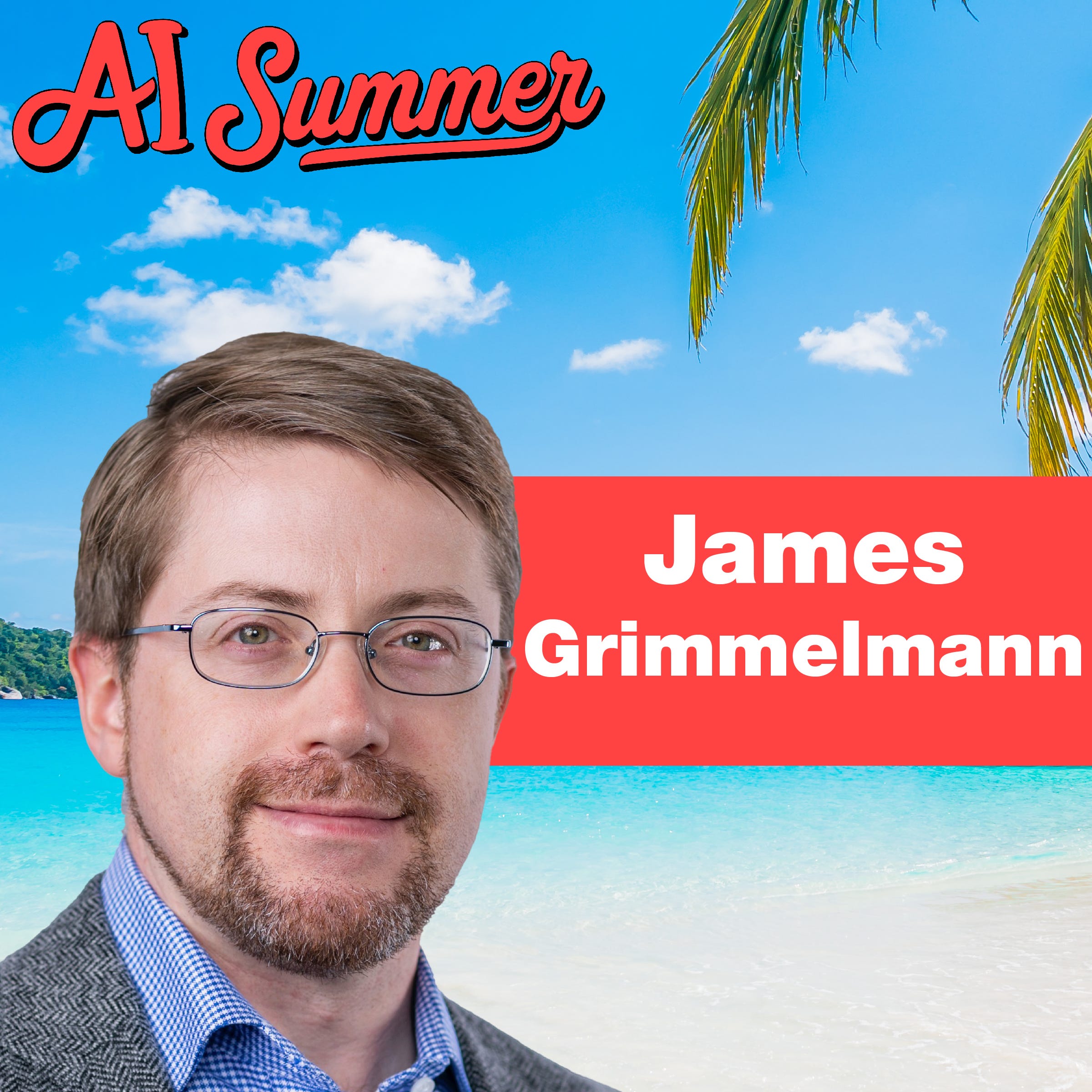
    James Grimmelmann on the copyright threat to AI companies

    James Grimmelmann is a professor of law at Cornell University and a leading expert on copyright law. Grimmelmann walks through the complex process courts use to determine whether training AI models on copyrighted materials—like OpenAI using New York Times articles—is infringement or fair use. He highlights key precedents like the Google Books case, emphasizing how courts weigh transformative uses against potential market harms. The discussion addresses the nuances of generative AI, notably cases where models inadvertently reproduce large excerpts from training materials. Grimmelmann argues that while the industry has largely addressed explicit "regurgitation," ambiguity remains around subtler forms of copying, particularly with image-generating models, which could substantially impact copyright holders like Getty Images. Grimmelmann and the hosts delve into potential legal outcomes, including moderate rulings that force licensing agreements, or harsher ones that could significantly restrict the availability of open-source AI models. The interview also touches on Congress's historical reluctance to intervene in contentious digital copyright issues, leaving critical decisions to be gradually shaped by court rulings. Dean and Tim conclude that while an outright shutdown of generative AI by courts is improbable, the forthcoming legal decisions will likely reshape the industry's structure, potentially favoring larger companies capable of negotiating extensive licensing deals. Grimmelmann anticipates initial district court rulings within the year and appellate decisions by 2026, setting the stage for a pivotal shift in how AI companies use copyrighted works. This is a public episode. If you would like to discuss this with other subscribers or get access to bonus episodes, visit www.aisummer.org

Showing 21–24 of 24 episodes