Skip to content
Artwork for AI Builds It: Easy Coding Tools
TechnologyEducationBusinessEntrepreneurship

AI Builds It: Easy Coding Tools

AIAgentStore.ai

AI Builds It: Easy Coding Tools is the podcast for the new era of software creation — where anyone can build real apps, tools, and automations using AI, no computer science degree required.

Published multiple times a week, each episode is a deep-research audio article analyzing the newest AI coding tools, vibe coding workflows, and agentic builders reshaping how software gets made. We break down tools like Cursor, Claude Code, Replit Agent, Lovable, Bolt, v0, Windsurf, and every major new launch — separating real capability from hype, and showing how non-developers are shipping production apps in hours instead of months.

The core idea: traditional coding education is no longer a gatekeeper. AI has unlocked building for everyone. Founders, marketers, designers, students, creators, and curious tinkerers — you're all coders now. This show is your research briefing on the tools making it possible.

What you'll hear:

  • In-depth reviews of the latest AI coding and no-code tools
  • Breakdowns of real apps built by non-developers
  • Vibe coding techniques, prompts, and workflows that actually work
  • Trends in agentic development and AI-native building
  • Honest analysis — what's hype, what's game-changing, what to try next
  • Dense, research-backed audio essays with no filler

New episodes multiple times per week. Subscribe to stay ahead of the fastest-moving space in tech.

🔗 Website, guides, and tool reviews: easycoding.tools

Play
  • 18 episodes
  • fortnightly
  • Avg 27 min
  • English
  • September 10 · 15 min

    Fix My Spreadsheet: Using Coding Agents for Everyday Office Tasks

    Read the full article: Fix My Spreadsheet: Using Coding Agents for Everyday Office Tasks Discover more at AI Builds It: Easy Coding Tools Excerpt: Fix My Spreadsheet: Using Coding Agents for Everyday Office Tasks Spreadsheets are powerful, but everyday work often involves the least enjoyable parts of using them: removing duplicate rows, correcting inconsistent labels, writing formulas, and turning a table into a chart that someone can understand. ... Continue reading

    • Transcript
  • August 28 · 21 min

    Summer 2026 Coding Agents: A Plain-English Guide for Beginners

    Read the full article: Summer 2026 Coding Agents: A Plain-English Guide for Beginners Discover more at AI Builds It: Easy Coding Tools Excerpt: Summer 2026 Coding Agents: A Plain-English Guide for Beginners Scope note: This guide reflects public product information and research available through August 28, 2026. “Summer 2026” means June through August, although the final two days of August have not yet occurred. ... Continue reading

    • Transcript
  • August 17 · 38 min

    Safety and Security of Autonomous Coders: Threat Models and Mitigations in 2026

    Read the full article: Safety and Security of Autonomous Coders: Threat Models and Mitigations in 2026 Discover more at AI Builds It: Easy Coding Tools Excerpt: Safety and Security of Autonomous Coders: Threat Models and Mitigations in 2026 As of August 17, 2026, autonomous coding agents are no longer limited to suggesting code. Modern systems can inspect repositories, edit files, execute shell commands, install dependencies, access external services, modify configuration, open pull requests, and sometimes interact with deployment infrastructure. GitHub describes its cloud coding agent as an autonomous system that can push changes and run security validation, while Anthropic describes coding agents as systems whose blast radius must be controlled through sandboxes, virtual machines, filesystem boundaries, and network restrictions. (docs.github.com) ... Continue reading

    • Transcript
  • August 6 · 29 min

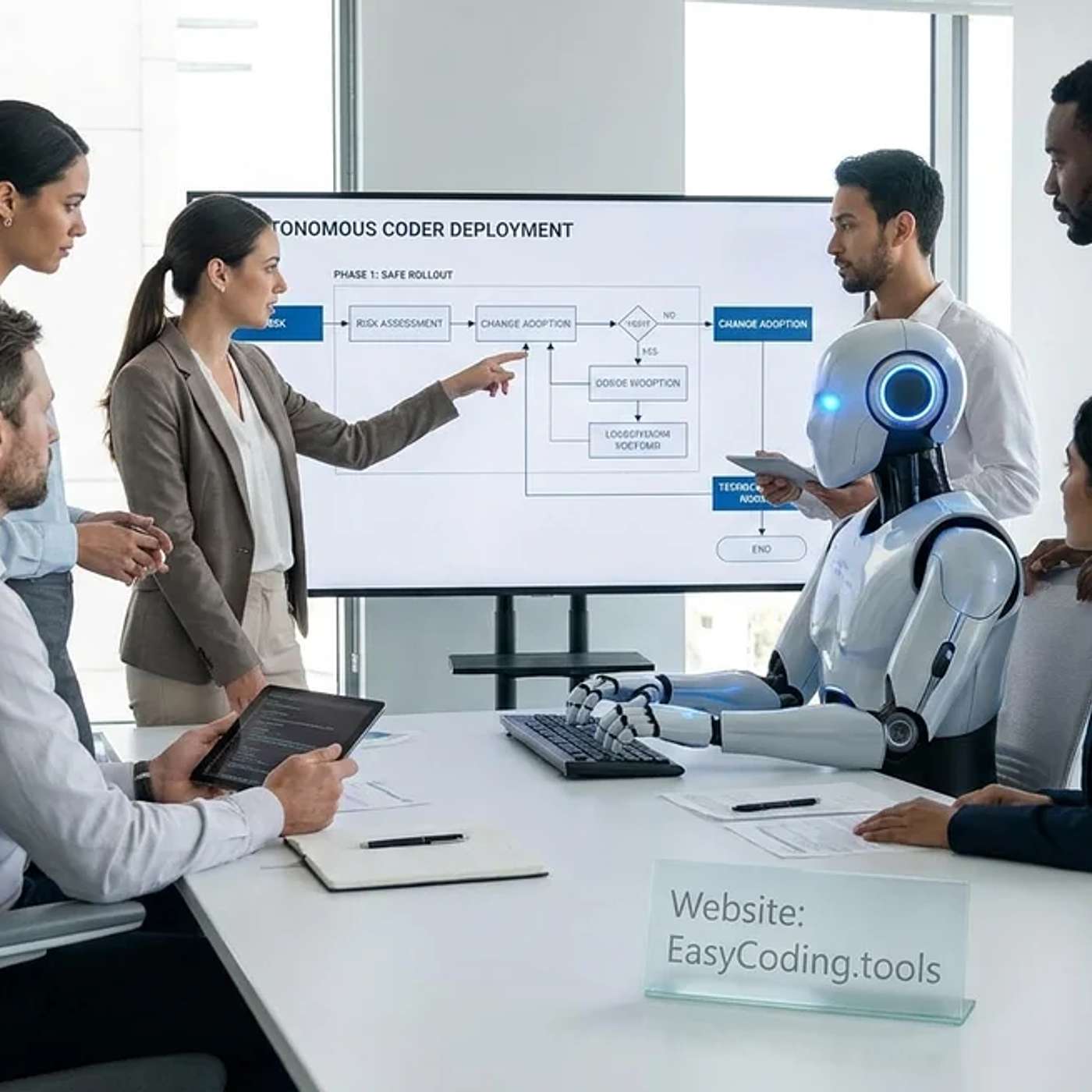
    Org Design and Change Management: Rolling Out Autonomous Coders Safely

    Read the full article: Org Design and Change Management: Rolling Out Autonomous Coders Safely Discover more at AI Builds It: Easy Coding Tools Excerpt: Org Design and Change Management: Rolling Out Autonomous Coders Safely Introduction ... Continue reading

    • Transcript
  • July 26 · 34 min

    Developer Education and Assessment in the Agent Era

    Read the full article: Developer Education and Assessment in the Agent Era Discover more at AI Builds It: Easy Coding Tools Excerpt: Developer Education and Assessment in the Agent Era This analysis reflects the education and certification landscape as of July 26, 2026. ... Continue reading

    • Transcript
  • July 14 · 26 min

    Research Priorities for the Next 18 Months: Where Autonomous Coding Should Go Next

    Read the full article: Research Priorities for the Next 18 Months: Where Autonomous Coding Should Go Next Discover more at AI Builds It: Easy Coding Tools Excerpt: Research Priorities: The Next 18 Months of Autonomous Coding AI-powered coding assistants are already transforming software development. By late 2025, tools like GitHub Copilot and AI chatbots are being used daily by most developers, and even non-programmers can prototype code with simple prompts. Google’s CEO notes that this trend – often called “vibe coding” – is making programming more approachable for non-technical staff (www.itpro.com). However, real-world deployments have exposed important gaps. AI-generated code often contains subtle bugs, fails on complex projects, and raises accountability and policy issues. To move from lab demos to reliable production systems, we need focused research on four fronts: reliability, long-horizon planning, verifiability, and socio-technical governance. Below we outline key open problems and propose research agendas, benchmarks, and collaborations to tackle them. ... Continue reading

    • Transcript
  • July 9 · 23 min

    Legacy Modernization: Agents for Mainframe, ERP, and Niche Languages

    Read the full article: Legacy Modernization: Agents for Mainframe, ERP, and Niche Languages Discover more at AI Builds It: Easy Coding Tools Excerpt: Legacy Modernization with AI Agents: Mainframe, ERP, and Niche Code Modern enterprises often depend on decades-old software in languages like COBOL (mainframes), SAP ABAP, PL/SQL, or VB6. These aging systems are hard to change and costly to maintain. Fortunately, new AI coding agents and design patterns now make it possible to incrementally modernize legacy stacks. In this article, we explore how AI-driven tools help parse and rewrite old code, and describe proven patterns (interface facades, the “strangler” approach, automated testing) to replace legacy functionality gradually. We also cover data lineage, risk controls, rollback planning, and real-world ROI versus pitfalls. Even beginners can learn how to start: AI now “unlocks” coding by turning legacy code into understandable documentation or new code, so anyone can take the first step toward modernizing an old system. ... Continue reading

    • Transcript
  • June 27 · 13 min

    Human-in-the-Loop Boundaries: Calibrating Autonomy and Oversight

    Read the full article: Human-in-the-Loop Boundaries: Calibrating Autonomy and Oversight Discover more at AI Builds It: Easy Coding Tools Excerpt: Human-in-the-Loop Boundaries: Calibrating Autonomy and Oversight Introduction: As AI coding assistants become widespread, they unlock coding for everyone – even non-developers – by generating code in seconds. But faster output introduces new risks. An untested AI-generated change might introduce bugs or security issues that a human would catch. The key is to find the right balance: let automation handle routine tasks, yet ensure humans review anything high-stakes. This article explains how to map out decision points for human approval vs. safe autonomy, design user interfaces that clarify AI changes and uncertainty, measure oversight workload, and set escalation paths for unclear or critical tasks. The aim is to help teams (from individual creators to enterprises) safely accelerate development using AI while minimizing review fatigue and errors (www.techradar.com) (www.clarityarc.com). ... Continue reading

    • Transcript
  • June 20 · 35 min

    Autonomous Coding Agents in June 2026: A Comprehensive Landscape and Taxonomy

    Read the full article: Autonomous Coding Agents in June 2026: A Comprehensive Landscape and Taxonomy Discover more at AI Builds It: Easy Coding Tools Excerpt: Autonomous Coding Agents: Landscape and Taxonomy (June 2026) Introduction. AI-powered coding agents have rapidly transformed software development. No longer just autocomplete helpers, they now execute complex tasks (“planning, editing, testing code and more”) on behalf of developers. The shift is dramatic: as UiPath’s CEO notes, “AI can write code … the question is what happens after the code is written” (www.uipath.com). In fact, by mid-2026 an estimated 84% of developers use or plan to use AI coding assistants (www.uipath.com). Today’s agents range from simple code-completion tools to fully autonomous collaborators that plan multi-step changes, run builds/tests, and create PRs. This article maps the rich 2026 ecosystem: commercial SaaS and self-hosted tools, open frameworks, and enterprise platforms. We classify agents by their autonomy level, supported languages, integration points, safety/ governance features, and deployment model. We also trace the research lineages (from transformers and chain-of-thought to memory-enhanced agents) and give a timeline of key releases. Finally, for newcomers we outline how to start using these tools and the first steps in building an AI-assisted development workflow. ... Continue reading

    • Transcript
  • June 11 · 43 min

    Where the Claude Fable 5 Codes Best: Claude Code vs Cursor vs Windsurf vs Copilot vs Cline/Roo for Agentic Software Engineering

    Read the full article: Where the Claude Fable 5 Codes Best: Claude Code vs Cursor vs Windsurf vs Copilot vs Cline/Roo for Agentic Software Engineering Discover more at AI Builds It: Easy Coding Tools Excerpt: Hook: Beyond the Best Code Model Imagine telling an AI, “Ship a feature to production,” and watching it plan, code, test, commit, and even create a pull request – all on its own. Today’s AI coding assistants are no longer just autocomplete machines; they are agentic software engineers working inside sophisticated systems. It’s not enough to ask, “Which model writes the best function?” Instead we ask, “Which setup turns a powerful model into a reliable coding partner?” The same Claude model can perform very differently if it’s used in a simple browser chat versus inside an IDE with terminal access, memory, and safety checks. This article untangles the latest Claude model and the tools – from Anthropic’s Claude Code to open-source editors – that harness it for real coding work. ... Continue reading

    • Transcript
  • June 1 · 26 min

    GPT-5.5 vs Claude Opus 4.8: Which Model Is Better for Agentic Coding Workflows?

    Read the full article: GPT-5.5 vs Claude Opus 4.8: Which Model Is Better for Agentic Coding Workflows? Discover more at AI Builds It: Easy Coding Tools Excerpt: Autonomous Coding Ability Large language models like GPT-5.5 and Claude Opus 4.8 are designed to act as autonomous coding assistants that can plan and execute multi-step programming tasks. OpenAI describes GPT-5.5 as able to “excels at writing and debugging code, … moving across tools until a task is finished” (openai.com). In practical terms, GPT-5.5 can take a vague, multi-part software request and handle the details itself – from breaking the problem into steps to writing code, running tests, and iterating on failures. Early testing reports indicate that GPT-5.5 can hold context across large codebases and “reason through ambiguous failures,” checking its work with tools as it goes (openai.com) (openai.com). In other words, for well-scoped development tasks (think moderate-sized features or fixes), GPT-5.5 often requires very little hand-holding. ... Continue reading

    • Transcript
  • May 25 · 1 hr

    Autonomous Coding Agents Ranked: Codex vs Claude Code vs Devin vs Cursor vs Copilot

    Read the full article: Autonomous Coding Agents Ranked: Codex vs Claude Code vs Devin vs Cursor vs Copilot Discover more at AI Builds It: Easy Coding Tools Excerpt: Autonomous Coding Agents Ranked: Codex vs Claude Code vs Devin vs Cursor vs Copilot Developers today have many “autonomous coding agents” to choose from – far beyond simple chatbots. Some are IDE plugins with built-in agent modes, others run as command-line tools or cloud services, and still others act as web app builders or bots that turn issue descriptions into pull requests. The useful question is not simply “which model is smartest?” but which agent workflow reliably produces production-quality code. This means evaluating agents as software team members: how they inspect codebases, plan and execute changes, test them, and integrate with existing development processes. For example, Time magazine observes that “agentic coding tools” like Cursor and OpenAI’s Codex are already being used by programmers to “take actions on the user’s behalf,” not just chat (time.com). In this article we compare the leading tools (e.g. Codex/ChatGPT’s coding agent, Anthropic’s Claude Code/Cowork, GitHub Copilot, Cursor, Devin, Replit Agent, Aider, Cline, Google’s Jules/Gemini agents, AWS Kiro, and others) on real coding tasks. We focus on workflow, reliability, autonomy, and safety, answering questions like: which tool is best for fixing an unfamiliar repo’s failing test? Who handles multi-file refactors more well? Which agents produce polished but potentially wrong PRs? Our goal is to show each agent’s strengths and limitations as a practical software team member, with citations to official docs, benchmarks, and independent reports. ... Continue reading

    • Transcript
  • May 16 · 31 min

    Roo Code: A Claude-Powered Dev Agent Inside VS Code

    Read the full article: Roo Code: A Claude-Powered Dev Agent Inside VS Code Discover more at AI Builds It: Easy Coding Tools Excerpt: Roo Code: A Claude-Powered Dev Agent Inside VS Code Roo Code is a free, open-source AI-powered assistant that lives inside Visual Studio Code. Like having “an AI-powered dev team” in your editor, it can read and write code across multiple files, run commands, and even browse the web to gather information (roocode.com) (direct.betterstack.com). Under the hood it uses large language models (you can “plug in” Anthropic’s Claude, OpenAI’s GPT, Google’s models, or local ones), and it lets you switch between specialized modes (Architect, Code, Ask, Debug, etc.) for planning, writing, querying, and debugging code (www.datacamp.com) (marketplace.visualstudio.com). This makes it much more than a simple autocomplete – you describe a task in natural language and Roo Code coordinates step-by-step actions to get it done, with you in control at every turn. ... Continue reading

    • Transcript
  • May 12 · 14 min

    Plandex: Large-Repo Autonomous Refactoring and Release Management

    Read the full article: Plandex: Large-Repo Autonomous Refactoring and Release Management Discover more at AI Builds It: Easy Coding Tools Excerpt: Plandex: Autonomous Refactoring and Release Management for Large Codebases Plandex is an open-source AI-powered coding assistant designed to handle large, real-world programming tasks that span many files. It uses modern language models (LLMs) to plan, apply, and verify multi-step changes. Unlike simple text-complete coding tools, Plandex builds a “plan-sandbox”: it generates all proposed edits in a separate space (viewable via plandex diff), and only applies them to your project when you explicitly confirm (using plandex apply) (www.noze.it). This plan-then-apply approach means you can rename functions, extract modules, or refactor code across dozens of files without leaving your repository in a broken state (www.noze.it). For example, one tutorial notes that Plandex can migrate a function name across 40 files without half-going to disk until all steps are correct (www.noze.it) (www.noze.it). ... Continue reading

    • Transcript
  • May 6 · 19 min

    Sweep AI: Issue-to-PR Automation in Public Repositories

    Read the full article: Sweep AI: Issue-to-PR Automation in Public Repositories Discover more at AI Builds It: Easy Coding Tools Excerpt: Introduction Sweep AI is an AI-powered junior developer for GitHub that turns written issue descriptions into code changes. In practice, a user writes a GitHub issue (e.g. “add type hints to this file”) and Sweep autonomously searches the codebase, generates the needed code, and opens a pull request for review (www.fondo.com) (pypi.org). As one security profile notes, “Sweep is an AI code assistant that turns GitHub issues into GitHub pull requests” (security-profiles.nudgesecurity.com). In other words, Sweep automates the mundane work of fixing bugs, writing tests, updating docs, and adding small features, so developers can focus on architecting the core product. ... Continue reading

    • Transcript
  • April 29 · 16 min

    Replit Agent: Product Capabilities and Early User Feedback

    Read the full article: Replit Agent: Product Capabilities and Early User Feedback Discover more at AI Builds It: Easy Coding Tools Excerpt: Introduction Replit is a web-based programming platform that lets anyone build software in the browser. Its Replit Agent is an AI-powered coding assistant that can turn plain-language prompts into working apps (skywork.ai) (blog.replit.com). In practice, you describe the app or feature you want, and the Agent “plans” the work, writes the code, runs tests, and even helps deploy it, all within the Replit workspace (skywork.ai) (docs.replit.com). This means non-coders or beginners can start creating software just by explaining what they need in everyday language. Replit emphasizes that the Agent can build complete apps “from a few sentences in minutes,” taking care of setup and infrastructure behind the scenes (skywork.ai) (skywork.ai). In short, the Agent is like an AI teammate that handles tedious coding tasks, so you can focus on your ideas and design. ... Continue reading

    • Transcript
  • April 26 · 17 min

    Inside Devin’s Workflow: Tool Use, Planning, and Autonomy

    Read the full article: Inside Devin’s Workflow: Tool Use, Planning, and Autonomy Discover more at AI Builds It: Easy Coding Tools Excerpt: Introduction Devin (from Cognition AI) is a new autonomous AI software engineer that can plan software development tasks and carry them out largely on its own. It works end-to-end on code projects, using tools like a code editor, a command-line shell, and a web browser to research, write, test, and deploy code. In demos and press, Devin has been shown scanning a codebase, generating a plan, editing files, running tests, and making pull requests with surprisingly little human input (medium.com) (www.linkedin.com). Cognition claims Devin can handle “complex engineering tasks requiring thousands of decisions,” recalling context at each step and even learning from mistakes (medium.com) (www.linkedin.com). We therefore explore the public details of Devin’s design and workflow. This includes how Devin breaks down tasks (its planning process), how it literally works in a developer environment (editor, terminal, browser), how it keeps memory or context across a coding session, how it self-corrects and iterates, and what guardrails or safety measures it uses. We also note what is not revealed – for example the exact model internals are undisclosed, so some community discussion relies on educated guesswork. Task Planning and Decomposition When a developer gives Devin a new assignment, the first step is planning what files to change and in what order. Cognition’s notes explain that Devin uses a “planning mode” sub-agent whose job is to figure out which files in the repository are relevant to the task (medium.com) (docs.devin.ai). In practice, Devin “investigates” the repo and proposes a plan before writing any code (docs.devin.ai) (docs.devin.ai). For complex tasks, developers see this plan and can approve or adjust it; if the Agency mode is enabled, Devin will automatically proceed with its plan without waiting for approval (docs.devin.ai) (docs.devin.ai). ... Continue reading

    • Transcript
  • April 23 · 17 min

    Cursor IDE Agent: Repository-Scale Edits and Developer Reports

    Read the full article: Cursor IDE Agent: Repository-Scale Edits and Developer Reports Discover more at AI Builds It: Easy Coding Tools Excerpt: Cursor IDE Agent: Repository-Scale Edits and Developer Reports Cursor is an AI-native code editor (a VS Code fork) designed to manage entire codebases with built-in artificial intelligence. Unlike basic autocomplete tools, Cursor’s Agent Mode lets the AI act “in the driver’s seat,” reading, editing and creating code across multiple files at once (federicocalo.dev) (www.datacamp.com). In this mode, the AI can search your code, update imports, change function definitions everywhere they appear, run build or test commands, and fix errors in a loop – much like a senior developer working in parallel (federicocalo.dev) (www.datacamp.com). It truly works at repository scale: for example, one guide describes telling the AI “Add JWT authentication to this Angular app” and watching it create services, update components, run tests, and repair errors without manual edits (federicocalo.dev). These agentic features are powered by a “tool use” architecture: the AI can call functions like read_file, edit_file, search_files, or even run_terminal_command to inspect and modify your project (federicocalo.dev). In practice, Cursor’s agent can autonomously carry out large refactors and feature builds by combining language understanding with direct code manipulation. ... Continue reading

    • Transcript
Showing 1–18 of 18 episodes