Skip to content
Artwork for Admissions Straight Talk
EducationHow To

Admissions Straight Talk

Linda Abraham

Advice from experts on the MBA, medical school, law school, and graduate school admissions process.

Play
  • 21 episodes
  • fortnightly
  • Avg 26 min
  • English
Counted on this page — what you have heard stays on this device, so it is not something the list can be paged by.
  • S3 · E630
    September 24 · 47 min

    Sarah’s Nontraditional Path to DO School: From Humanities Major to Med Student [Episode 630]

    Send us your admissions questions! What does it look like to leave a successful career in book publishing and build a new path to medical school? In this episode of Accepted’s Admissions Straight Talk, Dr. Valerie Wherley speaks with Sarah Shirley, an osteopathic medical student at the Western University of Health Sciences College of Osteopathic Medicine of the Pacific, about her journey from English and comparative literary studies to book publishing, premed coursework, and Doctor of Osteopathic Medicine (DO) school. Sarah shares how hospital volunteering helped her test whether medicine was the right fit, why career changers need to take their doubts seriously without letting fear make the decision for them, and how she built a med school application around authentic experiences rather than a “checkbox” list. She also discusses letters of recommendation, the value of staying fully present while shadowing, and the journaling habit that helped her make stronger recommendation requests. The conversation also explores osteopathic medicine, including what drew Sarah to the DO philosophy, how osteopathic manipulative medicine shaped her understanding of patient care, and why applicants should learn the tenets of osteopathy before writing their secondary essays. If you are a nontraditional applicant, a humanities major considering medicine, or a premed wondering whether your path is too different, this episode offers practical advice and honest encouragement. 00:00 Meet Sarah Shirley: From Humanities to DO School 03:21 Finding Medicine Through Hospital Volunteering 05:14 Deciding to Pursue the Premed Path 08:10 Self-Doubt, Failure, and Changing Careers 14:34 Building a Meaningful Med School Portfolio 22:29 Asking for Strong Letters of Recommendation 30:30 Why Osteopathic Medicine Was the Right Fit Related Episodes From Med School Reapplicant to Current M1 [Episode 609] Inside COMP: What the College of Osteopathic Medicine of the Pacific Looks for in Applicants [Episode 625] How to Get the Most Out of Your Premed Shadowing Experience [Episode 620] Follow Us YouTube Facebook LinkedIn Contact Us www.accepted.com support@accepted.com +1 (310) 815-9553

    • Chapters
  • S3 · E629
    September 10 · 32 min

    Inside the University of Iowa’s Top-Ranked PA Program [Episode 629]

    Send us your admissions questions! What makes the University of Iowa Physician Assistant (PA) Program one of the country’s top PA programs? In this episode of Accepted’s Admissions Straight Talk, host Dr. Valerie Wherley speaks with Thomas O’Shea, PhD, MEd, director of administrative and student services for the University of Iowa’s PA Program, about the program’s structure, curriculum, clinical training, student support, and admissions priorities. The University of Iowa PA Program admits a small cohort of 25 students each August and is housed in the Roy J. and Lucille A. Carver College of Medicine. Dr. O’Shea explains how Iowa’s 28-month program combines close student support with the resources of a major academic medical center, including access to faculty across the Carver College of Medicine and clinical opportunities through the University of Iowa Health Care system, local partners, regional sites, national placements, and international experiences. The conversation also explores Iowa’s distinctive integrated curriculum. During the didactic phase, PA students learn alongside MD and MD-PhD students, giving them shared preparation for the team-based clinical environments they will enter after graduation. Dr. O’Shea also describes the “triple helix” curriculum, the Medicine and Society strand of the curriculum, the student learning communities, alumni involvement, and the program’s long history dating back to 1972. The episode closes with practical advice for applicants: know the minimum requirements, understand your academic and science GPA trends, build meaningful healthcare experience, reflect on what you have learned, and develop relationships with people who can speak clearly to your readiness for PA school. 0:00 Welcome, Dr. Tom O’Shea 00:27 University of Iowa PA Program Basics 03:18 Why Iowa’s PA Program Stands Out 08:10 PA and MD Students Learning Together 12:18 The Triple Helix Curriculum 14:31 Learning Communities at Carver College of Medicine 20:11 How Alumni Support Current PA Students 23:53 What the University of Iowa’s PA Program Looks for in Applicants 29:17 Why Gap Years Can Strengthen an Application 31:01 Closing Thoughts and Next Steps Related Resources University of Iowa Physician Assistant Program University of Iowa PA Program Admission Requirements University of Iowa PA Program Staff The Ultimate Guide to Becoming a Physician Assistant, a free guide Accepted’s Physician Assistant Application Packages Follow Us YouTube Facebook LinkedIn Contact Us www.accepted.com support@accepted.com +1 (310) 815-9553

    • Chapters
  • S3 · E628
    August 27 · 23 min

    From Military Service to PA School: Advice for Veteran Applicants [Episode 628]

    Send us your admissions questions! How can military veterans translate their service, leadership, and clinical experience into a strong PA school application? In this episode of Admissions Straight Talk, host Dr. Valerie Wherley speaks with Brandon R. Beattie, MMSc, PA-C, assistant professor and program director, about the George Washington University (GW) PA Program, the military roots of the PA profession, and the opportunities and barriers veterans face when applying to PA school. Brandon brings both admissions expertise and lived experience to the conversation. Before becoming a PA, he served as a U.S. Army combat medic during multiple overseas tours. He later completed his PA training at Yale and now leads one of the country’s long-standing PA programs, which was founded in 1972 and was ranked sixth (tied with Baylor College of Medicine) in U.S. News & World Report’s 2025 Best Physician Assistant Programs rankings. The conversation focuses on how veterans can tell their stories in ways that admissions committees will understand. Brandon explains why military jargon, acronyms, and modesty can sometimes hide the depth of an applicant’s experience. He also shares practical advice for the PA application process, including proofreading, clarifying military roles for civilian readers, choosing recommendation writers strategically, and showing evidence of grit, teamwork, communication, coachability, and mission fit. If you are a veteran considering PA school, this episode offers a clear framework for presenting military service as a strength, not a complication. 0:00 From Military Service to PA School 01:32 What Sets the GW PA Program Apart 03:25 Veterans and the Origins of the PA Profession 05:27 Strengths Veterans Bring to PA School 07:03 Barriers Veterans Face in the Application Process 15:06 Strategies for a Strong PA Application 18:12 Choosing the Right Recommenders 20:21 What GW Looks for in Competitive Applicants Related Resources: Brandon R. Beattie faculty profile George Washington University Physician Assistant Program GW PA Program Admission Requirements GW PA Program How to Apply The Ultimate Guide to Becoming a Physician Assistant, a free guide Accepted’s Physician Assistant Application Packages Follow Us YouTube Facebook LinkedIn Contact Us www.accepted.com support@accepted.com +1 (310) 815-9553

    • Chapters
  • S3 · E627
    August 13 · 22 min

    Inside Wake Forest’s PA Program: Inquiry-Based Learning, Service, and Leadership Training [Episode 627]

    Send us your admissions questions! What makes Wake Forest University’s Physician Assistant Program different from the hundreds of PA programs applicants can choose from? In this episode of Accepted’s Admissions Straight Talk, host Dr. Valerie Wherley speaks with Sobia Hussaini, MHA, assistant professor of PA studies and director of admissions and strategic recruitment for PA studies at Wake Forest University School of Medicine, about the program’s curriculum, campuses, culture, and admissions priorities. Sobia explains how Wake Forest’s 24-month Master of Medical Science PA Program brings together a large class with a small-group learning environment across two North Carolina campuses: Winston-Salem and Boone. She describes how the program’s inquiry-based learning model asks students to work through patient cases from the beginning of PA school, building clinical reasoning, self-directed learning, and collaborative problem-solving skills before they enter rotations. The conversation also explores Wake Forest’s leadership focus, including its Emerging Leaders Program pathways in business and law, and the service-oriented experiences that begin during orientation. Sobia connects those experiences to the PA profession’s responsibility to understand the social drivers of health and serve patients in context. The episode closes with practical advice for applicants. Wake Forest looks for academic readiness, meaningful hands-on patient care experience, teamwork, service, leadership, resilience, and a clear answer to one essential question: why do you want to be a PA? 00:00 Introducing Wake Forest’s PA Program 03:35 Comparing the Winston-Salem and Boone Campuses 07:38 Serving Rural and Medically Underserved Communities 09:12 How Inquiry-Based Learning Works 14:21 Leadership Development Throughout the Curriculum 18:21 The Emerging Leaders Program in Business and Law 22:08 Community Service, Orientation, and Social Drivers of Health 28:38 What Wake Forest Looks for in PA Applicants 33:26 Closing Thoughts and Next Steps Related Resources: Wake Forest University School of Medicine Physician Assistant Program Wake Forest PA Program Emerging Leaders Programs Inside Wake PA, a digital publication The Ultimate Guide to Becoming a Physician Assistant, an Accepted guide Accepted’s Physician Assistant Application Packages Follow Us YouTube Facebook LinkedIn Contact Us www.accepted.com support@accepted.com +1 (310) 815-9553

    • Chapters
  • S3 · E626
    July 30 · 22 min

    Can You Get into Grad School with a Problematic Academic Record? Here’s What Actually Works [Episode 626]

    Send us your admissions questions! What do you do when your transcript tells a story you would rather not tell? In this episode of Accepted’s Admissions Straight Talk podcast, host Dr. Valerie Wherley is joined by Dr. Rachel Slutsky, an Accepted admissions consultant and Harvard PhD, to discuss one of the most common – and most feared – obstacles in the graduate admissions process: a problematic academic record. Dr. Slutsky draws on her background as a university writing tutor and professor to reframe how applicants think about academic setbacks. The conversation moves through three categories of challenges she commonly sees in her work: ethical issues, emotional and psychological struggles, and maturity gaps. She also addresses the often-overlooked role of financial hardship in academic performance. The episode is practical throughout. Dr. Slutsky and Dr. Wherley discuss where in your application to address your academic record, how much space to give it in a statement of purpose, and why self-awareness – not shame – is the quality that resonates with adcoms. They cover how to demonstrate help-seeking behaviors, professional growth, and determination when the numbers on your transcript do not tell your whole story. The conversation closes with an invitation: If you have been avoiding applying to graduate school because of your academic record, Dr. Slutsky wants to hear from you. 00:00 Welcoming Dr. Rachel Slutsky to the Podcast 02:53 Defining a Problematic Academic Record 04:28 Three Sources of Issues: Ethical, Emotional, and Maturity 07:11 Financial Hardship and the Hidden Story Behind Transcripts 09:35 Should You Even Apply? Don’t Write Off Grad School Prematurely 10:43 Addressing Academic Issues in a Statement of Purpose 13:41 Self-Awareness Over Shame: Own It, Show Growth, Move Forward 16:05 The Holistic Review Process: Highlighting Your Strengths 19:27 Demonstrating Help-Seeking Behaviors as Evidence of Growth Related Resources: Dr. Rachel Slutsky bio Sign up for a free consultation with Dr. Rachel Slutsky Related Episodes: How to Get Selected for a Fulbright and Other Competitive Fellowships [Episode 624] Is There Such a Thing as Too Many Drafts? Writing a Standout Med School Personal Statement [Episode 612] Follow Us YouTube Facebook LinkedIn Contact Us www.accepted.com support@accepted.com +1 (310) 815-9553

    • Chapters
  • S3 · E625
    July 16 · 40 min

    Inside the College of Osteopathic Medicine of the Pacific: A DO School That Trains Holistic Physicians [Episode 625]

    Send us your admissions questions! What exactly is—and isn’t—a DO? And what does it take to get into a Tier 1 primary care medical school that operates across two very different campuses? In this episode of Accepted’s Admissions Straight Talk, host Dr. Valerie Wherley sits down with the leadership and a current student from the College of Osteopathic Medicine of the Pacific (COMP) at Western University of Health Sciences. Dr. Lisa Warren, the dean and a COMP graduate; Dr. Marcel Fraix, associate dean for admissions and also a COMP graduate; TJ Pe, assistant director of recruitment; and Sarah Shirley, a rising second-year COMP DO student, walk listeners through what makes this program distinctive. The conversation covers the school’s two-campus structure—urban Pomona, California, and rural Lebanon, Oregon—and how the shared curriculum delivers a consistent experience in two very different environments. COMP has now earned U.S. News & World Report’s Tier 1 recognition for primary care training for three consecutive years, and the panel breaks down why that matters for applicants. Sarah shares her nontraditional path: a literature degree, a career in book publishing, a mid-20s pivot, and what drew her to osteopathic medicine specifically. The panel also discusses COMP’s longitudinal student tracks (business, rural health, sports medicine, and more), the technology-infused curriculum including simulation and AI exposure, and the robust student wellness infrastructure—from free yoga to open-door faculty. For applicants concerned about GPA and MCAT thresholds, Dr. Fraix and TJ offer a candid, encouraging reality check on holistic admissions and the one-year master’s program that creates a pathway for promising candidates who don’t yet meet full admission requirements. Related Resources: College of Osteopathic Medicine of the Pacific (COMP) at Western University of Health Sciences Experience WesternU (preview day): August 22, 2026 Dr. Lisa Warren, dean, Western University of Health Sciences COMP and COMP-Northwest: lwarren@westernu.edu Dr. Marcel Fraix, associate dean, admissions and enrollment chair, professor of physical medicine and rehabilitation: mfraix@westernu.edu TJ Pe, assistant director of recruitment: pet@westernu.edu Follow Us YouTube Facebook LinkedIn Contact Us www.accepted.com support@accepted.com +1 (310) 815-9553

    • Chapters
  • S3 · E624
    July 2 · 19 min

    How to Get Selected for a Fulbright and Other Competitive Fellowships [Episode 624]

    Send us your admissions questions! What does it take to get selected for a Fulbright or Boren Fellowship? In this episode of Accepted’s Admissions Straight Talk podcast, host Dr. Valerie Wherley sits down with Steven Tagle, an Accepted admissions consultant and fellowship specialist, to break down two of the most prestigious, and most misunderstood, awards in graduate education. Steven draws on his own journey: a Stanford undergraduate, an MFA funded by a Paul & Daisy Soros Fellowship, a Fulbright that turned into eight years in Greece, and a second writing fellowship from the Institute of Current World Affairs (ICWA). Today, he helps applicants navigate the entire fellowship landscape, from “fellowship matchmaking” to final interviews. The conversation covers the structure and purpose of the Fulbright U.S. Student Program, including the differences between Study/Research Awards and English Teaching Assistant Awards, and how country-specific requirements shape a successful application. Steven also makes a case for the Boren Awards, an often-overlooked option with acceptance rates as high as 40%, a service requirement, and language study built in. Whether you are a college senior, a graduate student, or a professional considering funded study or research abroad, this episode offers a clear, practical foundation for approaching some of the most competitive awards available. 00:00 Introducing Steven Tagle 01:03 Steven’s Path: Stanford, Soros, Fulbright, and ICWA 02:36 What Exactly Is a Fellowship? 04:09 How Fellowship Selection Advice Works 05:52 Inside the Fulbright U.S. Student Program 10:33 Study/Research vs. English Teaching Assistant Awards 12:08 Why the Boren Awards Are Often Overlooked 14:32 When to Start Preparing a Fellowship Application 17:54 How to Submit the Most Competitive Application 19:30 Closing Thoughts and How to Work with Steven Related Resources: Steven Tagle bio Accepted’s Fellowship Consulting Services Fulbright U.S. Student Program (U.S. Department of State) Boren Awards (National Security Education Program) Follow Us YouTube Facebook LinkedIn Contact Us www.accepted.com support@accepted.com +1 (310) 815-9553

    • Chapters
  • S3 · E623
    June 18 · 25 min

    USC Chan Doctorate of OT Program: Innovation, Leadership, and a Holistic Path to Occupational Therapy [Episode 623]

    Send us your admissions questions! This episode of Admissions Straight Talk covers what it takes to get accepted into the top-ranked Entry-Level Doctorate of Occupational Therapy (OTD) program at the USC Chan Division of Occupational Science and Occupational Therapy. Host Dr. Valerie Wherley speaks with Dr. Amber Bennett, associate professor of clinical occupational therapy at USC Chan, to break down how the occupational therapy (OT) field has shifted and what makes the school’s top-ranked curriculum stand out. This episode is especially valuable for OT school applicants seeking a competitive edge in the graduate admissions process. Dr. Bennett highlights the division’s historic commitment to clinical innovation, its extensive experiential learning partnerships, and the vast professional power of the global USC Trojan alumni network. Listeners will discover how the unique 14-week doctoral capstone allows students to complete their final year remotely while translating cutting-edge clinical research into direct healthcare advocacy and community action. For future applicants, Dr. Bennett delivers essential, hands-on strategies for mastering the program-specific prompts within the Occupational Therapist Centralized Application Service (OTCAS) application portal. Listeners will gain concrete insights into how to build a highly structured and reflective personal narrative, how to strategically select recommenders who can share character-driven examples, and how the USC Chan admissions committee evaluates applicants using a holistic review framework. 00:00 Introducing Dr. Amber Bennett, Associate Professor at USC Chan 00:39 The Evolution of Occupational Therapy and the Shift to the OTD Program 04:19 Why USC Chan Is the Nation’s Top-Ranked OT Program 08:39 Hands-On Learning, Fieldwork, and Student Experiences 12:15 Where Occupational Therapists Work: Traditional and Emerging Career Paths 14:44 Inside USC Chan’s 14-Week Doctoral Capstone 17:34 Application Essays: How to Answer USC Chan’s Prompts Effectively 20:05 What Makes a Competitive OTD Application? 24:13 Overcoming Imposter Syndrome and Final Advice for Applicants Related Resources: Dr. Amber Bennett bio USC Chan Department of Occupational Science and Occupational Therapy USC Chan Entry-Level Doctorate of Occupational Therapy (OTD) degree program Extracurricular Activities Can Help You Get Accepted to Graduate Therapy Programs Follow Us YouTube Facebook LinkedIn Contact Us www.accepted.com support@accepted.com +1 (310) 815-9553

    • Transcript
    • Chapters
  • S3 · E622
    June 4 · 27 min

    WashU Doctor of Physical Therapy Admissions: Inside a Top-Ranked Program [Episode 622]

    Send us your admissions questions! What should applicants know about WashU Medicine’s Doctor of Physical Therapy (DPT) program? In this episode of Admissions Straight Talk, Dr. Valerie Wherley speaks with Dr. Steven Ambler – professor of physical therapy and orthopaedic surgery, division director of education, and DPT program director at WashU Medicine – about the program’s curriculum, culture, student support, research opportunities, and admissions process. Dr. Ambler explains how WashU integrates early clinical experience into the curriculum, why the program emphasizes collaboration over competition, and how faculty coaching helps support students throughout their training. He also shares how the admissions committee evaluates applicants holistically and what qualities make an application stand out. If you’re considering physical therapy school and want an inside look at one of the country’s most respected DPT programs, this episode offers practical guidance and useful perspective. 00:00 WashU Medicine DPT Program Overview 01:22 Why the WashU DPT Program is Top-Ranked 04:08 Early Integrated Clinical Experience 07:05 Alumni Preceptors and Clinical Placements 07:53 Student Support, Collaboration, and Coaching 13:20 Research Opportunities for DPT Students 17:42 Holistic Admissions Review at WashU 21:53 What Makes a Competitive WashU DPT Applicant Follow Us YouTube Facebook LinkedIn Contact Us www.accepted.com support@accepted.com +1 (310) 815-9553

    • Transcript
    • Chapters
  • S2 · E621
    May 21 · 14 min

    How This Reapplicant Got into PA School [Episode 621]

    Send us your admissions questions! This episode of Admissions Straight Talk covers the essential strategies for overcoming rejection and successfully reapplying to physician assistant (PA) programs. In this episode, host Dr. Valerie Wherley speaks with Cassandra Zoetjes, a first-generation college student and current PA student at Sacred Heart University who successfully navigated three application cycles. Cassandra shares how she transformed her candidacy by pursuing a master’s in nutrition at Columbia University and diversifying her clinical experiences as a scribe and a medical assistant. This conversation is especially valuable for reapplicants facing an unsuccessful cycle or those considering a graduate degree to bolster their academic profile. Cassandra provides a transparent look at the emotional toll of the “drinking from a fire hose” aspect of PA school and the importance of maintaining a healthy work-life balance. Her story serves as a road map for applicants who need to add depth to their writing and medical knowledge. Listeners will gain concrete insights into these topics: How a specialized master’s degree can demonstrate academic rigor The benefit of diversifying patient care experience across specialties Strategies for crafting a resilient mindset and an honest personal statement What to expect in a PA curriculum 0:00 Introducing the Journey to PA School 1:06 Meet Cassandra: First-Gen Student Success 2:11 Choosing the PA Profession 3:39 Navigating Three PA Application Cycles 4:52 Strengthening Your GPA With a Master’s Degree 7:28 Diversifying Clinical and Volunteer Experience 9:58 Surviving the PA School Curriculum 11:47 Leadership and Student Government Opportunities in PA School 13:04 Advice for Reapplicants and Future PAs Follow Us YouTube Facebook LinkedIn Contact Us www.accepted.com support@accepted.com +1 (310) 815-9553

    • Transcript
    • Chapters
  • S2 · E620
    April 30 · 16 min

    How to Get the Most Out of Premed Shadowing [Episode 620]

    Send us your admissions questions! What does it take to maximize your premed shadowing opportunity, and why does this experience matter so much in your application? In this episode of Admissions Straight Talk, Dr. Valerie Wherley speaks with Dr. Rachel L. Schreiber, a board-certified allergist/immunologist and former president of the Greater Washington Allergy, Asthma, and Immunology Society. Recognized as a “Top Doctor” by Washingtonian magazine, Bethesda Magazine, and Washington Consumers’ Checkbook, Dr. Schreiber shares practical advice on finding shadowing opportunities, keeping a journal, and asking the right questions. Additionally, Dr. Wherley and Dr. Schreiber address the nonnegotiable topic of patient confidentiality. From HIPAA requirements, to what you can safely write about in your application essays, to the risks of discussing patients on social media, the bottom line is this: you must conduct yourself with professionalism from the moment you walk in the clinic, including after you walk out. If you are preparing to apply to medical school, this episode will change how you think about every hour you spend shadowing. 0:00 Meet Dr. Rachel L. Schreiber 0:30 Finding and Securing Premed Shadowing Opportunities 3:14 The Real Purpose of Shadowing Before Med School 4:23 Why You Should Keep a Shadowing Journal 7:08 Asking Questions and Choosing Specialties 13:25 Patient Privacy and HIPAA Follow Us YouTube Facebook LinkedIn Contact Us www.accepted.com support@accepted.com +1 (310) 815-9553

    • Transcript
    • Chapters
  • S2 · E619
    April 16 · 30 min

    How to Get into Touro University California College of Osteopathic Medicine [Episode 619]

    Send us your admissions questions! What does it take to stand out and become a competitive applicant to Touro University California College of Osteopathic Medicine (TUCOM), and what makes this program unique among osteopathic medical schools? In this episode of Admissions Straight Talk, Accepted consultant and podcast host Dr. Valerie Wherley speaks with Dr. Alesia Wagner, associate dean of academic affairs at TUCOM. Together, they explore how the school’s mission shapes its curriculum, how its 100% residency match rate reflects the breadth of specialty opportunities available to students, and how TUCOM’s approach to clinical education prepares future osteopathic physicians for a wide range of medical careers. If you are researching osteopathic medical schools or preparing your application, this conversation provides valuable insight into what sets TUCOM apart and what it takes to be a competitive applicant. 0:00 Meet Dr. Alesia Wagner, Associate Dean of Academic Affairs at TUCOM 0:42 Overview of Touro University California College of Osteopathic Medicine 4:56 Residency Match Data: Specialties and Outcomes 6:50 Clinical Rotation Sites and Student Placement at TUCOM 9:53 Primary Care vs. Specialty Matches: Breaking the Pigeonhole Myth 11:13 TUCOM’s Pre-Clinical Electives and the Clinical Distinction Program 16:34 Culinary Medicine and Nutrition Education Electives 19:56 Interprofessional Education and the Student-Run Free Clinic 23:53 What Makes a Competitive Applicant 29:11 Life on TUCOM’s Campus in Northern California Related Resources Bio for Dr. Alesia Wagner Touro University College of Osteopathic Medicine Touro’s Osteopathic Manipulative Treatment Clinic at Middletown TUCOM Academics Related Episodes How to Get into MSU’s College of Osteopathic Medicine [Episode 537] The Bryn Mawr Postbac Premed Program [Episode 614] Is There Such a Thing as Too Many Drafts? Writing a Standout Med School Personal Statement [Episode 612] Follow Us YouTube Facebook LinkedIn Contact Us www.accepted.com support@accepted.com +1 (310) 815-9553

    • Chapters
  • S2 · E618
    April 2 · 26 min

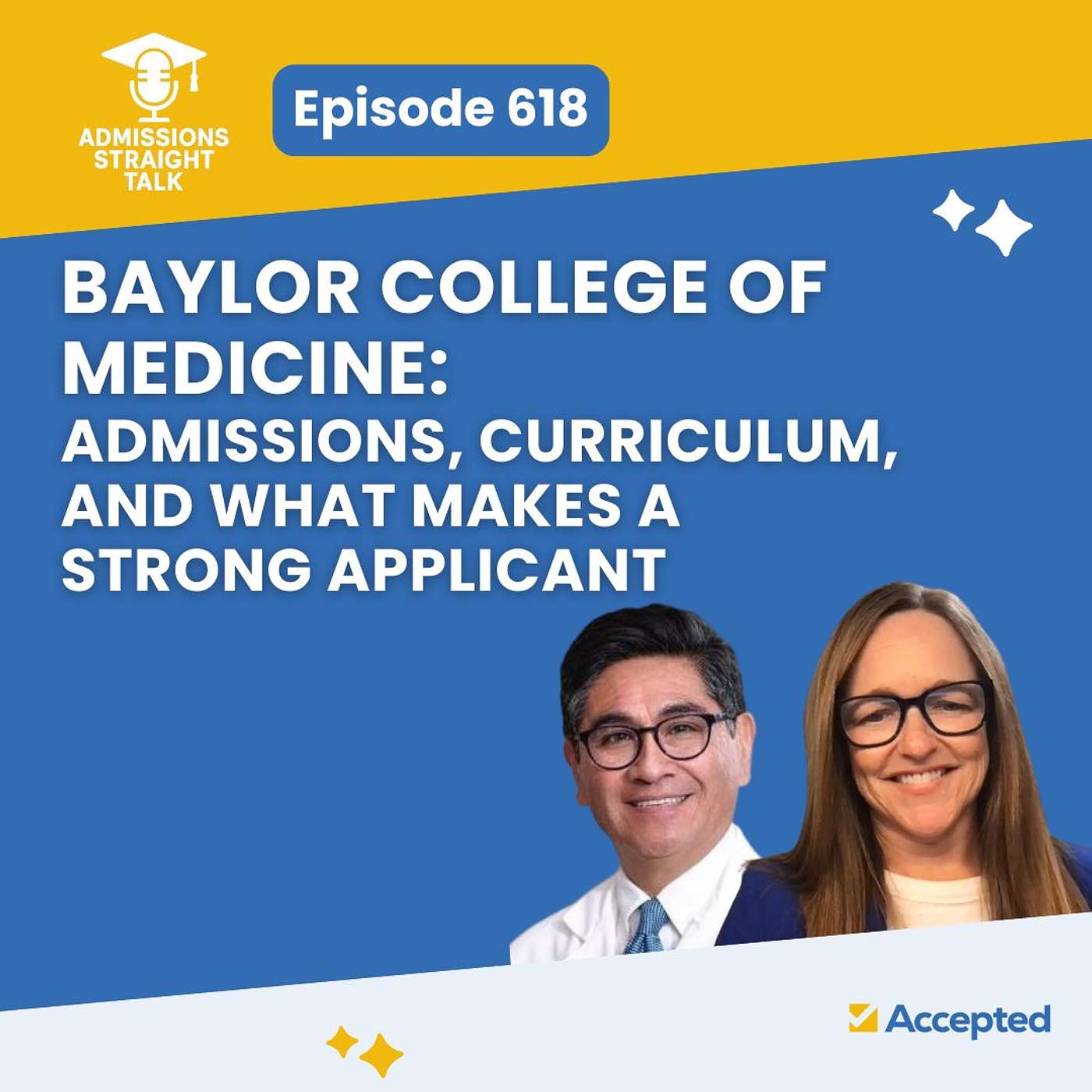
    Baylor College of Medicine: Admissions, Curriculum, and What Makes a Strong Applicant [Episode 618]

    Send us your admissions questions! What does Baylor College of Medicine look for in applicants, and how is its program evolving to meet the needs of today’s medical students? In this episode of Admissions Straight Talk, host Dr. Valerie Wherley speaks with Dr. Jesus Vallejo, senior associate dean of admissions at Baylor College of Medicine. Together, they explore Baylor’s dual-campus model, early clinical exposure, innovative curriculum, and extensive mentorship opportunities. Dr. Vallejo also shares how Baylor College of Medicine evaluates applicants holistically and what distinguishes those who stand out in a highly competitive pool. If you’re applying to medical school or considering Baylor, this episode offers valuable insights to guide your strategy. 00:00 Baylor College of Medicine Overview 00:30 Baylor College of Medicine: Houston versus Temple Campus Experience 02:10 In-State versus Out-of-State Admissions at Baylor College of Medicine 04:10 Early Patient Exposure at Baylor College of Medicine 06:10 Baylor College of Medicine’s Modern Curriculum and Learning Style 10:10 Research Requirements for Baylor College of Medicine Applicants 14:25 Baylor College of Medicine’s Mentorship and Student Support Programs 20:10 Baylor College of Medicine’s HEAL Program and Humanities in Medicine 24:05 What Baylor College of Medicine Looks for in Applicants 25:50 Final Advice for Medical School Applicants Follow Us YouTube Facebook LinkedIn Contact Us www.accepted.com support@accepted.com +1 (310) 815-9553

    • Transcript
    • Chapters
  • S2 · E617
    March 19 · 28 min

    Inside the Zucker School of Medicine at Hofstra/Northwell [Episode 617]

    Send us your admissions questions! In this episode of Admissions Straight Talk, host Dr. Valerie Wherley welcomes Dr. Rona Woldenberg, associate dean for admissions and interim associate dean of student affairs at the Zucker School of Medicine at Hofstra/Northwell. Dr. Woldenberg explains how the school’s unique partnership with Northwell Health provides students with consistent clinical training opportunities and a dynamic learning environment. The conversation highlights Zucker’s rapid rise as a top-tier research institution and explores the innovative educational model that emphasizes hands-on experience from the very beginning of medical school. One of the school’s most distinctive features is its EMT training program, in which first-year medical students become licensed EMTs during their first nine weeks and participate in real emergency response scenarios. Dr. Woldenberg also discusses the school’s commitment to inclusive education, cultural humility in patient care, and the importance of collaboration in modern medicine. Finally, she shares what the admissions committee looks for in successful applicants – including curiosity, resilience, teamwork, and a growth mindset. If you’re considering applying to medical school – or simply want insight into how innovative programs are shaping physician training – this episode offers valuable guidance. 00:00 Introduction 00:33 The Founding of the Zucker School of Medicine 04:05 Zucker School of Medicine Admissions Stats and Growing Applicant Interest 07:59 Research Reputation and National Rankings 11:21 Building an Inclusive Medical School Environment and Cultural Humility in the Curriculum 16:32 EMT Training During the First Nine Weeks and Mass Casualty Incident Day Simulation 21:00 Student Feedback on the EMT Experience 23:42 What the Zucker School of Medicine Looks for in Applicants 27:18 Final Advice for Prospective Applicants Related Resources Zucker School of Medicine at Hofstra/Northwell Dr. Rona Woldenberg bio Medical School Secondary Essay Tips A Strategic Guide for Applying to Medical School Related Episodes Inside the University of Miami’s Three-Year M.D. Accelerated Pathway [Episode 615] The Bryn Mawr Postbac Premed Program [Episode 614] Inside UMass Chan: How Wellness, Community, and Leadership Shape Future Physicians [Episode 611] Follow Us YouTube Facebook LinkedIn Contact Us www.accepted.com support@accepted.com +1 (310) 815-9553

    • Transcript
    • Chapters
  • S2 · E616
    February 19 · 32 min

    How GW Law Reviews Applications: Timing, Waitlists, LSAT Optional, and Scholarships [Episode 616]

    Send us your admissions questions! Applying to law school and wondering how admissions decisions really get made? In this episode of Admissions Straight Talk, Accepted Law Consultant Brigitte talks with Sophia Sim, associate dean for admissions and financial aid at the George Washington University Law School (GW Law), about what applicants need to know – from rolling admissions timelines and waitlists to scholarships, LSAT-optional pathways, and professional etiquette. With decades of experience in law school admissions, Sophia offers clear, honest advice to help applicants make smarter decisions throughout the cycle. 00:00 Introduction and Background 02:43 The Challenges of Law School Admissions 05:10 Understanding the GW Law Admissions Process 08:26 The GW Law Waitlist Process Explained 10:58 Navigating the GW Law Personal Statement 13:51 LSAT Optional: Who Should Consider It? 16:37 GW Law Part-Time Program Insights 19:15 Final Thoughts and Advice Resources Sophia Sim bio GW Law JD Admissions Law School Admissions Calculator, a free tool Related Admissions Straight Talk Episodes How to Get into George Washington School of Law, Episode 584 Get Accepted to Cornell School of Law, Episode 590 How to Get into Washington University in St. Louis School of Law, Episode 579 Follow Us YouTube Facebook LinkedIn Contact Us www.accepted.com support@accepted.com +1 (310) 815-9553

    • Transcript
    • Chapters
  • S2 · E615
    January 22 · 25 min

    Inside the University of Miami’s Three-Year M.D. Accelerated Pathway [Episode 615]

    Send us your admissions questions! Can you earn an MD in three years without sacrificing training quality? In this episode of Admissions Straight Talk, Dr. Valerie Wherley sits down with Dr. Jonathan Tolentino to explore the University of Miami’s three-year Accelerated Pathway to Residency Program. Learn how the program works, who it’s designed for, how clinical immersion and scholarly projects are integrated, and what admissions committees look for in competitive applicants. Dr. Tolentino also explains residency outcomes, specialty options, and the safety net for students who need to return to the four-year track. A must-listen for applicants weighing accelerated MD programs. 00:00 Overview of the University of Miami 3-Year Accelerated MD Program 03:05 Accelerated MD Curriculum Structure & Integrated Coursework 05:50 Clinical Training, Longitudinal Experience & Research Opportunities 08:35 Residency Match Outcomes & Specialty Pathways for Accelerated MD Students 11:13 Logistics, Timeline & Student Considerations in a 3-Year MD Program 13:54 How Competitive Is the UMiami Accelerated MD Program? Admissions Insights 25:11 Is the University of Miami 3-Year Accelerated MD Program Right for You? Related Resources Dr. Jonathan Tolentino bio For more information on the University of Miami’s Accelerated Pathway, contact Dr. Tolentino at jxt1084@med.miami.edu Erica Simms at esimms@med.miami.edu University of Miami Miller School of Medicine Three-Year M.D. Accelerated Pathway Medical School Secondary Essay Tips A Strategic Guide for Applying to Medical School Related Admissions Straight Talk Episodes Is There Such a Thing as Too Many Drafts? Writing a Standout Med School Personal Statement [Episode 612] How to Apply Successfully to Med School from Postbac Programs [Episode 526] Follow Us YouTube Facebook LinkedIn Contact Us www.accepted.com support@accepted.com +1 (310) 815-9553

    • Transcript
    • Chapters
  • S2 · E614
    January 8 · 24 min

    The Bryn Mawr Postbac Premed Program [Episode 614]

    Send us your admissions questions! In this episode of Admissions Straight Talk, Dr. Valerie Wherley welcomes Dr. Glenn Cummings, associate dean and director of health professions advising at Bryn Mawr, for an in-depth look at one of the nation’s oldest and most respected career-changer post-bac pathways. Dr. Cummings explains the distinctive mission and history of the Postbaccalaureate Premedical Program – founded in 1972 at Bryn Mawr College – and clarifies what truly defines a “career changer” in the post-bac world. He walks listeners through the program’s rigorous 12-month curriculum – including the accelerated summer chemistry sequence and the full-time fall and spring science load – while also outlining how Bryn Mawr supports students through intensive academic advising, structured MCAT preparation, and opportunities for clinical volunteering, research, and service. Dr. Cummings also highlights the program’s unique advantages, such as its extensive network of medical school linkage partnerships, its individualized W.I.S.E. advising model, and its robust alumni mentoring system. In addition, he discusses what the admissions committee looks for in competitive applicants: strong academic performance, demonstrated motivation for medicine, a history of service, and the maturity to thrive in a tight-knit, collaborative cohort. Whether you’re a true career changer, a recent graduate ready to pivot toward medicine, or simply exploring structured post-bac options, this episode offers valuable insights into how Bryn Mawr prepares students not only for the application process but also for success in medical school and beyond. 00:00 Introduction and Guest Welcome 00:35 History of the Bryn Mawr Postbac Premed Program 01:47 Defining a Career Changer vs. Academic Enhancer 02:08 Who the Program Is Designed For 05:05 Curriculum Overview and 12-Month Structure 07:19 Unique Features of the Bryn Mawr Postbac 07:25 Medical School Linkage Programs 09:45 W.I.S.E. Advising Model and Alumni Mentorship 12:17 Preparing Students for Med School Applications 14:10 Clinical Volunteering, Research, and Service 17:15 What Makes a Competitive Bryn Mawr Applicant 21:40 Letters of Recommendation and Applicant Evaluation 23:50 Final Advice Related Resources Dr. Glenn Cummings contact information Bryn Mawr Postbac Program email: postbac@brynmawr.edu The Basics of Postbac Programs: What You Need to Know Related Admissions Straight Talk Episodes How to Apply Successfully to Med School from Postbac Programs [Episode 526] The Fastest Way to Medical School Is Slowly: Avoiding Early Premed Mistakes [Episode 608] Follow Us YouTube Facebook LinkedIn Contact Us www.accepted.com support@accepted.com +1 (310) 815-9553

    • Transcript
    • Chapters
  • S2 · E613
    Dec 18, 2025 · 21 min

    Becoming a PA at Sacred Heart: International Opportunities, Orthopedic Training, and Admissions Advice [Episode 613]

    Send us your admissions questions! In this episode of Admissions Straight Talk, host Dr. Valerie Wherley sits down with Dr. Reynold Jaglal, program director of the Sacred Heart University Master of Science in Physician Assistant Studies (MSPAS) program, for an in-depth look at Sacred Heart’s values-focused approach to physician assistant (PA) education. Dr. Jaglal breaks down the program’s 27-month curriculum, including its team-taught didactic model, hands-on clinical rotations, and distinctive international clinical opportunities in Ireland and Spain. He also shares what makes Sacred Heart’s primary care–focused training unique, such as its required orthopedics rotation, and provides clear, practical advice for PA school applicants on demonstrating their fit with the school’s mission, communicating their personal values, and explaining their academic challenges. Whether you’re preparing to apply, exploring clinical programs, or curious about global PA education, this episode offers a thoughtful, insider perspective. 00:00 Welcome to the Admissions Straight Talk podcast 00:35 Welcome our guest, Dr. Reynold Jaglal 00:55 The PA program at Sacred Heart University 02:07 PA program curriculum and faculty 06:01 International training opportunities 09:15 Clinical phase 12:41 Dual degree: Bachelor's-MS in Physician Assistant Studies (BS-MSPAS) 15:42 Growing interest in the PA degree 17:35 How to create a competitive PA application Related Resources: Dr. Reynold Jaglal contact information Sacred Heart University Master of Science in Physician Assistant Studies Sacred Heart University Bachelor’s–MS in Physician Assistant Studies The Ultimate Guide to Becoming a Physician Assistant, a free Accepted guide Related Admissions Straight Talk Episodes How to Get Accepted to Duke’s Physician Assistant Program [Episode 591] How to Get into Physician Assistant Programs [Episode 515] Inside the Emory PA Program: Admissions, Curriculum, and Keys to Success [Episode 603] Follow Us YouTube Facebook LinkedIn Contact Us www.accepted.com support@accepted.com +1 (310) 815-9553

    • Transcript
    • Chapters
  • S2 · E612
    Dec 4, 2025 · 21 min

    Is There Such a Thing as Too Many Drafts? Writing a Standout Med School Personal Statement [Episode 612]

    Send us your admissions questions! In this episode of Admissions Straight Talk, host Dr. Valerie Wherley sits down with Accepted Admissions Consultant Alicia Nimonkar, an expert writing coach with a background in composition and rhetoric, to unpack one of the most important – and often most intimidating – parts of the medical school application: the personal statement. Alicia explains how applicants can use the AAMC’s premed competencies as a framework to craft authentic, focused narratives that highlight their strengths. From creating a timeline of formative experiences to developing an outline that connects recurring themes, she shares how to identify what makes your story uniquely yours – and how to make it resonate with admissions committees. Alicia also offers practical insight into the writing process itself: how many drafts it really takes, when to stop editing, and how to avoid the “too many cooks in the kitchen” trap of excessive feedback. She and Dr. Wherley discuss the power of resilience, effort, and voice – exploring how applicants can address challenges without sounding apologetic and how to write from a place of strength and advocacy. Whether you’re starting your first draft or polishing your final version, this episode will help you approach your personal statement with clarity, confidence, and purpose. Related Resources AAMC The Premed Competencies for Entering Medical Students Mindsets: A View From Two Eras The Obstacle Is the Way Alicia Nimonkar bio and contact information Related Admissions Straight Talk Episodes The Fastest Way to Medical School Is Slowly: Avoiding Early Premed Mistakes [Episode 608] How to Overcome the Biggest Weaknesses in Med School Applications [Episode 605] Rejection and Reapplication: How to Respond [Episode 523] Follow Us YouTube Facebook LinkedIn Contact Us www.accepted.com support@accepted.com +1 (310) 815-9553

    • Transcript
  • S2 · E611
    Nov 13, 2025 · 24 min

    Inside UMass Chan: How Wellness, Community, and Leadership Shape Future Physicians [Episode 611]

    Send us your admissions questions! In this inspiring episode of Admissions Straight Talk, host Dr. Valerie Wherley sits down with Dr. Tracy Kedian, professor of family medicine and associate dean of admissions at UMass Chan Medical School. Together, they explore how UMass Chan fosters not only academic excellence but also personal growth, leadership, and wellness among its medical students. Dr. Kedian discusses how programs such as WIN (“what I need”) Week and the Vista Curriculum create a supportive environment where students learn to lead with compassion and resilience. She also highlights the school’s emphasis on community engagement—from the Worcester campus to the Population-based Urban and Rural Community Health (PURCH) track in Springfield—and the critical importance of understanding the diverse communities physicians serve. Listeners will gain insight into how UMass Chan’s holistic approach prepares future doctors to thrive in medicine while maintaining their well-being and purpose. Whether you’re an aspiring physician or advising premed students, this episode offers an authentic look at a medical school that truly “walks the talk” of student support and community-driven medicine. Related Resources UMass Chan Medical School Vista Curriculum PURCH track LEAD@Lahey track Morningside University Related Admissions Straight Talk Episodes The Fastest Way to Medical School Is Slowly: Avoiding Early Premed Mistakes [Episode 608] How to Overcome the Biggest Weaknesses in Med School Applications [Episode 605] How Many Med Schools Should You Apply To? [Episode 607] Tuft’s MS in Biomedical Sciences: Your Pathway to Med School? [Episode 535] Follow Us YouTube Facebook LinkedIn Contact Us www.accepted.com support@accepted.com +1 (310) 815-9553

Showing 1–20 of 21 episodes