Skip to content
Artwork for 4-Quarter Lives
Society & CultureBusinessCareers

4-Quarter Lives

Avivah Wittenberg-Cox

You are likely to live longer than you think. Are you ready? Science has gifted us ever longer, 100-year lives. This impacts… everything! From couples and careers - to companies and countries. We’ll interview the experts who are exploring the consequences – and the individuals applying it to their own lives and choices. Generational and gender expert Avivah Wittenberg-Cox talks with people designing new ways of living, working and loving at all ages – across life’s 4 quarters.

elderberries.substack.com
Play
  • 21 episodes
  • weekly
  • Avg 37 min
  • English
Counted on this page — what you have heard stays on this device, so it is not something the list can be paged by.
  • Friday · 14 min

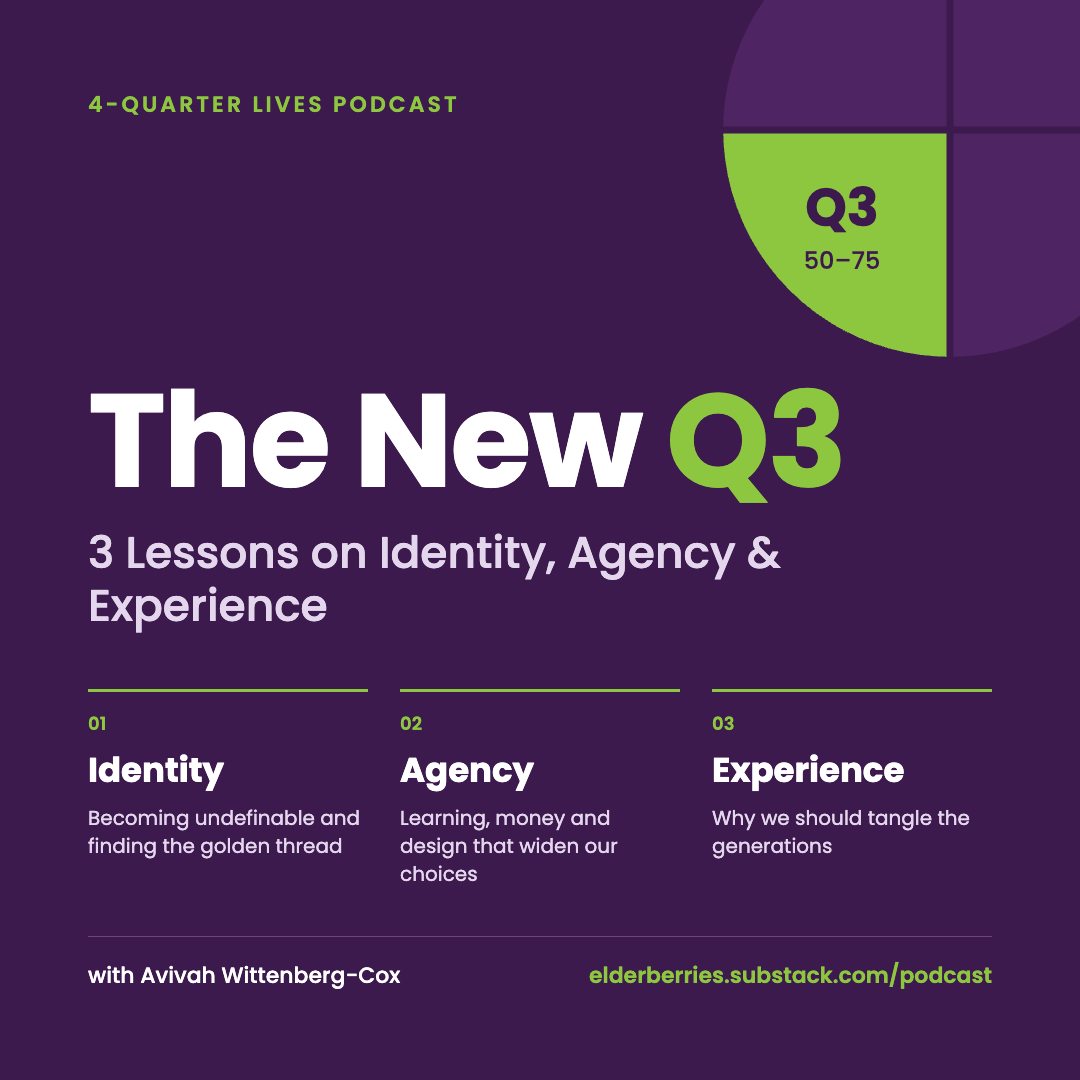
    The New Q3: 3 Lessons on Identity, Agency & Experience

    What have I learned from a summer of conversations about longer lives? Looking back over this season of the 4-Quarter Lives podcast, I realised that my guests – despite coming from very different worlds – kept circling around three big themes: identity, agency and experience. Together, they offer a surprisingly coherent map of the New Q3: the 25 or so years between roughly 50 and 75 that are emerging as a distinct new quarter of life. In this solo episode, I draw together some of the ideas that stayed with me from the season. Charlie Rogers introduced me to the idea of becoming “undefinable” and finding the golden thread connecting the different parts of a life. Jane Moffatt and Denise Taylor explored what happens when professional identities begin to loosen and achievement gives way to questions of meaning. Jane Duncan Rogers offered another beautiful description of this process: unmasking. But freedom alone isn’t enough. Anne Button and Rachel Cohen’s Change Makers programme points towards the kind of midlife learning infrastructure longer lives will require. Richard Smith explains why financial clarity is really about agency – and why what many of us need is a “pensions hug”. Briana Gilmore reframes accessibility as something much bigger: longevity design. Finally, there is experience. Alastair Greener argues that rather than separating generations at work, we should “tangle” them. And Victoria Tomlinson, author of Expiry Date Never, asks why organisations continue to filter out experienced people just as demographic change and AI may be making human judgement, context and pattern recognition more valuable. Different conversations. One emerging map.Longer lives don’t simply add years. They change who we can become, the choices available to us, and the value of everything we accumulate along the way. Perhaps the New Q3 is where we finally start figuring out what all those extra years are for. IN THIS EPISODE I explore: * Why becoming less definable may be one of the freedoms of Q3 * The difference between purpose and meaning * Why longer lives require us to become better at transitions * Why education shouldn’t stop after Q1 * How money becomes a source of agency in Q3 * Why accessibility is really longevity design * The difference between generational differences and life-stage differences * Why organisations should tangle the generations * How AI may increase rather than diminish the value of human experience * Why the “50-plus” category has outlived its usefulness * What identity, agency and experience tell us about the emerging New Q3 GUESTS REFERENCED Charlie Rogers – Undefinable Community and the idea of the “golden thread” Jane Moffatt – identity, transition, meaning and life after full-time work Dr Denise Taylor – ThriveSpan, Jung and the inward turn in the second half of life Anne Button & Rachel Cohen – Change Makers at the University of Colorado Denver and new models of midlife learning Richard Smith – pensions, financial clarity and the “pensions hug” Briana Gilmore – accessibility as innovation and longevity design Alastair Greener – Generationally Speaking and “tangling the generations” Jane Duncan Rogers – Gifted by Grief, mortality and ageing as “unmasking” Victoria Tomlinson – Expiry Date Never, ageism, experience and the future of work Get full access to 4-Quarter Lives | Elderberries at elderberries.substack.com/subscribe
  • September 10 · 36 min

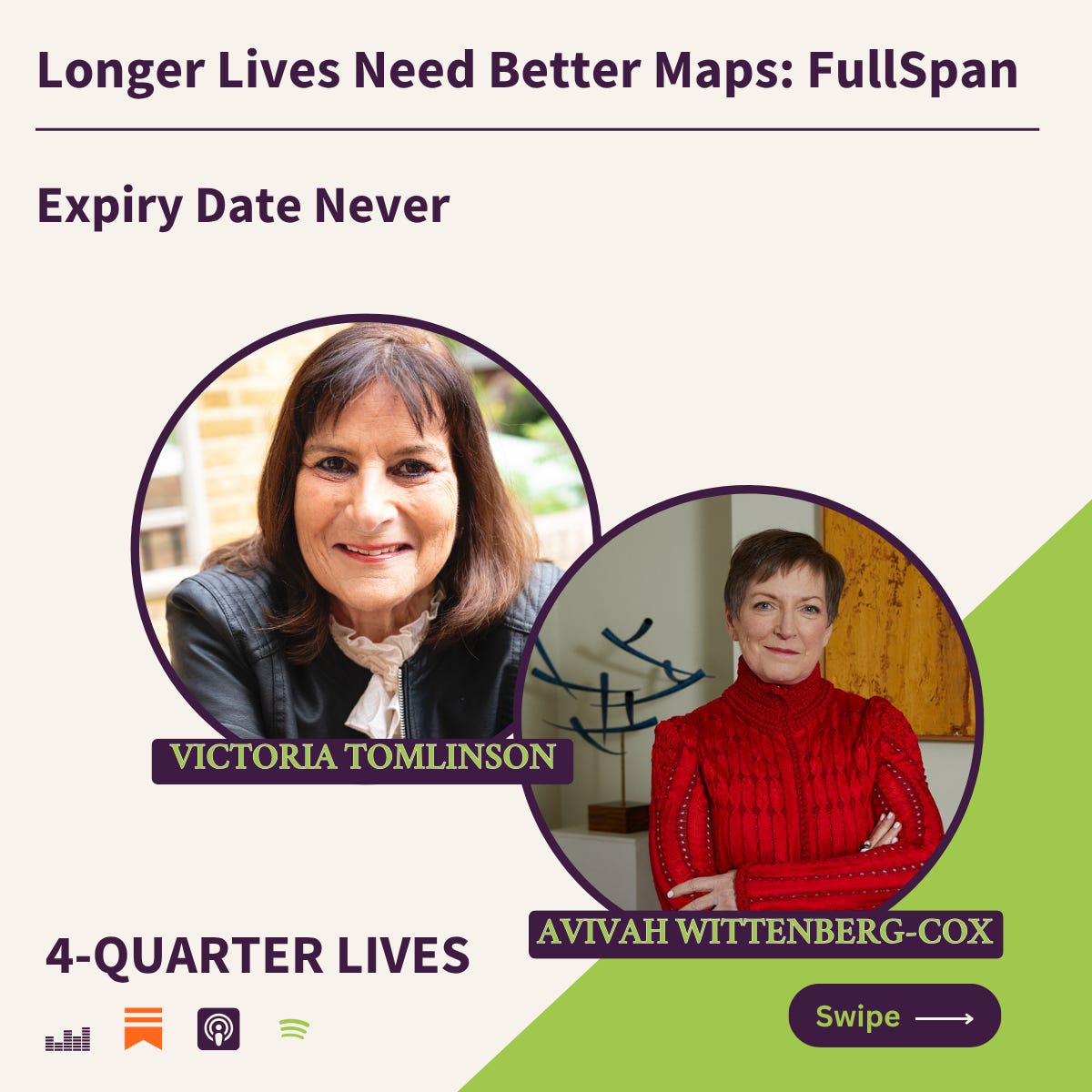
    Victoria Tomlinson – Expiry Date Never

    In this week’s 4-Quarter Lives Podcast, Avivah Wittenberg-Cox is joined by Victoria Tomlinson, founder and CEO of Next-Up, to talk about her new book, Expiry Date Never, and the systems quietly pushing experienced people out of work. Tomlinson argues the problem is not age but obsolete workplace design, and that the first thing to fix is recruitment, where candidates are screened out at 50 and increasingly at 40. She makes the case for scrapping the 50-plus label, which collapses 66 years of life into one category. The conversation turns to AI, where hallucinated reports and expensive mistakes are, she argues, raising rather than lowering the value of experienced judgment. They close on money, purpose, and what a good transition looks like when it starts a decade early rather than a year out. Victoria Tomlinson is the founder and CEO of Next-Up, helping professional services firms and boards turn partner/leadership retirement and succession into an advantage rather than a risk. She was previously a director at EY and ran her own communications agency for thirty years. She is an international keynote speaker, TEDx speaker (‘A Generation of Wasted Talent’), Amazon bestselling author, a Teaching Fellow at Lancaster University and a Fellow of the RSA. Her new book, Expiry Date Never, written with co-author Louise Ballard, is published by Pearson in September 2026. Useful Links: * Expiry Date Never – Age is the New Superpower Get full access to 4-Quarter Lives | Elderberries at elderberries.substack.com/subscribe
  • September 3 · 33 min

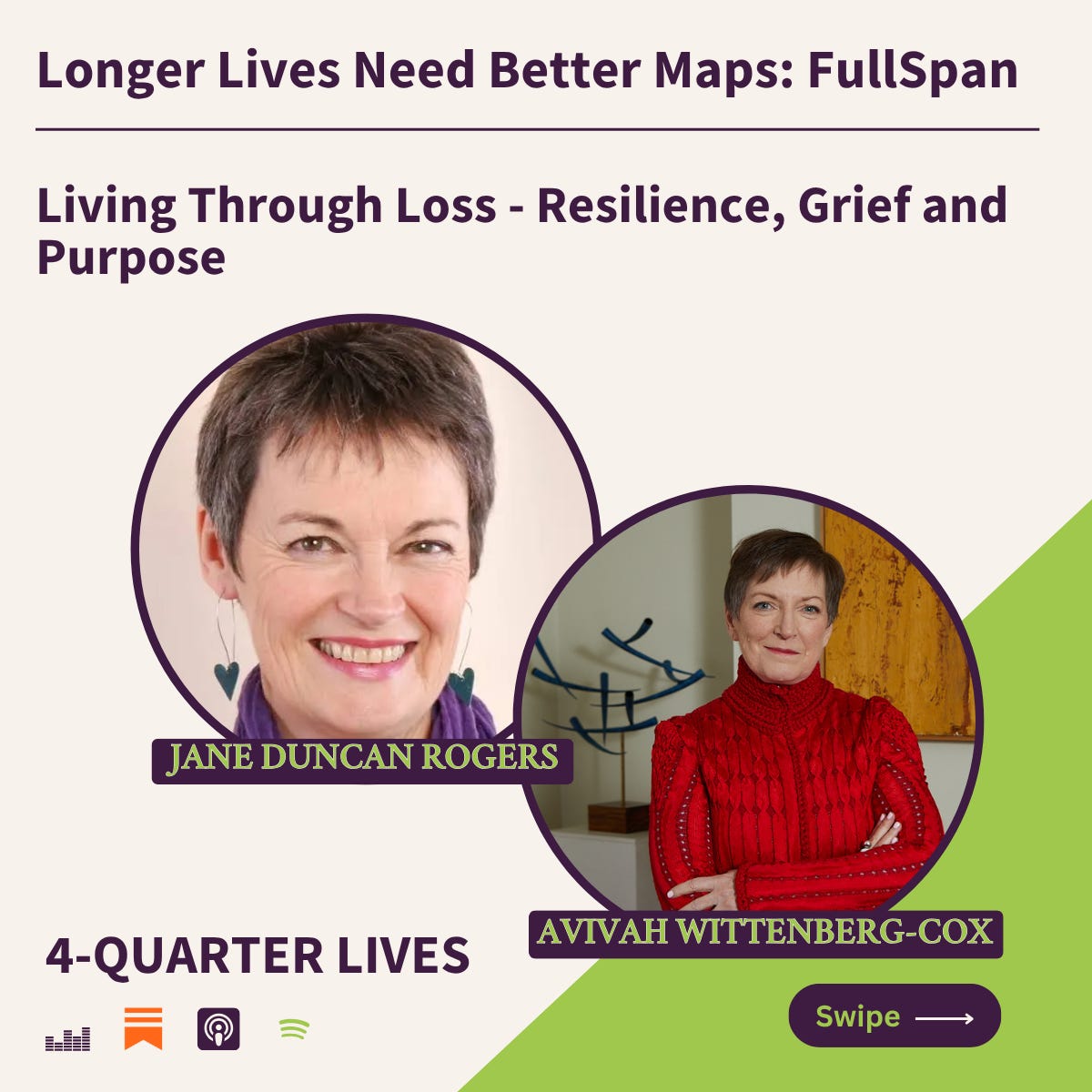
    Jane Duncan Rogers - Living Through Loss - Resilience, Grief and Purpose

    In this week’s 4-Quarter Lives Podcast, Avivah Wittenberg-Cox is joined by Jane Duncan Rogers, author and end-of-life planning pioneer, for a wide-ranging conversation about facing mortality with honesty and even joy. Jane makes the case that end-of-life planning is a form of emotional liberation, freeing the energy we tie up in avoidance. They explore grief and widowhood, the ‘after-self’ that emerges from loss, and Jane’s image of the heart as a flowing stream with gates that open and close. The conversation ranges across assisted dying, ageing without children, the power of micro-communities, and the confidence and voice that can emerge in Q3. Above all, Jane reframes ageing as an unmasking — an invitation to meet the person you never expected to become, and to greet later life with what she calls quiet joy. Jane Duncan Rogers is a writer, speaker, and pioneer in the field of end-of-life planning. She is the author of Gifted by Grief, written in the years following the death of her first husband, and the creator of the Substack Embracing Age, recently recognised at the Advantage of Age Awards. In 2016 she founded an end-of-life planning organisation, which she led for eight years before passing it on. Now in her late sixties, she writes and speaks candidly about grief, widowhood, ageing without children, and the emotional liberation that comes from planning honestly for the end of life. Get full access to 4-Quarter Lives | Elderberries at elderberries.substack.com/subscribe
  • August 27 · 40 min

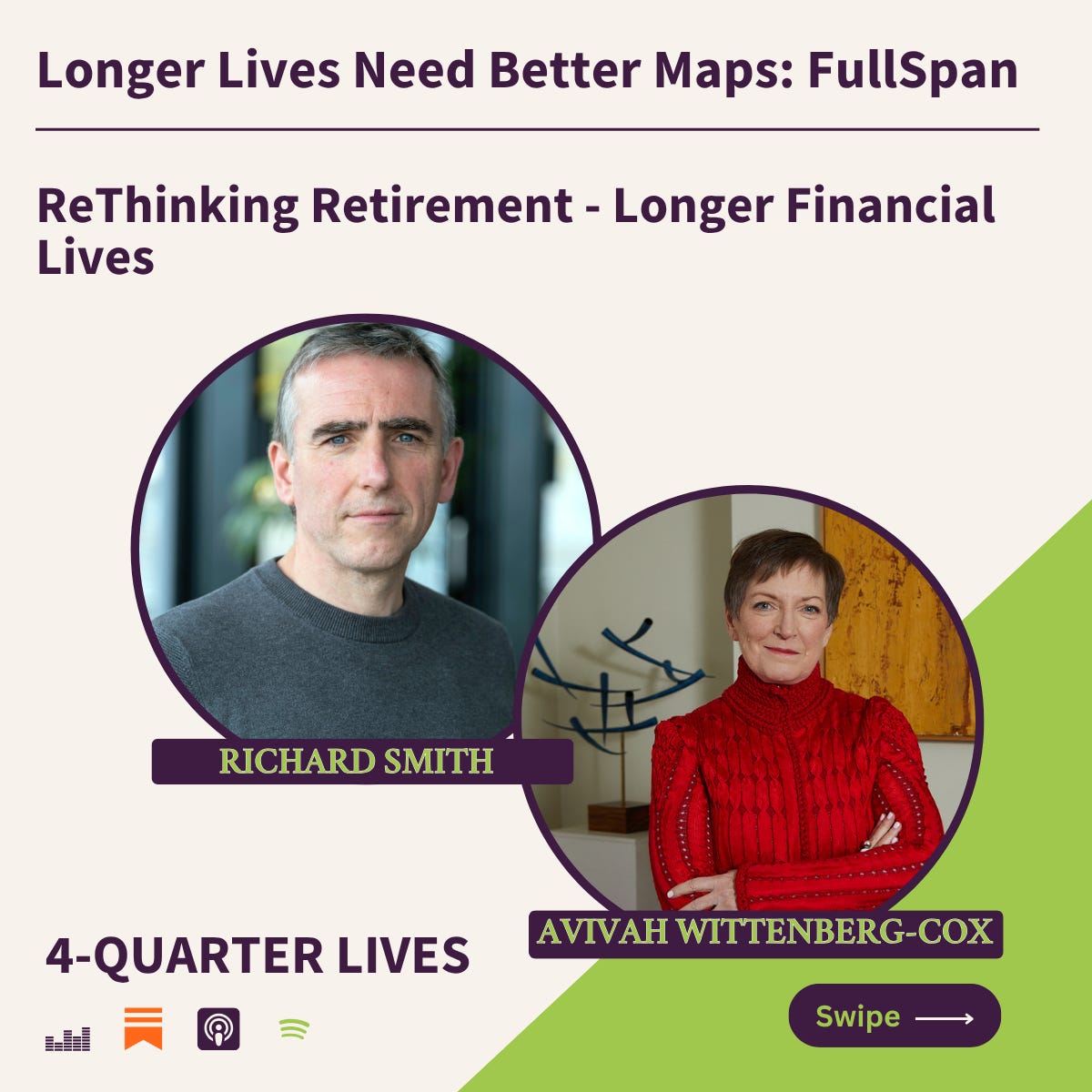
    Richard Smith - ReThinking Retirement - Longer Financial Lives

    In this week’s 4-Quarter Lives Podcast, Avivah Wittenberg-Cox is joined by pensions expert Richard Smith for a conversation about money, longevity and the decades we spend planning for a future we can’t predict. Smith explains why the average UK worker now juggles three or four separate pensions across a churning career, and why almost 80% of people have no idea what they hold in total. The two explore the coming UK pensions dashboard, which will finally connect over 100 million scattered records, and unpack why an income figure people can relate to matters far more than a headline pot. They turn to the harder questions Q3 raises — how to spend when you don’t know how long you’ll live, why even wealthy savers freeze at decumulation, and why women face a double longevity-and-pensions gap. Throughout, Richard argues for awareness delivered with what he calls a pensions hug. Richard Smith is a UK-based career pensions professional who began in pensions administration and has spent the latter part of his career focused, in his words, narrowly and deeply on one topic: pensions dashboards. He helped the UK government define the data standards underpinning the dashboard technology ecosystem and has held roles across the programme since. Now working largely pro bono and independently, he is a leading consumer-advocacy voice for the initiative. He has toured Belgium, the Netherlands, Denmark, Sweden and Norway researching how other countries connect citizens’ pensions, and advises fintechs on making pension data understandable to ordinary savers. Get full access to 4-Quarter Lives | Elderberries at elderberries.substack.com/subscribe
  • August 20 · 36 min

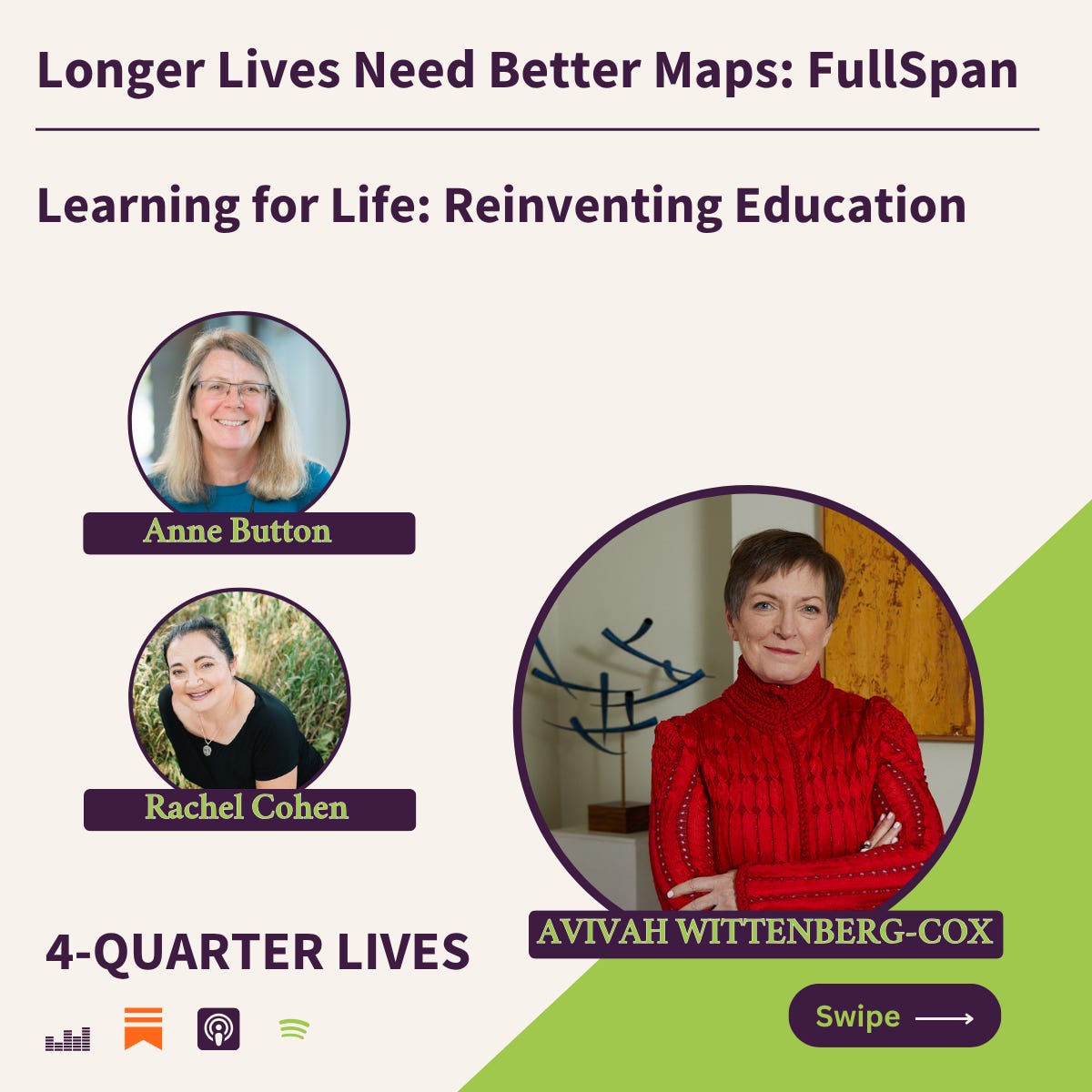
    Anne Button & Rachel Cohen - Change Makers in Midlife, Making Longevity Learning Accessible

    In this week’s 4-Quarter Lives, Avivah Wittenberg-Cox is joined by Anne Button and Rachel Cohen to explore how universities can support purposeful midlife transitions at scale. Anne and Rachel co-developed Change Makers, a 15-week programme based at University of Colorado Denver, designed for adults navigating their next chapter. Built for accessibility, the course runs evenings, blends online and in-person sessions, and costs under $4,000. That design choice also brings in people who are still working, often overlooked by traditional, year-long, high-cost programmes. They explain how Change Makers follows a clear three-part arc. Inner reflection helps participants reassess identity, values, and strengths. Outer exploration opens up new options through speakers, peer exchange, and real examples. Integration turns insight into action through short, practical 12-week plans that build momentum. A standout feature is the peer advisory process. Small, rotating groups help participants test ideas, voice long-held ambitions, and move from stuck to forward motion. Anne and Rachel share stories of alumni who have redesigned careers, stepped into community leadership, launched new ventures, or found new ways to contribute and engage. The conversation also looks beyond the classroom. Change Makers is influencing university thinking on lifelong learning, workforce participation, and ageing. Its alumni are feeding into local media, policy discussions, and community initiatives, reframing older adults as experienced contributors rather than liabilities. Looking ahead, Anne and Rachel outline plans for a fully virtual programme, a stronger alumni network, and a wider national reach. Their shared aim is clear. Help more people age with confidence, direction, and impact. Anne Button is the founding director of Change Makers at the University of Colorado Denver. She designed the programme to fill a gap in higher education for midlife adults navigating transitions in work and life and thinking intentionally about what comes next. Anne focuses on making this kind of learning practical, affordable, and accessible. Her work positions universities as active players in longer careers and ageing societies. Rachel Cohen is a gerontologist, social worker, and founder of Aging Dynamics. Her work focuses on age-friendly communities, systems change, and helping individuals shape meaningful later chapters. Rachel brought deep expertise in ageing, community planning, and facilitation to Change Makers, where she co-led curriculum and peer advisory processes. She works nationally with organisations and cities to support longer, more engaged lives. Useful Links: ● Change Makers Programme at University of Colorado Denver: https://www.ucdenver.edu/change-makers ● Aging Dynamics: https://www.aging-dynamics.com ● Anne Button on LinkedIn: https://www.linkedin.com/in/anne-button-cudenver-change-makers-program/ ● Rachel Cohen on LinkedIn: https://www.linkedin.com/in/rachelbcohen/ Get full access to 4-Quarter Lives | Elderberries at elderberries.substack.com/subscribe
  • August 13 · 30 min

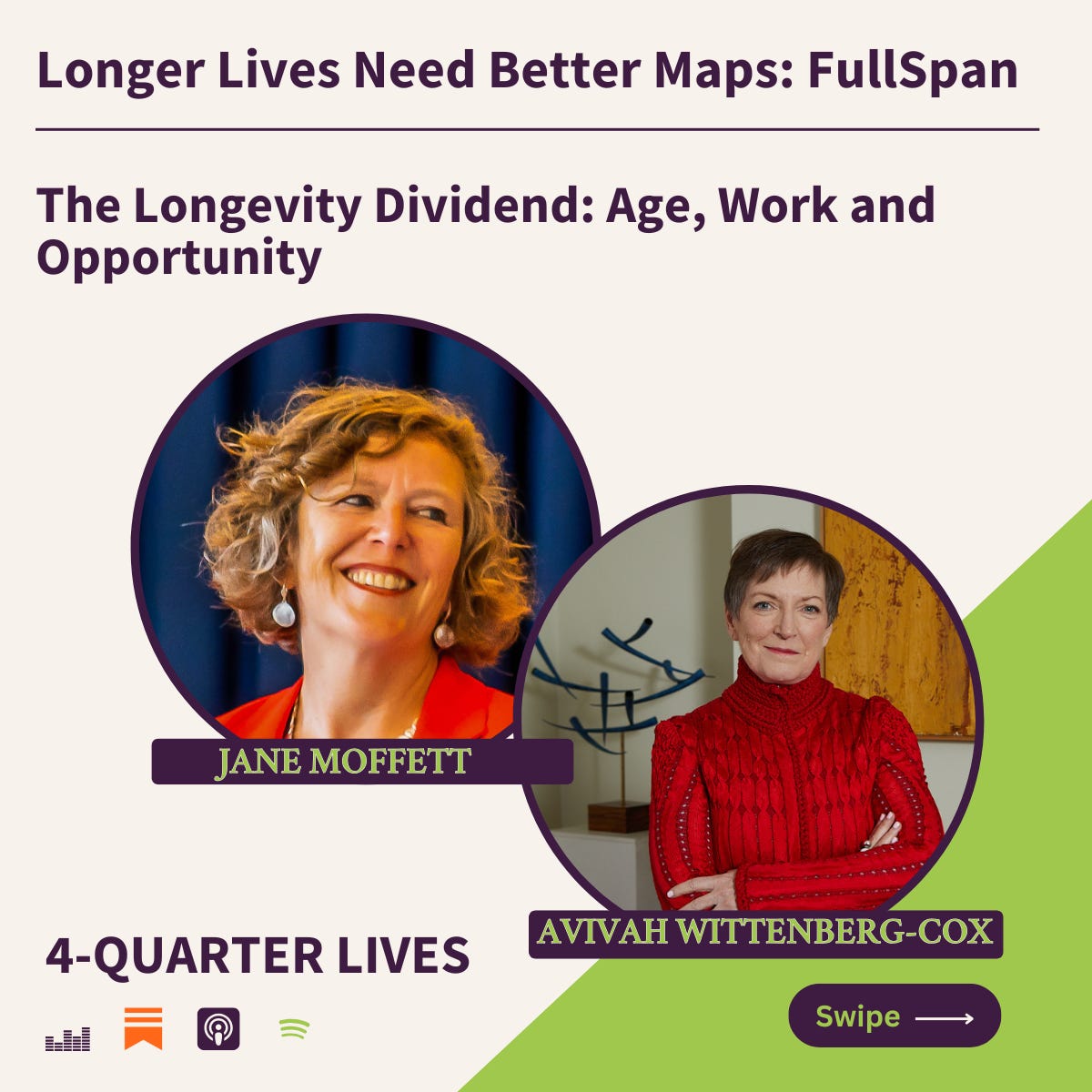
    Jane Moffett - Women Wrote the Map First: Navigating longer lives

    In this week’s 4-Quarter Lives Podcast, Avivah Wittenberg-Cox is joined by Jane Moffett, author of What Next? and the Founder of KANGAROO Coaching, for a conversation about the life stage still awkwardly labelled retirement. Moffett argues the adjustment after leaving work can take up to seven years, because stopping work is a major psychological transition involving shifts in identity, values and meaning — none of which can be hurried. She maps six recurring challenges, from the manner of leaving to the reshaping of time, structure and relationships, and pushes back on the pressure to name a purpose, offering meaning as the more useful word. The conversation turns to gendered career shapes — the male mountain versus women’s rolling landscape — the layer of Q3 women hitting their strongest decades, and why so few couples do this thinking together. Both agree: start early, and don’t go it alone. Jane Moffett has spent thirty years supporting women through major life transitions, particularly the points where the professional and the personal intersect — becoming a mother, leaving the workplace, returning after a career break. Her interest in the transition out of work grew from conversations with friends of her own generation: the first large cohort of professional women to have built full careers, and to face stopping work with no blueprint to follow. Finding nothing written for women in the UK on the subject, she researched and wrote What Next?, a six-part map of the challenges of redefining retirement. Useful Links: Book - From Retired to Defined Get full access to 4-Quarter Lives | Elderberries at elderberries.substack.com/subscribe
  • August 6 · 37 min

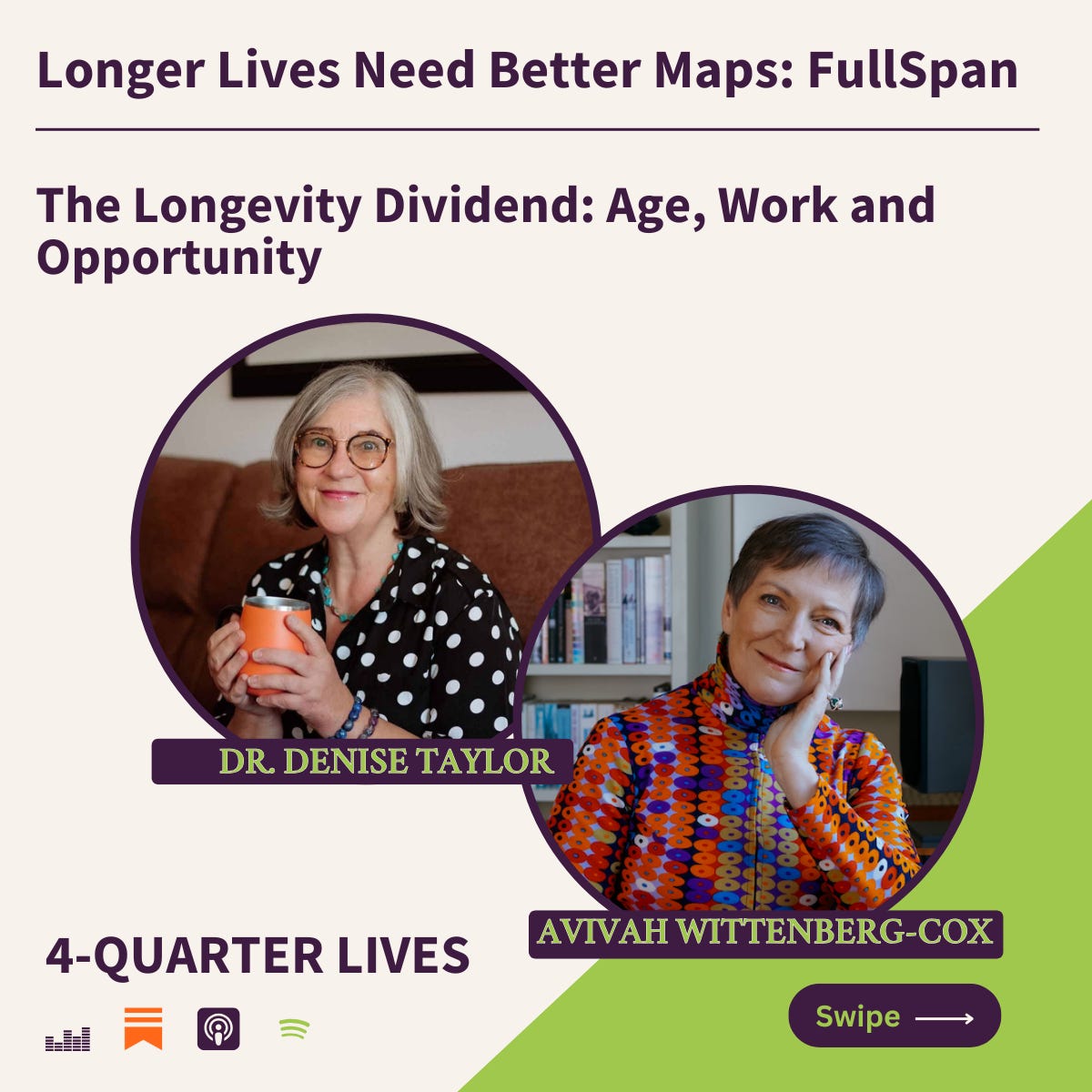
    Dr. Denise Taylor - The Longevity Dividend: Age, work and opportunity

    In this week’s 4-Quarter Lives Podcast, Avivah Wittenberg-Cox is joined by psychologist and author Dr Denise Taylor, who after more than 50 years of work stepped away from client practice to write. Taylor argues that most people misread Carl Jung: the second half of life is not about striving differently, but about going inwards. She unpicks the assumption that work means paid work, and questions the language now forming around 60-year careers. The conversation turns to identity — who am I without my job? — and to the health and financial foundations of later-life agency, including the idea of voluntary simplicity. Taylor describes writing her new book, ThriveSpan, in the four acres of woodland she bought during lockdown, structuring it as paths through a wood rather than chapters. Her closing permission is simple: you have more time than you think. Dr Denise Taylor is a psychologist, career coach and author who has worked in retirement and later-life for more than 40 years, beginning as a welfare officer at Royal Mail running pre-retirement seminars in her twenties. After a corporate career and a long practice in careers coaching, she completed a doctorate and turned to writing full time. Her books include Rethinking Retirement, Career Coaching for Midlife and Beyond, and ThriveSpan, Walking Gently into What Matters Now, with Olderhood Unfolding — 52 essays on ageing — to follow. She writes for the iPaper, publishes academic research, and works from her own four acres of woodland. Get full access to 4-Quarter Lives | Elderberries at elderberries.substack.com/subscribe
  • July 30 · 43 min

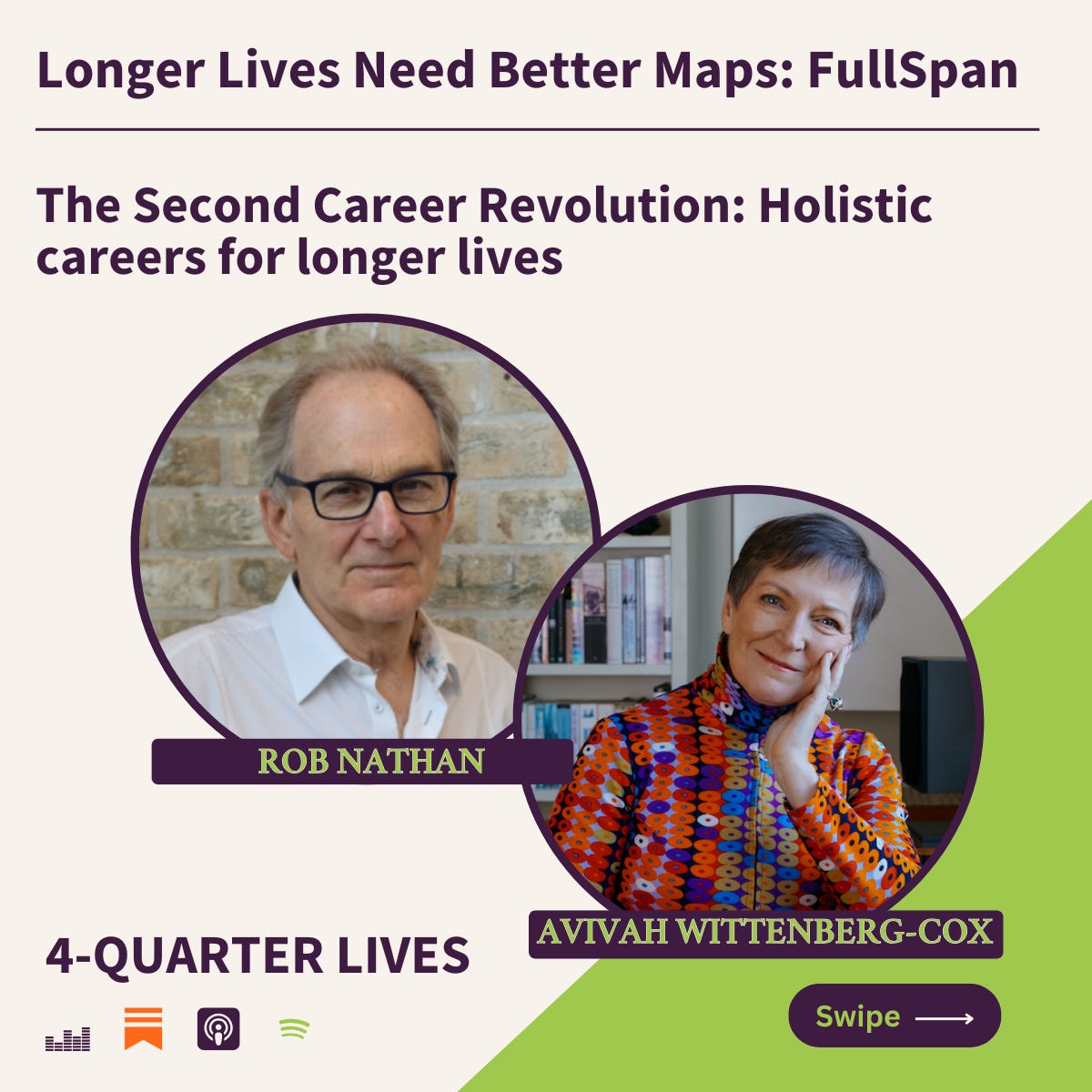
    Rob Nathan - The Second Career Revolution: Holistic careers for longer lives

    In this week’s 4-Quarter Lives Podcast, Avivah Wittenberg-Cox is joined by Rob Nathan, occupational psychologist and career coach, to ask why the three-stage life — education, work, retirement — is proving so stubborn. Recorded on his 77th birthday, Nathan argues the systems around us were built for shorter lives and have not caught up, while individuals get financially and socially bound into their employers. He draws on William Bridges to separate change from transition, and unpacks the self-limiting beliefs that keep people stuck at the edge of the diving board. The conversation turns to cultural contrasts — the respect afforded elders across Southeast Asia against a Western workplace that reads older workers as slower and replaceable — and to the case for career conversations and multi-generational teams. Nathan closes with whitewater rafting and his own definition of a good fourth quarter. Rob Nathan is an occupational psychologist and career coach of more than four decades. He set up his own practice in 1978 and now directs Career Counselling Services, whose training and coaching work he is expanding into Southeast Asia. He commissioned, edited and co-authored The Holistic Career Conversations Handbook, including a Chapter on Career Conversations to The Holistic Career Coaching Handbook, and an earlier co-authored career title was serialised on television. He designed the Thrive at 55 programme for people rethinking work in later career. Alongside his practice he holds a master’s in creative writing, writes short stories, and runs shared reading groups for elders with Age UK. Links: * www.career-counselling-services.co.uk * https://www.routledge.com/The-Holistic-Career-Coaching-Handbook-A-Guide-for-Managers-and-Employers/Nathan/p/book/9781032802350?utm_source=cjaffiliates&utm_medium=affiliates&cjevent=7d2ae9f1873a11f1806700590a18b8f7 * https://career-counselling-services.co.uk/accredited-career-coach-training/ * https://career-counselling-services.co.uk/advanced-icf-career-coaching-certificate/ * https://www.linkedin.com/in/robnathanccs/ Get full access to 4-Quarter Lives | Elderberries at elderberries.substack.com/subscribe
  • July 23 · 39 min

    UBER - Designing for Everyone: Accessibility as Innovation

    In this week’s 4-Quarter Lives Podcast, Avivah Wittenberg-Cox is joined by UBER’s Briana Gilmore to explore how ageing, disability and mobility intersect — and what that means for the future of work, cities and independence. Briana reframes ageing not as a demographic segment but as an access issue, shifting the conversation from “senior markets” to systems that either enable or restrict independence. She introduces self-efficacy — the confidence to navigate the world predictably — and shows how it erodes when environments fail to adapt, not because of personal limitations. Applying the social model of disability to ageing, she argues that disability lies in environments, not impairments, opening fresh ways to design products, services and cities. Along the way she unpacks the tension between safety and autonomy, the dignity of risk, and how this thinking reshaped Uber’s approach to older users — and what age-friendly cities truly require: meaningful choice. Briana Gilmore is Head of Global Accessibility Policy at Uber, focused on disability access, ageing and inclusive mobility. With a background spanning global migration policy, public health and urban planning, her work examines how systems shape access to resources, movement and independence. A long-time disability advocate, she integrates the social model of disability into product and policy design, challenging traditional assumptions about ageing and adaptability. At Uber, she leads efforts to expand access for older adults and marginalized communities, Get full access to 4-Quarter Lives | Elderberries at elderberries.substack.com/subscribe

  • July 16 · 37 min

    Alastair Greener - Lost in Translation: Communicating across generations

    In this week’s 4-Quarter Lives Podcast, Avivah Wittenberg-Cox is joined by Alastair Greener, speaker, consultant and author of Generationally Speaking, to unpick what we get wrong about generations at work. Alastair argues that much of what we label generational conflict is really about life stage, and that organisations stereotype at their peril: his research across six generations found we are, on average, only about 65% “stereotypical”, meaning a third of people won’t match the labels applied to them. The conversation explores a striking gap: just 6% of HR leaders report overt generational friction, yet almost two-thirds believe better intergenerational communication would boost productivity. Avivah and Alastair dig into the overlooked Q3 workforce, the value of multi-generational teams, and three strategies leaders can adopt now: omni-channel communication, “tangling” the generations within teams, and recruitment that genuinely matches onboarding. Alastair Greener is a speaker, trainer and consultant specialising in intergenerational communication, helping organisations turn generational difference into a source of engagement and productivity rather than friction. His book Generationally Speaking, published in November 2025, draws on his research with 4,000 people across six generations and all socioeconomic groups, examining how each generation prefers to communicate and how far the stereotypes really hold. After a career in the corporate world, Alastair now works with major organisations on communication, culture and multi-generational teams, with a follow-up study and a second book already in the pipeline. Get full access to 4-Quarter Lives | Elderberries at elderberries.substack.com/subscribe

  • July 9 · 44 min

    Charlie Rogers - The Courage to Become Undefinable: Life beyond labels

    What if the most valuable thing you can become is... undefinable? In the first episode of the Longer Lives Need Better Maps summer series, Avivah Wittenberg-Cox talks with Charlie Rogers, founder of the Undefinable Community and author of Undefinable Life Design. Together they explore why younger generations are rejecting traditional career paths—and why their search for identity mirrors the questions many people face later in life as they transition into a new Q3. Charlie introduces his idea of the “golden thread”: finding the unique connections between your interests instead of defining yourself by a single job or profession. The conversation ranges from portfolio careers and AI to flexible organisations and the future of work, revealing a surprising insight: whether you’re 28 or 58, longer lives demand greater freedom to evolve. Perhaps the future belongs not to specialists—but to those willing to become undefinable. * Undefinable Life Design (book): https://mybook.to/undefinablelifedesign/ * Subscribe to Charlie’s Newsletter: * Work with Charlie: https://www.undefinablelifedesign.com/ Get full access to 4-Quarter Lives | Elderberries at elderberries.substack.com/subscribe

  • June 18 · 8 min

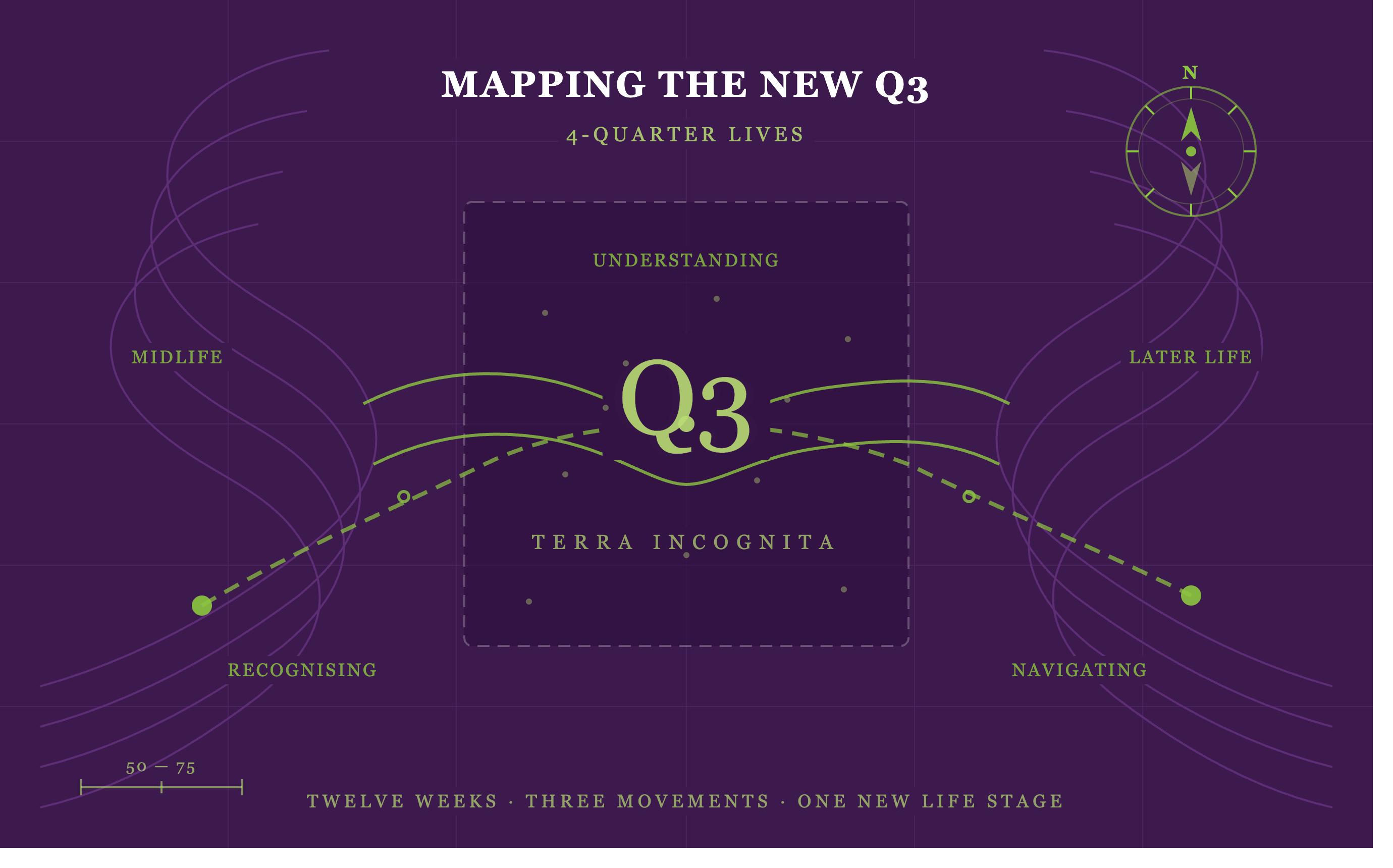
    Mapping The New Q3: What Twelve Weeks Taught Me About Life's New Quarter

    After twelve weeks exploring what it means to live longer, this summary steps back from individual conversations to examine the bigger picture. Rather than recapping each episode, Avivah looks at the entire series from above and asks a more fundamental question: if the emergence of a new third quarter of life is such a profound shift, why do we still understand it so poorly? The answer, she argues, is that we’re trying to squeeze an entirely new life stage into outdated frameworks. The series naturally organised itself into three movements: Recognising, Understanding and Navigating. Recognising The first challenge is one of scale. Organisations, institutions and individuals have not yet grasped the sheer size of this demographic transformation. We have added decades of healthy life expectancy but continue to use industrial-age assumptions about education, work and retirement. We have built systems around a three-stage life model of learning, earning and retiring, even though millions of people are now entering a distinct and substantial third quarter between roughly 50 and 75. This isn’t an extension of midlife or a delayed version of old age. It is a new life stage entirely. Understanding The second phase explored the inner experience of Q3 itself. While external markers may remain unclear, people inside this transition often describe remarkably similar feelings. There is a growing desire to shift from ambition towards meaning, from accumulation towards contribution, and from identity built around achievement towards identity built around becoming. Many experience an unsettling sense of freedom alongside uncertainty. The old scripts no longer apply, yet new ones have not been widely written. This leaves many successful people feeling temporarily lost, not because they are failing, but because they are entering unfamiliar territory without a map. Navigating The final episodes focused on navigation. How do individuals, couples and organisations adapt to a life course that may now span a century? Avivah argues that the biggest opportunity lies not in adding more years to life, but in redesigning the institutions that shape those years. Companies must rethink careers, leaders must rethink talent, and individuals must embrace transitions as a normal and necessary feature of modern life. The central insight emerging from the series is that Q3 is not a problem to solve but a resource to cultivate. We are witnessing the birth of a new life stage, one that may ultimately become one of the most creative, productive and socially valuable periods of our lives. Why Care? We are no longer simply living longer. We are creating an entirely new chapter of adulthood. The question is no longer whether Q3 exists, but whether our systems, organisations and imaginations can catch up with it. Memorable lines “The question isn’t whether Q3 is real. The evidence has only got louder. The question is why something this large is still so badly understood.” “We have added decades to life, but we haven’t yet redesigned life itself.” “Q3 is not a problem to solve. It’s a resource to cultivate.” “Many people don’t feel lost because they’re failing. They feel lost because they’re entering a new life stage without a map.” “The complexities only really show up when you hold recognising, understanding and navigating together.” Get full access to 4-Quarter Lives | Elderberries at elderberries.substack.com/subscribe

  • June 11 · 42 min

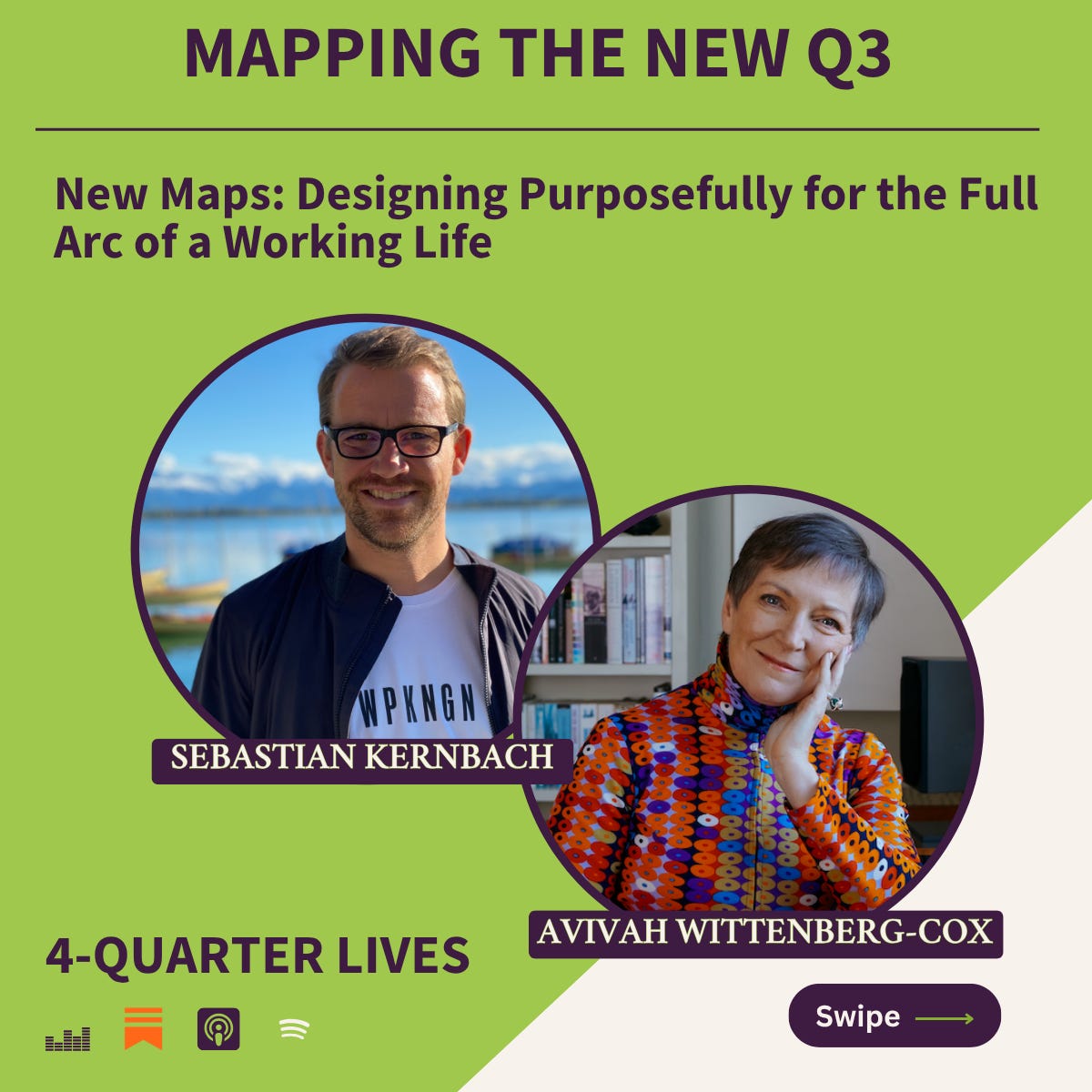
    New Maps: Sebastian Kernbach on Designing Purposefully for the Full Arc of a Working Life

    This week on 4 Quarter Lives, we revisit Avivah Wittenberg-Cox’s conversation with Sebastian Kernbach, founder of the University of St. Gallen’s Next – Design Your Future initiative — the first university-based midlife programme in continental Europe. They discuss how St. Gallen’s approach blends design thinking, positive psychology and behavioural economics to help accomplished professionals rethink their purpose, portfolio, and personal transitions, in what Kernbach calls the multi-stage life. He describes how the three-day “sabbatical” has evolved into a five-day immersive experience, designed to give participants a structured yet creative space to pause, prototype, and rediscover what drives them. Together, Avivah and Sebastian compare models emerging from Harvard, Stanford and Chicago with Europe’s more academically grounded, culturally diverse programmes. They explore Kernbach’s key ideas — from infinite procrastination and the magic circle to the stairway to heaven — practical methods for turning reflection into action. The conversation widens to include the role of universities and employers in supporting lifelong learning, intergenerational connection and longer, healthier, more flexible careers. Kernbach shares his vision of “transition competence” — the lifelong skill of navigating change with agency, creativity and patience — and why Europe’s blend of rigour, reflection and community may offer a new model for longevity education worldwide. Sebastian Kernbach is Professor at the University of St. Gallen, where he teaches creativity, life design and visual thinking. Her is Visiting Scholar at Columbia University and Stanford University, and Guest Professor at the African Doctoral Academy and the Central University of Beijing. Previously he worked for Xerox and Interbrand. He advises and consults organizations like Nike, The United Nations, IBM and others. He founded the Visual Collaboration Lab and the Life Design Lab at the University of St. Gallen and co-authored the award-winning book “Meet up!” as well as the best-selling books “Life Design” and “Life Design Action Book”. His most recent book is Design Your Future (April 2026). Useful links: * University of St. Gallen – Next Programme web page * Order Sebastian’s new book: Design Your Future Get full access to 4-Quarter Lives | Elderberries at elderberries.substack.com/subscribe

  • June 4 · 43 min

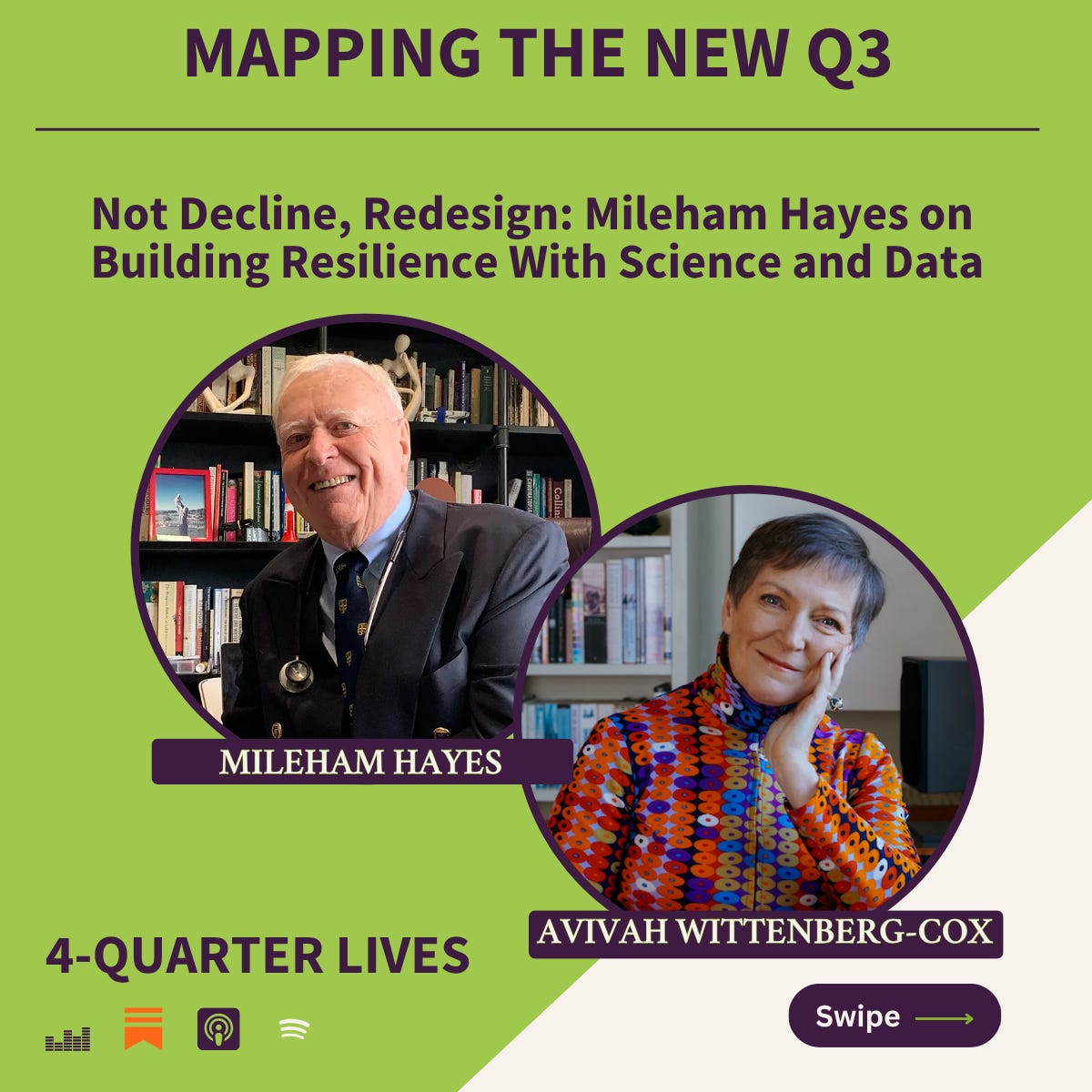
    Dr Mileham Hayes - Not Decline, Redesign: Mileham Hayes on Building Resilience With Science and Data

    This week, on 4-Quarter Lives, we revisit the conversation between Avivah Wittenberg-Cox and Dr Mileham Hayes, author of ‘Live Longer: Revealing Today’s Secrets of Longevity and Wellbeing’ and a specialist in preventative medicine. As he says, “preventive medicine has never realized its promise or potential...until now”. Mileham, who launched the world’s first longevity clinic and has spent nearly six decades in coronary care, shares how much of heart disease—still the world’s top killer - is preventable, yet persistently neglected. He discusses key diagnostic tests such as ApoB, Lp(a), and coronary artery calcium scans, many of which he began using in the 1990s but still remain underused. He advocates a targeted 20-test health screening battery for anyone over 40, customized by age and gender, which is downloadable with the episode. He critiques the broader health ecosystem where profit-driven industries—from pharma to fast food—drown out preventive efforts, leaving doctors and patients with minimal influence. He shares sobering statistics on the top causes of death by decade and gender across the US, UK, and Australia—highlighting suicide as a leading killer of younger men. Rather than obsessing over radical life-extension strategies, Hayes urges a back-to-basics focus on preventing known, measurable threats. Witty, forthright, and deeply experienced, Hayes is a passionate advocate for practical, accessible healthcare that prioritizes staying alive—and healthy—as the first rule of longevity. Dr Mileham Hayes is a Specialist Physician and a Fellow of both the Royal College of Physicians of London and Edinburgh. He was appointed to the world’s first Coronary Care Unit and researched prevention of heart attacks – still the greatest cause of premature death. He has now spent some 50 years in clinical practice and is the author of two medical textbooks and a series of books on living longer through prevention, nutrition and exercise. His most recent book is ‘Live Longer: Revealing Today’s Secrets of Longevity and Wellbeing’. Mileham studied medicine at the University of Queensland. He has five children, played most sports at a high level, farmed, gardens, writes doggerel and cooks. He also had an ABC radio weekly program and two national TV shows presenting and playing jazz. He has the Order of Australia Medal for his services to Jazz. Useful Links: * Download a pdf from Mileham on main causes of death by sex and age, and recommended tests * Buy Mileham’s book ‘Live Longer’ * On Amazon.com * On Amazon.co.uk Get full access to 4-Quarter Lives | Elderberries at elderberries.substack.com/subscribe
  • May 28 · 42 min

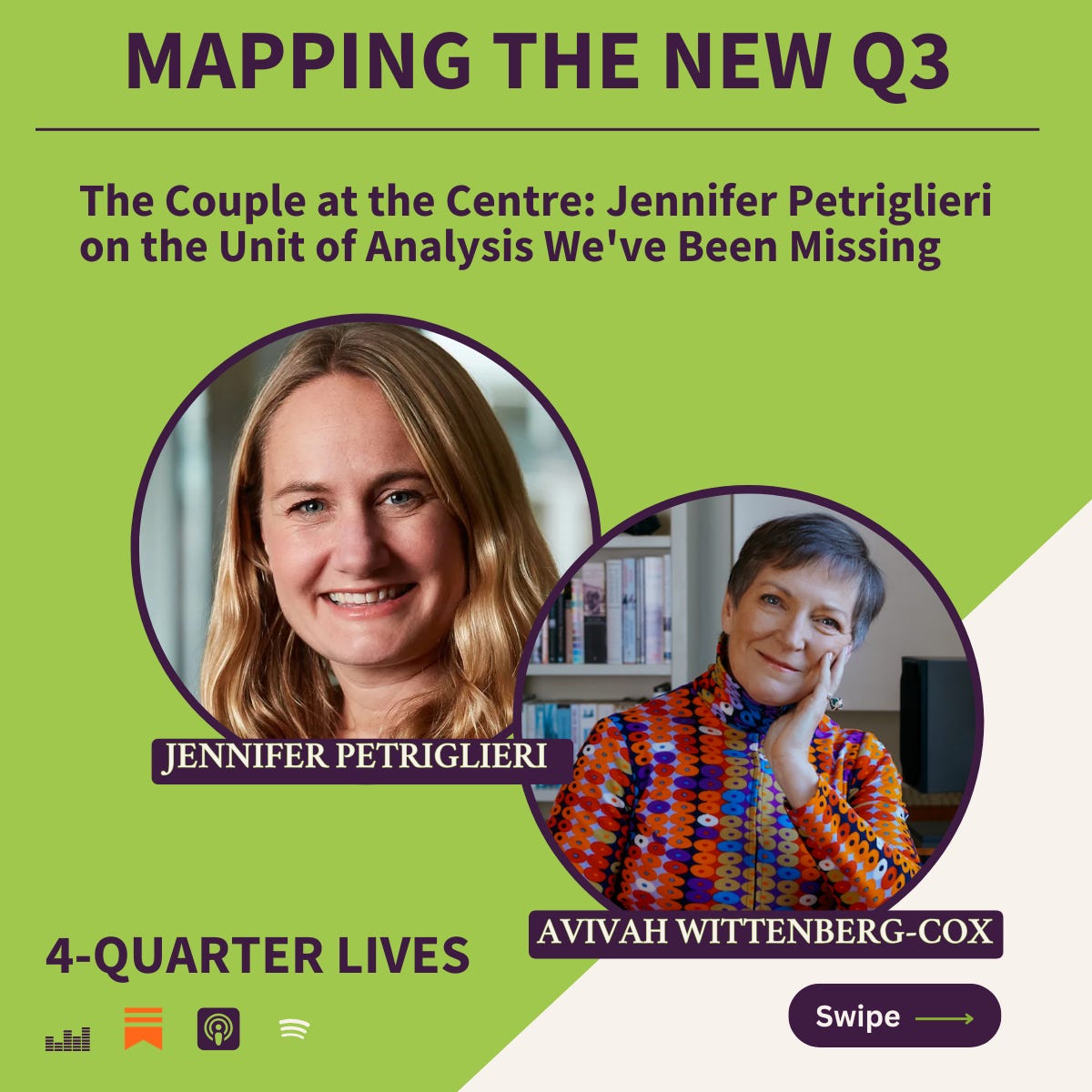
    Jennifer Petriglieri - The Couple at the Centre: Jennifer Petriglieri on the Unit of Analysis We've Been Missing

    In this week’s 4-Quarter Lives Podcast, Avivah Wittenberg-Cox is joined by Jennifer Petriglieri, Professor of Organisational Behaviour at INSEAD Business School and author of Couples That Work, to explore how longer lives are reshaping modern coupledom, careers, and power dynamics inside relationships. Jennifer argues that living and working longer removes the pressure to “have it all at once” and replaces it with a need to sequence ambitions across a lifetime. For couples, this means the old idea of a fixed deal or settled marriage no longer holds. What works in your 30s rarely works in your 50s or 60s. Instead, she introduces the idea of a more fluid marriage, one that adapts as careers, caregiving roles, and personal identities evolve. The conversation digs into why midlife has become such a critical inflection point. Empty nesting, career ceilings, and shifting energy levels often collide at the same moment. Jennifer explains why women in particular are driving the rise in midlife divorce, not because relationships are broken, but because being “supported” is not the same as being seen and celebrated. They explore the hidden role of power in couples, how it is shaped by thousands of small decisions over time rather than money alone, and why resentment builds when desire and agency go unspoken. Jennifer also maps her three major transitions in dual-career couples onto four-quarter lives, showing how reinvention now repeats several times as careers stretch into later decades. Looking ahead, Jennifer shares practical tools for navigating mobility, retirement, and reinvention together, from simple decision exercises to small daily practices that build connection. She closes by reimagining the future of coupledom, calling for relational literacy to be taught early, normalized often, and practiced intentionally throughout longer lives. Jennifer Petriglieri is Professor of Organizational Behavior at INSEAD and a leading expert on dual-career couples, leadership, and identity at work. Her research focuses on how professionals navigate ambition, relationships, and power over long careers. She is the author of Couples That Work, a widely cited book on modern coupledom and career sustainability. Jennifer teaches globally, advises organizations on leadership and talent, and is a frequent speaker on how longer lives are changing the way we work and love. Useful Links: * Jennifer’s Website: https://www.jpetriglieri.com * Book: Couples That Work: https://www.jpetriglieri.com/books/ * Jennifer Petriglieri on LinkedIn: https://www.linkedin.com/in/jpetriglieri/ * INSEAD: https://www.insead.edu Get full access to 4-Quarter Lives | Elderberries at elderberries.substack.com/subscribe
  • May 21 · 40 min

    Michael Fossat: After the Ladder: Schneider Electric Builds Career Architecture for the 21st Century

    In this week’s 4-Quarter Lives, we republish Avivah Wittenberg-Cox’s conversation with Michael Fossat, head of Schneider Electric’s Future Ready program and Director of HR at Schneider Electric France. With a 180-year history, Schneider is now focused on assisting and driving the energy transition to an electric and digital future. Yet this 150,000 strong company discovered that employees over the age of 50 (what Avivah calls Q3) weren’t as motivated and engaged as the rest. Schneider determined to fix that, especially given the talent wars they feel pressing on their business needs every day. The Future Ready Program is their response. Michael Fossat has worked at Schneider for much of his professional career. Passionate about sustainable business and people’s central role in achieving it, he joined Schneider Electric in France as an HR apprentice in an industrial department, participated in the creation of HR shared services for the entire group and worked in the R&D division, before moving to Barcelona to create the HR Metrics function globally. Returning to Paris he was successively HR VP for one of the business units, HR head of Central and Eastern Europe and HR leader for European plants and distribution centres. He is currently Head of HR for Schneider Electric France. Since 2021 he has also headed up the Future Ready Program, bringing to the role a wide knowledge of what motivates people across the group. RELEVANT LINKS * Schneider Electric website * Schneider Electric – Company Purpose * Schneider Electric Senior Talent Program white paper * https://www.kornferry.com/content/dam/kornferry/docs/pdfs/KF-Future-of-Work-Talent-Crunch-Report.pdf * https://www.aarpinternational.org/ * Articles by Avivah on other Corporate Initiatives: Unilever and Aviva Get full access to 4-Quarter Lives | Elderberries at elderberries.substack.com/subscribe
  • May 21 · 40 min

    Michael Fossat: After the Ladder: Schneider Electric Builds Career Architecture for the 21st Century

    In this week’s 4-Quarter Lives, we republish Avivah Wittenberg-Cox’s conversation with Michael Fossat, head of Schneider Electric’s Future Ready program and Director of HR at Schneider Electric France. With a 180-year history, Schneider is now focused on assisting and driving the energy transition to an electric and digital future. Yet this 150,000 strong company discovered that employees over the age of 50 (what Avivah calls Q3) weren’t as motivated and engaged as the rest. Schneider determined to fix that, especially given the talent wars they feel pressing on their business needs every day. The Future Ready Program is their response. Michael Fossat has worked at Schneider for much of his professional career. Passionate about sustainable business and people’s central role in achieving it, he joined Schneider Electric in France as an HR apprentice in an industrial department, participated in the creation of HR shared services for the entire group and worked in the R&D division, before moving to Barcelona to create the HR Metrics function globally. Returning to Paris he was successively HR VP for one of the business units, HR head of Central and Eastern Europe and HR leader for European plants and distribution centres. He is currently Head of HR for Schneider Electric France. Since 2021 he has also headed up the Future Ready Program, bringing to the role a wide knowledge of what motivates people across the group. RELEVANT LINKS * Schneider Electric website * Schneider Electric – Company Purpose * Schneider Electric Senior Talent Program white paper * https://www.kornferry.com/content/dam/kornferry/docs/pdfs/KF-Future-of-Work-Talent-Crunch-Report.pdf * https://www.aarpinternational.org/ * Articles by Avivah on other Corporate Initiatives: Unilever and Aviv Get full access to 4-Quarter Lives | Elderberries at elderberries.substack.com/subscribe
  • May 14 · 48 min

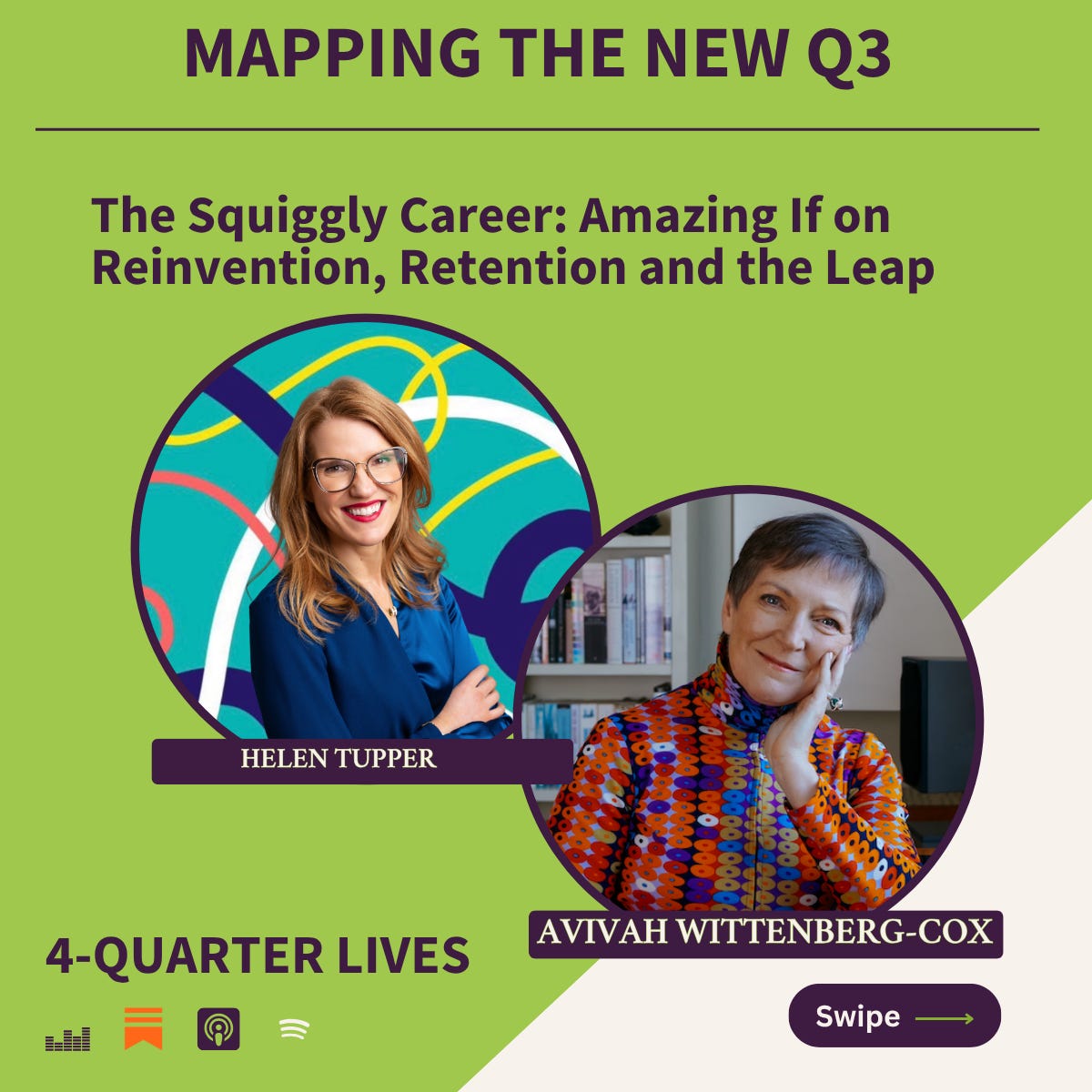
    Helen Tupper: The Squiggly Career: Amazing If on Reinvention, Retention and the Leap

    In this episode of 4-Quarter Lives, we re-visit a conversation between Avivah Wittenberg-Cox and Helen Tupper, Chief Executive of Amazing If, a company redefining careers for individuals and companies. Together they explore the intricacies of career transitions during midlife and how organizations can support these changes. The conversation also delves into personal experience, highlighting the essential balance between work and life. Helen Tupper is co-founder and CEO of Amazing If, a company with an ambition to make careers better for everyone. Together with her business partner Sarah Ellis, she is the author of three books: The Squiggly Career, You Coach You and, most recently, Learn Like a Lobster: Confidence boosting tools to help you get unstuck at work and reignite your career. Sarah and Helen are also hosts of the podcast Squiggly Careers which has had 4m downloads and their TED talk, The best career isn’t always a straight line, has been watched by almost 2m people. In 2023 Helen was awarded a place on EYs International Winning Women programme. Prior to founding Amazing If, Helen held leadership roles for Microsoft, Virgin and BP and was awarded the FT & 30% Club’s Women in Leadership MBA Scholarship. Some Useful Links: * Amazing If website. * Book: The Squiggly Career, by Helen Tupper and Sarah Ellis * Book: Learn Like a Lobster, by Helen Tupper and Sarah Ellis * The Squiggly Careers podcast. * Helen Tupper’s LinkedIn Get full access to 4-Quarter Lives | Elderberries at elderberries.substack.com/subscribe
  • May 7 · 43 min

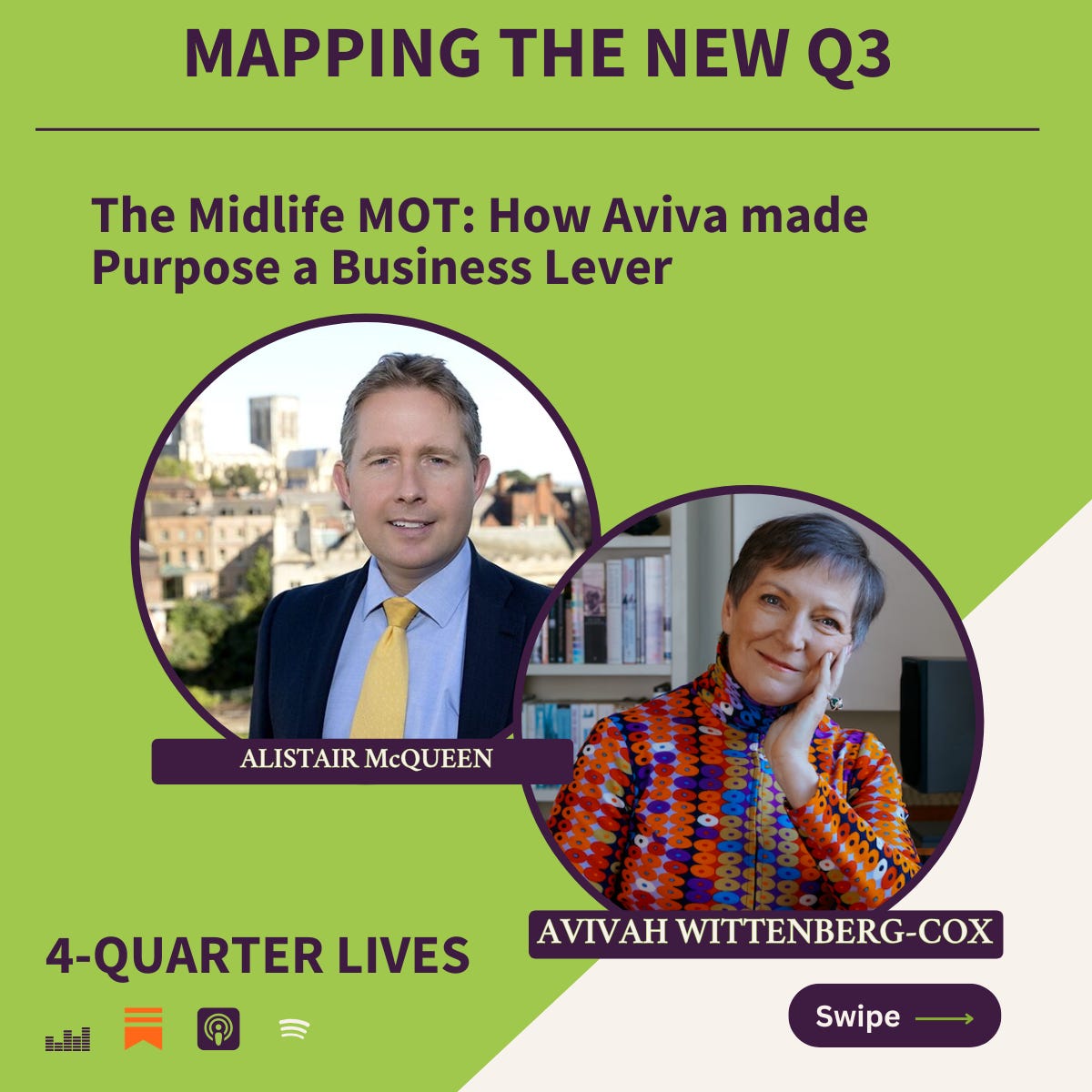
    Alistair McQueen: The Midlife MOT: How Aviva Made Purpose a Business Lever

    This week we revisit a conversation between Avivah Wittenberg-Cox and Alistair McQueen, Head of Savings and Retirement at Aviva, the UK’s largest general insurance company and a major life and pensions provider. Aviva also has a significant presence in Canada and Ireland. Alistair leads Aviva’s pensions business, helping six million people save for and live in retirement, as well as representing Aviva in the media and with government. He is also a member of the Association of British Insurers’ retirement working group; the Money and Pensions Service long-term savings challenge group; the Department for Work & Pensions Mid-life-MOT board; the Business in the Community Age Leadership Team; and sits on the advisory board of Bravestarts – a social enterprise with the goal of supporting a fuller working life. Some Useful Links: * Aviva – How Long will Retirement Be? * Aviva Mid-Life MOT app. * UK Government Mid-Life MOT * Brave Starts – new opportunities for over 45s. Get full access to 4-Quarter Lives | Elderberries at elderberries.substack.com/subscribe

  • April 30 · 40 min

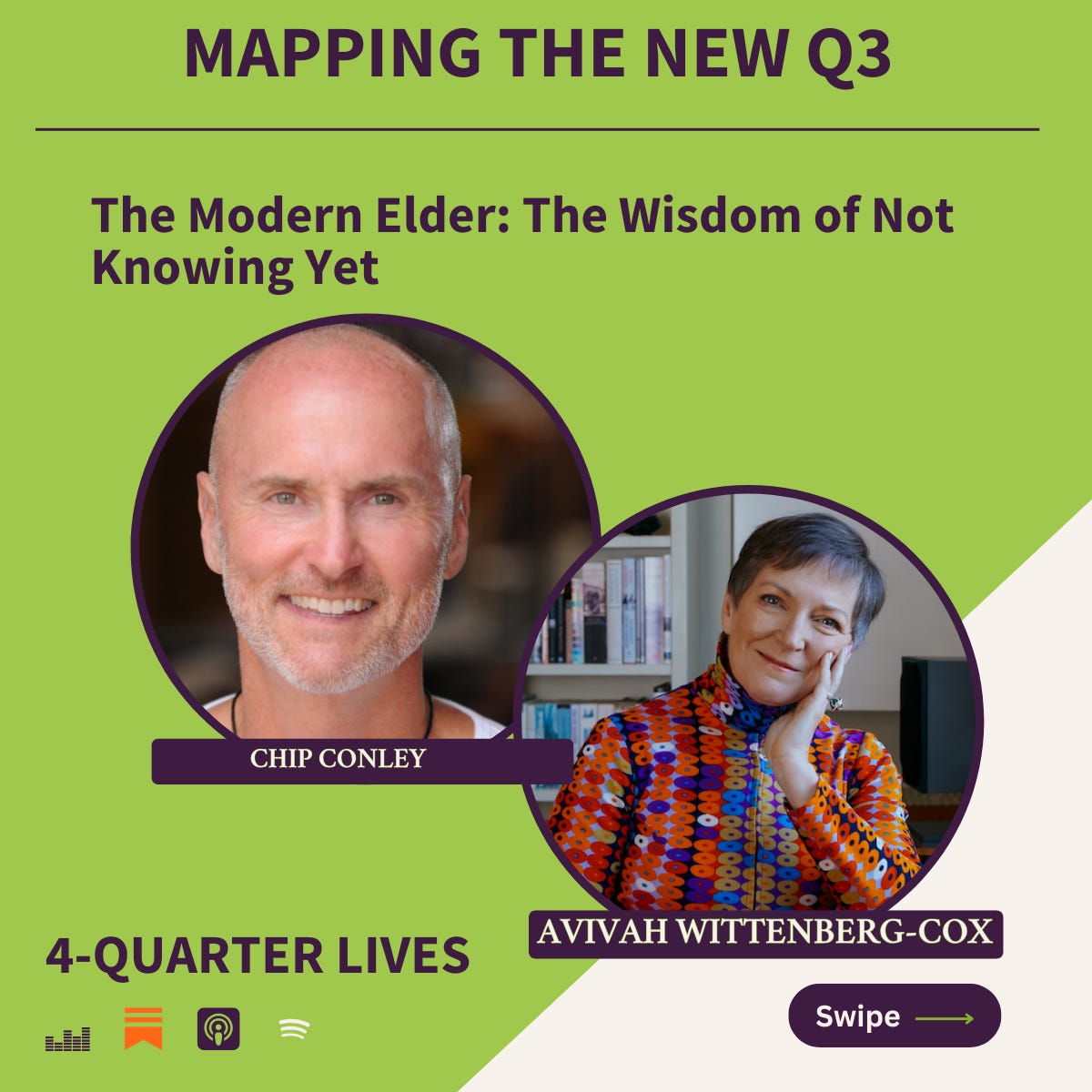
    Chip Conley: The Modern Elder: The Wisdom of Not Knowing Yet

    This week, we republish a conversation between Avivah Wittenberg-Cox and Chip Conley, the Founder and CEO of the Modern Elder Academy. Chip Conley is on a midlife mission. After disrupting the hospitality industry twice, first as the founder of Joie de Vivre Hospitality, the second-largest operator of boutique hotels in the U.S., and then as Airbnb’s Head of Global Hospitality and Strategy, leading a worldwide revolution in travel, Conley co-founded MEA (Modern Elder Academy) in January 2018 in Baja California, Mexico. Inspired by his experience of intergenerational mentoring as a ‘modern elder’ at Airbnb, where his guidance was instrumental to the company’s extraordinary transformation from fast-growing start-up to the world’s most valuable hospitality brand, MEA is the world’s first ‘midlife wisdom school’. Dedicated to reframing the concept of ageing, MEA supports students to navigate midlife with a renewed sense of purpose and possibility. A New York Times bestselling author, Conley’s 7th book “Learning to Love Midlife: 12 Reasons Why Life Gets Better with Age” is about rebranding midlife to help people understand the upside of this often-misunderstood life stage. In 2023 he gave a TED talk on the “midlife chrysalis.” Some Useful Links: * Website: Chip Conley * Book: Learning to Love Midlife – or at Amazon * Website: Modern Elder Academy * Chip Copley’s Daily Blog: Wisdom Well * Blue Zones Retreat at MEA Get full access to 4-Quarter Lives | Elderberries at elderberries.substack.com/subscribe

Showing 1–20 of 21 episodes