Skip to content
Artwork for Translating the Tradition
Translating the Tradition · March 30 · 24 min

Our Desert Struggle

So we’re getting to the end of Great Lent, and the Church gives us, on this Sunday, St. Mary of Egypt to think about. I won’t go through the whole of the story of St. Mary of Egypt, but just very briefly, St. Mary was very much not a saint at the beginning of her life. But the story actually doesn’t begin with her. It begins with Elder Zosima, who was a very righteous young man. He lived in the monastery for most of his life, had managed to exhaust almost all the spiritual disciplines, and was actually thinking, “Is there anyone who can teach me anything in this world about being a monastic, about working out my salvation in fear and trembling?” And if you know anything about monasticism, he’s in a very dangerous spiritual place at that point. He then decides to leave the monastery where he’s spent most of his life and goes to another monastery in the desert near the Jordan River. The custom in that monastery is to go out into the desert during the time of Great Lent, for each of the monks to just be alone in the desert with God, and then come back together for Pascha. He goes out into the desert really hoping to find someone who can teach him more about being a monk. As he’s out there in the desert, he sees a shape flitting away from him. He calls out to them to stop, and the figure replies that she can’t turn and face him because she’s a woman and naked — but please throw her his cloak. So he does, and she wraps it around herself. He obviously assumes that this is a very holy person, but is a little bit scared when she calls him by name — Zosima — when he hasn’t told her his name. He really wants to learn from her, because he is a humble man genuinely seeking to further his spiritual work on his own salvation. He asks her for her story, and she tells him with some reluctance. At about 12 years of age, she left home — she had been brought up in a good Christian family — and basically lived on the streets of Alexandria doing what a young woman with beauty could do in that situation, and doing it because she liked it. Nowadays we would probably label her a nymphomaniac. This went on for 17 years. Then on a lark, she decides to go to Jerusalem for the Feast of the Holy Cross, because everybody else is going and she can get free passage with the sailors. She continues in her horrible, self-destructive lifestyle the whole time. Then, of course, it’s the feast, and she goes to enter the church to venerate the Holy Cross — and she can’t get in. She’s thinking, what’s going on here? There’s a big crowd, and it’s not a polite Canadian crowd, so maybe she just small so she can’t get through. She tries again and again, and then she finally realizes: no, she can’t get in because God himself is keeping her out. That is a devastating moment for her. She’s out there in the narthex, and she looks up and sees an icon of the Mother of God. She contrasts her sinfulness with Mary’s holiness, but calls out to her in fear and desperation, asking her to pray for her, to help her, saying that she’ll do whatever it takes. And so she’s then able to just step right into the church. She goes up and venerates the Holy Cross, and as she comes out she hears a voice saying, “In the desert you will find perfect rest.” So she goes out into the desert and spends the rest of her life there, alone, praying to God, eating whatever comes to hand. It’s in this situation that Elder Zosima encounters her. She’s so holy that not only does she know his name, but when he asks her to pray, she says, “Okay, I’ll pray.” He can’t quite make out all the words, and when he looks up, she’s about a cubit off the ground, praying. At which point he freaks out, and she says, “No, no, I’m flesh and blood like you,” and then continues praying. Her one wish was that Elder Zosima should come back to her the next year with the Eucharist — that’s the one thing she had missed in the desert. Well, not quite. She also tells him something else, which I’ll come back to in a moment. So he does. The following year they meet at the Jordan River. He has the Eucharist for her, as well as a little bit of food, and he’s there at the river wondering what’s going to happen, since she doesn’t have a boat and there’s a fair bit of water. Mary shows up, makes the sign of the cross, and walks across the water like it’s dry land. He’s about to fall down before her, and she says, “No, what are you doing? You’re a priest with the Holy Gifts. You can’t bow in this situation — you have the Body and Blood of Christ there.” So he communes her. He’s eager to see her again, and she says, “Come next year to where you first met me.” When he does, the following Lent, he comes to where he first met her. There she is, dead on the ground, with her name written by her head: Mary. She’s passed away, and he realizes from the writing that God has transported her from where he gave her communion to this place — a 20-day journey — in an instant. He buries her with the help of a lion and then tells the other monks the story. The story is given to us at this point in Great Lent — usually with the Canon of St. Andrew of Crete, but also on this Sunday — for us to think about as we work on our own salvation in the depths of Great Lent. At this point in Lent, we’re in one of two possible spots. We might be — and this is probably the less likely — in the spot of Elder Zosima: it’s been a great Lent, I’ve actually managed to keep the fast, I’ve been doing pretty well! This is actually a bit of a dangerous spiritual place to be in, but it’s also a fairly natural one. We do this all the time. We saw it, actually, in both of the Gospel readings we just heard. Jesus is telling his disciples how he’s going to go down to Jerusalem and be crucified — and what are they doing? They’re oblivious. They say, “Lord, when you come into your kingdom, I want to be on your right hand, and this guy wants to be on your left.” And Jesus is like, “You just don’t get it.” He explains to them what being in his kingdom really means. Or the Pharisee who invites Jesus to supper with him — he’s thinking, “I’m a fairly important man, I’ve got this great teacher here, everything’s going great.” And then the sinful woman comes in: “Her? What’s she doing here? She’s making a scene!” We kind of laugh at the Pharisee and the disciples, but that’s us. Very often we’re just oblivious to the fact that we’re not really working out our salvation in fear and trembling, we’re not really making any kind of spiritual progress, and we’re not as good as we think we are. However, there’s another place where, by this point in Lent, most of us probably actually are at. I would say it’s where Mary was for a good 17 years of her sojourn in the desert. Because she lived in sin for 17 years in Alexandria and, as she tells her story to Elder Zosima, she says to him that for 17 years even in the desert she was longing for what she had left behind. She was tempted by that way of life. Those thoughts just kept coming back and coming back. She would throw herself on the ground and water it with her tears, sometimes for a day and a night, just struggling to repent. And I think maybe that’s where most of us are at this point in Great Lent. Because Lent is hard. Keeping the fast is difficult. You’re tired. You’re hungry. You really want all those nice things — which are coming, it’s okay, they’re coming! But that is actually an image of the sin that we’re struggling with, and continue to struggle with. And sometimes we find ourselves despairing: I’m not making any spiritual progress. I keep wanting to go back. I keep going back. And if we’re at this spiritual low-point, the temptation is to despair. I find Mary’s story encouraging in one way, because it tells us there is going to be a very long road ahead as we try to turn our backs on sin. Mary was in that life for 17 years, and so in the desert it took her 17 years to repent. That’s encouraging to me, because it explains why it’s so hard to repent. But on the other hand, it ca… This is a public episode. If you would like to discuss this with other subscribers or get access to bonus episodes, visit translatingthetradition.substack.com

0:00-24:05

transcript

No transcript — this publisher did not publish one.

show notes

So we’re getting to the end of Great Lent, and the Church gives us, on this Sunday, St. Mary of Egypt to think about.

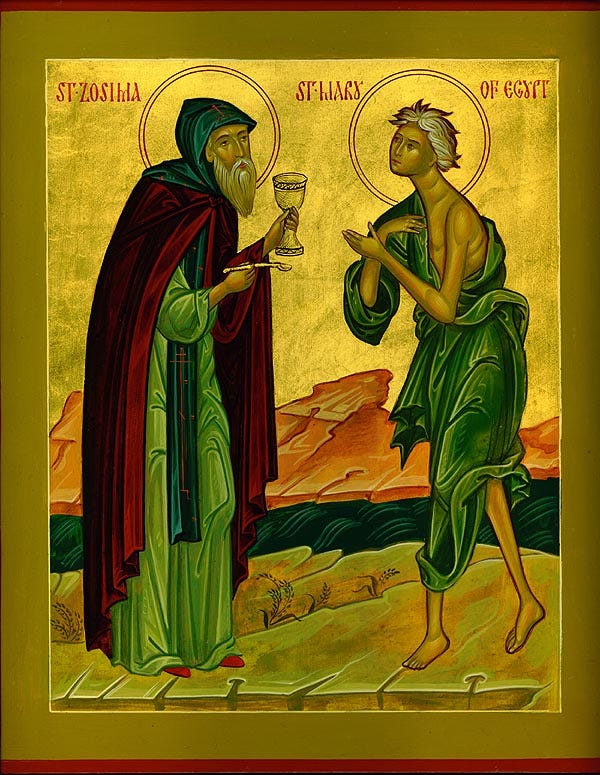
I won’t go through the whole of the story of St. Mary of Egypt, but just very briefly, St. Mary was very much not a saint at the beginning of her life. But the story actually doesn’t begin with her. It begins with Elder Zosima, who was a very righteous young man. He lived in the monastery for most of his life, had managed to exhaust almost all the spiritual disciplines, and was actually thinking, “Is there anyone who can teach me anything in this world about being a monastic, about working out my salvation in fear and trembling?” And if you know anything about monasticism, he’s in a very dangerous spiritual place at that point.

He then decides to leave the monastery where he’s spent most of his life and goes to another monastery in the desert near the Jordan River. The custom in that monastery is to go out into the desert during the time of Great Lent, for each of the monks to just be alone in the desert with God, and then come back together for Pascha. He goes out into the desert really hoping to find someone who can teach him more about being a monk.

As he’s out there in the desert, he sees a shape flitting away from him. He calls out to them to stop, and the figure replies that she can’t turn and face him because she’s a woman and naked — but please throw her his cloak. So he does, and she wraps it around herself. He obviously assumes that this is a very holy person, but is a little bit scared when she calls him by name — Zosima — when he hasn’t told her his name. He really wants to learn from her, because he is a humble man genuinely seeking to further his spiritual work on his own salvation. He asks her for her story, and she tells him with some reluctance.

At about 12 years of age, she left home — she had been brought up in a good Christian family — and basically lived on the streets of Alexandria doing what a young woman with beauty could do in that situation, and doing it because she liked it. Nowadays we would probably label her a nymphomaniac. This went on for 17 years.

Then on a lark, she decides to go to Jerusalem for the Feast of the Holy Cross, because everybody else is going and she can get free passage with the sailors. She continues in her horrible, self-destructive lifestyle the whole time. Then, of course, it’s the feast, and she goes to enter the church to venerate the Holy Cross — and she can’t get in. She’s thinking, what’s going on here? There’s a big crowd, and it’s not a polite Canadian crowd, so maybe she just small so she can’t get through. She tries again and again, and then she finally realizes: no, she can’t get in because God himself is keeping her out.

That is a devastating moment for her. She’s out there in the narthex, and she looks up and sees an icon of the Mother of God. She contrasts her sinfulness with Mary’s holiness, but calls out to her in fear and desperation, asking her to pray for her, to help her, saying that she’ll do whatever it takes. And so she’s then able to just step right into the church. She goes up and venerates the Holy Cross, and as she comes out she hears a voice saying, “In the desert you will find perfect rest.”

So she goes out into the desert and spends the rest of her life there, alone, praying to God, eating whatever comes to hand. It’s in this situation that Elder Zosima encounters her. She’s so holy that not only does she know his name, but when he asks her to pray, she says, “Okay, I’ll pray.” He can’t quite make out all the words, and when he looks up, she’s about a cubit off the ground, praying. At which point he freaks out, and she says, “No, no, I’m flesh and blood like you,” and then continues praying.

Her one wish was that Elder Zosima should come back to her the next year with the Eucharist — that’s the one thing she had missed in the desert. Well, not quite. She also tells him something else, which I’ll come back to in a moment.

So he does. The following year they meet at the Jordan River. He has the Eucharist for her, as well as a little bit of food, and he’s there at the river wondering what’s going to happen, since she doesn’t have a boat and there’s a fair bit of water. Mary shows up, makes the sign of the cross, and walks across the water like it’s dry land. He’s about to fall down before her, and she says, “No, what are you doing? You’re a priest with the Holy Gifts. You can’t bow in this situation — you have the Body and Blood of Christ there.” So he communes her.

He’s eager to see her again, and she says, “Come next year to where you first met me.” When he does, the following Lent, he comes to where he first met her. There she is, dead on the ground, with her name written by her head: Mary. She’s passed away, and he realizes from the writing that God has transported her from where he gave her communion to this place — a 20-day journey — in an instant. He buries her with the help of a lion and then tells the other monks the story.

The story is given to us at this point in Great Lent — usually with the Canon of St. Andrew of Crete, but also on this Sunday — for us to think about as we work on our own salvation in the depths of Great Lent.

At this point in Lent, we’re in one of two possible spots. We might be — and this is probably the less likely — in the spot of Elder Zosima: it’s been a great Lent, I’ve actually managed to keep the fast, I’ve been doing pretty well! This is actually a bit of a dangerous spiritual place to be in, but it’s also a fairly natural one. We do this all the time. We saw it, actually, in both of the Gospel readings we just heard.

Jesus is telling his disciples how he’s going to go down to Jerusalem and be crucified — and what are they doing? They’re oblivious. They say, “Lord, when you come into your kingdom, I want to be on your right hand, and this guy wants to be on your left.” And Jesus is like, “You just don’t get it.” He explains to them what being in his kingdom really means.

Or the Pharisee who invites Jesus to supper with him — he’s thinking, “I’m a fairly important man, I’ve got this great teacher here, everything’s going great.” And then the sinful woman comes in: “Her? What’s she doing here? She’s making a scene!” We kind of laugh at the Pharisee and the disciples, but that’s us. Very often we’re just oblivious to the fact that we’re not really working out our salvation in fear and trembling, we’re not really making any kind of spiritual progress, and we’re not as good as we think we are.

However, there’s another place where, by this point in Lent, most of us probably actually are at. I would say it’s where Mary was for a good 17 years of her sojourn in the desert. Because she lived in sin for 17 years in Alexandria and, as she tells her story to Elder Zosima, she says to him that for 17 years even in the desert she was longing for what she had left behind. She was tempted by that way of life. Those thoughts just kept coming back and coming back. She would throw herself on the ground and water it with her tears, sometimes for a day and a night, just struggling to repent.

And I think maybe that’s where most of us are at this point in Great Lent. Because Lent is hard. Keeping the fast is difficult. You’re tired. You’re hungry. You really want all those nice things — which are coming, it’s okay, they’re coming! But that is actually an image of the sin that we’re struggling with, and continue to struggle with. And sometimes we find ourselves despairing: I’m not making any spiritual progress. I keep wanting to go back. I keep going back.

And if we’re at this spiritual low-point, the temptation is to despair.

I find Mary’s story encouraging in one way, because it tells us there is going to be a very long road ahead as we try to turn our backs on sin. Mary was in that life for 17 years, and so in the desert it took her 17 years to repent. That’s encouraging to me, because it explains why it’s so hard to repent. But on the other hand, it ca…


This is a public episode. If you would like to discuss this with other subscribers or get access to bonus episodes, visit translatingthetradition.substack.com
links2

more episodes

All episodes